
BUN-to-creatinine ratio
• The BUN-to-creatinine ratio is the ratio of two serum
laboratory values, the blood urea nitrogen (BUN) (mg/dL)
and serum creatinine (Cr) (mg/dL). Outside the United
States, particularly in Canada and Europe, the truncated
term urea is used (though it is still the same blood
chemical) and the units are different (mmol/L).
• The units of creatinine are also different (μmol/L), and
this value is termed the urea-to-creatinine ratio. The
ratio may be used to determine the cause of acute
kidney injury or dehydration.
• The principle behind this ratio is the fact that both urea
(BUN) and creatinine are freely filtered by
the glomerulus; however, urea reabsorbed by the tubules
can be regulated (increased or decreased) whereas
creatinine reabsorption remains the same (minimal
reabsorption)
• Urea and creatinine are nitrogenous end products of
metabolism. Urea is the primary metabolite derived from
dietary protein and tissue protein turnover. Creatinine is
the product of muscle creatine catabolism. Both are
relatively small molecules (60 and 113 daltons,
respectively) that distribute throughout total body water.
• In Europe, the whole urea molecule is assayed, whereas
in the United States only the nitrogen component of urea
(the blood or serum urea nitrogen, i.e., BUN or SUN) is
measured. The BUN, then, is roughly one-half (7/15 or
0.466) of the blood urea.
• The normal range of urea nitrogen in blood or serum is 5
to 20 mg/dl, or 1.8 to 7.1 mmol urea per liter. The range
is wide because of normal variations due to protein
intake, endogenous protein catabolism, state of
hydration, hepatic urea synthesis, and renal urea
excretion.
• A BUN of 15 mg/dl would represent significantly impaired
function for a woman in the thirtieth week of gestation.
Her higher glomerular filtration rate (GFR), expanded
extracellular fluid volume, and anabolism in the
developing fetus contribute to her relatively low BUN of 5
to 7 mg/dl.
• In contrast, the rugged rancher who eats in excess of
125 g protein each day may have a normal BUN of
20 mg/dl.
• The normal serum creatinine (sCr) varies with the
subject's body muscle mass and with the technique used
to measure it. For the adult male, the normal range is 0.6
to 1.2 mg/dl, or 53 to 106 μmol/L by the kinetic or
enzymatic method, and 0.8 to 1.5 mg/dl, or 70 to 133
μmol/L by the older manual Jaffé reaction. For the adult
female, with her generally lower muscle mass, the
normal range is 0.5 to 1.1 mg/dl, or 44 to 97 μmol/L by
the enzymatic method.
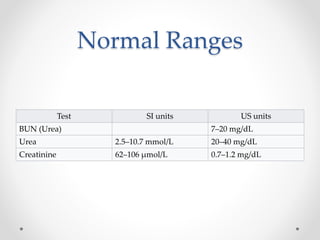
Normal Ranges
Test SI units US units
BUN (Urea) 7–20 mg/dL
Urea 2.5–10.7 mmol/L 20–40 mg/dL
Creatinine 62–106 μmol/L 0.7–1.2 mg/dL

urea creatinine ratio

  • 2.
    BUN-to-creatinine ratio • TheBUN-to-creatinine ratio is the ratio of two serum laboratory values, the blood urea nitrogen (BUN) (mg/dL) and serum creatinine (Cr) (mg/dL). Outside the United States, particularly in Canada and Europe, the truncated term urea is used (though it is still the same blood chemical) and the units are different (mmol/L).
  • 3.
    • The unitsof creatinine are also different (μmol/L), and this value is termed the urea-to-creatinine ratio. The ratio may be used to determine the cause of acute kidney injury or dehydration.
  • 4.
    • The principlebehind this ratio is the fact that both urea (BUN) and creatinine are freely filtered by the glomerulus; however, urea reabsorbed by the tubules can be regulated (increased or decreased) whereas creatinine reabsorption remains the same (minimal reabsorption)
  • 5.
    • Urea andcreatinine are nitrogenous end products of metabolism. Urea is the primary metabolite derived from dietary protein and tissue protein turnover. Creatinine is the product of muscle creatine catabolism. Both are relatively small molecules (60 and 113 daltons, respectively) that distribute throughout total body water.
  • 6.
    • In Europe,the whole urea molecule is assayed, whereas in the United States only the nitrogen component of urea (the blood or serum urea nitrogen, i.e., BUN or SUN) is measured. The BUN, then, is roughly one-half (7/15 or 0.466) of the blood urea.
  • 7.
    • The normalrange of urea nitrogen in blood or serum is 5 to 20 mg/dl, or 1.8 to 7.1 mmol urea per liter. The range is wide because of normal variations due to protein intake, endogenous protein catabolism, state of hydration, hepatic urea synthesis, and renal urea excretion.
  • 8.
    • A BUNof 15 mg/dl would represent significantly impaired function for a woman in the thirtieth week of gestation. Her higher glomerular filtration rate (GFR), expanded extracellular fluid volume, and anabolism in the developing fetus contribute to her relatively low BUN of 5 to 7 mg/dl.
  • 9.
    • In contrast,the rugged rancher who eats in excess of 125 g protein each day may have a normal BUN of 20 mg/dl.
  • 10.
    • The normalserum creatinine (sCr) varies with the subject's body muscle mass and with the technique used to measure it. For the adult male, the normal range is 0.6 to 1.2 mg/dl, or 53 to 106 μmol/L by the kinetic or enzymatic method, and 0.8 to 1.5 mg/dl, or 70 to 133 μmol/L by the older manual Jaffé reaction. For the adult female, with her generally lower muscle mass, the normal range is 0.5 to 1.1 mg/dl, or 44 to 97 μmol/L by the enzymatic method.
  • 11.
    Normal Ranges Test SIunits US units BUN (Urea) 7–20 mg/dL Urea 2.5–10.7 mmol/L 20–40 mg/dL Creatinine 62–106 μmol/L 0.7–1.2 mg/dL