Language Course Design:
Introduction and definitions
Getting started

    What is the typical situation for a teacher regarding a
    language course?


        How could the study of course design help you in your
        professional career?


    Have you ever had to design a language course in your
    context?

        In short, what do you expect of this course?
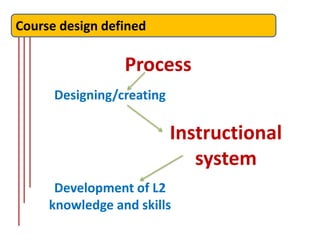
Course design defined

                 Process
      Designing/creating

                           Instructional
                              system
      Development of L2
     knowledge and skills
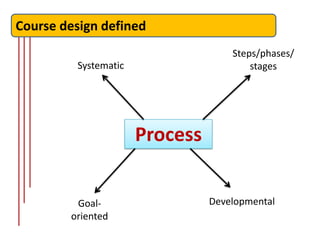
Course design defined
                                    Steps/phases/
         Systematic                     stages


                      Process


         Goal-                  Developmental
        oriented
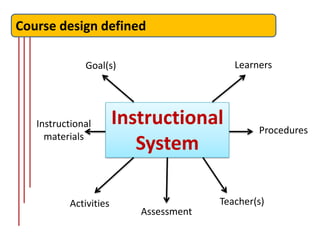
Course design defined

              Goal(s)                     Learners


   Instructional       Instructional           Procedures
     materials
                          System

          Activities                   Teacher(s)
                          Assessment
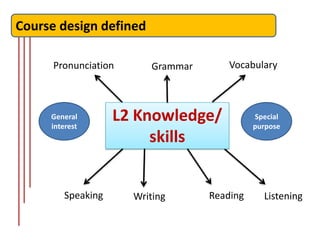
Course design defined

      Pronunciation      Grammar       Vocabulary


     General
     interest
                   L2 Knowledge/             Special
                                             purpose
                        skills


        Speaking      Writing      Reading     Listening
Some important terms

   • Syllabus

   • Curriculum
Syllabus vs. Curriculum

    CURRICULA are concerned with making
    general statements about language learning,
    learning purpose and experience, evaluation
    and the relationships between teachers and
    learners… [ they also include] banks of learning
    items and suggestions about how these might
    be used in class

                                        Nunan, 1988, p. 3
Syllabus vs. Curriculum


    CURRICULUM refers to the collectivity of
    course offerings at an educational institution…


                                       Yalden, 1987, p. 72
Syllabus vs. Curriculum


   CURRICULUM is a very general concept which
   involves considerations of the whole complex
   of philosophical, social and administrative
   factors which contribute to the planning of an
   educational programme.

                                        Allen, 1984, p. 6
Syllabus vs. Curriculum


    CURRICULUM planning involves such things
    as the setting of goals, , the selection of
    materials and teaching approaches, the design
    of the testing program, and the appropriate use
    of program-evaluation procedures…

                                   Omaggio, 1986, p. 408
Syllabus vs. Curriculum


    CURRICULUM involves “progress
    systematically from needs assessment, to goals
    and objectives, to specification of the
    instructional content of the program”

                                     Richards, 1990, p. 8
Syllabus vs. Curriculum


    Syllabus provides direction and guidance in
    the scope, sequence and pacing of classroom
    activities.


                                  Omaggio, 1986, p. 410
Syllabus vs. Curriculum


    Syllabus design is concerned with the choice
    and sequencing of instructional content.


                                     Richards, 1990, p. 8
Syllabus vs. Curriculum


    Syllabi are more localized and are based on
    accounts and records of what actually happens
    at the classroom level as teachers and learners
    apply a given curriculum to their own situation.


                                       Nunan, 1988, p. 3
Syllabus vs. Curriculum


    Syllabus means the specification of content
    for a single course or subject.


                                      Yalden, 1987, p. 72
Syllabus vs. Curriculum


   Syllabus refers to that subpart of the
   curriculum which is concerned with a
   specification of what units will be taught.


                                         Allen, 1984, p. 6
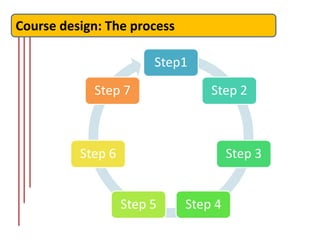
Course design: The process

                        Step1
            Step 7               Step 2


          Step 6                      Step 3


                   Step 5    Step 4
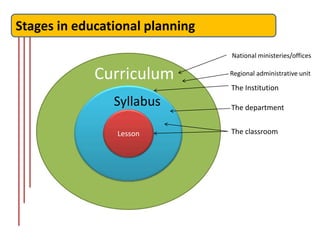
Stages in educational planning
                                 National ministeries/offices

             Curriculum          Regional administrative unit

                                 The Institution
                Syllabus         The department


                 Lesson          The classroom
Reflection

   Think about your teaching context…

     Is there a programme document stating purpose,
     objectives, contents, scope and sequence, teaching
     materials, methodology and assessment?

     What kind of instructional materials are used:
     commercial textbook or in-house materials?

     What was your level of participation in the decision
     about objectives, content and sequence?

     Is there an explicit statement of the view of language
     and language learning underlying the programme?
References
   Allen, J.P. (1984). General purpose language teaching: a
   variable focus approach. In Brumfit, C.J. (Ed.) General
   purpose syllabus design. Oxford: Pergamon.

   Nunan, D. (1988). Syllabus design. Oxford: Oxford
   University Press.

   Richards, J.C. (1990). The language teaching matrix.
   Cambridge: Cambridge University Press.

   Yalden, J. (1987). Principles of course design for
   language teaching. Cambridge: Cambridge University
   Press.
References
   Allen, J.P. (1984). General purpose language teaching: a variable focus
   approach. In Brumfit, C.J. (Ed.) General purpose syllabus design. Oxford:
   Pergamon.

   Nunan, D. (1988). Syllabus design. Oxford: Oxford University Press.

   Omaggio, A.C. (1986). Teaching language in context. Proficiency oriented
   instyruction. Boston: Heinle & Heinle Publishers, Inc.

   Richards, J.C. (1990). The language teaching matrix. Cambridge:
   Cambridge University Press.

   Yalden, J. (1987). Principles of course design for language teaching.
   Cambridge: Cambridge University Press.

Language course design

  • 1.
  • 2.
    Getting started What is the typical situation for a teacher regarding a language course? How could the study of course design help you in your professional career? Have you ever had to design a language course in your context? In short, what do you expect of this course?
  • 3.
    Course design defined Process Designing/creating Instructional system Development of L2 knowledge and skills
  • 4.
    Course design defined Steps/phases/ Systematic stages Process Goal- Developmental oriented
  • 5.
    Course design defined Goal(s) Learners Instructional Instructional Procedures materials System Activities Teacher(s) Assessment
  • 6.
    Course design defined Pronunciation Grammar Vocabulary General interest L2 Knowledge/ Special purpose skills Speaking Writing Reading Listening
  • 7.
    Some important terms • Syllabus • Curriculum
  • 8.
    Syllabus vs. Curriculum CURRICULA are concerned with making general statements about language learning, learning purpose and experience, evaluation and the relationships between teachers and learners… [ they also include] banks of learning items and suggestions about how these might be used in class Nunan, 1988, p. 3
  • 9.
    Syllabus vs. Curriculum CURRICULUM refers to the collectivity of course offerings at an educational institution… Yalden, 1987, p. 72
  • 10.
    Syllabus vs. Curriculum CURRICULUM is a very general concept which involves considerations of the whole complex of philosophical, social and administrative factors which contribute to the planning of an educational programme. Allen, 1984, p. 6
  • 11.
    Syllabus vs. Curriculum CURRICULUM planning involves such things as the setting of goals, , the selection of materials and teaching approaches, the design of the testing program, and the appropriate use of program-evaluation procedures… Omaggio, 1986, p. 408
  • 12.
    Syllabus vs. Curriculum CURRICULUM involves “progress systematically from needs assessment, to goals and objectives, to specification of the instructional content of the program” Richards, 1990, p. 8
  • 13.
    Syllabus vs. Curriculum Syllabus provides direction and guidance in the scope, sequence and pacing of classroom activities. Omaggio, 1986, p. 410
  • 14.
    Syllabus vs. Curriculum Syllabus design is concerned with the choice and sequencing of instructional content. Richards, 1990, p. 8
  • 15.
    Syllabus vs. Curriculum Syllabi are more localized and are based on accounts and records of what actually happens at the classroom level as teachers and learners apply a given curriculum to their own situation. Nunan, 1988, p. 3
  • 16.
    Syllabus vs. Curriculum Syllabus means the specification of content for a single course or subject. Yalden, 1987, p. 72
  • 17.
    Syllabus vs. Curriculum Syllabus refers to that subpart of the curriculum which is concerned with a specification of what units will be taught. Allen, 1984, p. 6
  • 18.
    Course design: Theprocess Step1 Step 7 Step 2 Step 6 Step 3 Step 5 Step 4
  • 19.
    Stages in educationalplanning National ministeries/offices Curriculum Regional administrative unit The Institution Syllabus The department Lesson The classroom
  • 20.
    Reflection Think about your teaching context… Is there a programme document stating purpose, objectives, contents, scope and sequence, teaching materials, methodology and assessment? What kind of instructional materials are used: commercial textbook or in-house materials? What was your level of participation in the decision about objectives, content and sequence? Is there an explicit statement of the view of language and language learning underlying the programme?
  • 21.
    References Allen, J.P. (1984). General purpose language teaching: a variable focus approach. In Brumfit, C.J. (Ed.) General purpose syllabus design. Oxford: Pergamon. Nunan, D. (1988). Syllabus design. Oxford: Oxford University Press. Richards, J.C. (1990). The language teaching matrix. Cambridge: Cambridge University Press. Yalden, J. (1987). Principles of course design for language teaching. Cambridge: Cambridge University Press.
  • 22.
    References Allen, J.P. (1984). General purpose language teaching: a variable focus approach. In Brumfit, C.J. (Ed.) General purpose syllabus design. Oxford: Pergamon. Nunan, D. (1988). Syllabus design. Oxford: Oxford University Press. Omaggio, A.C. (1986). Teaching language in context. Proficiency oriented instyruction. Boston: Heinle & Heinle Publishers, Inc. Richards, J.C. (1990). The language teaching matrix. Cambridge: Cambridge University Press. Yalden, J. (1987). Principles of course design for language teaching. Cambridge: Cambridge University Press.