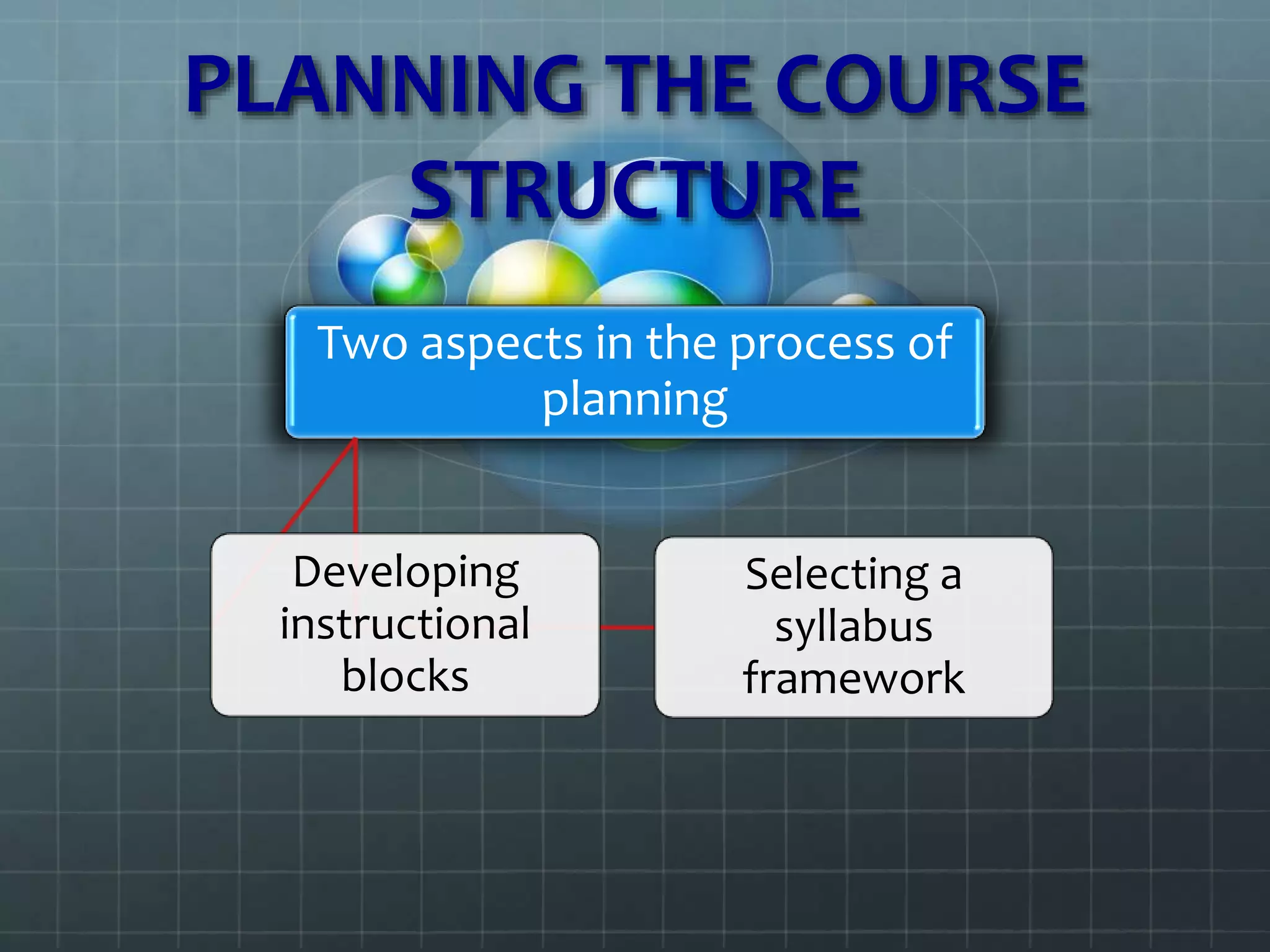
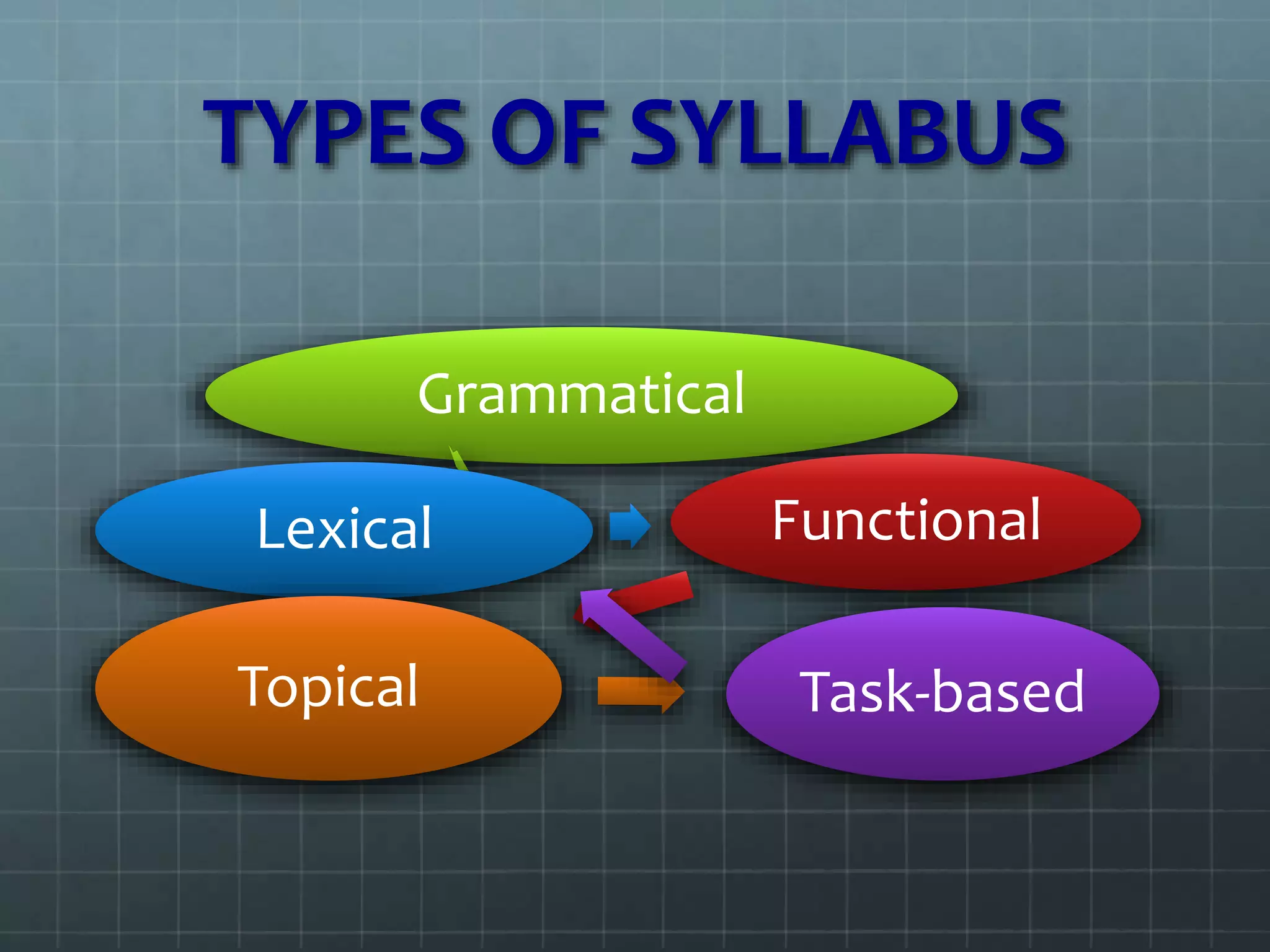
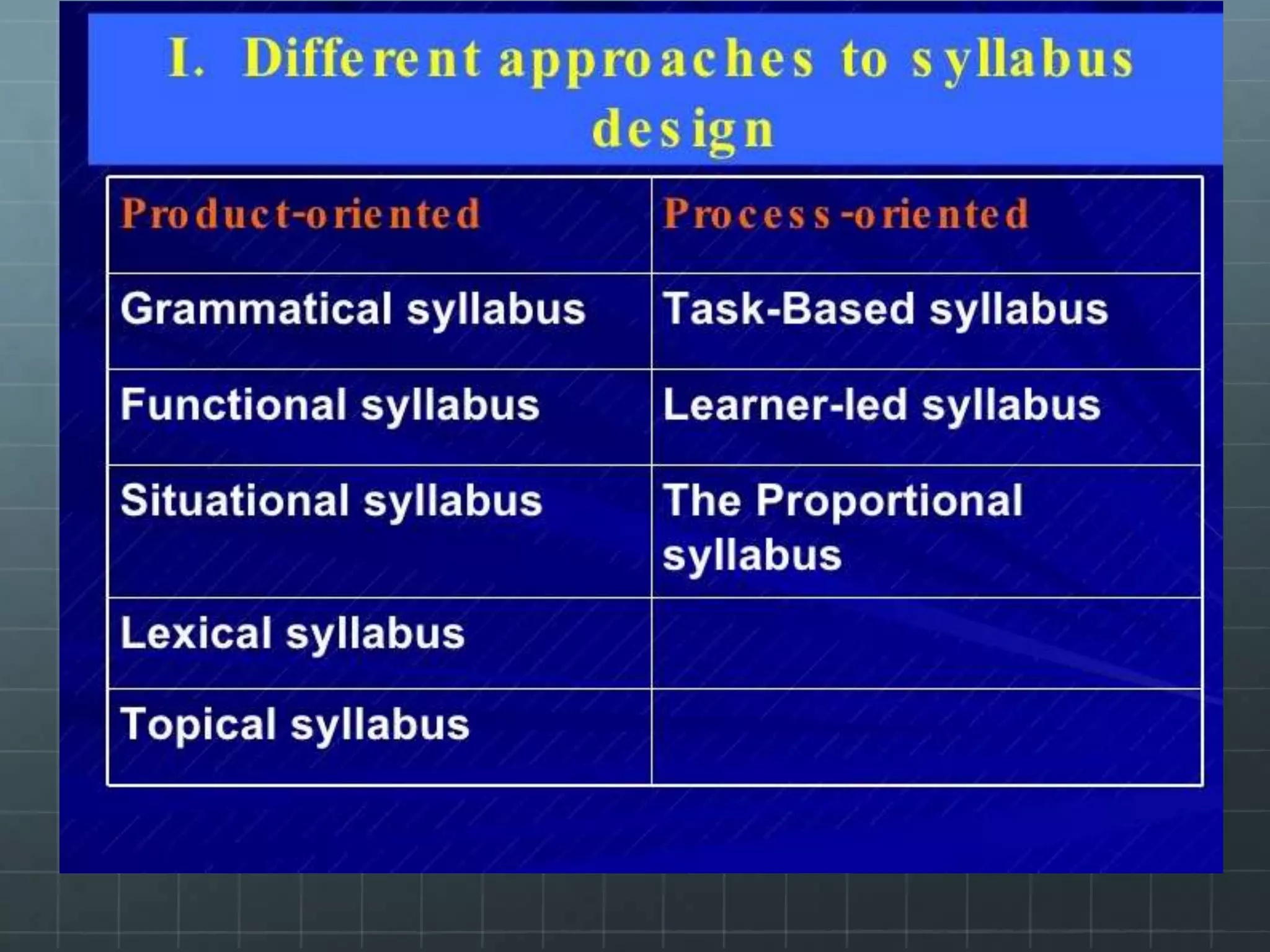
Syllabus design involves organizing instructional content and evaluation methods. It differs from curriculum which outlines broader educational goals. When designing a course, instructors must select a syllabus framework and develop instructional blocks. Various approaches to syllabus design include grammatical, lexical, functional, situational, topical, competency-based, text-based, skills-based, and task-based. No single approach is best - instructors should consider learner needs and integrate multiple approaches. The goal is not to choose one type but to connect different types to effectively teach language skills.
.WHAT IS SYLLABUSDESIGN
Syllabus design can be defined as selection and
organization of instructional content including
suggested strategy for presenting content and
evaluation
•Whereas, Curriculum is a broad description of
general goals by indicating an overall educational-
cultural philosophy which applies across subjects
together with a theoretical orientation to
language and language learning.
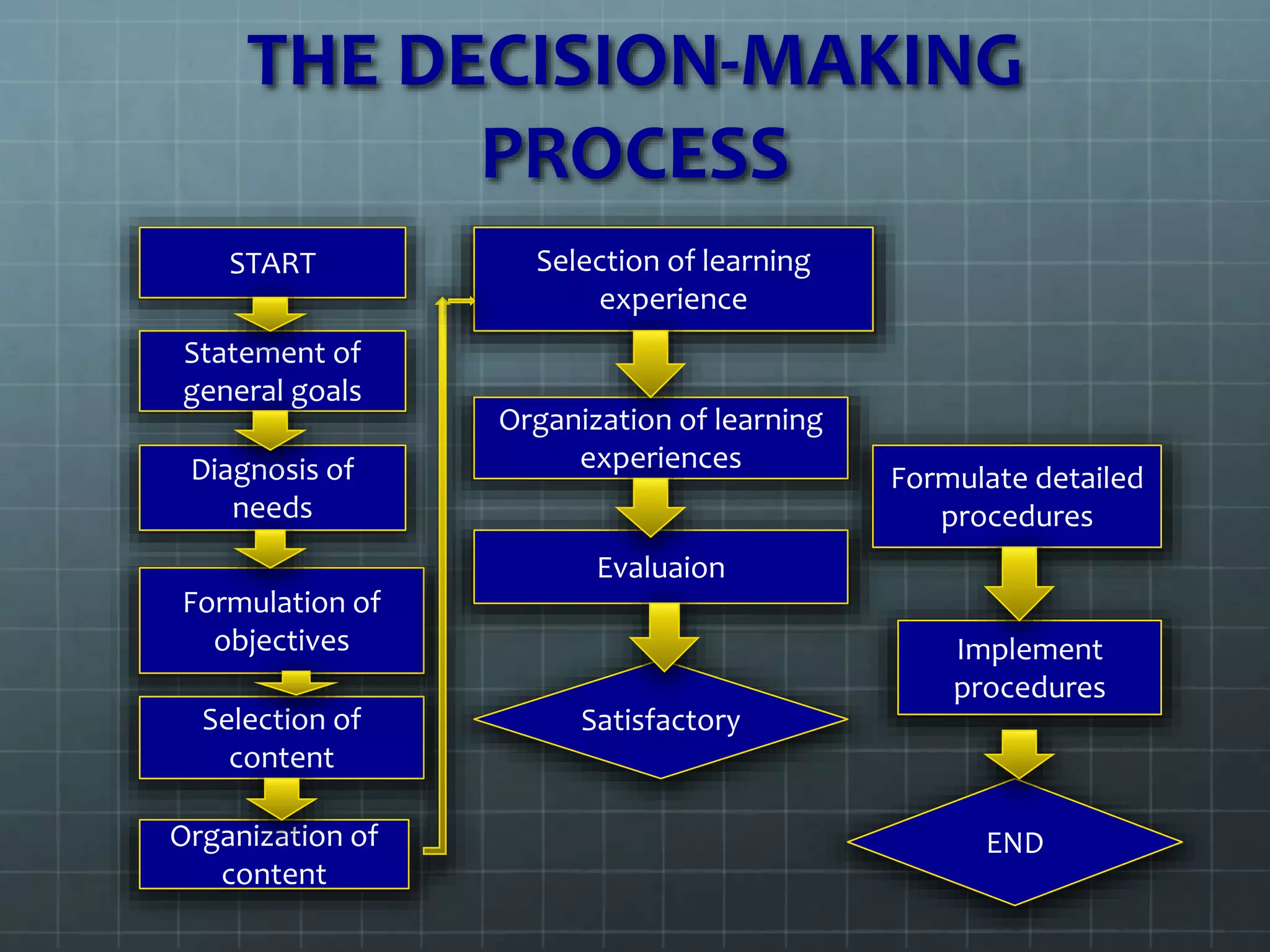
THE DECISION-MAKING
PROCESS
START
Statement of
generalgoals
Diagnosis of
needs
Formulation of
objectives
Selection of
content
Organization of
content
Selection of learning
experience
Organization of learning
experiences
Evaluaion
Satisfactory
Formulate detailed
procedures
Implement
procedures
END
6.
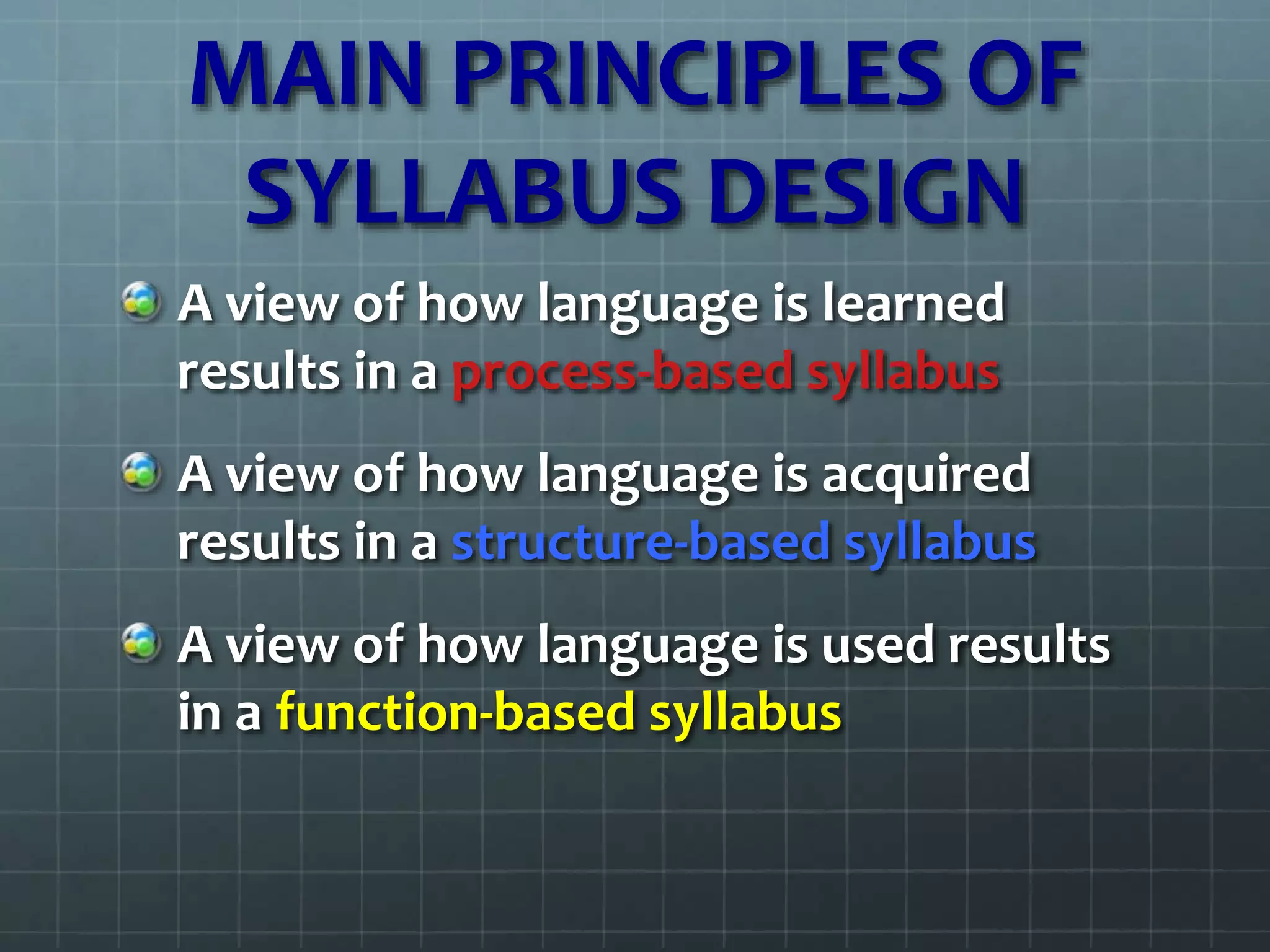
MAIN PRINCIPLES OF
SYLLABUSDESIGN
A view of how language is learned
results in a process-based syllabus
A view of how language is acquired
results in a structure-based syllabus
A view of how language is used results
in a function-based syllabus
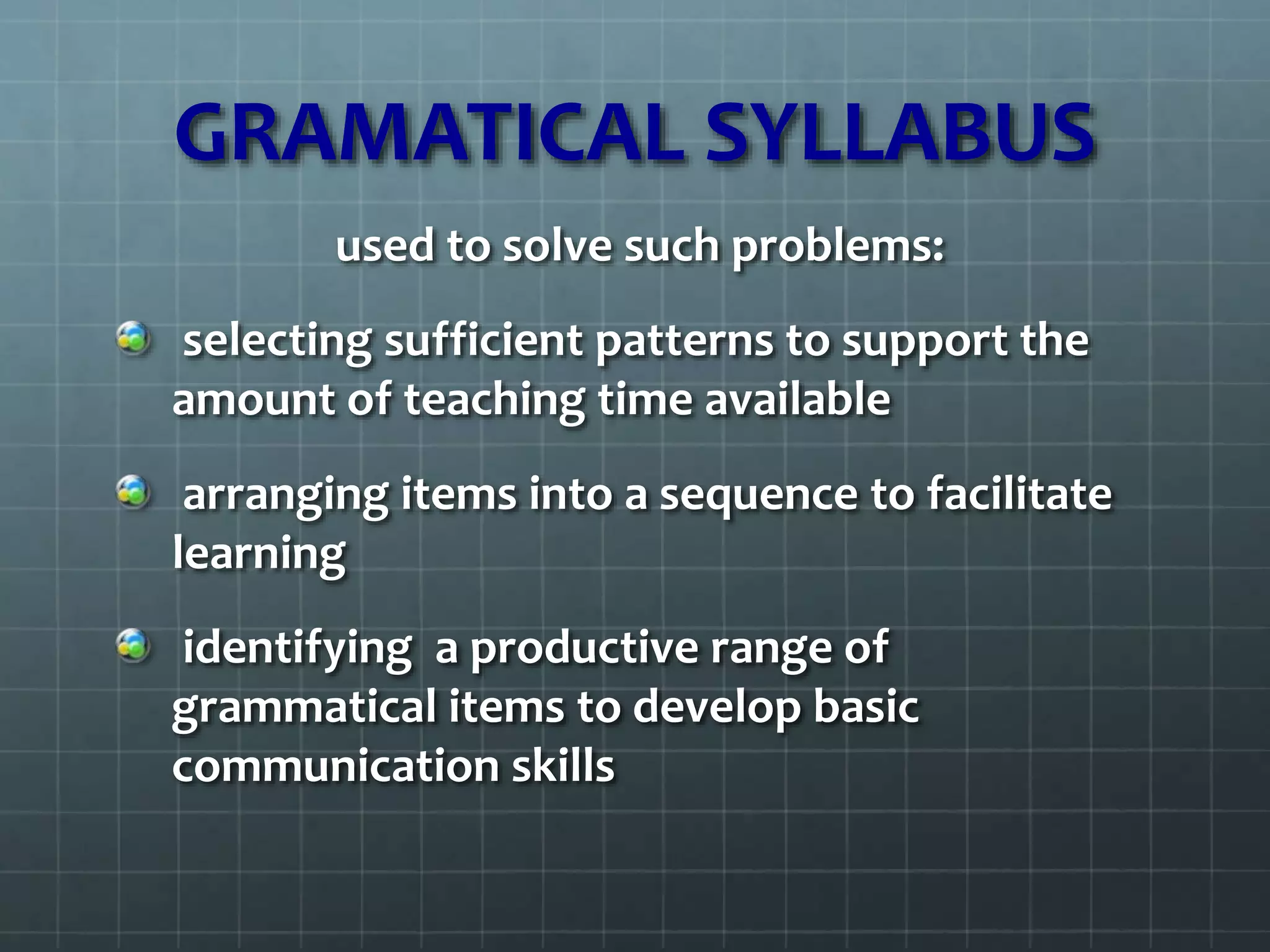
GRAMATICAL SYLLABUS
used tosolve such problems:
selecting sufficient patterns to support the
amount of teaching time available
arranging items into a sequence to facilitate
learning
identifying a productive range of
grammatical items to develop basic
communication skills
10.
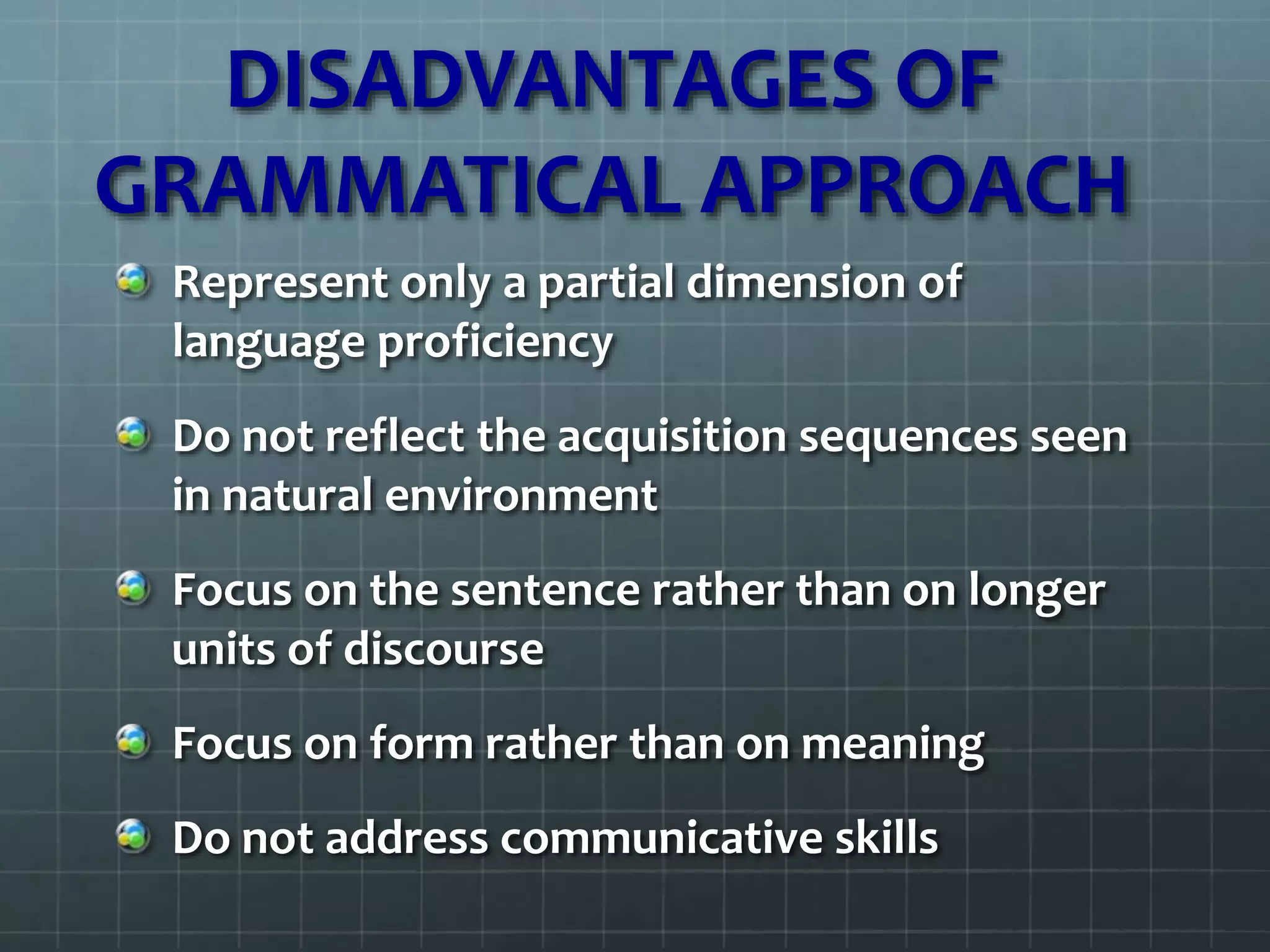
DISADVANTAGES OF
GRAMMATICAL APPROACH
Representonly a partial dimension of
language proficiency
Do not reflect the acquisition sequences seen
in natural environment
Focus on the sentence rather than on longer
units of discourse
Focus on form rather than on meaning
Do not address communicative skills
11.
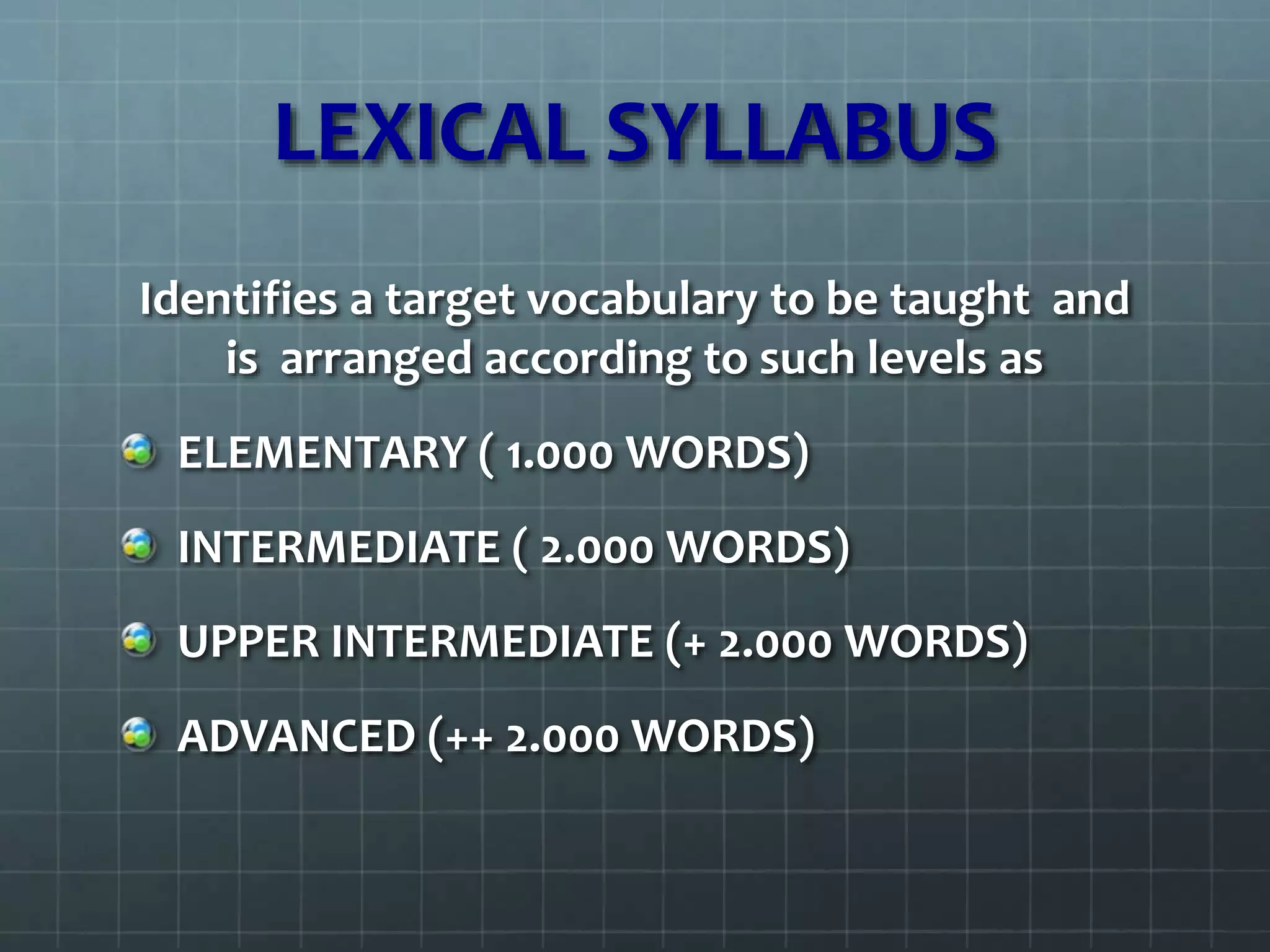
LEXICAL SYLLABUS
Identifies atarget vocabulary to be taught and
is arranged according to such levels as
ELEMENTARY ( 1.000 WORDS)
INTERMEDIATE ( 2.000 WORDS)
UPPER INTERMEDIATE (+ 2.000 WORDS)
ADVANCED (++ 2.000 WORDS)
ADVANTAGES OF
FUNCTIONAL SYLLABUS
Reflectinga more comprehensive view of
language and focusing on the use of the
language
Can be linked to other types of syllabus content
Providing convenient framework for the design
of teaching materials, particularly in the
domains of listening and speaking
14.
DISADVANTAGES OF
FUNCTIONAL SYLLABUS
Thelack of clear criteria for selecting or grading
functions
Simplistic view of communicative competence
Failure to address the process of communication
Atomistic approach to language
Concentration on expressions and idioms
Negative result on grammatical competence
15.
SITUATIONAL
SYLLABUS
Organized around thelanguage required for
different situations where particular communicative
acts are typically occur.
Ex: (1) on an airplane
(2) at an immigration counter
(3) at a bank
(4) on the telephone) etc.
16.
DISADVANTAGES OF
SITUATIONAL SYLLABUS
Languageused in specific situations may not
be transferred to other ones
Often leads to phrase-book approach
Grammar is dealt with incidentally thus
resulting in gaps in grammatical knowledge
ADVANTAGES OF
TOPICAL SYLLABUS
Facilitatingcomprehension
making linguistics form more meaningful and serves
as the best basis for teaching the skill areas
Addressing students’ needs and motivate them
Providing the integration of four skills
Increasing the use of authentic materials
19.
COMPETENCY-BASED
SYLLABUS
Based on aspecification of learners’
competences and aimed to master
language in relation to specific
situations and activities
Widely used in social survival and work-
oriented language programs
20.
TEXT-BASED SYLLABUS
Built aroundtexts and samples of
extended discourse
Considered to be a type of
integrated syllabus as it combines
elements of different types of
syllabus
21.
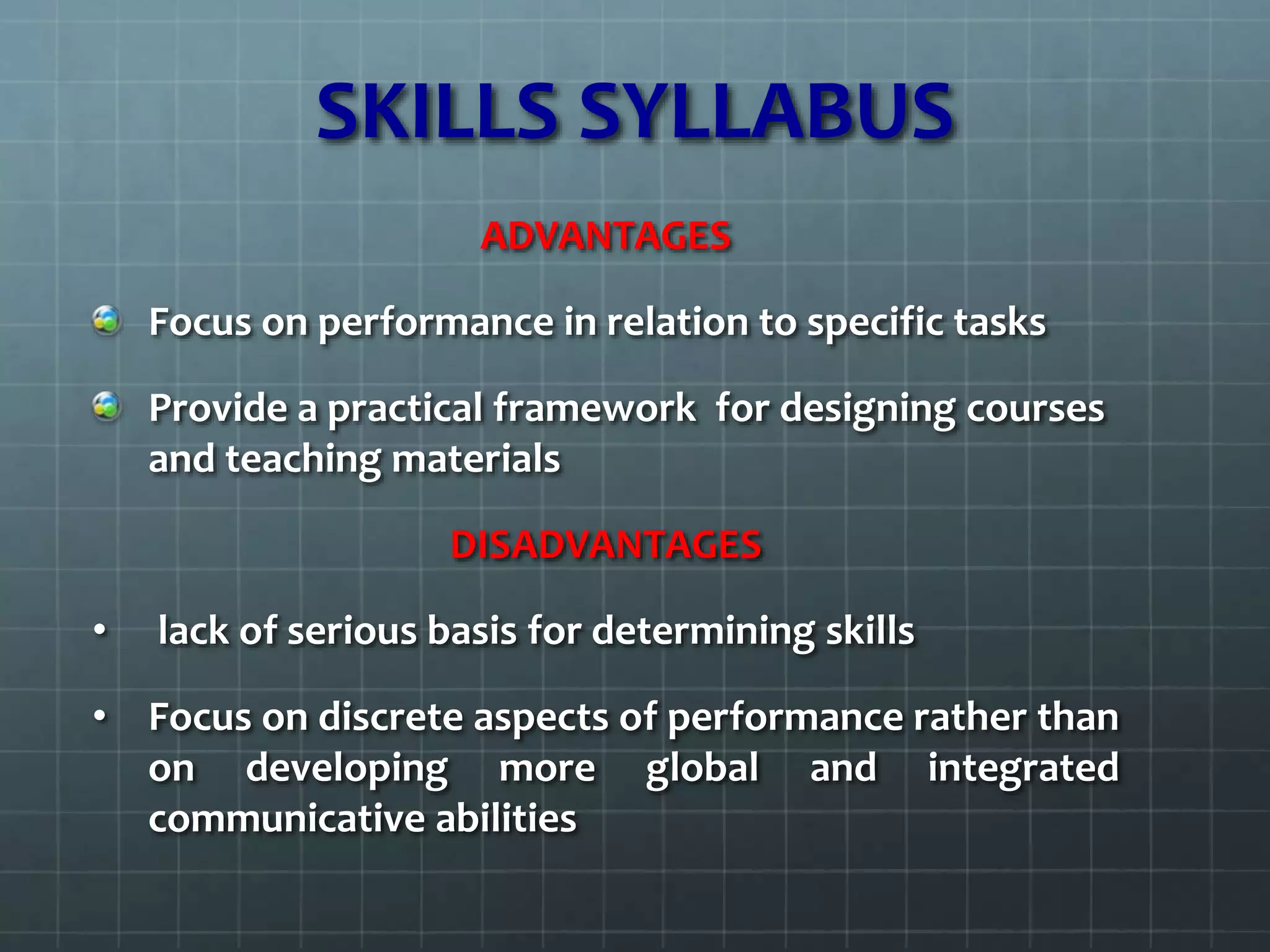
SKILLS SYLLABUS
Organized aroundthe different
underlying abilities involved in
using language for such
purposes as reading, writing,
listening and speaking
22.
SKILLS SYLLABUS
ADVANTAGES
Focus onperformance in relation to specific tasks
Provide a practical framework for designing courses
and teaching materials
DISADVANTAGES
• lack of serious basis for determining skills
• Focus on discrete aspects of performance rather than
on developing more global and integrated
communicative abilities
23.
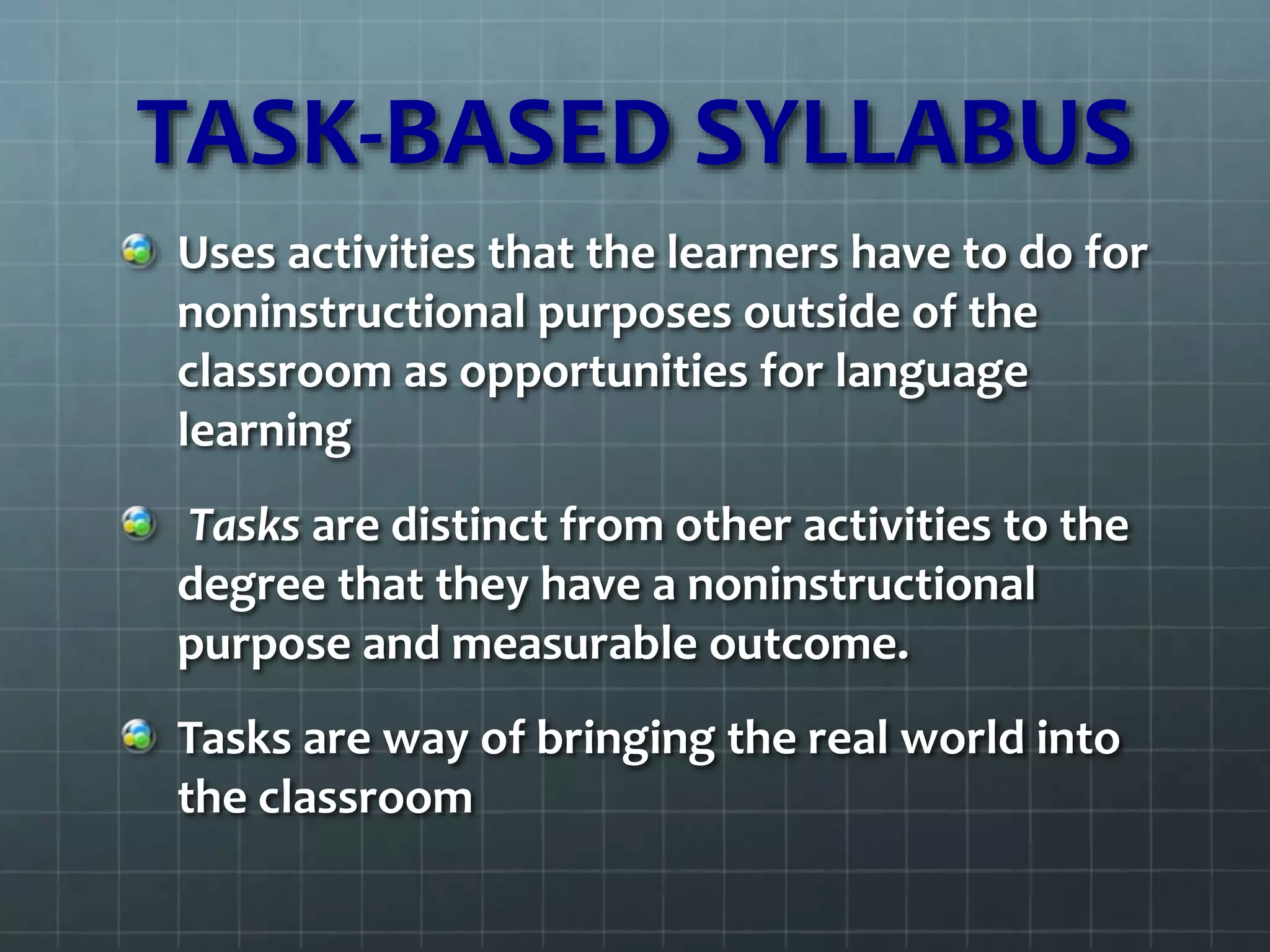
TASK-BASED SYLLABUS
Uses activitiesthat the learners have to do for
noninstructional purposes outside of the
classroom as opportunities for language
learning
Tasks are distinct from other activities to the
degree that they have a noninstructional
purpose and measurable outcome.
Tasks are way of bringing the real world into
the classroom
24.
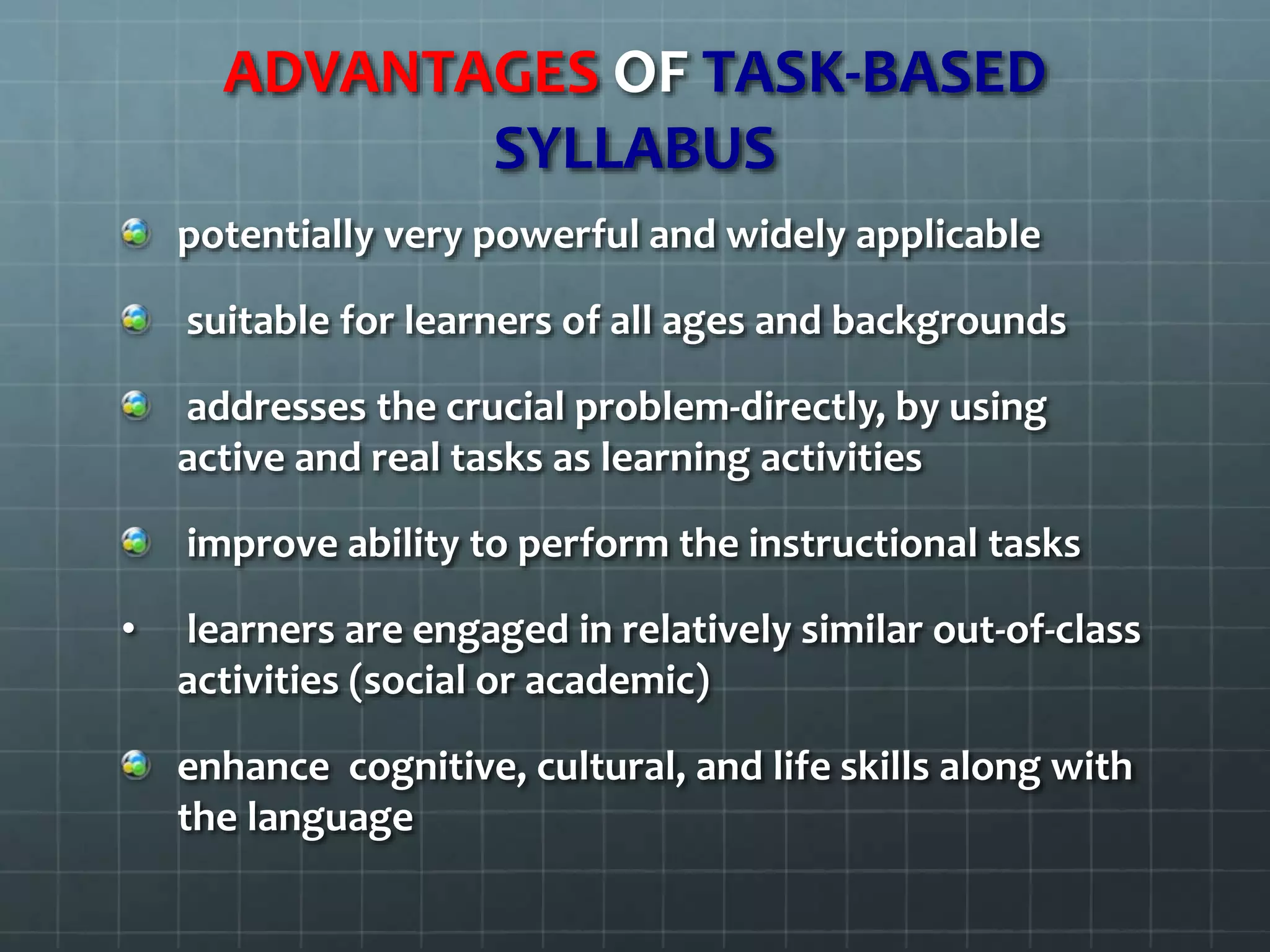
ADVANTAGES OF TASK-BASED
SYLLABUS
potentiallyvery powerful and widely applicable
suitable for learners of all ages and backgrounds
addresses the crucial problem-directly, by using
active and real tasks as learning activities
improve ability to perform the instructional tasks
• learners are engaged in relatively similar out-of-class
activities (social or academic)
enhance cognitive, cultural, and life skills along with
the language
25.
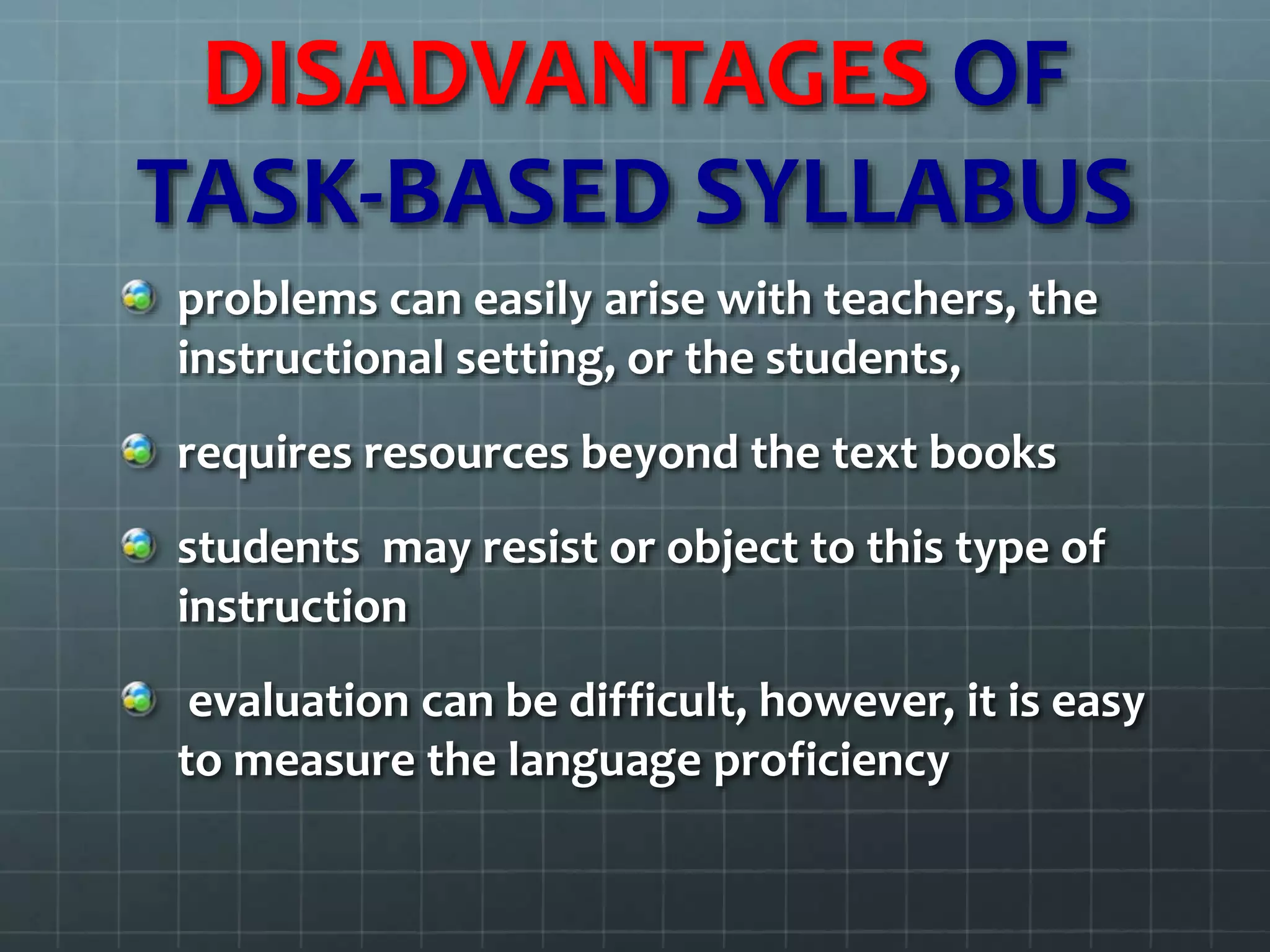
DISADVANTAGES OF
TASK-BASED SYLLABUS
problemscan easily arise with teachers, the
instructional setting, or the students,
requires resources beyond the text books
students may resist or object to this type of
instruction
evaluation can be difficult, however, it is easy
to measure the language proficiency
26.
WHAT TYPE OFSYLLABUS SHOULD
BE USED
It should be kept in mind that the question is
not which type to choose but which types and
how to connect them with the other. No
single type of syllabus is appropriate for all
teaching settings.
It depends on how you teach. Choose one
that fits your teaching procedures.
Don’t forget to use multiple types.