Language Curriculum
Development: AnOverview
This presentation provides a comprehensive overview of language curriculum
development, exploring its multifaceted nature from theoretical definitions to
practical implementation. We will delve into various conceptualizations of
curriculum, the dynamic process of its development, and the critical factors
influencing its design and effectiveness. Special attention will be given to the role
of needs analysis as a foundational step in creating responsive and relevant
language programs.
2.
What is Curriculum?Varying Levels and Definitions
Curriculum can be understood through different levels, each representing a distinct distance from the learner and a specific focus within the educational system. These levels highlight the complexity and layers involved in what is ultimately taught and learned.
1 Societal Level Curriculum
This refers to what is mandated for study at a national level, reflecting broad educational goals and standards set by governing bodies.
2 Intended or Written Curriculum
A normative statement of intent for a course or program, specifying goals, objectives, sequence of study, and learning activities to ensure educational goals are met.
3 Planned Curriculum
The outcome of teachers' interactions with the written curriculum, their personal theories of practice, and the contextual opportunities and constraints of their teaching environment.
4 Instructional, Taught, or Implemented Curriculum
The curriculum that teachers actively negotiate and construct with learners in the classroom, adapting to dynamic constraints and opportunities.
5 Received or Experiential Curriculum
What learners personally experience and from which they construct their understandings, emphasizing the individual's interaction with the learning process.
6 Learned or Achieved Curriculum
The actual portion of the received curriculum that learners internalize and master, representing the ultimate impact on their values, skills, knowledge, and behavior.
7 Recommended Curriculum
Proposed by scholars and professional organizations, encompassing requirements from policymaking groups (e.g., DepEd, CHED, TESDA) identifying essential skills and concepts.
8 Supported Curriculum
Includes resources that facilitate the curriculum, such as textbooks, software, and various other media.
9 Assessed Curriculum
The measurable outcomes derived from tests and performance measures, including state, standardized, district, and teacher-made tests.
10 Hidden Curriculum
The unintended lessons students learn from the physical environment, policies, and procedures of the school, often influencing attitudes and behaviors implicitly.
3.
Defining Curriculum: AMultifaceted Concept
Beyond its various levels, curriculum can be broadly defined in several ways, reflecting its diverse roles and interpretations within education.
These definitions highlight its purpose as a guiding framework for learning.
A Plan for Achieving Goals
Curriculum serves as a strategic
blueprint, outlining the objectives and
pathways to attain specific educational
outcomes.
Dealing with Learners’
Experiences
It encompasses the totality of
experiences designed to engage and
educate learners, fostering holistic
development.
A System for Society and Field of
Study
Curriculum functions as a structured
system, grounded in foundational
theories, principles, and specialized
knowledge, addressing societal needs.
Concise Statement of Content
It can be a summary or table of contents for a discourse,
treatise, or series of lectures, outlining key subjects.
Subject Matter or Course Content
At its most fundamental, curriculum refers to the specific
academic subjects and topics taught within a course or program.
The concept of curriculum is dynamic and evolving, reflecting the changing landscape of education and societal demands. As Matias (2012)
notes, education is crucial for national competitiveness, and a robust curriculum is essential for productive learning.
4.
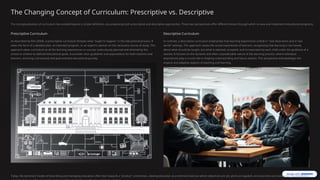
The Changing Conceptof Curriculum: Prescriptive vs. Descriptive
The conceptualization of curriculum has evolved beyond a simple definition, encompassing both prescriptive and descriptive approaches. These two perspectives offer different lenses through which to view and implement educational programs.
Prescriptive Curriculum
As described by Ellis (2004), a prescriptive curriculum dictates what "ought to happen" in the educational process. It
takes the form of a detailed plan, an intended program, or an expert's opinion on the necessary course of study. This
approach views curriculum as all the learning experiences or courses meticulously planned and directed by the
school to achieve its defined educational goals. It provides clear guidelines and expectations for both teachers and
learners, ensuring a structured and goal-oriented educational journey.
Descriptive Curriculum
In contrast, a descriptive curriculum emphasizes how learning experiences unfold in "real classrooms and in real
world" settings. This approach values the actual experiences of learners, recognizing that learning is not merely
about what should be taught, but what is selected, accepted, and incorporated by each child under the guidance of a
teacher. It focuses on the dynamic and often unpredictable nature of the learning process, where individual
experiences play a crucial role in shaping understanding and future actions. This perspective acknowledges the
organic and adaptive aspects of teaching and learning.
Today, the dominant modes of describing and managing education often lean towards a "product" orientation, viewing education as a technical exercise where objectives are set, plans are applied, and outcomes are measured. This highlights
5.
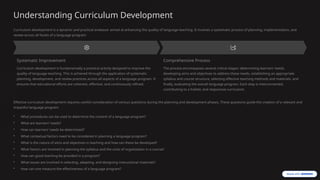
Understanding Curriculum Development
Curriculumdevelopment is a dynamic and practical endeavor aimed at enhancing the quality of language teaching. It involves a systematic process of planning, implementation, and
review across all facets of a language program.
Systematic Improvement
Curriculum development is fundamentally a practical activity designed to improve the
quality of language teaching. This is achieved through the application of systematic
planning, development, and review practices across all aspects of a language program. It
ensures that educational efforts are coherent, effective, and continuously refined.
Comprehensive Process
The process encompasses several critical stages: determining learners’ needs,
developing aims and objectives to address these needs, establishing an appropriate
syllabus and course structure, selecting effective teaching methods and materials, and
finally, evaluating the overall language program. Each step is interconnected,
contributing to a holistic and responsive curriculum.
Effective curriculum development requires careful consideration of various questions during the planning and development phases. These questions guide the creation of a relevant and
impactful language program.
• What procedures can be used to determine the content of a language program?
• What are learners’ needs?
• How can learners’ needs be determined?
• What contextual factors need to be considered in planning a language program?
• What is the nature of aims and objectives in teaching and how can these be developed?
• What factors are involved in planning the syllabus and the units of organization in a course?
• How can good teaching be provided in a program?
• What issues are involved in selecting, adapting, and designing instructional materials?
• How can one measure the effectiveness of a language program?
6.
Teaching Method asa Factor in Curriculum Development
Historically, language teaching has often been narrowly focused on teaching methods, with the latest method sometimes seen as the sole determinant of program success. However, a comprehensive understanding reveals that teaching methods are just
one piece of a larger, interconnected puzzle.
Beyond Method-Centric Views
While teaching methods are important, their interaction with other critical factors in the teaching-learning process is often
overlooked. A holistic view of curriculum development acknowledges that effective teaching is influenced by a multitude of
elements beyond just the chosen method.
• Learners and teachers, and their expectations for the program.
• Learning and teaching styles they bring to the program.
• Purposes and goals of the language course/curriculum.
• Settings where teaching takes place.
• Organizational structure designed to support good teaching.
• Resources to be used and their roles.
• The role of textbooks, technology, and other teaching materials.
• Measures used to determine program success.
Curriculum-Based Approach
A curriculum-based approach to language teaching emphasizes that the choice of teaching method cannot be made in
isolation. It requires extensive knowledge about the program's context and the interactions between all involved elements.
As Richards (2001) highlights, effective teaching depends on:
• Understanding the context for teaching.
• The needs of teachers and learners.
• Careful planning of courses and materials.
• Monitoring of teaching and learning.
7.
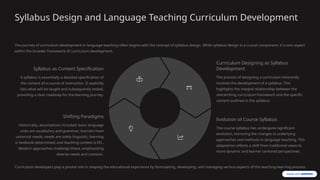
Syllabus Design andLanguage Teaching Curriculum Development
The journey of curriculum development in language teaching often begins with the concept of syllabus design. While syllabus design is a crucial component, it is one aspect
within the broader framework of curriculum development.
Syllabus as Content Specification
A syllabus is essentially a detailed specification of
the content of a course of instruction. It explicitly
lists what will be taught and subsequently tested,
providing a clear roadmap for the learning journey.
Curriculum Designing as Syllabus
Development
The process of designing a curriculum inherently
involves the development of a syllabus. This
highlights the integral relationship between the
overarching curriculum framework and the specific
content outlined in the syllabus.
Evolution of Course Syllabus
The course syllabus has undergone significant
evolution, mirroring the changes in underlying
approaches and methods in language teaching. This
adaptation reflects a shift from traditional views to
more dynamic and learner-centered perspectives.
Shifting Paradigms
Historically, assumptions included: basic language
units are vocabulary and grammar; learners have
universal needs; needs are solely linguistic; learning
is textbook-determined; and teaching context is EFL.
Modern approaches challenge these, emphasizing
diverse needs and contexts.
Curriculum developers play a pivotal role in shaping the educational experience by formulating, developing, and managing various aspects of the teaching-learning process.
8.
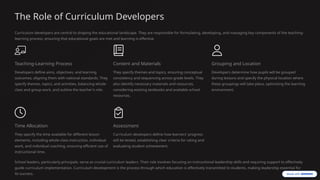
The Role ofCurriculum Developers
Curriculum developers are central to shaping the educational landscape. They are responsible for formulating, developing, and managing key components of the teaching-
learning process, ensuring that educational goals are met and learning is effective.
Teaching-Learning Process
Developers define aims, objectives, and learning
outcomes, aligning them with national standards. They
specify themes, topics, and activities, balancing whole-
class and group work, and outline the teacher's role.
Content and Materials
They specify themes and topics, ensuring conceptual
consistency and sequencing across grade levels. They
also identify necessary materials and resources,
considering existing textbooks and available school
resources.
Grouping and Location
Developers determine how pupils will be grouped
during lessons and specify the physical location where
these groupings will take place, optimizing the learning
environment.
Time Allocation
They specify the time available for different lesson
elements, including whole-class instruction, individual
work, and individual coaching, ensuring efficient use of
instructional time.
Assessment
Curriculum developers define how learners' progress
will be tested, establishing clear criteria for rating and
evaluating student achievement.
School leaders, particularly principals, serve as crucial curriculum leaders. Their role involves focusing on instructional leadership skills and requiring support to effectively
guide curriculum implementation. Curriculum development is the process through which education is effectively transmitted to students, making leadership essential for
its success.
9.
Factors Affecting CurriculumToday
Curriculum development in the 21st century is influenced by a complex interplay of factors, ranging from governmental norms to societal diversity and technological advancements. Blueprinting curriculum requires careful consideration of
these elements to meet the needs of contemporary learners.
Political Factors
Politics profoundly impacts curriculum development, primarily through funding. Both private and public educational
institutions rely on funding for personnel, facilities, and equipment. Local, state, and national political standards
influence every aspect of curriculum, from defining goals and interpreting materials to approving examination
systems.
Economic Factors
Economic considerations drive curriculum content, especially in corporate training focused on employee promotion
for profit returns. Nations investing in education expect economic contributions from educated students, fostering
global competitiveness in technical fields. The nation's economy subtly influences learner goals and academic
achievement standards.
Technological Factors
Technology-driven curriculum development is the norm of the 21st century. Computer technology influences
curriculum at every learning level, with increasing provision of computers in classrooms and learning centers.
Multimedia use shapes educational goals and experiences, and computer technology degrees are growing in
popularity.
Diversity Factors
Diversity significantly affects curriculum development by opening new learning opportunities. Social diversity,
including religion, culture, and social groupings, influences topic selection and teaching methods. Developing
relevant curriculum requires accommodating societal expectations, group traditions, and promoting equality.
Environmental Factors
Environmental issues increasingly impact curriculum development. Growing global awareness and action against
pollution lead to the integration of environmental practices, such as recycling, in elementary classrooms. Higher
education offers environmentally-focused degrees, reflecting a broader commitment to sustainability.
10.
Curriculum Change vs.Curriculum Innovation
While often used interchangeably, curriculum change and curriculum innovation represent distinct approaches to evolving educational practices. Both impact various aspects of a language program, from content to assessment.
Curriculum Change
Curriculum change is a dynamic process aimed at ensuring the relevance of learning within the broader framework of quality education and
effective educational policy. It involves a structured approach to adapting the curriculum to new demands and contexts.
Policy Dialogue and Formulation: Examining triggers and rationales for policy change, analyzing local strengths and weaknesses, and
identifying stakeholders. It considers stakeholder involvement and potential resistance to change.
Curriculum Design: Presenting a generic structure for curriculum frameworks and exploring relationships between constituent elements. It
provides an overview of approaches to defining learner outcomes (e.g., objectives, skills, competencies, standards) and their implications for
content, time, methodologies, and assessment.
System Management and Governance: Examining the relationship between sound management/governance and successful curriculum
development. It explores effective leadership at central, regional, and school levels, balancing centralization and decentralization, and
localizing curriculum for responsiveness to local needs.
Development of Textbooks and Teaching-Learning Materials: Exploring current trends in policy and processes of textbook development,
presenting various models, and considering stakeholder roles in production and distribution. It also covers the selection and production of a
full range of teaching-learning materials.
Curriculum Innovation
Curriculum innovation involves teaching a subject in a new way, often connecting it with other activities or introducing novel experiences. It
aims to transform students' knowledge through creative and unprecedented approaches.
Capacity Building for Curriculum Implementation: Developing knowledge, skills, and insight of individuals and groups involved in
curriculum change. This includes empowering them in policy formulation, curriculum design, textbook development, evaluation, piloting, and
student assessment through training and discourse. It highlights targeted capacity building and varied approaches for sustaining change.
Processes of Curriculum Implementation: Exploring and clarifying possible models of implementation, including planning, analyzing
funding/resources, piloting new curricula, initial and continuing teacher training, and the roles of regional/school leaders.
Curriculum Evaluation and Student Assessment: Presenting evaluation as a source of policy change and ongoing feedback for continuous
adaptation. It considers rationales, identifies evaluable components, and explores approaches, processes, and techniques for data collection
and utilization.