Text-based
Syllabus Design
By Susan Feez
Presented by:
Khansa AL-Qudaimi
A Summary of the book:
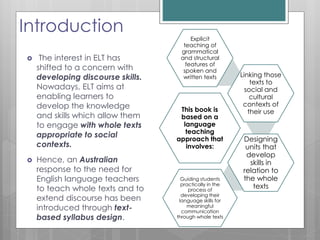
Introduction
 The interest in ELT has
shifted to a concern with
developing discourse skills.
Nowadays, ELT aims at
enabling learners to
develop the knowledge
and skills which allow them
to engage with whole texts
appropriate to social
contexts.
 Hence, an Australian
response to the need for
English language teachers
to teach whole texts and to
extend discourse has been
introduced through text-
based syllabus design.
This book is
based on a
language
teaching
approach that
involves:
Explicit
teaching of
grammatical
and structural
features of
spoken and
written texts Linking those
texts to
social and
cultural
contexts of
their use
Designing
units that
develop
skills in
relation to
the whole
texts
Guiding students
practically in the
process of
developing their
language skills for
meaningful
communication
through whole texts
Chapter one:
Text-based syllabus design
 In this chapter, the author introduces the elements
of course design. She describes the characteristics
of a text-based syllabus. Besides, the social theory
of language is underlined. Syllabus types of ELT in
20th C are mentioned.
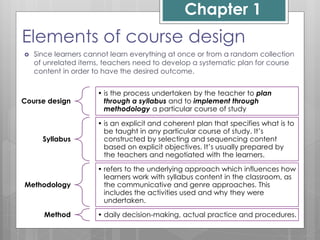
Elements of course design
 Since learners cannot learn everything at once or from a random collection
of unrelated items, teachers need to develop a systematic plan for course
content in order to have the desired outcome.
Chapter 1
Course design
• is the process undertaken by the teacher to plan
through a syllabus and to implement through
methodology a particular course of study
Syllabus
• is an explicit and coherent plan that specifies what is to
be taught in any particular course of study. It’s
constructed by selecting and sequencing content
based on explicit objectives. It’s usually prepared by
the teachers and negotiated with the learners.
Methodology
• refers to the underlying approach which influences how
learners work with syllabus content in the classroom, as
the communicative and genre approaches. This
includes the activities used and why they were
undertaken.
Method • daily decision-making, actual practice and procedures.
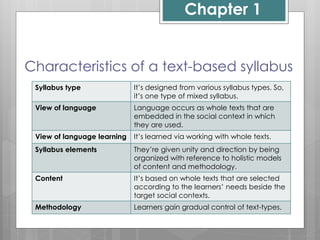
Characteristics of a text-based syllabus
Chapter 1
Syllabus type It’s designed from various syllabus types. So,
it’s one type of mixed syllabus.
View of language Language occurs as whole texts that are
embedded in the social context in which
they are used.
View of language learning It’s learned via working with whole texts.
Syllabus elements They’re given unity and direction by being
organized with reference to holistic models
of content and methodology.
Content It’s based on whole texts that are selected
according to the learners’ needs beside the
target social contexts.
Methodology Learners gain gradual control of text-types.
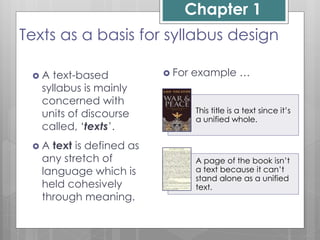
Texts as a basis for syllabus design
 A text-based
syllabus is mainly
concerned with
units of discourse
called, ‘texts’.
 A text is defined as
any stretch of
language which is
held cohesively
through meaning.
This title is a text since it’s
a unified whole.
A page of the book isn’t
a text because it can’t
stand alone as a unified
text.
Chapter 1
 For example …
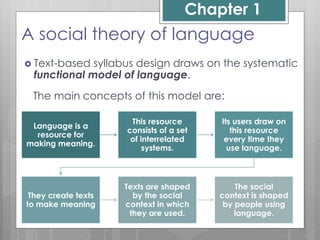
Language is a
resource for
making meaning.
This resource
consists of a set
of interrelated
systems.
Its users draw on
this resource
every time they
use language.
They create texts
to make meaning
Texts are shaped
by the social
context in which
they are used.
The social
context is shaped
by people using
language.
Chapter 1
A social theory of language
 Text-based syllabus design draws on the systematic
functional model of language.
The main concepts of this model are:
Chapter two:
Implementing a text-based syllabus
 In this chapter, the author spotlights the elements
of the unit of work and the methodology. She
demonstrates the genre- based approach as one
realization of the text-based content. Also, she
explains the Learning/teaching cycle based on
the concept of scaffolding.
Chapter 2
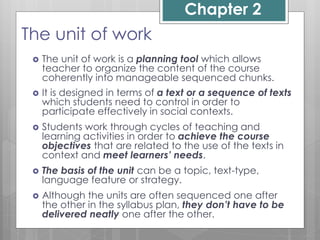
The unit of work
 The unit of work is a planning tool which allows
teacher to organize the content of the course
coherently into manageable sequenced chunks.
 It is designed in terms of a text or a sequence of texts
which students need to control in order to
participate effectively in social contexts.
 Students work through cycles of teaching and
learning activities in order to achieve the course
objectives that are related to the use of the texts in
context and meet learners’ needs.
 The basis of the unit can be a topic, text-type,
language feature or strategy.
 Although the units are often sequenced one after
the other in the syllabus plan, they don’t have to be
delivered neatly one after the other.
Chapter 2
A methodology for Implementing a
text-based syllabus
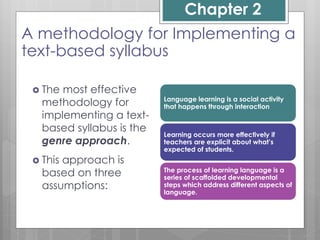
 The most effective
methodology for
implementing a text-
based syllabus is the
genre approach.
 This approach is
based on three
assumptions:
Language learning is a social activity
that happens through interaction
Learning occurs more effectively if
teachers are explicit about what’s
expected of students.
The process of learning language is a
series of scaffolded developmental
steps which address different aspects of
language.
Chapter 2
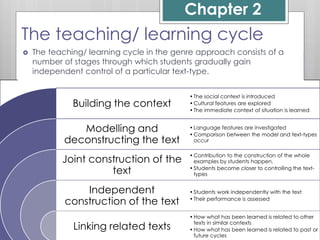
Building the context
Modelling and
deconstructing the text
Joint construction of the
text
Independent
construction of the text
Linking related texts
•The social context is introduced
•Cultural features are explored
•The immediate context of situation is learned
•Language features are investigated
•Comparison between the model and text-types
occur
•Contribution to the construction of the whole
examples by students happen.
•Students become closer to controlling the text-
types
•Students work independently with the text
•Their performance is assessed
•How what has been learned is related to other
texts in similar contexts
•How what has been learned is related to past or
future cycles
The teaching/ learning cycle
 The teaching/ learning cycle in the genre approach consists of a
number of stages through which students gradually gain
independent control of a particular text-type.
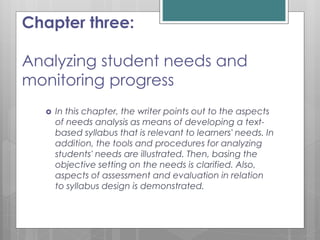
Chapter three:
Analyzing student needs and
monitoring progress
 In this chapter, the writer points out to the aspects
of needs analysis as means of developing a text-
based syllabus that is relevant to learners' needs. In
addition, the tools and procedures for analyzing
students' needs are illustrated. Then, basing the
objective setting on the needs is clarified. Also,
aspects of assessment and evaluation in relation
to syllabus design is demonstrated.
Chapter 3
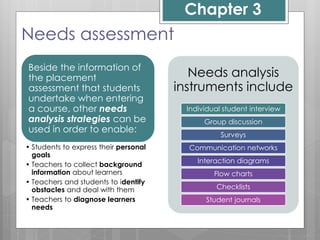
Needs assessment
Beside the information of
the placement
assessment that students
undertake when entering
a course, other needs
analysis strategies can be
used in order to enable:
• Students to express their personal
goals
• Teachers to collect background
information about learners
• Teachers and students to identify
obstacles and deal with them
• Teachers to diagnose learners
needs
Needs analysis
instruments include
Individual student interview
Group discussion
Surveys
Communication networks
Interaction diagrams
Flow charts
Checklists
Student journals
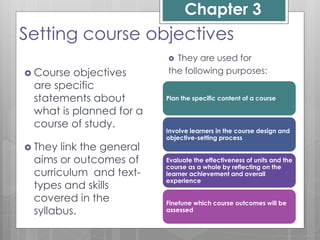
Setting course objectives
 Course objectives
are specific
statements about
what is planned for a
course of study.
 They link the general
aims or outcomes of
curriculum and text-
types and skills
covered in the
syllabus.
Chapter 3
 They are used for
the following purposes:
Plan the specific content of a course
Involve learners in the course design and
objective-setting process
Evaluate the effectiveness of units and the
course as a whole by reflecting on the
learner achievement and overall
experience
Finetune which course outcomes will be
assessed
Chapter 3
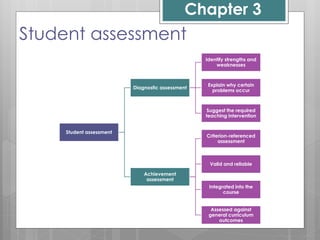
Student assessment
Diagnostic assessment
Identify strengths and
weaknesses
Explain why certain
problems occur
Suggest the required
teaching intervention
Achievement
assessment
Criterion-referenced
assessment
Valid and reliable
Integrated into the
course
Assessed against
general curriculum
outcomes
Student assessment
Course evaluation
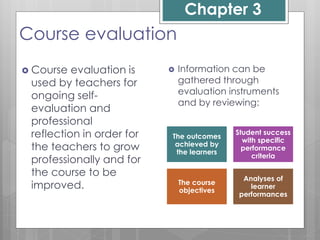
 Course evaluation is
used by teachers for
ongoing self-
evaluation and
professional
reflection in order for
the teachers to grow
professionally and for
the course to be
improved.
Chapter 3
The outcomes
achieved by
the learners
Student success
with specific
performance
criteria
The course
objectives
Analyses of
learner
performances
 Information can be
gathered through
evaluation instruments
and by reviewing:
Chapter four:
Designing a course
 In this chapter, the author discusses issues,
processes and procedures involved in designing a
course for specific group of learners. principles of
course design are also illustrated. Different ways of
focusing course design are presented.
Chapter 4
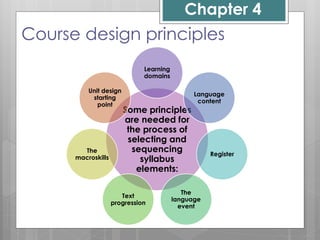
Course design principles
Some principles
are needed for
the process of
selecting and
sequencing
syllabus
elements:
Learning
domains
Language
content
Register
The
language
event
Text
progression
The
macroskills
Unit design
starting
point
Chapter 4
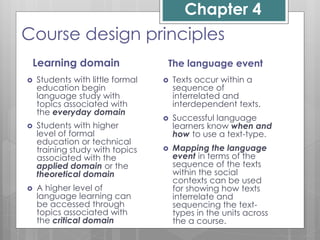
Course design principles
Learning domain
 Students with little formal
education begin
language study with
topics associated with
the everyday domain
 Students with higher
level of formal
education or technical
training study with topics
associated with the
applied domain or the
theoretical domain
 A higher level of
language learning can
be accessed through
topics associated with
the critical domain
The language event
 Texts occur within a
sequence of
interrelated and
interdependent texts.
 Successful language
learners know when and
how to use a text-type.
 Mapping the language
event in terms of the
sequence of the texts
within the social
contexts can be used
for showing how texts
interrelate and
sequencing the text-
types in the units across
the a course.
Chapter 4
Course design principles
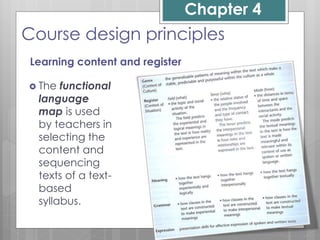
Learning content and register
 The functional
language
map is used
by teachers in
selecting the
content and
sequencing
texts of a text-
based
syllabus.
Chapter 4
Course design principles
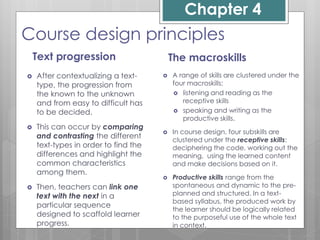
Text progression
 After contextualizing a text-
type, the progression from
the known to the unknown
and from easy to difficult has
to be decided.
 This can occur by comparing
and contrasting the different
text-types in order to find the
differences and highlight the
common characteristics
among them.
 Then, teachers can link one
text with the next in a
particular sequence
designed to scaffold learner
progress.
The macroskills
 A range of skills are clustered under the
four macroskills:
 listening and reading as the
receptive skills
 speaking and writing as the
productive skills.
 In course design, four subskills are
clustered under the receptive skills:
deciphering the code, working out the
meaning, using the learned content
and make decisions based on it.
 Productive skills range from the
spontaneous and dynamic to the pre-
planned and structured. In a text-
based syllabus, the produced work by
the learner should be logically related
to the purposeful use of the whole text
in context.
Chapter five:
Planning units of work and lessons
 In this chapter, the writer demonstrates how
syllabus comes to life in class. Besides, developing
coherent and relevant units are presented. In
addition, resources examination, as coursebooks
and teacher-produced materials, is illustrated.
Planning units of work
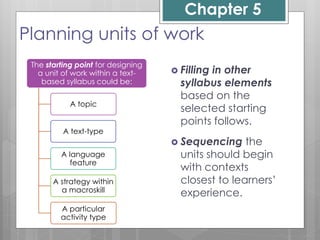
The starting point for designing
a unit of work within a text-
based syllabus could be:
A topic
A text-type
A language
feature
A strategy within
a macroskill
A particular
activity type
Chapter 5
 Filling in other
syllabus elements
based on the
selected starting
points follows.
 Sequencing the
units should begin
with contexts
closest to learners’
experience.
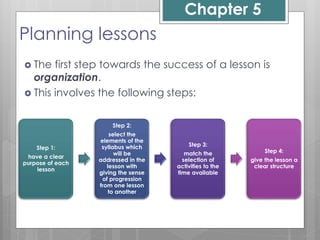
Planning lessons
Chapter 5
Step 1:
have a clear
purpose of each
lesson
Step 2:
select the
elements of the
syllabus which
will be
addressed in the
lesson with
giving the sense
of progression
from one lesson
to another
Step 3:
match the
selection of
activities to the
time available
Step 4:
give the lesson a
clear structure
 The first step towards the success of a lesson is
organization.
 This involves the following steps:
Chapter 5
Teaching resources
Coursebooks
 Instead of planning the course
themselves, the teachers may
prefer to follow a course book.
 Coursebooks are designed by
experienced teachers who
know a lot about selecting and
sequencing syllabus elements.
Hence, they provide excellent
model syllabus, texts and well-
designed classroom activities,
especially for student teachers.
 There are different qualities of
available coursebooks.
However, it always needs to be
customized to meet students’
needs regardless of the its
quality.
Teacher-produced material
 Some of the most effective
resources of all are designed and
prepared by teachers since they
target the exact needs and
learning styles of a particular
group of learners.
 However, development of
resources requires considerable
expertise.
 Writing on the board, preparing
slides, designing worksheets, ..etc.
are all examples of teacher-
produced materials.
 Therefore, they need to be always
evaluated and fall within copyright
regulations.
Conclusion
 In conclusion, ‘Text-based Syllabus’ by Susan
Feez has covered the planning, implementation
and evaluation of designing a text-based
syllabus. She provided supporting examples and
illustrations. Also, suggested resources were
listed after each chapter. Hence, this handbook
is recommended for teachers aiming at
designing their text-based syllabus courses.
Feez, S. (1998). Text-based syllabus design. Sydney: National Centre for English
Language Teaching and Research.

Text-based syllabus design

  • 1.
    Text-based Syllabus Design By SusanFeez Presented by: Khansa AL-Qudaimi A Summary of the book:
  • 2.
    Introduction  The interestin ELT has shifted to a concern with developing discourse skills. Nowadays, ELT aims at enabling learners to develop the knowledge and skills which allow them to engage with whole texts appropriate to social contexts.  Hence, an Australian response to the need for English language teachers to teach whole texts and to extend discourse has been introduced through text- based syllabus design. This book is based on a language teaching approach that involves: Explicit teaching of grammatical and structural features of spoken and written texts Linking those texts to social and cultural contexts of their use Designing units that develop skills in relation to the whole texts Guiding students practically in the process of developing their language skills for meaningful communication through whole texts
  • 3.
    Chapter one: Text-based syllabusdesign  In this chapter, the author introduces the elements of course design. She describes the characteristics of a text-based syllabus. Besides, the social theory of language is underlined. Syllabus types of ELT in 20th C are mentioned.
  • 4.
    Elements of coursedesign  Since learners cannot learn everything at once or from a random collection of unrelated items, teachers need to develop a systematic plan for course content in order to have the desired outcome. Chapter 1 Course design • is the process undertaken by the teacher to plan through a syllabus and to implement through methodology a particular course of study Syllabus • is an explicit and coherent plan that specifies what is to be taught in any particular course of study. It’s constructed by selecting and sequencing content based on explicit objectives. It’s usually prepared by the teachers and negotiated with the learners. Methodology • refers to the underlying approach which influences how learners work with syllabus content in the classroom, as the communicative and genre approaches. This includes the activities used and why they were undertaken. Method • daily decision-making, actual practice and procedures.
  • 5.
    Characteristics of atext-based syllabus Chapter 1 Syllabus type It’s designed from various syllabus types. So, it’s one type of mixed syllabus. View of language Language occurs as whole texts that are embedded in the social context in which they are used. View of language learning It’s learned via working with whole texts. Syllabus elements They’re given unity and direction by being organized with reference to holistic models of content and methodology. Content It’s based on whole texts that are selected according to the learners’ needs beside the target social contexts. Methodology Learners gain gradual control of text-types.
  • 6.
    Texts as abasis for syllabus design  A text-based syllabus is mainly concerned with units of discourse called, ‘texts’.  A text is defined as any stretch of language which is held cohesively through meaning. This title is a text since it’s a unified whole. A page of the book isn’t a text because it can’t stand alone as a unified text. Chapter 1  For example …
  • 7.
    Language is a resourcefor making meaning. This resource consists of a set of interrelated systems. Its users draw on this resource every time they use language. They create texts to make meaning Texts are shaped by the social context in which they are used. The social context is shaped by people using language. Chapter 1 A social theory of language  Text-based syllabus design draws on the systematic functional model of language. The main concepts of this model are:
  • 8.
    Chapter two: Implementing atext-based syllabus  In this chapter, the author spotlights the elements of the unit of work and the methodology. She demonstrates the genre- based approach as one realization of the text-based content. Also, she explains the Learning/teaching cycle based on the concept of scaffolding.
  • 9.
    Chapter 2 The unitof work  The unit of work is a planning tool which allows teacher to organize the content of the course coherently into manageable sequenced chunks.  It is designed in terms of a text or a sequence of texts which students need to control in order to participate effectively in social contexts.  Students work through cycles of teaching and learning activities in order to achieve the course objectives that are related to the use of the texts in context and meet learners’ needs.  The basis of the unit can be a topic, text-type, language feature or strategy.  Although the units are often sequenced one after the other in the syllabus plan, they don’t have to be delivered neatly one after the other.
  • 10.
    Chapter 2 A methodologyfor Implementing a text-based syllabus  The most effective methodology for implementing a text- based syllabus is the genre approach.  This approach is based on three assumptions: Language learning is a social activity that happens through interaction Learning occurs more effectively if teachers are explicit about what’s expected of students. The process of learning language is a series of scaffolded developmental steps which address different aspects of language.
  • 11.
    Chapter 2 Building thecontext Modelling and deconstructing the text Joint construction of the text Independent construction of the text Linking related texts •The social context is introduced •Cultural features are explored •The immediate context of situation is learned •Language features are investigated •Comparison between the model and text-types occur •Contribution to the construction of the whole examples by students happen. •Students become closer to controlling the text- types •Students work independently with the text •Their performance is assessed •How what has been learned is related to other texts in similar contexts •How what has been learned is related to past or future cycles The teaching/ learning cycle  The teaching/ learning cycle in the genre approach consists of a number of stages through which students gradually gain independent control of a particular text-type.
  • 12.
    Chapter three: Analyzing studentneeds and monitoring progress  In this chapter, the writer points out to the aspects of needs analysis as means of developing a text- based syllabus that is relevant to learners' needs. In addition, the tools and procedures for analyzing students' needs are illustrated. Then, basing the objective setting on the needs is clarified. Also, aspects of assessment and evaluation in relation to syllabus design is demonstrated.
  • 13.
    Chapter 3 Needs assessment Besidethe information of the placement assessment that students undertake when entering a course, other needs analysis strategies can be used in order to enable: • Students to express their personal goals • Teachers to collect background information about learners • Teachers and students to identify obstacles and deal with them • Teachers to diagnose learners needs Needs analysis instruments include Individual student interview Group discussion Surveys Communication networks Interaction diagrams Flow charts Checklists Student journals
  • 14.
    Setting course objectives Course objectives are specific statements about what is planned for a course of study.  They link the general aims or outcomes of curriculum and text- types and skills covered in the syllabus. Chapter 3  They are used for the following purposes: Plan the specific content of a course Involve learners in the course design and objective-setting process Evaluate the effectiveness of units and the course as a whole by reflecting on the learner achievement and overall experience Finetune which course outcomes will be assessed
  • 15.
    Chapter 3 Student assessment Diagnosticassessment Identify strengths and weaknesses Explain why certain problems occur Suggest the required teaching intervention Achievement assessment Criterion-referenced assessment Valid and reliable Integrated into the course Assessed against general curriculum outcomes Student assessment
  • 16.
    Course evaluation  Courseevaluation is used by teachers for ongoing self- evaluation and professional reflection in order for the teachers to grow professionally and for the course to be improved. Chapter 3 The outcomes achieved by the learners Student success with specific performance criteria The course objectives Analyses of learner performances  Information can be gathered through evaluation instruments and by reviewing:
  • 17.
    Chapter four: Designing acourse  In this chapter, the author discusses issues, processes and procedures involved in designing a course for specific group of learners. principles of course design are also illustrated. Different ways of focusing course design are presented.
  • 18.
    Chapter 4 Course designprinciples Some principles are needed for the process of selecting and sequencing syllabus elements: Learning domains Language content Register The language event Text progression The macroskills Unit design starting point
  • 19.
    Chapter 4 Course designprinciples Learning domain  Students with little formal education begin language study with topics associated with the everyday domain  Students with higher level of formal education or technical training study with topics associated with the applied domain or the theoretical domain  A higher level of language learning can be accessed through topics associated with the critical domain The language event  Texts occur within a sequence of interrelated and interdependent texts.  Successful language learners know when and how to use a text-type.  Mapping the language event in terms of the sequence of the texts within the social contexts can be used for showing how texts interrelate and sequencing the text- types in the units across the a course.
  • 20.
    Chapter 4 Course designprinciples Learning content and register  The functional language map is used by teachers in selecting the content and sequencing texts of a text- based syllabus.
  • 21.
    Chapter 4 Course designprinciples Text progression  After contextualizing a text- type, the progression from the known to the unknown and from easy to difficult has to be decided.  This can occur by comparing and contrasting the different text-types in order to find the differences and highlight the common characteristics among them.  Then, teachers can link one text with the next in a particular sequence designed to scaffold learner progress. The macroskills  A range of skills are clustered under the four macroskills:  listening and reading as the receptive skills  speaking and writing as the productive skills.  In course design, four subskills are clustered under the receptive skills: deciphering the code, working out the meaning, using the learned content and make decisions based on it.  Productive skills range from the spontaneous and dynamic to the pre- planned and structured. In a text- based syllabus, the produced work by the learner should be logically related to the purposeful use of the whole text in context.
  • 22.
    Chapter five: Planning unitsof work and lessons  In this chapter, the writer demonstrates how syllabus comes to life in class. Besides, developing coherent and relevant units are presented. In addition, resources examination, as coursebooks and teacher-produced materials, is illustrated.
  • 23.
    Planning units ofwork The starting point for designing a unit of work within a text- based syllabus could be: A topic A text-type A language feature A strategy within a macroskill A particular activity type Chapter 5  Filling in other syllabus elements based on the selected starting points follows.  Sequencing the units should begin with contexts closest to learners’ experience.
  • 24.
    Planning lessons Chapter 5 Step1: have a clear purpose of each lesson Step 2: select the elements of the syllabus which will be addressed in the lesson with giving the sense of progression from one lesson to another Step 3: match the selection of activities to the time available Step 4: give the lesson a clear structure  The first step towards the success of a lesson is organization.  This involves the following steps:
  • 25.
    Chapter 5 Teaching resources Coursebooks Instead of planning the course themselves, the teachers may prefer to follow a course book.  Coursebooks are designed by experienced teachers who know a lot about selecting and sequencing syllabus elements. Hence, they provide excellent model syllabus, texts and well- designed classroom activities, especially for student teachers.  There are different qualities of available coursebooks. However, it always needs to be customized to meet students’ needs regardless of the its quality. Teacher-produced material  Some of the most effective resources of all are designed and prepared by teachers since they target the exact needs and learning styles of a particular group of learners.  However, development of resources requires considerable expertise.  Writing on the board, preparing slides, designing worksheets, ..etc. are all examples of teacher- produced materials.  Therefore, they need to be always evaluated and fall within copyright regulations.
  • 26.
    Conclusion  In conclusion,‘Text-based Syllabus’ by Susan Feez has covered the planning, implementation and evaluation of designing a text-based syllabus. She provided supporting examples and illustrations. Also, suggested resources were listed after each chapter. Hence, this handbook is recommended for teachers aiming at designing their text-based syllabus courses. Feez, S. (1998). Text-based syllabus design. Sydney: National Centre for English Language Teaching and Research.