COURSE PLANNING AND SYLLABUS DESIGN
Jovy D. Elimanao – Mihm, MAEd
Language Curriculum for Secondary Schools
Dimensions of course development
(Richard 2001)
• Developing a course rationale
• Describing entry and exit levels
• Choosing course content
• Sequencing course content
• Planning the course content (syllabus and
instructional blocks)
A. The Course Rationale
• A starting point in course development is a
description of the course rationale. This is a
brief written description of the reasons for
the course and the nature of it. The course
rationale seeks to answer the following
questions:
• Who is this course for?
• What is the course about?
• What kind of teaching and learning will take
place in the course?
A. The Course Rationale
• The course rationale answers these questions
by describing the beliefs, values and goals
that underlie the course. It would be normally
be a two- or three- paragraph statement that
has been developed by those planning and
teaching a course and that serves to provide
the justification for the type of teaching and
learning that will take place in the course.
A. The Course Rationale
• Developing a rationale also helps provide focus
and direction to some of the deliberations
involved in course planning. The rationale thus
serves the purposes of:
• Guiding the planning of the various components
of the course.
• Emphasizing the kinds of teaching and learning
the course should exemplify.
• Providing a check in the consistency of the
various course components in terms of the course
values and goals.
B. Describing Entry and Exit Levels
• In order to plan a language course, it is necessary
to know the level at which the program will
start and the level learners may be expected to
reach at the end of the course. Language programs
and commercial materials typically distinguish
between elementary, intermediate, and advanced
levels, but these categories are too broad for the
kind of detailed planning that program and
materials development involves. For these
purposes, more detailed descriptions are needed
of students’ proficiency levels before they enter a
program and targeted proficiency levels at the
end of it.
B. Describing Entry and Exit Levels
• Information may be available on students’
entry level from their results on international
proficiency tests such as TOEFL or IELTS. Or
specially designed tests may be needed to
determine the level of the students’ language
skills.
C. Choosing Course Content
• The question of course content is probably the
most basic issue in course design. Given that a
course has to develop to address a specific set
of needs to cover a given set of objectives,
what will the content of the course look like?
The Link Between Goals and Objectives
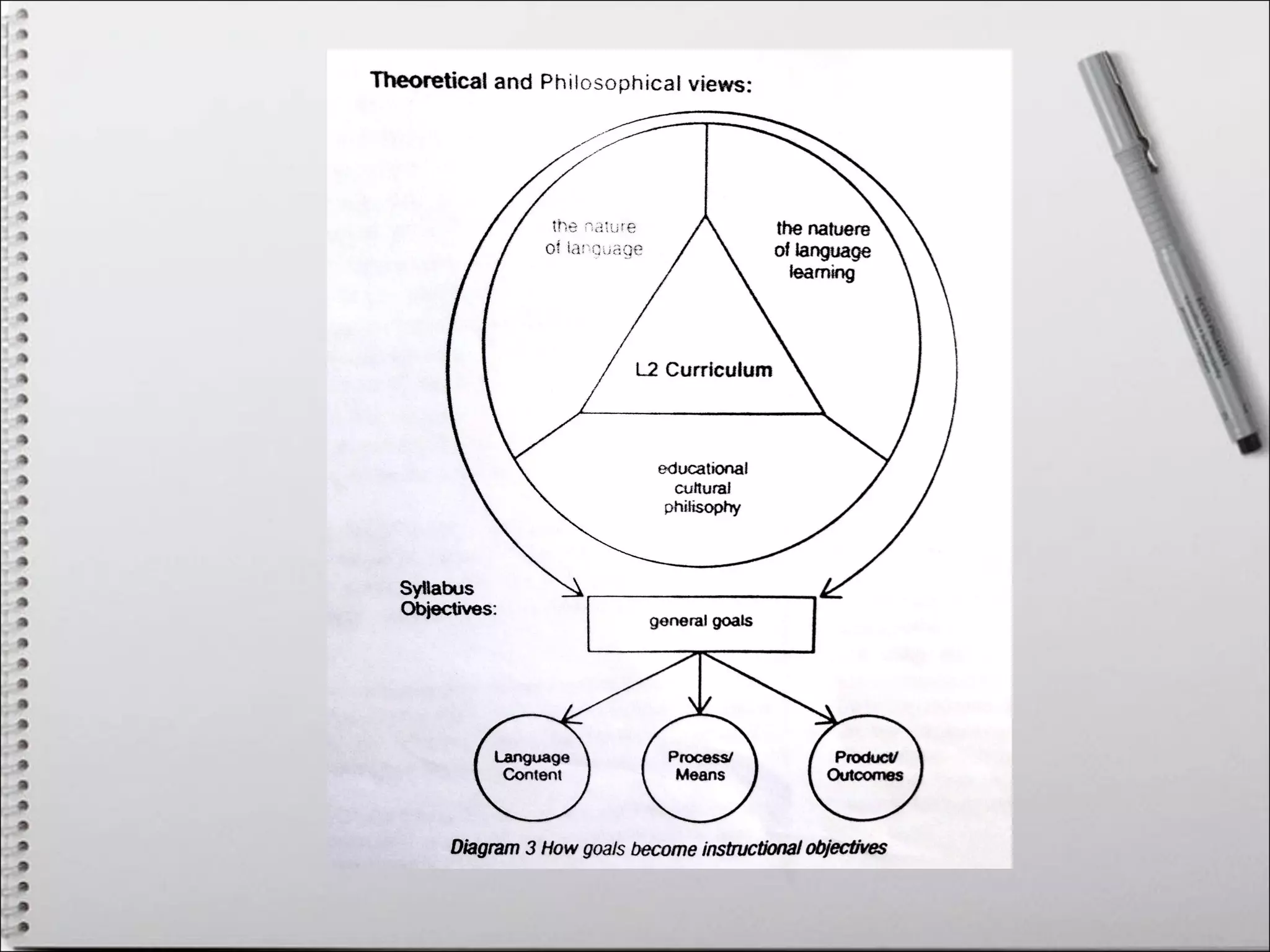
• The connection between the general goals at the
curriculum level and specific objectives at the
syllabus level is evident in the effect which goals
have on the three concerns of a syllabus:
1. The dimension of the language content
2. Processes or means
3. Product or outcomes
In general, curriculum goals tend to place emphasis
on one or another of these dimensions.
The Link Between Goals and Objectives
• Key questions about language content (based
on a particular theory of language that has been
adopted as the foundation upon which to write a
curriculum):
1. What elements, items, units, or themes of
language content should be selected for inclusion
in the syllabus?
2. In what order or sequence should the elements be
presented in the syllabus?
3. What are the criteria for deciding on the order of
elements in the syllabus?
The Link Between Goals and Objectives
• Questions about process dimension:
1. How should language be presented to facilitate
the acquisition process?
2.What should be the roles of teachers and
learners in the learning process?
3. How should the materials contribute to the
process of language learning in the classroom?
The Link Between Goals and Objectives
• Product/outcome questions:
1. What knowledge is the learner expected to attain by
the end of the course? What understandings based on
analyses of structures and lexis will learners have as an
outcome of the course?
2. What specific language skills do the learners need in
their immediate future, or in their professional lives?
How will these skills be presented in the syllabus?
3. What techniques of evaluation or examination in the
target language will be used to assess course outcomes?
The Link Between Goals and Objectives
• Product/outcome questions:
1. What knowledge is the learner expected to attain by
the end of the course? What understandings based on
analyses of structures and lexis will learners have as an
outcome of the course?
2. What specific language skills do the learners need in
their immediate future, or in their professional lives?
How will these skills be presented in the syllabus?
3. What techniques of evaluation or examination in the
target language will be used to assess course outcomes?
The BASIC EDUCATION CURRICULUM
The BASIC EDUCATION
CURRICULUM
• Curriculum polices are usually set forth by the
Department of Education through various
orders, circulars, memoranda and bulletins.
• They are aligned with national priorities and
contribute to the achievement of
development goals. However, several laws
passed by the national legislature specifically
relate to the school curriculum.
The BASIC EDUCATION
CURRICULUM
• The Basic Education Curriculum (BEC) aims
to produce more functionally literate
students by empowering them with life skills
and promote more ideal teachers that will
perform collaborative teaching and
transcending knowledge in a non-
authoritative way of instructing.
The BASIC EDUCATION
CURRICULUM
• It has reduced the number of subjects from
an average of eight to five, focusing on
Filipino, English, Science, Mathematics
which is seen to prepare students for global
competitiveness. A fifth subject, Makabayan
also called as the “laboratory of life,” instruct
complete learning to students.
The BASIC EDUCATION
CURRICULUM
• Makabayan intends to develop personal and
national identity through adequate
knowledge of Philippine history and its
politico-economic system, local cultures,
crafts, arts, music and games.
• It covers a wide range of values system that
stresses the development of social awareness,
understanding and commitment to the
common good.
The BASIC EDUCATION
CURRICULUM
• The subjects in the new curriculum respond to
the individual needs of the students, and are
contextualized in their present conditions.
• Reciprocal interaction between student-
teacher, among students, students-
instructional materials, students-multi-media
sources, students-teachers of different
disciplines is also reinforce.
The BASIC EDUCATION
CURRICULUM
• The approach to the subject is “integrated”.
Thus, Filipino and English would, in addition
to reading, writing and grammar, include
literature and current affairs. The school
principal is authorized to make adjustments,
but not modification, to the content of the
subjects. (Guzman and Sevilleno 2003).
Development of the
BASIC EDUCATION CURRICULUM
(SEAMEO INNOTECH 2002)
The Development of the Basic Education
Curriculum (SEAMEO INNOTECH 2002)
• is the responsibility of the Central Office Bureau
of Elementary and Secondary Education
Curriculum Development Divisions. This bureau
defines the learning competencies for the
different subject areas; conceptualizes the
structure of the curriculum; and formulate
national curricular policies.
• These functions are exercised in consultation
with other agencies and sectors of society (e.g.
industry, social and civic groups, teacher-training
institutions, professional organizations, school
administrators, parents, students, etc.).
The Development of the Basic Education
Curriculum (SEAMEO INNOTECH 2002)
• The subject offerings, credit points and time
allotments for the different subject areas are
also determined at the national level.
• In this sense, a national curriculum exists in
the Philippines. However, while curriculum
implementation guidelines are issued at the
national level, the actual implementation is
left to school teachers. They determine the
resources to be used; teaching and assessment
strategies and other processes.
The Development of the Basic Education
Curriculum (SEAMEO INNOTECH 2002)
• Furthermore, schools have the option to
modify the national curriculum (e.g. content,
sequence and the teaching strategies) in order
to ensure that the curriculum responds to local
concerns.
The Development of the Basic Education
Curriculum (SEAMEO INNOTECH 2002)
• The approach of curriculum design in the
country is based on content topic and
competency. The Department of Education
prescribes competencies for the subject areas
in all the grade / year levels.
• The Bureau of Elementary and Secondary
Education develops, publishes and
disseminates these learning competencies to
the field.
The Development of the Basic Education
Curriculum (SEAMEO INNOTECH 2002)
• Most of the subject / learning areas have a list
of learning competencies expected to be
mastered by the children at the end of each
grade / year level and also at the end of
elementary / secondary schooling.
• Some subject / learning areas have a
combination of both (i.e. a learning
competencies under each content / topic).
The Development of the Basic Education
Curriculum (SEAMEO INNOTECH 2002)
• The curriculum is designed to be interpreted
by teachers and implemented with
variations. Schools are encouraged to
innovate and enrich or adapt, as long as they
have met the basic requirements of the
curriculum.
• The curriculum plan (learning competencies)
does not present teaching methods and
learning activities that the teachers must
follow in implementing the curriculum.
The Development of the Basic Education
Curriculum (SEAMEO INNOTECH 2002)
• The guiding philosophy is that the creativity
of teachers is stimulated by the option to
plan and use the appropriate teaching /
learning activities independently. However,
teacher’s manuals or guides do incorporate
higher-level content areas and suggestions for
teaching and assessing. (Marinas and Ditapat
2000).
Features of the
2002 BASIC EDUCATION CURRICULUM
for Elementary and Secondary Education
Features of the 2002 Basic Education Curriculum for
Elementary and Secondary Education
• Restructuring of the learning areas, reducing them to
five (Filipino, English Math, Science and Makabayan)
• Stronger integration of competencies and values
within and across learning areas
• Greater emphasis on the learning process and
integrative modes of teaching; and
• Increased time for tasks to gain mastery of
competencies of the basic tool subjects.
• The objectives are expressed in terms of competencies,
which are knowledge, skills and attitudes that the
learner is expected to acquire at the end of the
program.
Features of the 2002 Basic Education Curriculum for
Elementary and Secondary Education
• A significant feature of the competencies is the
inclusion of the use of ICTs, articulated in terms of
skills in accessing, processing, and applying
information, and using educational software in solving
mathematical problems and conducting experiments.
• Content is delivered using a variety of media and
resources.
• The teaching-learning process considers the learner an
active partner rather than an object of pedagogy.
• The learner takes on the role of constructor of
meaning, while the teacher serves as facilitator,
enabler and manager of learning. (Department of
Education 2002)
REVIEWING THE OLD CURRICULUM
• The main objectives of Secondary Education
Development Program (SEDP) are to strengthen
the Ministry of Science, Technology, Education
and Culture (MOSTEC), develop the quality and
coverage of basic, non-formal and secondary
education, and create a market- driven Technical
Education and Vocational Training (TEVT)
program and fortify the Science and Technology
(S & T) capacity at the tertiary level. SEDP will
also direct the Government’s poverty alleviation
strategy in the education sector.
REVIEWING THE OLD CURRICULUM
• The SEDP contains the New Secondary Education
Curriculum (NSEC) implemented in 1989, which
changed the 1973 Revised Education Program
(RSEP). The program was applied in response to
the following needs: continuation of the Program
for Decentralized Education (PRODED) giving
emphasis on science and technology,
mathematics, reading, and writing, improve the
values of high school graduates; and develop
access to quality education.
BEC vs SEDP
• SEDP said to be overcrowded, putting together too
many competencies and topics. This results to the
loss of mastery of basic skills, narrow opportunity to
process and contextualize major concepts and weak
interconnections of competence.
• On the other hand, BEC had encountered various
criticisms.
• Tessa Aquino Oreta, the main author of Republic Act
No. 9115 or the Governance of Basic Education Act, said
the “outcome of learning” among students in public
schools nationwide will be sacrificed and eventually
suffer because a number of teachers in the country are
not prepared to teach the new curriculum.
BEC vs SEDP
• The research agency, IBON Foundation, also
criticized the design of the BEC, claiming it
caters to the needs of multinational
corporations for highly skilled and technically
proficient workers at the expense of
nationalism.
BEC vs SEDP
• Antonio Tinio, national coordinator of the
Alliance of Concerned Teachers (ACT), said the
new curriculum will have a strategically adverse
impact on the promotion of a scientific and
nationalist education program which are critical
components in the holistic development and
progress of a nation.
• He said the BEC is a scheme crafted to produce
lowly paid labor force that will support the
niche marketing schemes of the government and
corporations in the era of globalization.
BEC vs SEDP
• He added that the DepEd rushed the
implementation of the program to catch up
with the full implementation of World Trade
Organization agreements in 2004.
• According to ACT, BEC will be producing
cheap skilled laborers for the world market
instead of Filipinos with a strong sense of
history, culture, arts and life skills.
BEC vs SEDP
• In spite of the negative impressions, the
restructured curriculum allows teachers to
address important issues promoting social
awareness to the students. It develops wider
views of each subject matter while reducing
redundancy of content. It also helps to keep
pace with the changes in the global context
of our educational system and to attain
functional literacy.
BEC vs SEDP
• It aims to provide more attention to the
means of learning and at the same time
promote values development to all students.
• It features greater importance on helping
every learner particularly in Grades 1-3 to
become successful reader. Mathematics on
the other hand is the focus in the secondary
level. It emphasizes interactive teaching
approaches and values formation in all subject
areas. (Guzman and Sevilleno 2003)

Course Planning and Syllabus Design

  • 1.
    COURSE PLANNING ANDSYLLABUS DESIGN Jovy D. Elimanao – Mihm, MAEd Language Curriculum for Secondary Schools
  • 2.
    Dimensions of coursedevelopment (Richard 2001) • Developing a course rationale • Describing entry and exit levels • Choosing course content • Sequencing course content • Planning the course content (syllabus and instructional blocks)
  • 3.
    A. The CourseRationale • A starting point in course development is a description of the course rationale. This is a brief written description of the reasons for the course and the nature of it. The course rationale seeks to answer the following questions: • Who is this course for? • What is the course about? • What kind of teaching and learning will take place in the course?
  • 4.
    A. The CourseRationale • The course rationale answers these questions by describing the beliefs, values and goals that underlie the course. It would be normally be a two- or three- paragraph statement that has been developed by those planning and teaching a course and that serves to provide the justification for the type of teaching and learning that will take place in the course.
  • 5.
    A. The CourseRationale • Developing a rationale also helps provide focus and direction to some of the deliberations involved in course planning. The rationale thus serves the purposes of: • Guiding the planning of the various components of the course. • Emphasizing the kinds of teaching and learning the course should exemplify. • Providing a check in the consistency of the various course components in terms of the course values and goals.
  • 6.
    B. Describing Entryand Exit Levels • In order to plan a language course, it is necessary to know the level at which the program will start and the level learners may be expected to reach at the end of the course. Language programs and commercial materials typically distinguish between elementary, intermediate, and advanced levels, but these categories are too broad for the kind of detailed planning that program and materials development involves. For these purposes, more detailed descriptions are needed of students’ proficiency levels before they enter a program and targeted proficiency levels at the end of it.
  • 7.
    B. Describing Entryand Exit Levels • Information may be available on students’ entry level from their results on international proficiency tests such as TOEFL or IELTS. Or specially designed tests may be needed to determine the level of the students’ language skills.
  • 8.
    C. Choosing CourseContent • The question of course content is probably the most basic issue in course design. Given that a course has to develop to address a specific set of needs to cover a given set of objectives, what will the content of the course look like?
  • 9.
    The Link BetweenGoals and Objectives • The connection between the general goals at the curriculum level and specific objectives at the syllabus level is evident in the effect which goals have on the three concerns of a syllabus: 1. The dimension of the language content 2. Processes or means 3. Product or outcomes In general, curriculum goals tend to place emphasis on one or another of these dimensions.
  • 10.
    The Link BetweenGoals and Objectives • Key questions about language content (based on a particular theory of language that has been adopted as the foundation upon which to write a curriculum): 1. What elements, items, units, or themes of language content should be selected for inclusion in the syllabus? 2. In what order or sequence should the elements be presented in the syllabus? 3. What are the criteria for deciding on the order of elements in the syllabus?
  • 11.
    The Link BetweenGoals and Objectives • Questions about process dimension: 1. How should language be presented to facilitate the acquisition process? 2.What should be the roles of teachers and learners in the learning process? 3. How should the materials contribute to the process of language learning in the classroom?
  • 12.
    The Link BetweenGoals and Objectives • Product/outcome questions: 1. What knowledge is the learner expected to attain by the end of the course? What understandings based on analyses of structures and lexis will learners have as an outcome of the course? 2. What specific language skills do the learners need in their immediate future, or in their professional lives? How will these skills be presented in the syllabus? 3. What techniques of evaluation or examination in the target language will be used to assess course outcomes?
  • 13.
    The Link BetweenGoals and Objectives • Product/outcome questions: 1. What knowledge is the learner expected to attain by the end of the course? What understandings based on analyses of structures and lexis will learners have as an outcome of the course? 2. What specific language skills do the learners need in their immediate future, or in their professional lives? How will these skills be presented in the syllabus? 3. What techniques of evaluation or examination in the target language will be used to assess course outcomes?
  • 15.
  • 16.
    The BASIC EDUCATION CURRICULUM •Curriculum polices are usually set forth by the Department of Education through various orders, circulars, memoranda and bulletins. • They are aligned with national priorities and contribute to the achievement of development goals. However, several laws passed by the national legislature specifically relate to the school curriculum.
  • 17.
    The BASIC EDUCATION CURRICULUM •The Basic Education Curriculum (BEC) aims to produce more functionally literate students by empowering them with life skills and promote more ideal teachers that will perform collaborative teaching and transcending knowledge in a non- authoritative way of instructing.
  • 18.
    The BASIC EDUCATION CURRICULUM •It has reduced the number of subjects from an average of eight to five, focusing on Filipino, English, Science, Mathematics which is seen to prepare students for global competitiveness. A fifth subject, Makabayan also called as the “laboratory of life,” instruct complete learning to students.
  • 19.
    The BASIC EDUCATION CURRICULUM •Makabayan intends to develop personal and national identity through adequate knowledge of Philippine history and its politico-economic system, local cultures, crafts, arts, music and games. • It covers a wide range of values system that stresses the development of social awareness, understanding and commitment to the common good.
  • 20.
    The BASIC EDUCATION CURRICULUM •The subjects in the new curriculum respond to the individual needs of the students, and are contextualized in their present conditions. • Reciprocal interaction between student- teacher, among students, students- instructional materials, students-multi-media sources, students-teachers of different disciplines is also reinforce.
  • 21.
    The BASIC EDUCATION CURRICULUM •The approach to the subject is “integrated”. Thus, Filipino and English would, in addition to reading, writing and grammar, include literature and current affairs. The school principal is authorized to make adjustments, but not modification, to the content of the subjects. (Guzman and Sevilleno 2003).
  • 22.
    Development of the BASICEDUCATION CURRICULUM (SEAMEO INNOTECH 2002)
  • 23.
    The Development ofthe Basic Education Curriculum (SEAMEO INNOTECH 2002) • is the responsibility of the Central Office Bureau of Elementary and Secondary Education Curriculum Development Divisions. This bureau defines the learning competencies for the different subject areas; conceptualizes the structure of the curriculum; and formulate national curricular policies. • These functions are exercised in consultation with other agencies and sectors of society (e.g. industry, social and civic groups, teacher-training institutions, professional organizations, school administrators, parents, students, etc.).
  • 24.
    The Development ofthe Basic Education Curriculum (SEAMEO INNOTECH 2002) • The subject offerings, credit points and time allotments for the different subject areas are also determined at the national level. • In this sense, a national curriculum exists in the Philippines. However, while curriculum implementation guidelines are issued at the national level, the actual implementation is left to school teachers. They determine the resources to be used; teaching and assessment strategies and other processes.
  • 25.
    The Development ofthe Basic Education Curriculum (SEAMEO INNOTECH 2002) • Furthermore, schools have the option to modify the national curriculum (e.g. content, sequence and the teaching strategies) in order to ensure that the curriculum responds to local concerns.
  • 26.
    The Development ofthe Basic Education Curriculum (SEAMEO INNOTECH 2002) • The approach of curriculum design in the country is based on content topic and competency. The Department of Education prescribes competencies for the subject areas in all the grade / year levels. • The Bureau of Elementary and Secondary Education develops, publishes and disseminates these learning competencies to the field.
  • 27.
    The Development ofthe Basic Education Curriculum (SEAMEO INNOTECH 2002) • Most of the subject / learning areas have a list of learning competencies expected to be mastered by the children at the end of each grade / year level and also at the end of elementary / secondary schooling. • Some subject / learning areas have a combination of both (i.e. a learning competencies under each content / topic).
  • 28.
    The Development ofthe Basic Education Curriculum (SEAMEO INNOTECH 2002) • The curriculum is designed to be interpreted by teachers and implemented with variations. Schools are encouraged to innovate and enrich or adapt, as long as they have met the basic requirements of the curriculum. • The curriculum plan (learning competencies) does not present teaching methods and learning activities that the teachers must follow in implementing the curriculum.
  • 29.
    The Development ofthe Basic Education Curriculum (SEAMEO INNOTECH 2002) • The guiding philosophy is that the creativity of teachers is stimulated by the option to plan and use the appropriate teaching / learning activities independently. However, teacher’s manuals or guides do incorporate higher-level content areas and suggestions for teaching and assessing. (Marinas and Ditapat 2000).
  • 30.
    Features of the 2002BASIC EDUCATION CURRICULUM for Elementary and Secondary Education
  • 31.
    Features of the2002 Basic Education Curriculum for Elementary and Secondary Education • Restructuring of the learning areas, reducing them to five (Filipino, English Math, Science and Makabayan) • Stronger integration of competencies and values within and across learning areas • Greater emphasis on the learning process and integrative modes of teaching; and • Increased time for tasks to gain mastery of competencies of the basic tool subjects. • The objectives are expressed in terms of competencies, which are knowledge, skills and attitudes that the learner is expected to acquire at the end of the program.
  • 32.
    Features of the2002 Basic Education Curriculum for Elementary and Secondary Education • A significant feature of the competencies is the inclusion of the use of ICTs, articulated in terms of skills in accessing, processing, and applying information, and using educational software in solving mathematical problems and conducting experiments. • Content is delivered using a variety of media and resources. • The teaching-learning process considers the learner an active partner rather than an object of pedagogy. • The learner takes on the role of constructor of meaning, while the teacher serves as facilitator, enabler and manager of learning. (Department of Education 2002)
  • 33.
  • 34.
    REVIEWING THE OLDCURRICULUM • The main objectives of Secondary Education Development Program (SEDP) are to strengthen the Ministry of Science, Technology, Education and Culture (MOSTEC), develop the quality and coverage of basic, non-formal and secondary education, and create a market- driven Technical Education and Vocational Training (TEVT) program and fortify the Science and Technology (S & T) capacity at the tertiary level. SEDP will also direct the Government’s poverty alleviation strategy in the education sector.
  • 35.
    REVIEWING THE OLDCURRICULUM • The SEDP contains the New Secondary Education Curriculum (NSEC) implemented in 1989, which changed the 1973 Revised Education Program (RSEP). The program was applied in response to the following needs: continuation of the Program for Decentralized Education (PRODED) giving emphasis on science and technology, mathematics, reading, and writing, improve the values of high school graduates; and develop access to quality education.
  • 36.
    BEC vs SEDP •SEDP said to be overcrowded, putting together too many competencies and topics. This results to the loss of mastery of basic skills, narrow opportunity to process and contextualize major concepts and weak interconnections of competence. • On the other hand, BEC had encountered various criticisms. • Tessa Aquino Oreta, the main author of Republic Act No. 9115 or the Governance of Basic Education Act, said the “outcome of learning” among students in public schools nationwide will be sacrificed and eventually suffer because a number of teachers in the country are not prepared to teach the new curriculum.
  • 37.
    BEC vs SEDP •The research agency, IBON Foundation, also criticized the design of the BEC, claiming it caters to the needs of multinational corporations for highly skilled and technically proficient workers at the expense of nationalism.
  • 38.
    BEC vs SEDP •Antonio Tinio, national coordinator of the Alliance of Concerned Teachers (ACT), said the new curriculum will have a strategically adverse impact on the promotion of a scientific and nationalist education program which are critical components in the holistic development and progress of a nation. • He said the BEC is a scheme crafted to produce lowly paid labor force that will support the niche marketing schemes of the government and corporations in the era of globalization.
  • 39.
    BEC vs SEDP •He added that the DepEd rushed the implementation of the program to catch up with the full implementation of World Trade Organization agreements in 2004. • According to ACT, BEC will be producing cheap skilled laborers for the world market instead of Filipinos with a strong sense of history, culture, arts and life skills.
  • 40.
    BEC vs SEDP •In spite of the negative impressions, the restructured curriculum allows teachers to address important issues promoting social awareness to the students. It develops wider views of each subject matter while reducing redundancy of content. It also helps to keep pace with the changes in the global context of our educational system and to attain functional literacy.
  • 41.
    BEC vs SEDP •It aims to provide more attention to the means of learning and at the same time promote values development to all students. • It features greater importance on helping every learner particularly in Grades 1-3 to become successful reader. Mathematics on the other hand is the focus in the secondary level. It emphasizes interactive teaching approaches and values formation in all subject areas. (Guzman and Sevilleno 2003)