

THE POST METHODS ERA
Jhonier Hernán Sarasty
What is the main
difference between
a method and an
approach?
2
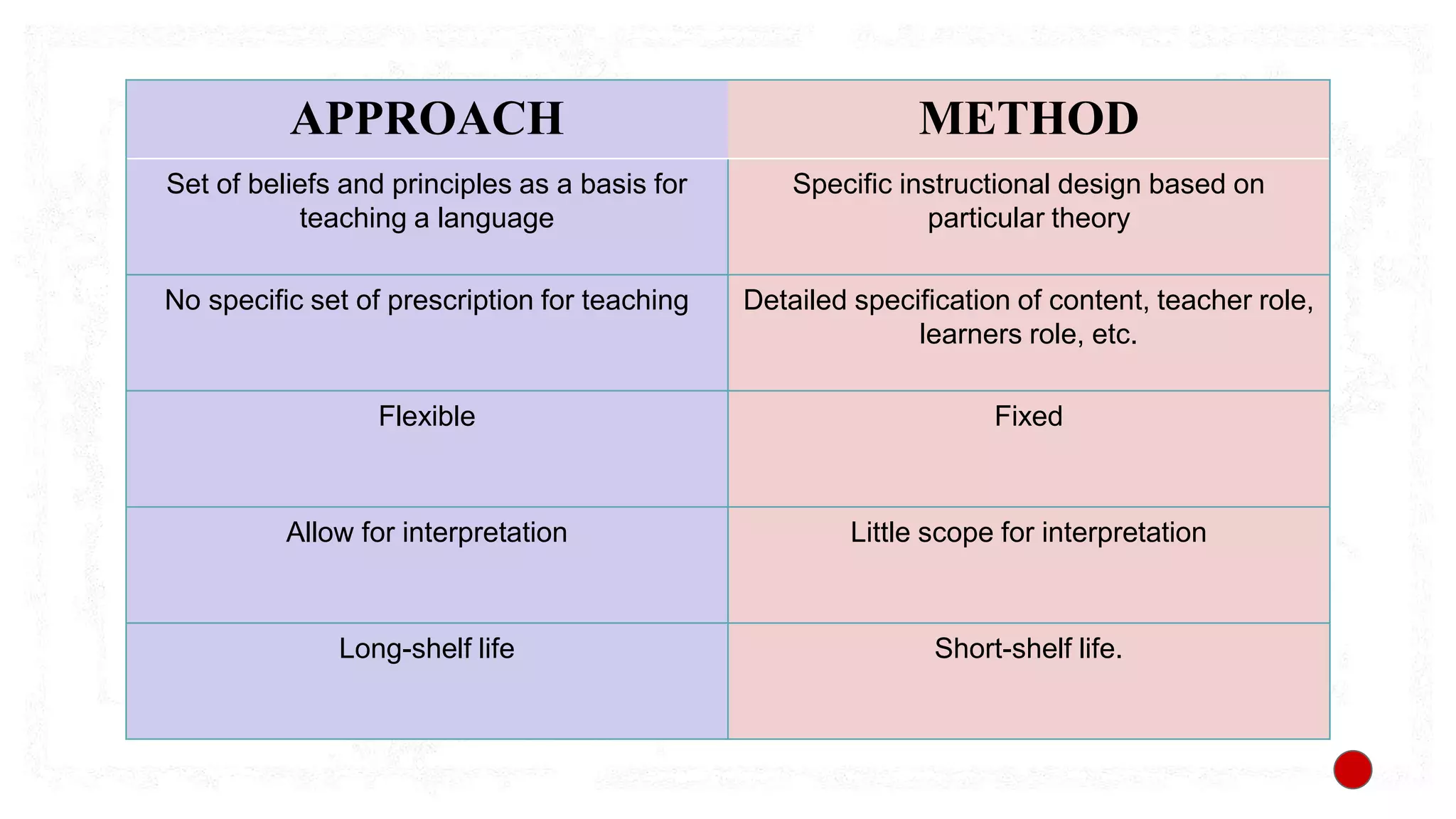
APPROACH METHOD
Set of beliefs and principles as a basis for
teaching a language
Specific instructional design based on
particular theory
No specific set of prescription for teaching Detailed specification of content, teacher role,
learners role, etc.
Flexible Fixed
Allow for interpretation Little scope for interpretation
Long-shelf life Short-shelf life.
4
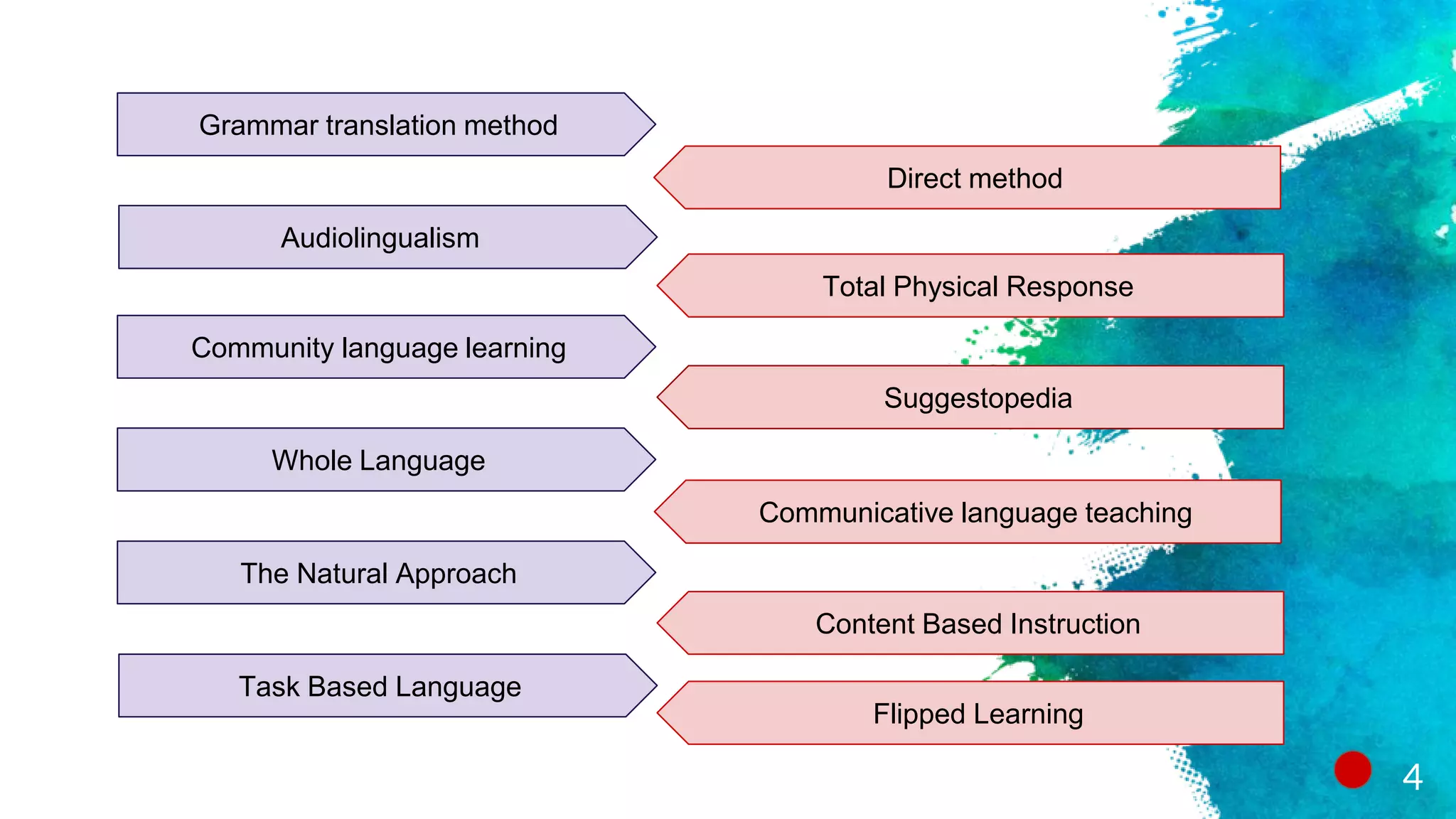
Grammar translation method
Audiolingualism
Total Physical Response
Whole Language
Task Based Language
Community language learning
The Natural Approach
Suggestopedia
Communicative language teaching
Content Based Instruction
Direct method
Flipped Learning
The post method paradigm is an
attempt at finding an alternative to
method rather than an alternative
method.
Kumaravadivelu, 2006
5
BACKGROUND
6
❑ Emerged after the gradual dissatisfaction with conventional Methods.
❑ Kumaravadivelu (2006) termed those ‘designer non-methods’
❑ Prime success of methods lasted up till late 1980s.
❑ Eclecticism was widespread Post-method came to light during
1990s.
❑ Aimed to break the ‘cycle’ of methods
❑ Refigures relationship between theorizers and practitioners.
❑ Signifies teacher autonomy.
The history of language teaching has been characterized by the
search for most effective way of teaching second and foreign
languages.The commonest solution was the adoption of teaching
approach or method.
7
(Richards & Rodgers, 2001).
The “top down” criticism
8
❑ In method, teachers have to accept the theory underlying the method and
apply it in the classroom.
❑ The role of the teacher is marginalized, he must submit to the method.
❑ Learners are passive recipients of the method and must submit themselves
to body of exercises & activities.
❑ In learner-centeredness teaching must be flexible and adoptive to learners
needs & interest.
9
The role of the teacher
❑ teacher’s role is both didactic and facilitative, and serves primarily to
mediate the coursebook materials, by, for example, explaining,
demonstrating and modelling language items, and by setting up and
monitoring student interactions.
× Encouraging the learners to assume the role of
ethnographers to investigate and understand how
language as ideology served vested interests
× Asking them to reflect on their developing identities by
writing diaries… related to the social world
10
× Helping them in the formation of learning
communities where they develop into unified,
socially cohesive, mutually supportive groups
seeking self-awareness and self improvements;
× Providing opportunities for them to explore the
unlimited possibilities offered by online services
and bringing back to the class their own topics
for discussions, and their own perspectives on
those topics.
11
Role of contextual factors
12
In trying to apply approaches or methods, teachers sometimes ignore what is the
starting point in language program design, namely, a careful consideration of
the context in which teaching & learning occurs, including cultural context,
political context and local institutional context.
(Richards & Rodgers, 2001).
The need for curriculum development
processes
a) The careful examination, drawing on all available sources of knowledge
and informed judgement
b) Use of those methods and materials which are judge mostly to achieve
the objectives.
c) To assess if the development work has in fact achieved its objectives.
d) Feedback of all the experience gained
(Nicholls & Nicholls, 1972)
13
The lack of a research basis
14
The belief that a precise focus on a particular form leads to learning and
automatization (that learners will learn what is taught in the order in
which is taught) no longer carries much credibility.
(Skehan, 1996)
Similarity of classroom practices
It is very difficult for teachers to use approaches and methods in ways
that precisely reflect the underlying principles of the method.
Generally, methods are quite distinctive at the early, beginning stages of
language course, and rather indistinguishable from each other at a later
stage.
(as cited in
Richards & Rodgers, 2001).
15
Beyond approaches and methods
Approaches and methods can still be used studied and selectively mastered in order to:
16
LEARN how to use different approaches and methods and understand
when they might be useful.
UNDERSTAND some of the issues and controversies that characterize
the history of language teaching.
PARTICIPATE in language learning experiences based on different
approaches and methods as a basis for reflection and comparison
BE AWARE of the rich set of activity resources available to the
imaginative teacher.
APPRECIATE how theory and practice can be linked from a variety of
different perspectives.
“To facilitate the growth
and development of
teachers’ own theory to
practice”
Kumaravadivelu, 2006
17
MAIN FOCUS:TEACHER AUTONOMY
18
To be sensitive towards
to the parameters of
particularity, practicality
and possibility
Emphasizes on teacher
experience along with
strong theoretical
knowledge.
19
THREE PEDAGOGICAL PARAMETERS
Particularity
Practicality
Possibility
20
Particularity
Particularity denotes factors surrounding the teaching context such as,
people, local knowledge, physical settings, course and institution nature,
time and teaching resources.
(Kumaravadivelu, 2006)
A relationship between the teaching context and the applied methodology.
(Probhu,1990)
21
Practicality
Rupture the reified role relationship between theorizers and practitioners
by enabling and encouraging teachers to theorize from their practice and
practice what they theorize
(Kumaravadivelu, 2006)
22
Possibility
Possibility pertains to macro-social factors such as institutional, social, economic,
cultural, and political environments which shape identity formation and social
transformation.
Bibliography
23
Kumaravadivelu, B. (2006). Understanding language teaching from method to post-method. London: Lawrence
Erlbaum Associates, Publishers
Prabhu, N. S. (1990). There is no best method—why? TESOL Quarterly, 24, 161–176.
http://dx.doi.org/10.2307/353586897 .
Richards, J. C., & Rodgers, T. S. (2001). Approaches and methods in language teaching (Cambridge language
teaching library). Cambridge University, Cambridge.
Richards, J. C., & Rodgers, T. S. (2014). Approaches and methods in language teaching. Cambridge university
press.

The Post-Method era

  • 1.
    THE POST METHODSERA Jhonier Hernán Sarasty
  • 2.
    What is themain difference between a method and an approach? 2
  • 3.
    APPROACH METHOD Set ofbeliefs and principles as a basis for teaching a language Specific instructional design based on particular theory No specific set of prescription for teaching Detailed specification of content, teacher role, learners role, etc. Flexible Fixed Allow for interpretation Little scope for interpretation Long-shelf life Short-shelf life.
  • 4.
    4 Grammar translation method Audiolingualism TotalPhysical Response Whole Language Task Based Language Community language learning The Natural Approach Suggestopedia Communicative language teaching Content Based Instruction Direct method Flipped Learning
  • 5.
    The post methodparadigm is an attempt at finding an alternative to method rather than an alternative method. Kumaravadivelu, 2006 5
  • 6.
    BACKGROUND 6 ❑ Emerged afterthe gradual dissatisfaction with conventional Methods. ❑ Kumaravadivelu (2006) termed those ‘designer non-methods’ ❑ Prime success of methods lasted up till late 1980s. ❑ Eclecticism was widespread Post-method came to light during 1990s. ❑ Aimed to break the ‘cycle’ of methods ❑ Refigures relationship between theorizers and practitioners. ❑ Signifies teacher autonomy.
  • 7.
    The history oflanguage teaching has been characterized by the search for most effective way of teaching second and foreign languages.The commonest solution was the adoption of teaching approach or method. 7 (Richards & Rodgers, 2001).
  • 8.
    The “top down”criticism 8 ❑ In method, teachers have to accept the theory underlying the method and apply it in the classroom. ❑ The role of the teacher is marginalized, he must submit to the method. ❑ Learners are passive recipients of the method and must submit themselves to body of exercises & activities. ❑ In learner-centeredness teaching must be flexible and adoptive to learners needs & interest.
  • 9.
    9 The role ofthe teacher ❑ teacher’s role is both didactic and facilitative, and serves primarily to mediate the coursebook materials, by, for example, explaining, demonstrating and modelling language items, and by setting up and monitoring student interactions.
  • 10.
    × Encouraging thelearners to assume the role of ethnographers to investigate and understand how language as ideology served vested interests × Asking them to reflect on their developing identities by writing diaries… related to the social world 10
  • 11.
    × Helping themin the formation of learning communities where they develop into unified, socially cohesive, mutually supportive groups seeking self-awareness and self improvements; × Providing opportunities for them to explore the unlimited possibilities offered by online services and bringing back to the class their own topics for discussions, and their own perspectives on those topics. 11
  • 12.
    Role of contextualfactors 12 In trying to apply approaches or methods, teachers sometimes ignore what is the starting point in language program design, namely, a careful consideration of the context in which teaching & learning occurs, including cultural context, political context and local institutional context. (Richards & Rodgers, 2001).
  • 13.
    The need forcurriculum development processes a) The careful examination, drawing on all available sources of knowledge and informed judgement b) Use of those methods and materials which are judge mostly to achieve the objectives. c) To assess if the development work has in fact achieved its objectives. d) Feedback of all the experience gained (Nicholls & Nicholls, 1972) 13
  • 14.
    The lack ofa research basis 14 The belief that a precise focus on a particular form leads to learning and automatization (that learners will learn what is taught in the order in which is taught) no longer carries much credibility. (Skehan, 1996)
  • 15.
    Similarity of classroompractices It is very difficult for teachers to use approaches and methods in ways that precisely reflect the underlying principles of the method. Generally, methods are quite distinctive at the early, beginning stages of language course, and rather indistinguishable from each other at a later stage. (as cited in Richards & Rodgers, 2001). 15
  • 16.
    Beyond approaches andmethods Approaches and methods can still be used studied and selectively mastered in order to: 16 LEARN how to use different approaches and methods and understand when they might be useful. UNDERSTAND some of the issues and controversies that characterize the history of language teaching. PARTICIPATE in language learning experiences based on different approaches and methods as a basis for reflection and comparison BE AWARE of the rich set of activity resources available to the imaginative teacher. APPRECIATE how theory and practice can be linked from a variety of different perspectives.
  • 17.
    “To facilitate thegrowth and development of teachers’ own theory to practice” Kumaravadivelu, 2006 17
  • 18.
    MAIN FOCUS:TEACHER AUTONOMY 18 Tobe sensitive towards to the parameters of particularity, practicality and possibility Emphasizes on teacher experience along with strong theoretical knowledge.
  • 19.
  • 20.
    20 Particularity Particularity denotes factorssurrounding the teaching context such as, people, local knowledge, physical settings, course and institution nature, time and teaching resources. (Kumaravadivelu, 2006) A relationship between the teaching context and the applied methodology. (Probhu,1990)
  • 21.
    21 Practicality Rupture the reifiedrole relationship between theorizers and practitioners by enabling and encouraging teachers to theorize from their practice and practice what they theorize (Kumaravadivelu, 2006)
  • 22.
    22 Possibility Possibility pertains tomacro-social factors such as institutional, social, economic, cultural, and political environments which shape identity formation and social transformation.
  • 23.
    Bibliography 23 Kumaravadivelu, B. (2006).Understanding language teaching from method to post-method. London: Lawrence Erlbaum Associates, Publishers Prabhu, N. S. (1990). There is no best method—why? TESOL Quarterly, 24, 161–176. http://dx.doi.org/10.2307/353586897 . Richards, J. C., & Rodgers, T. S. (2001). Approaches and methods in language teaching (Cambridge language teaching library). Cambridge University, Cambridge. Richards, J. C., & Rodgers, T. S. (2014). Approaches and methods in language teaching. Cambridge university press.