












Blood
Transfusion
  Nursing Procedure


                http://nursesinfosite.blogspot.com
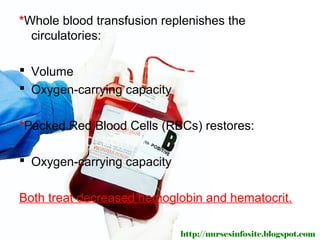
*Whole blood transfusion replenishes the
  circulatories:

 Volume
 Oxygen-carrying capacity


*Packed Red Blood Cells (RBCs) restores:

 Oxygen-carrying capacity


Both treat decreased hemoglobin and hematocrit.

                             http://nursesinfosite.blogspot.com
Two nurses must identify the:

1. Patient
2. Blood products

before administering a transfusion (to
  prevent errors & potentially fatal reaction)


                           http://nursesinfosite.blogspot.com
If a patient is a Jehova’s Witness, a
   transfusion requires special written
   permission.


                           http://nursesinfosite.blogspot.com
Equipments needed
1. Blood recipient
  set (filter &
  tubing with drip
  chamber for
  blood, or
  combined set)


                     http://nursesinfosite.blogspot.com
Equipments needed
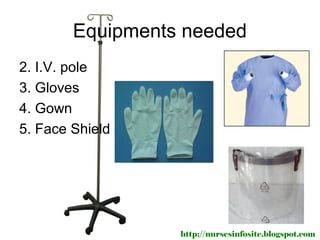
2. I.V. pole
3. Gloves
4. Gown
5. Face Shield


                  http://nursesinfosite.blogspot.com
Equipments needed
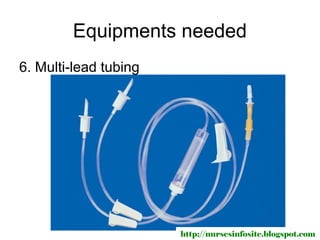
6. Multi-lead tubing


                       http://nursesinfosite.blogspot.com
Equipments needed
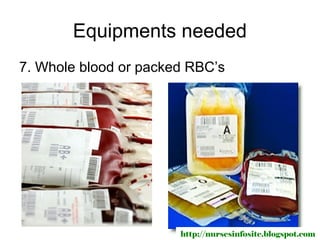
7. Whole blood or packed RBC’s


                       http://nursesinfosite.blogspot.com
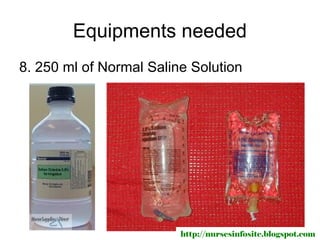
Equipments needed
8. 250 ml of Normal Saline Solution


                         http://nursesinfosite.blogspot.com
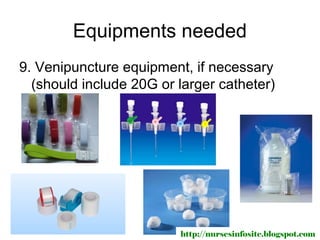
Equipments needed
9. Venipuncture equipment, if necessary
  (should include 20G or larger catheter)


                         http://nursesinfosite.blogspot.com
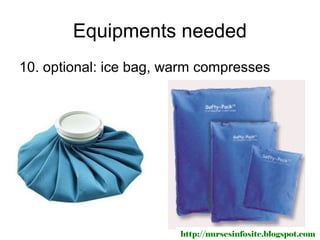
Equipments needed
10. optional: ice bag, warm compresses


                        http://nursesinfosite.blogspot.com
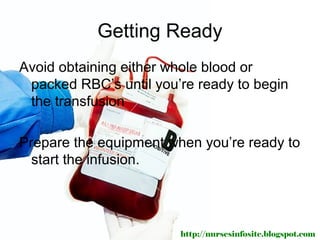
Getting Ready
Avoid obtaining either whole blood or
 packed RBC’s until you’re ready to begin
 the transfusion

Prepare the equipment when you’re ready to
  start the infusion.


                        http://nursesinfosite.blogspot.com
The Procedure
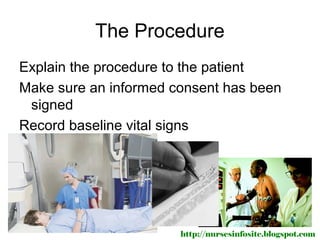
Explain the procedure to the patient
Make sure an informed consent has been
 signed
Record baseline vital signs


                       http://nursesinfosite.blogspot.com
The Procedure
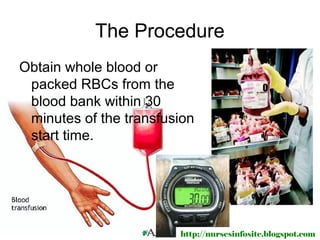
Obtain whole blood or
 packed RBCs from the
 blood bank within 30
 minutes of the transfusion
 start time.


                        http://nursesinfosite.blogspot.com
The Procedure
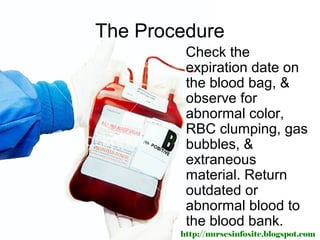
         Check the
         expiration date on
         the blood bag, &
         observe for
         abnormal color,
         RBC clumping, gas
         bubbles, &
         extraneous
         material. Return
         outdated or
         abnormal blood to
         the blood bank.
        http://nursesinfosite.blogspot.com
The Procedure
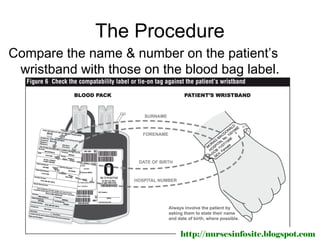
Compare the name & number on the patient’s
 wristband with those on the blood bag label.


                            http://nursesinfosite.blogspot.com
The Procedure
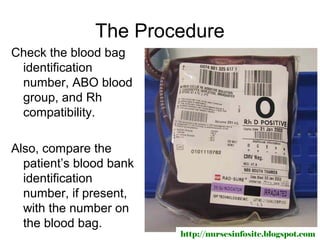
Check the blood bag
 identification
 number, ABO blood
 group, and Rh
 compatibility.

Also, compare the
  patient’s blood bank
  identification
  number, if present,
  with the number on
  the blood bag.
                         http://nursesinfosite.blogspot.com
The Procedure
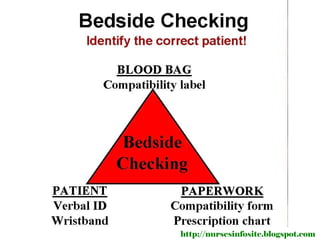
Identification of blood & blood products is
performed at the patient’s bedside by two
licensed profesionals, according to the
facility’s policy.


                        http://nursesinfosite.blogspot.com
http://nursesinfosite.blogspot.com
The Procedure
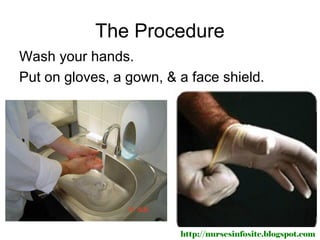
Wash your hands.
Put on gloves, a gown, & a face shield.


                         http://nursesinfosite.blogspot.com
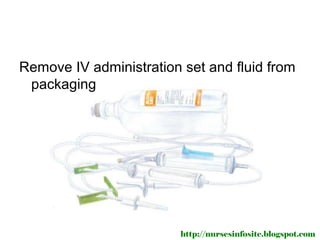
Remove IV administration set and fluid from
 packaging


                         http://nursesinfosite.blogspot.com
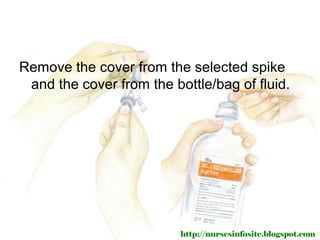
Remove the cover from the selected spike
 and the cover from the bottle/bag of fluid.


                          http://nursesinfosite.blogspot.com
The Procedure
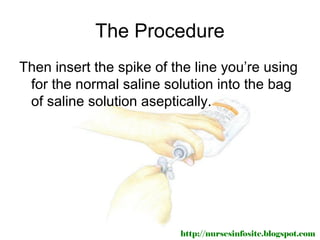
Then insert the spike of the line you’re using
 for the normal saline solution into the bag
 of saline solution aseptically.


                          http://nursesinfosite.blogspot.com
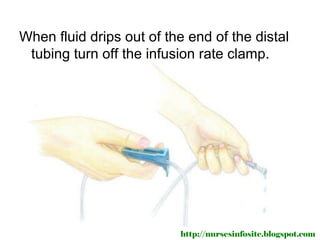
When fluid drips out of the end of the distal
 tubing turn off the infusion rate clamp.


                          http://nursesinfosite.blogspot.com
The Procedure
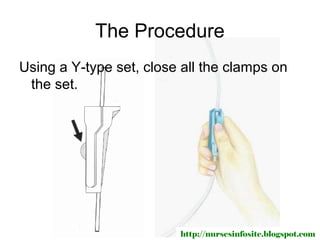
Using a Y-type set, close all the clamps on
 the set.


                         http://nursesinfosite.blogspot.com
The Procedure
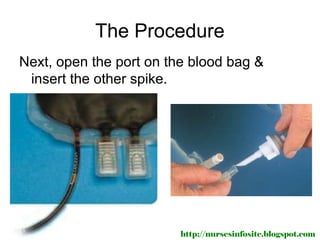
Next, open the port on the blood bag &
 insert the other spike.


                         http://nursesinfosite.blogspot.com
The Procedure
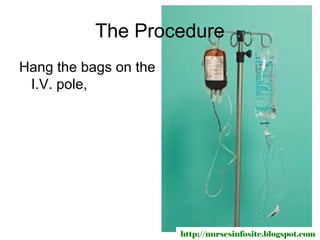
Hang the bags on the
 I.V. pole,


                       http://nursesinfosite.blogspot.com
The Procedure
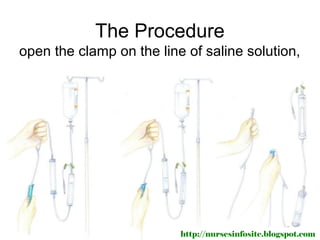
open the clamp on the line of saline solution,


                          http://nursesinfosite.blogspot.com
The Procedure
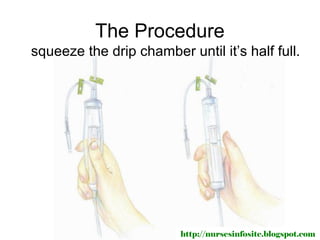
squeeze the drip chamber until it’s half full.


                         http://nursesinfosite.blogspot.com
The Procedure
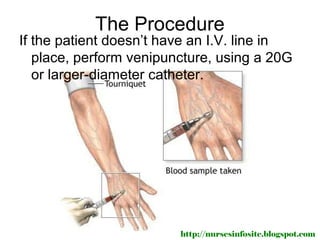
If the patient doesn’t have an I.V. line in
   place, perform venipuncture, using a 20G
   or larger-diameter catheter.


                         http://nursesinfosite.blogspot.com
The Procedure
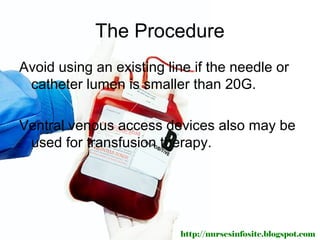
Avoid using an existing line if the needle or
 catheter lumen is smaller than 20G.

Ventral venous access devices also may be
 used for transfusion therapy.


                          http://nursesinfosite.blogspot.com
The Procedure
If you’re administering whole blood, gently
   invert the bag several times to mix the
   cells.


                          http://nursesinfosite.blogspot.com
The Procedure
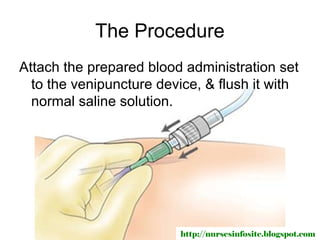
Attach the prepared blood administration set
  to the venipuncture device, & flush it with
  normal saline solution.


                         http://nursesinfosite.blogspot.com
The Procedure
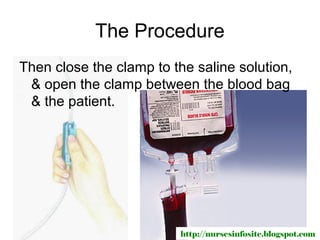
Then close the clamp to the saline solution,
 & open the clamp between the blood bag
 & the patient.


                          http://nursesinfosite.blogspot.com
The Procedure
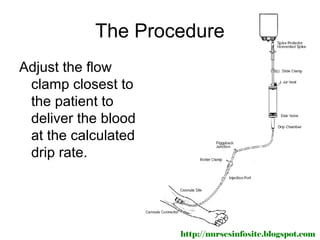
Adjust the flow
 clamp closest to
 the patient to
 deliver the blood
 at the calculated
 drip rate.


                     http://nursesinfosite.blogspot.com
The Procedure
Remain with the patient, & watch for the
 signs of a tranfusion reaction, such as
 fever, chills, & wheezing.


                         http://nursesinfosite.blogspot.com
The Procedure
If such sign develop, record vital signs and
   stop the transfusion.


                          http://nursesinfosite.blogspot.com
The Procedure
Infuse saline solution at a moderately slow
  infusion rate, & notify the doctor at once.


                           http://nursesinfosite.blogspot.com
The Procedure
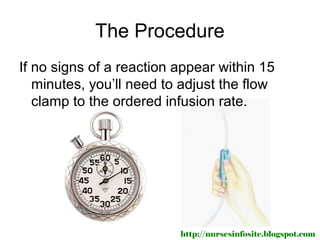
If no signs of a reaction appear within 15
   minutes, you’ll need to adjust the flow
   clamp to the ordered infusion rate.


                          http://nursesinfosite.blogspot.com
The Procedure
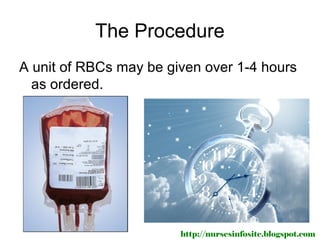
A unit of RBCs may be given over 1-4 hours
  as ordered.


                        http://nursesinfosite.blogspot.com
The Procedure
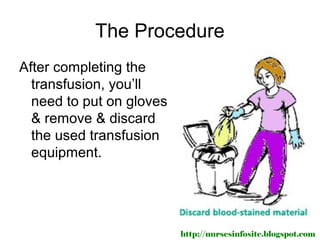
After completing the
  transfusion, you’ll
  need to put on gloves
  & remove & discard
  the used transfusion
  equipment.


                          http://nursesinfosite.blogspot.com
The Procedure
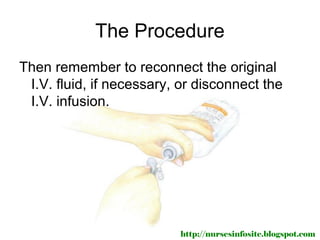
Then remember to reconnect the original
 I.V. fluid, if necessary, or disconnect the
 I.V. infusion.


                          http://nursesinfosite.blogspot.com
The Procedure
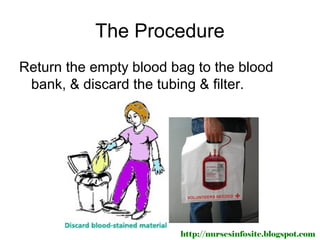
Return the empty blood bag to the blood
 bank, & discard the tubing & filter.


                        http://nursesinfosite.blogspot.com
The Procedure
Record the patient’s vital signs.


                           http://nursesinfosite.blogspot.com
Practice Pointers
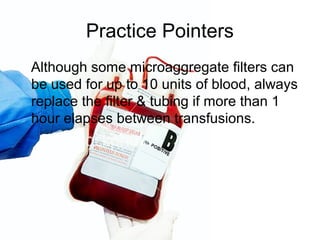
Although some microaggregate filters can
be used for up to 10 units of blood, always
replace the filter & tubing if more than 1
hour elapses between transfusions.
Practice Pointers
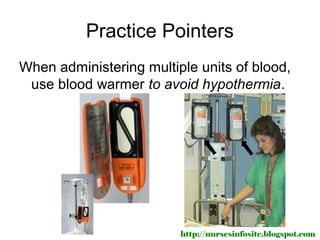
When administering multiple units of blood,
 use blood warmer to avoid hypothermia.


                         http://nursesinfosite.blogspot.com
Practice Pointers
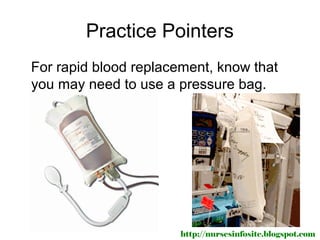
For rapid blood replacement, know that
you may need to use a pressure bag.


                       http://nursesinfosite.blogspot.com
Practice Pointers
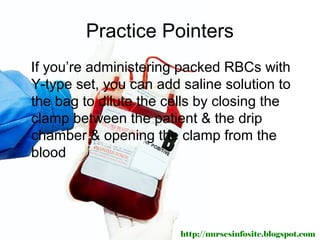
If you’re administering packed RBCs with
Y-type set, you can add saline solution to
the bag to dilute the cells by closing the
clamp between the patient & the drip
chamber & opening the clamp from the
blood


                        http://nursesinfosite.blogspot.com
Practice Pointers
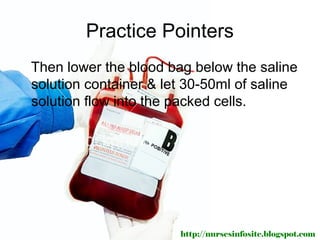
Then lower the blood bag below the saline
solution container & let 30-50ml of saline
solution flow into the packed cells.


                       http://nursesinfosite.blogspot.com
Practice Pointers
Finally, close the clamp to the blood bag,
rehang the bag, rotate it gently to mix the
cells & saline container


                        http://nursesinfosite.blogspot.com
Documenting Blood Transfusion
In your notes, record:
Date & time of the transfusion.
Type & amount of transfusion product.
Patient’s vital signs.
Your check of all identification data.
Transfusion reaction & nursing actions
  taken.


                        http://nursesinfosite.blogspot.com
“Nurses Information”
http://nursesinfosite.blogspot.com

Blood Transfusion (a nursing procedure) by www.nursesinfosite.blogspot.com

  • 1.
    Blood Transfusion NursingProcedure http://nursesinfosite.blogspot.com
  • 2.
    *Whole blood transfusionreplenishes the circulatories:  Volume  Oxygen-carrying capacity *Packed Red Blood Cells (RBCs) restores:  Oxygen-carrying capacity Both treat decreased hemoglobin and hematocrit. http://nursesinfosite.blogspot.com
  • 3.
    Two nurses mustidentify the: 1. Patient 2. Blood products before administering a transfusion (to prevent errors & potentially fatal reaction) http://nursesinfosite.blogspot.com
  • 4.
    If a patientis a Jehova’s Witness, a transfusion requires special written permission. http://nursesinfosite.blogspot.com
  • 5.
    Equipments needed 1. Bloodrecipient set (filter & tubing with drip chamber for blood, or combined set) http://nursesinfosite.blogspot.com
  • 6.
    Equipments needed 2. I.V.pole 3. Gloves 4. Gown 5. Face Shield http://nursesinfosite.blogspot.com
  • 7.
    Equipments needed 6. Multi-leadtubing http://nursesinfosite.blogspot.com
  • 8.
    Equipments needed 7. Wholeblood or packed RBC’s http://nursesinfosite.blogspot.com
  • 9.
    Equipments needed 8. 250ml of Normal Saline Solution http://nursesinfosite.blogspot.com
  • 10.
    Equipments needed 9. Venipunctureequipment, if necessary (should include 20G or larger catheter) http://nursesinfosite.blogspot.com
  • 11.
    Equipments needed 10. optional:ice bag, warm compresses http://nursesinfosite.blogspot.com
  • 12.
    Getting Ready Avoid obtainingeither whole blood or packed RBC’s until you’re ready to begin the transfusion Prepare the equipment when you’re ready to start the infusion. http://nursesinfosite.blogspot.com
  • 13.
    The Procedure Explain theprocedure to the patient Make sure an informed consent has been signed Record baseline vital signs http://nursesinfosite.blogspot.com
  • 14.
    The Procedure Obtain wholeblood or packed RBCs from the blood bank within 30 minutes of the transfusion start time. http://nursesinfosite.blogspot.com
  • 15.
    The Procedure Check the expiration date on the blood bag, & observe for abnormal color, RBC clumping, gas bubbles, & extraneous material. Return outdated or abnormal blood to the blood bank. http://nursesinfosite.blogspot.com
  • 16.
    The Procedure Compare thename & number on the patient’s wristband with those on the blood bag label. http://nursesinfosite.blogspot.com
  • 17.
    The Procedure Check theblood bag identification number, ABO blood group, and Rh compatibility. Also, compare the patient’s blood bank identification number, if present, with the number on the blood bag. http://nursesinfosite.blogspot.com
  • 18.
    The Procedure Identification ofblood & blood products is performed at the patient’s bedside by two licensed profesionals, according to the facility’s policy. http://nursesinfosite.blogspot.com
  • 19.
  • 20.
    The Procedure Wash yourhands. Put on gloves, a gown, & a face shield. http://nursesinfosite.blogspot.com
  • 21.
    Remove IV administrationset and fluid from packaging http://nursesinfosite.blogspot.com
  • 22.
    Remove the coverfrom the selected spike and the cover from the bottle/bag of fluid. http://nursesinfosite.blogspot.com
  • 23.
    The Procedure Then insertthe spike of the line you’re using for the normal saline solution into the bag of saline solution aseptically. http://nursesinfosite.blogspot.com
  • 24.
    When fluid dripsout of the end of the distal tubing turn off the infusion rate clamp. http://nursesinfosite.blogspot.com
  • 25.
    The Procedure Using aY-type set, close all the clamps on the set. http://nursesinfosite.blogspot.com
  • 26.
    The Procedure Next, openthe port on the blood bag & insert the other spike. http://nursesinfosite.blogspot.com
  • 27.
    The Procedure Hang thebags on the I.V. pole, http://nursesinfosite.blogspot.com
  • 28.
    The Procedure open theclamp on the line of saline solution, http://nursesinfosite.blogspot.com
  • 29.
    The Procedure squeeze thedrip chamber until it’s half full. http://nursesinfosite.blogspot.com
  • 30.
    The Procedure If thepatient doesn’t have an I.V. line in place, perform venipuncture, using a 20G or larger-diameter catheter. http://nursesinfosite.blogspot.com
  • 31.
    The Procedure Avoid usingan existing line if the needle or catheter lumen is smaller than 20G. Ventral venous access devices also may be used for transfusion therapy. http://nursesinfosite.blogspot.com
  • 32.
    The Procedure If you’readministering whole blood, gently invert the bag several times to mix the cells. http://nursesinfosite.blogspot.com
  • 33.
    The Procedure Attach theprepared blood administration set to the venipuncture device, & flush it with normal saline solution. http://nursesinfosite.blogspot.com
  • 34.
    The Procedure Then closethe clamp to the saline solution, & open the clamp between the blood bag & the patient. http://nursesinfosite.blogspot.com
  • 35.
    The Procedure Adjust theflow clamp closest to the patient to deliver the blood at the calculated drip rate. http://nursesinfosite.blogspot.com
  • 36.
    The Procedure Remain withthe patient, & watch for the signs of a tranfusion reaction, such as fever, chills, & wheezing. http://nursesinfosite.blogspot.com
  • 37.
    The Procedure If suchsign develop, record vital signs and stop the transfusion. http://nursesinfosite.blogspot.com
  • 38.
    The Procedure Infuse salinesolution at a moderately slow infusion rate, & notify the doctor at once. http://nursesinfosite.blogspot.com
  • 39.
    The Procedure If nosigns of a reaction appear within 15 minutes, you’ll need to adjust the flow clamp to the ordered infusion rate. http://nursesinfosite.blogspot.com
  • 40.
    The Procedure A unitof RBCs may be given over 1-4 hours as ordered. http://nursesinfosite.blogspot.com
  • 41.
    The Procedure After completingthe transfusion, you’ll need to put on gloves & remove & discard the used transfusion equipment. http://nursesinfosite.blogspot.com
  • 42.
    The Procedure Then rememberto reconnect the original I.V. fluid, if necessary, or disconnect the I.V. infusion. http://nursesinfosite.blogspot.com
  • 43.
    The Procedure Return theempty blood bag to the blood bank, & discard the tubing & filter. http://nursesinfosite.blogspot.com
  • 44.
    The Procedure Record thepatient’s vital signs. http://nursesinfosite.blogspot.com
  • 45.
    Practice Pointers Although somemicroaggregate filters can be used for up to 10 units of blood, always replace the filter & tubing if more than 1 hour elapses between transfusions.
  • 46.
    Practice Pointers When administeringmultiple units of blood, use blood warmer to avoid hypothermia. http://nursesinfosite.blogspot.com
  • 47.
    Practice Pointers For rapidblood replacement, know that you may need to use a pressure bag. http://nursesinfosite.blogspot.com
  • 48.
    Practice Pointers If you’readministering packed RBCs with Y-type set, you can add saline solution to the bag to dilute the cells by closing the clamp between the patient & the drip chamber & opening the clamp from the blood http://nursesinfosite.blogspot.com
  • 49.
    Practice Pointers Then lowerthe blood bag below the saline solution container & let 30-50ml of saline solution flow into the packed cells. http://nursesinfosite.blogspot.com
  • 50.
    Practice Pointers Finally, closethe clamp to the blood bag, rehang the bag, rotate it gently to mix the cells & saline container http://nursesinfosite.blogspot.com
  • 51.
    Documenting Blood Transfusion Inyour notes, record: Date & time of the transfusion. Type & amount of transfusion product. Patient’s vital signs. Your check of all identification data. Transfusion reaction & nursing actions taken. http://nursesinfosite.blogspot.com
  • 52.