 Blood transfusions can be life-saving in some
situations, such as massive blood loss due to
trauma, or can be used to replace blood lost during
surgery.
 Blood transfusion is the process of transferring
blood or blood-based products from one person
into the circulatory system of another.
 Components of the blood early transfusions used
whole blood, but modern medical practice
commonly uses only components of the blood.
Assisting in transfusion of blood or blood
products into vein using aseptic technique.
Blood transfusion consists of administration
of compatible donor’s whole blood or any of
its components to correct/treat any
clinical condition.
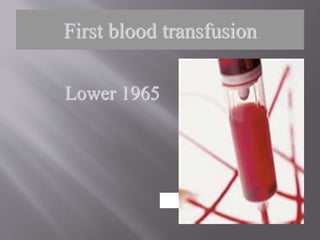
Lower 1965
First blood transfusion
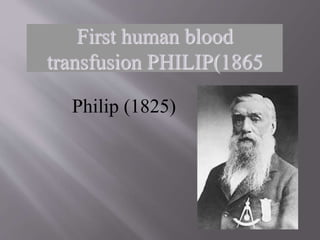
Philip (1825)
First human blood
transfusion PHILIP(1865
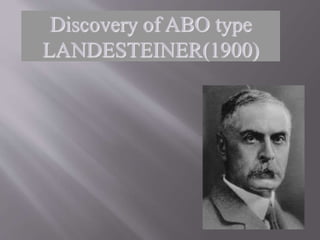
Discovery of ABO type
LANDESTEINER(1900)
 Restore and maintain blood volume
 Improve oxygen carrying capacity of
blood
 Replace deficient blood components and
improve coagulation
Not be be given
“just to make the patient feel better”
 To raise the hemoglobin level in cases of severe
anemia which are not corrected by the
administration of vitamins and iron therapy.
 To treat deficiencies of plasma proteins, clotting
factors and hemophilic globulin etc.
 To provide antibodies to those persons who are
sick and having lowered immunity by giving
blood or plasma.
 To replace the blood with hemolytic agents with
fresh blood as in case of erythroblastosis foetalis,
hemolytic anemia.
 To improve the leucocytes count of blood as in
agranulocytosis.
 To combat infection in patients with leucopenia
Type of Transfusion:
 Whole Blood
 Blood Component
RBC,PLT,CLT
 Plasma Substitutes
Blood Transfusion
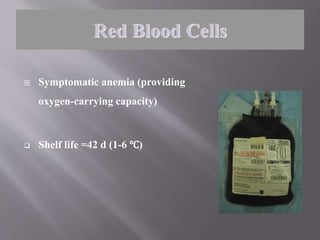
 Symptomatic anemia (providing
oxygen-carrying capacity)
 Shelf life =42 d (1-6 ℃)
Red Blood Cells
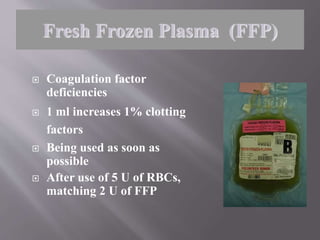
 Coagulation factor
deficiencies
 1 ml increases 1% clotting
factors
 Being used as soon as
possible
 After use of 5 U of RBCs,
matching 2 U of FFP
Fresh Frozen Plasma (FFP)
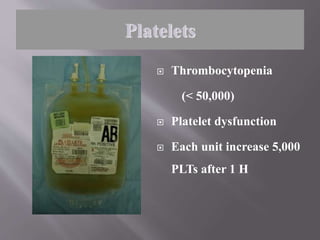
 Thrombocytopenia
(< 50,000)
 Platelet dysfunction
 Each unit increase 5,000
PLTs after 1 H
Platelets
Indication:
 Acute massive blood loss
 Anaemia
 Overwhelming Infection
 Dysfunction of Coagulation
 Any illness
Blood Transfusion
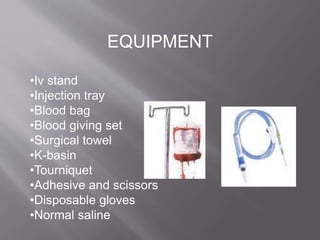
EQUIPMENT
•Iv stand
•Injection tray
•Blood bag
•Blood giving set
•Surgical towel
•K-basin
•Tourniquet
•Adhesive and scissors
•Disposable gloves
•Normal saline
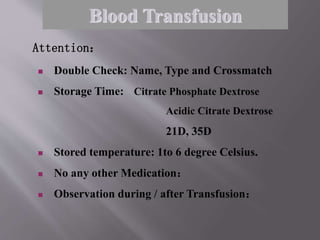
 Double Check: Name, Type and Crossmatch
 Storage Time: Citrate Phosphate Dextrose
Acidic Citrate Dextrose
21D, 35D
 Stored temperature: 1to 6 degree Celsius.
 No any other Medication:
 Observation during / after Transfusion:
Attention:
Blood Transfusion
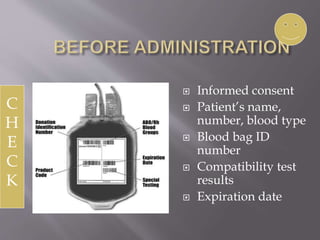
 Informed consent
 Patient’s name,
number, blood type
 Blood bag ID
number
 Compatibility test
results
 Expiration date
C
H
E
C
K
 Ask another person to check all
information
 According to hospital policy
 Sign confirmation slip / transfusion
record
V
E
R
I
F
Y Return unit to blood bank if any
discrepancy exists
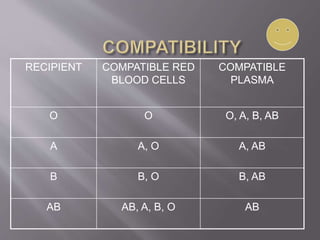
RECIPIENT COMPATIBLE RED
BLOOD CELLS
COMPATIBLE
PLASMA
O O O, A, B, AB
A A, O A, AB
B B, O B, AB
AB AB, A, B, O AB
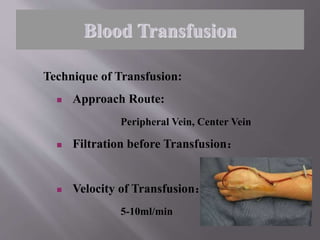
Technique of Transfusion:
 Approach Route:
Peripheral Vein, Center Vein
 Filtration before Transfusion:
 Velocity of Transfusion:
5-10ml/min
Blood Transfusion
 Red blood cells : Initial rate no more than
25 ml in first 15 mts.
 Usual transfusion time is 2hrs & maximum
time is 4hrs.
 Platelets 10 ml/min
 Plasma 10 ml/min
 Cryoprecipitate 10ml/min
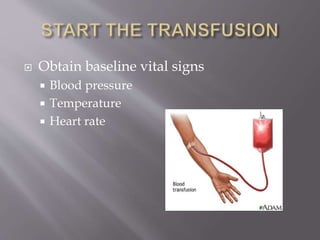
 Obtain baseline vital signs
 Blood pressure
 Temperature
 Heart rate
 Prime filter
 Set flow rate to 5-10 ml/minute for first 15
minutes .
 Monitor vital signs for the first 15 mts/hour
 If no adverse effects are noted adjust flow to
faster rate
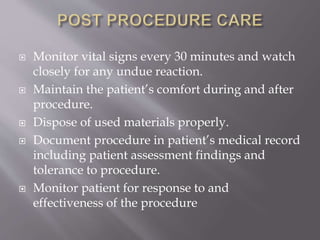
 Monitor vital signs every 30 minutes and watch
closely for any undue reaction.
 Maintain the patient’s comfort during and after
procedure.
 Dispose of used materials properly.
 Document procedure in patient’s medical record
including patient assessment findings and
tolerance to procedure.
 Monitor patient for response to and
effectiveness of the procedure
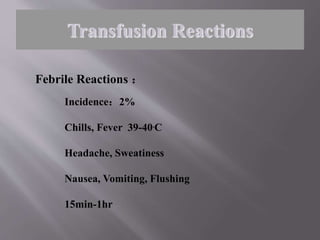
Incidence:2%
Chills, Fever 39-40.C
Headache, Sweatiness
Nausea, Vomiting, Flushing
15min-1hr
Febrile Reactions :
Transfusion Reactions
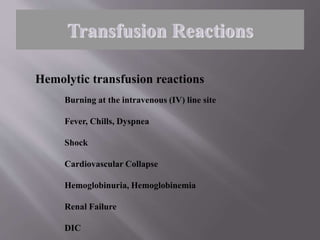
Burning at the intravenous (IV) line site
Fever, Chills, Dyspnea
Shock
Cardiovascular Collapse
Hemoglobinuria, Hemoglobinemia
Renal Failure
DIC
Hemolytic transfusion reactions
Transfusion Reactions
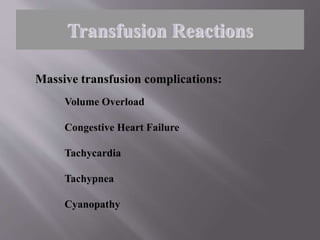
Massive transfusion complications:
Volume Overload
Congestive Heart Failure
Tachycardia
Tachypnea
Cyanopathy
Transfusion Reactions
 Due to improper
 Component
 Dosage
 Seen with
 Whole blood, plasma
 S & S
 Headache, dyspnea, heaviness in
limbs
 Due to improper
 Storage
 Processing
 Seen with
 Platelets
 S & S
 Fever, chest pain, headache
 Fever
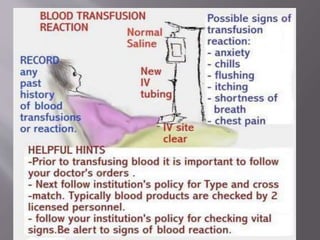
 Chills
 Headache
 Nausea
 Dyspnea
 Facial flushing
 Anxiety
 Hypotension
 Itchiness
 Chest pain
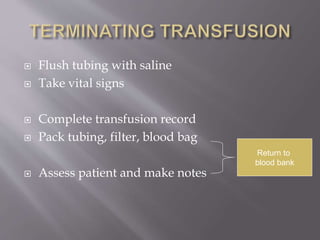
 Flush tubing with saline
 Take vital signs
 Complete transfusion record
 Pack tubing, filter, blood bag
 Assess patient and make notes
Return to
blood bank
 Rate of flow should be slow for the first 10 minutes.
If there are no signs of reaction, transfusion rate
may be increased to required rate.
 Rate of flow must be slower for elderly patients
and those who have heart disease
 If there are signs of complications, stop transfusion
immediately. keep IV line open by connecting
normal saline and notify doctor.
 Change transfusion set if another unit of
blood/blood components is to be given
 Do not add medications to blood/blood
components.
 Do not store blood/blood component in ward.
 Keep emergency drugs(e.g.
Antihistamines,lasix,hydrocortisone,adrenaline.t.c)
ready at hand
 Administration of blood and blood
components requires knowledge of correct
administration techniques and possible
complications. It is very important to be
familiar with the agency’s policies and
procedures for transfusion therapy.
Blood transfusion

Blood transfusion

  • 2.
     Blood transfusionscan be life-saving in some situations, such as massive blood loss due to trauma, or can be used to replace blood lost during surgery.  Blood transfusion is the process of transferring blood or blood-based products from one person into the circulatory system of another.  Components of the blood early transfusions used whole blood, but modern medical practice commonly uses only components of the blood.
  • 3.
    Assisting in transfusionof blood or blood products into vein using aseptic technique. Blood transfusion consists of administration of compatible donor’s whole blood or any of its components to correct/treat any clinical condition.
  • 4.
  • 5.
    Philip (1825) First humanblood transfusion PHILIP(1865
  • 6.
    Discovery of ABOtype LANDESTEINER(1900)
  • 7.
     Restore andmaintain blood volume  Improve oxygen carrying capacity of blood  Replace deficient blood components and improve coagulation Not be be given “just to make the patient feel better”
  • 8.
     To raisethe hemoglobin level in cases of severe anemia which are not corrected by the administration of vitamins and iron therapy.  To treat deficiencies of plasma proteins, clotting factors and hemophilic globulin etc.  To provide antibodies to those persons who are sick and having lowered immunity by giving blood or plasma.  To replace the blood with hemolytic agents with fresh blood as in case of erythroblastosis foetalis, hemolytic anemia.  To improve the leucocytes count of blood as in agranulocytosis.  To combat infection in patients with leucopenia
  • 9.
    Type of Transfusion: Whole Blood  Blood Component RBC,PLT,CLT  Plasma Substitutes Blood Transfusion
  • 10.
     Symptomatic anemia(providing oxygen-carrying capacity)  Shelf life =42 d (1-6 ℃) Red Blood Cells
  • 11.
     Coagulation factor deficiencies 1 ml increases 1% clotting factors  Being used as soon as possible  After use of 5 U of RBCs, matching 2 U of FFP Fresh Frozen Plasma (FFP)
  • 12.
     Thrombocytopenia (< 50,000) Platelet dysfunction  Each unit increase 5,000 PLTs after 1 H Platelets
  • 13.
    Indication:  Acute massiveblood loss  Anaemia  Overwhelming Infection  Dysfunction of Coagulation  Any illness Blood Transfusion
  • 14.
    EQUIPMENT •Iv stand •Injection tray •Bloodbag •Blood giving set •Surgical towel •K-basin •Tourniquet •Adhesive and scissors •Disposable gloves •Normal saline
  • 15.
     Double Check:Name, Type and Crossmatch  Storage Time: Citrate Phosphate Dextrose Acidic Citrate Dextrose 21D, 35D  Stored temperature: 1to 6 degree Celsius.  No any other Medication:  Observation during / after Transfusion: Attention: Blood Transfusion
  • 16.
     Informed consent Patient’s name, number, blood type  Blood bag ID number  Compatibility test results  Expiration date C H E C K
  • 17.
     Ask anotherperson to check all information  According to hospital policy  Sign confirmation slip / transfusion record V E R I F Y Return unit to blood bank if any discrepancy exists
  • 18.
    RECIPIENT COMPATIBLE RED BLOODCELLS COMPATIBLE PLASMA O O O, A, B, AB A A, O A, AB B B, O B, AB AB AB, A, B, O AB
  • 19.
    Technique of Transfusion: Approach Route: Peripheral Vein, Center Vein  Filtration before Transfusion:  Velocity of Transfusion: 5-10ml/min Blood Transfusion
  • 20.
     Red bloodcells : Initial rate no more than 25 ml in first 15 mts.  Usual transfusion time is 2hrs & maximum time is 4hrs.  Platelets 10 ml/min  Plasma 10 ml/min  Cryoprecipitate 10ml/min
  • 21.
     Obtain baselinevital signs  Blood pressure  Temperature  Heart rate
  • 22.
     Prime filter Set flow rate to 5-10 ml/minute for first 15 minutes .  Monitor vital signs for the first 15 mts/hour  If no adverse effects are noted adjust flow to faster rate
  • 24.
     Monitor vitalsigns every 30 minutes and watch closely for any undue reaction.  Maintain the patient’s comfort during and after procedure.  Dispose of used materials properly.  Document procedure in patient’s medical record including patient assessment findings and tolerance to procedure.  Monitor patient for response to and effectiveness of the procedure
  • 25.
    Incidence:2% Chills, Fever 39-40.C Headache,Sweatiness Nausea, Vomiting, Flushing 15min-1hr Febrile Reactions : Transfusion Reactions
  • 26.
    Burning at theintravenous (IV) line site Fever, Chills, Dyspnea Shock Cardiovascular Collapse Hemoglobinuria, Hemoglobinemia Renal Failure DIC Hemolytic transfusion reactions Transfusion Reactions
  • 27.
    Massive transfusion complications: VolumeOverload Congestive Heart Failure Tachycardia Tachypnea Cyanopathy Transfusion Reactions
  • 28.
     Due toimproper  Component  Dosage  Seen with  Whole blood, plasma  S & S  Headache, dyspnea, heaviness in limbs
  • 29.
     Due toimproper  Storage  Processing  Seen with  Platelets  S & S  Fever, chest pain, headache
  • 30.
     Fever  Chills Headache  Nausea  Dyspnea  Facial flushing  Anxiety  Hypotension  Itchiness  Chest pain
  • 32.
     Flush tubingwith saline  Take vital signs  Complete transfusion record  Pack tubing, filter, blood bag  Assess patient and make notes Return to blood bank
  • 33.
     Rate offlow should be slow for the first 10 minutes. If there are no signs of reaction, transfusion rate may be increased to required rate.  Rate of flow must be slower for elderly patients and those who have heart disease  If there are signs of complications, stop transfusion immediately. keep IV line open by connecting normal saline and notify doctor.  Change transfusion set if another unit of blood/blood components is to be given  Do not add medications to blood/blood components.  Do not store blood/blood component in ward.  Keep emergency drugs(e.g. Antihistamines,lasix,hydrocortisone,adrenaline.t.c) ready at hand
  • 34.
     Administration ofblood and blood components requires knowledge of correct administration techniques and possible complications. It is very important to be familiar with the agency’s policies and procedures for transfusion therapy.