CONTENTS
Introduction
Purposes
Indications
Contraindications
Types of blood content
Preparation for blood transfusion
Nursing management
Risk and complications
INTRODUCTION
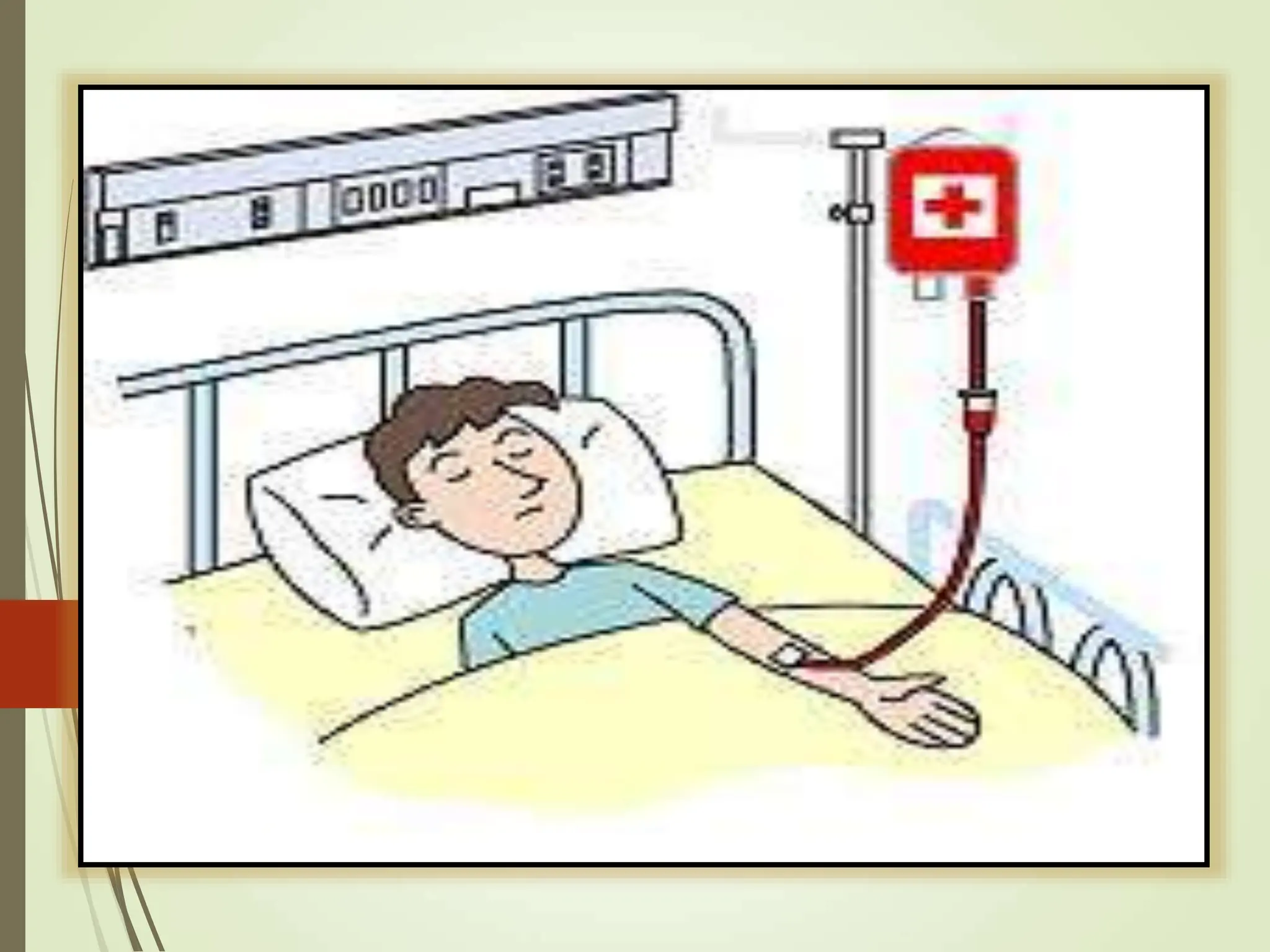
 Blood transfusion is the process of transferring blood products
into a person's circulation intravenously.
 Blood transfusion should be undertaken when:
• Hemoglobin (Hb) < 7-8 gm/dl (American Association of blood
bank)
• Hb < 10 gram/dl and Hematocrit below 30 % for ongoing bleeding
during surgery or trauma (American Association of blood bank)
• Hb < 6 gm/ dl almost always indication (WHO)
PURPOSES
 To replace the blood volume
 To replace the needed component
 To meet the target level of blood and blood
components
INDICATIONS
 Low production of blood
 Major road traffic accident
 Chronic blood loss with anemia
 Conditions such as : bleeding disorders,
malignancies, coagulopathies, major surgeries,
severe burn
CONTRAINDICATIONS
 Whole blood is not indicated when
component specific therapy are needed &
chronic anemia
 For megaloblastic anemia (Vitamin B12
deficiency) transfusion may cause heart
failure or death
TYPES OF BLOOD CONTENT
Whole blood
 Obtained from donors & none of elements has been
removed or combined with anticoagulant
 Indication: Cases of severe hemorrhage and low
hemoglobin , to restore blood volume and when there is
no time for other preparation
 Duration/shelf-life : 35-42 days
 Storage and transportation temperature : +2° C to + 6° C
 Transfusion temperature : (37°c/98.6ºF)
 Transfusion duration : 2 to 4 hours
TYPES OF BLOOD CONTENT
Packed red cells (packed red blood
concentration / PRBC) / RCC
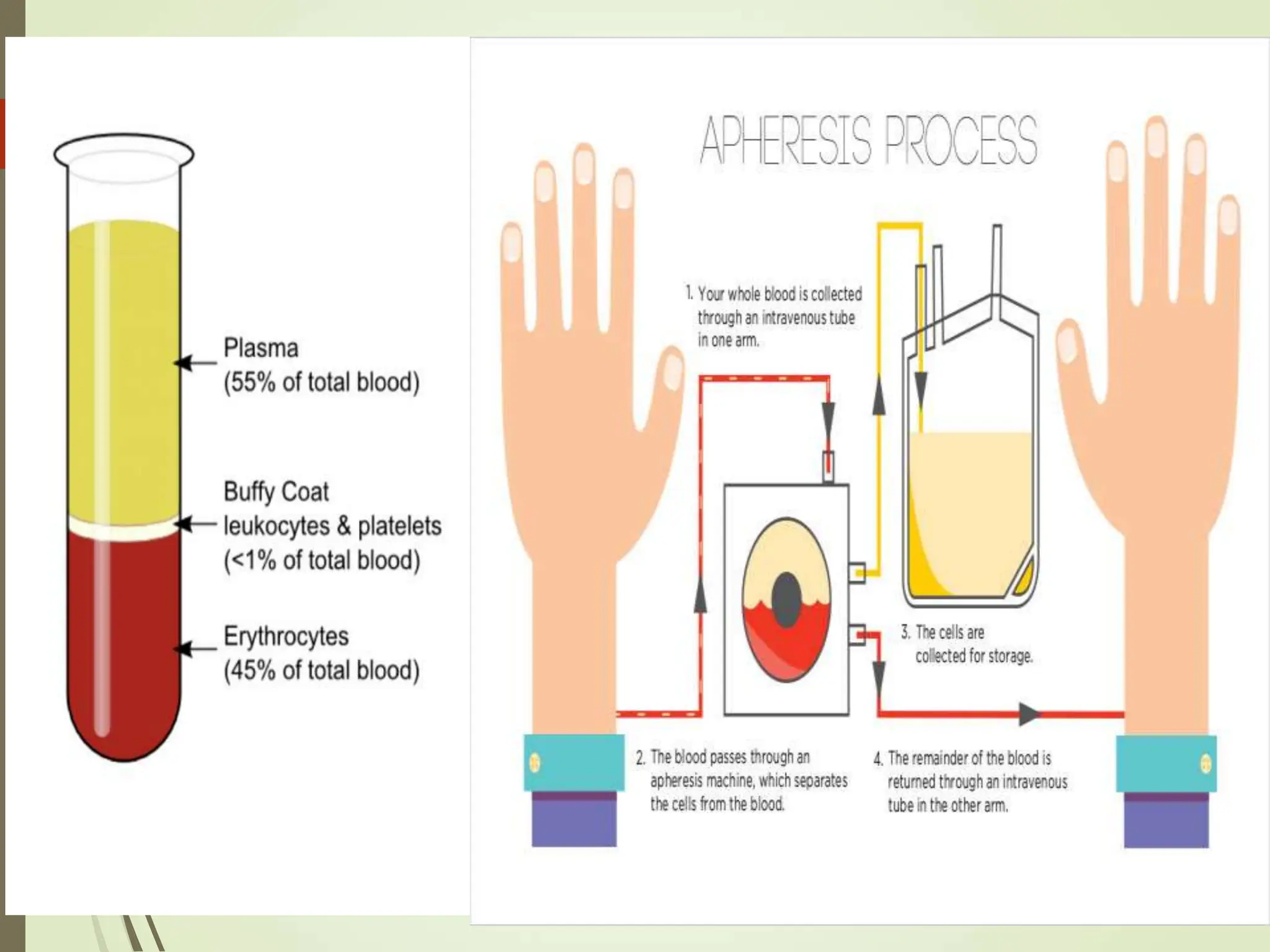
 Erythrocytes are separated from whole blood through
apheresis process
 Indication: post op acute bleeding, chronic severe
anemia, leukemia, thalassemia, congenital/acquired
anemic disorders
 Duration/shelf-life : 35-42 days
 Storage and transportation temperature : +2° C to + 6° C
 Transfusion temperature : (37°c/98.6ºF)
 Transfusion duration : 2 to 4 hours
TYPES OF BLOOD CONTENT
Platelet concentrates
 Platelets, or thrombocytes, are small, colorless cell
fragments in our blood whose main function is to stop or
prevent bleeding
 Indication: Bleeding due to platelets dysfunction,
Malignancy
 Duration/self-life : 4-7 days
 Storage and transportation temperature : +20° C to + 24° C
 Transfusion temperature : (37°c/98.6ºF)
 Transfusion duration : 1-2 hours
TYPES OF BLOOD CONTENT
Fresh Frozen Plasma (FFP)
 Separated from unit of blood which contains water,
electrolytes, coagulation factors, and protein
 Indication: To treat bleeding disorder, for factor v
deficiency, antithrombin III deficiency, treatment of
immunodeficiency
 Duration/self-life : 1 year (storage condition frozen)
 Transfusion temperature : (37°c/98.6ºF)
 Transfusion duration : 1 hour
 FFP : no need of x-match
 FFP volume - 150-300ml
Preparation for blood transfusion
(Articles required)
A clean tray containing articles
 For vein open : alcohol swab, torniquet, cannula
(16/18G), IV set, NS, adhesive tape, scissors,
roller bandage and splint if needed, IV stand
 Vital signs: Blood pressure set, thermometer,
portable Saturation probe
 Disposable bag/kidney tray, gloves, specimen
container
 Different size syringe with needle (3ml,5ml,10ml)
 Lifesaving drugs
Preparation for blood transfusion
(Articles required)
NURSING MANAGEMENT
BEFORE PROCEDURE
 Identify the patient
 Check the physician’s order, patient condition and past
history of transfusion reaction
 Obtain blood from blood bank
 Explain patient about the procedure, need for transfusion and
approximate length of time
 Obtain informed consent from the patient/ patient party
 Bedside curtain / close the door
NURSING MANAGEMENT
BEFORE PROCEDURE
 Wash and dry hands
 Prepare required articles
 Identify the patient’s condition by taking vital
signs and document pre-transfusion vital signs in
patients file
 Check for type of blood and compatibility
 Ensure the patient to empty bowel and bladder and
collect urine specimen
 Keep the patient in comfortable position
NURSING MANAGEMENT
DURING PROCEDURE
 Wash and dry hands
 Vein open
 Inspect the blood product by
2 nurses
• Patient’s name
• Blood group and type
• Collection date
• Expiry date
• Identification number
• Compatibility
• Abnormal color, clots
NURSING MANAGEMENT
DURING PROCEDURE
 Warm blood if needed using special blood warmer
 If blood product is found to be correct, stop the saline
solution and start the blood transfusion
 Start blood product slowly at the rate of 2ml/ minute.
Remain at bedside for 15-30minutes,check the vital
signs every 15 minutes according to hospital policy
 Increase infusion rate if no adverse reactions are
noticed.
RISK AND COMPLICATIONS
ACUTE REACTION DELAYED REACTION
Reaction occurring during the
transfusion or within 24
hours
Reaction occurring >24 hours
after the start of the transfusion
Can be seen up to 30 days of
post-transfusion
Symptoms : flushing,
urticarial, anxiety, vomiting,
headache, back pain, edema,
hives and itching
Symptoms : nausea, fever,
chills, chest and lower back
pain, and dark urine
Urticaria
If complication occurs
 Stop the transfusion immediately
 Start IV fluid
 Consult duty doctor
 Send both recipient and donor blood specimen
for repeat grouping and X matching
 Most allergic reactions, this can be treated with
antihistamines
 Monitoring the patient's vital signs before and
during the transfusion is important to identify
reactions promptly
REFERENCES
 Continuous professional development module for nurses, Nursing and
Social security division, DoHS, MoHP, 2020.
 College, U., 2023. Step-by-Step Master’s Guide to Blood Transfusions.
Unitek Coll. URL https://www.unitekcollege.edu/blog/a-step-by-step-
guide-to-blood-transfusion/ (accessed 12.26.23).
 Blood Transfusion Reaction - an overview | ScienceDirect Topics [WWW
Document], n.d. URL https://www.sciencedirect.com/topics/medicine-and-
dentistry/blood-transfusion-reaction (accessed 12.29.23).
 Blood transfusion: Types, purpose, procedure, and recovery, 2020.
URL https://www.medicalnewstoday.com/articles/327513 (accessed
12.26.23).
 fresh-frozen-plasma-factsheet-april-2021-v5.pdf, n.d.
 Blood Components, URL https://www.redcrossblood.org/donate-
blood/how-to-donate/types-of-blood-donations/blood-components.html
(accessed 12.27.23)
Blood transfusion (CPD) nursing students

Blood transfusion (CPD) nursing students

  • 2.
    CONTENTS Introduction Purposes Indications Contraindications Types of bloodcontent Preparation for blood transfusion Nursing management Risk and complications
  • 3.
    INTRODUCTION  Blood transfusionis the process of transferring blood products into a person's circulation intravenously.  Blood transfusion should be undertaken when: • Hemoglobin (Hb) < 7-8 gm/dl (American Association of blood bank) • Hb < 10 gram/dl and Hematocrit below 30 % for ongoing bleeding during surgery or trauma (American Association of blood bank) • Hb < 6 gm/ dl almost always indication (WHO)
  • 4.
    PURPOSES  To replacethe blood volume  To replace the needed component  To meet the target level of blood and blood components
  • 5.
    INDICATIONS  Low productionof blood  Major road traffic accident  Chronic blood loss with anemia  Conditions such as : bleeding disorders, malignancies, coagulopathies, major surgeries, severe burn
  • 6.
    CONTRAINDICATIONS  Whole bloodis not indicated when component specific therapy are needed & chronic anemia  For megaloblastic anemia (Vitamin B12 deficiency) transfusion may cause heart failure or death
  • 7.
    TYPES OF BLOODCONTENT Whole blood  Obtained from donors & none of elements has been removed or combined with anticoagulant  Indication: Cases of severe hemorrhage and low hemoglobin , to restore blood volume and when there is no time for other preparation  Duration/shelf-life : 35-42 days  Storage and transportation temperature : +2° C to + 6° C  Transfusion temperature : (37°c/98.6ºF)  Transfusion duration : 2 to 4 hours
  • 8.
    TYPES OF BLOODCONTENT Packed red cells (packed red blood concentration / PRBC) / RCC  Erythrocytes are separated from whole blood through apheresis process  Indication: post op acute bleeding, chronic severe anemia, leukemia, thalassemia, congenital/acquired anemic disorders  Duration/shelf-life : 35-42 days  Storage and transportation temperature : +2° C to + 6° C  Transfusion temperature : (37°c/98.6ºF)  Transfusion duration : 2 to 4 hours
  • 10.
    TYPES OF BLOODCONTENT Platelet concentrates  Platelets, or thrombocytes, are small, colorless cell fragments in our blood whose main function is to stop or prevent bleeding  Indication: Bleeding due to platelets dysfunction, Malignancy  Duration/self-life : 4-7 days  Storage and transportation temperature : +20° C to + 24° C  Transfusion temperature : (37°c/98.6ºF)  Transfusion duration : 1-2 hours
  • 11.
    TYPES OF BLOODCONTENT Fresh Frozen Plasma (FFP)  Separated from unit of blood which contains water, electrolytes, coagulation factors, and protein  Indication: To treat bleeding disorder, for factor v deficiency, antithrombin III deficiency, treatment of immunodeficiency  Duration/self-life : 1 year (storage condition frozen)  Transfusion temperature : (37°c/98.6ºF)  Transfusion duration : 1 hour  FFP : no need of x-match  FFP volume - 150-300ml
  • 12.
    Preparation for bloodtransfusion (Articles required) A clean tray containing articles  For vein open : alcohol swab, torniquet, cannula (16/18G), IV set, NS, adhesive tape, scissors, roller bandage and splint if needed, IV stand  Vital signs: Blood pressure set, thermometer, portable Saturation probe  Disposable bag/kidney tray, gloves, specimen container  Different size syringe with needle (3ml,5ml,10ml)  Lifesaving drugs
  • 13.
    Preparation for bloodtransfusion (Articles required)
  • 14.
    NURSING MANAGEMENT BEFORE PROCEDURE Identify the patient  Check the physician’s order, patient condition and past history of transfusion reaction  Obtain blood from blood bank  Explain patient about the procedure, need for transfusion and approximate length of time  Obtain informed consent from the patient/ patient party  Bedside curtain / close the door
  • 15.
    NURSING MANAGEMENT BEFORE PROCEDURE Wash and dry hands  Prepare required articles  Identify the patient’s condition by taking vital signs and document pre-transfusion vital signs in patients file  Check for type of blood and compatibility  Ensure the patient to empty bowel and bladder and collect urine specimen  Keep the patient in comfortable position
  • 16.
    NURSING MANAGEMENT DURING PROCEDURE Wash and dry hands  Vein open  Inspect the blood product by 2 nurses • Patient’s name • Blood group and type • Collection date • Expiry date • Identification number • Compatibility • Abnormal color, clots
  • 17.
    NURSING MANAGEMENT DURING PROCEDURE Warm blood if needed using special blood warmer  If blood product is found to be correct, stop the saline solution and start the blood transfusion  Start blood product slowly at the rate of 2ml/ minute. Remain at bedside for 15-30minutes,check the vital signs every 15 minutes according to hospital policy  Increase infusion rate if no adverse reactions are noticed.
  • 18.
    RISK AND COMPLICATIONS ACUTEREACTION DELAYED REACTION Reaction occurring during the transfusion or within 24 hours Reaction occurring >24 hours after the start of the transfusion Can be seen up to 30 days of post-transfusion Symptoms : flushing, urticarial, anxiety, vomiting, headache, back pain, edema, hives and itching Symptoms : nausea, fever, chills, chest and lower back pain, and dark urine
  • 19.
  • 20.
    If complication occurs Stop the transfusion immediately  Start IV fluid  Consult duty doctor  Send both recipient and donor blood specimen for repeat grouping and X matching  Most allergic reactions, this can be treated with antihistamines  Monitoring the patient's vital signs before and during the transfusion is important to identify reactions promptly
  • 23.
    REFERENCES  Continuous professionaldevelopment module for nurses, Nursing and Social security division, DoHS, MoHP, 2020.  College, U., 2023. Step-by-Step Master’s Guide to Blood Transfusions. Unitek Coll. URL https://www.unitekcollege.edu/blog/a-step-by-step- guide-to-blood-transfusion/ (accessed 12.26.23).  Blood Transfusion Reaction - an overview | ScienceDirect Topics [WWW Document], n.d. URL https://www.sciencedirect.com/topics/medicine-and- dentistry/blood-transfusion-reaction (accessed 12.29.23).  Blood transfusion: Types, purpose, procedure, and recovery, 2020. URL https://www.medicalnewstoday.com/articles/327513 (accessed 12.26.23).  fresh-frozen-plasma-factsheet-april-2021-v5.pdf, n.d.  Blood Components, URL https://www.redcrossblood.org/donate- blood/how-to-donate/types-of-blood-donations/blood-components.html (accessed 12.27.23)

Editor's Notes

  • #8 Fresh blood: Transfusion within 6 to 12 hours after donation/within the day 1 pint of whole blood contains – 350 ml
  • #9 RCC – red cell concentrates Unit are vary (200-550ml) Pint is approximate ½ lite
  • #10 The process of apheresis involves removal of whole blood from a patient or donor. Within an instrument that is essentially designed as a centrifuge
  • #11 PRP – platelets rich products – 1 PRP – 5 thousand platelets count increase 1 PC – platelets – 20 k platelets count increase
  • #12 the FFP must not be refrozen and should be transfused as soon as possible FFP no need of x-match FFP volume 150-300ml
  • #13 Lifesaving drugs – atropine (if brady), adrenaline (arrest, anaphylaxis, hypotension), hydrocortisone, avil (chlorpheramine - an antihistamine used to treat allergic conditions)
  • #18 Cold blood can cause hypothermia and cardiac arrythmia Transfusion reaction typically occurs during infusion of initial 50-100ml. Frequent checking of vital signs helps in early detection of transfusion reaction The usual recommended time period ranges between 1.5 and 2 hours per unit. The maximum time period allowed for infusion of a single unit of blood is 4 hours
  • #19 Blood-borne Infections: All donated blood is screened and tested for potential viruses, bacteria, and parasites. HIV : All donated blood is thoroughly tested for HIV. There is a 1 in 2 million chance Hepatitis B and C: The odds of catching hepatitis B from donated blood is about 1 in 300,000. The risk with hepatitis C is 1 in 1.5 million
  • #21 IF MASSIVE BLEEDING – 2:1:1 RATIO – PRBC, FFP, PLATELETS (AMERICAN BLLOD TRANFUSION PROTOCOL) Transfusion reactions may be seen in up to 1% of transfusions. It is rarely fatal