Whole Blood
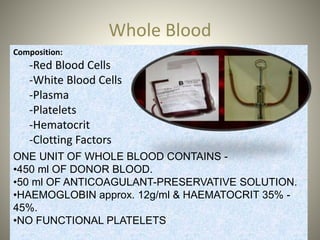
Composition:
-Red Blood Cells
-White Blood Cells
-Plasma
-Platelets
-Hematocrit
-Clotting Factors
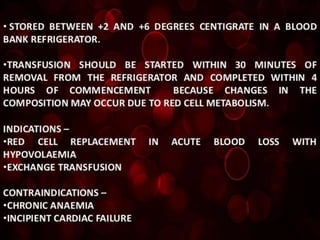
ONE UNIT OF WHOLE BLOOD CONTAINS -
•450 ml OF DONOR BLOOD.
•50 ml OF ANTICOAGULANT-PRESERVATIVE SOLUTION.
•HAEMOGLOBIN approx. 12g/ml & HAEMATOCRIT 35% -
45%.
•NO FUNCTIONAL PLATELETS
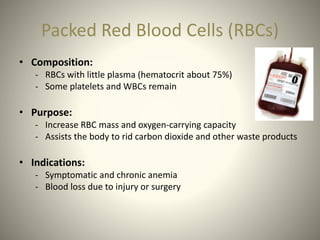
Packed Red Blood Cells (RBCs)
• Composition:
- RBCs with little plasma (hematocrit about 75%)
- Some platelets and WBCs remain
• Purpose:
- Increase RBC mass and oxygen-carrying capacity
- Assists the body to rid carbon dioxide and other waste products
• Indications:
- Symptomatic and chronic anemia
- Blood loss due to injury or surgery
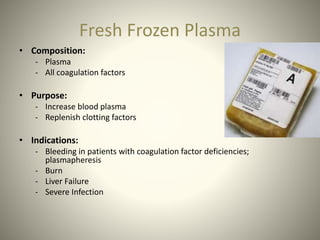
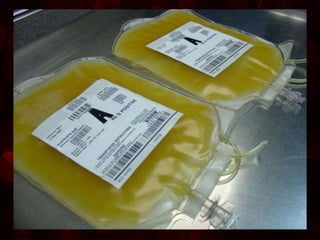
Fresh Frozen Plasma
• Composition:
- Plasma
- All coagulation factors
• Purpose:
- Increase blood plasma
- Replenish clotting factors
• Indications:
- Bleeding in patients with coagulation factor deficiencies;
plasmapheresis
- Burn
- Liver Failure
- Severe Infection
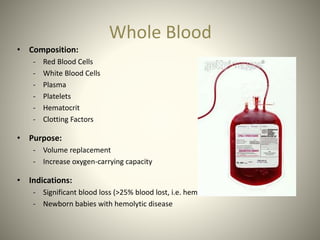
Whole Blood
• Composition:
- Red Blood Cells
- White Blood Cells
- Plasma
- Platelets
- Hematocrit
- Clotting Factors
• Purpose:
- Volume replacement
- Increase oxygen-carrying capacity
• Indications:
- Significant blood loss (>25% blood lost, i.e. hemorrhage)
- Newborn babies with hemolytic disease
Platelets
• Composition:
- Platelets
- Plasma
- RBCs
- WBCs
• Purpose:
- Helps to stop bleeding (restore clotting ability)
- Essential for coagulation of blood
• Indications:
- Decreased platelet count
- Hemophilia
- Thrombocytopenia
- Platelet dysfunction (End stage renal disease, DIC)
CRYOPRECIPITATE
•CRYOPRECIPITATE IS A SUPERNATANT PRECIPITATE OF
FRESH FROZEN PLASMA AND IS RICH IN FACTOR VIII AND
FIBRINOGEN.
•IT IS STORED AT -30 DEGREES CENTIGRATE WITH A 2 YEARS
SHELF
LIFE.
•INDICATED IN LOW FIBRINOGEN STATES (<1g/L) OR IN
CASES OF
FACTOR VIII DEFICIENCY (HAEMOPHILIA-A), VON
WILLEBRAND’S DISEASE AND AS A SOURCE OF
FIBRINOGEN IN DISSEMINATED INTRAVASCULAR
COAGULATION.
•POOLED UNITS CONTAINING 3-6 gms FIBRINOGEN IN 200-
500 ml RAISES THE FIBRINOGEN LEVEL BY APPROX. 1g/L.
•MUST BE INFUSED WITHIN 6 HOURS.
GENERAL INSTRUCTIONS FOR GIVING
BLOOD TRANSFUSIONS
Selection of the donor
•Donor shall be free of diseases of heart ,kidneys,lungs,liver
etc.
•There should not be any history of cancer, jaundice,
hepatitis, tuberculosis ,allergies
•They should be physically healthy, and should be between
18 and 65 years of age with in average height and weight.
•Donors must have normal temperature ,pulse and blood
pressure.
•They must not have been pregnant with in the last 6months.
CONT.......
•Before the blood is transfused,the donors blood must
be cross matched with the recipients blood.
•Explain the procedure to the donor and reassure
him/her to win his confidence and co-operation.explain
the sequence of the procedure and tell him how we can
co-operate in the procedure.
•Blood should not be collected empty stomach .the donor
should not be dehydrated. following the donation of
blood the donor should be given a sweetened drink and
asked to take rest for one to two hr to prevent fainting
attacks.
CONT.......
-The donor is asked to complete a questionnaire
detailing any history of infectious diseases and other
medical issues before they are allowed to donate blood
for transfusion.
- The donor’s hemoglobin level is checked.
- Once collected, the blood is examined and screened for
possible infectious agents such as HIV and hepatitis.
CONT.......
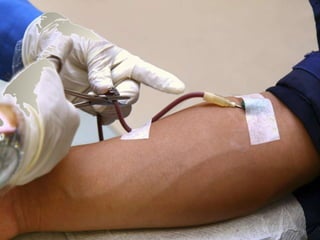
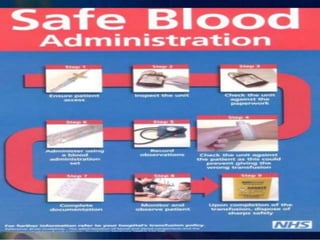
The blood is transfused through tubing that is connected
to a needle or catheter supplying the vein.
The amount of blood transfused depends on the
individual patient’s needs.
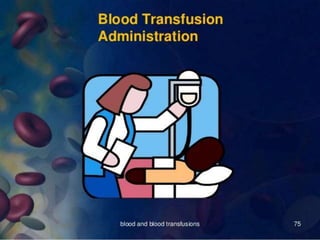
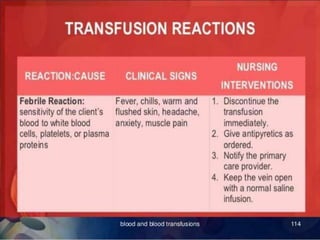
During blood transfusion, vital signs such as temperature,
heart rate, and blood pressure are carefully monitored.
Some patients may get a sudden fever during or within
24 hours of the transfusion, which may be relieved with
acetaminophen or paracetamol. This fever is a common
reaction to the white blood cells present in donated blood.
Nursing Implications
Before transfusion:
• Check physician’s orders
• Review hospital policy
• Ensure informed and written consent is provided
• Check laboratory values
• Understand the indications and rationale
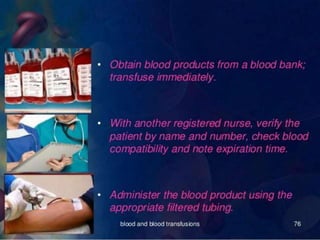
• Verification procedure occurs with
two nurses
Nursing Implications (Con’t)
Before transfusion (con’t):
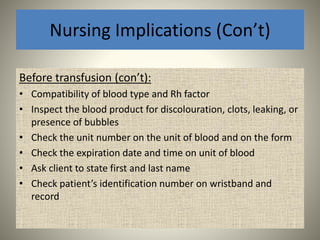
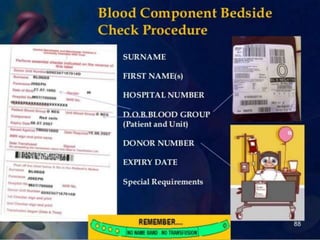
• Compatibility of blood type and Rh factor
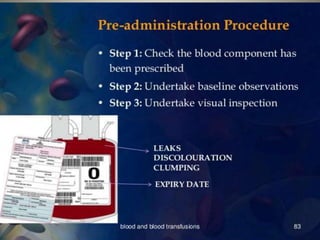
• Inspect the blood product for discolouration, clots, leaking, or
presence of bubbles
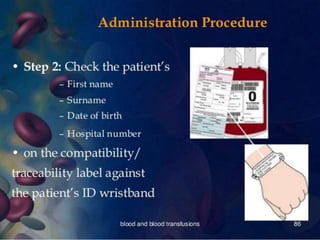
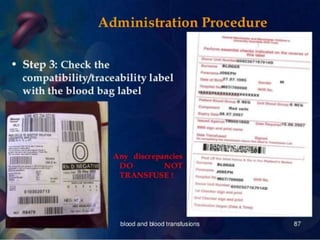
• Check the unit number on the unit of blood and on the form
• Check the expiration date and time on unit of blood
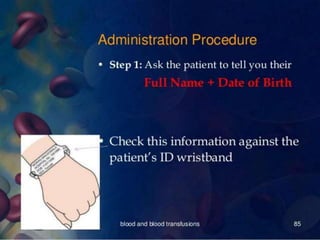
• Ask client to state first and last name
• Check patient’s identification number on wristband and
record
Nursing Implications Con’t
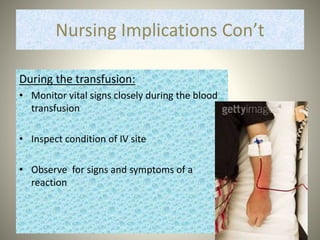
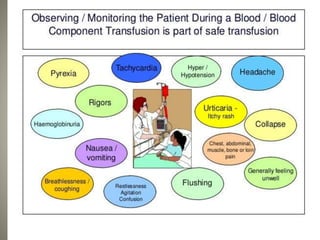
During the transfusion:
• Monitor vital signs closely during the blood
transfusion
• Inspect condition of IV site
• Observe for signs and symptoms of a
reaction
. RECORD:
•TIME WHEN THE TRANSFUSION IS STARTED.
•TIME WHEN THE TRANSFUSION IN COMPLETED.
•VOLUME AND TYPE OF ALL PRODUCTS
TRANSFUSED.
•BLOOD PACK NUMBERS.
•ANY ADVERSE EFFECTS.
SEVERE REACTIONS MOST COMMONLY PRESENT IN
THE FIRST 15-30 MINUTES OF A TRANSFUSION
THEREFORE THEY SHOULD BE CLOSELY MONITORED
DURING THIS TIME.
-IF THE PATIENT APPEARS TO BE EXPERIENCING AN
ADVERSE REACTION THE TRANSFUSION MUST BE
IMMEDIATELY STOPPED AND URGENT MEDICAL
ASSISTANCE SHOULD BE SEEKED FOR.
Nursing Implications Con’t
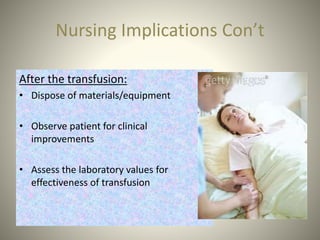
After the transfusion:
• Dispose of materials/equipment
• Observe patient for clinical
improvements
• Assess the laboratory values for
effectiveness of transfusion
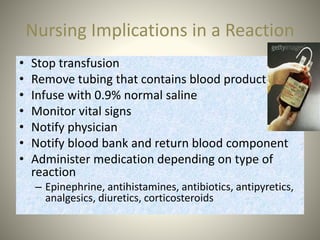
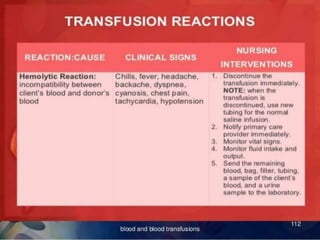
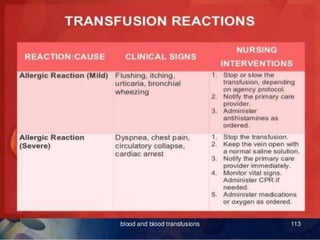
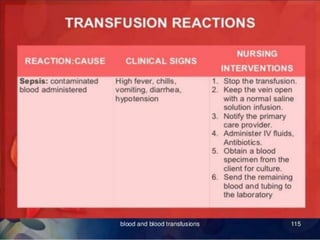
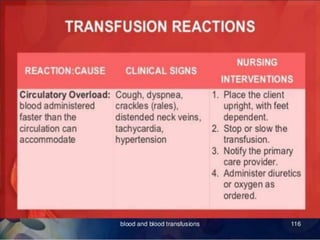
Nursing Implications in a Reaction
• Stop transfusion
• Remove tubing that contains blood product
• Infuse with 0.9% normal saline
• Monitor vital signs
• Notify physician
• Notify blood bank and return blood component
• Administer medication depending on type of
reaction
– Epinephrine, antihistamines, antibiotics, antipyretics,
analgesics, diuretics, corticosteroids
BLOOD TRANSFUSION
BLOOD TRANSFUSION
BLOOD TRANSFUSION
BLOOD TRANSFUSION
BLOOD TRANSFUSION
BLOOD TRANSFUSION
BLOOD TRANSFUSION
BLOOD TRANSFUSION
BLOOD TRANSFUSION

BLOOD TRANSFUSION

  • 6.
    Whole Blood Composition: -Red BloodCells -White Blood Cells -Plasma -Platelets -Hematocrit -Clotting Factors ONE UNIT OF WHOLE BLOOD CONTAINS - •450 ml OF DONOR BLOOD. •50 ml OF ANTICOAGULANT-PRESERVATIVE SOLUTION. •HAEMOGLOBIN approx. 12g/ml & HAEMATOCRIT 35% - 45%. •NO FUNCTIONAL PLATELETS
  • 8.
    Packed Red BloodCells (RBCs) • Composition: - RBCs with little plasma (hematocrit about 75%) - Some platelets and WBCs remain • Purpose: - Increase RBC mass and oxygen-carrying capacity - Assists the body to rid carbon dioxide and other waste products • Indications: - Symptomatic and chronic anemia - Blood loss due to injury or surgery
  • 9.
    Fresh Frozen Plasma •Composition: - Plasma - All coagulation factors • Purpose: - Increase blood plasma - Replenish clotting factors • Indications: - Bleeding in patients with coagulation factor deficiencies; plasmapheresis - Burn - Liver Failure - Severe Infection
  • 10.
    Whole Blood • Composition: -Red Blood Cells - White Blood Cells - Plasma - Platelets - Hematocrit - Clotting Factors • Purpose: - Volume replacement - Increase oxygen-carrying capacity • Indications: - Significant blood loss (>25% blood lost, i.e. hemorrhage) - Newborn babies with hemolytic disease
  • 11.
    Platelets • Composition: - Platelets -Plasma - RBCs - WBCs • Purpose: - Helps to stop bleeding (restore clotting ability) - Essential for coagulation of blood • Indications: - Decreased platelet count - Hemophilia - Thrombocytopenia - Platelet dysfunction (End stage renal disease, DIC)
  • 12.
    CRYOPRECIPITATE •CRYOPRECIPITATE IS ASUPERNATANT PRECIPITATE OF FRESH FROZEN PLASMA AND IS RICH IN FACTOR VIII AND FIBRINOGEN. •IT IS STORED AT -30 DEGREES CENTIGRATE WITH A 2 YEARS SHELF LIFE. •INDICATED IN LOW FIBRINOGEN STATES (<1g/L) OR IN CASES OF FACTOR VIII DEFICIENCY (HAEMOPHILIA-A), VON WILLEBRAND’S DISEASE AND AS A SOURCE OF FIBRINOGEN IN DISSEMINATED INTRAVASCULAR COAGULATION. •POOLED UNITS CONTAINING 3-6 gms FIBRINOGEN IN 200- 500 ml RAISES THE FIBRINOGEN LEVEL BY APPROX. 1g/L. •MUST BE INFUSED WITHIN 6 HOURS.
  • 14.
    GENERAL INSTRUCTIONS FORGIVING BLOOD TRANSFUSIONS Selection of the donor •Donor shall be free of diseases of heart ,kidneys,lungs,liver etc. •There should not be any history of cancer, jaundice, hepatitis, tuberculosis ,allergies •They should be physically healthy, and should be between 18 and 65 years of age with in average height and weight. •Donors must have normal temperature ,pulse and blood pressure. •They must not have been pregnant with in the last 6months.
  • 15.
    CONT....... •Before the bloodis transfused,the donors blood must be cross matched with the recipients blood. •Explain the procedure to the donor and reassure him/her to win his confidence and co-operation.explain the sequence of the procedure and tell him how we can co-operate in the procedure. •Blood should not be collected empty stomach .the donor should not be dehydrated. following the donation of blood the donor should be given a sweetened drink and asked to take rest for one to two hr to prevent fainting attacks.
  • 16.
    CONT....... -The donor isasked to complete a questionnaire detailing any history of infectious diseases and other medical issues before they are allowed to donate blood for transfusion. - The donor’s hemoglobin level is checked. - Once collected, the blood is examined and screened for possible infectious agents such as HIV and hepatitis.
  • 17.
    CONT....... The blood istransfused through tubing that is connected to a needle or catheter supplying the vein. The amount of blood transfused depends on the individual patient’s needs. During blood transfusion, vital signs such as temperature, heart rate, and blood pressure are carefully monitored. Some patients may get a sudden fever during or within 24 hours of the transfusion, which may be relieved with acetaminophen or paracetamol. This fever is a common reaction to the white blood cells present in donated blood.
  • 21.
    Nursing Implications Before transfusion: •Check physician’s orders • Review hospital policy • Ensure informed and written consent is provided • Check laboratory values • Understand the indications and rationale • Verification procedure occurs with two nurses
  • 22.
    Nursing Implications (Con’t) Beforetransfusion (con’t): • Compatibility of blood type and Rh factor • Inspect the blood product for discolouration, clots, leaking, or presence of bubbles • Check the unit number on the unit of blood and on the form • Check the expiration date and time on unit of blood • Ask client to state first and last name • Check patient’s identification number on wristband and record
  • 28.
    Nursing Implications Con’t Duringthe transfusion: • Monitor vital signs closely during the blood transfusion • Inspect condition of IV site • Observe for signs and symptoms of a reaction
  • 29.
    . RECORD: •TIME WHENTHE TRANSFUSION IS STARTED. •TIME WHEN THE TRANSFUSION IN COMPLETED. •VOLUME AND TYPE OF ALL PRODUCTS TRANSFUSED. •BLOOD PACK NUMBERS. •ANY ADVERSE EFFECTS. SEVERE REACTIONS MOST COMMONLY PRESENT IN THE FIRST 15-30 MINUTES OF A TRANSFUSION THEREFORE THEY SHOULD BE CLOSELY MONITORED DURING THIS TIME. -IF THE PATIENT APPEARS TO BE EXPERIENCING AN ADVERSE REACTION THE TRANSFUSION MUST BE IMMEDIATELY STOPPED AND URGENT MEDICAL ASSISTANCE SHOULD BE SEEKED FOR.
  • 30.
    Nursing Implications Con’t Afterthe transfusion: • Dispose of materials/equipment • Observe patient for clinical improvements • Assess the laboratory values for effectiveness of transfusion
  • 33.
    Nursing Implications ina Reaction • Stop transfusion • Remove tubing that contains blood product • Infuse with 0.9% normal saline • Monitor vital signs • Notify physician • Notify blood bank and return blood component • Administer medication depending on type of reaction – Epinephrine, antihistamines, antibiotics, antipyretics, analgesics, diuretics, corticosteroids

Editor's Notes

  • #12 - helps to stop bleeding - including internal bleeding