IV’s OVERVIEW IV solutions are instilled through a vein.  Includes water, chemicals, blood, blood products, and meds. LPN’s are certified through their facility, each facility’s policies/procedures vary.
ADVANTAGES/DISADVANTAGES ADVANTAGES Drug or solutions enter bloodstream instantly and circulate into the tissue.  This can be considered a disadvantage also. DISADVANTAGE Fluids cannot be retrieved in the event of an error. Extreme caution must be used. Needle or catheter must be used to provide entry. Materials must be sterile to prevent infection.
IV DRUGS ARE ADMINISTERED FOR : Restoring fluid balance secondary to trauma, illness, or dehydration. Maintain fluid balance when pt is NPO. Administer medication/electrolytes/vitamins. Administer anesthesia. Administer blood/blood products. Long-term pain management.  (avoids multiple injections) Trauma. Maintain blood levels of drugs. Establish access to vascular system for Dialysis, etc.
IV ADMINISTRATION IV MEDICATIONS ARE ADMINISTERED THROUGH 2 TYPES OF VEINS: PERIPHERAL CENTRAL (requires sterile dressing changes.)
TYPES OF IV CATHETERS CENTRAL VENOUS: Extends to vena cava or right atrium.  Administers meds in a large volume of blood.  Used for long-term IV therapy or when meds are irritating to peripheral veins.  If catheter is multiple lumen, meds incompatible w/each other can be administered simultaneously. TUNNELED: Inserted into central vein.  Part of the catheter is secured in subcutaneous tissue.
TYPES OF IV CATHETERS (CONT) PERCUTANEOUS: Inserted into a peripheral vein.  For short-term therapy.  Sutured to the skin. IMPLANTED: (Porta-Cath).  Sealed beneath the skin.  Greatest protection against infection.  Self-sealing port which is pierced through the skin with a special needle.  Local anesthetic can be applied prior.  Can remain for several years.  Flushed periodically with Heparin. PICC LINE: Peripherally inserted central catheter.
TYPES OF IV SOLUTION ISOTONIC: Maintains balance-resembles body fluids. 0.9% NS (Sodium Chloride).  Fluid loss/rehydration. D5W (Dextrose 5% in water).  Hydration. Lactated Ringers.  Hydration, burns, acute blood loss, replace electrolytes.
TYPES OF IV SOLUTIONS (CONT) HYPOTONIC: Causes cellular hydration.  Used for fluid loss secondary to diarrhea/vomiting. Normal Saline 0.45%.  Cellular hydration, electrolyte replacement. Dextrose/Water (DW) 2.5%.  Hydration. Dextrose 5% in Normal Saline 0.45% (D51/2NS).  Hydration. Normosol M.  Hydration, electrolyte replacement.
TYPES OF IV SOLUTIONS (CONT) HYPERTONIC: Causes cell shrinkage.  Used with extreme caution when reducing cerebral edema or to expand circulatory volume rapidly.  Can cause circulatory overload by increasing the circulatory volume too rapidly. 5% Dextrose in Normal Saline.  Hydration and shock. 5% Dextrose in 0.45% Normal Saline.  Diabetic Ketoacidosis. 5% Dextrose in Lactated Ringer’s.  Hydration. 5% Dextrose in 0.33% Normal Saline.  Hydration. 10% Dextrose in Water.  Provides a small amount of nutritional glucose.
TYPES OF IV SOLUTIONS (CONT) TPN: Usually in Central Line.  For nutrition if unable to eat or consume fluids over a long period.  Example:  Cancer, trauma, inflammatory bowel disease.  BLOOD AND BLOOD PRODUCTS: Whole Blood-Massive blood loss, restores blood volume.  Raises HMG and HMCT count. Packed Cells-Cellular replacement.  Extra volume not needed. Plasma-Replaces clotting factors.
ASSESSMENT OF SITE What is the IV used for?  Irritating substances, larger volumes, thicker fluids require larger veins. Use F/A and hand in adults.  Legs used only with a Dr order.  Scalps used for infants. Use non-dominant hand. Where is the surgery? Patient preference. Do not use a compromised site.  (bruising, swelling, previous IV, impaired circulation, rash, infection, amputation, etc.) Choose a site good for 72 hours. Use alternate sites. Try a warm compress for 10 minutes, BP cuff, have pt make a fist, tap skin, lower arm (promotes distal pooling).
INFUSION TECHNIQUES CONTINUOUS; Administration of a drug over a period of several hours. INTERMITTENT: Administration of medication in a relatively short span. BOLUS: Medication given all at one time.  Through an existing port or lock.
INFUSION TECHNIQUES (CONT) SECONDARY INFUSION: Administration of a drug that has been diluted in a small volume of IV solution, usually over 30-60minutes.  (Piggyback)  Hang higher than Primary. VOLUME CONTROL SET: Chamber in IV tubing that holds a portion of the solution from a larger container.  Avoids overloading Circulatory System.  (Volutrol, Buretrol, Soluset.)
PRIMARY: Approx 110in.  Spans the distance between solution and infusion site. SECONDARY: Approx 37in.  Used to administer small volumes of solution into a port within the Primary Tubing. VENTED: Draws air into the container.  Used with glass container.  Allows fluids to flow. NON-VENTED: Prevents air from entering container.  Does not need air because plastic bag collapses as fluid infuses. IV TUBING
TYPES OF TUBING (CONT) MICRODRIP: Used for slow infusing solutions. MACRODRIP: Easier to count if infusing fast-flowing solutions. FILTERED: Removes air bubbles as well as undissolved drugs, bacteria, and larger substances.  Used for:  Parenteral nutrition, Pediatrics, High Infection Risk, Administering blood. NEEDLELESS SYSTEM: Eliminates need for needle access.
IV COMPLICATIONS CIRCULATORY OVERLOAD INFILTRATION  THROMBUS  THROMBOPHLEBITIS INFECTION PULMONARY EMBOLUS AIR EMBOLISM
COMPLICATIONS CIRCULATORY OVERLOAD: Symptoms: Increased BP, SOB, Anxiety. Cause: Rapid infusion, reduced kidney function, impaired heart  contractions. Action: First action of nurse is to assess for Respiratory Distress  (VS), then Decrease Flow-Rate, Fowler’s position, call  Physician. INFILTRATION: Symptoms: Swelling at site, burning, color-pallor, coldness, slow or no  rate. Cause: Solution escaping into subcutaneous tissue. Action: Restart IV, elevate, warm compress X20 minutes.
COMPLICATIONS (CONT) THROMBUS: Symptoms: Pain, swelling. Cause: Cannula point traumatizes wall of vein.  Thrombi form on  the vein and tip of cannula.  Traps bacteria. Action: D/C site.  Call physician. THROMBOPHLEBITIS: Symptoms: Pain along length of vein.  Vein becomes increasingly  painful and hard. Cause: Thrombus with inflammation, chemicals or irritation. Action: Watch for Septicemia and Acute bacterial endocarditis.  D/C  IV, notify Physician.
COMPLICATIONS (CONT) INFECTION: Symptoms: Redness, puffiness.  Purulent drainage.  Temperature and  chills. Cause: Spread of bacteria. Action: D/C site.  Notify physician.  Culture if necessary. PULMONARY EMBOLUS: Symptoms: SOB, Anxiety, Sudden Chest Pain, Rapid heart rate with a  drop in BP. Cause: Movement of previously stationary blood clot. Action: Stay with patient and call for assistance.
COMPLICATIONS (CONT) AIR EMBOLUS: Symptoms: Drop in BP, Tachycardia, Decreased LOC, Cyanosis. Cause: Air enters vein, disconnected tubing, running solutions  simultaneously, lethal amount unknown.  Associated with  Central Lines.  Action: Trendelenberg position on L side.  (air rises to R atrium,  preventing it from entering the Pulmonary Artery. CALL FOR ASSISTANCE
BLOOD TRANSFUSION Blood is dispensed in 500ml containers.  It is very thick and viscous.  A pressure bag may be used to permit continuous drip.  VS are closely monitored.  Usually Q5minX3 then Q15min.  Check with your facility policy.  First sign of a reaction is usually within 5-15min.  Patients will c/o a burning sensation, after this they will develop: Tachycardia Hypotension Flushing Dyspnea Restlessness Back Pain Mild Allergic Reaction: Hives Itching If the infusion continues: Fever   Chills    Change in body temp.  Intervention: Stop the transfusion Do not remove needle Report observations Monitor VS Save tubing for analysis by Lab
SIGNS/SXS’S OF INFECTION (LOCAL AND SYSTEMIC) ABDOMINAL PAIN DIAPHORESIS GLUCOSE INTOLERANCE NV/DIARRHEA ALTERED MENTAL STATUS FATIGUE, MUSCLE ACHES, WEAKNESS
KEY POINTS HL need to be flushed QS and after admin of med. Make sure flush is compatible with medication being given and IV fluid. Use filter needle when using ampules. Cleanse site first. When giving antineoplastic drugs, wear long-sleeved, cuffed, low-permeable gown with closed front and non-powdered gloves.  Cover drug preparation area with disposable pad  to absorb spills.  Avoid inhalation of drug. If IV is running too slowly, do not play catch-up.  Assess patient for respiratory distress secondary to fluid overload.  IV fluids are considered medications and are ordered by the Physician.  The Five Rights are strictly adhered to and are critical, as well as assessment of the patient and site.  The drug, rate, and volume must be included in the order.
ASSESSMENT/CARE OF THE IV ASSESSMENT: Q1HOUR SITE RATE TIME STRIP NOTIFY MED NURSE IF BAG RUNNING DRY. CARE: MAY USE ARMBOARD FOR POSITIONING PROTECT NEEDLE SITE/STERILITY OF FLUID CHANGE DRESSING Q24-72HR ACCORDING TO POLICY KEEP SITE CLEAN/DRY CHECK FOR BUBBLES (wind tubing around pencil, milk tubing)
GENERAL INFORMATION The longer the duration of infusion, the more likely complication are to occur. Solutions/meds are irritating to the vein. Cannula’s can irritate and pierce venous walls causing complications. Small veins are more likely to be irritated. Cannula can occlude vein and prevent blood flow. Veins in lower extremities are a factor when there is pooling or stagnant blood. Poor technique can cause inflammation and infection. Phlebitis with sepsis is associated with technique.  (like disconnecting a gown) Infection is a risk.  Skin must be thoroughly and properly cleansed to maintain asepsis.  Such as thorough handwashing.
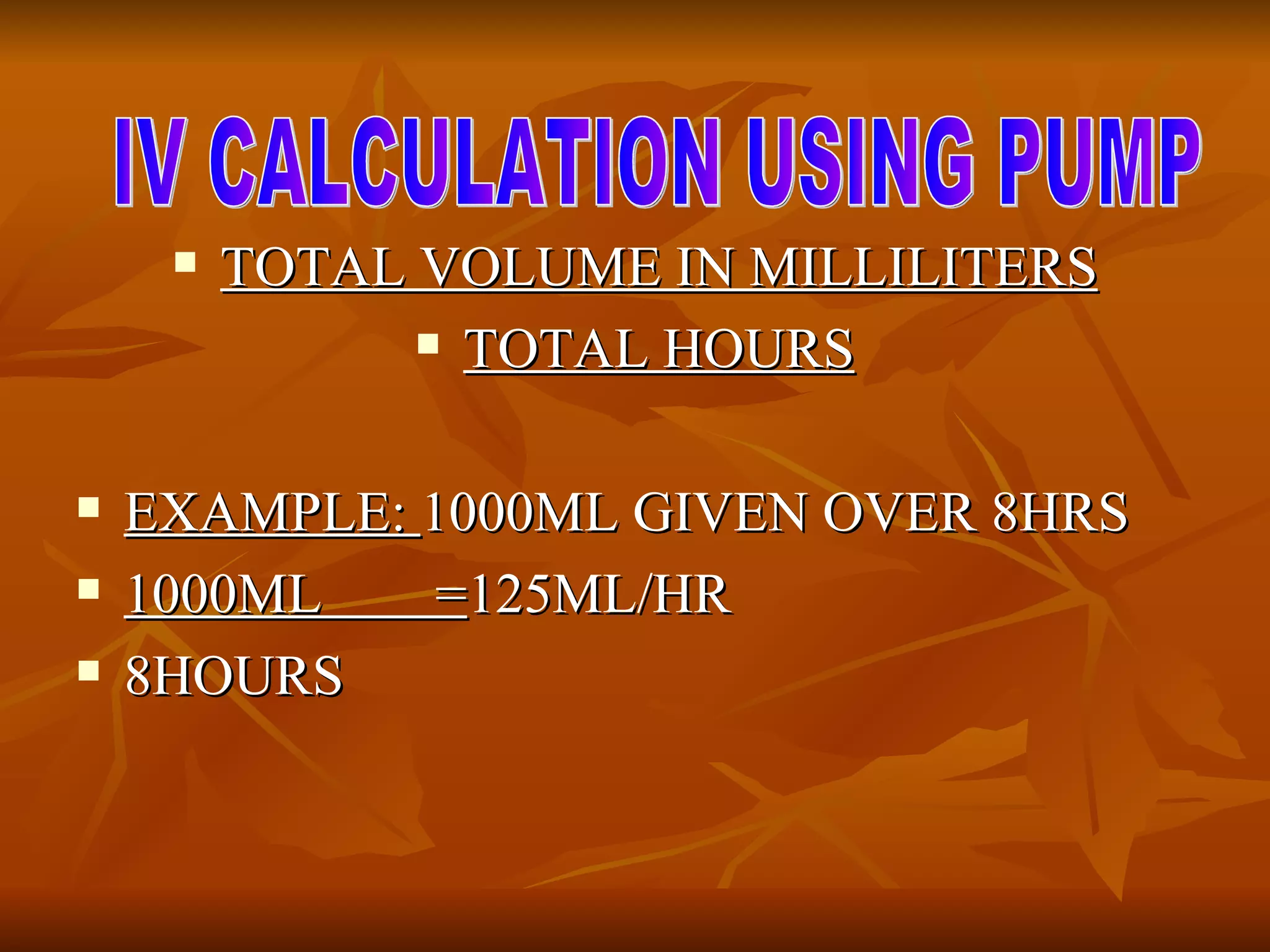
TOTAL VOLUME IN MILLILITERS TOTAL HOURS EXAMPLE:  1000ML GIVEN OVER 8HRS 1000ML  = 125ML/HR 8HOURS IV CALCULATION USING PUMP
CALCULATIONS DROP RATE: REGULAR : 15GTTS/ML MACRO: 10GTTS/ML  (BLOOD) MICRO: 60GTTS/ML  (INFANTS/PEDS) EXAMPLE: 1000ML OVER 12 HRS  (ADULT) VOLUME X SIZE OF DROP TIME (IN MINUTES) 1000x15  = 21GTTS/MIN 60MINx12HRS

IVs

  • 1.
    IV’s OVERVIEW IVsolutions are instilled through a vein. Includes water, chemicals, blood, blood products, and meds. LPN’s are certified through their facility, each facility’s policies/procedures vary.
  • 2.
    ADVANTAGES/DISADVANTAGES ADVANTAGES Drugor solutions enter bloodstream instantly and circulate into the tissue. This can be considered a disadvantage also. DISADVANTAGE Fluids cannot be retrieved in the event of an error. Extreme caution must be used. Needle or catheter must be used to provide entry. Materials must be sterile to prevent infection.
  • 3.
    IV DRUGS AREADMINISTERED FOR : Restoring fluid balance secondary to trauma, illness, or dehydration. Maintain fluid balance when pt is NPO. Administer medication/electrolytes/vitamins. Administer anesthesia. Administer blood/blood products. Long-term pain management. (avoids multiple injections) Trauma. Maintain blood levels of drugs. Establish access to vascular system for Dialysis, etc.
  • 4.
    IV ADMINISTRATION IVMEDICATIONS ARE ADMINISTERED THROUGH 2 TYPES OF VEINS: PERIPHERAL CENTRAL (requires sterile dressing changes.)
  • 5.
    TYPES OF IVCATHETERS CENTRAL VENOUS: Extends to vena cava or right atrium. Administers meds in a large volume of blood. Used for long-term IV therapy or when meds are irritating to peripheral veins. If catheter is multiple lumen, meds incompatible w/each other can be administered simultaneously. TUNNELED: Inserted into central vein. Part of the catheter is secured in subcutaneous tissue.
  • 6.
    TYPES OF IVCATHETERS (CONT) PERCUTANEOUS: Inserted into a peripheral vein. For short-term therapy. Sutured to the skin. IMPLANTED: (Porta-Cath). Sealed beneath the skin. Greatest protection against infection. Self-sealing port which is pierced through the skin with a special needle. Local anesthetic can be applied prior. Can remain for several years. Flushed periodically with Heparin. PICC LINE: Peripherally inserted central catheter.
  • 7.
    TYPES OF IVSOLUTION ISOTONIC: Maintains balance-resembles body fluids. 0.9% NS (Sodium Chloride). Fluid loss/rehydration. D5W (Dextrose 5% in water). Hydration. Lactated Ringers. Hydration, burns, acute blood loss, replace electrolytes.
  • 8.
    TYPES OF IVSOLUTIONS (CONT) HYPOTONIC: Causes cellular hydration. Used for fluid loss secondary to diarrhea/vomiting. Normal Saline 0.45%. Cellular hydration, electrolyte replacement. Dextrose/Water (DW) 2.5%. Hydration. Dextrose 5% in Normal Saline 0.45% (D51/2NS). Hydration. Normosol M. Hydration, electrolyte replacement.
  • 9.
    TYPES OF IVSOLUTIONS (CONT) HYPERTONIC: Causes cell shrinkage. Used with extreme caution when reducing cerebral edema or to expand circulatory volume rapidly. Can cause circulatory overload by increasing the circulatory volume too rapidly. 5% Dextrose in Normal Saline. Hydration and shock. 5% Dextrose in 0.45% Normal Saline. Diabetic Ketoacidosis. 5% Dextrose in Lactated Ringer’s. Hydration. 5% Dextrose in 0.33% Normal Saline. Hydration. 10% Dextrose in Water. Provides a small amount of nutritional glucose.
  • 10.
    TYPES OF IVSOLUTIONS (CONT) TPN: Usually in Central Line. For nutrition if unable to eat or consume fluids over a long period. Example: Cancer, trauma, inflammatory bowel disease. BLOOD AND BLOOD PRODUCTS: Whole Blood-Massive blood loss, restores blood volume. Raises HMG and HMCT count. Packed Cells-Cellular replacement. Extra volume not needed. Plasma-Replaces clotting factors.
  • 11.
    ASSESSMENT OF SITEWhat is the IV used for? Irritating substances, larger volumes, thicker fluids require larger veins. Use F/A and hand in adults. Legs used only with a Dr order. Scalps used for infants. Use non-dominant hand. Where is the surgery? Patient preference. Do not use a compromised site. (bruising, swelling, previous IV, impaired circulation, rash, infection, amputation, etc.) Choose a site good for 72 hours. Use alternate sites. Try a warm compress for 10 minutes, BP cuff, have pt make a fist, tap skin, lower arm (promotes distal pooling).
  • 12.
    INFUSION TECHNIQUES CONTINUOUS;Administration of a drug over a period of several hours. INTERMITTENT: Administration of medication in a relatively short span. BOLUS: Medication given all at one time. Through an existing port or lock.
  • 13.
    INFUSION TECHNIQUES (CONT)SECONDARY INFUSION: Administration of a drug that has been diluted in a small volume of IV solution, usually over 30-60minutes. (Piggyback) Hang higher than Primary. VOLUME CONTROL SET: Chamber in IV tubing that holds a portion of the solution from a larger container. Avoids overloading Circulatory System. (Volutrol, Buretrol, Soluset.)
  • 14.
    PRIMARY: Approx 110in. Spans the distance between solution and infusion site. SECONDARY: Approx 37in. Used to administer small volumes of solution into a port within the Primary Tubing. VENTED: Draws air into the container. Used with glass container. Allows fluids to flow. NON-VENTED: Prevents air from entering container. Does not need air because plastic bag collapses as fluid infuses. IV TUBING
  • 15.
    TYPES OF TUBING(CONT) MICRODRIP: Used for slow infusing solutions. MACRODRIP: Easier to count if infusing fast-flowing solutions. FILTERED: Removes air bubbles as well as undissolved drugs, bacteria, and larger substances. Used for: Parenteral nutrition, Pediatrics, High Infection Risk, Administering blood. NEEDLELESS SYSTEM: Eliminates need for needle access.
  • 16.
    IV COMPLICATIONS CIRCULATORYOVERLOAD INFILTRATION THROMBUS THROMBOPHLEBITIS INFECTION PULMONARY EMBOLUS AIR EMBOLISM
  • 17.
    COMPLICATIONS CIRCULATORY OVERLOAD:Symptoms: Increased BP, SOB, Anxiety. Cause: Rapid infusion, reduced kidney function, impaired heart contractions. Action: First action of nurse is to assess for Respiratory Distress (VS), then Decrease Flow-Rate, Fowler’s position, call Physician. INFILTRATION: Symptoms: Swelling at site, burning, color-pallor, coldness, slow or no rate. Cause: Solution escaping into subcutaneous tissue. Action: Restart IV, elevate, warm compress X20 minutes.
  • 18.
    COMPLICATIONS (CONT) THROMBUS:Symptoms: Pain, swelling. Cause: Cannula point traumatizes wall of vein. Thrombi form on the vein and tip of cannula. Traps bacteria. Action: D/C site. Call physician. THROMBOPHLEBITIS: Symptoms: Pain along length of vein. Vein becomes increasingly painful and hard. Cause: Thrombus with inflammation, chemicals or irritation. Action: Watch for Septicemia and Acute bacterial endocarditis. D/C IV, notify Physician.
  • 19.
    COMPLICATIONS (CONT) INFECTION:Symptoms: Redness, puffiness. Purulent drainage. Temperature and chills. Cause: Spread of bacteria. Action: D/C site. Notify physician. Culture if necessary. PULMONARY EMBOLUS: Symptoms: SOB, Anxiety, Sudden Chest Pain, Rapid heart rate with a drop in BP. Cause: Movement of previously stationary blood clot. Action: Stay with patient and call for assistance.
  • 20.
    COMPLICATIONS (CONT) AIREMBOLUS: Symptoms: Drop in BP, Tachycardia, Decreased LOC, Cyanosis. Cause: Air enters vein, disconnected tubing, running solutions simultaneously, lethal amount unknown. Associated with Central Lines. Action: Trendelenberg position on L side. (air rises to R atrium, preventing it from entering the Pulmonary Artery. CALL FOR ASSISTANCE
  • 21.
    BLOOD TRANSFUSION Bloodis dispensed in 500ml containers. It is very thick and viscous. A pressure bag may be used to permit continuous drip. VS are closely monitored. Usually Q5minX3 then Q15min. Check with your facility policy. First sign of a reaction is usually within 5-15min. Patients will c/o a burning sensation, after this they will develop: Tachycardia Hypotension Flushing Dyspnea Restlessness Back Pain Mild Allergic Reaction: Hives Itching If the infusion continues: Fever Chills Change in body temp. Intervention: Stop the transfusion Do not remove needle Report observations Monitor VS Save tubing for analysis by Lab
  • 22.
    SIGNS/SXS’S OF INFECTION(LOCAL AND SYSTEMIC) ABDOMINAL PAIN DIAPHORESIS GLUCOSE INTOLERANCE NV/DIARRHEA ALTERED MENTAL STATUS FATIGUE, MUSCLE ACHES, WEAKNESS
  • 23.
    KEY POINTS HLneed to be flushed QS and after admin of med. Make sure flush is compatible with medication being given and IV fluid. Use filter needle when using ampules. Cleanse site first. When giving antineoplastic drugs, wear long-sleeved, cuffed, low-permeable gown with closed front and non-powdered gloves. Cover drug preparation area with disposable pad to absorb spills. Avoid inhalation of drug. If IV is running too slowly, do not play catch-up. Assess patient for respiratory distress secondary to fluid overload. IV fluids are considered medications and are ordered by the Physician. The Five Rights are strictly adhered to and are critical, as well as assessment of the patient and site. The drug, rate, and volume must be included in the order.
  • 24.
    ASSESSMENT/CARE OF THEIV ASSESSMENT: Q1HOUR SITE RATE TIME STRIP NOTIFY MED NURSE IF BAG RUNNING DRY. CARE: MAY USE ARMBOARD FOR POSITIONING PROTECT NEEDLE SITE/STERILITY OF FLUID CHANGE DRESSING Q24-72HR ACCORDING TO POLICY KEEP SITE CLEAN/DRY CHECK FOR BUBBLES (wind tubing around pencil, milk tubing)
  • 25.
    GENERAL INFORMATION Thelonger the duration of infusion, the more likely complication are to occur. Solutions/meds are irritating to the vein. Cannula’s can irritate and pierce venous walls causing complications. Small veins are more likely to be irritated. Cannula can occlude vein and prevent blood flow. Veins in lower extremities are a factor when there is pooling or stagnant blood. Poor technique can cause inflammation and infection. Phlebitis with sepsis is associated with technique. (like disconnecting a gown) Infection is a risk. Skin must be thoroughly and properly cleansed to maintain asepsis. Such as thorough handwashing.
  • 26.
    TOTAL VOLUME INMILLILITERS TOTAL HOURS EXAMPLE: 1000ML GIVEN OVER 8HRS 1000ML = 125ML/HR 8HOURS IV CALCULATION USING PUMP
  • 27.
    CALCULATIONS DROP RATE:REGULAR : 15GTTS/ML MACRO: 10GTTS/ML (BLOOD) MICRO: 60GTTS/ML (INFANTS/PEDS) EXAMPLE: 1000ML OVER 12 HRS (ADULT) VOLUME X SIZE OF DROP TIME (IN MINUTES) 1000x15 = 21GTTS/MIN 60MINx12HRS