PRANATI PATRA
M.SC NURSING 1ST YEAR
OBJECTIVES
At the end of class student will be
• Able to define blood transfusion.
• Enlist the purpose of blood transfusion
• List out the blood products
• Enumerate the general instruction follow before, during
and after blood transfusion ?
• List out the articles needed before blood transfusion
• Explain the procedure blood transfusion ?
• Describe the complication arises in blood transfusion ?
DEFINITION
• Blood transfusion is the transfusion of whole
blood or its components such as blood cells and
plasma from one person to another person
through an intravenous live .
• Transfusions usually involve the use of two
sources of blood – ONE’S OWN
(AUTOLOGOUS TRANSFUSION) OR
SOMEONE ELSE’ (ALLOGENIC
TRANSFUSION).
PURPOSE
• To replace blood volume and blood
pressure during hemorrhage
{ hemoptysis, hematemesis,operation} ,
trauma and burns .
• To increase the hemoglobin level in
cases of severe anemia.
• To correct and treat deficiency of
plasma proteins, clotting factors.
COMPONENTS OF BLOOD
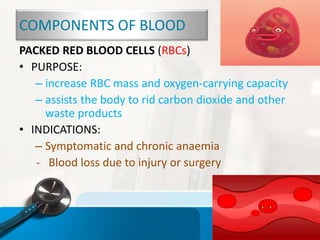
PACKED RED BLOOD CELLS (RBCs)
• PURPOSE:
– increase RBC mass and oxygen-carrying capacity
– assists the body to rid carbon dioxide and other
waste products
• INDICATIONS:
– Symptomatic and chronic anaemia
- Blood loss due to injury or surgery
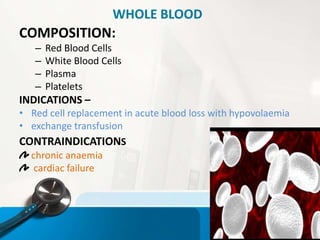
WHOLE BLOOD
COMPOSITION:
– Red Blood Cells
– White Blood Cells
– Plasma
– Platelets
INDICATIONS –
• Red cell replacement in acute blood loss with hypovolaemia
• exchange transfusion
CONTRAINDICATIONS
chronic anaemia
cardiac failure
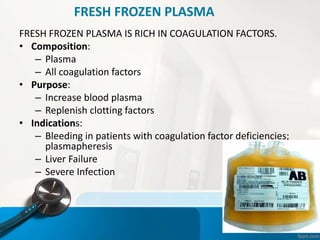
FRESH FROZEN PLASMA
FRESH FROZEN PLASMA IS RICH IN COAGULATION FACTORS.
• Composition:
– Plasma
– All coagulation factors
• Purpose:
– Increase blood plasma
– Replenish clotting factors
• Indications:
– Bleeding in patients with coagulation factor deficiencies;
plasmapheresis
– Liver Failure
– Severe Infection
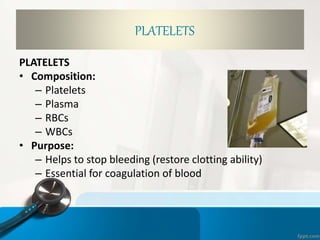
PLATELETS
• Composition:
– Platelets
– Plasma
– RBCs
– WBCs
• Purpose:
– Helps to stop bleeding (restore clotting ability)
– Essential for coagulation of blood
PLATELETS
PLATELETS
INDICATIONS:
– Decreased platelet count
– Hemophilia
– Platelet dysfunction
CONTRAINDICATION
- Autoimmune thrombocytopenia.
BLOOD TYPES
There are four blood types:
1. A
2. B
3. AB
4. O
• Every person has one of the above four blood types. In
addition, each person's blood is either:
• Rh-positive, or
• Rh-negative.
CONT….
Rh-positive and Rh-negative
• People who have Rh-positive blood can receive Rh-
positive or Rh-negative blood.
• If a person has Rh-negative blood, they should only
receive Rh-negative blood.
• Rh-negative blood is used for emergencies when
there is not time to test a person's Rh type.
Donors should not have any history of cancer
,jaundice , hepatitis,tuberculosis ,allergies.
Donors must have normal temperature, pulse and
blood pressure.
They should be physically healthy, and should be
between 18 and 65 years of age with in average
height and weight.
GENERAL INSTRUCTION
CONT….
• Explain the procedure to the donor and reassure
him/her to win his confidence and co-operation.
• Blood should not be collected empty stomach.
Following the donation of blood the donor should be
given a sweetened drink and asked to take rest for
one to two hr to prevent fainting attacks.
CONT…….
• The donor’s haemoglobin level is checked.
• Once collected, the blood is examined and screened
for possible infectious agents such as HIV and
hepatitis.
• Blood should be fresh.
• Blood should be stored at a temperature 1’C to 6’C.
- Don’t administered medication through the same
line, where blood product is transfused.
- Cover the bag with a towel when it hangs on the iv
pole.
- Gently rotate the blood bag periodically .
- 1unit of blood contain 350ml of blood.
Preservative – Citrate Dextrose Phosphate Adenine.
Cont...
• Freezing ,heating of the blood will destroy the blood
cells.
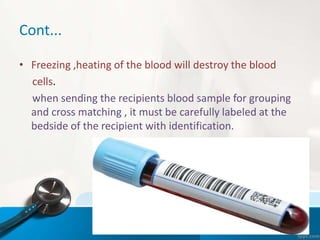
when sending the recipients blood sample for grouping
and cross matching , it must be carefully labeled at the
bedside of the recipient with identification.
Cont...
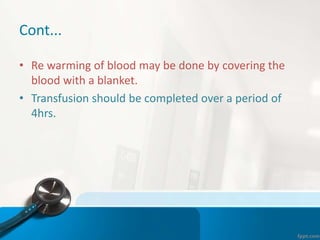
• Re warming of blood may be done by covering the
blood with a blanket.
• Transfusion should be completed over a period of
4hrs.
CONT..................
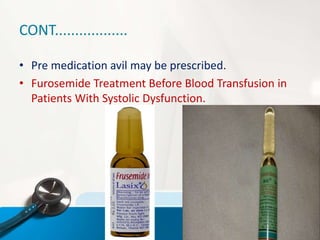
• Pre medication avil may be prescribed.
• Furosemide Treatment Before Blood Transfusion in
Patients With Systolic Dysfunction.
Benadryl
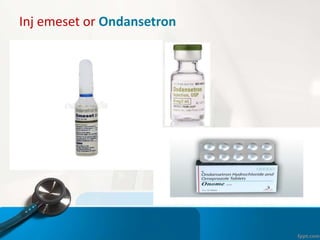
Inj emeset or Ondansetron
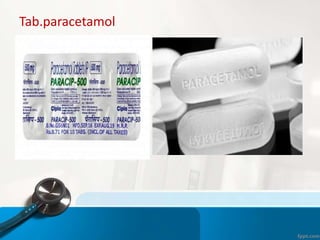
Tab.paracetamol
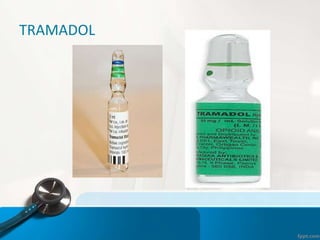
TRAMADOL
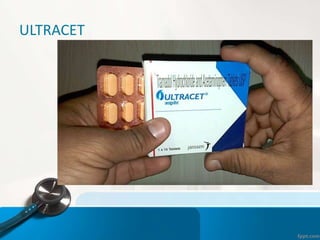
ULTRACET
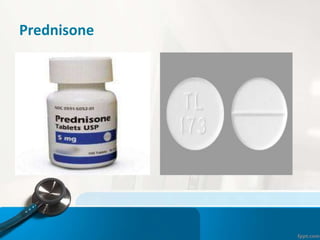
Prednisone
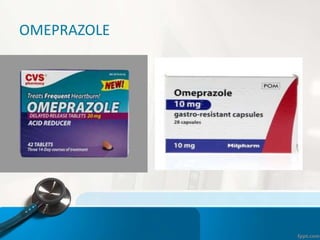
OMEPRAZOLE
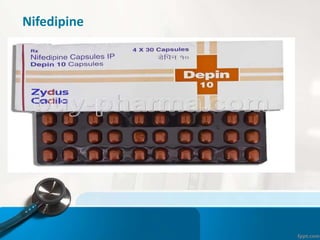
Nifedipine
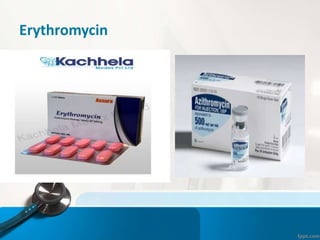
Erythromycin
Diazepam
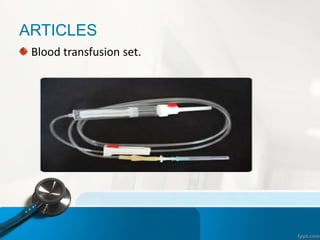
ARTICLES
Blood transfusion set.
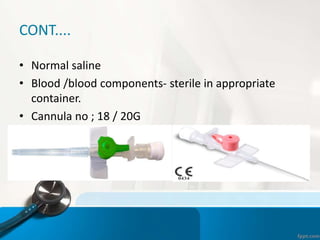
CONT....
• Normal saline
• Blood /blood components- sterile in appropriate
container.
• Cannula no ; 18 / 20G
CONT.....
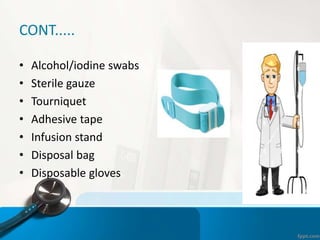
• Alcohol/iodine swabs
• Sterile gauze
• Tourniquet
• Adhesive tape
• Infusion stand
• Disposal bag
• Disposable gloves
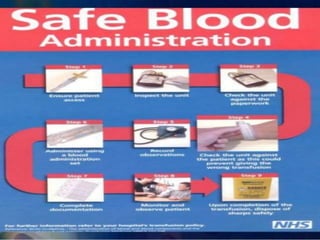
PROCEDURE
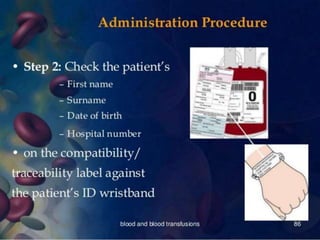
1.Check physician;s order,patients condition,and history of
transfusion /infusion reaction,reason for present transfusion
etc
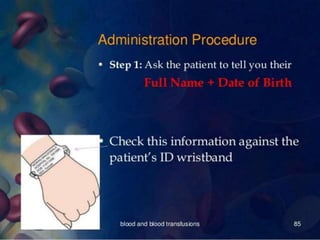
2.Identify patients
Cont…..
4.Explain the procedure to the patient.
Obtain informed consent from patient
5.Obtain blood from blood bank in accordance with
agency policy.
6.Encourage patient to empty bowel and
bladder and assist to a comfortable
position .
7.Ensure privacy .
8.Wash and dry hands
9.Check vital signs and record.
10.Use disposable gloves
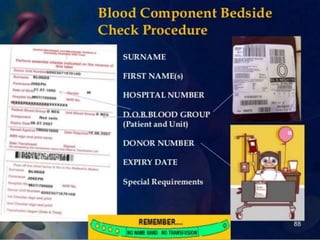
12. Inspect the blood product[by 2 nurses] for
1.Identification number
2.Expiry date.
3.Compartibility
4.Patients name
5.Abnormal colour,clots,excess air etc
13.Warm blood if needed using special blood
warmer.
14.Start infusion of blood product slowly , for first 15mn adjust
flow rate at 5 to 10ml/min .check vital signs every 15mn for
first 30mn or as per agency policy.
15.Increase infusion rate if no adverse reaction are
noticed. the flow rate should be within safe limits.
16.Assess the condition of pt every 30minutes and if
any adverse effect is observed stop transfusion and
start saline. send urine sample ,blood sample, and
remaining blood product in container with
transfusion set, back to the blood bank.
17.Complete transfusion and administer saline [ as
per physician's order] if no adverse reaction is
observed.
18.Dispose blood product container and set in
a appropriate receptable.
19.Wash hands.
20. Record the following ;product and volume transfused
,identification number and blood group.
-Time of administration. stated and completed.
-Name and signature of nursing staff caring out
procedure and patient condition. if agency policy
requires remove label from blood bag and paste it on
patients record.
21.Assist patient to comfortable position.
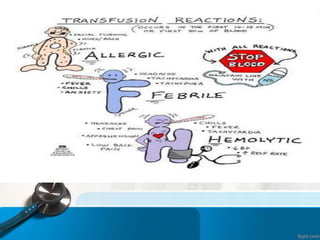
COMPLICATION
1.HEMOLYTIC REACTION
- Incompatibility between clients blood and donors
blood.
CLINICAL SIGNS
• Chills, fever, headache, backache, dyspnea,
Cyanosis, chestpain,hypotension.
NURSING INTERVENTION
• Stop transfusion as soon as a reaction is suspected.
• Replace the donor blood with normal saline.
• Examine the blood to determine if the patient was the intended
recipient and then send the unit back to the blood bank.
• Furosemide may be administered to increase renal blood flow.
• Low-dose dopamine may be considered to improve renal blood
flow.
• Make efforts to maintain urine output at 30-100 mL/h.
ALLERGIC REACTION
• CLINICAL SIGNS
- Chills
- Abdominal cramps
- Dyspnoea
- Vomiting
- Diarrhoea
- Tachycardia
- Flushing
NURSING INTERVENTION
• Stop transfusion immediately and notify MD
• Support airway (endotracheal intubation may be
needed) and circulation as needed
• Anticipate administering epinephrine,
diphenhydramine, and corticosteroids
• Maintain intravascular volume
CIRCULATORY OVERLOAD
• CLINICAL SIGN-
Dyspnea, orthopnea, cyanosis, sudden anxiety
If severe:
Coughing of pink, frothy sputum, neck vein
distension, crackles in bases of lungs
NURSING INTERVENTION
• Position patient in sitting position
• Stop transfusion and notify MD
• Keep IV open with slow infusion of normal saline
.
• Anticipate diuretics, oxygen, morphine, and
aminophylline
FEBRILE REACTION
• Sensitivity of client to white blood cells ,platelets
and with plasma protein.
CLINICAL SIGN
- Fever
- Chills,
- Dyspnoea,
- Headache,
- Muscle pain.
NURSING INTERVENTION
• Discontinue the transfusion immediately.
• Give antipyretics as ordered.
• Keep a vein open with a normal saline.
CONCLUSION
• Transfusions of blood & blood components are
labour intensive & expensive but are frequently life
saving. In a few patients, however they can result in
potentially fatal complications. It is therefore
essential that they are only given when the benefits
outweight the risks
BIBILIOGRAPHY
1.The who handbook on the clinical use of blood – who blood
transfusion safety, Geneva, 2017.
2. Bailey & love’s short practice of surgery – 25th edition –2010
3.Davidson’s principle & practice of medicine – 21st edition –
2008.
4.Essential paediatrics –o.p. ghai– 6th edition.
5.Online text from the british medical journal
www.bmj.co.uk/bloodtransfusionsafety31781/o3.
Blood transfusion -procedure,precaution and complication

Blood transfusion -procedure,precaution and complication

  • 2.
  • 3.
    OBJECTIVES At the endof class student will be • Able to define blood transfusion. • Enlist the purpose of blood transfusion • List out the blood products • Enumerate the general instruction follow before, during and after blood transfusion ? • List out the articles needed before blood transfusion • Explain the procedure blood transfusion ? • Describe the complication arises in blood transfusion ?
  • 4.
    DEFINITION • Blood transfusionis the transfusion of whole blood or its components such as blood cells and plasma from one person to another person through an intravenous live . • Transfusions usually involve the use of two sources of blood – ONE’S OWN (AUTOLOGOUS TRANSFUSION) OR SOMEONE ELSE’ (ALLOGENIC TRANSFUSION).
  • 5.
    PURPOSE • To replaceblood volume and blood pressure during hemorrhage { hemoptysis, hematemesis,operation} , trauma and burns . • To increase the hemoglobin level in cases of severe anemia. • To correct and treat deficiency of plasma proteins, clotting factors.
  • 6.
    COMPONENTS OF BLOOD PACKEDRED BLOOD CELLS (RBCs) • PURPOSE: – increase RBC mass and oxygen-carrying capacity – assists the body to rid carbon dioxide and other waste products • INDICATIONS: – Symptomatic and chronic anaemia - Blood loss due to injury or surgery
  • 7.
    WHOLE BLOOD COMPOSITION: – RedBlood Cells – White Blood Cells – Plasma – Platelets INDICATIONS – • Red cell replacement in acute blood loss with hypovolaemia • exchange transfusion CONTRAINDICATIONS chronic anaemia cardiac failure
  • 8.
    FRESH FROZEN PLASMA FRESHFROZEN PLASMA IS RICH IN COAGULATION FACTORS. • Composition: – Plasma – All coagulation factors • Purpose: – Increase blood plasma – Replenish clotting factors • Indications: – Bleeding in patients with coagulation factor deficiencies; plasmapheresis – Liver Failure – Severe Infection
  • 9.
    PLATELETS • Composition: – Platelets –Plasma – RBCs – WBCs • Purpose: – Helps to stop bleeding (restore clotting ability) – Essential for coagulation of blood PLATELETS
  • 10.
    PLATELETS INDICATIONS: – Decreased plateletcount – Hemophilia – Platelet dysfunction CONTRAINDICATION - Autoimmune thrombocytopenia.
  • 11.
    BLOOD TYPES There arefour blood types: 1. A 2. B 3. AB 4. O • Every person has one of the above four blood types. In addition, each person's blood is either: • Rh-positive, or • Rh-negative.
  • 12.
    CONT…. Rh-positive and Rh-negative •People who have Rh-positive blood can receive Rh- positive or Rh-negative blood. • If a person has Rh-negative blood, they should only receive Rh-negative blood. • Rh-negative blood is used for emergencies when there is not time to test a person's Rh type.
  • 13.
    Donors should nothave any history of cancer ,jaundice , hepatitis,tuberculosis ,allergies. Donors must have normal temperature, pulse and blood pressure. They should be physically healthy, and should be between 18 and 65 years of age with in average height and weight. GENERAL INSTRUCTION
  • 14.
    CONT…. • Explain theprocedure to the donor and reassure him/her to win his confidence and co-operation. • Blood should not be collected empty stomach. Following the donation of blood the donor should be given a sweetened drink and asked to take rest for one to two hr to prevent fainting attacks.
  • 15.
    CONT……. • The donor’shaemoglobin level is checked. • Once collected, the blood is examined and screened for possible infectious agents such as HIV and hepatitis. • Blood should be fresh. • Blood should be stored at a temperature 1’C to 6’C.
  • 16.
    - Don’t administeredmedication through the same line, where blood product is transfused. - Cover the bag with a towel when it hangs on the iv pole. - Gently rotate the blood bag periodically . - 1unit of blood contain 350ml of blood. Preservative – Citrate Dextrose Phosphate Adenine.
  • 17.
    Cont... • Freezing ,heatingof the blood will destroy the blood cells. when sending the recipients blood sample for grouping and cross matching , it must be carefully labeled at the bedside of the recipient with identification.
  • 18.
    Cont... • Re warmingof blood may be done by covering the blood with a blanket. • Transfusion should be completed over a period of 4hrs.
  • 19.
    CONT.................. • Pre medicationavil may be prescribed. • Furosemide Treatment Before Blood Transfusion in Patients With Systolic Dysfunction.
  • 20.
  • 21.
    Inj emeset orOndansetron
  • 22.
  • 23.
  • 24.
  • 25.
  • 26.
  • 27.
  • 28.
  • 29.
  • 30.
  • 31.
    CONT.... • Normal saline •Blood /blood components- sterile in appropriate container. • Cannula no ; 18 / 20G
  • 32.
    CONT..... • Alcohol/iodine swabs •Sterile gauze • Tourniquet • Adhesive tape • Infusion stand • Disposal bag • Disposable gloves
  • 33.
    PROCEDURE 1.Check physician;s order,patientscondition,and history of transfusion /infusion reaction,reason for present transfusion etc 2.Identify patients
  • 35.
    Cont….. 4.Explain the procedureto the patient. Obtain informed consent from patient 5.Obtain blood from blood bank in accordance with agency policy. 6.Encourage patient to empty bowel and bladder and assist to a comfortable position .
  • 36.
    7.Ensure privacy . 8.Washand dry hands 9.Check vital signs and record. 10.Use disposable gloves
  • 37.
    12. Inspect theblood product[by 2 nurses] for 1.Identification number 2.Expiry date. 3.Compartibility 4.Patients name 5.Abnormal colour,clots,excess air etc
  • 41.
    13.Warm blood ifneeded using special blood warmer. 14.Start infusion of blood product slowly , for first 15mn adjust flow rate at 5 to 10ml/min .check vital signs every 15mn for first 30mn or as per agency policy. 15.Increase infusion rate if no adverse reaction are noticed. the flow rate should be within safe limits.
  • 42.
    16.Assess the conditionof pt every 30minutes and if any adverse effect is observed stop transfusion and start saline. send urine sample ,blood sample, and remaining blood product in container with transfusion set, back to the blood bank. 17.Complete transfusion and administer saline [ as per physician's order] if no adverse reaction is observed. 18.Dispose blood product container and set in a appropriate receptable.
  • 43.
    19.Wash hands. 20. Recordthe following ;product and volume transfused ,identification number and blood group. -Time of administration. stated and completed. -Name and signature of nursing staff caring out procedure and patient condition. if agency policy requires remove label from blood bag and paste it on patients record.
  • 44.
    21.Assist patient tocomfortable position.
  • 47.
    COMPLICATION 1.HEMOLYTIC REACTION - Incompatibilitybetween clients blood and donors blood. CLINICAL SIGNS • Chills, fever, headache, backache, dyspnea, Cyanosis, chestpain,hypotension.
  • 48.
    NURSING INTERVENTION • Stoptransfusion as soon as a reaction is suspected. • Replace the donor blood with normal saline. • Examine the blood to determine if the patient was the intended recipient and then send the unit back to the blood bank. • Furosemide may be administered to increase renal blood flow. • Low-dose dopamine may be considered to improve renal blood flow. • Make efforts to maintain urine output at 30-100 mL/h.
  • 49.
    ALLERGIC REACTION • CLINICALSIGNS - Chills - Abdominal cramps - Dyspnoea - Vomiting - Diarrhoea - Tachycardia - Flushing
  • 50.
    NURSING INTERVENTION • Stoptransfusion immediately and notify MD • Support airway (endotracheal intubation may be needed) and circulation as needed • Anticipate administering epinephrine, diphenhydramine, and corticosteroids • Maintain intravascular volume
  • 51.
    CIRCULATORY OVERLOAD • CLINICALSIGN- Dyspnea, orthopnea, cyanosis, sudden anxiety If severe: Coughing of pink, frothy sputum, neck vein distension, crackles in bases of lungs
  • 52.
    NURSING INTERVENTION • Positionpatient in sitting position • Stop transfusion and notify MD • Keep IV open with slow infusion of normal saline . • Anticipate diuretics, oxygen, morphine, and aminophylline
  • 53.
    FEBRILE REACTION • Sensitivityof client to white blood cells ,platelets and with plasma protein. CLINICAL SIGN - Fever - Chills, - Dyspnoea, - Headache, - Muscle pain.
  • 54.
    NURSING INTERVENTION • Discontinuethe transfusion immediately. • Give antipyretics as ordered. • Keep a vein open with a normal saline.
  • 57.
    CONCLUSION • Transfusions ofblood & blood components are labour intensive & expensive but are frequently life saving. In a few patients, however they can result in potentially fatal complications. It is therefore essential that they are only given when the benefits outweight the risks
  • 58.
    BIBILIOGRAPHY 1.The who handbookon the clinical use of blood – who blood transfusion safety, Geneva, 2017. 2. Bailey & love’s short practice of surgery – 25th edition –2010 3.Davidson’s principle & practice of medicine – 21st edition – 2008. 4.Essential paediatrics –o.p. ghai– 6th edition. 5.Online text from the british medical journal www.bmj.co.uk/bloodtransfusionsafety31781/o3.