INTRAVENOUS
CANNULATION
Eileen Whitehead 2010
1
Cannulation
“The aim of intravenous management is safe,
effective delivery of treatment without discomfort
or tissue damage and without compromising
venous access, especially if long term therapy is
proposed”
The Royal Marsden
NHS Trust Manual of Clinical Nursing Procedures
Fourth Addition
2
Cannulation
Indications:
 Fluid and electrolyte replacement
 Administration of medicines
 Administration of blood/blood products
 Administration of Total Parenteral Nutrition
 Haemodynamic monitoring
 Blood sampling
3
Cannulation
Advantages
 Immediate effect
 Control over the rate of administration
 Patient cannot tolerate drugs / fluids orally
 Some drugs cannot be absorbed by any other
route
 Pain and irritation is avoided compared to some
substances when given SC/IM
4
Cannulation
What equipment do you need?
 Dressing Tray - ANTT
 Non Sterile Gloves / Apron
 Cleaning Wipes
 Gauze swab
 IV cannula (separate slide)
 Tourniquet
 Dressing to secure cannula
 Alcohol wipes
 Saline flush and sterile syringe or fluid to be
administered
 Sharps bin
5
Cannulation
Preperation:
 Consult with patient
 Give explanation
 Gain consent
 Position the patient appropriately and identify
the non-dominant hand / arm
 Support arm on pillow or in other suitable
manner.
 Check for any contra-indications e.g. infection,
damaged tissue, AV fistula etc.
6
Cannulation
Encourage venous filling by:
 Correctly applying a tourniquet (A tourniquet
should be applied to the patient’s upper arm.
The tourniquet should be applied at a pressure
which is high enough to impede venous
distension but not to restrict arterial flow)
 Opening & closing the fist
 Lowering the limb below the heart
7
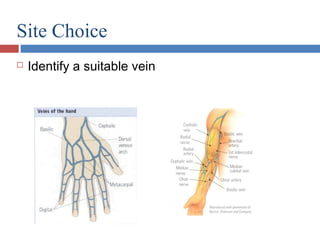
Site Choice
 Identify a suitable vein
Cannulation
 What are the signs of a good vein ?
 Bouncy
 Soft
 Above previous sites
 Refills when depressed
 Visible
 Has a large lumen
 Well supported
 Straight
 Easily palpable
9
Cannulation
 What veins should you avoid ?
 Thrombosed / sclerosed / fibrosed
 Inflamed / bruised
 Thin / Fragile
 Mobile
 Near bony prominences
 Areas or sites of infection, oedema or phlebitis
 Have undergone multiple previous punctures
 Do not use if patient has IV fluid in situ
10
Cannulation
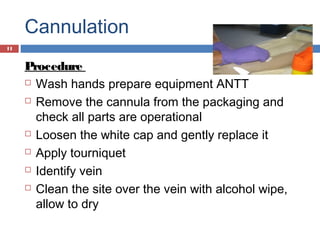
Procedure
 Wash hands prepare equipment ANTT
 Remove the cannula from the packaging and
check all parts are operational
 Loosen the white cap and gently replace it
 Apply tourniquet
 Identify vein
 Clean the site over the vein with alcohol wipe,
allow to dry
11
Cannulation
 Remove tourniquet if not able to proceed
 Put on non-sterile gloves
 Re-apply the tourniquet, 7-10 cm above site
 Remove the protective sleeve from the needle
taking care not to touch it at any time
 Hold the cannula in your dominant hand,
stretch the skin over the vein to anchor the
vein with your non-dominant hand (Do not re
palpate the vein)
12
Cannulation
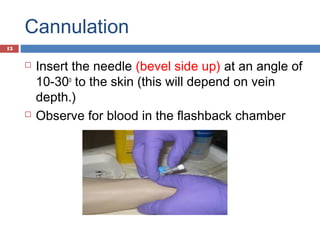
 Insert the needle (bevel side up) at an angle of
10-30o
to the skin (this will depend on vein
depth.)
 Observe for blood in the flashback chamber
13
Cannulation
 Lower the cannula slightly to ensure it enters
the lumen and does not puncture exterior wall
of the vessel
 Gently advance the cannula over the needle
whilst withdrawing the guide, noting secondary
flashback along the cannula
 Release the tourniquet
14
Cannulation
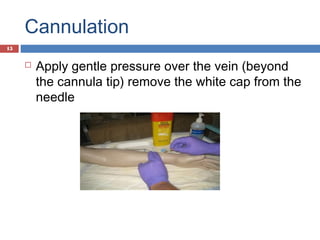
 Apply gentle pressure over the vein (beyond
the cannula tip) remove the white cap from the
needle
15
Cannulation
 Remove the needle from the cannula and
dispose of it into a sharps container
 Attach the white lock cap
 Secure the cannula with an appropriate
dressing
16
Cannulation
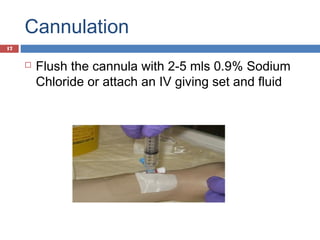
 Flush the cannula with 2-5 mls 0.9% Sodium
Chloride or attach an IV giving set and fluid
17
Cannulation
Finally
 Document the procedure including
 Date & time
 Site and size of cannula
 Any problems encountered
 Review date (cannula should be in situ no longer than 72 hours
without appropriate risk assessment.)
 Note: some hospitals have pre-printed forms to record cannula
events
 Thank the patient
 Clean up, dispose of rubbish
18
Cannulation
 Possible Complications:
 The intravenous (IV) cannula offers direct
access to a patient's vascular system and
provides a potential route for entry of micro
organisms into that system. These organisms
can cause serious infection if they are allowed
to enter and proliferate in the IV cannula,
insertion site, or IV fluid.
19
Cannulation
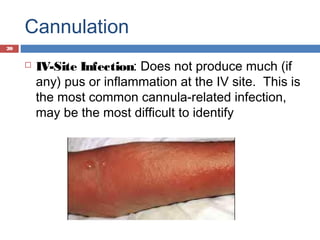
 IV-Site Infection: Does not produce much (if
any) pus or inflammation at the IV site.  This is
the most common cannula-related infection,
may be the most difficult to identify
20
Cannulation
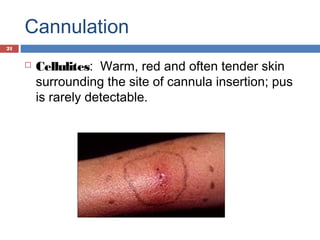
 Cellulites:  Warm, red and often tender skin
surrounding the site of cannula insertion; pus
is rarely detectable.
21
Cannulation
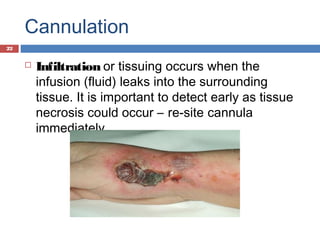
 Infiltration or tissuing occurs when the
infusion (fluid) leaks into the surrounding
tissue. It is important to detect early as tissue
necrosis could occur – re-site cannula
immediately
22
Cannulation
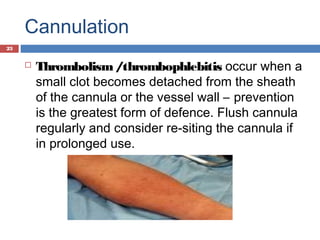
 Thrombolism /thrombophlebitis occur when a
small clot becomes detached from the sheath
of the cannula or the vessel wall – prevention
is the greatest form of defence. Flush cannula
regularly and consider re-siting the cannula if
in prolonged use.
23
Cannulation
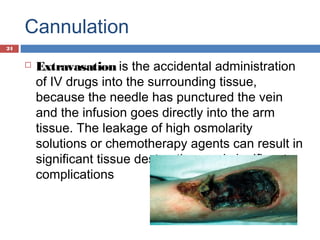
 Extravasation is the accidental administration
of IV drugs into the surrounding tissue,
because the needle has punctured the vein
and the infusion goes directly into the arm
tissue. The leakage of high osmolarity
solutions or chemotherapy agents can result in
significant tissue destruction, and significant
complications
24
Cannulation
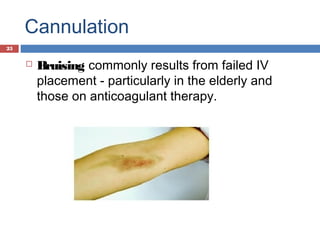
 Bruising commonly results from failed IV
placement - particularly in the elderly and
those on anticoagulant therapy.
25
Cannulation
 Airembolism occurs when air enters the
infusion line, although this is very rare it is best
if we consider the preventive measures –
Make sure all lines are well primed prior to use
and connections are secure
26
Cannulation
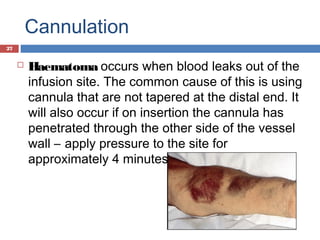
 Haematoma occurs when blood leaks out of the
infusion site. The common cause of this is using
cannula that are not tapered at the distal end. It
will also occur if on insertion the cannula has
penetrated through the other side of the vessel
wall – apply pressure to the site for
approximately 4 minutes and elevate the limb
27
Cannulation
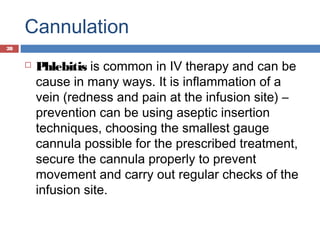
 Phlebitis is common in IV therapy and can be
cause in many ways. It is inflammation of a
vein (redness and pain at the infusion site) –
prevention can be using aseptic insertion
techniques, choosing the smallest gauge
cannula possible for the prescribed treatment,
secure the cannula properly to prevent
movement and carry out regular checks of the
infusion site.
28
Cannulation
29
Cannulation
 References
 Clinical Skills Education Centre
http://www.qub.ac.uk/cskills/index.htm
 Standards for Infusion Therapy RCN
http://www.rcn.org.uk/publications/pdf/standardsinfus
30

Intravenous cannulation

  • 1.
  • 2.
    Cannulation “The aim ofintravenous management is safe, effective delivery of treatment without discomfort or tissue damage and without compromising venous access, especially if long term therapy is proposed” The Royal Marsden NHS Trust Manual of Clinical Nursing Procedures Fourth Addition 2
  • 3.
    Cannulation Indications:  Fluid andelectrolyte replacement  Administration of medicines  Administration of blood/blood products  Administration of Total Parenteral Nutrition  Haemodynamic monitoring  Blood sampling 3
  • 4.
    Cannulation Advantages  Immediate effect Control over the rate of administration  Patient cannot tolerate drugs / fluids orally  Some drugs cannot be absorbed by any other route  Pain and irritation is avoided compared to some substances when given SC/IM 4
  • 5.
    Cannulation What equipment doyou need?  Dressing Tray - ANTT  Non Sterile Gloves / Apron  Cleaning Wipes  Gauze swab  IV cannula (separate slide)  Tourniquet  Dressing to secure cannula  Alcohol wipes  Saline flush and sterile syringe or fluid to be administered  Sharps bin 5
  • 6.
    Cannulation Preperation:  Consult withpatient  Give explanation  Gain consent  Position the patient appropriately and identify the non-dominant hand / arm  Support arm on pillow or in other suitable manner.  Check for any contra-indications e.g. infection, damaged tissue, AV fistula etc. 6
  • 7.
    Cannulation Encourage venous fillingby:  Correctly applying a tourniquet (A tourniquet should be applied to the patient’s upper arm. The tourniquet should be applied at a pressure which is high enough to impede venous distension but not to restrict arterial flow)  Opening & closing the fist  Lowering the limb below the heart 7
  • 8.
    Site Choice  Identifya suitable vein
  • 9.
    Cannulation  What arethe signs of a good vein ?  Bouncy  Soft  Above previous sites  Refills when depressed  Visible  Has a large lumen  Well supported  Straight  Easily palpable 9
  • 10.
    Cannulation  What veinsshould you avoid ?  Thrombosed / sclerosed / fibrosed  Inflamed / bruised  Thin / Fragile  Mobile  Near bony prominences  Areas or sites of infection, oedema or phlebitis  Have undergone multiple previous punctures  Do not use if patient has IV fluid in situ 10
  • 11.
    Cannulation Procedure  Wash handsprepare equipment ANTT  Remove the cannula from the packaging and check all parts are operational  Loosen the white cap and gently replace it  Apply tourniquet  Identify vein  Clean the site over the vein with alcohol wipe, allow to dry 11
  • 12.
    Cannulation  Remove tourniquetif not able to proceed  Put on non-sterile gloves  Re-apply the tourniquet, 7-10 cm above site  Remove the protective sleeve from the needle taking care not to touch it at any time  Hold the cannula in your dominant hand, stretch the skin over the vein to anchor the vein with your non-dominant hand (Do not re palpate the vein) 12
  • 13.
    Cannulation  Insert theneedle (bevel side up) at an angle of 10-30o to the skin (this will depend on vein depth.)  Observe for blood in the flashback chamber 13
  • 14.
    Cannulation  Lower thecannula slightly to ensure it enters the lumen and does not puncture exterior wall of the vessel  Gently advance the cannula over the needle whilst withdrawing the guide, noting secondary flashback along the cannula  Release the tourniquet 14
  • 15.
    Cannulation  Apply gentlepressure over the vein (beyond the cannula tip) remove the white cap from the needle 15
  • 16.
    Cannulation  Remove theneedle from the cannula and dispose of it into a sharps container  Attach the white lock cap  Secure the cannula with an appropriate dressing 16
  • 17.
    Cannulation  Flush thecannula with 2-5 mls 0.9% Sodium Chloride or attach an IV giving set and fluid 17
  • 18.
    Cannulation Finally  Document theprocedure including  Date & time  Site and size of cannula  Any problems encountered  Review date (cannula should be in situ no longer than 72 hours without appropriate risk assessment.)  Note: some hospitals have pre-printed forms to record cannula events  Thank the patient  Clean up, dispose of rubbish 18
  • 19.
    Cannulation  Possible Complications: The intravenous (IV) cannula offers direct access to a patient's vascular system and provides a potential route for entry of micro organisms into that system. These organisms can cause serious infection if they are allowed to enter and proliferate in the IV cannula, insertion site, or IV fluid. 19
  • 20.
    Cannulation  IV-Site Infection:Does not produce much (if any) pus or inflammation at the IV site.  This is the most common cannula-related infection, may be the most difficult to identify 20
  • 21.
    Cannulation  Cellulites:  Warm,red and often tender skin surrounding the site of cannula insertion; pus is rarely detectable. 21
  • 22.
    Cannulation  Infiltration ortissuing occurs when the infusion (fluid) leaks into the surrounding tissue. It is important to detect early as tissue necrosis could occur – re-site cannula immediately 22
  • 23.
    Cannulation  Thrombolism /thrombophlebitisoccur when a small clot becomes detached from the sheath of the cannula or the vessel wall – prevention is the greatest form of defence. Flush cannula regularly and consider re-siting the cannula if in prolonged use. 23
  • 24.
    Cannulation  Extravasation isthe accidental administration of IV drugs into the surrounding tissue, because the needle has punctured the vein and the infusion goes directly into the arm tissue. The leakage of high osmolarity solutions or chemotherapy agents can result in significant tissue destruction, and significant complications 24
  • 25.
    Cannulation  Bruising commonlyresults from failed IV placement - particularly in the elderly and those on anticoagulant therapy. 25
  • 26.
    Cannulation  Airembolism occurswhen air enters the infusion line, although this is very rare it is best if we consider the preventive measures – Make sure all lines are well primed prior to use and connections are secure 26
  • 27.
    Cannulation  Haematoma occurswhen blood leaks out of the infusion site. The common cause of this is using cannula that are not tapered at the distal end. It will also occur if on insertion the cannula has penetrated through the other side of the vessel wall – apply pressure to the site for approximately 4 minutes and elevate the limb 27
  • 28.
    Cannulation  Phlebitis iscommon in IV therapy and can be cause in many ways. It is inflammation of a vein (redness and pain at the infusion site) – prevention can be using aseptic insertion techniques, choosing the smallest gauge cannula possible for the prescribed treatment, secure the cannula properly to prevent movement and carry out regular checks of the infusion site. 28
  • 29.
  • 30.
    Cannulation  References  ClinicalSkills Education Centre http://www.qub.ac.uk/cskills/index.htm  Standards for Infusion Therapy RCN http://www.rcn.org.uk/publications/pdf/standardsinfus 30