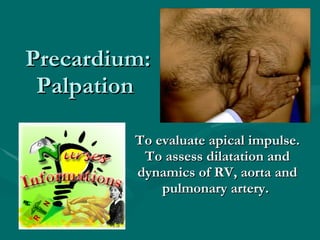

Precardium: Palpation  To evaluate apical impulse. To assess dilatation and dynamics of RV, aorta and pulmonary artery.
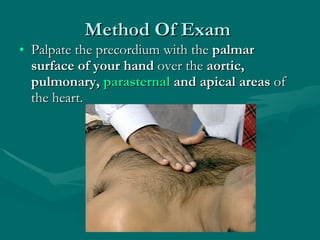
Method Of Exam  Palpate the precordium with the  palmar surface of your hand  over the  aortic, pulmonary,  parasternal  and apical areas  of the heart.
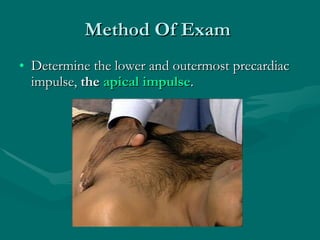
Method Of Exam  Determine the lower and outermost precardiac impulse,  the  apical impulse .
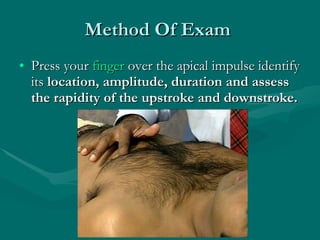
Method Of Exam  Press your  finger  over the apical impulse identify its  location, amplitude, duration and assess the rapidity of the upstroke and downstroke.
Normal:  In thin individuals, the  apical impulse  is recognizable. Apical impulse is normally in 5th interspace just medial to midclavicular line and is about  1-2 cm in diameter . The apical impulse feels like a  gentle tap  and is  small in amplitude  and corresponds to first two thirds of systole.
Abnormal Finding  Bulge:  Note the site of bulge.  Precordial bulge :  RV hypertrophy, LA enlargement, LV aneurysm  Aortic area bulge :  Aortic aneurysm, Dilation (e.g., post stenotic dilation)
Abnormal Finding  Thrust:  Note the site, size, amplitude , duration, upstroke and downstroke characteristics.  Parasternal area  :  Marked increase in amplitude with little change in duration; Volume overload of RV (ASD)  Marked increase in amplitude and duration; Pressure overload of RV (Pulmonic stenosis, Pulmonary hypertension)
Aortic area : ( Aortic aneurysm)  Pulmonic area :  Prominent pulsation (Pulmonary artery dilatation ,Increased flow , Pulmonary hypertension)  Apical impulse  Sustained lift  : Pressure overload, LV hypertrophy ( Aortic stenosis)  Hyperdynamic : Marked increase in amplitude Volume overload (Mitral insufficiency, Aortic insufficiency)  Undetectable  apical impulse: (Obesity, Emphysema, Muscular chest, Pericardial effusion)  Hypokinetic  apical impulse and displaced to left:(Dilated failing Heart)
Thrill:  It is a purring sensation. Note its location and timing.  Parasternal area  :  (PDA, ASD, VSD)  Aortic area :  ( Aortic stenosis)  Pulmonic area :  ( Pulmonary stenosis)  Apical area :  ( Mitral insufficiency, Mitral stenosis)
Tap :  Loud sounds evoke a palpable feeling like a tap.  Aortic area :  Palpable A2 ( Hypertension)  Pulmonic area :  Palpable P2 ( Pulmonary hypertension)   Rub :  Scratchy feeling.  ( Pericardial)  Szorsy Gallops:  Can be palpable
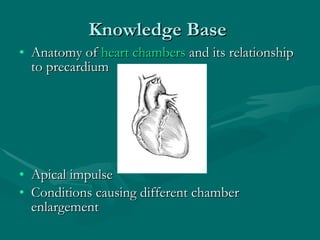
Knowledge Base  Anatomy of  heart chambers  and its relationship to precardium  Apical impulse  Conditions causing different chamber enlargement
Knowledge Base  Physiology of cardiac function  Surface anatomy of valves and major vessels  Hemodynamics of abnormal chambers and valves
Ref: :  Bates,  A Guide to Physical Exam ....279-284.  Review Dr. John McNulty's lesson, "Human cross sections". .  “ Nurses Informations” http://nursesinformations.blogspot.com

Precardium: Palpation

  • 1.
    Precardium: Palpation To evaluate apical impulse. To assess dilatation and dynamics of RV, aorta and pulmonary artery.
  • 2.
    Method Of Exam Palpate the precordium with the palmar surface of your hand over the aortic, pulmonary, parasternal and apical areas of the heart.
  • 3.
    Method Of Exam Determine the lower and outermost precardiac impulse, the apical impulse .
  • 4.
    Method Of Exam Press your finger over the apical impulse identify its location, amplitude, duration and assess the rapidity of the upstroke and downstroke.
  • 5.
    Normal: Inthin individuals, the apical impulse is recognizable. Apical impulse is normally in 5th interspace just medial to midclavicular line and is about 1-2 cm in diameter . The apical impulse feels like a gentle tap and is small in amplitude and corresponds to first two thirds of systole.
  • 6.
    Abnormal Finding Bulge: Note the site of bulge. Precordial bulge : RV hypertrophy, LA enlargement, LV aneurysm Aortic area bulge : Aortic aneurysm, Dilation (e.g., post stenotic dilation)
  • 7.
    Abnormal Finding Thrust: Note the site, size, amplitude , duration, upstroke and downstroke characteristics. Parasternal area : Marked increase in amplitude with little change in duration; Volume overload of RV (ASD) Marked increase in amplitude and duration; Pressure overload of RV (Pulmonic stenosis, Pulmonary hypertension)
  • 8.
    Aortic area :( Aortic aneurysm) Pulmonic area : Prominent pulsation (Pulmonary artery dilatation ,Increased flow , Pulmonary hypertension) Apical impulse Sustained lift : Pressure overload, LV hypertrophy ( Aortic stenosis) Hyperdynamic : Marked increase in amplitude Volume overload (Mitral insufficiency, Aortic insufficiency) Undetectable apical impulse: (Obesity, Emphysema, Muscular chest, Pericardial effusion) Hypokinetic apical impulse and displaced to left:(Dilated failing Heart)
  • 9.
    Thrill: Itis a purring sensation. Note its location and timing. Parasternal area : (PDA, ASD, VSD) Aortic area : ( Aortic stenosis) Pulmonic area : ( Pulmonary stenosis) Apical area : ( Mitral insufficiency, Mitral stenosis)
  • 10.
    Tap : Loud sounds evoke a palpable feeling like a tap. Aortic area : Palpable A2 ( Hypertension) Pulmonic area : Palpable P2 ( Pulmonary hypertension) Rub : Scratchy feeling. ( Pericardial) Szorsy Gallops: Can be palpable
  • 11.
    Knowledge Base Anatomy of heart chambers and its relationship to precardium Apical impulse Conditions causing different chamber enlargement
  • 12.
    Knowledge Base Physiology of cardiac function Surface anatomy of valves and major vessels Hemodynamics of abnormal chambers and valves
  • 13.
    Ref: : Bates, A Guide to Physical Exam ....279-284. Review Dr. John McNulty's lesson, "Human cross sections". . “ Nurses Informations” http://nursesinformations.blogspot.com