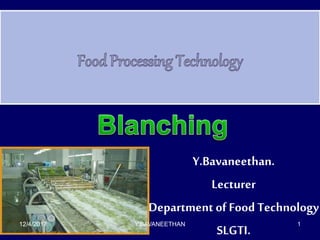
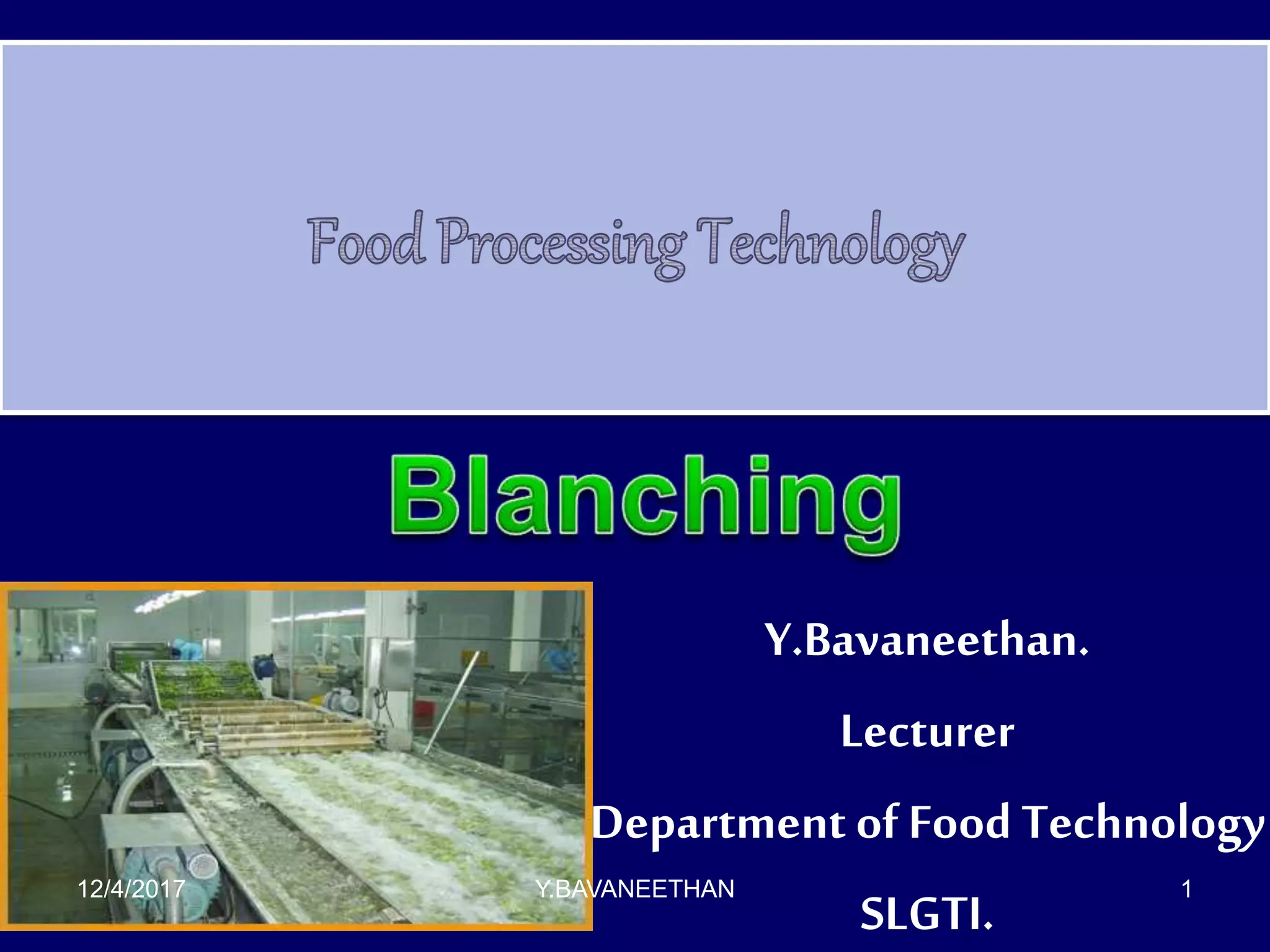
Y.Bavaneethan.
Lecturer
Department of Food Technology
SLGTI.
12/4/2017 Y.BAVANEETHAN 1
Heat Processing Overview
 Heat processing using steam or water
– Blanching | Pasteurisation | Heat sterilisation
 Heat processing using hot air
– Dehydration | Baking and roasting
 Heat processing using hot oils
– Frying
 Heat processing by direct and radiated energy
– Dielectric | Ohmic | Infrared
 Processing by The Removal of Heat
– Chilling | Controlled- or modified-atmosphere
storage and packaging | Freezing | Freeze drying
12/4/2017 Y.BAVANEETHAN 2
Blanching
Blanching is used to
– lower enzymatic activity in vegetables and fruits
Not final method of preservation but as a pre-
treatment,
– between the preparation of the raw material and
further processing steps
Combined with peeling and/or cleaning
Some vegetables are not blanched
– specific location of the enzymes
12/4/2017 Y.BAVANEETHAN 3
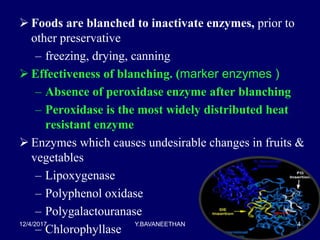
 Foods are blanched to inactivate enzymes, prior to
other preservative
– freezing, drying, canning
 Effectiveness of blanching. (marker enzymes )
– Absence of peroxidase enzyme after blanching
– Peroxidase is the most widely distributed heat
resistant enzyme
 Enzymes which causes undesirable changes in fruits &
vegetables
– Lipoxygenase
– Polyphenol oxidase
– Polygalactouranase
– Chlorophyllase
12/4/2017 Y.BAVANEETHAN 4
Main objectives of blanching:
– Inactivation of enzymes
– Reduction of the microbial contamination
– Reduction of the volume
– Air removal
– Preheating
– Cleaning
 Blanching –
– Softens vegetable tissues
• facilitate filling into containers
– Removes air from intercellular spaces
• increases the density of food
– Help to formation of a head-space vacuum in cans12/4/2017 Y.BAVANEETHAN 5
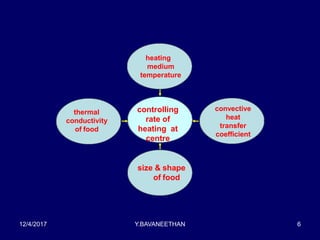
thermal
conductivity
of food
size & shape
of food
convective
heat
transfer
coefficient
heating
medium
temperature
controlling
rate of
heating at
centre
12/4/2017 Y.BAVANEETHAN 6
Methods of blanching
1. Steam blanching- steam for 30-90 sec
2. Hot water blanching - dipping in hot water for 1-5
minutes
 Reduce the energy consumption and reduce the loss of
soluble components of foods,
– reduces the volume and polluting potential of
effluents
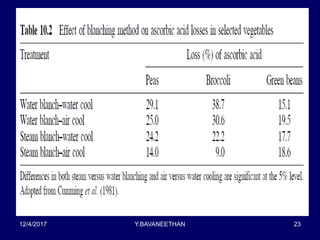
 Steam blanching results higher nutrient retention than
hot water.
 After blanching, cooling is by cold-air or cold-water
sprays.
12/4/2017 Y.BAVANEETHAN 7
1. Cooling with running water (fluming)
– increases leaching losses,
– gain weight by absorbing water
2. Air cooling
– weight loss due to evaporation
– nutrient retention
 Nutrition retention - method of preparation
– slicing and peeling increase nutrition losses and
reduce the yield
12/4/2017 Y.BAVANEETHAN 8
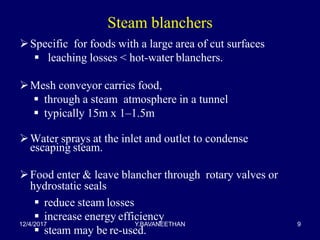
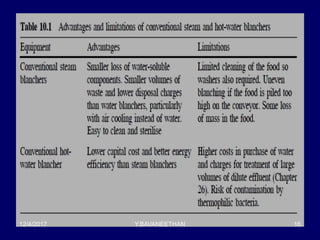
Steam blanchers
Specific for foods with a large area of cut surfaces
 leaching losses < hot-water blanchers.
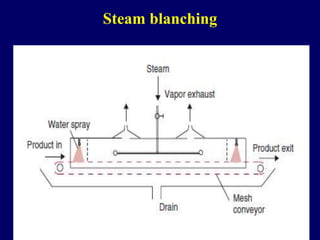
Mesh conveyor carries food,
 through a steam atmosphere in a tunnel
 typically 15m x 1–1.5m
Water sprays at the inlet and outlet to condense
escaping steam.
Food enter & leave blancher through rotary valves or
hydrostatic seals
 reduce steam losses
 increase energy efficiency
 steam may be re-used.
12/4/2017 Y.BAVANEETHAN 9
Steam blanching
12/4/2017 Y.BAVANEETHAN 10
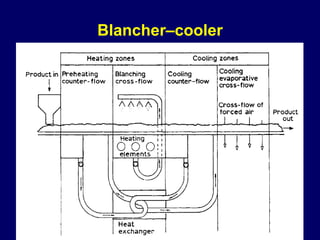
Blancher–cooler
12/4/2017 Y.BAVANEETHAN 11
Batch fluidised-bed blanchers
• Batch fluidised-bed blanchers
– mixture of air & steam
– fluidises & heats product simultaneously.
• Advantages:
– faster, more uniform heating
– good mixing of product
– reduction of effluent volume
– shorter processing times
– smaller losses of vitamins & other soluble heat
sensitive components.
12/4/2017 Y.BAVANEETHAN 12
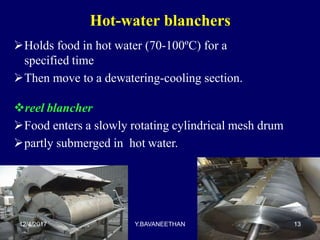
Hot-water blanchers
Holds food in hot water (70-100ºC) for a
specified time
Then move to a dewatering-cooling section.
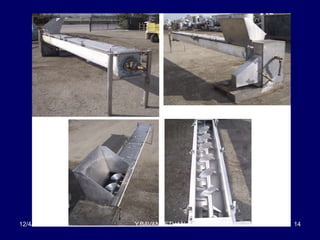
reel blancher
Food enters a slowly rotating cylindrical mesh drum
partly submerged in hot water.
12/4/2017 Y.BAVANEETHAN 13
12/4/2017 Y.BAVANEETHAN 14
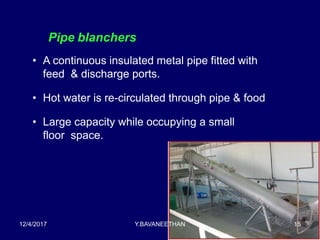
Pipe blanchers
• A continuous insulated metal pipe fitted with
feed & discharge ports.
• Hot water is re-circulated through pipe & food
• Large capacity while occupying a small
floor space.
12/4/2017 Y.BAVANEETHAN 15
12/4/2017 Y.BAVANEETHAN 16
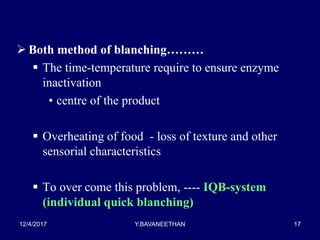
 Both method of blanching………
 The time-temperature require to ensure enzyme
inactivation
• centre of the product
 Overheating of food - loss of texture and other
sensorial characteristics
 To over come this problem, ---- IQB-system
(individual quick blanching)
12/4/2017 Y.BAVANEETHAN 17
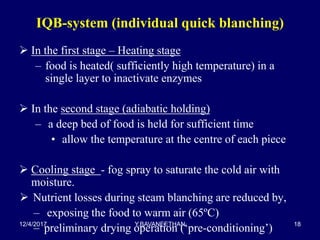
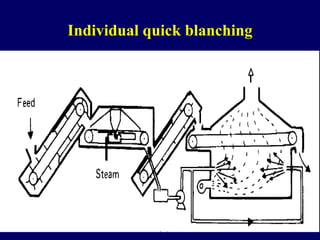
IQB-system (individual quick blanching)
 In the first stage – Heating stage
– food is heated( sufficiently high temperature) in a
single layer to inactivate enzymes
 In the second stage (adiabatic holding)
– a deep bed of food is held for sufficient time
• allow the temperature at the centre of each piece
 Cooling stage - fog spray to saturate the cold air with
moisture.
 Nutrient losses during steam blanching are reduced by,
– exposing the food to warm air (65ºC)
– preliminary drying operation (‘pre-conditioning’)12/4/2017 Y.BAVANEETHAN 18
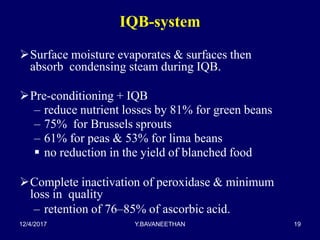
IQB-system
Surface moisture evaporates & surfaces then
absorb condensing steam during IQB.
Pre-conditioning + IQB
– reduce nutrient losses by 81% for green beans
– 75% for Brussels sprouts
– 61% for peas & 53% for lima beans
 no reduction in the yield of blanched food
Complete inactivation of peroxidase & minimum
loss in quality
– retention of 76–85% of ascorbic acid.
12/4/2017 Y.BAVANEETHAN 19
Individual quick blanching
12/4/2017 Y.BAVANEETHAN 20
Effect on foods
1. Nutrients
 Some minerals, water-soluble vitamins and other
water-soluble components are lost during blanching.
 Losses of vitamins mostly by
– leaching, thermal destruction and oxidation.
12/4/2017 Y.BAVANEETHAN 21
Nutrition loss depends on:
– maturity and variety
– methods of preparation (cutting, slicing or
dicing)
– surface-area-to-volume ratio of the pieces
– method of blanching
– time and temperature of blanching (lower
vitamin losses at HTST)
– method of cooling
12/4/2017 Y.BAVANEETHAN 22
12/4/2017 Y.BAVANEETHAN 23
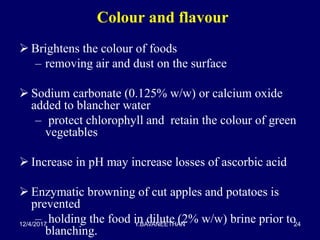
Colour and flavour
 Brightens the colour of foods
– removing air and dust on the surface
 Sodium carbonate (0.125% w/w) or calcium oxide
added to blancher water
– protect chlorophyll and retain the colour of green
vegetables
 Increase in pH may increase losses of ascorbic acid
 Enzymatic browning of cut apples and potatoes is
prevented
– holding the food in dilute (2% w/w) brine prior to
blanching.
12/4/2017 Y.BAVANEETHAN 24
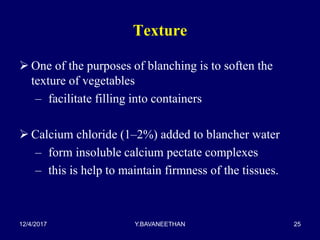
Texture
 One of the purposes of blanching is to soften the
texture of vegetables
– facilitate filling into containers
 Calcium chloride (1–2%) added to blancher water
– form insoluble calcium pectate complexes
– this is help to maintain firmness of the tissues.
12/4/2017 Y.BAVANEETHAN 25
12/4/2017 Y.BAVANEETHAN 26
References
• BOMBEN, J. C., DIETRICH, W. C., FARKAS, D. F., HUDSON, J. S. and
DE MARCHENA, E. S. (1973) Pilot plant evaluation of individual quick
blanching for vegetables. J. Food Sci. 38, 590–594.
• BOMBEN, J. C., DIETRICH, W. C., HUDSON, J. S., HAMILTON, H. K.
and FARKAS, D.F. (1975) Yields and solids loss in steam blanching,
cooling and freezing vegetables. J. Food Sci. 40, 660–664.
• CUMMING, D. B., STARK, R. and SANFORD, K. A. (1981) The effect
of an individual quick blanching method on ascorbic acid retention in
selected vegetables. J. Food Process Preserv. 5, 31–37.
• CUMMING, D. B., STARK, R., TIMBERS, G. E. and COWMEADOW,
R. (1984) A new blanching system for the food industry, II, Commercial
design and testing. J. Food Process Preserv. 8, 137–150.
12/4/2017 Y.BAVANEETHAN 27
References….
• GILBERT, H., BAXERRES, J. L. and KIM, H. (1980) In: P. Linko, Y.
Malkki, J. Olkku and J. Larinkan (eds) Food Process Engineering, Vol. 1.
Applied Science, London, pp. 75–85.
• HALLSTROM, B., SKJOLDERBRAND, C. and TRAGARDH, C. (1988)
Heat Transfer and Food Products. Elsevier Applied Science, London, pp.
158–242.
• LAZAR, M. E., LUND, D. B. and DIETRICH, W. C. (1971) IQB – a new
concept in blanching. Food Technol. 25, 684– 686.
• PHILIPPON, J. (1984) Methods de blanchiment-refroidissement des
legumes destines a la congelation. Sci. Aliments 4, 523–550.
• SCOTT, E. P., CARROAD, P. A., RUMSEY, T. R., HORN, J.,
BUHLERT, J. and ROSE, W. W. (1981) Energy consumption in steam
blanchers. J. Food Process Engng 5, 77–88.
12/4/2017 Y.BAVANEETHAN 28

Blanching

  • 1.
    Y.Bavaneethan. Lecturer Department of FoodTechnology SLGTI. 12/4/2017 Y.BAVANEETHAN 1
  • 2.
    Heat Processing Overview Heat processing using steam or water – Blanching | Pasteurisation | Heat sterilisation  Heat processing using hot air – Dehydration | Baking and roasting  Heat processing using hot oils – Frying  Heat processing by direct and radiated energy – Dielectric | Ohmic | Infrared  Processing by The Removal of Heat – Chilling | Controlled- or modified-atmosphere storage and packaging | Freezing | Freeze drying 12/4/2017 Y.BAVANEETHAN 2
  • 3.
    Blanching Blanching is usedto – lower enzymatic activity in vegetables and fruits Not final method of preservation but as a pre- treatment, – between the preparation of the raw material and further processing steps Combined with peeling and/or cleaning Some vegetables are not blanched – specific location of the enzymes 12/4/2017 Y.BAVANEETHAN 3
  • 4.
     Foods areblanched to inactivate enzymes, prior to other preservative – freezing, drying, canning  Effectiveness of blanching. (marker enzymes ) – Absence of peroxidase enzyme after blanching – Peroxidase is the most widely distributed heat resistant enzyme  Enzymes which causes undesirable changes in fruits & vegetables – Lipoxygenase – Polyphenol oxidase – Polygalactouranase – Chlorophyllase 12/4/2017 Y.BAVANEETHAN 4
  • 5.
    Main objectives ofblanching: – Inactivation of enzymes – Reduction of the microbial contamination – Reduction of the volume – Air removal – Preheating – Cleaning  Blanching – – Softens vegetable tissues • facilitate filling into containers – Removes air from intercellular spaces • increases the density of food – Help to formation of a head-space vacuum in cans12/4/2017 Y.BAVANEETHAN 5
  • 6.
    thermal conductivity of food size &shape of food convective heat transfer coefficient heating medium temperature controlling rate of heating at centre 12/4/2017 Y.BAVANEETHAN 6
  • 7.
    Methods of blanching 1.Steam blanching- steam for 30-90 sec 2. Hot water blanching - dipping in hot water for 1-5 minutes  Reduce the energy consumption and reduce the loss of soluble components of foods, – reduces the volume and polluting potential of effluents  Steam blanching results higher nutrient retention than hot water.  After blanching, cooling is by cold-air or cold-water sprays. 12/4/2017 Y.BAVANEETHAN 7
  • 8.
    1. Cooling withrunning water (fluming) – increases leaching losses, – gain weight by absorbing water 2. Air cooling – weight loss due to evaporation – nutrient retention  Nutrition retention - method of preparation – slicing and peeling increase nutrition losses and reduce the yield 12/4/2017 Y.BAVANEETHAN 8
  • 9.
    Steam blanchers Specific forfoods with a large area of cut surfaces  leaching losses < hot-water blanchers. Mesh conveyor carries food,  through a steam atmosphere in a tunnel  typically 15m x 1–1.5m Water sprays at the inlet and outlet to condense escaping steam. Food enter & leave blancher through rotary valves or hydrostatic seals  reduce steam losses  increase energy efficiency  steam may be re-used. 12/4/2017 Y.BAVANEETHAN 9
  • 10.
  • 11.
  • 12.
    Batch fluidised-bed blanchers •Batch fluidised-bed blanchers – mixture of air & steam – fluidises & heats product simultaneously. • Advantages: – faster, more uniform heating – good mixing of product – reduction of effluent volume – shorter processing times – smaller losses of vitamins & other soluble heat sensitive components. 12/4/2017 Y.BAVANEETHAN 12
  • 13.
    Hot-water blanchers Holds foodin hot water (70-100ºC) for a specified time Then move to a dewatering-cooling section. reel blancher Food enters a slowly rotating cylindrical mesh drum partly submerged in hot water. 12/4/2017 Y.BAVANEETHAN 13
  • 14.
  • 15.
    Pipe blanchers • Acontinuous insulated metal pipe fitted with feed & discharge ports. • Hot water is re-circulated through pipe & food • Large capacity while occupying a small floor space. 12/4/2017 Y.BAVANEETHAN 15
  • 16.
  • 17.
     Both methodof blanching………  The time-temperature require to ensure enzyme inactivation • centre of the product  Overheating of food - loss of texture and other sensorial characteristics  To over come this problem, ---- IQB-system (individual quick blanching) 12/4/2017 Y.BAVANEETHAN 17
  • 18.
    IQB-system (individual quickblanching)  In the first stage – Heating stage – food is heated( sufficiently high temperature) in a single layer to inactivate enzymes  In the second stage (adiabatic holding) – a deep bed of food is held for sufficient time • allow the temperature at the centre of each piece  Cooling stage - fog spray to saturate the cold air with moisture.  Nutrient losses during steam blanching are reduced by, – exposing the food to warm air (65ºC) – preliminary drying operation (‘pre-conditioning’)12/4/2017 Y.BAVANEETHAN 18
  • 19.
    IQB-system Surface moisture evaporates& surfaces then absorb condensing steam during IQB. Pre-conditioning + IQB – reduce nutrient losses by 81% for green beans – 75% for Brussels sprouts – 61% for peas & 53% for lima beans  no reduction in the yield of blanched food Complete inactivation of peroxidase & minimum loss in quality – retention of 76–85% of ascorbic acid. 12/4/2017 Y.BAVANEETHAN 19
  • 20.
  • 21.
    Effect on foods 1.Nutrients  Some minerals, water-soluble vitamins and other water-soluble components are lost during blanching.  Losses of vitamins mostly by – leaching, thermal destruction and oxidation. 12/4/2017 Y.BAVANEETHAN 21
  • 22.
    Nutrition loss dependson: – maturity and variety – methods of preparation (cutting, slicing or dicing) – surface-area-to-volume ratio of the pieces – method of blanching – time and temperature of blanching (lower vitamin losses at HTST) – method of cooling 12/4/2017 Y.BAVANEETHAN 22
  • 23.
  • 24.
    Colour and flavour Brightens the colour of foods – removing air and dust on the surface  Sodium carbonate (0.125% w/w) or calcium oxide added to blancher water – protect chlorophyll and retain the colour of green vegetables  Increase in pH may increase losses of ascorbic acid  Enzymatic browning of cut apples and potatoes is prevented – holding the food in dilute (2% w/w) brine prior to blanching. 12/4/2017 Y.BAVANEETHAN 24
  • 25.
    Texture  One ofthe purposes of blanching is to soften the texture of vegetables – facilitate filling into containers  Calcium chloride (1–2%) added to blancher water – form insoluble calcium pectate complexes – this is help to maintain firmness of the tissues. 12/4/2017 Y.BAVANEETHAN 25
  • 26.
  • 27.
    References • BOMBEN, J.C., DIETRICH, W. C., FARKAS, D. F., HUDSON, J. S. and DE MARCHENA, E. S. (1973) Pilot plant evaluation of individual quick blanching for vegetables. J. Food Sci. 38, 590–594. • BOMBEN, J. C., DIETRICH, W. C., HUDSON, J. S., HAMILTON, H. K. and FARKAS, D.F. (1975) Yields and solids loss in steam blanching, cooling and freezing vegetables. J. Food Sci. 40, 660–664. • CUMMING, D. B., STARK, R. and SANFORD, K. A. (1981) The effect of an individual quick blanching method on ascorbic acid retention in selected vegetables. J. Food Process Preserv. 5, 31–37. • CUMMING, D. B., STARK, R., TIMBERS, G. E. and COWMEADOW, R. (1984) A new blanching system for the food industry, II, Commercial design and testing. J. Food Process Preserv. 8, 137–150. 12/4/2017 Y.BAVANEETHAN 27
  • 28.
    References…. • GILBERT, H.,BAXERRES, J. L. and KIM, H. (1980) In: P. Linko, Y. Malkki, J. Olkku and J. Larinkan (eds) Food Process Engineering, Vol. 1. Applied Science, London, pp. 75–85. • HALLSTROM, B., SKJOLDERBRAND, C. and TRAGARDH, C. (1988) Heat Transfer and Food Products. Elsevier Applied Science, London, pp. 158–242. • LAZAR, M. E., LUND, D. B. and DIETRICH, W. C. (1971) IQB – a new concept in blanching. Food Technol. 25, 684– 686. • PHILIPPON, J. (1984) Methods de blanchiment-refroidissement des legumes destines a la congelation. Sci. Aliments 4, 523–550. • SCOTT, E. P., CARROAD, P. A., RUMSEY, T. R., HORN, J., BUHLERT, J. and ROSE, W. W. (1981) Energy consumption in steam blanchers. J. Food Process Engng 5, 77–88. 12/4/2017 Y.BAVANEETHAN 28