FOOD PROCESSING(FST-504)
ADVANCES IN FOOD PROCESSING AND PRESERVATION
BY HEAT TREATMENT
BLANCHING
Submitted by: Submitted to:
Aryama Dipt Dr. Anil Kumar Chauhan
Department of Dairy Science and Food Technology
Institute of Agriculture Sciences
Banaras Hindu University
INTRODUCTION
• Blanching involves heating fruits and vegetables to a predetermined
temperature and maintain it for a specified amount of time, typically 2-10
minutes. Product is then immediately cooled or passed to next process.
• It is a thermal treatment that is usually performed prior to food processes
such as drying, freezing, frying and canning.
• It is a pre-treatment necessary to preserve product quality during long term
storage.
• Inadequate blanching may cause more damage to food than the absence of
blanching does.
INDICATOR ENZYMES
• Enzymes which cause a loss of eating and nutritional qualities in vegetables and
fruits include lipoxygenase, polyphenoloxidase, polygalacturonase and
chlorophyllase.
• Two heat-resistant enzymes which are found in most vegetables are catalase and
peroxidase.
• Peroxidase being more heat resistant of the two is taken as an indicator organism.
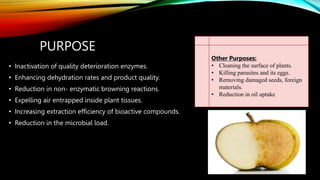
PURPOSE
Other Purposes:
• Cleaning the surface of plants.
• Killing parasites and its eggs.
• Removing damaged seeds, foreign
materials.
• Reduction in oil uptake.
• Inactivation of quality deterioration enzymes.
• Enhancing dehydration rates and product quality.
• Reduction in non- enzymatic browning reactions.
• Expelling air entrapped inside plant tissues.
• Increasing extraction efficiency of bioactive compounds.
• Reduction in the microbial load.
A
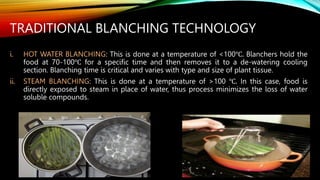
TRADITIONAL BLANCHING TECHNOLOGY
i. HOT WATER BLANCHING: This is done at a temperature of <100℃. Blanchers hold the
food at 70-100℃ for a specific time and then removes it to a de-watering cooling
section. Blanching time is critical and varies with type and size of plant tissue.
ii. STEAM BLANCHING: This is done at a temperature of >100 ℃. In this case, food is
directly exposed to steam in place of water, thus process minimizes the loss of water
soluble compounds.
A
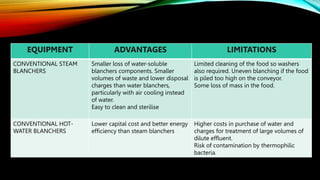
EQUIPMENT ADVANTAGES LIMITATIONS
CONVENTIONAL STEAM
BLANCHERS
Smaller loss of water-soluble
blanchers components. Smaller
volumes of waste and lower disposal
charges than water blanchers,
particularly with air cooling instead
of water.
Easy to clean and sterilise
Limited cleaning of the food so washers
also required. Uneven blanching if the food
is piled too high on the conveyor.
Some loss of mass in the food.
CONVENTIONAL HOT-
WATER BLANCHERS
Lower capital cost and better energy
efficiency than steam blanchers
Higher costs in purchase of water and
charges for treatment of large volumes of
dilute effluent.
Risk of contamination by thermophilic
bacteria.
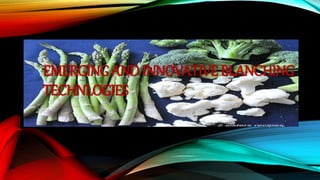
EMERGING AND INNOVATIVE BLANCHING
TECHNLOGIES
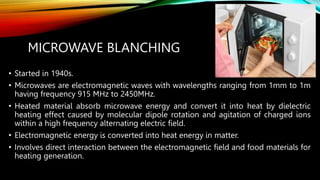
MICROWAVE BLANCHING
• Started in 1940s.
• Microwaves are electromagnetic waves with wavelengths ranging from 1mm to 1m
having frequency 915 MHz to 2450MHz.
• Heated material absorb microwave energy and convert it into heat by dielectric
heating effect caused by molecular dipole rotation and agitation of charged ions
within a high frequency alternating electric field.
• Electromagnetic energy is converted into heat energy in matter.
• Involves direct interaction between the electromagnetic field and food materials for
heating generation.
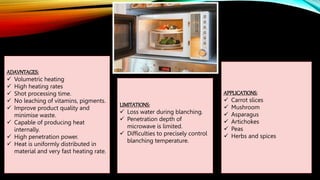
ADAVNTAGES:
 Volumetric heating
 High heating rates
 Shot processing time.
 No leaching of vitamins, pigments.
 Improve product quality and
minimise waste.
 Capable of producing heat
internally.
 High penetration power.
 Heat is uniformly distributed in
material and very fast heating rate.
LIMITATIONS:
 Loss water during blanching.
 Penetration depth of
microwave is limited.
 Difficulties to precisely control
blanching temperature.
APPLICATIONS:
 Carrot slices
 Mushroom
 Asparagus
 Artichokes
 Peas
 Herbs and spices
INFRARED BLANCHING
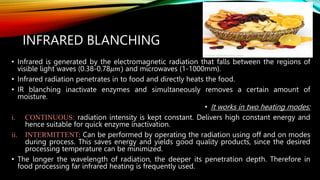
• Infrared is generated by the electromagnetic radiation that falls between the regions of
visible light waves (0.38-0.78𝜇𝑚) and microwaves (1-1000mm).
• Infrared radiation penetrates in to food and directly heats the food.
• IR blanching inactivate enzymes and simultaneously removes a certain amount of
moisture.
• It works in two heating modes:
i. CONTINUOUS: radiation intensity is kept constant. Delivers high constant energy and
hence suitable for quick enzyme inactivation.
ii. INTERMITTENT: Can be performed by operating the radiation using off and on modes
during process. This saves energy and yields good quality products, since the desired
processing temperature can be minimized.
• The longer the wavelength of radiation, the deeper its penetration depth. Therefore in
food processing far infrared heating is frequently used.
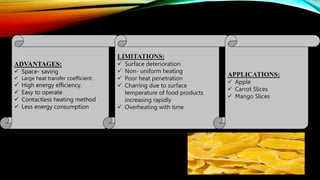
ADVANTAGES:
 Space- saving
 Large heat transfer coefficient.
 High energy efficiency.
 Easy to operate
 Contactless heating method
 Less energy consumption
LIMITATIONS:
 Surface deterioration
 Non- uniform heating
 Poor heat penetration
 Charring due to surface
temperature of food products
increasing rapidly
 Overheating with time
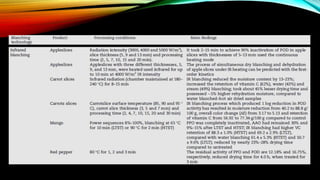
APPLICATIONS:
 Apple
 Carrot Slices
 Mango Slices
OHMIC BLANCHING
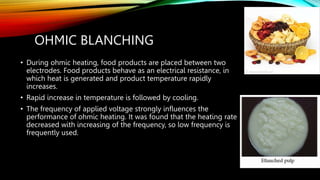
• During ohmic heating, food products are placed between two
electrodes. Food products behave as an electrical resistance, in
which heat is generated and product temperature rapidly
increases.
• Rapid increase in temperature is followed by cooling.
• The frequency of applied voltage strongly influences the
performance of ohmic heating. It was found that the heating rate
decreased with increasing of the frequency, so low frequency is
frequently used.
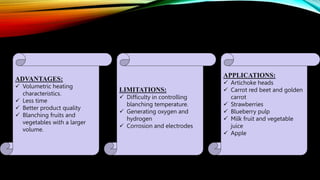
ADVANTAGES:
 Volumetric heating
characteristics.
 Less time
 Better product quality
 Blanching fruits and
vegetables with a larger
volume.
LIMITATIONS:
 Difficulty in controlling
blanching temperature.
 Generating oxygen and
hydrogen
 Corrosion and electrodes
APPLICATIONS:
 Artichoke heads
 Carrot red beet and golden
carrot
 Strawberries
 Blueberry pulp
 Milk fruit and vegetable
juice
 Apple
EFFECT OF BLANCHING ON FOOD
QUALITY
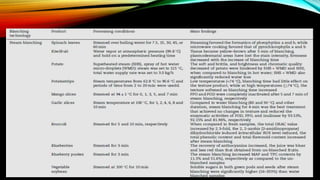
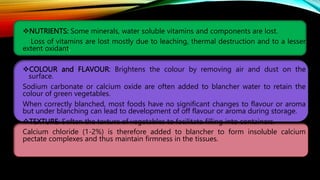
NUTRIENTS: Some minerals, water soluble vitamins and components are lost.
Loss of vitamins are lost mostly due to leaching, thermal destruction and to a lesser
extent oxidant.
COLOUR and FLAVOUR: Brightens the colour by removing air and dust on the
surface.
Sodium carbonate or calcium oxide are often added to blancher water to retain the
colour of green vegetables.
When correctly blanched, most foods have no significant changes to flavour or aroma
but under blanching can lead to development of off flavour or aroma during storage.
TEXTURE: Soften the texture of vegetables to facilitate filling into containers.
Calcium chloride (1-2%) is therefore added to blancher to form insoluble calcium
pectate complexes and thus maintain firmness in the tissues.
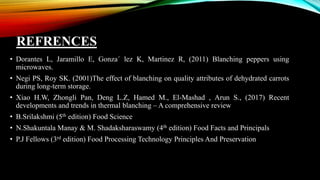
REFRENCES
• Dorantes L, Jaramillo E, Gonza´ lez K, Martinez R, (2011) Blanching peppers using
microwaves.
• Negi PS, Roy SK. (2001)The effect of blanching on quality attributes of dehydrated carrots
during long-term storage.
• Xiao H.W, Zhongli Pan, Deng L.Z, Hamed M., El-Mashad , Arun S., (2017) Recent
developments and trends in thermal blanching – A comprehensive review
• B.Srilakshmi (5th edition) Food Science
• N.Shakuntala Manay & M. Shadaksharaswamy (4th edition) Food Facts and Principals
• P.J Fellows (3rd edition) Food Processing Technology Principles And Preservation
THANK YOU

BLANCHING.pptx

  • 1.
    FOOD PROCESSING(FST-504) ADVANCES INFOOD PROCESSING AND PRESERVATION BY HEAT TREATMENT BLANCHING Submitted by: Submitted to: Aryama Dipt Dr. Anil Kumar Chauhan Department of Dairy Science and Food Technology Institute of Agriculture Sciences Banaras Hindu University
  • 2.
    INTRODUCTION • Blanching involvesheating fruits and vegetables to a predetermined temperature and maintain it for a specified amount of time, typically 2-10 minutes. Product is then immediately cooled or passed to next process. • It is a thermal treatment that is usually performed prior to food processes such as drying, freezing, frying and canning. • It is a pre-treatment necessary to preserve product quality during long term storage. • Inadequate blanching may cause more damage to food than the absence of blanching does.
  • 3.
    INDICATOR ENZYMES • Enzymeswhich cause a loss of eating and nutritional qualities in vegetables and fruits include lipoxygenase, polyphenoloxidase, polygalacturonase and chlorophyllase. • Two heat-resistant enzymes which are found in most vegetables are catalase and peroxidase. • Peroxidase being more heat resistant of the two is taken as an indicator organism.
  • 4.
    PURPOSE Other Purposes: • Cleaningthe surface of plants. • Killing parasites and its eggs. • Removing damaged seeds, foreign materials. • Reduction in oil uptake. • Inactivation of quality deterioration enzymes. • Enhancing dehydration rates and product quality. • Reduction in non- enzymatic browning reactions. • Expelling air entrapped inside plant tissues. • Increasing extraction efficiency of bioactive compounds. • Reduction in the microbial load.
  • 5.
    A TRADITIONAL BLANCHING TECHNOLOGY i.HOT WATER BLANCHING: This is done at a temperature of <100℃. Blanchers hold the food at 70-100℃ for a specific time and then removes it to a de-watering cooling section. Blanching time is critical and varies with type and size of plant tissue. ii. STEAM BLANCHING: This is done at a temperature of >100 ℃. In this case, food is directly exposed to steam in place of water, thus process minimizes the loss of water soluble compounds.
  • 6.
    A EQUIPMENT ADVANTAGES LIMITATIONS CONVENTIONALSTEAM BLANCHERS Smaller loss of water-soluble blanchers components. Smaller volumes of waste and lower disposal charges than water blanchers, particularly with air cooling instead of water. Easy to clean and sterilise Limited cleaning of the food so washers also required. Uneven blanching if the food is piled too high on the conveyor. Some loss of mass in the food. CONVENTIONAL HOT- WATER BLANCHERS Lower capital cost and better energy efficiency than steam blanchers Higher costs in purchase of water and charges for treatment of large volumes of dilute effluent. Risk of contamination by thermophilic bacteria.
  • 8.
    EMERGING AND INNOVATIVEBLANCHING TECHNLOGIES
  • 9.
    MICROWAVE BLANCHING • Startedin 1940s. • Microwaves are electromagnetic waves with wavelengths ranging from 1mm to 1m having frequency 915 MHz to 2450MHz. • Heated material absorb microwave energy and convert it into heat by dielectric heating effect caused by molecular dipole rotation and agitation of charged ions within a high frequency alternating electric field. • Electromagnetic energy is converted into heat energy in matter. • Involves direct interaction between the electromagnetic field and food materials for heating generation.
  • 10.
    ADAVNTAGES:  Volumetric heating High heating rates  Shot processing time.  No leaching of vitamins, pigments.  Improve product quality and minimise waste.  Capable of producing heat internally.  High penetration power.  Heat is uniformly distributed in material and very fast heating rate. LIMITATIONS:  Loss water during blanching.  Penetration depth of microwave is limited.  Difficulties to precisely control blanching temperature. APPLICATIONS:  Carrot slices  Mushroom  Asparagus  Artichokes  Peas  Herbs and spices
  • 12.
    INFRARED BLANCHING • Infraredis generated by the electromagnetic radiation that falls between the regions of visible light waves (0.38-0.78𝜇𝑚) and microwaves (1-1000mm). • Infrared radiation penetrates in to food and directly heats the food. • IR blanching inactivate enzymes and simultaneously removes a certain amount of moisture. • It works in two heating modes: i. CONTINUOUS: radiation intensity is kept constant. Delivers high constant energy and hence suitable for quick enzyme inactivation. ii. INTERMITTENT: Can be performed by operating the radiation using off and on modes during process. This saves energy and yields good quality products, since the desired processing temperature can be minimized. • The longer the wavelength of radiation, the deeper its penetration depth. Therefore in food processing far infrared heating is frequently used.
  • 13.
    ADVANTAGES:  Space- saving Large heat transfer coefficient.  High energy efficiency.  Easy to operate  Contactless heating method  Less energy consumption LIMITATIONS:  Surface deterioration  Non- uniform heating  Poor heat penetration  Charring due to surface temperature of food products increasing rapidly  Overheating with time APPLICATIONS:  Apple  Carrot Slices  Mango Slices
  • 15.
    OHMIC BLANCHING • Duringohmic heating, food products are placed between two electrodes. Food products behave as an electrical resistance, in which heat is generated and product temperature rapidly increases. • Rapid increase in temperature is followed by cooling. • The frequency of applied voltage strongly influences the performance of ohmic heating. It was found that the heating rate decreased with increasing of the frequency, so low frequency is frequently used.
  • 16.
    ADVANTAGES:  Volumetric heating characteristics. Less time  Better product quality  Blanching fruits and vegetables with a larger volume. LIMITATIONS:  Difficulty in controlling blanching temperature.  Generating oxygen and hydrogen  Corrosion and electrodes APPLICATIONS:  Artichoke heads  Carrot red beet and golden carrot  Strawberries  Blueberry pulp  Milk fruit and vegetable juice  Apple
  • 18.
    EFFECT OF BLANCHINGON FOOD QUALITY
  • 19.
    NUTRIENTS: Some minerals,water soluble vitamins and components are lost. Loss of vitamins are lost mostly due to leaching, thermal destruction and to a lesser extent oxidant. COLOUR and FLAVOUR: Brightens the colour by removing air and dust on the surface. Sodium carbonate or calcium oxide are often added to blancher water to retain the colour of green vegetables. When correctly blanched, most foods have no significant changes to flavour or aroma but under blanching can lead to development of off flavour or aroma during storage. TEXTURE: Soften the texture of vegetables to facilitate filling into containers. Calcium chloride (1-2%) is therefore added to blancher to form insoluble calcium pectate complexes and thus maintain firmness in the tissues.
  • 20.
    REFRENCES • Dorantes L,Jaramillo E, Gonza´ lez K, Martinez R, (2011) Blanching peppers using microwaves. • Negi PS, Roy SK. (2001)The effect of blanching on quality attributes of dehydrated carrots during long-term storage. • Xiao H.W, Zhongli Pan, Deng L.Z, Hamed M., El-Mashad , Arun S., (2017) Recent developments and trends in thermal blanching – A comprehensive review • B.Srilakshmi (5th edition) Food Science • N.Shakuntala Manay & M. Shadaksharaswamy (4th edition) Food Facts and Principals • P.J Fellows (3rd edition) Food Processing Technology Principles And Preservation
  • 21.