SUBMITTED BY
BHAVANA PRASAD 2016 BDM 11
SIBIN O 2016 BDM 34
INTRODUCTION
Fruits and vegetables are important constituents
of our diet and they serve as a vehicle of
nutrients like vitamins, minerals, sugars and fiber.
However, being harvested from farm or field they
are prone to contain dirt, soil, bacterial
contamination, extraneous matter making them
unfit for direct consumption by consumers. For
reducing these and to increase the shelf life, all
fruits and vegetables undergo some preliminary
operations.
Post Harvest Preliminary Processing
Operations
• Sorting
• Grading
• Washing
• Peeling
• Sizing
• Blanching
Sorting
Sorting is a separation based on a individual
physical properties of raw materials such as
weight, size, shape, density, photometric
property, etc.
Grading
grading is classification on the basis of
quality incorporating commercial value, end
use and official standards.
Washing
The graded fruits and vegetables are
washed with water in different ways, such as
soaking and subsequent washing in running
water or sprayed with water or dry air to
remove surface adhering material.
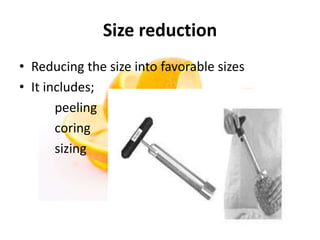
Size reduction
• Reducing the size into favorable sizes
• It includes;
peeling
coring
sizing
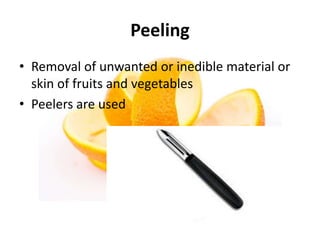
Peeling
• Removal of unwanted or inedible material or
skin of fruits and vegetables
• Peelers are used
Classification of peeling
• Hand peeling
• By heat
• Lye peeling
• Flame peeling
Hand peeling and mechanical peeling
This type of operation is performed with
various types of equipment which depend upon
the result expected and the characteristics of the
fruit and vegetables, for example:
• A machine with abrasion device
(potatoes, root vegetables);
• equipment with knives (apples, pears, potatoes,
etc.);
• equipment with rotating sieve drums (root
vegetables).
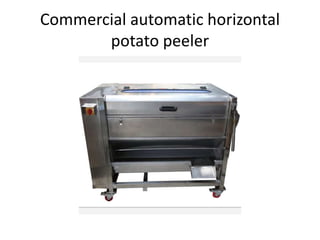
Commercial automatic horizontal
potato peeler
Peeling by heat
• Steam or boiling water is used to soften and
loosen the skin, which is subsequently removed
easily by hand.
• 40�C for 10-60 seconds
• where by the skin bursts and retracts facilitating
its easy removal by means of pressure sprays.
• there is practically no loss of flavour and the
product is of uniform colour, free from any
blemishes.
• For potatoes and peaches
Lye peeling
• By dipping in boiling caustic soda or lye solution
1 to 2%, for 0.5 to 2 minutes
• Hot lye loosens the skin from the flesh
underneath.
• Peel is removed by hand
• Any traces of alkali is removed by washing in
running cold water or preferably by dipping it for
a few seconds in a very weak solution of
hydrochloric or citric acid.
• Fruits and vegetables such as peaches, apricots,
sweet orange, carrots, sweet potatoes, etc.
Flame peeling
• It is used only for garlic and onion which have
a papery outer covering. This is just burnt off.
• about 1 min at 1000° C or to hot gases in
rotary tube flame peelers.
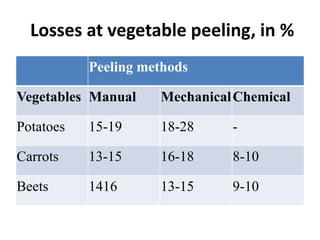
Losses at vegetable peeling, in %
Peeling methods
Vegetables Manual MechanicalChemical
Potatoes 15-19 18-28 -
Carrots 13-15 16-18 8-10
Beets 1416 13-15 9-10
Blanching
• Unit operation prior to freezing, canning or drying
• Fruits and vegetables are heated for the purpose of
 Inactivating enzymes
 Modifying texture
 Preserving colour,flavor&nutritional value
 Remove traped air
• Blanching removes traped air within vegetable cells
&replaces it with semicontinuos water phase –more
uniform crystal growth during freezing
• Blanching reduces microbial load
• Onion &pepper will lose flavor on blanching
• To inactivate enzymes
• Too little is ineffective, and too much damages
the vegetables by excessive cooking, especially
where the fresh character of the vegetable is
subsequently to be preserved by processing.
• Depends upon the specificity of vegetables,
subsequent processing / preservation
methods.
• Destroy catalase and peroxidase
• To reduce losses of hydrosoluble substances
(mineral salts, vitamins, sugars, etc.) during
water blanching, several methods have been
developed:
• Temperature setting at 85-95° C instead of
100° C;
• Blanching time has to be just sufficient to
inactivate enzymes catalase and peroxidase;
• Assure elimination of air from tissues.
• Microwave treatment is also used
WATER BLANCHING
• Medium - hot water(70-100°C)
• Uniform treatment
• Longer processing time-increased leaching of
minerals
• Effluent with high BOD
• Screw or chain conveyor transport product to
hot water tank
STEAM BLANCHING
• 100°C steam(food grade)is injected directly
• Used for cut and small products
• Less time than water
• Chance of over blanching and underblanching
due to high temperature gradient
• Forced convection blanchers are used to increase
heat transfer efficiency
• Individual quick blanching –single layer of
product is conveyed through steam chamber
• More energy efficient
• Low BOD effluent
MICROWAVE BLANCHING
• Studies started around 1940s
• Retention of ascorbic acid &carotene and very
short process time compared to conventional
blanching
• High potential to improve product quality and
minimize waste
• Not implemented much in industries
• High equipment cost
GAS BLANCHING
• Hot gas with steam to increase humidity
• Reduced waste production
• Needs further research and not used in
industry
EFFECTS ON FOOD
FLAVOUR
• Blocking off flavours formation due to
inactivation of enzymes-the most notable is
lipoxygenase
• Flavour retention increases
• Remove undesirable bitter flavours from
product
TEXTURE
• Blanching results in softened texture
• Texture assessment include sensory charectarization of
firmness, crunchiness and crispiness
• Lack of crispiness in fruits
• Blanching of fruit done in calcium chloride solution to
firm the fruit
COLOUR
• Direct effect on colour - destruction of pigments by heat
Eg:chlorophil
• Indirect - in potato reducing sugar content adjusted,
affects colour develepment during later heating steps
where maillard browning takes place
NUTRITIONAL VALUE
• Vitamins degraded by heat mainly vitamin C
QUALITY INDICATOR
• Peroxidase &catalase
• More resistant to heat than most enzymes
• Rapid methods to measure their activity
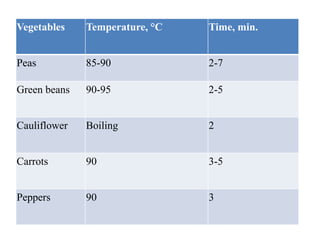
Vegetables Temperature, °C Time, min.
Peas 85-90 2-7
Green beans 90-95 2-5
Cauliflower Boiling 2
Carrots 90 3-5
Peppers 90 3
References
• www.agrimoon.com
• https://en.wikipedia.org/wiki/Blanching_(cooking
)
• FOOD PROCESS ENERGY THEORY&LABORATORY
EXPERIMENTS –SHRIK SHARMA,SYED S H RIZVI
• FRUITS AND VEGETABLES
HARVESTING,HANDLING,STORAGE-A K
THOMPSON
• HAND BOOK OF FRUITS AND FRUIT PROCESSING-
NIRMAL K SINHA,JIWAN S SIDHU,JOSEPH
BARTA,JAMES S B WU AND M PILAR CANO
THANK YOU

Post harvest oprations.pptx

  • 1.
    SUBMITTED BY BHAVANA PRASAD2016 BDM 11 SIBIN O 2016 BDM 34
  • 2.
    INTRODUCTION Fruits and vegetablesare important constituents of our diet and they serve as a vehicle of nutrients like vitamins, minerals, sugars and fiber. However, being harvested from farm or field they are prone to contain dirt, soil, bacterial contamination, extraneous matter making them unfit for direct consumption by consumers. For reducing these and to increase the shelf life, all fruits and vegetables undergo some preliminary operations.
  • 3.
    Post Harvest PreliminaryProcessing Operations • Sorting • Grading • Washing • Peeling • Sizing • Blanching
  • 4.
    Sorting Sorting is aseparation based on a individual physical properties of raw materials such as weight, size, shape, density, photometric property, etc. Grading grading is classification on the basis of quality incorporating commercial value, end use and official standards.
  • 5.
    Washing The graded fruitsand vegetables are washed with water in different ways, such as soaking and subsequent washing in running water or sprayed with water or dry air to remove surface adhering material.
  • 6.
    Size reduction • Reducingthe size into favorable sizes • It includes; peeling coring sizing
  • 7.
    Peeling • Removal ofunwanted or inedible material or skin of fruits and vegetables • Peelers are used
  • 8.
    Classification of peeling •Hand peeling • By heat • Lye peeling • Flame peeling
  • 9.
    Hand peeling andmechanical peeling This type of operation is performed with various types of equipment which depend upon the result expected and the characteristics of the fruit and vegetables, for example: • A machine with abrasion device (potatoes, root vegetables); • equipment with knives (apples, pears, potatoes, etc.); • equipment with rotating sieve drums (root vegetables).
  • 10.
  • 11.
    Peeling by heat •Steam or boiling water is used to soften and loosen the skin, which is subsequently removed easily by hand. • 40�C for 10-60 seconds • where by the skin bursts and retracts facilitating its easy removal by means of pressure sprays. • there is practically no loss of flavour and the product is of uniform colour, free from any blemishes. • For potatoes and peaches
  • 12.
    Lye peeling • Bydipping in boiling caustic soda or lye solution 1 to 2%, for 0.5 to 2 minutes • Hot lye loosens the skin from the flesh underneath. • Peel is removed by hand • Any traces of alkali is removed by washing in running cold water or preferably by dipping it for a few seconds in a very weak solution of hydrochloric or citric acid. • Fruits and vegetables such as peaches, apricots, sweet orange, carrots, sweet potatoes, etc.
  • 13.
    Flame peeling • Itis used only for garlic and onion which have a papery outer covering. This is just burnt off. • about 1 min at 1000° C or to hot gases in rotary tube flame peelers.
  • 14.
    Losses at vegetablepeeling, in % Peeling methods Vegetables Manual MechanicalChemical Potatoes 15-19 18-28 - Carrots 13-15 16-18 8-10 Beets 1416 13-15 9-10
  • 15.
    Blanching • Unit operationprior to freezing, canning or drying • Fruits and vegetables are heated for the purpose of  Inactivating enzymes  Modifying texture  Preserving colour,flavor&nutritional value  Remove traped air • Blanching removes traped air within vegetable cells &replaces it with semicontinuos water phase –more uniform crystal growth during freezing • Blanching reduces microbial load • Onion &pepper will lose flavor on blanching
  • 16.
    • To inactivateenzymes • Too little is ineffective, and too much damages the vegetables by excessive cooking, especially where the fresh character of the vegetable is subsequently to be preserved by processing. • Depends upon the specificity of vegetables, subsequent processing / preservation methods.
  • 17.
    • Destroy catalaseand peroxidase • To reduce losses of hydrosoluble substances (mineral salts, vitamins, sugars, etc.) during water blanching, several methods have been developed: • Temperature setting at 85-95° C instead of 100° C; • Blanching time has to be just sufficient to inactivate enzymes catalase and peroxidase; • Assure elimination of air from tissues. • Microwave treatment is also used
  • 18.
    WATER BLANCHING • Medium- hot water(70-100°C) • Uniform treatment • Longer processing time-increased leaching of minerals • Effluent with high BOD • Screw or chain conveyor transport product to hot water tank
  • 19.
    STEAM BLANCHING • 100°Csteam(food grade)is injected directly • Used for cut and small products • Less time than water • Chance of over blanching and underblanching due to high temperature gradient • Forced convection blanchers are used to increase heat transfer efficiency • Individual quick blanching –single layer of product is conveyed through steam chamber • More energy efficient • Low BOD effluent
  • 20.
    MICROWAVE BLANCHING • Studiesstarted around 1940s • Retention of ascorbic acid &carotene and very short process time compared to conventional blanching • High potential to improve product quality and minimize waste • Not implemented much in industries • High equipment cost
  • 21.
    GAS BLANCHING • Hotgas with steam to increase humidity • Reduced waste production • Needs further research and not used in industry
  • 22.
    EFFECTS ON FOOD FLAVOUR •Blocking off flavours formation due to inactivation of enzymes-the most notable is lipoxygenase • Flavour retention increases • Remove undesirable bitter flavours from product
  • 23.
    TEXTURE • Blanching resultsin softened texture • Texture assessment include sensory charectarization of firmness, crunchiness and crispiness • Lack of crispiness in fruits • Blanching of fruit done in calcium chloride solution to firm the fruit COLOUR • Direct effect on colour - destruction of pigments by heat Eg:chlorophil • Indirect - in potato reducing sugar content adjusted, affects colour develepment during later heating steps where maillard browning takes place NUTRITIONAL VALUE • Vitamins degraded by heat mainly vitamin C
  • 24.
    QUALITY INDICATOR • Peroxidase&catalase • More resistant to heat than most enzymes • Rapid methods to measure their activity
  • 25.
    Vegetables Temperature, °CTime, min. Peas 85-90 2-7 Green beans 90-95 2-5 Cauliflower Boiling 2 Carrots 90 3-5 Peppers 90 3
  • 26.
    References • www.agrimoon.com • https://en.wikipedia.org/wiki/Blanching_(cooking ) •FOOD PROCESS ENERGY THEORY&LABORATORY EXPERIMENTS –SHRIK SHARMA,SYED S H RIZVI • FRUITS AND VEGETABLES HARVESTING,HANDLING,STORAGE-A K THOMPSON • HAND BOOK OF FRUITS AND FRUIT PROCESSING- NIRMAL K SINHA,JIWAN S SIDHU,JOSEPH BARTA,JAMES S B WU AND M PILAR CANO
  • 27.