CONTENTS
 Introduction
 Chromatin
 Histone
 Histone modifications
 DNA methylation
 Epigenetic effects
 Epigenetics and cancer
 Scope
 Conclusion
INTRODUCTION
 Epigenetics is heritable modifications to DNA that alter
gene expression but not nucleotide sequence of genome
 Retained through cell divison and passed on to future
generations and influenced by environmental factors
 After replication,epigenetic mark remains on template
strand which recruit enzymes that make similar changes
in new strand
 Some of the epigenetic “tags” remain in place and
therefore pass from generation to generation, this is
called epigenetic inheritance
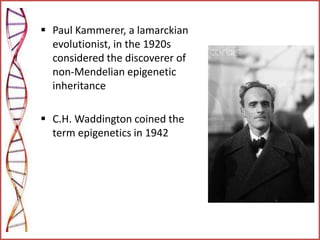
 Paul Kammerer, a lamarckian
evolutionist, in the 1920s
considered the discoverer of
non-Mendelian epigenetic
inheritance
 C.H. Waddington coined the
term epigenetics in 1942
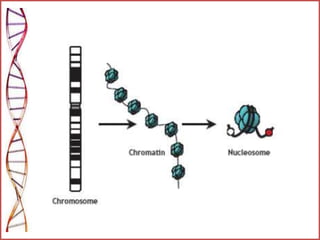
CHROMATIN
 Complex of DNA with an equal weight of basic proteins
called histones
 Histone protein forms octamer around which helical DNA
coils tightly
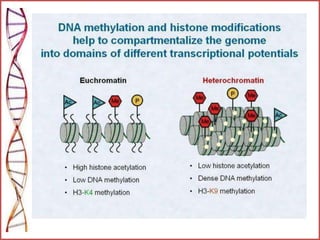
 Euchromatin-Transcriptionally active, less compact
Heterochromatin-Less transcriptionally active, very
compact
HISTONES
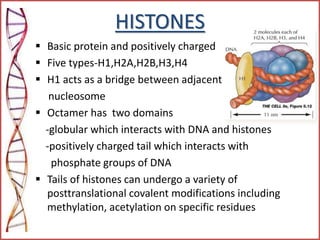
 Basic protein and positively charged
 Five types-H1,H2A,H2B,H3,H4
 H1 acts as a bridge between adjacent
nucleosome
 Octamer has two domains
-globular which interacts with DNA and histones
-positively charged tail which interacts with
phosphate groups of DNA
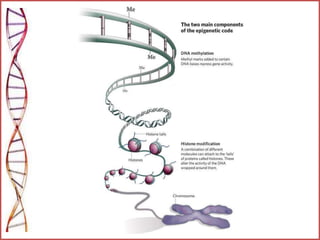
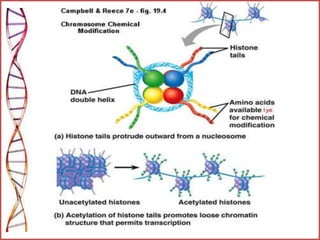
 Tails of histones can undergo a variety of
posttranslational covalent modifications including
methylation, acetylation on specific residues
HISTONE MODIFICATION
 Methylation
– Addition of methyl to tail;activation/repression
depending upon which amino acid in tail is
methylated.
– Methylation can either prevent certain proteins
from binding to DNA, or it can attract certain
proteins with repressing properties.
– Histone methylases are known to specifically
methylate H3 at lysine 4 and lysine 9.
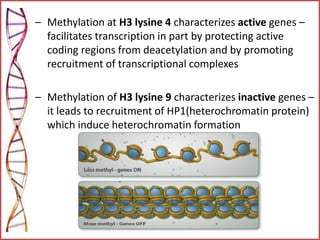
– Methylation at H3 lysine 4 characterizes active genes –
facilitates transcription in part by protecting active
coding regions from deacetylation and by promoting
recruitment of transcriptional complexes
– Methylation of H3 lysine 9 characterizes inactive genes –
it leads to recruitment of HP1(heterochromatin protein)
which induce heterochromatin formation
 Acetylation-
– Stimulates transcription because chromatin is in open
configuration and available for transcription
– Added by Histone acetyl transferase (HAT) enzyme
– Weakens interaction of tail with DNA and permits
transcription factors to bind to DNA
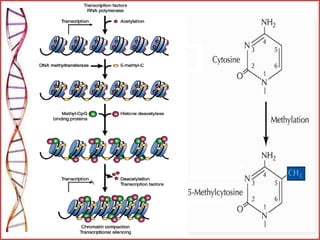
DNA METHYLATION
 Covalent addition of methyl group to 5th Position of
cystosine with in CPG di-nucleotides which are
frequently located in the promoter region of genes.
 Complex process catalyzed by DNA methyl transferase.
 Attracts deacetylase which removes acetyl group from
histone tails and stabilizes nucleosome structure thus
represses transcription
 Lead to gene silencing by either preventing or
promoting the recruitment of regulatory proteins to
DNA
 Most seen in female mammals where the inactive X-
chromosome is extensively methylated
 Also seen in regions containing repetitive sequences
including those that are rich in transposable
elements
EPIGENETIC EFFECTS
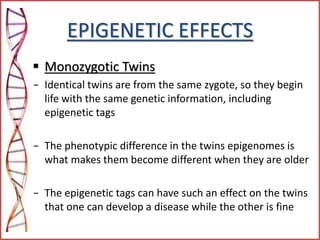
 Monozygotic Twins
‒ Identical twins are from the same zygote, so they begin
life with the same genetic information, including
epigenetic tags
‒ The phenotypic difference in the twins epigenomes is
what makes them become different when they are older
‒ The epigenetic tags can have such an effect on the twins
that one can develop a disease while the other is fine
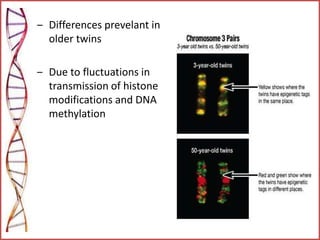
‒ Differences prevelant in
older twins
‒ Due to fluctuations in
transmission of histone
modifications and DNA
methylation
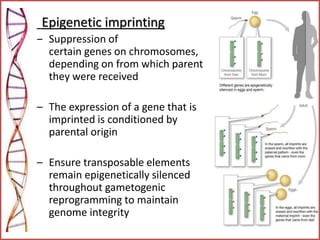
Epigenetic imprinting
‒ Suppression of
certain genes on chromosomes,
depending on from which parent
they were received
– The expression of a gene that is
imprinted is conditioned by
parental origin
– Ensure transposable elements
remain epigenetically silenced
throughout gametogenic
reprogramming to maintain
genome integrity
– The alleles of imprinted genes are marked epigenetically
at imprinting control regions (ICRs) with their parental
origin in gametes through the use of DNA methylation
– There are currently more than 50 known imprinted human
genes,play a part in morphogenesis,cell growth
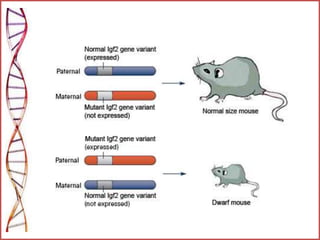
– In mice,the Igf2 gene is expressed when it is inherited
from father and not from mother
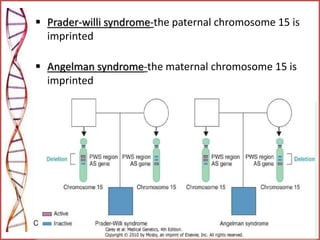
 Prader-willi syndrome-the paternal chromosome 15 is
imprinted
 Angelman syndrome-the maternal chromosome 15 is
imprinted
EPIGENETICS AND CANCER
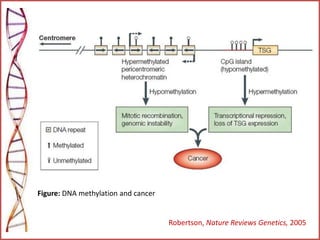
 Aberrant DNA methylation patterns associated with a
large number of human malignancies and found in two
distinct forms
-hypermethylation causes cancer by silencing the
expression of tumor suppressor gene
-hypomethylation activates oncogenes
 Cancer epigenome is marked by genome-wide
hypomethylation and site-specific CpG island promoter
hypermethylation
 DNA hypomethylation at repeat sequences leads to
increased genomic instability by promoting chromosomal
rearrangements
 p16, a gene that normally functions to prevent cancer
but is commonly methylated in a broad spectrum of
human cancers.
 An approach to engineer DNA methylation specifically
to the mouse p16 regulatory region (promoter) has
been devised.
 The engineered p16 promoter acts as a 'methylation
magnet'. As the mice reaches adulthood, gradually
increasing p16 methylation leads to a higher incidence
of spontaneous cancers.
Yu et al., Journal of Clinical Investigation, 2014
Robertson, Nature Reviews Genetics, 2005
Figure: DNA methylation and cancer
SCOPE OF EPIGENETICS
 Epigenetic pharmaceuticals could be a replacement for
currently accepted treatment methods such as
radiation and chemotherapy, or could enhance the
effects of these current treatments. Epigenetics also
has the factor of reversibility, a characteristic that other
cancer treatments do not offer
 Vornistat is an HDAC inhibitor.HDAC has been shown to
play an integral role in the progression of oral
squamous cancer
 Azacitidine,an epigenetic drug is used to treat a blood
disease called myelodysplastic syndrome
 The Roadmap Epigenomics Program,a$190 million
project started in 2008 by the National Institutes of
Health
CONCLUSION
 Epigenetics refers to heritable changes in gene
expression that does not involve changes to the
underlying DNA sequence
 Two prominent epigentic mechanisms involve DNA
methylation (gene silencing) and histone acetylation
(gene activation) and methylation
 Errors in epigenetic patterns can influence the
presentation of human diseases including cancer
 New and ongoing research is continuously uncovering
the role of epigenetics in a variety of human disorders
and fatal diseases.
 Drugs that influence the epigenome represent a major
area of current research
Epigenetics

Epigenetics

  • 2.
    CONTENTS  Introduction  Chromatin Histone  Histone modifications  DNA methylation  Epigenetic effects  Epigenetics and cancer  Scope  Conclusion
  • 3.
    INTRODUCTION  Epigenetics isheritable modifications to DNA that alter gene expression but not nucleotide sequence of genome  Retained through cell divison and passed on to future generations and influenced by environmental factors  After replication,epigenetic mark remains on template strand which recruit enzymes that make similar changes in new strand  Some of the epigenetic “tags” remain in place and therefore pass from generation to generation, this is called epigenetic inheritance
  • 4.
     Paul Kammerer,a lamarckian evolutionist, in the 1920s considered the discoverer of non-Mendelian epigenetic inheritance  C.H. Waddington coined the term epigenetics in 1942
  • 5.
    CHROMATIN  Complex ofDNA with an equal weight of basic proteins called histones  Histone protein forms octamer around which helical DNA coils tightly  Euchromatin-Transcriptionally active, less compact Heterochromatin-Less transcriptionally active, very compact
  • 7.
    HISTONES  Basic proteinand positively charged  Five types-H1,H2A,H2B,H3,H4  H1 acts as a bridge between adjacent nucleosome  Octamer has two domains -globular which interacts with DNA and histones -positively charged tail which interacts with phosphate groups of DNA  Tails of histones can undergo a variety of posttranslational covalent modifications including methylation, acetylation on specific residues
  • 10.
    HISTONE MODIFICATION  Methylation –Addition of methyl to tail;activation/repression depending upon which amino acid in tail is methylated. – Methylation can either prevent certain proteins from binding to DNA, or it can attract certain proteins with repressing properties. – Histone methylases are known to specifically methylate H3 at lysine 4 and lysine 9.
  • 11.
    – Methylation atH3 lysine 4 characterizes active genes – facilitates transcription in part by protecting active coding regions from deacetylation and by promoting recruitment of transcriptional complexes – Methylation of H3 lysine 9 characterizes inactive genes – it leads to recruitment of HP1(heterochromatin protein) which induce heterochromatin formation
  • 12.
     Acetylation- – Stimulatestranscription because chromatin is in open configuration and available for transcription – Added by Histone acetyl transferase (HAT) enzyme – Weakens interaction of tail with DNA and permits transcription factors to bind to DNA
  • 14.
    DNA METHYLATION  Covalentaddition of methyl group to 5th Position of cystosine with in CPG di-nucleotides which are frequently located in the promoter region of genes.  Complex process catalyzed by DNA methyl transferase.  Attracts deacetylase which removes acetyl group from histone tails and stabilizes nucleosome structure thus represses transcription
  • 15.
     Lead togene silencing by either preventing or promoting the recruitment of regulatory proteins to DNA  Most seen in female mammals where the inactive X- chromosome is extensively methylated  Also seen in regions containing repetitive sequences including those that are rich in transposable elements
  • 17.
    EPIGENETIC EFFECTS  MonozygoticTwins ‒ Identical twins are from the same zygote, so they begin life with the same genetic information, including epigenetic tags ‒ The phenotypic difference in the twins epigenomes is what makes them become different when they are older ‒ The epigenetic tags can have such an effect on the twins that one can develop a disease while the other is fine
  • 18.
    ‒ Differences prevelantin older twins ‒ Due to fluctuations in transmission of histone modifications and DNA methylation
  • 19.
    Epigenetic imprinting ‒ Suppressionof certain genes on chromosomes, depending on from which parent they were received – The expression of a gene that is imprinted is conditioned by parental origin – Ensure transposable elements remain epigenetically silenced throughout gametogenic reprogramming to maintain genome integrity
  • 20.
    – The allelesof imprinted genes are marked epigenetically at imprinting control regions (ICRs) with their parental origin in gametes through the use of DNA methylation – There are currently more than 50 known imprinted human genes,play a part in morphogenesis,cell growth – In mice,the Igf2 gene is expressed when it is inherited from father and not from mother
  • 22.
     Prader-willi syndrome-thepaternal chromosome 15 is imprinted  Angelman syndrome-the maternal chromosome 15 is imprinted
  • 23.
    EPIGENETICS AND CANCER Aberrant DNA methylation patterns associated with a large number of human malignancies and found in two distinct forms -hypermethylation causes cancer by silencing the expression of tumor suppressor gene -hypomethylation activates oncogenes  Cancer epigenome is marked by genome-wide hypomethylation and site-specific CpG island promoter hypermethylation  DNA hypomethylation at repeat sequences leads to increased genomic instability by promoting chromosomal rearrangements
  • 24.
     p16, agene that normally functions to prevent cancer but is commonly methylated in a broad spectrum of human cancers.  An approach to engineer DNA methylation specifically to the mouse p16 regulatory region (promoter) has been devised.  The engineered p16 promoter acts as a 'methylation magnet'. As the mice reaches adulthood, gradually increasing p16 methylation leads to a higher incidence of spontaneous cancers. Yu et al., Journal of Clinical Investigation, 2014
  • 25.
    Robertson, Nature ReviewsGenetics, 2005 Figure: DNA methylation and cancer
  • 26.
    SCOPE OF EPIGENETICS Epigenetic pharmaceuticals could be a replacement for currently accepted treatment methods such as radiation and chemotherapy, or could enhance the effects of these current treatments. Epigenetics also has the factor of reversibility, a characteristic that other cancer treatments do not offer  Vornistat is an HDAC inhibitor.HDAC has been shown to play an integral role in the progression of oral squamous cancer
  • 27.
     Azacitidine,an epigeneticdrug is used to treat a blood disease called myelodysplastic syndrome  The Roadmap Epigenomics Program,a$190 million project started in 2008 by the National Institutes of Health
  • 28.
    CONCLUSION  Epigenetics refersto heritable changes in gene expression that does not involve changes to the underlying DNA sequence  Two prominent epigentic mechanisms involve DNA methylation (gene silencing) and histone acetylation (gene activation) and methylation  Errors in epigenetic patterns can influence the presentation of human diseases including cancer  New and ongoing research is continuously uncovering the role of epigenetics in a variety of human disorders and fatal diseases.  Drugs that influence the epigenome represent a major area of current research

Editor's Notes

  • #3 Inherited thru mitosis n sometimes meiosis - In the past we thought that a embryos epigenome was completely erased and rebuilt from scratch. This is partially true,
  • #4 Inherited thru mitosis n sometimes meiosis - In the past we thought that a embryos epigenome was completely erased and rebuilt from scratch. This is partially true,
  • #15 The addition of the methyl group from the universal methyl Donor s-adenosyl L –methionine
  • #16 Seen in transposable regions to prevent disastrous effect of transposons Methylated cpg bind proteins that prevents transcripton
  • #21 but it is estimated that there are more than 200-300 such genes in the human genome many of which occur in clusters of greater than 1Mb in length.
  • #24 Cancer was the first human disease to be linked to epigenetics DNA hypomethylation can activate oncogenes and initiate chromosome instability
  • #25 Yu et al of baylor college of medicine
  • #27 It has been shown that the epigenetic control of the proto-onco regions and the tumor suppressor sequences by conformational changes in histones directly affects the formation and progression of cancer Drug development has focused mainly on histone acetyltransferase (HAT) and histone deacetylase (HDAC), and has lead to production of One of the first FDA-approved drugs to drive epigenetic changes is azacitidine, per Bob Weinhold for Environmental Health Perspectives. The drug is used to treat a blood disease called myelodysplastic syndrome The Roadmap Epigenomics Program,a$190 million project started in 2008 by the National Institutes of Health. Through this program, researchers are looking at how epigenetics factors into diseases
  • #28 It has been shown that the epigenetic control of the proto-onco regions and the tumor suppressor sequences by conformational changes in histones directly affects the formation and progression of cancer Drug development has focused mainly on histone acetyltransferase (HAT) and histone deacetylase (HDAC), and has lead to production of One of the first FDA-approved drugs to drive epigenetic changes is azacitidine, per Bob Weinhold for Environmental Health Perspectives. The drug is used to treat a blood disease called myelodysplastic syndrome The Roadmap Epigenomics Program,a$190 million project started in 2008 by the National Institutes of Health. Through this program, researchers are looking at how epigenetics factors into diseases
  • #29 It has been shown that the epigenetic control of the proto-onco regions and the tumor suppressor sequences by conformational changes in histones directly affects the formation and progression of cancer