JOINTS
By:- Dr. Vibhash Kumar Vaidya
Department of Anatomy
Dr. Vibhash Kumar
Introduction of Joints
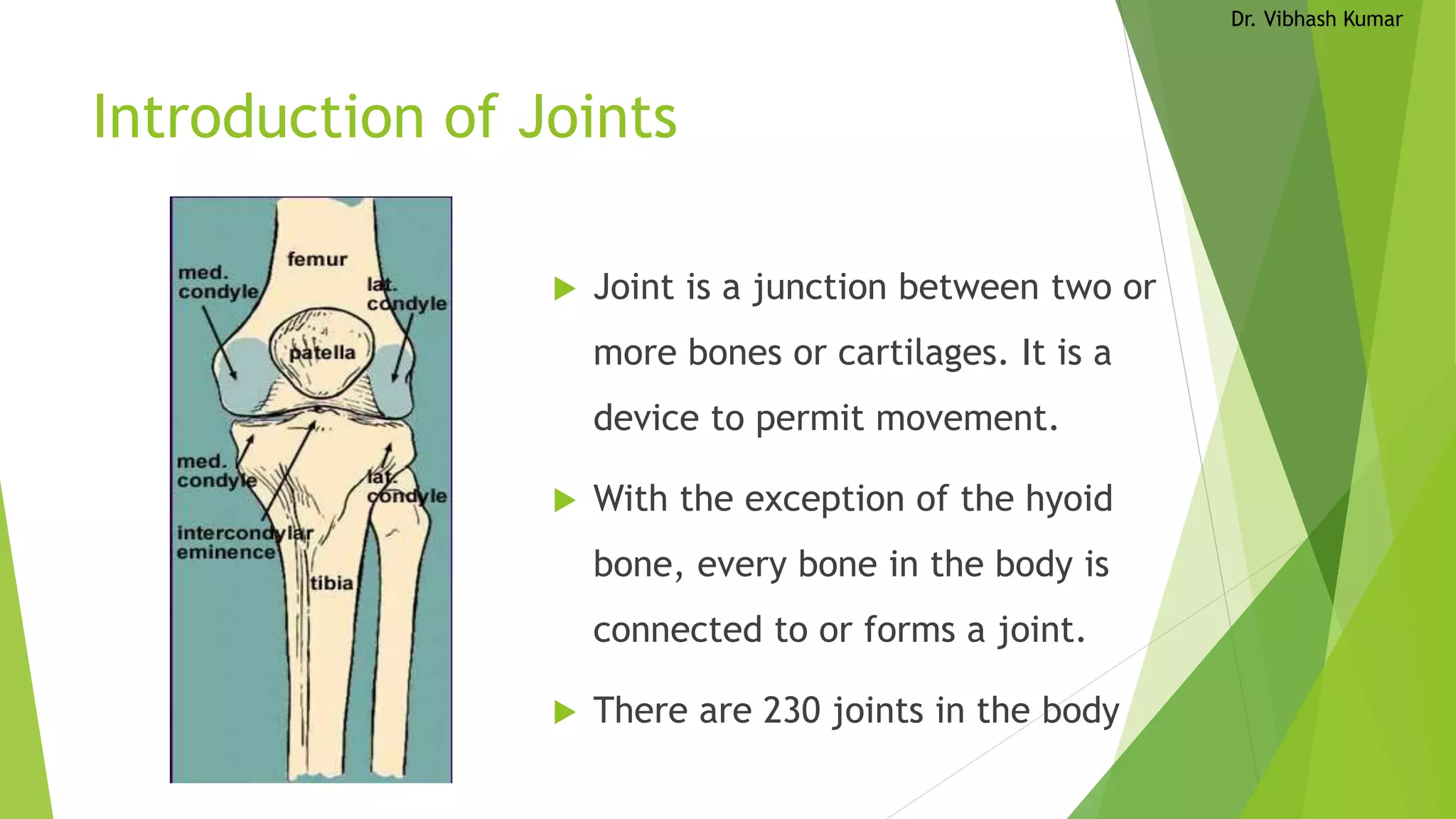
 Joint is a junction between two or
more bones or cartilages. It is a
device to permit movement.
 With the exception of the hyoid
bone, every bone in the body is
connected to or forms a joint.
 There are 230 joints in the body
Dr. Vibhash Kumar
Functions of joint
 Hold the skeletal bones together.
 Allow the skeleton some flexibility so gross movement can
occur.
 Make bone growth possible.
Dr. Vibhash Kumar
Classification of joints
 Joint are classified into structural and functional.
 Structural classification is determined by how the bones
connect to each other, while functional classification is
determined by the degree of movement between the
articulating bones.
Dr. Vibhash Kumar
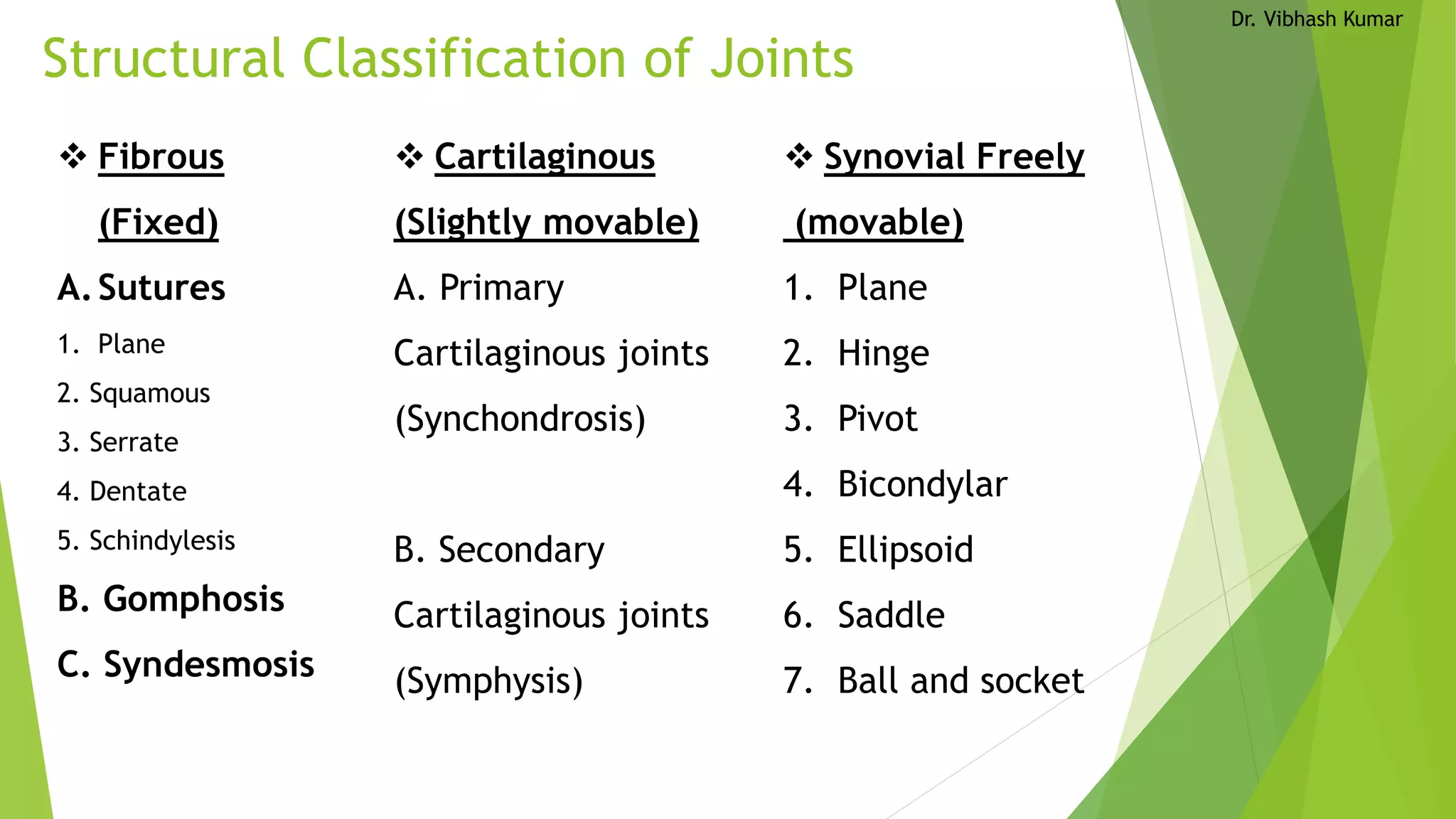
Structural Classification of Joints
 Fibrous
(Fixed)
A.Sutures
1. Plane
2. Squamous
3. Serrate
4. Dentate
5. Schindylesis
B. Gomphosis
C. Syndesmosis
 Cartilaginous
(Slightly movable)
A. Primary
Cartilaginous joints
(Synchondrosis)
B. Secondary
Cartilaginous joints
(Symphysis)
 Synovial Freely
(movable)
1. Plane
2. Hinge
3. Pivot
4. Bicondylar
5. Ellipsoid
6. Saddle
7. Ball and socket
Dr. Vibhash Kumar
Structural classification cont…
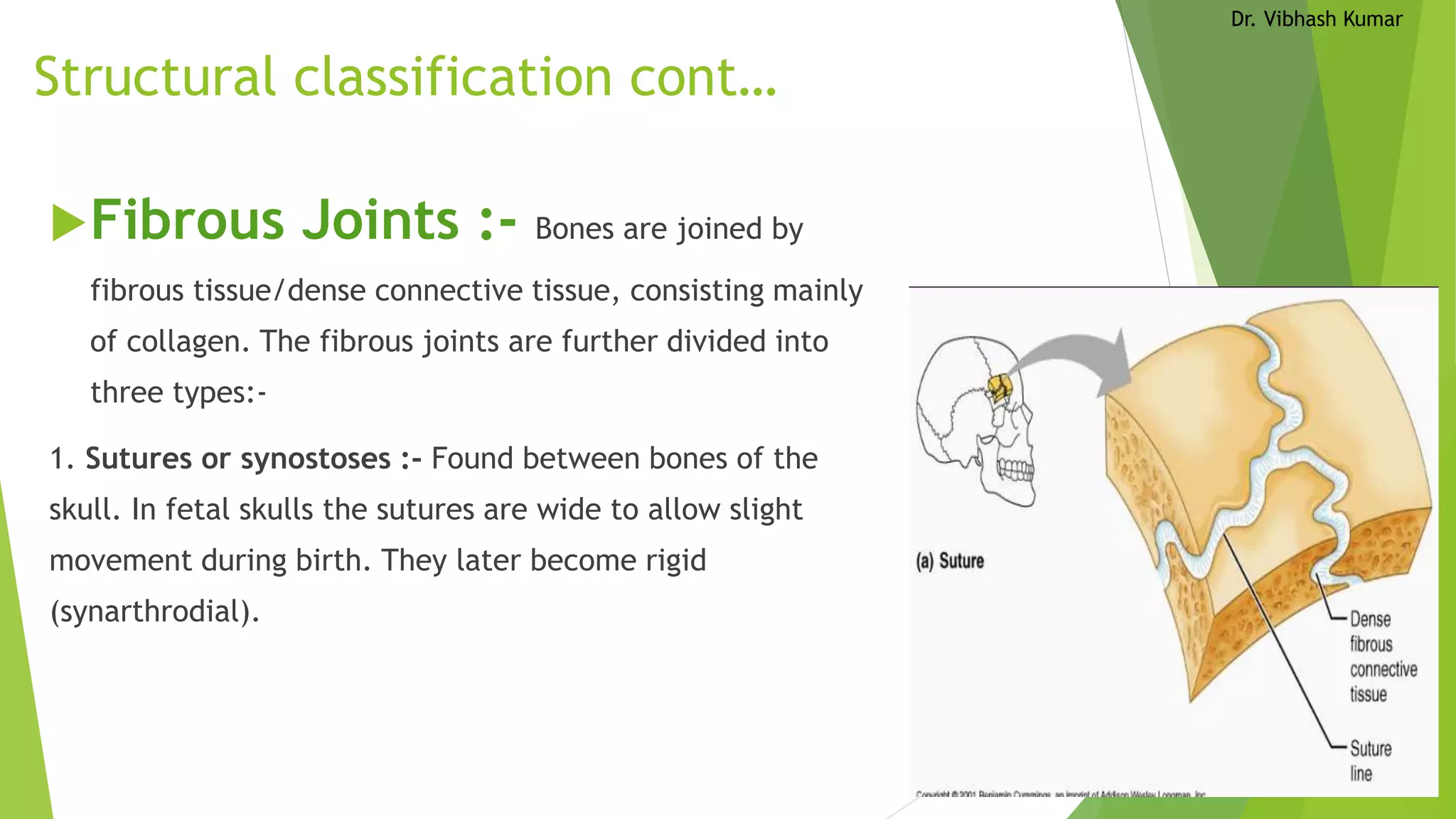
Fibrous Joints :- Bones are joined by
fibrous tissue/dense connective tissue, consisting mainly
of collagen. The fibrous joints are further divided into
three types:-
1. Sutures or synostoses :- Found between bones of the
skull. In fetal skulls the sutures are wide to allow slight
movement during birth. They later become rigid
(synarthrodial).
Dr. Vibhash Kumar
Types of Sutures..
(lambdoid suture)
Dr. Vibhash Kumar
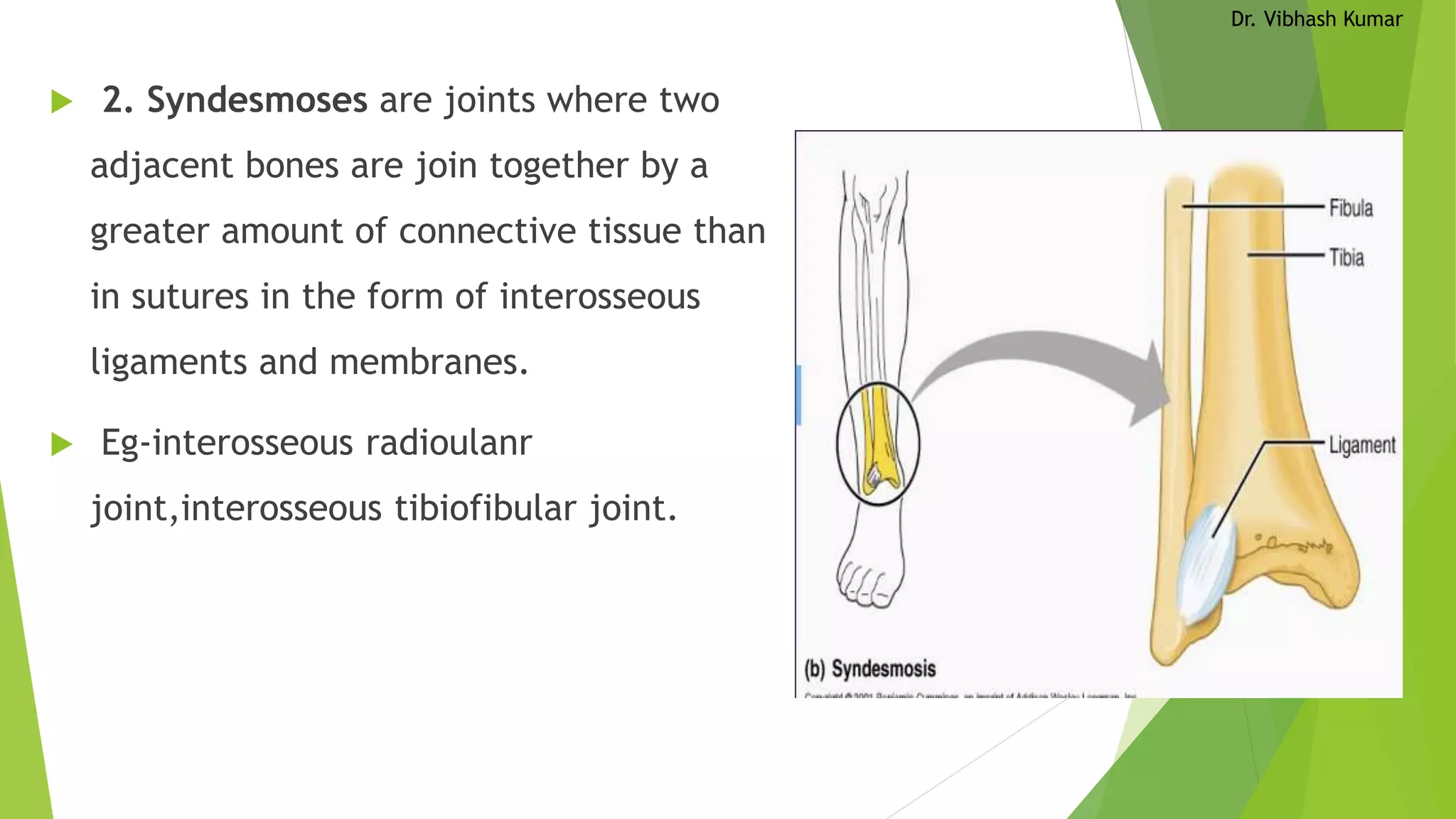
 2. Syndesmoses are joints where two
adjacent bones are join together by a
greater amount of connective tissue than
in sutures in the form of interosseous
ligaments and membranes.
 Eg-interosseous radioulanr
joint,interosseous tibiofibular joint.
Dr. Vibhash Kumar
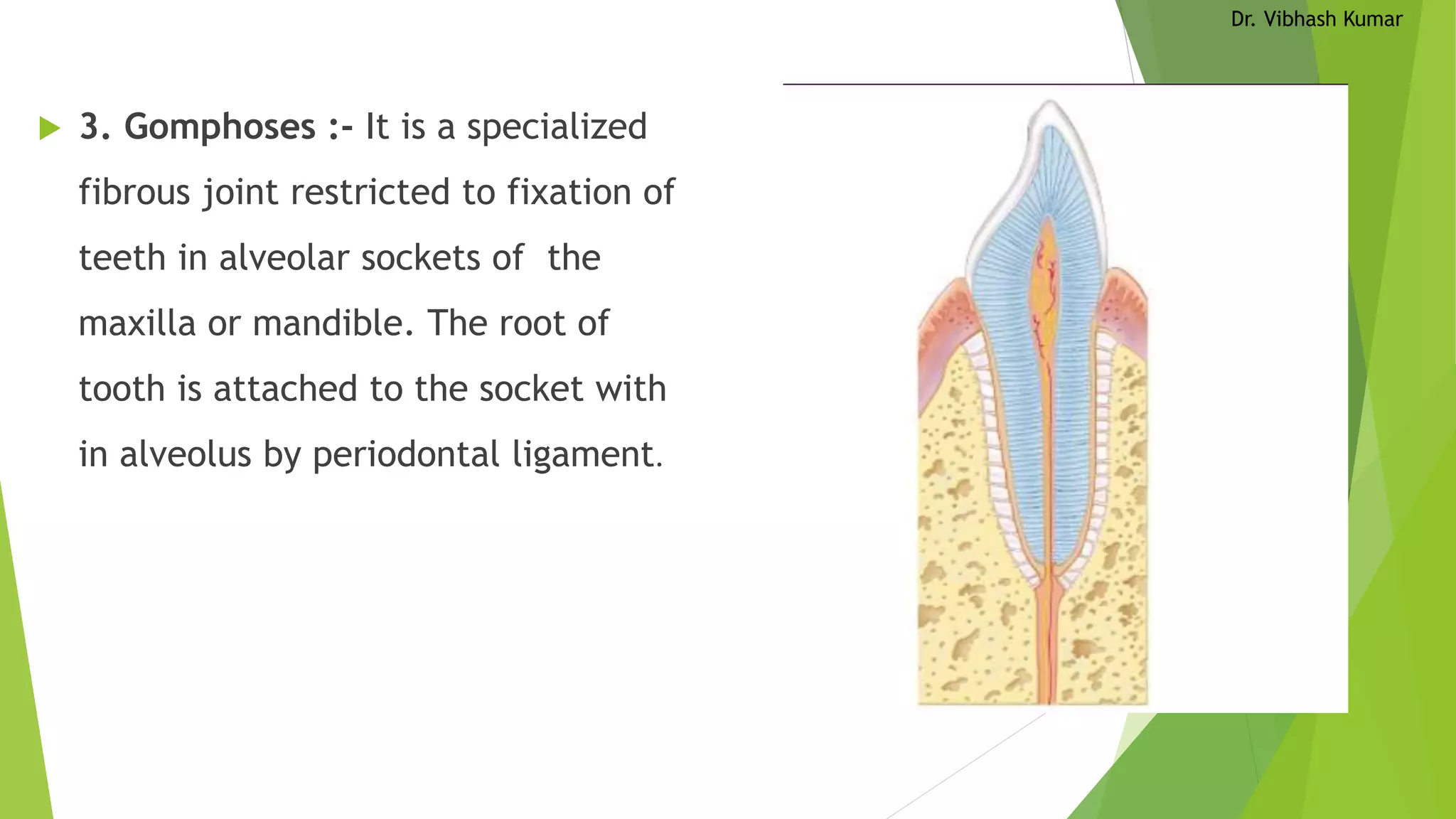
 3. Gomphoses :- It is a specialized
fibrous joint restricted to fixation of
teeth in alveolar sockets of the
maxilla or mandible. The root of
tooth is attached to the socket with
in alveolus by periodontal ligament.
Dr. Vibhash Kumar
CARTILAGINOUS JOINTS
 In this type of joint the bones are joined by cartilage.
 There are two types of cartilaginous joints:
1. Primary cartilaginous joints
2. Secondary cartilaginous joints
Dr. Vibhash Kumar
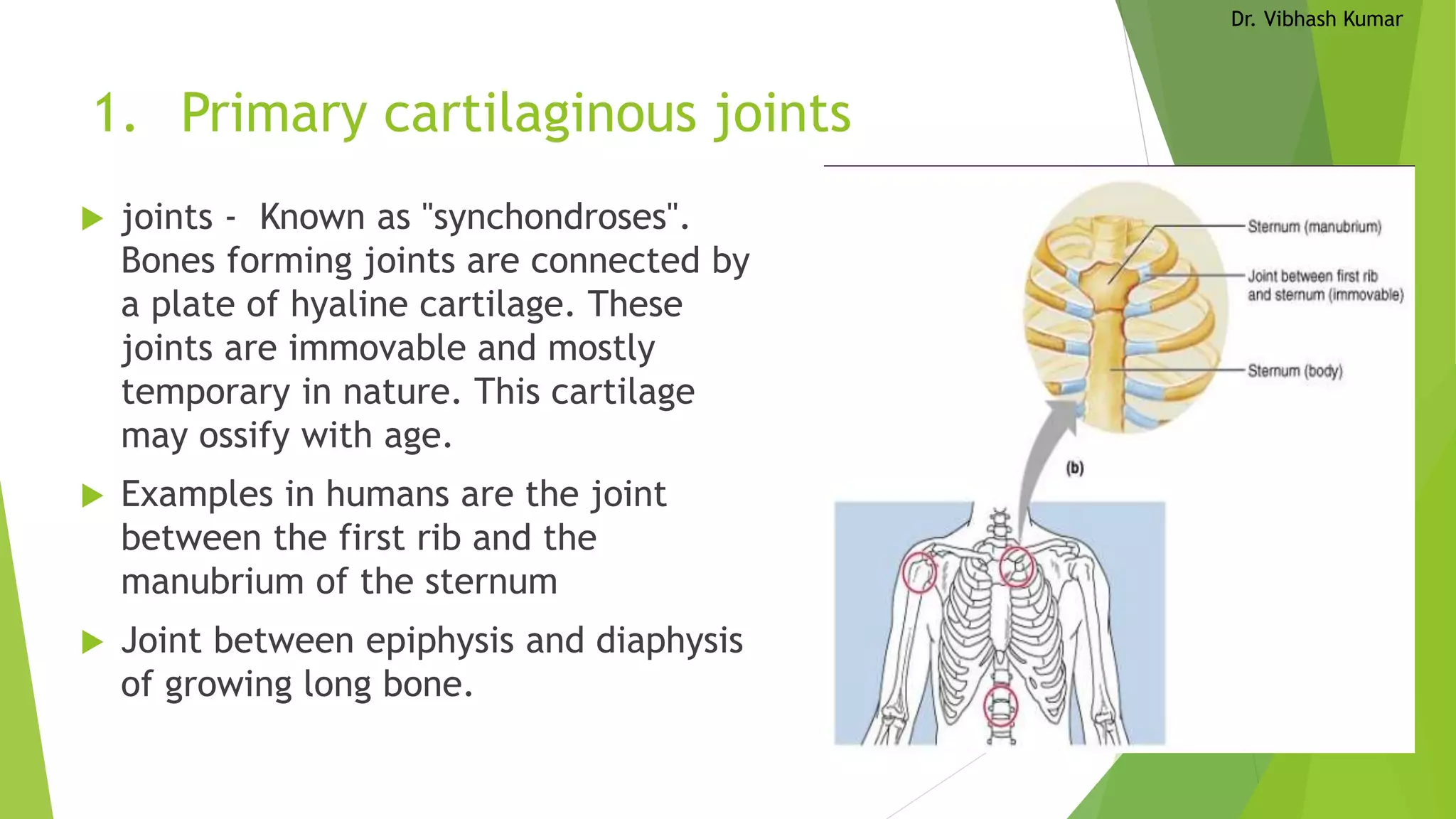
1. Primary cartilaginous joints
 joints - Known as "synchondroses".
Bones forming joints are connected by
a plate of hyaline cartilage. These
joints are immovable and mostly
temporary in nature. This cartilage
may ossify with age.
 Examples in humans are the joint
between the first rib and the
manubrium of the sternum
 Joint between epiphysis and diaphysis
of growing long bone.
Dr. Vibhash Kumar
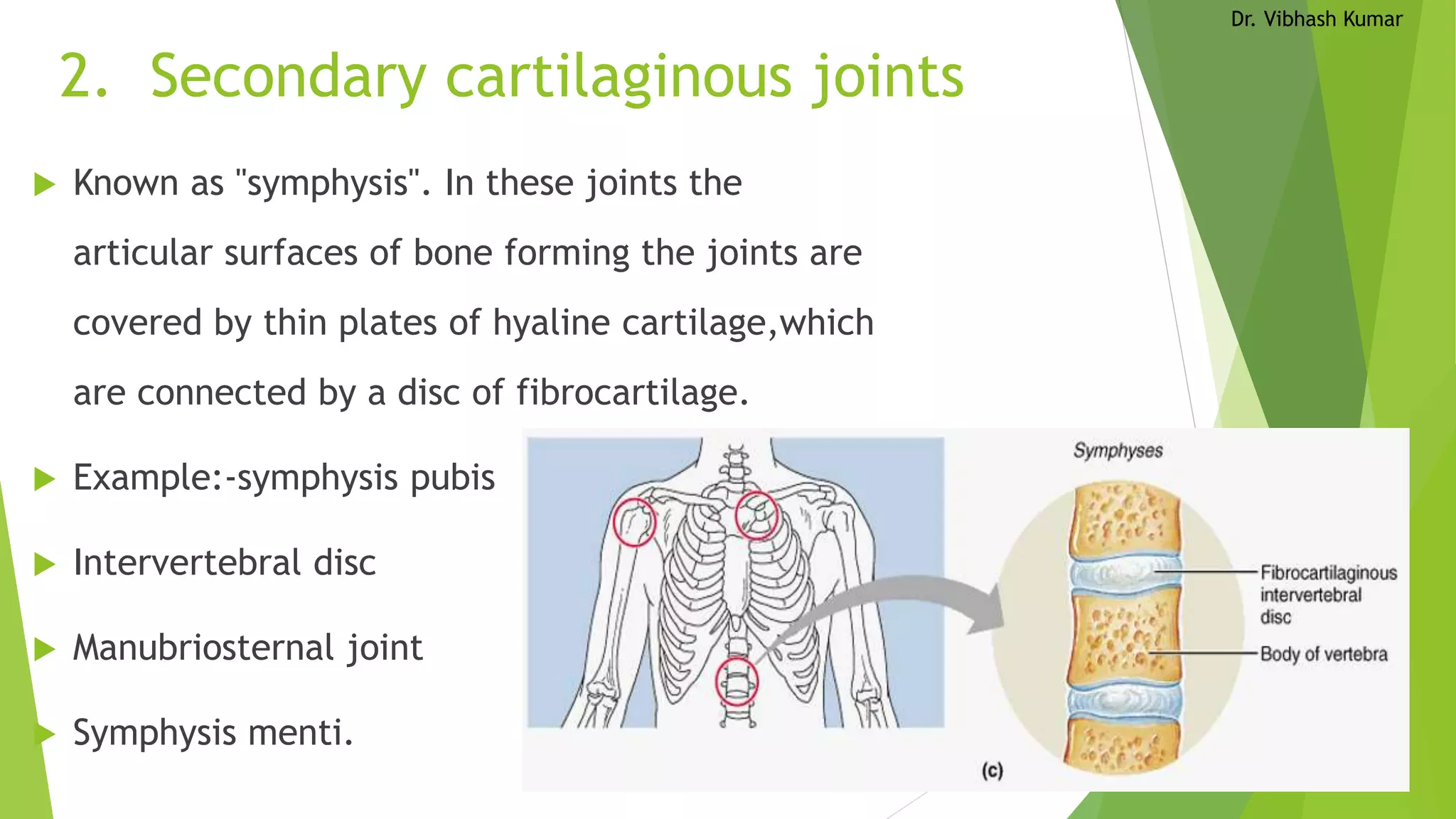
2. Secondary cartilaginous joints
 Known as "symphysis". In these joints the
articular surfaces of bone forming the joints are
covered by thin plates of hyaline cartilage,which
are connected by a disc of fibrocartilage.
 Example:-symphysis pubis
 Intervertebral disc
 Manubriosternal joint
 Symphysis menti.
Dr. Vibhash Kumar
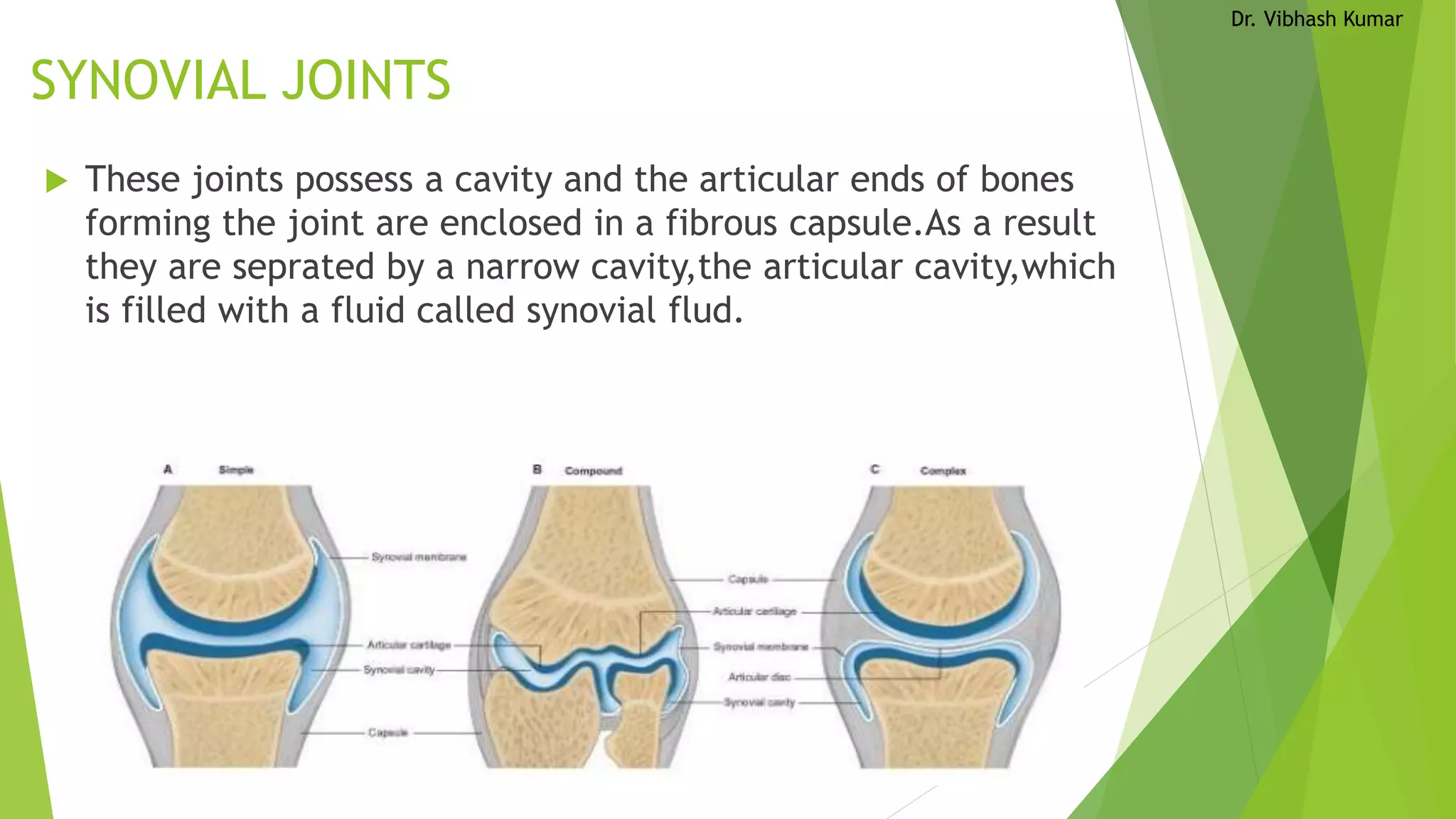
SYNOVIAL JOINTS
 These joints possess a cavity and the articular ends of bones
forming the joint are enclosed in a fibrous capsule.As a result
they are seprated by a narrow cavity,the articular cavity,which
is filled with a fluid called synovial flud.
Dr. Vibhash Kumar
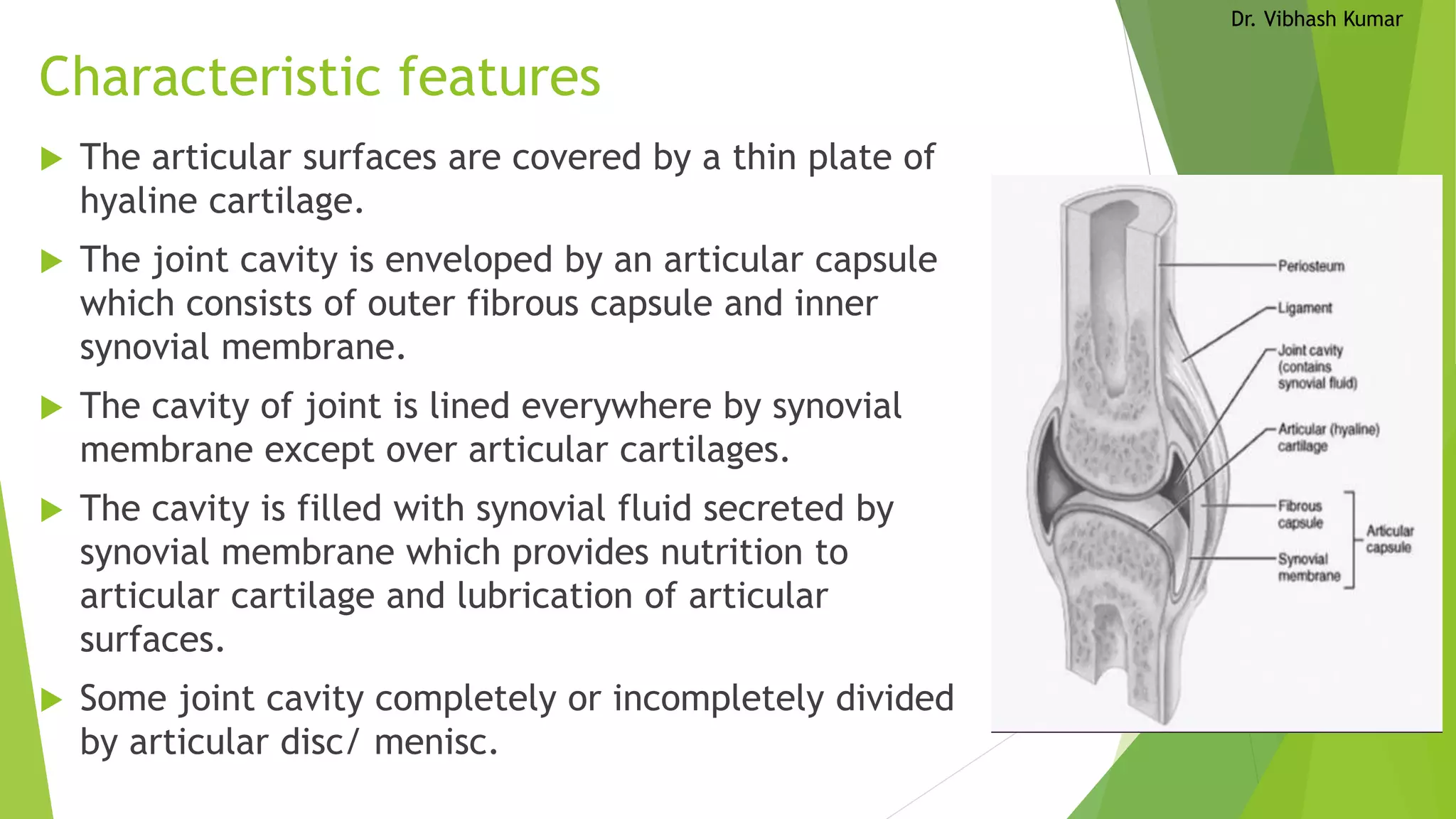
Characteristic features
 The articular surfaces are covered by a thin plate of
hyaline cartilage.
 The joint cavity is enveloped by an articular capsule
which consists of outer fibrous capsule and inner
synovial membrane.
 The cavity of joint is lined everywhere by synovial
membrane except over articular cartilages.
 The cavity is filled with synovial fluid secreted by
synovial membrane which provides nutrition to
articular cartilage and lubrication of articular
surfaces.
 Some joint cavity completely or incompletely divided
by articular disc/ menisc.
Dr. Vibhash Kumar
Types of synovial joints
 Plane Joint
 Hinge Joint
 Pivot Joint
 Condylar Joint
 Ellipsoid joint
 Saddle Joint
 Ball-and-Socket Joint
Dr. Vibhash Kumar
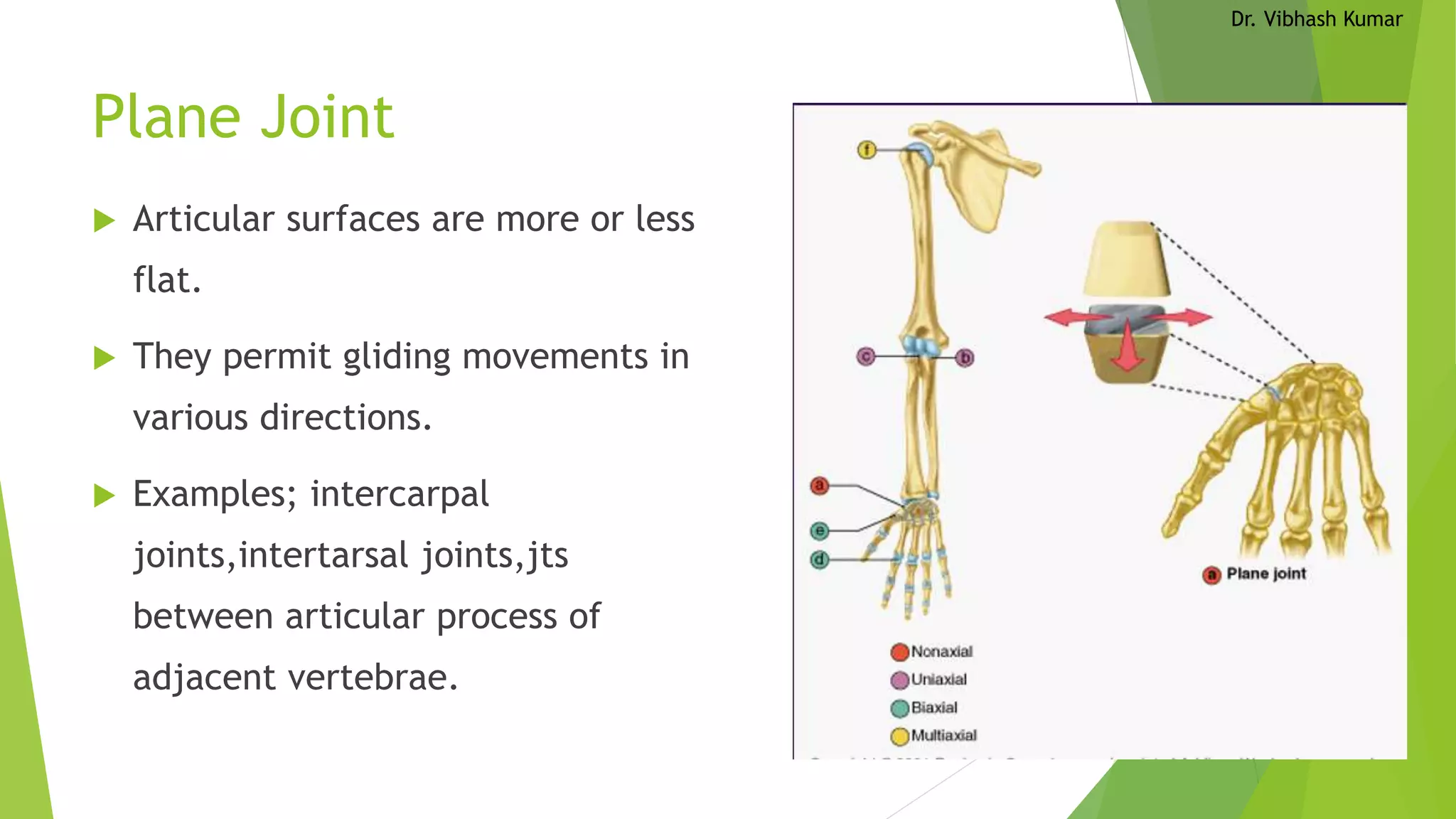
Plane Joint
 Articular surfaces are more or less
flat.
 They permit gliding movements in
various directions.
 Examples; intercarpal
joints,intertarsal joints,jts
between articular process of
adjacent vertebrae.
Dr. Vibhash Kumar
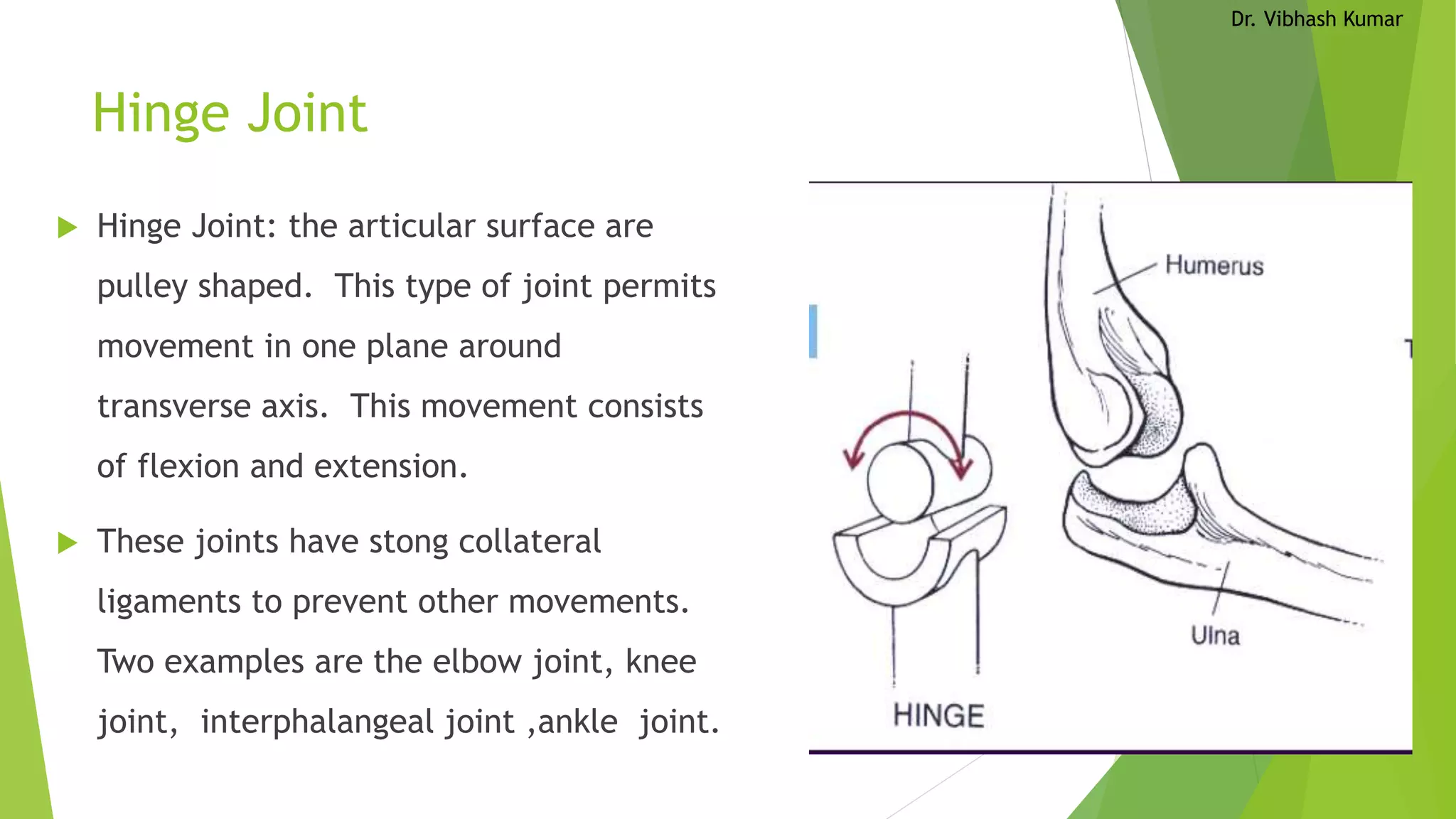
Hinge Joint
 Hinge Joint: the articular surface are
pulley shaped. This type of joint permits
movement in one plane around
transverse axis. This movement consists
of flexion and extension.
 These joints have stong collateral
ligaments to prevent other movements.
Two examples are the elbow joint, knee
joint, interphalangeal joint ,ankle joint.
Dr. Vibhash Kumar
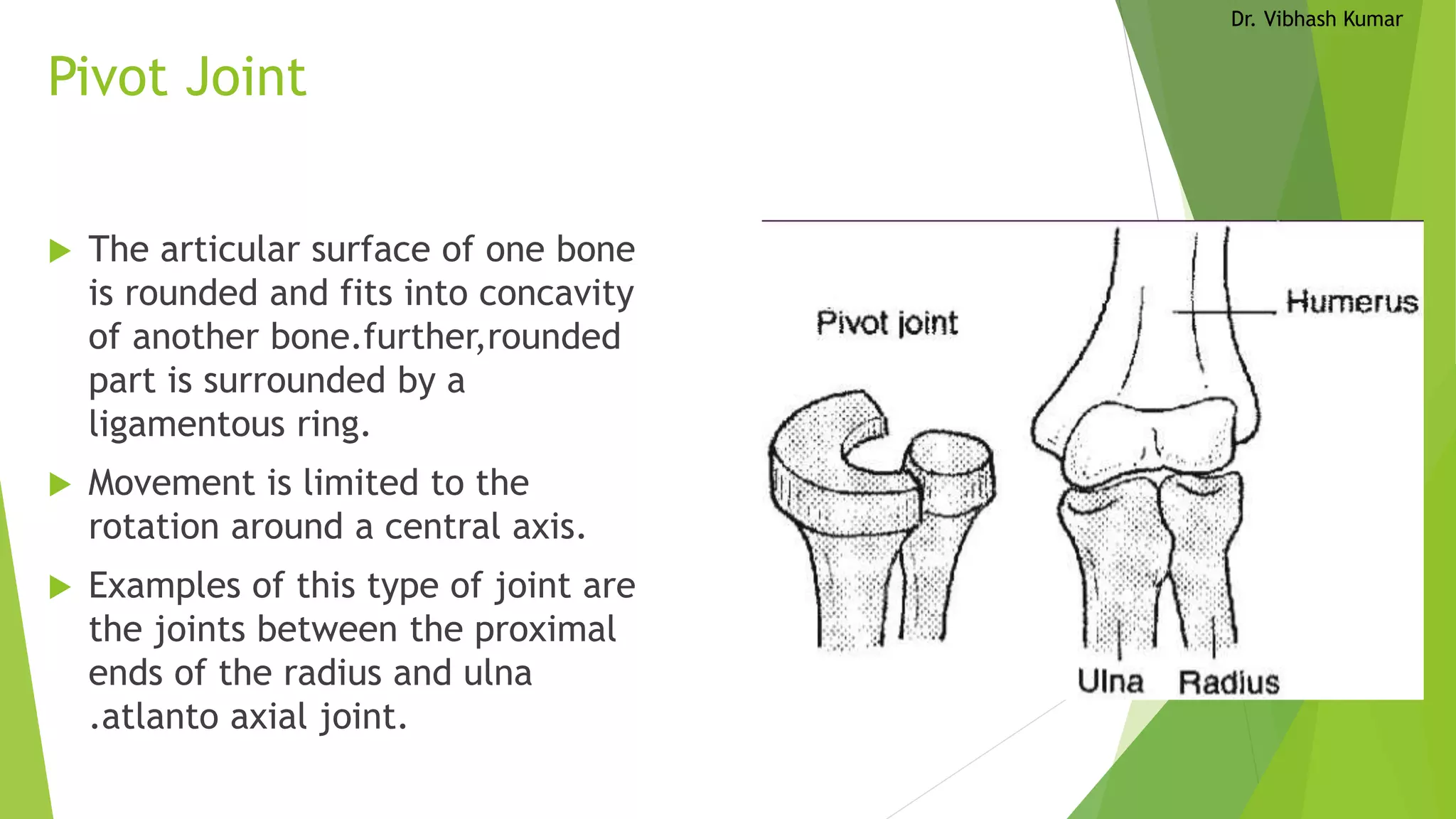
Pivot Joint
 The articular surface of one bone
is rounded and fits into concavity
of another bone.further,rounded
part is surrounded by a
ligamentous ring.
 Movement is limited to the
rotation around a central axis.
 Examples of this type of joint are
the joints between the proximal
ends of the radius and ulna
.atlanto axial joint.
Dr. Vibhash Kumar
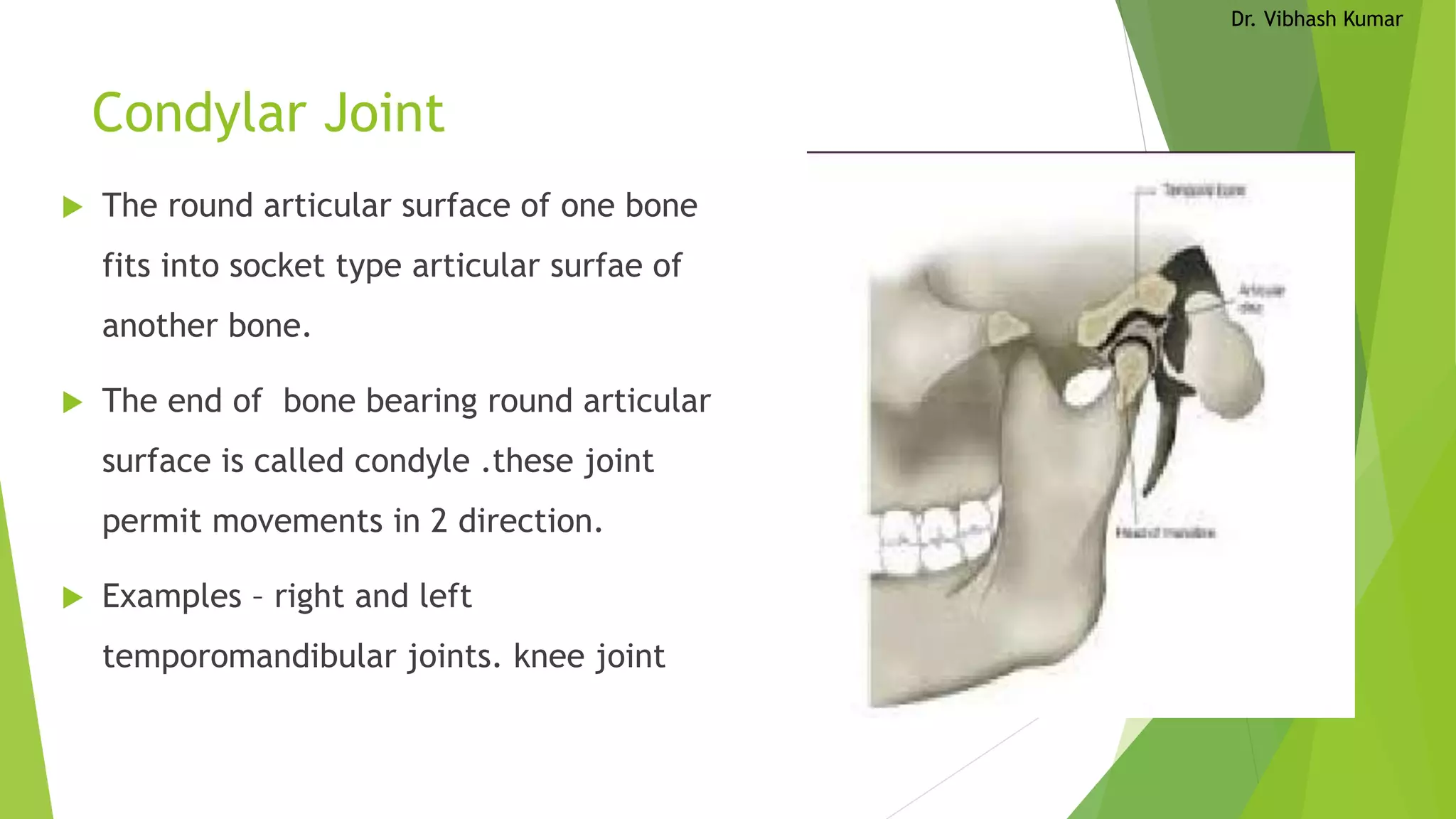
Condylar Joint
 The round articular surface of one bone
fits into socket type articular surfae of
another bone.
 The end of bone bearing round articular
surface is called condyle .these joint
permit movements in 2 direction.
 Examples – right and left
temporomandibular joints. knee joint
Dr. Vibhash Kumar
Ellipsoid joint
 Elliptical convex surface of one bone
articulates with elliptical concave
surface of another bone.
 The movements are permitted in two
directions.
 Eg; wrist joint , atlanto occipital
joint,metacarpo phalangeal
joints,metatarso phalangeal joint
Dr. Vibhash Kumar
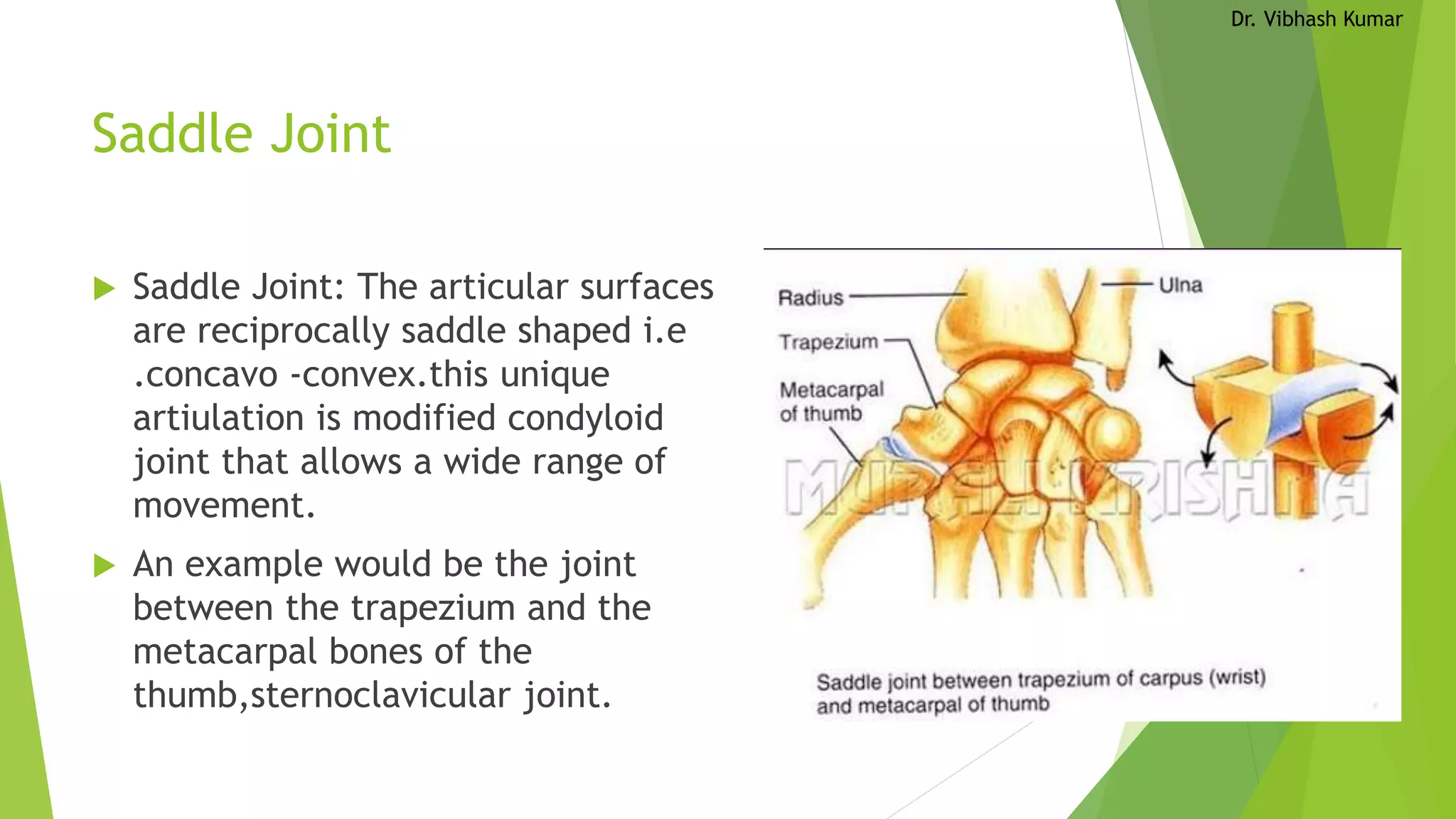
Saddle Joint
 Saddle Joint: The articular surfaces
are reciprocally saddle shaped i.e
.concavo -convex.this unique
artiulation is modified condyloid
joint that allows a wide range of
movement.
 An example would be the joint
between the trapezium and the
metacarpal bones of the
thumb,sternoclavicular joint.
Dr. Vibhash Kumar
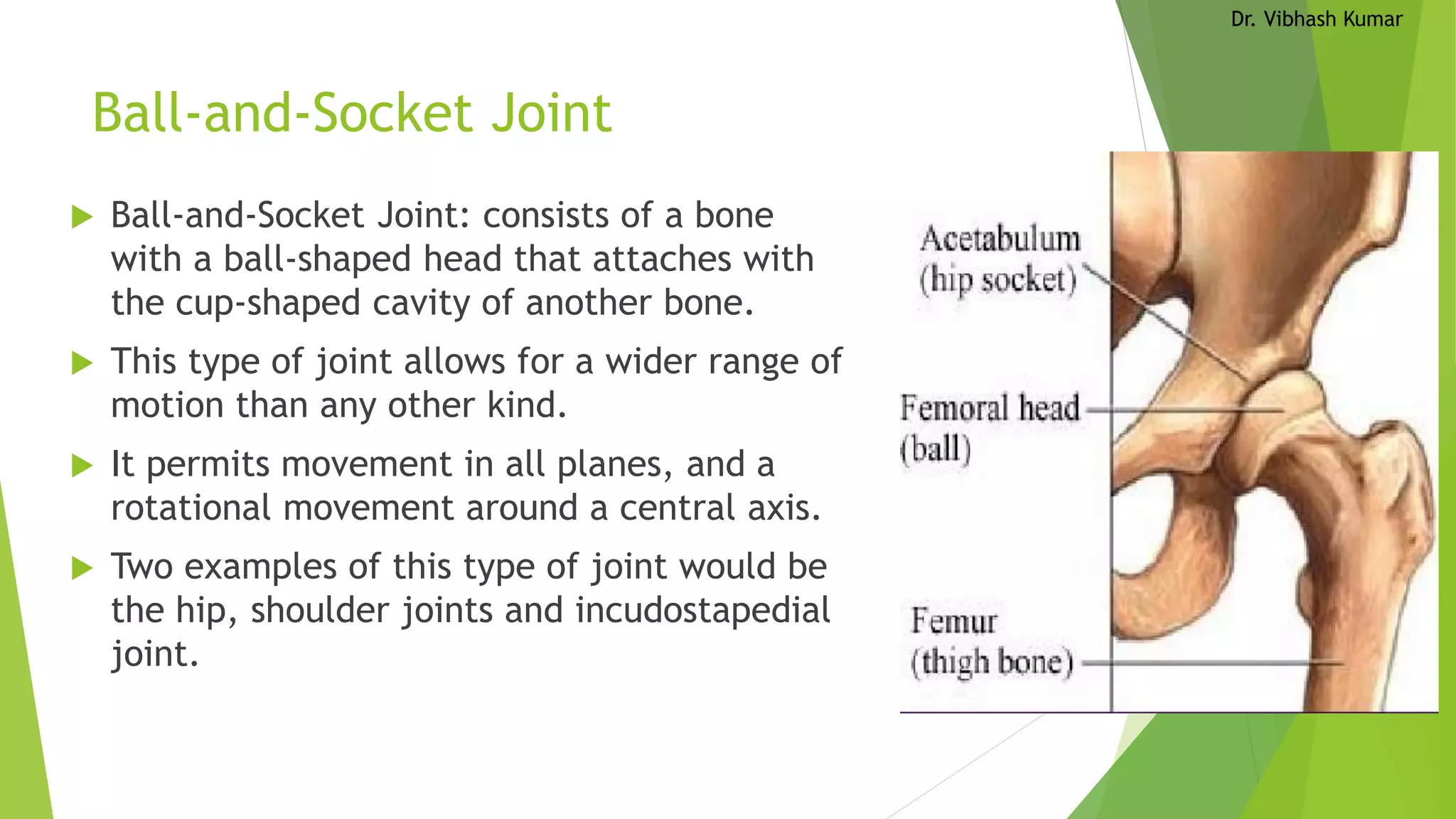
Ball-and-Socket Joint
 Ball-and-Socket Joint: consists of a bone
with a ball-shaped head that attaches with
the cup-shaped cavity of another bone.
 This type of joint allows for a wider range of
motion than any other kind.
 It permits movement in all planes, and a
rotational movement around a central axis.
 Two examples of this type of joint would be
the hip, shoulder joints and incudostapedial
joint.
Dr. Vibhash Kumar
FUNCTIONAL CLASSIFICATION
 Synarthrosis :- Synarthroses permit little or no mobility. Most synarthrosis
joints are fibrous joints.Egcranial sutures in adult.
 Amphiarthrosis :-Amphiarthroses permit slight mobility. The two bone
surfaces at the joint are both covered in hyaline cartilage and joined by
strands of fibrocartilage. eg: secondary cartilaginous joints
 Diarthrosis:- Permit a variety of movements. Only synovial joints are
diarthrodial.
Dr. Vibhash Kumar
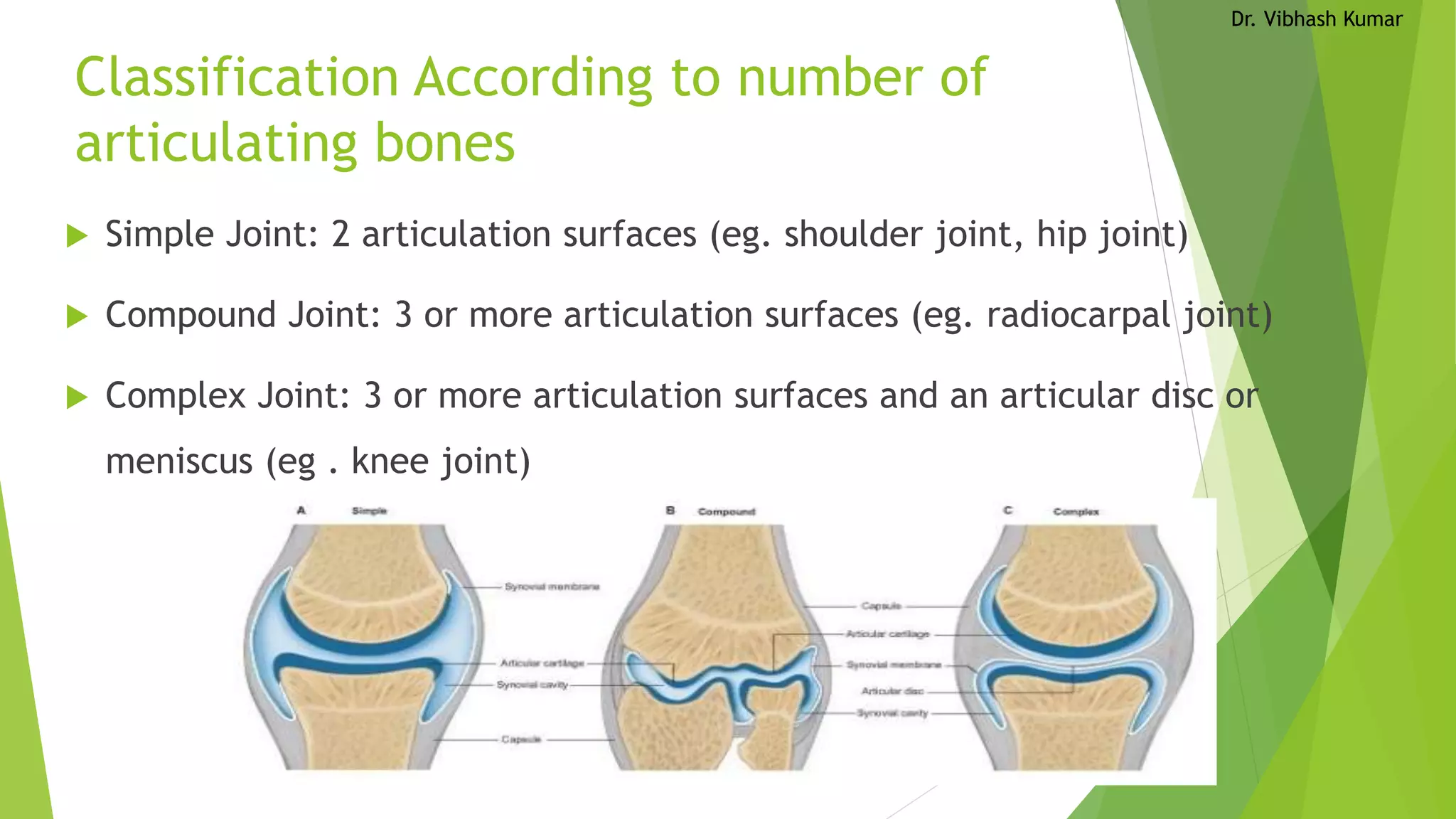
Classification According to number of
articulating bones
 Simple Joint: 2 articulation surfaces (eg. shoulder joint, hip joint)
 Compound Joint: 3 or more articulation surfaces (eg. radiocarpal joint)
 Complex Joint: 3 or more articulation surfaces and an articular disc or
meniscus (eg . knee joint)
Dr. Vibhash Kumar
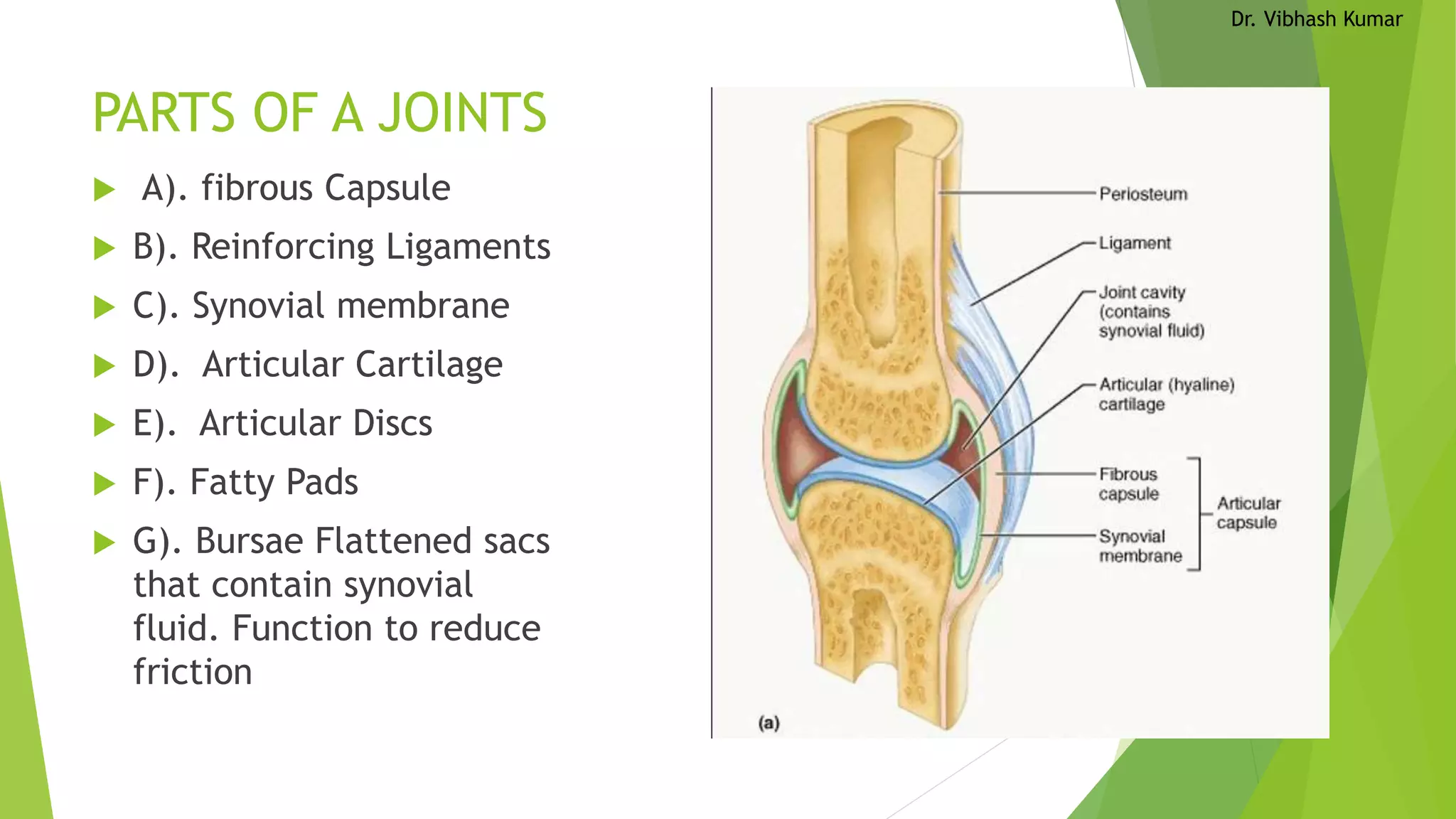
PARTS OF A JOINTS
 A). fibrous Capsule
 B). Reinforcing Ligaments
 C). Synovial membrane
 D). Articular Cartilage
 E). Articular Discs
 F). Fatty Pads
 G). Bursae Flattened sacs
that contain synovial
fluid. Function to reduce
friction
Dr. Vibhash Kumar
PARTS OF A JOINTS
Dr. Vibhash Kumar

Anatomy of Joints & its classification

  • 1.
    JOINTS By:- Dr. VibhashKumar Vaidya Department of Anatomy
  • 2.
    Dr. Vibhash Kumar Introductionof Joints  Joint is a junction between two or more bones or cartilages. It is a device to permit movement.  With the exception of the hyoid bone, every bone in the body is connected to or forms a joint.  There are 230 joints in the body
  • 3.
    Dr. Vibhash Kumar Functionsof joint  Hold the skeletal bones together.  Allow the skeleton some flexibility so gross movement can occur.  Make bone growth possible.
  • 4.
    Dr. Vibhash Kumar Classificationof joints  Joint are classified into structural and functional.  Structural classification is determined by how the bones connect to each other, while functional classification is determined by the degree of movement between the articulating bones.
  • 5.
    Dr. Vibhash Kumar StructuralClassification of Joints  Fibrous (Fixed) A.Sutures 1. Plane 2. Squamous 3. Serrate 4. Dentate 5. Schindylesis B. Gomphosis C. Syndesmosis  Cartilaginous (Slightly movable) A. Primary Cartilaginous joints (Synchondrosis) B. Secondary Cartilaginous joints (Symphysis)  Synovial Freely (movable) 1. Plane 2. Hinge 3. Pivot 4. Bicondylar 5. Ellipsoid 6. Saddle 7. Ball and socket
  • 6.
    Dr. Vibhash Kumar Structuralclassification cont… Fibrous Joints :- Bones are joined by fibrous tissue/dense connective tissue, consisting mainly of collagen. The fibrous joints are further divided into three types:- 1. Sutures or synostoses :- Found between bones of the skull. In fetal skulls the sutures are wide to allow slight movement during birth. They later become rigid (synarthrodial).
  • 7.
    Dr. Vibhash Kumar Typesof Sutures.. (lambdoid suture)
  • 8.
    Dr. Vibhash Kumar 2. Syndesmoses are joints where two adjacent bones are join together by a greater amount of connective tissue than in sutures in the form of interosseous ligaments and membranes.  Eg-interosseous radioulanr joint,interosseous tibiofibular joint.
  • 9.
    Dr. Vibhash Kumar 3. Gomphoses :- It is a specialized fibrous joint restricted to fixation of teeth in alveolar sockets of the maxilla or mandible. The root of tooth is attached to the socket with in alveolus by periodontal ligament.
  • 10.
    Dr. Vibhash Kumar CARTILAGINOUSJOINTS  In this type of joint the bones are joined by cartilage.  There are two types of cartilaginous joints: 1. Primary cartilaginous joints 2. Secondary cartilaginous joints
  • 11.
    Dr. Vibhash Kumar 1.Primary cartilaginous joints  joints - Known as "synchondroses". Bones forming joints are connected by a plate of hyaline cartilage. These joints are immovable and mostly temporary in nature. This cartilage may ossify with age.  Examples in humans are the joint between the first rib and the manubrium of the sternum  Joint between epiphysis and diaphysis of growing long bone.
  • 12.
    Dr. Vibhash Kumar 2.Secondary cartilaginous joints  Known as "symphysis". In these joints the articular surfaces of bone forming the joints are covered by thin plates of hyaline cartilage,which are connected by a disc of fibrocartilage.  Example:-symphysis pubis  Intervertebral disc  Manubriosternal joint  Symphysis menti.
  • 13.
    Dr. Vibhash Kumar SYNOVIALJOINTS  These joints possess a cavity and the articular ends of bones forming the joint are enclosed in a fibrous capsule.As a result they are seprated by a narrow cavity,the articular cavity,which is filled with a fluid called synovial flud.
  • 14.
    Dr. Vibhash Kumar Characteristicfeatures  The articular surfaces are covered by a thin plate of hyaline cartilage.  The joint cavity is enveloped by an articular capsule which consists of outer fibrous capsule and inner synovial membrane.  The cavity of joint is lined everywhere by synovial membrane except over articular cartilages.  The cavity is filled with synovial fluid secreted by synovial membrane which provides nutrition to articular cartilage and lubrication of articular surfaces.  Some joint cavity completely or incompletely divided by articular disc/ menisc.
  • 15.
    Dr. Vibhash Kumar Typesof synovial joints  Plane Joint  Hinge Joint  Pivot Joint  Condylar Joint  Ellipsoid joint  Saddle Joint  Ball-and-Socket Joint
  • 16.
    Dr. Vibhash Kumar PlaneJoint  Articular surfaces are more or less flat.  They permit gliding movements in various directions.  Examples; intercarpal joints,intertarsal joints,jts between articular process of adjacent vertebrae.
  • 17.
    Dr. Vibhash Kumar HingeJoint  Hinge Joint: the articular surface are pulley shaped. This type of joint permits movement in one plane around transverse axis. This movement consists of flexion and extension.  These joints have stong collateral ligaments to prevent other movements. Two examples are the elbow joint, knee joint, interphalangeal joint ,ankle joint.
  • 18.
    Dr. Vibhash Kumar PivotJoint  The articular surface of one bone is rounded and fits into concavity of another bone.further,rounded part is surrounded by a ligamentous ring.  Movement is limited to the rotation around a central axis.  Examples of this type of joint are the joints between the proximal ends of the radius and ulna .atlanto axial joint.
  • 19.
    Dr. Vibhash Kumar CondylarJoint  The round articular surface of one bone fits into socket type articular surfae of another bone.  The end of bone bearing round articular surface is called condyle .these joint permit movements in 2 direction.  Examples – right and left temporomandibular joints. knee joint
  • 20.
    Dr. Vibhash Kumar Ellipsoidjoint  Elliptical convex surface of one bone articulates with elliptical concave surface of another bone.  The movements are permitted in two directions.  Eg; wrist joint , atlanto occipital joint,metacarpo phalangeal joints,metatarso phalangeal joint
  • 21.
    Dr. Vibhash Kumar SaddleJoint  Saddle Joint: The articular surfaces are reciprocally saddle shaped i.e .concavo -convex.this unique artiulation is modified condyloid joint that allows a wide range of movement.  An example would be the joint between the trapezium and the metacarpal bones of the thumb,sternoclavicular joint.
  • 22.
    Dr. Vibhash Kumar Ball-and-SocketJoint  Ball-and-Socket Joint: consists of a bone with a ball-shaped head that attaches with the cup-shaped cavity of another bone.  This type of joint allows for a wider range of motion than any other kind.  It permits movement in all planes, and a rotational movement around a central axis.  Two examples of this type of joint would be the hip, shoulder joints and incudostapedial joint.
  • 23.
    Dr. Vibhash Kumar FUNCTIONALCLASSIFICATION  Synarthrosis :- Synarthroses permit little or no mobility. Most synarthrosis joints are fibrous joints.Egcranial sutures in adult.  Amphiarthrosis :-Amphiarthroses permit slight mobility. The two bone surfaces at the joint are both covered in hyaline cartilage and joined by strands of fibrocartilage. eg: secondary cartilaginous joints  Diarthrosis:- Permit a variety of movements. Only synovial joints are diarthrodial.
  • 24.
    Dr. Vibhash Kumar ClassificationAccording to number of articulating bones  Simple Joint: 2 articulation surfaces (eg. shoulder joint, hip joint)  Compound Joint: 3 or more articulation surfaces (eg. radiocarpal joint)  Complex Joint: 3 or more articulation surfaces and an articular disc or meniscus (eg . knee joint)
  • 25.
    Dr. Vibhash Kumar PARTSOF A JOINTS  A). fibrous Capsule  B). Reinforcing Ligaments  C). Synovial membrane  D). Articular Cartilage  E). Articular Discs  F). Fatty Pads  G). Bursae Flattened sacs that contain synovial fluid. Function to reduce friction
  • 26.
  • 27.