CENTER OF GRAVITY
OUTLINES
- Definition
- Location Of COG
- Factors Affecting Location Of COG in the body
- Determination Of Total body COG
- Mathematical method
- Laboratory method
- Determination Of Segmental Body COG
- Value Of Determination of COG
INTRODUCTION
2 Types of Forces affecting HB
↓
Internal Force & External Force
↓
GRF , GF , Resistance , Friction ,Pressure
DEFINITION OF CENTRE OF GRAVITY
- Gravitational Force (GF) : Force that pull The Body
Downward.
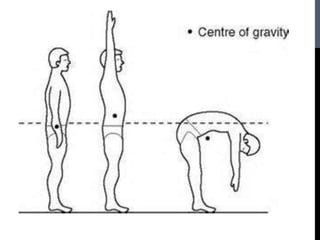
- Centre of gravity (COG) :
• is the balancing Point
• Where the body is concentrated & equally distributed
• It is the point of exact center where the body rotates in
all directions
• called center of mass
• Sum of all forces = 0 & sum of moments =0
LOCATION OF COG
- It Depends on The Body’s Shape & position
- If Distribution of mass is symmetrical :
• Square block or cylinder  At the center of object
- If distribution of mass is asymmetrical :
• Limbs of Hb  Nearer to the larger & heavier end
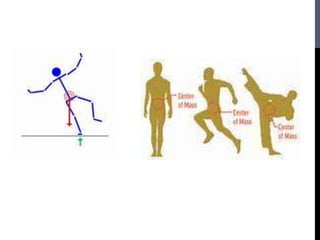
- In a normal Person Standing position  anterior 2nd sacral
vertebra
N . b : The exact location is not the same between individuals
since there are factors affecting it
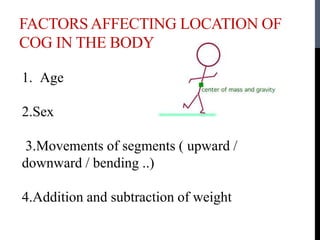
FACTORS AFFECTING LOCATION OF
COG IN THE BODY
1. Age
2.Sex
3.Movements of segments ( upward /
downward / bending ..)
4.Addition and subtraction of weight
AGE
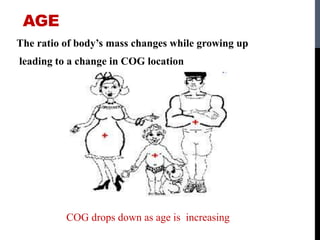
The ratio of body’s mass changes while growing up
leading to a change in COG location
COG drops down as age is increasing
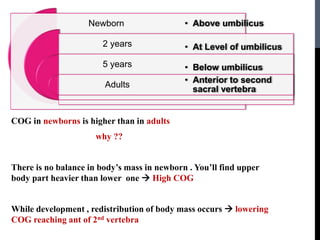
COG in newborns is higher than in adults
why ??
There is no balance in body’s mass in newborn . You’ll find upper
body part heavier than lower one  High COG
While development , redistribution of body mass occurs  lowering
COG reaching ant of 2nd vertebra
Newborn
2 years
5 years
Adults
• Above umbilicus
• At Level of umbilicus
• Below umbilicus
• Anterior to second
sacral vertebra
SEX
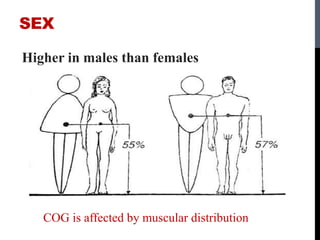
Higher in males than females
COG is affected by muscular distribution
In males :
oThe muscles of upper division weights more than lower
division
oBody build
=> COG higher
o57 % of standing height
In females
oThe pelvis is wider & lower than male’s pelvis
o55% of standing height
MOVEMENT OF SEGMENTS
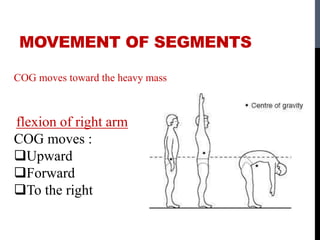
COG moves toward the heavy mass
flexion of right arm
COG moves :
Upward
Forward
To the right
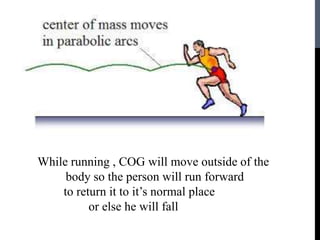
While running , COG will move outside of the
body so the person will run forward
to return it to it’s normal place
or else he will fall
ADDITION WEIGHT
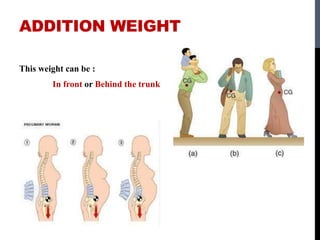
This weight can be :
In front or Behind the trunk
If the weight was behind the trunk
=> COG moves backward
=> person will make a forward trunk movement or
else the backward weight will pull him back
If the weight was in front the trunk
=> COG will move forward
=> person will make a backward trunk movement
=> leads to increase lumbar lordosis and back pain
later on .
SUBTRACTION OF WEIGHT
In case of amputation
oCOG moves away from amputated limb  toward the
healthy side
oTo have a normal gait and distributed body segment ,
the artificial limb’s weight & the normal limb’s weight
should be identical
This identical limb will balance in body’s weight thus
returning COG to normal
DETERMINATION OFTHE LOCATION OF COG
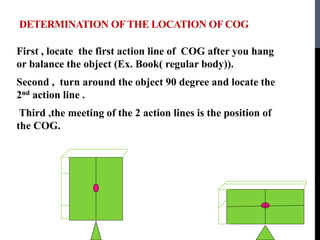
First , locate the first action line of COG after you hang
or balance the object (Ex. Book( regular body)).
Second , turn around the object 90 degree and locate the
2nd action line .
Third ,the meeting of the 2 action lines is the position of
the COG.
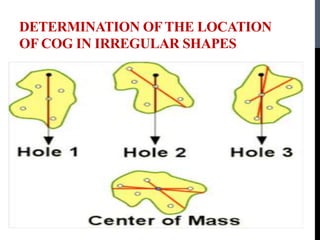
DETERMINATION OFTHE LOCATION
OF COG IN IRREGULAR SHAPES
DETERMINATION OF
TOTAL BODY COG:
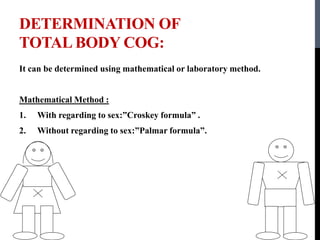
It can be determined using mathematical or laboratory method.
Mathematical Method :
1. With regarding to sex:”Croskey formula” .
2. Without regarding to sex:”Palmar formula”.
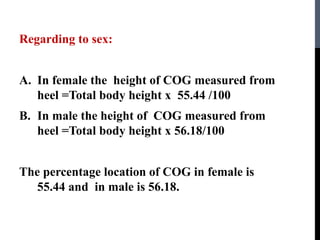
Regarding to sex:
A. In female the height of COG measured from
heel =Total body height x 55.44 /100
B. In male the height of COG measured from
heel =Total body height x 56.18/100
The percentage location of COG in female is
55.44 and in male is 56.18.
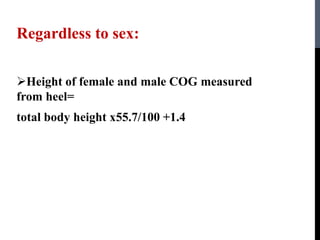
Regardless to sex:
Height of female and male COG measured
from heel=
total body height x55.7/100 +1.4
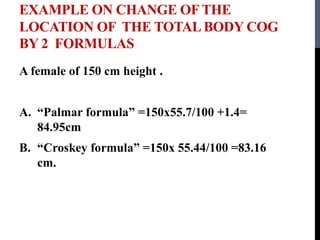
EXAMPLE ON CHANGE OF THE
LOCATION OF THE TOTAL BODY COG
BY 2 FORMULAS
A female of 150 cm height .
A. “Palmar formula” =150x55.7/100 +1.4=
84.95cm
B. “Croskey formula” =150x 55.44/100 =83.16
cm.
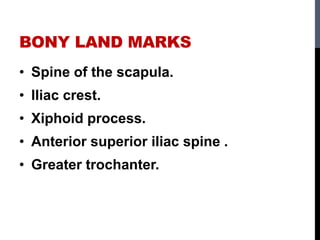
BONY LAND MARKS
• Spine of the scapula.
• Iliac crest.
• Xiphoid process.
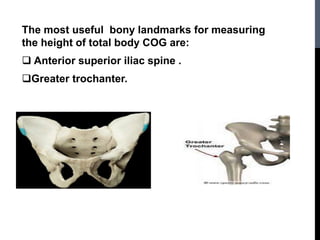
• Anterior superior iliac spine .
• Greater trochanter.
The most useful bony landmarks for measuring
the height of total body COG are:
 Anterior superior iliac spine .
Greater trochanter.
MEASUREMENT OF TOTAL
BODY HEIGHT
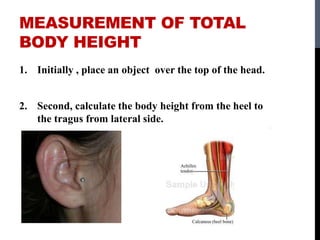
1. Initially , place an object over the top of the head.
2. Second, calculate the body height from the heel to
the tragus from lateral side.
3. Third , use Palmar or Croskey formula.
4.Forth , find the relation of the total body
center of gravity height to either bony or soft
tissue land mark .
THE LABORATORY METHOD
“BOARD and Scale Method” or “Balance
Board Method”
TRANSVERSE PLANE
TRANSVERSE PLANE
TRANSVERSE PLANE
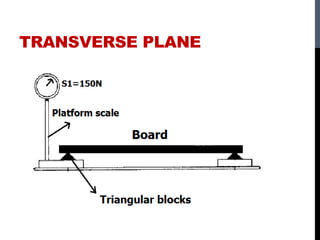
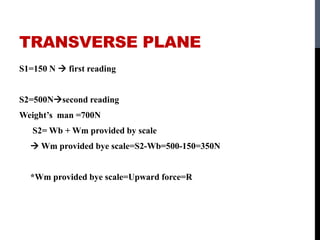
S1=150 N  first reading
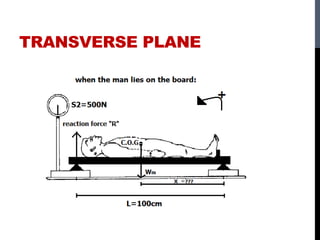
S2=500Nsecond reading
Weight’s man =700N
S2= Wb + Wm provided by scale
 Wm provided bye scale=S2-Wb=500-150=350N
*Wm provided bye scale=Upward force=R
TRANSVERSE PLANE
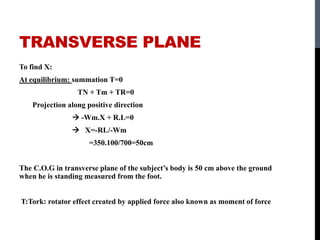
To find X:
At equilibrium: summation T=0
TN + Tm + TR=0
Projection along positive direction
 -Wm.X + R.L=0
 X=-RL/-Wm
=350.100/700=50cm
The C.O.G in transverse plane of the subject’s body is 50 cm above the ground
when he is standing measured from the foot.
T:Tork: rotator effect created by applied force also known as moment of force
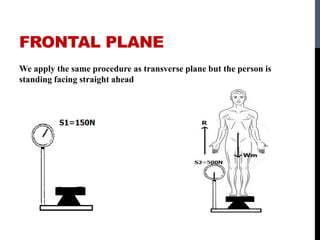
FRONTAL PLANE
We apply the same procedure as transverse plane but the person is
standing facing straight ahead
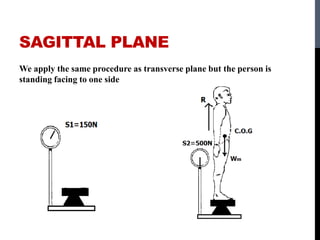
SAGITTAL PLANE
We apply the same procedure as transverse plane but the person is
standing facing to one side
DETERMINATION OF SEGMENTAL
BODY COG
Body Segments:
The body is made up of eight segments, these
segments are:
1-Head and Neck 5-Hand
2-Trunk 6-Thigh
3-Arm 7-Leg
4-Forearm 8-Foot
The location of COG of each body segment is toward the
heavier end, which is approximately 4/7 of segment length
measured from distal end.
How to determine COG of any segment?
-First, the location of proximal and distal end of each
segment should be in appendicular and axial skeleton, then
measure the segmental length of this segment.
-Second, Mathematically multiply the segmental length by
4/7 in order to find the location of segmental COG,
Then measure the final result from the distal end.
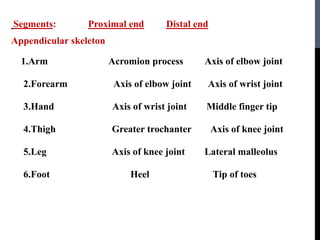
Segments: Proximal end Distal end
Appendicular skeleton
1.Arm Acromion process Axis of elbow joint
2.Forearm Axis of elbow joint Axis of wrist joint
3.Hand Axis of wrist joint Middle finger tip
4.Thigh Greater trochanter Axis of knee joint
5.Leg Axis of knee joint Lateral malleolus
6.Foot Heel Tip of toes
Axial skeleton
7.Head and Neck Sternal notch Tragus
(midpoint between (top of head)
2 shoulders)
8.Trunk Crotch Sternal notch
(midpoint between
2 hip joints )
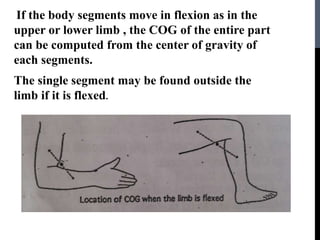
If the body segments move in flexion as in the
upper or lower limb , the COG of the entire part
can be computed from the center of gravity of
each segments.
The single segment may be found outside the
limb if it is flexed.
VALUE OF
DETERMINATION OF COG
• Total Body COG
• Segmental COG
TOTAL BODY COG
During gait training of any patient the key of sucessful handling to
control and support patients at the pelvis which is the COG .
The therapist may assist by grasping the patients belt or steadying
the pelvis .
Total COG help to enhance the performance of athletes .
SEGMENTAL COG
In amputee patient it help to design the weight of artifical limb that
will be equal to the amputated limb .
If the artifical limb increase the segmental COG will change so the
total COG will change as a result they may place overload on a
diseased part which cause pain .
SEGMENTAL COG
It help to determine the leverage effect of gravity .
In segment is more difficult to lift in extended position than in
flexed .
Change of body segment position
away from the joint cause
an increased need for muscle
activity .
REFERENCES
• Hand out
• www.slide.share (Lecture to dr. shimaa Essa)
• Basic Biomechanics Book-chapter13,Equilibrium and human
movement
• Handout
• http://thumb1.shutterstock.com/display_pic_with_logo/374293/37
4293,1271146890,4/stock-vector-full-length-profile-front-back-
view-of-a-standing-naked-man-50821411.jpg
• faculty.mu.edu.sa ( Majmaah University)
THANK YOU


Kinesiology & biomechanics

  • 1.
  • 2.
    OUTLINES - Definition - LocationOf COG - Factors Affecting Location Of COG in the body - Determination Of Total body COG - Mathematical method - Laboratory method - Determination Of Segmental Body COG - Value Of Determination of COG
  • 3.
    INTRODUCTION 2 Types ofForces affecting HB ↓ Internal Force & External Force ↓ GRF , GF , Resistance , Friction ,Pressure
  • 4.
    DEFINITION OF CENTREOF GRAVITY - Gravitational Force (GF) : Force that pull The Body Downward. - Centre of gravity (COG) : • is the balancing Point • Where the body is concentrated & equally distributed • It is the point of exact center where the body rotates in all directions • called center of mass • Sum of all forces = 0 & sum of moments =0
  • 6.
    LOCATION OF COG -It Depends on The Body’s Shape & position - If Distribution of mass is symmetrical : • Square block or cylinder  At the center of object - If distribution of mass is asymmetrical : • Limbs of Hb  Nearer to the larger & heavier end - In a normal Person Standing position  anterior 2nd sacral vertebra N . b : The exact location is not the same between individuals since there are factors affecting it
  • 7.
    FACTORS AFFECTING LOCATIONOF COG IN THE BODY 1. Age 2.Sex 3.Movements of segments ( upward / downward / bending ..) 4.Addition and subtraction of weight
  • 8.
    AGE The ratio ofbody’s mass changes while growing up leading to a change in COG location COG drops down as age is increasing
  • 9.
    COG in newbornsis higher than in adults why ?? There is no balance in body’s mass in newborn . You’ll find upper body part heavier than lower one  High COG While development , redistribution of body mass occurs  lowering COG reaching ant of 2nd vertebra Newborn 2 years 5 years Adults • Above umbilicus • At Level of umbilicus • Below umbilicus • Anterior to second sacral vertebra
  • 10.
    SEX Higher in malesthan females COG is affected by muscular distribution
  • 11.
    In males : oThemuscles of upper division weights more than lower division oBody build => COG higher o57 % of standing height In females oThe pelvis is wider & lower than male’s pelvis o55% of standing height
  • 12.
    MOVEMENT OF SEGMENTS COGmoves toward the heavy mass flexion of right arm COG moves : Upward Forward To the right
  • 13.
    While running ,COG will move outside of the body so the person will run forward to return it to it’s normal place or else he will fall
  • 14.
    ADDITION WEIGHT This weightcan be : In front or Behind the trunk
  • 15.
    If the weightwas behind the trunk => COG moves backward => person will make a forward trunk movement or else the backward weight will pull him back If the weight was in front the trunk => COG will move forward => person will make a backward trunk movement => leads to increase lumbar lordosis and back pain later on .
  • 16.
    SUBTRACTION OF WEIGHT Incase of amputation oCOG moves away from amputated limb  toward the healthy side oTo have a normal gait and distributed body segment , the artificial limb’s weight & the normal limb’s weight should be identical This identical limb will balance in body’s weight thus returning COG to normal
  • 17.
    DETERMINATION OFTHE LOCATIONOF COG First , locate the first action line of COG after you hang or balance the object (Ex. Book( regular body)). Second , turn around the object 90 degree and locate the 2nd action line . Third ,the meeting of the 2 action lines is the position of the COG.
  • 18.
    DETERMINATION OFTHE LOCATION OFCOG IN IRREGULAR SHAPES
  • 19.
    DETERMINATION OF TOTAL BODYCOG: It can be determined using mathematical or laboratory method. Mathematical Method : 1. With regarding to sex:”Croskey formula” . 2. Without regarding to sex:”Palmar formula”.
  • 20.
    Regarding to sex: A.In female the height of COG measured from heel =Total body height x 55.44 /100 B. In male the height of COG measured from heel =Total body height x 56.18/100 The percentage location of COG in female is 55.44 and in male is 56.18.
  • 21.
    Regardless to sex: Heightof female and male COG measured from heel= total body height x55.7/100 +1.4
  • 22.
    EXAMPLE ON CHANGEOF THE LOCATION OF THE TOTAL BODY COG BY 2 FORMULAS A female of 150 cm height . A. “Palmar formula” =150x55.7/100 +1.4= 84.95cm B. “Croskey formula” =150x 55.44/100 =83.16 cm.
  • 23.
    BONY LAND MARKS •Spine of the scapula. • Iliac crest. • Xiphoid process. • Anterior superior iliac spine . • Greater trochanter.
  • 24.
    The most usefulbony landmarks for measuring the height of total body COG are:  Anterior superior iliac spine . Greater trochanter.
  • 25.
    MEASUREMENT OF TOTAL BODYHEIGHT 1. Initially , place an object over the top of the head. 2. Second, calculate the body height from the heel to the tragus from lateral side.
  • 26.
    3. Third ,use Palmar or Croskey formula. 4.Forth , find the relation of the total body center of gravity height to either bony or soft tissue land mark .
  • 27.
    THE LABORATORY METHOD “BOARDand Scale Method” or “Balance Board Method”
  • 28.
  • 29.
  • 30.
    TRANSVERSE PLANE S1=150 N first reading S2=500Nsecond reading Weight’s man =700N S2= Wb + Wm provided by scale  Wm provided bye scale=S2-Wb=500-150=350N *Wm provided bye scale=Upward force=R
  • 31.
    TRANSVERSE PLANE To findX: At equilibrium: summation T=0 TN + Tm + TR=0 Projection along positive direction  -Wm.X + R.L=0  X=-RL/-Wm =350.100/700=50cm The C.O.G in transverse plane of the subject’s body is 50 cm above the ground when he is standing measured from the foot. T:Tork: rotator effect created by applied force also known as moment of force
  • 32.
    FRONTAL PLANE We applythe same procedure as transverse plane but the person is standing facing straight ahead
  • 33.
    SAGITTAL PLANE We applythe same procedure as transverse plane but the person is standing facing to one side
  • 34.
    DETERMINATION OF SEGMENTAL BODYCOG Body Segments: The body is made up of eight segments, these segments are: 1-Head and Neck 5-Hand 2-Trunk 6-Thigh 3-Arm 7-Leg 4-Forearm 8-Foot
  • 35.
    The location ofCOG of each body segment is toward the heavier end, which is approximately 4/7 of segment length measured from distal end. How to determine COG of any segment? -First, the location of proximal and distal end of each segment should be in appendicular and axial skeleton, then measure the segmental length of this segment. -Second, Mathematically multiply the segmental length by 4/7 in order to find the location of segmental COG, Then measure the final result from the distal end.
  • 36.
    Segments: Proximal endDistal end Appendicular skeleton 1.Arm Acromion process Axis of elbow joint 2.Forearm Axis of elbow joint Axis of wrist joint 3.Hand Axis of wrist joint Middle finger tip 4.Thigh Greater trochanter Axis of knee joint 5.Leg Axis of knee joint Lateral malleolus 6.Foot Heel Tip of toes
  • 37.
    Axial skeleton 7.Head andNeck Sternal notch Tragus (midpoint between (top of head) 2 shoulders) 8.Trunk Crotch Sternal notch (midpoint between 2 hip joints )
  • 38.
    If the bodysegments move in flexion as in the upper or lower limb , the COG of the entire part can be computed from the center of gravity of each segments. The single segment may be found outside the limb if it is flexed.
  • 39.
    VALUE OF DETERMINATION OFCOG • Total Body COG • Segmental COG
  • 40.
    TOTAL BODY COG Duringgait training of any patient the key of sucessful handling to control and support patients at the pelvis which is the COG . The therapist may assist by grasping the patients belt or steadying the pelvis . Total COG help to enhance the performance of athletes .
  • 42.
    SEGMENTAL COG In amputeepatient it help to design the weight of artifical limb that will be equal to the amputated limb . If the artifical limb increase the segmental COG will change so the total COG will change as a result they may place overload on a diseased part which cause pain .
  • 43.
    SEGMENTAL COG It helpto determine the leverage effect of gravity . In segment is more difficult to lift in extended position than in flexed . Change of body segment position away from the joint cause an increased need for muscle activity .
  • 44.
    REFERENCES • Hand out •www.slide.share (Lecture to dr. shimaa Essa) • Basic Biomechanics Book-chapter13,Equilibrium and human movement • Handout • http://thumb1.shutterstock.com/display_pic_with_logo/374293/37 4293,1271146890,4/stock-vector-full-length-profile-front-back- view-of-a-standing-naked-man-50821411.jpg • faculty.mu.edu.sa ( Majmaah University)
  • 45.