FACIAL PALSY
Dr. Vibhash Kumar Vaidya
Contents
• Introduction
• Anatomy
• Epidemiology
• Cause
• Clinical Features
• Differential Diagnosis
• Ramse Hunt syndrome
• Evaluation & Diagnosis
•Treatment
•Prognosis
•Complications
•Physiotherapy management
Introduction
• Facial palsy accounts for 75% of cases of
acute facial nerve (7th cranial nerve) paralysis
• Imaging is not needed in majority of patients
unless they have atypical features
• W/atypical features, MR & CT may
demonstrate potentially treatable lesions
affecting facial nerves
• Facial nerves can be affected anywhere along
their course
- Sir Charles Bell, Scottish
Surgeon
- First described in early
1800s based on trauma
to facial nerves
- Definition of Bell’s
Palsy: Acute peripheral
CN VII (facial nerve)
palsy of unknown cause
Anatomy of Facial nerve
• The facial nerve contains approximately 10,000 fibers
• 7000 myelinated fibers innervate the muscles of
facial expression, stapedius muscle, postauricular
muscles, posterior belly of digastric muscle, and
platysma
• 3000 fibers form the nervus intermedius (Nerve of
Wrisberg)
– sensory fibers (taste) from the anterior 2/3 of the tongue
– taste fibers from soft palate via palatine and greater
petrosal nerve
– parasympathetic secretomotor fibers to the parotid,
submandibular, sublingual, and lacrimal gland
Anatomy of Facial nerve
1) Intracranial part
• Supranuclear segment
• Nuclear segment
• Infranuclear segment
– Cerebellopontine angle
– Internal acoustic canal
– Labyrinthine segment
– Tympanic segment
– Mastoid segment
2) Extracranial part
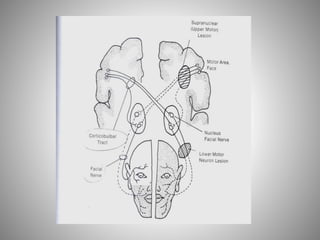
Supranuclear segment
• Cerebral cortex  Corticobulbar tract 
Facial nucleus (pons)
–Upper face  crossed & uncrossed
–Lower face  crossed only
Nuclear segment
• Facial motor nucleus
–lower 1/3 of Pons
• abducent nucleus
• Out from brain stem at pons recess between
olive and inferior cerebellar peduncle
Infranuclear segment
• Cerebellopontine angle
• Internal acoustic canal
• Labyrinthine segment
• Tympanic segment
• Mastoid segment
Cerebellopontine angle
• The facial nerve and nervus intermedius exit
the brain stem at the pontomedullary junction
and travel with CN VIII to enter the internal
acoustic meatus
Internal acoustic canal
• Motor facial nerve (medial)
• Nervus intermedius (between)
• Acoustic nerve (lateral)
Labyrinthine segment
• Fallopian canal
– Shortest & Narrowest part
– Temporal bone
• Facial nerve enter fallopian canal until middle ear
• First genu
• Geniculate ganglion
• Branches
– Greater superficial petrosal nerve  lacrimal gland
– Lessor superficial petrosal nerve  parotid gland
Tympanic segment
• First genu  above oval window  stapes
• Second genu beyond middle ear
• Out of cranium through stylomastoid
foramen
Mastoid segment
• Stylomastoid foramen
• Branches
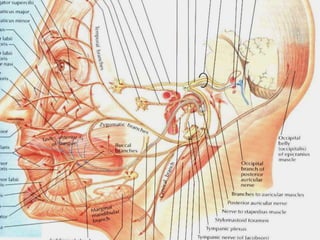
–Motor nerve to stapedius muscle
–Chorda tympani nerve between malleus and
incus
• secretomotor : Submandibular & Sublingual
gland
• taste fiber : anterior 2/3 of tongue
Extracranial segment
• Posterior auricular nerve : auricularis, occipitalis
and sensation at auricular, post auricular area
• Branch to posterior belly of digastric muscle and
stylohyoid muscle
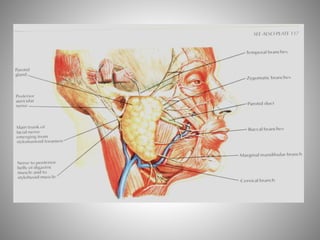
• Temporal branch : muscle above zygoma
• Zygomatic branch : orbicularis occli
• Buccal branch : buccinator and upper lip
• Marginal mandibular branch : orbicularis oris and
lower lip
• Cervical branch : platysma
Epidemiology
• ½ of all facial palsy’s qualify as “Bell’s Palsy”
• Annual Incidence 10-40/100,000
• Lifetime incidence 1:60
• Risk is 3xs greater in pregnancy, especially 3rd
trimester
• Increased risk with diabetes
Cause
• Widely accepted cause is HSV-1, however not
proven
• HSV mediates inflammatory/immune
response which leads to myelin sheath
degeneration, & edema which causes
compression and further damage of CN VII
Clinical Features
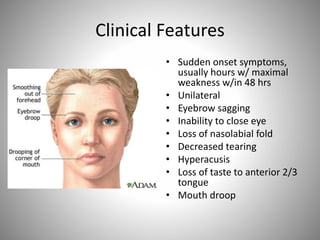
• Sudden onset symptoms,
usually hours w/ maximal
weakness w/in 48 hrs
• Unilateral
• Eyebrow sagging
• Inability to close eye
• Loss of nasolabial fold
• Decreased tearing
• Hyperacusis
• Loss of taste to anterior 2/3
tongue
• Mouth droop
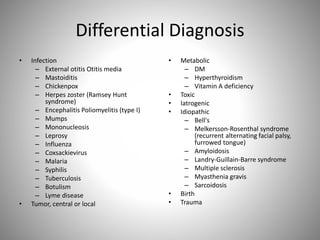
Differential Diagnosis
• Infection
– External otitis Otitis media
– Mastoiditis
– Chickenpox
– Herpes zoster (Ramsey Hunt
syndrome)
– Encephalitis Poliomyelitis (type I)
– Mumps
– Mononucleosis
– Leprosy
– Influenza
– Coxsackievirus
– Malaria
– Syphilis
– Tuberculosis
– Botulism
– Lyme disease
• Tumor, central or local
• Metabolic
– DM
– Hyperthyroidism
– Vitamin A deficiency
• Toxic
• Iatrogenic
• Idiopathic
– Bell's
– Melkersson-Rosenthal syndrome
(recurrent alternating facial palsy,
furrowed tongue)
– Amyloidosis
– Landry-Guillain-Barre syndrome
– Multiple sclerosis
– Myasthenia gravis
– Sarcoidosis
• Birth
• Trauma
Herpes Zoster Oticus
(Ramsay Hunt Syndrome)
• 3rd most common of peripheral facial paralysis
(10%)
• Aged > 60 yrs. or low immune (low CMIR)
• Virus travels to the dorsal root extramedullary
cranial nerve ganglion
• Infected of HZV at auricular, external canal or
face
• Prodromal symptoms very similar to those seen
in Bell's palsy
• but usually more severe
Herpes Zoster Oticus
(Ramsay Hunt Syndrome)
• Symptoms include severe otalgia, facial
paralysis, facial numbness, and a vesicular
eruption on the concha, external auditory
canal, and palate
• Facial paralysis + hearing loss + vertigo 
“canal paralysis”
• Pathophysiology & treatment liked in Bell
’s palsy
Evaluation & Diagnosis
• Bell’s Palsy is a clinical
diagnosis based on
– typical presentation
– absence of other
explanation or other
underlying disease
– absence of cutaneous
lesions
– otherwise normal neuro
exam
• Possible Labs to check:
ESR, RPR, Lyme titer,
glucose, PCR if vesicular
lesions
• Proceed with imaging
(MRI) if
– Atypical Presentation
– Slowly progressive over 2-3
weeks
– If no improvement in
symptoms in 6 wks
• Electrophysiology (CMAP)
performed if complete
facial paralysis remains
after 1 week of treatment
Treatment
• Manual closing of eye such as with tape while
sleeping, lubricating eye drops
• Steroids 60-80 mg daily x 5 days then tapered
over next 5 days or 1 mg/kg daily x 7 days
• +/-Acyclovir 400 mg 5xs daily x 10 days vs
Valacyclovir 1 g BID x 7 days
• Surgical Decompression – no good evidence to
support
Prognosis
• 80% recover within weeks to months
• If motor nerve conduction studies show
evidence of denervation after 10 days
indicates prolonged recovery of ~ 3 months &
possible incomplete recovery
Complications
• Complications of facial nerve
decompression
–dural tears
–conductive or sensorineural hearing loss
–vestibular function loss
–persistent CSF leaks
–meningitis
–injury to the anterior inferior cerebellar
artery (AICA) or its branches
PHYSIOTHERAPY MANAGEMENT
GOALS
1- to educate patient about the condition.
2- to relief pain.
3- to establish the bases for re-education of muscle
and nerve conduction.
4- to re-educate the sensation if involved.
5- to improve muscle contraction.
6- to improve facial symmetry.
7- to prevent complications.

Facial palsy

  • 1.
  • 2.
    Contents • Introduction • Anatomy •Epidemiology • Cause • Clinical Features • Differential Diagnosis • Ramse Hunt syndrome • Evaluation & Diagnosis
  • 3.
  • 4.
    Introduction • Facial palsyaccounts for 75% of cases of acute facial nerve (7th cranial nerve) paralysis • Imaging is not needed in majority of patients unless they have atypical features • W/atypical features, MR & CT may demonstrate potentially treatable lesions affecting facial nerves • Facial nerves can be affected anywhere along their course
  • 5.
    - Sir CharlesBell, Scottish Surgeon - First described in early 1800s based on trauma to facial nerves - Definition of Bell’s Palsy: Acute peripheral CN VII (facial nerve) palsy of unknown cause
  • 6.
    Anatomy of Facialnerve • The facial nerve contains approximately 10,000 fibers • 7000 myelinated fibers innervate the muscles of facial expression, stapedius muscle, postauricular muscles, posterior belly of digastric muscle, and platysma • 3000 fibers form the nervus intermedius (Nerve of Wrisberg) – sensory fibers (taste) from the anterior 2/3 of the tongue – taste fibers from soft palate via palatine and greater petrosal nerve – parasympathetic secretomotor fibers to the parotid, submandibular, sublingual, and lacrimal gland
  • 7.
    Anatomy of Facialnerve 1) Intracranial part • Supranuclear segment • Nuclear segment • Infranuclear segment – Cerebellopontine angle – Internal acoustic canal – Labyrinthine segment – Tympanic segment – Mastoid segment 2) Extracranial part
  • 8.
    Supranuclear segment • Cerebralcortex  Corticobulbar tract  Facial nucleus (pons) –Upper face  crossed & uncrossed –Lower face  crossed only
  • 9.
    Nuclear segment • Facialmotor nucleus –lower 1/3 of Pons • abducent nucleus • Out from brain stem at pons recess between olive and inferior cerebellar peduncle
  • 11.
    Infranuclear segment • Cerebellopontineangle • Internal acoustic canal • Labyrinthine segment • Tympanic segment • Mastoid segment
  • 12.
    Cerebellopontine angle • Thefacial nerve and nervus intermedius exit the brain stem at the pontomedullary junction and travel with CN VIII to enter the internal acoustic meatus
  • 13.
    Internal acoustic canal •Motor facial nerve (medial) • Nervus intermedius (between) • Acoustic nerve (lateral)
  • 14.
    Labyrinthine segment • Fallopiancanal – Shortest & Narrowest part – Temporal bone • Facial nerve enter fallopian canal until middle ear • First genu • Geniculate ganglion • Branches – Greater superficial petrosal nerve  lacrimal gland – Lessor superficial petrosal nerve  parotid gland
  • 15.
    Tympanic segment • Firstgenu  above oval window  stapes • Second genu beyond middle ear • Out of cranium through stylomastoid foramen
  • 16.
    Mastoid segment • Stylomastoidforamen • Branches –Motor nerve to stapedius muscle –Chorda tympani nerve between malleus and incus • secretomotor : Submandibular & Sublingual gland • taste fiber : anterior 2/3 of tongue
  • 17.
    Extracranial segment • Posteriorauricular nerve : auricularis, occipitalis and sensation at auricular, post auricular area • Branch to posterior belly of digastric muscle and stylohyoid muscle • Temporal branch : muscle above zygoma • Zygomatic branch : orbicularis occli • Buccal branch : buccinator and upper lip • Marginal mandibular branch : orbicularis oris and lower lip • Cervical branch : platysma
  • 20.
    Epidemiology • ½ ofall facial palsy’s qualify as “Bell’s Palsy” • Annual Incidence 10-40/100,000 • Lifetime incidence 1:60 • Risk is 3xs greater in pregnancy, especially 3rd trimester • Increased risk with diabetes
  • 21.
    Cause • Widely acceptedcause is HSV-1, however not proven • HSV mediates inflammatory/immune response which leads to myelin sheath degeneration, & edema which causes compression and further damage of CN VII
  • 22.
    Clinical Features • Suddenonset symptoms, usually hours w/ maximal weakness w/in 48 hrs • Unilateral • Eyebrow sagging • Inability to close eye • Loss of nasolabial fold • Decreased tearing • Hyperacusis • Loss of taste to anterior 2/3 tongue • Mouth droop
  • 23.
    Differential Diagnosis • Infection –External otitis Otitis media – Mastoiditis – Chickenpox – Herpes zoster (Ramsey Hunt syndrome) – Encephalitis Poliomyelitis (type I) – Mumps – Mononucleosis – Leprosy – Influenza – Coxsackievirus – Malaria – Syphilis – Tuberculosis – Botulism – Lyme disease • Tumor, central or local • Metabolic – DM – Hyperthyroidism – Vitamin A deficiency • Toxic • Iatrogenic • Idiopathic – Bell's – Melkersson-Rosenthal syndrome (recurrent alternating facial palsy, furrowed tongue) – Amyloidosis – Landry-Guillain-Barre syndrome – Multiple sclerosis – Myasthenia gravis – Sarcoidosis • Birth • Trauma
  • 24.
    Herpes Zoster Oticus (RamsayHunt Syndrome) • 3rd most common of peripheral facial paralysis (10%) • Aged > 60 yrs. or low immune (low CMIR) • Virus travels to the dorsal root extramedullary cranial nerve ganglion • Infected of HZV at auricular, external canal or face • Prodromal symptoms very similar to those seen in Bell's palsy • but usually more severe
  • 25.
    Herpes Zoster Oticus (RamsayHunt Syndrome) • Symptoms include severe otalgia, facial paralysis, facial numbness, and a vesicular eruption on the concha, external auditory canal, and palate • Facial paralysis + hearing loss + vertigo  “canal paralysis” • Pathophysiology & treatment liked in Bell ’s palsy
  • 26.
    Evaluation & Diagnosis •Bell’s Palsy is a clinical diagnosis based on – typical presentation – absence of other explanation or other underlying disease – absence of cutaneous lesions – otherwise normal neuro exam • Possible Labs to check: ESR, RPR, Lyme titer, glucose, PCR if vesicular lesions • Proceed with imaging (MRI) if – Atypical Presentation – Slowly progressive over 2-3 weeks – If no improvement in symptoms in 6 wks • Electrophysiology (CMAP) performed if complete facial paralysis remains after 1 week of treatment
  • 27.
    Treatment • Manual closingof eye such as with tape while sleeping, lubricating eye drops • Steroids 60-80 mg daily x 5 days then tapered over next 5 days or 1 mg/kg daily x 7 days • +/-Acyclovir 400 mg 5xs daily x 10 days vs Valacyclovir 1 g BID x 7 days • Surgical Decompression – no good evidence to support
  • 28.
    Prognosis • 80% recoverwithin weeks to months • If motor nerve conduction studies show evidence of denervation after 10 days indicates prolonged recovery of ~ 3 months & possible incomplete recovery
  • 29.
    Complications • Complications offacial nerve decompression –dural tears –conductive or sensorineural hearing loss –vestibular function loss –persistent CSF leaks –meningitis –injury to the anterior inferior cerebellar artery (AICA) or its branches
  • 30.
    PHYSIOTHERAPY MANAGEMENT GOALS 1- toeducate patient about the condition. 2- to relief pain. 3- to establish the bases for re-education of muscle and nerve conduction. 4- to re-educate the sensation if involved. 5- to improve muscle contraction. 6- to improve facial symmetry. 7- to prevent complications.

Editor's Notes

  • #22 HSV is unproven
  • #23 Can have prodromal URI Hyperacusis: abnormal acuteness of hearing due to increased irritability of the sensory neural mechanism; characterized by intolerance for ordinary sound levels
  • #27 CMAP: Compound Muscle Action Potential; this value correlates histologically with the # of degenerating motor neurons, CMAP value 10% of normal corresponds with loss of 90% of motor axons; if >90% consider surgery for decompression
  • #28 Eye drops and lid closure to prevent corneal dryness and damage If permanent, surgical reconstruction considered