

VASA DEFERENTIA
(DEFERENT DUCTS)
By Dr. Vibhash kumar Vaidya
VASA DEFERENTIA (DEFERENT DUCTS)
 These are two in number (right and left).
 Each vas deferens is a thick-walled muscular tube
which transports spermatozoa from the epididymis
to the ejaculatory duct.
 The vas deferens is about 18 inches (45 cm) long
and has a narrow lumen except in the terminal part
which is sacculated—the ampulla of vas deferens.
COURSE AND RELATIONS
External Course of Vas Deferens-
 It begins at the inferior pole of the testis as direct
continuation of the duct of epididymis and ascends upward
behind the testis and medial to the epididymis.
 It enters the spermatic cord, where it lies in its posterior
part, which is the usual site of vasectomy.
 It passes through inguinal canal and enters the abdominal
cavity by passing through the deep inguinal ring located
lateral to the inferior epigastric artery.
Internal Course of Vas Deferens-
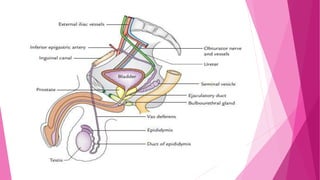
 It hooks around the lateral side of the inferior epigastric artery and passes backward and
medially across the external iliac vessels and enters the lesser pelvis.
 In the lesser pelvis, it runs downward and backward on the lateral pelvic wall crossing
successively obliterated umbilical artery, obturator nerve, and vessels.
 Then it crosses above and medial to the terminal part of the ureter and makes an angular bend
downward and medially.
 Thereafter, it passes behind the base of the bladder in front of the rectal ampulla and on the
medial side of the seminal vesicle.
 This part of the vas deferens is enlarged and sacculated to form an ampulla which probably
stores the semen.
 Finally it reach the base of prostate where it joins the duct of the seminal vesicle to form the
ejaculatory duct.
ARTERIAL SUPPLY-
1. Artery to vas deferens, a branch of superior vesical artery.
2. Artery to vas deferens, a branch of inferior vesical artery.
3. Artery to vas deferens, a branch of middle rectal artery.
VENOUS DRAINAGE-
The veins from vas deferens join the vesical venous plexus which in turn drains into the
internal iliac veins.
NERVE SUPPLY-
It is primarily by the parasympathetic fibres from the pelvic splanchnic nerves.
Clinical correlation
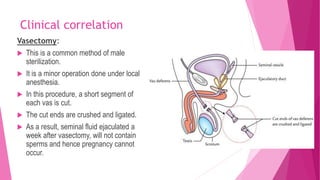
Vasectomy:
 This is a common method of male
sterilization.
 It is a minor operation done under local
anesthesia.
 In this procedure, a short segment of
each vas is cut.
 The cut ends are crushed and ligated.
 As a result, seminal fluid ejaculated a
week after vasectomy, will not contain
sperms and hence pregnancy cannot
occur.
Ductus deference

Ductus deference

  • 1.
    VASA DEFERENTIA (DEFERENT DUCTS) ByDr. Vibhash kumar Vaidya
  • 2.
    VASA DEFERENTIA (DEFERENTDUCTS)  These are two in number (right and left).  Each vas deferens is a thick-walled muscular tube which transports spermatozoa from the epididymis to the ejaculatory duct.  The vas deferens is about 18 inches (45 cm) long and has a narrow lumen except in the terminal part which is sacculated—the ampulla of vas deferens.
  • 4.
    COURSE AND RELATIONS ExternalCourse of Vas Deferens-  It begins at the inferior pole of the testis as direct continuation of the duct of epididymis and ascends upward behind the testis and medial to the epididymis.  It enters the spermatic cord, where it lies in its posterior part, which is the usual site of vasectomy.  It passes through inguinal canal and enters the abdominal cavity by passing through the deep inguinal ring located lateral to the inferior epigastric artery.
  • 5.
    Internal Course ofVas Deferens-  It hooks around the lateral side of the inferior epigastric artery and passes backward and medially across the external iliac vessels and enters the lesser pelvis.  In the lesser pelvis, it runs downward and backward on the lateral pelvic wall crossing successively obliterated umbilical artery, obturator nerve, and vessels.  Then it crosses above and medial to the terminal part of the ureter and makes an angular bend downward and medially.  Thereafter, it passes behind the base of the bladder in front of the rectal ampulla and on the medial side of the seminal vesicle.  This part of the vas deferens is enlarged and sacculated to form an ampulla which probably stores the semen.  Finally it reach the base of prostate where it joins the duct of the seminal vesicle to form the ejaculatory duct.
  • 6.
    ARTERIAL SUPPLY- 1. Arteryto vas deferens, a branch of superior vesical artery. 2. Artery to vas deferens, a branch of inferior vesical artery. 3. Artery to vas deferens, a branch of middle rectal artery. VENOUS DRAINAGE- The veins from vas deferens join the vesical venous plexus which in turn drains into the internal iliac veins. NERVE SUPPLY- It is primarily by the parasympathetic fibres from the pelvic splanchnic nerves.
  • 7.
    Clinical correlation Vasectomy:  Thisis a common method of male sterilization.  It is a minor operation done under local anesthesia.  In this procedure, a short segment of each vas is cut.  The cut ends are crushed and ligated.  As a result, seminal fluid ejaculated a week after vasectomy, will not contain sperms and hence pregnancy cannot occur.