RADIAL NERVE - ANATOMY
 DR.Murali.M.S;M.B.A
Prof. of Surgery
D Y Patil Medical College
Mauritius.
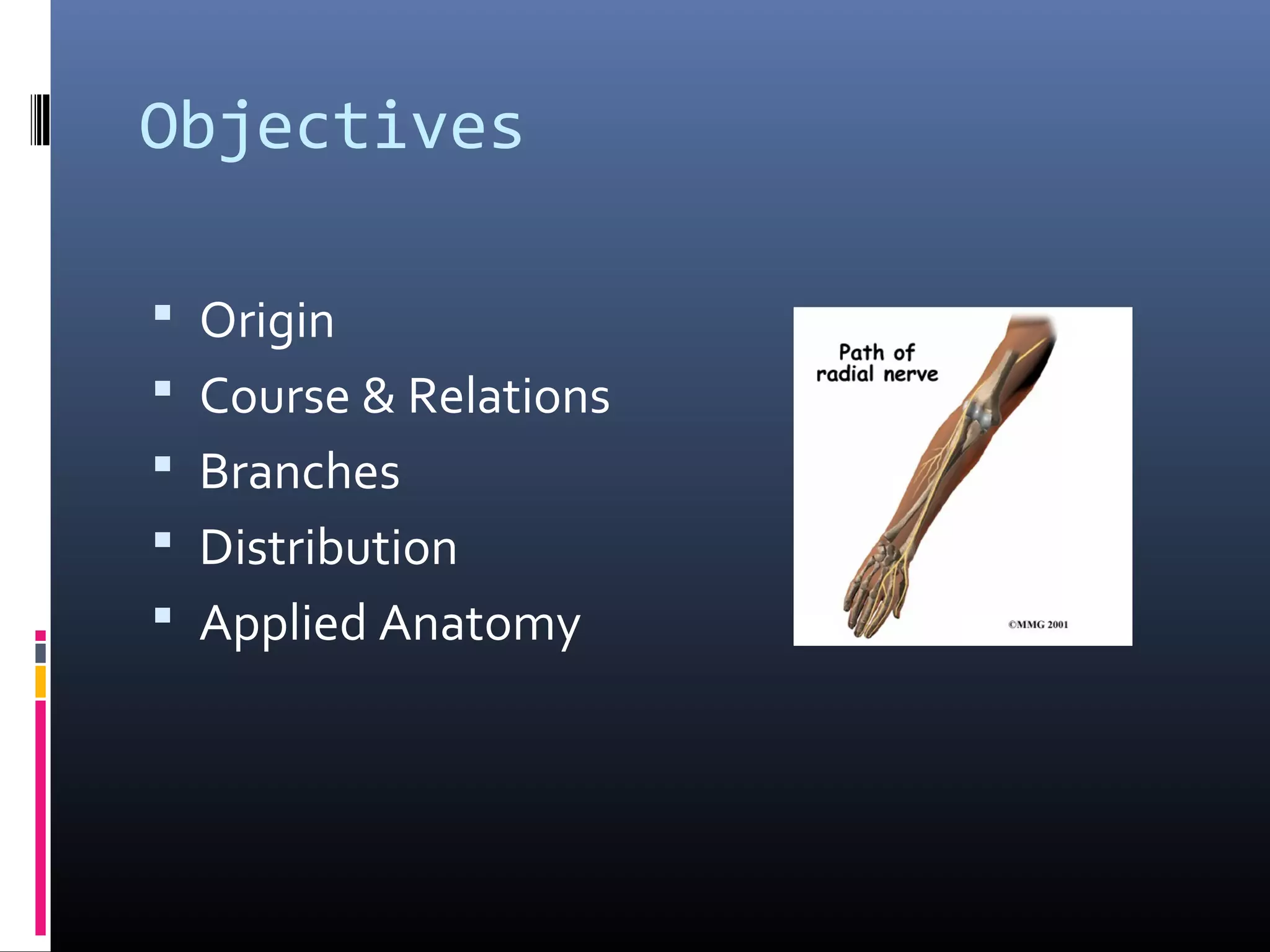
Objectives
 Origin
 Course & Relations
 Branches
 Distribution
 Applied Anatomy
Radial Nerve
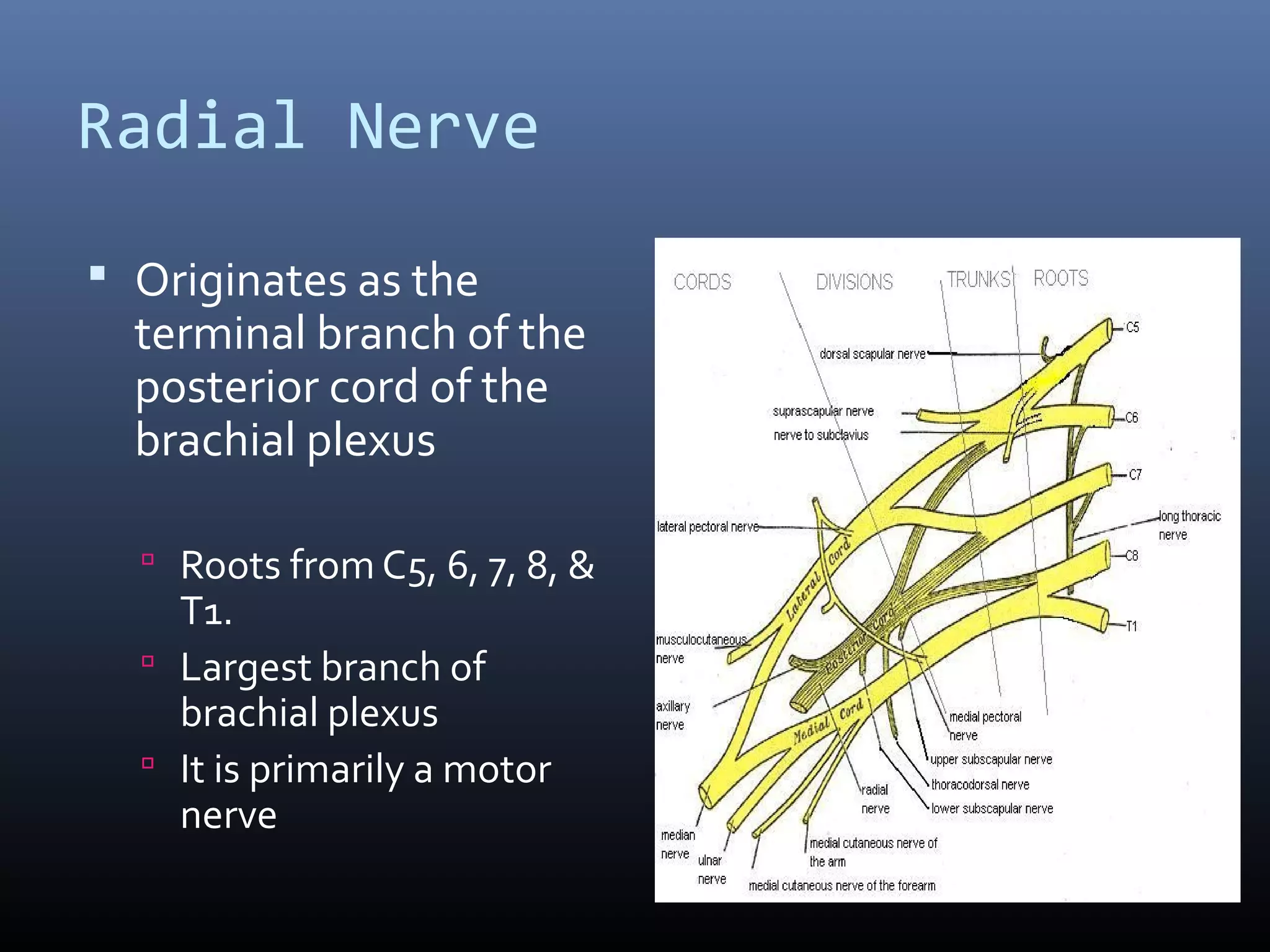
 Originates as the
terminal branch of the
posterior cord of the
brachial plexus
 Roots from C5, 6, 7, 8, &
T1.
 Largest branch of
brachial plexus
 It is primarily a motor
nerve
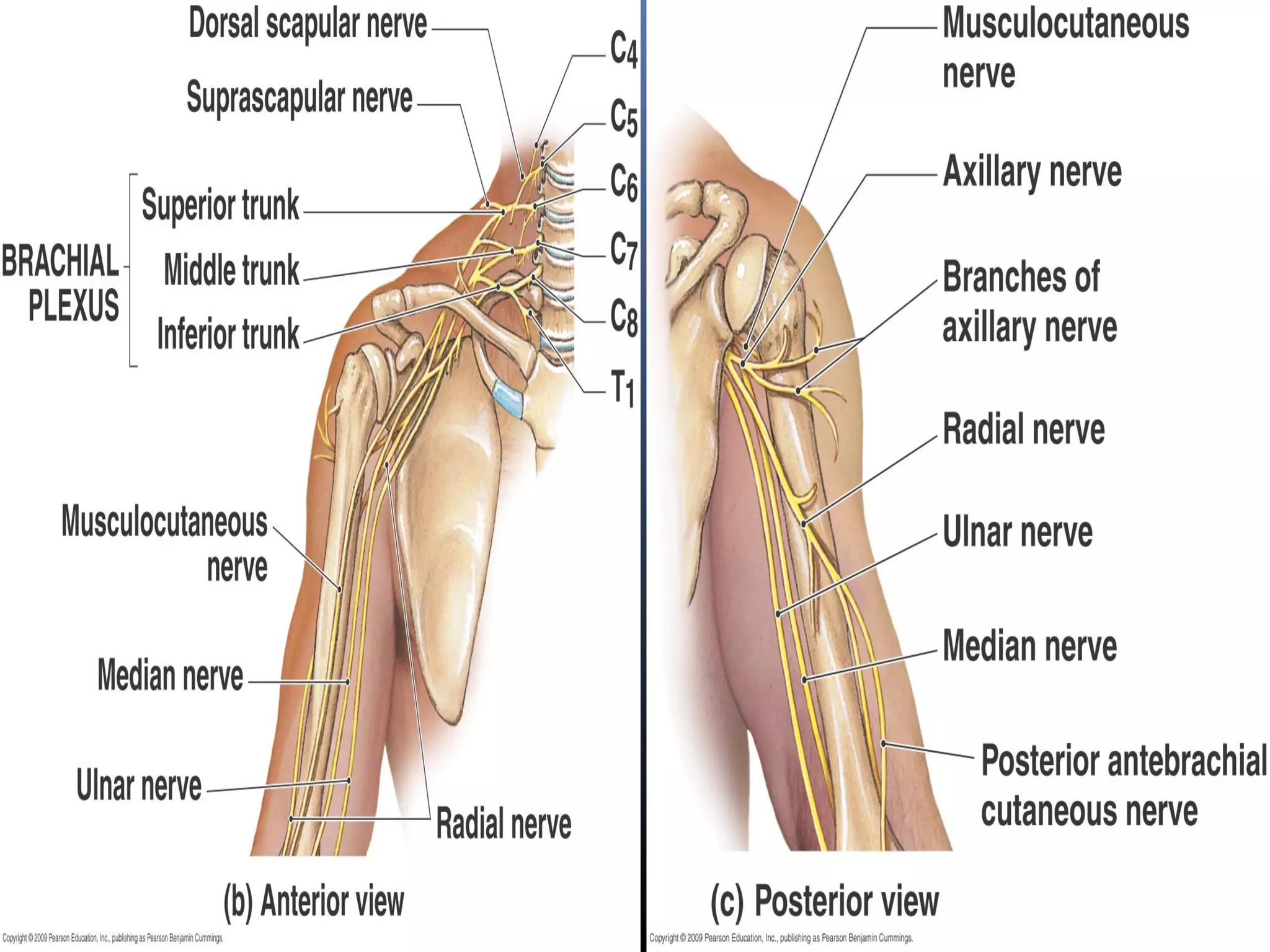
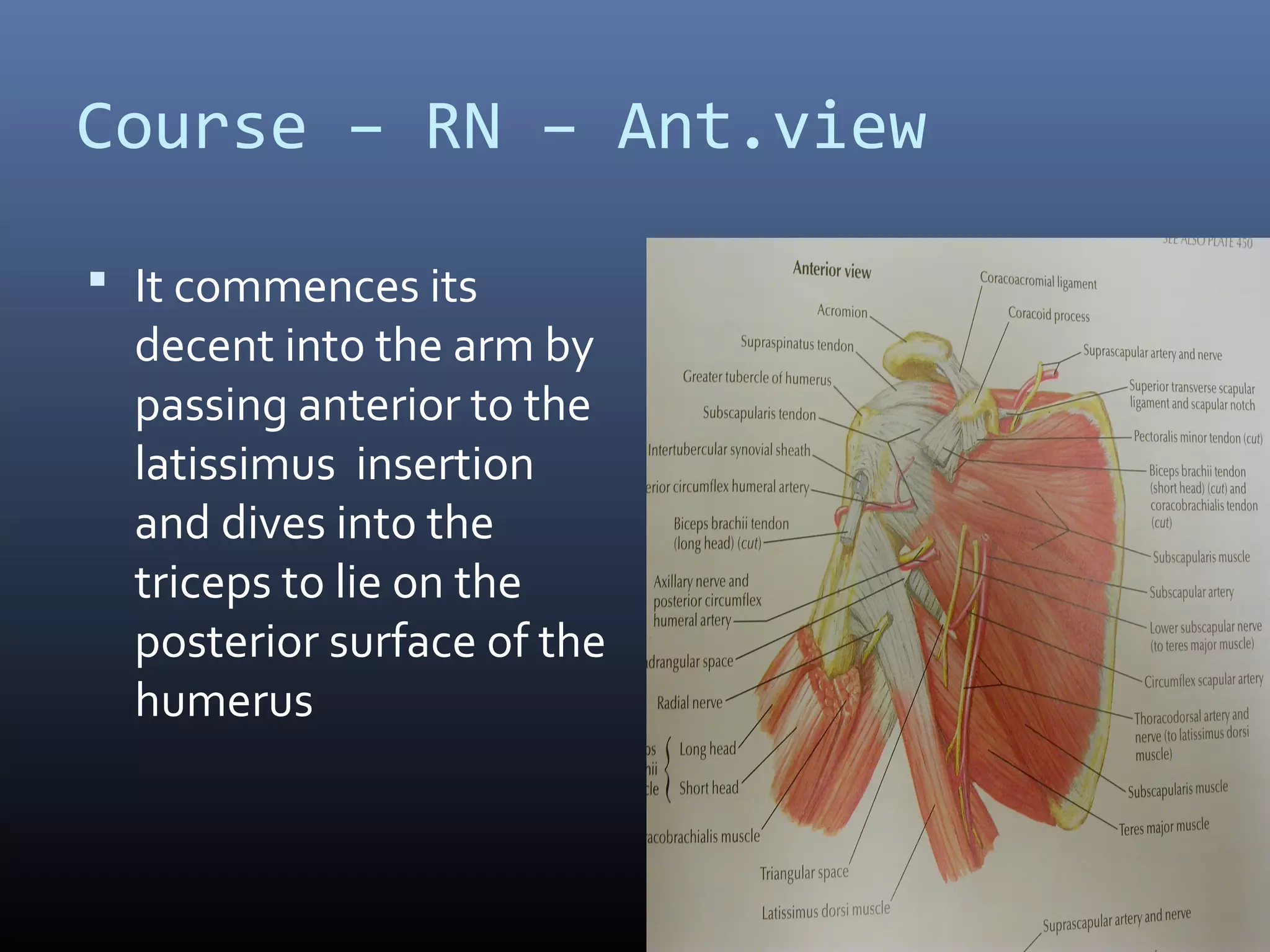
Course – RN – Ant.view
 It commences its
decent into the arm by
passing anterior to the
latissimus insertion
and dives into the
triceps to lie on the
posterior surface of the
humerus
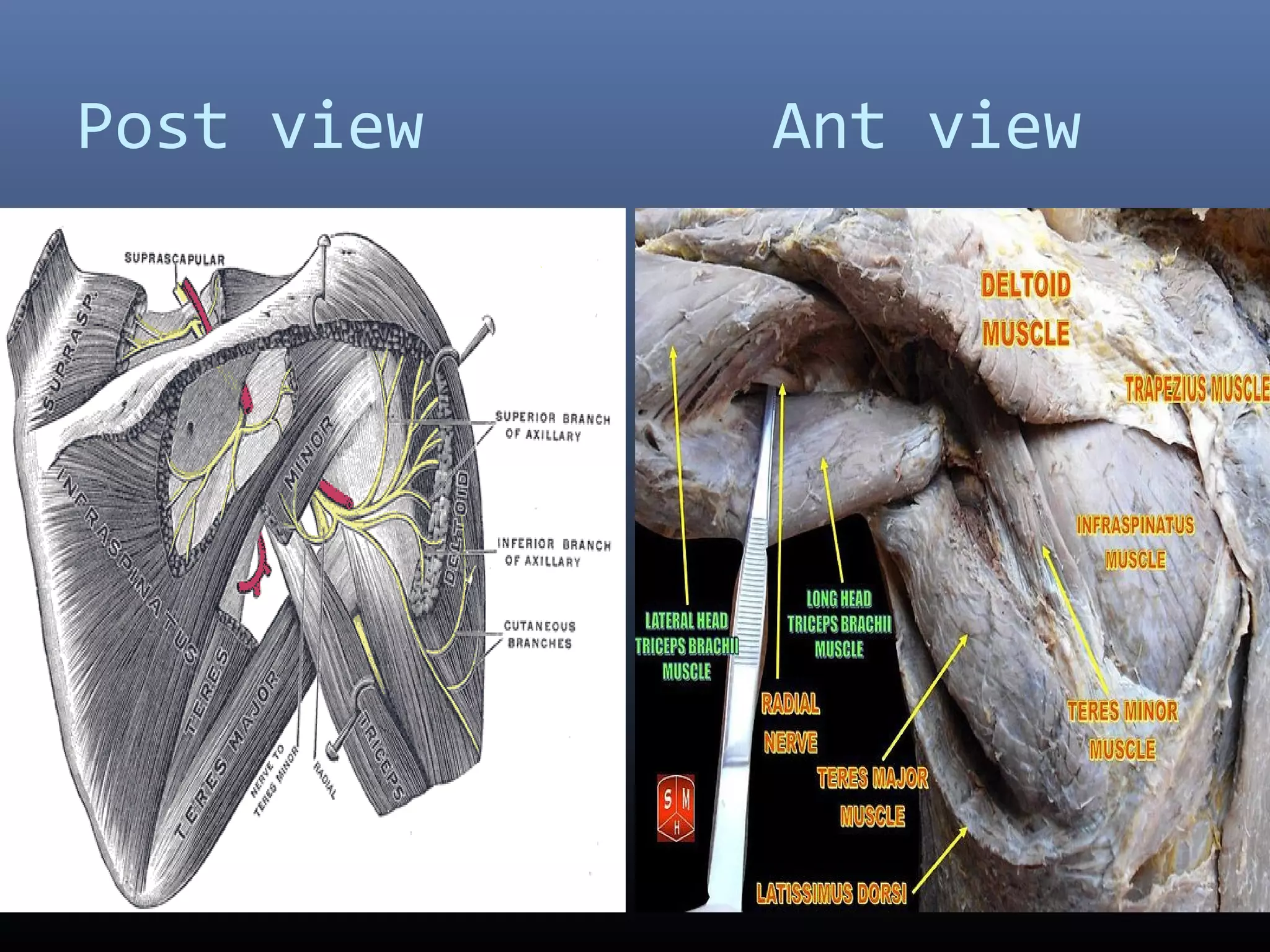
Post view Ant view
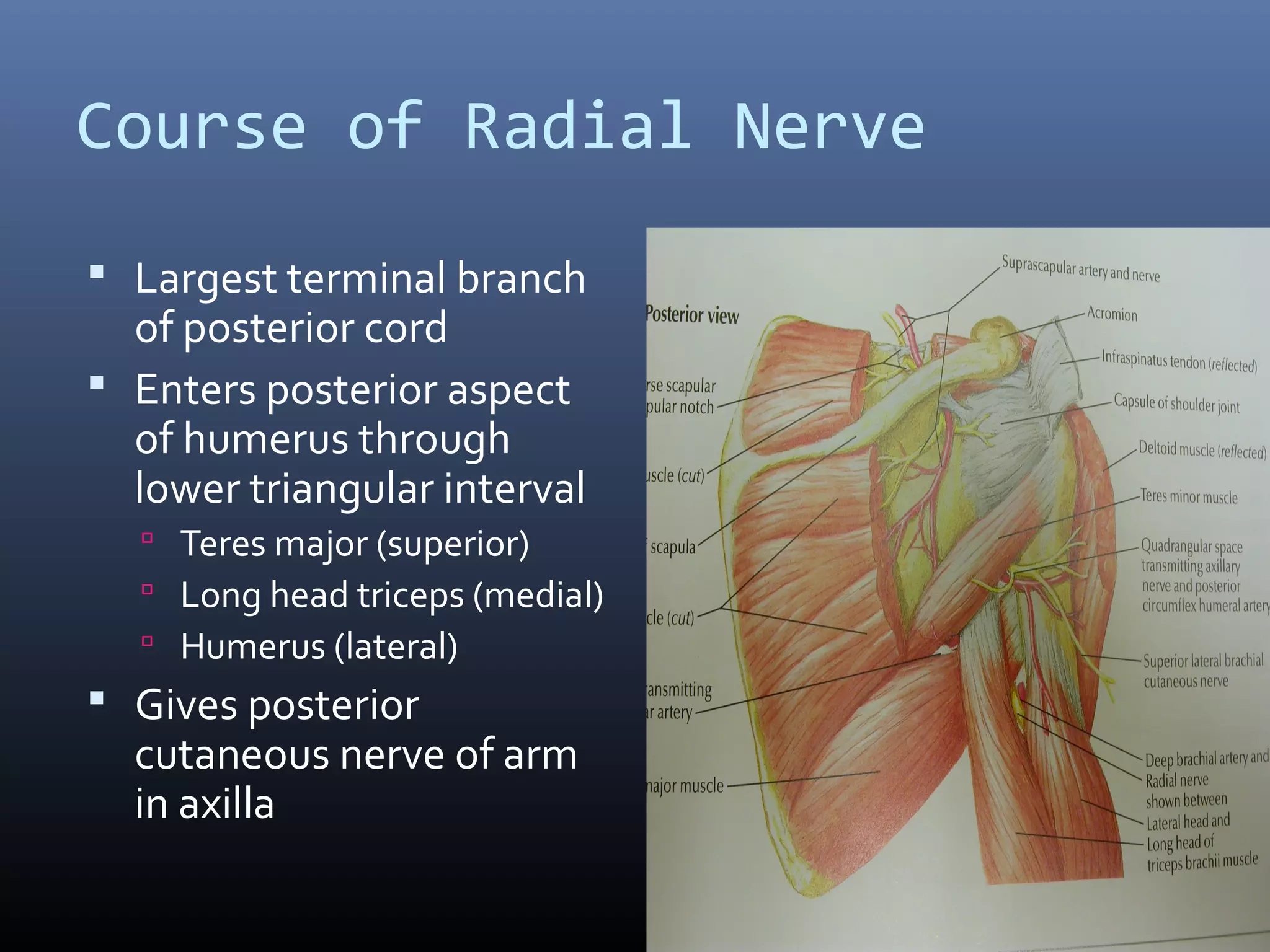
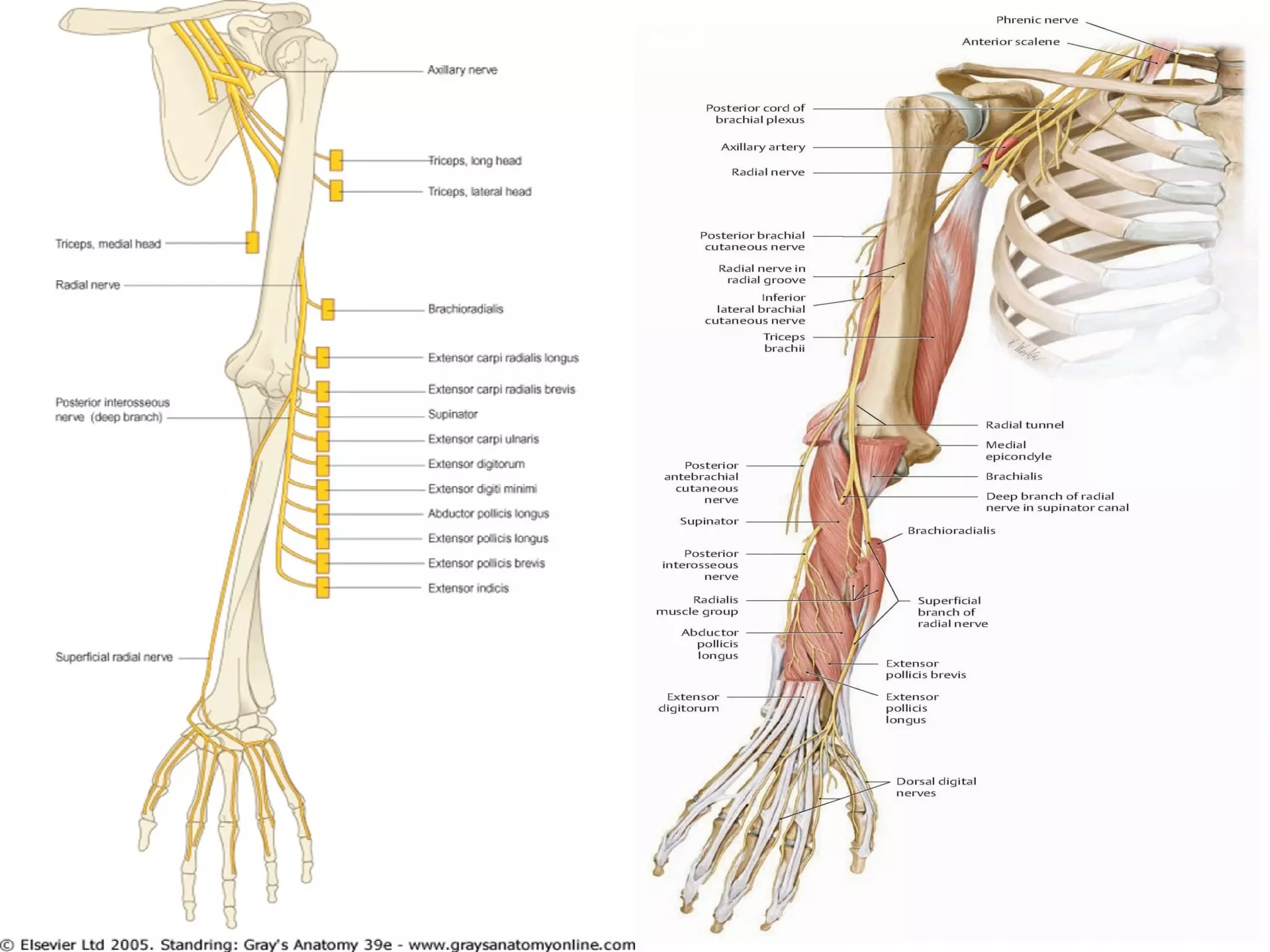
Course of Radial Nerve
 Largest terminal branch
of posterior cord
 Enters posterior aspect
of humerus through
lower triangular interval
 Teres major (superior)
 Long head triceps (medial)
 Humerus (lateral)
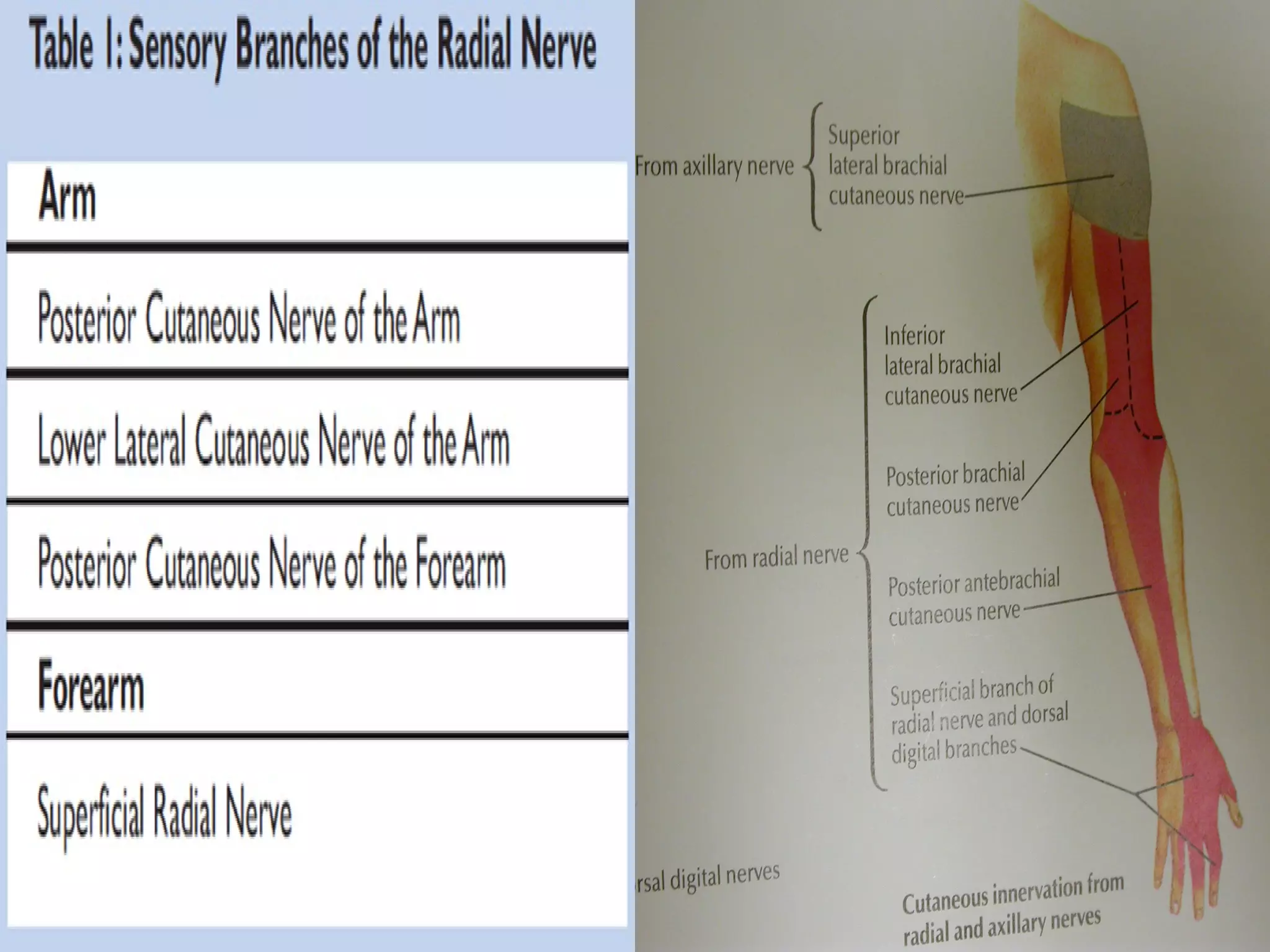
 Gives posterior
cutaneous nerve of arm
in axilla
Course of Radial Nerve
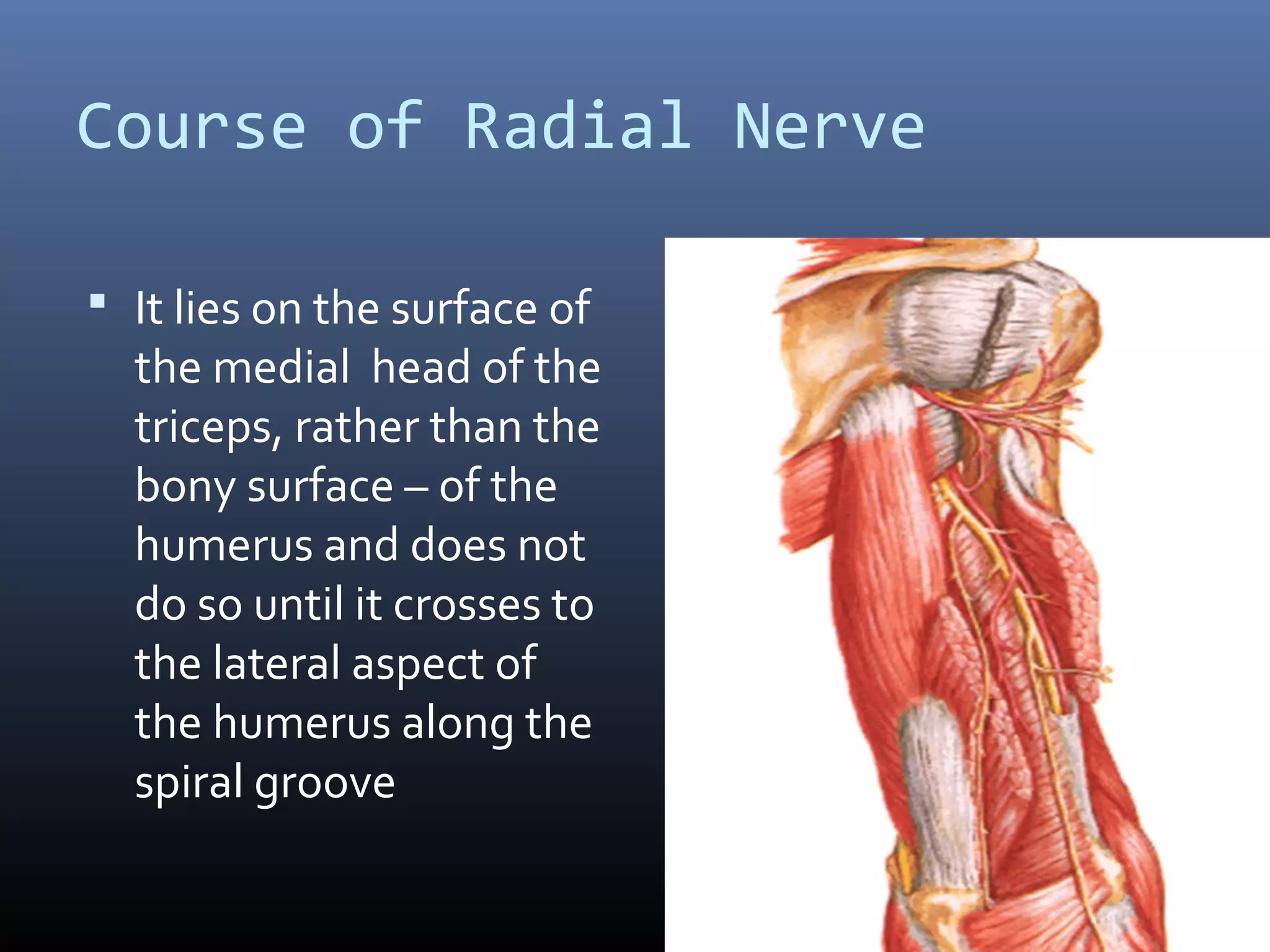
 It lies on the surface of
the medial head of the
triceps, rather than the
bony surface – of the
humerus and does not
do so until it crosses to
the lateral aspect of
the humerus along the
spiral groove
Course of R N
 Comes to lie in distal part
of spiral groove with
profundi brachii artery
 Beneath lateral head of
triceps and proximal to
origin of medial head
 Gives branches to
triceps, anconeus and
inferior lateral cutaneous
nerve of arm
Course of Radial Nerve
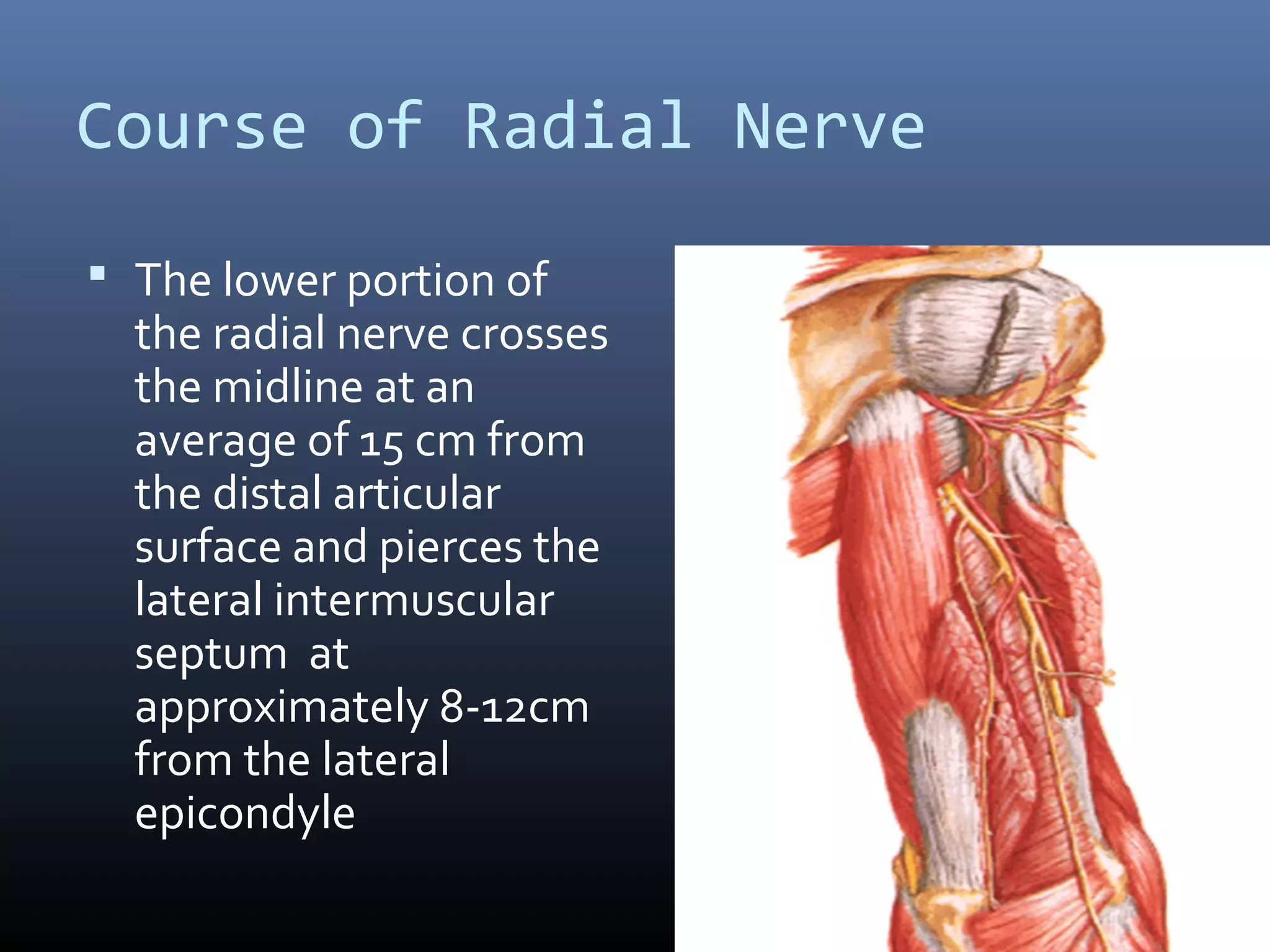
 The lower portion of
the radial nerve crosses
the midline at an
average of 15 cm from
the distal articular
surface and pierces the
lateral intermuscular
septum at
approximately 8-12cm
from the lateral
epicondyle
Course of Radial Nerve
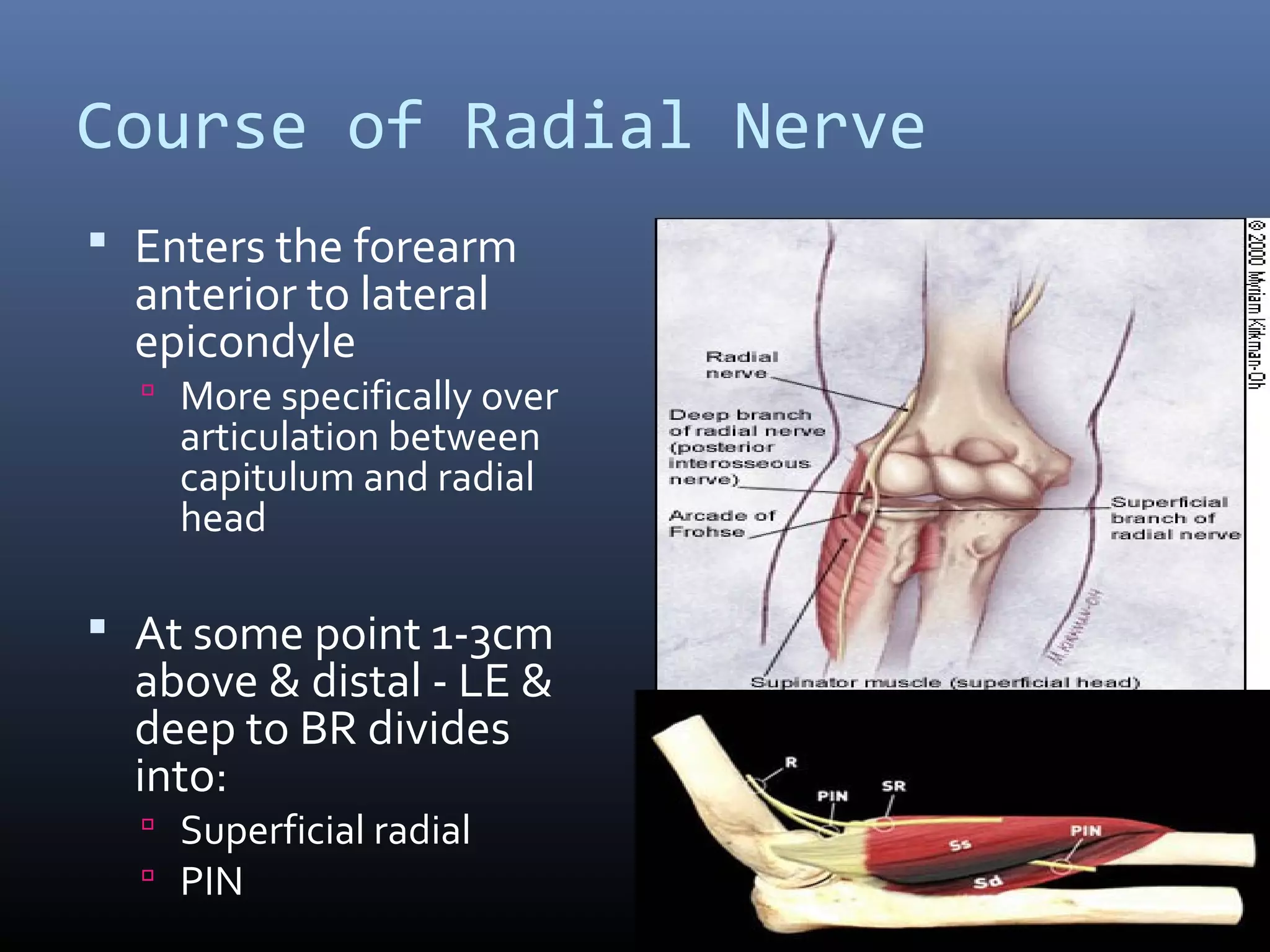
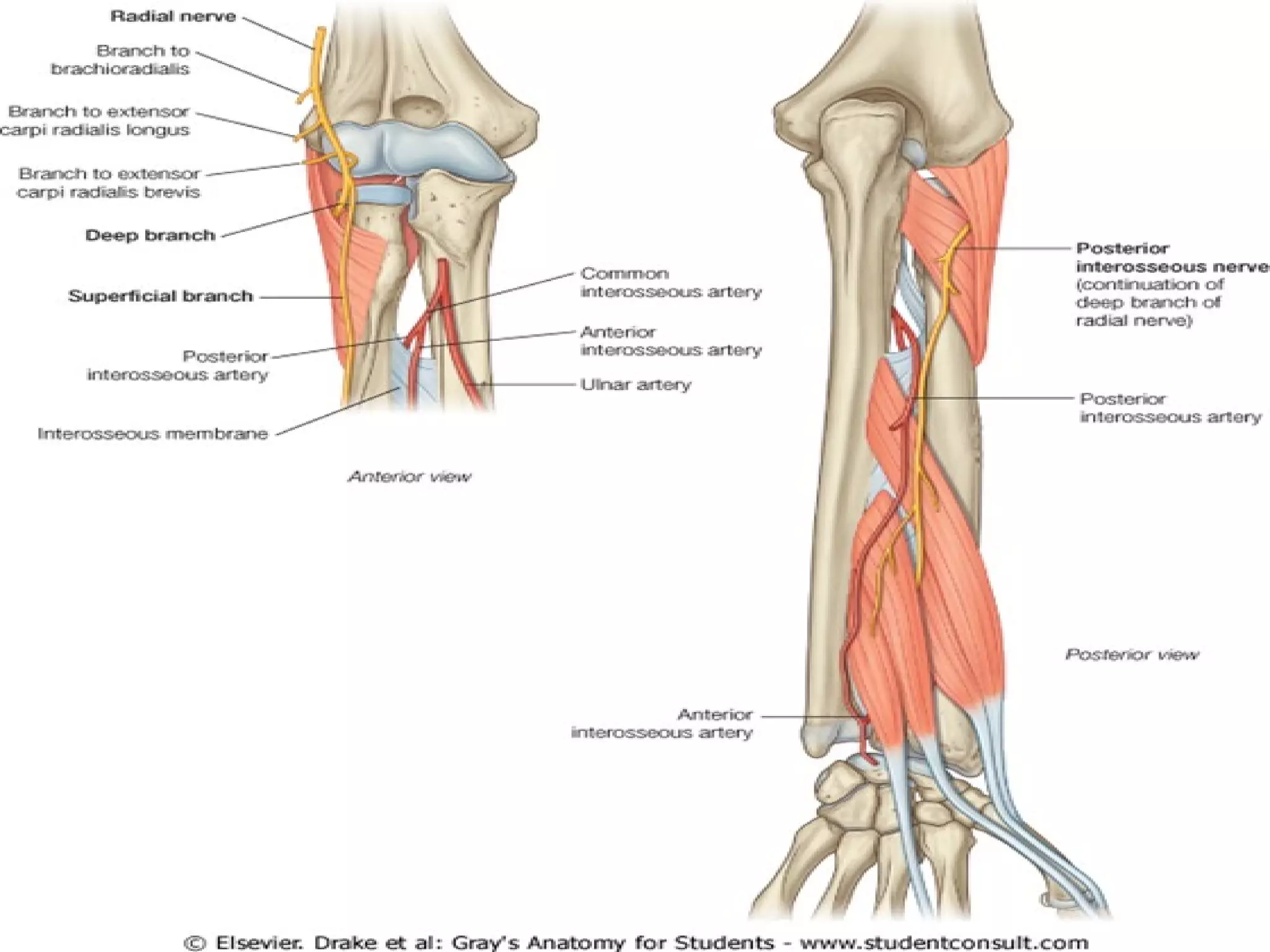
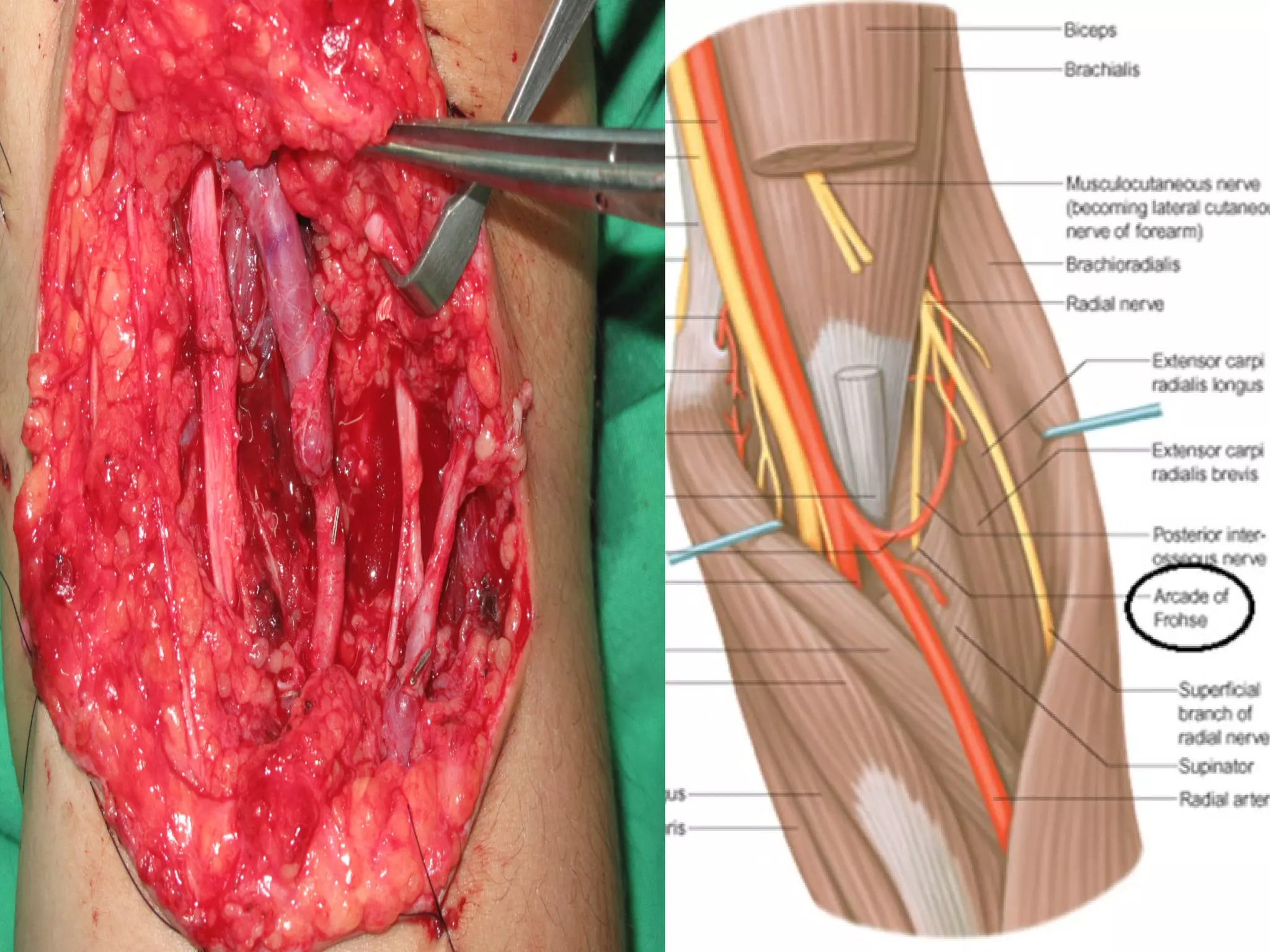
 Enters the forearm
anterior to lateral
epicondyle
 More specifically over
articulation between
capitulum and radial
head
 At some point 1-3cm
above & distal - LE &
deep to BR divides
into:
 Superficial radial
 PIN
Course of Radial Nerve
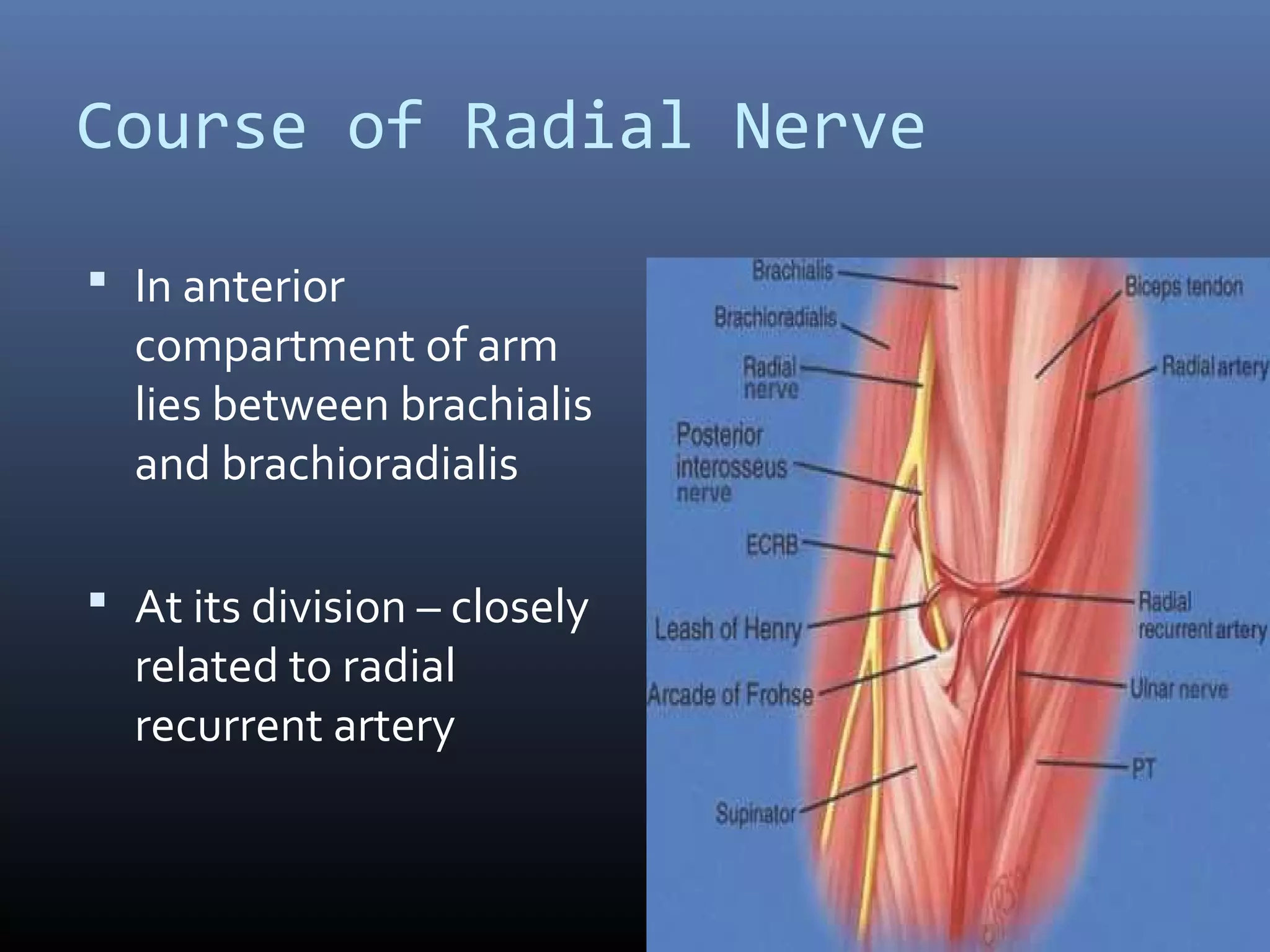
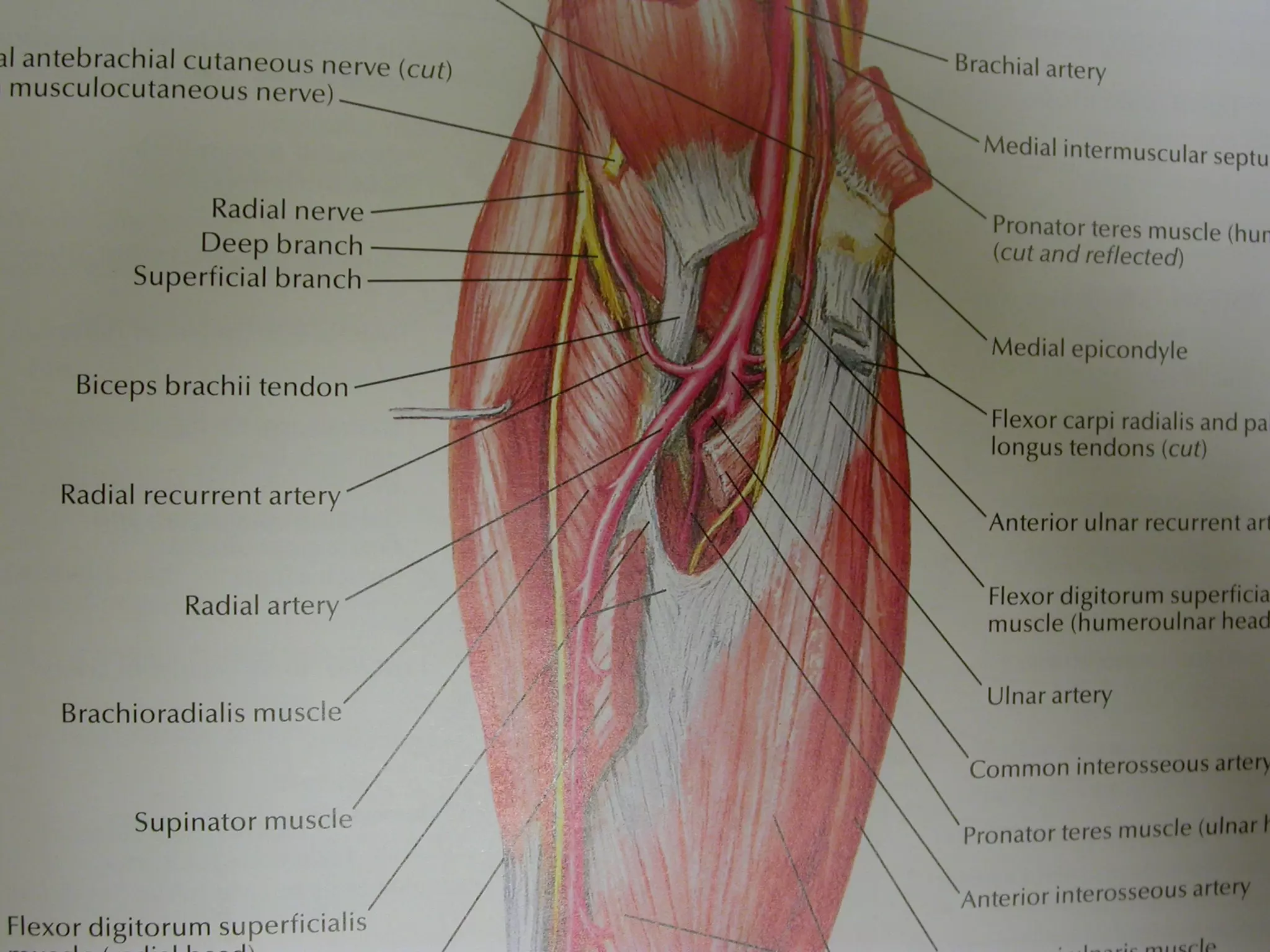
 In anterior
compartment of arm
lies between brachialis
and brachioradialis
 At its division – closely
related to radial
recurrent artery
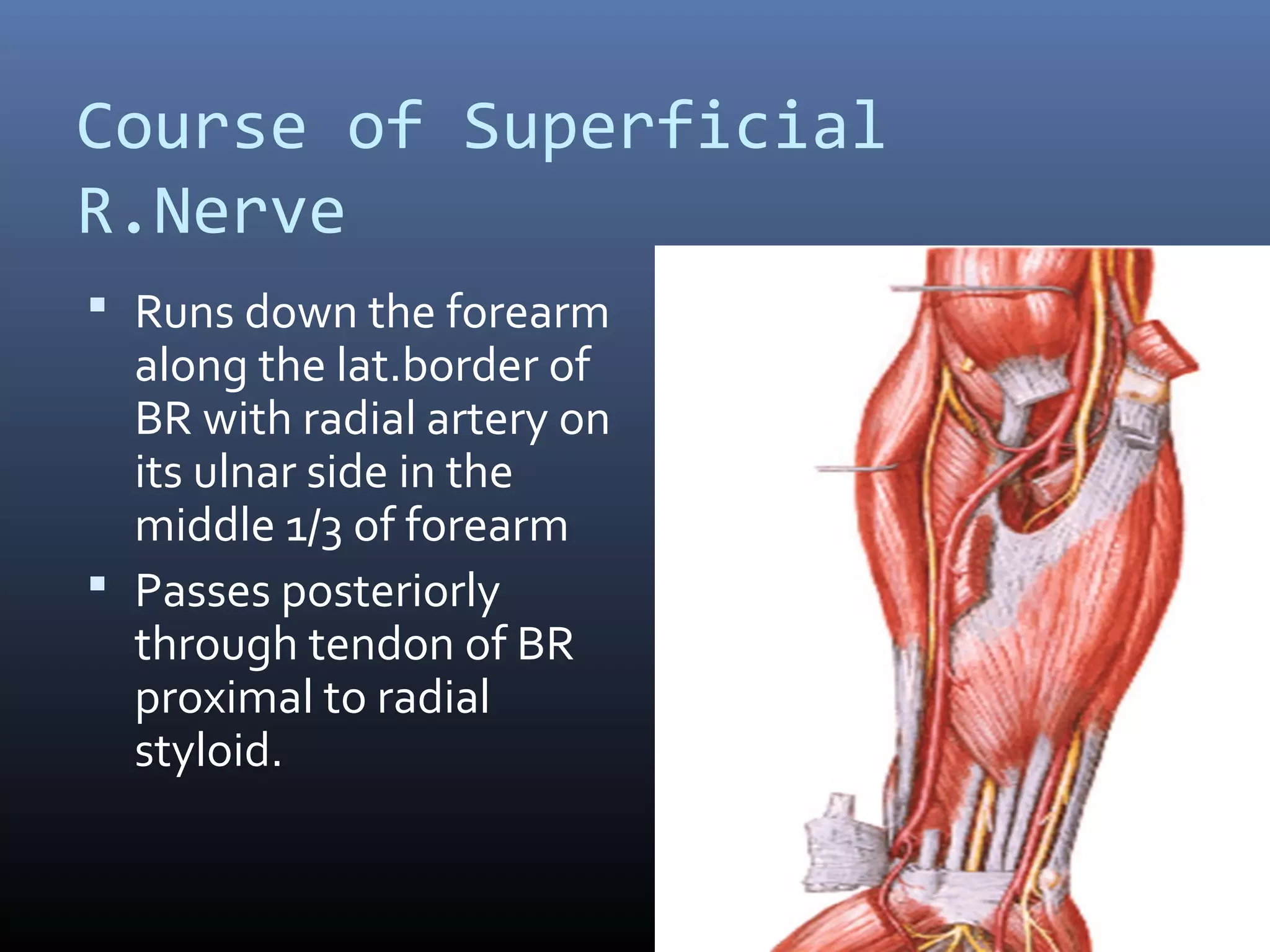
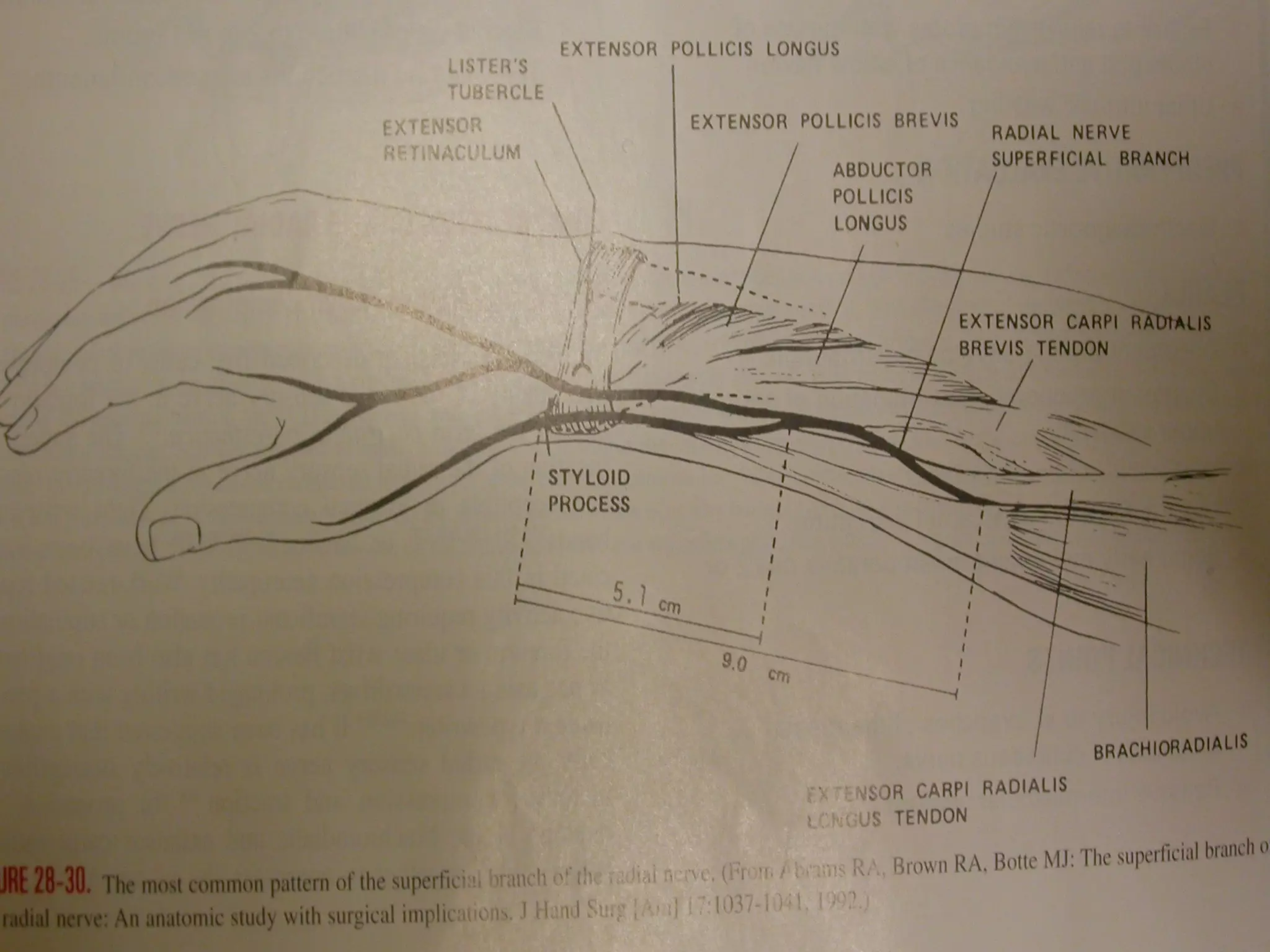
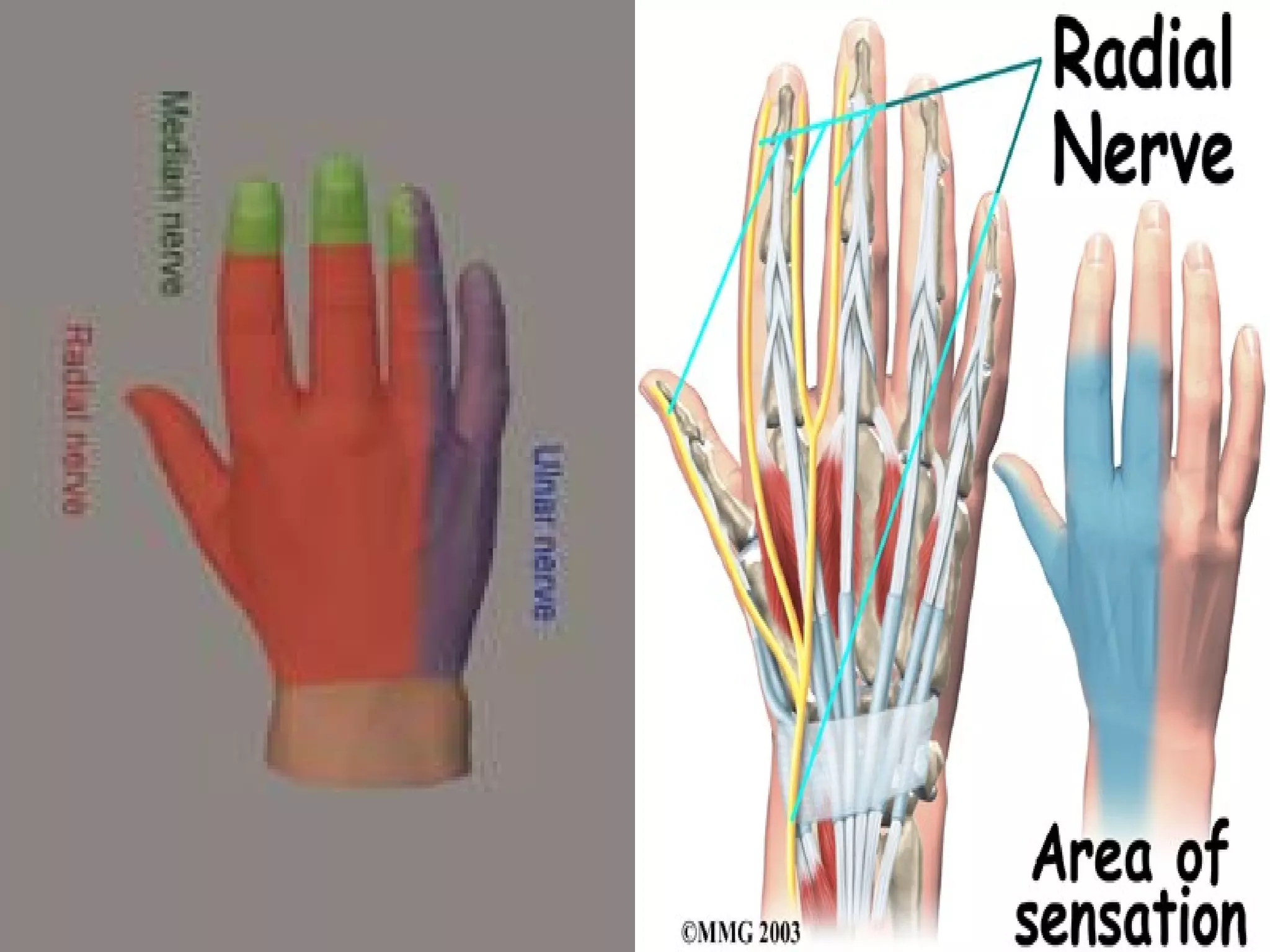
Course of Superficial
R.Nerve
 Runs down the forearm
along the lat.border of
BR with radial artery on
its ulnar side in the
middle 1/3 of forearm
 Passes posteriorly
through tendon of BR
proximal to radial
styloid.
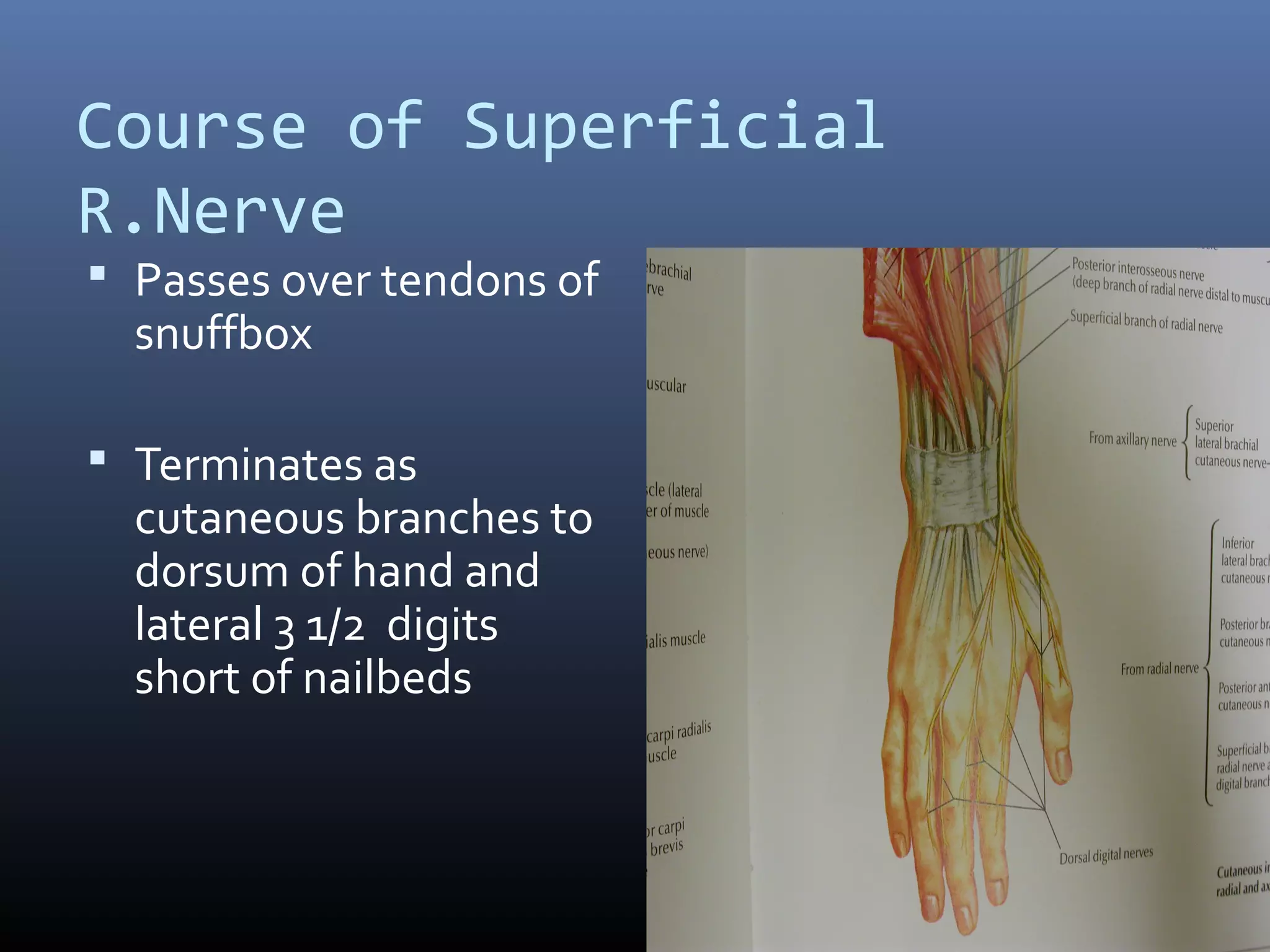
Course of Superficial
R.Nerve
 Passes over tendons of
snuffbox
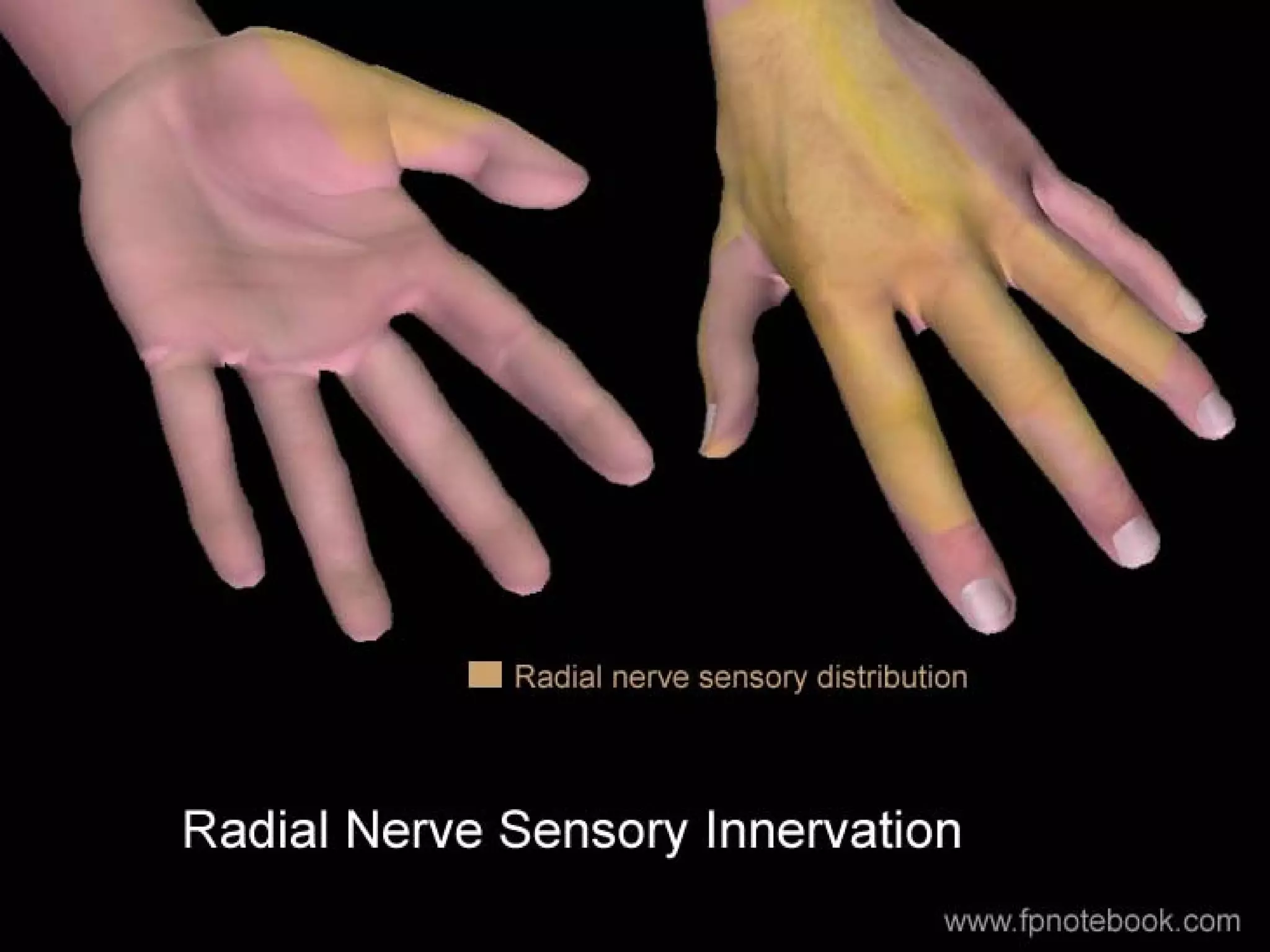
 Terminates as
cutaneous branches to
dorsum of hand and
lateral 3 1/2 digits
short of nailbeds
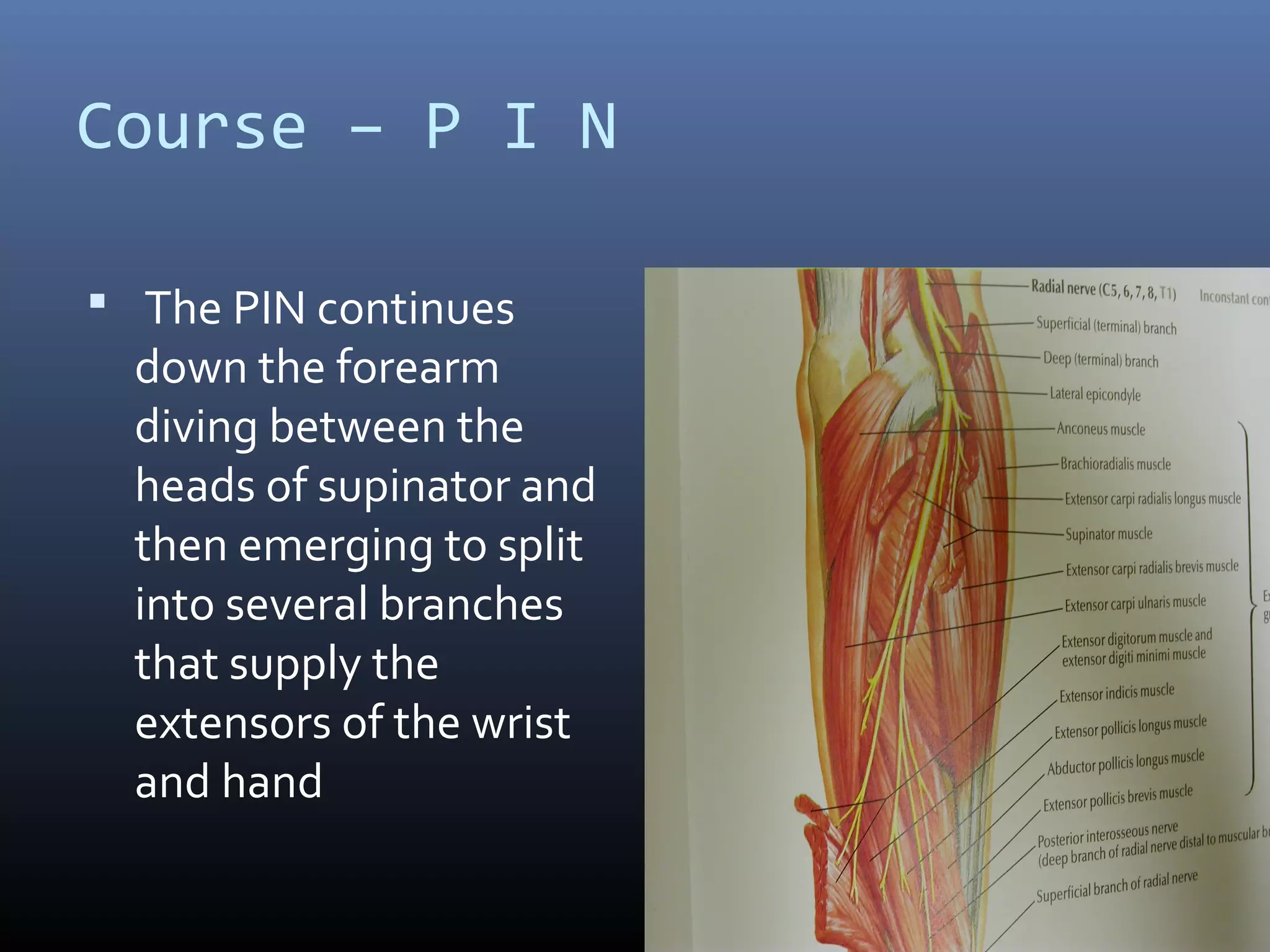
Course – P I N
 The PIN continues
down the forearm
diving between the
heads of supinator and
then emerging to split
into several branches
that supply the
extensors of the wrist
and hand
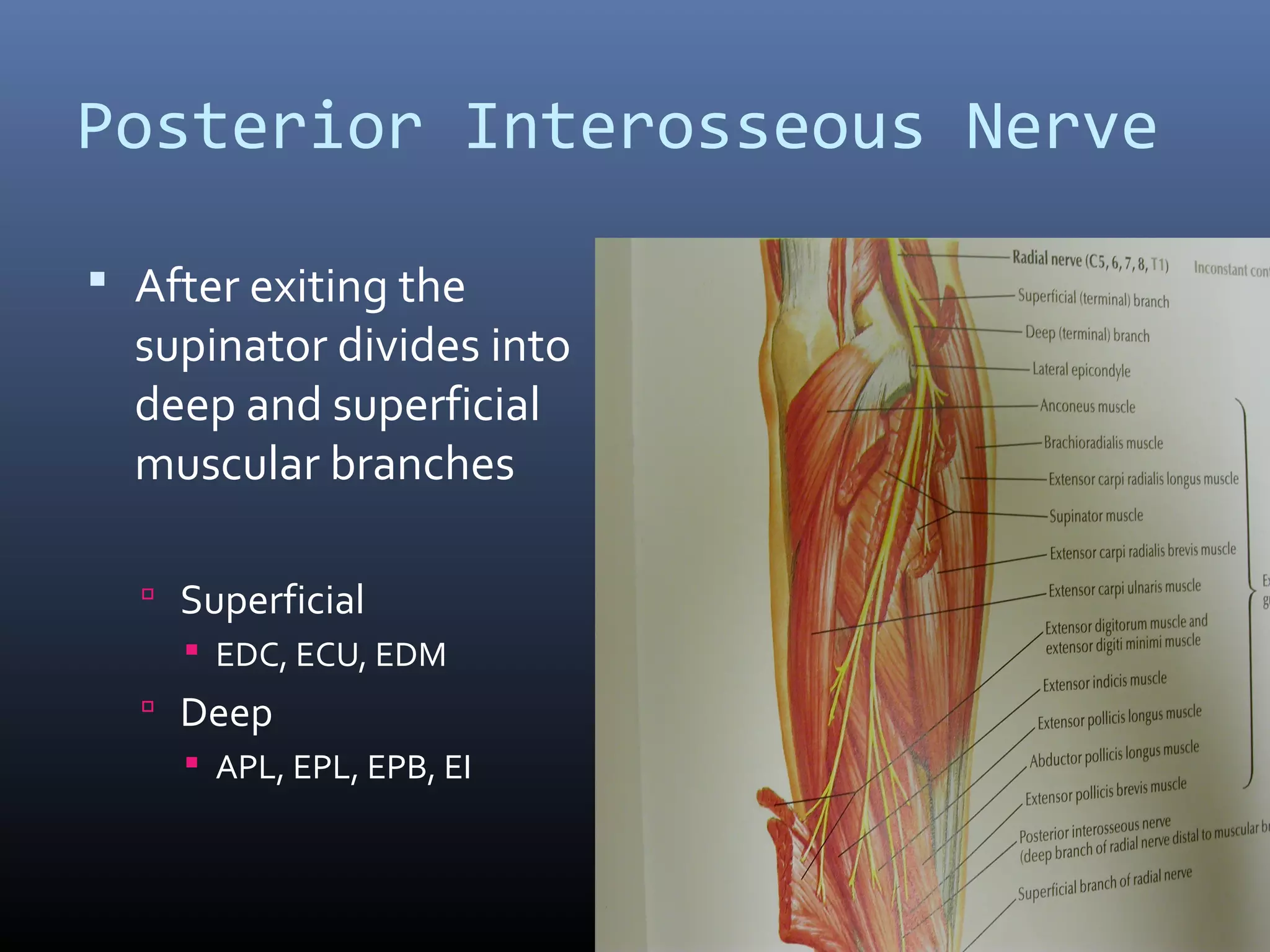
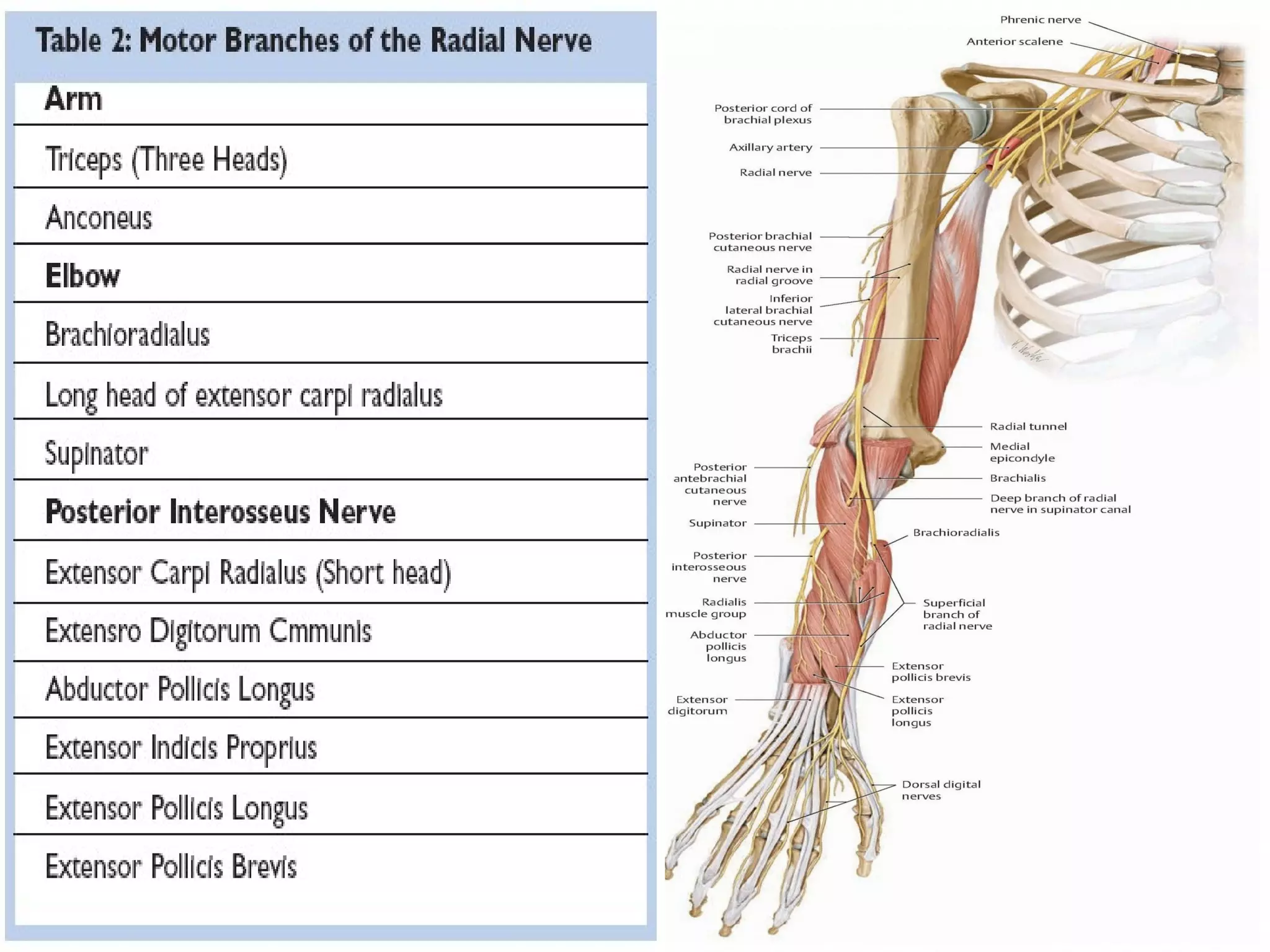
Posterior Interosseous Nerve
 After exiting the
supinator divides into
deep and superficial
muscular branches
 Superficial
 EDC, ECU, EDM
 Deep
 APL, EPL, EPB, EI
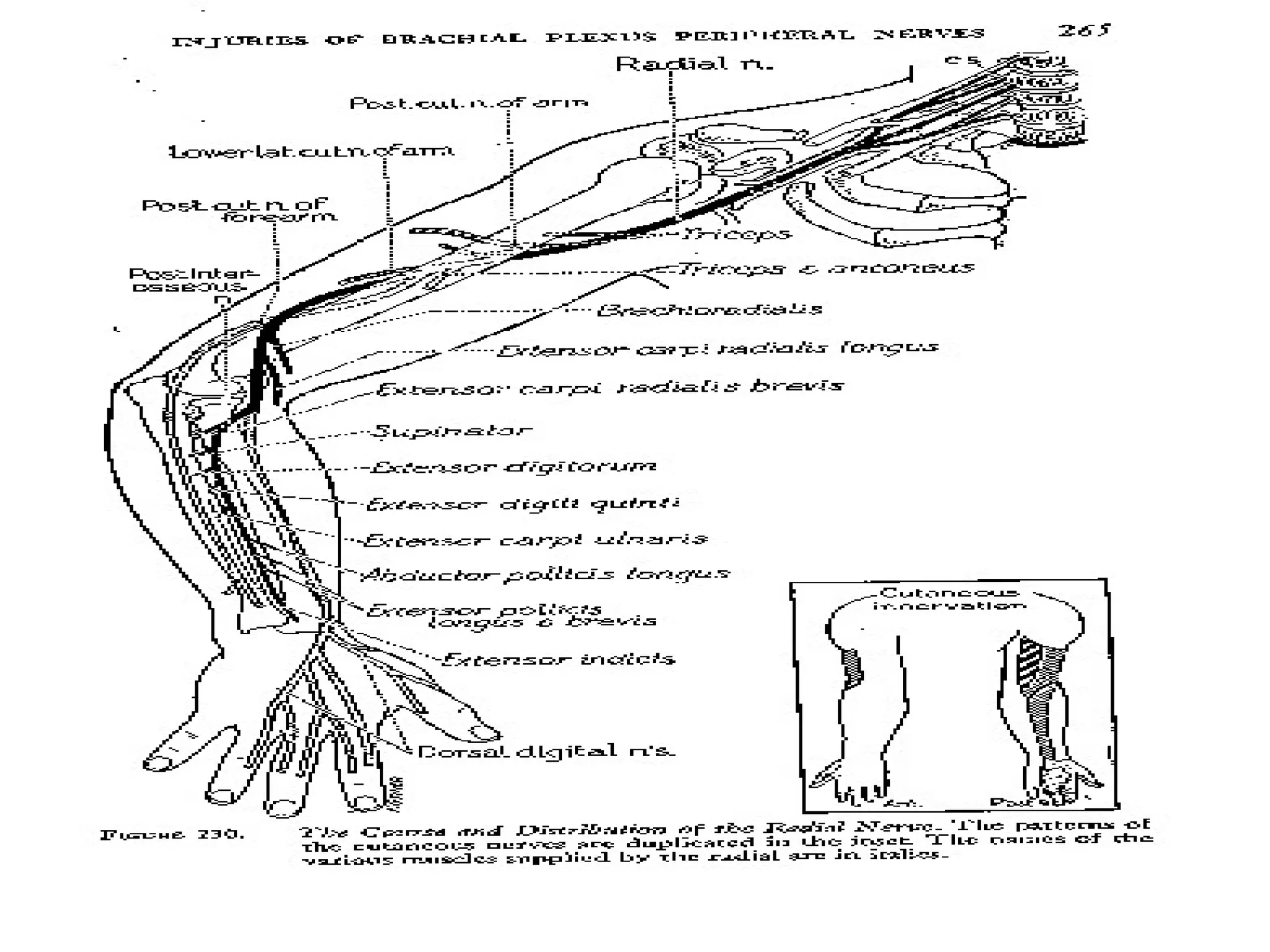
APPLIED ANATOMY
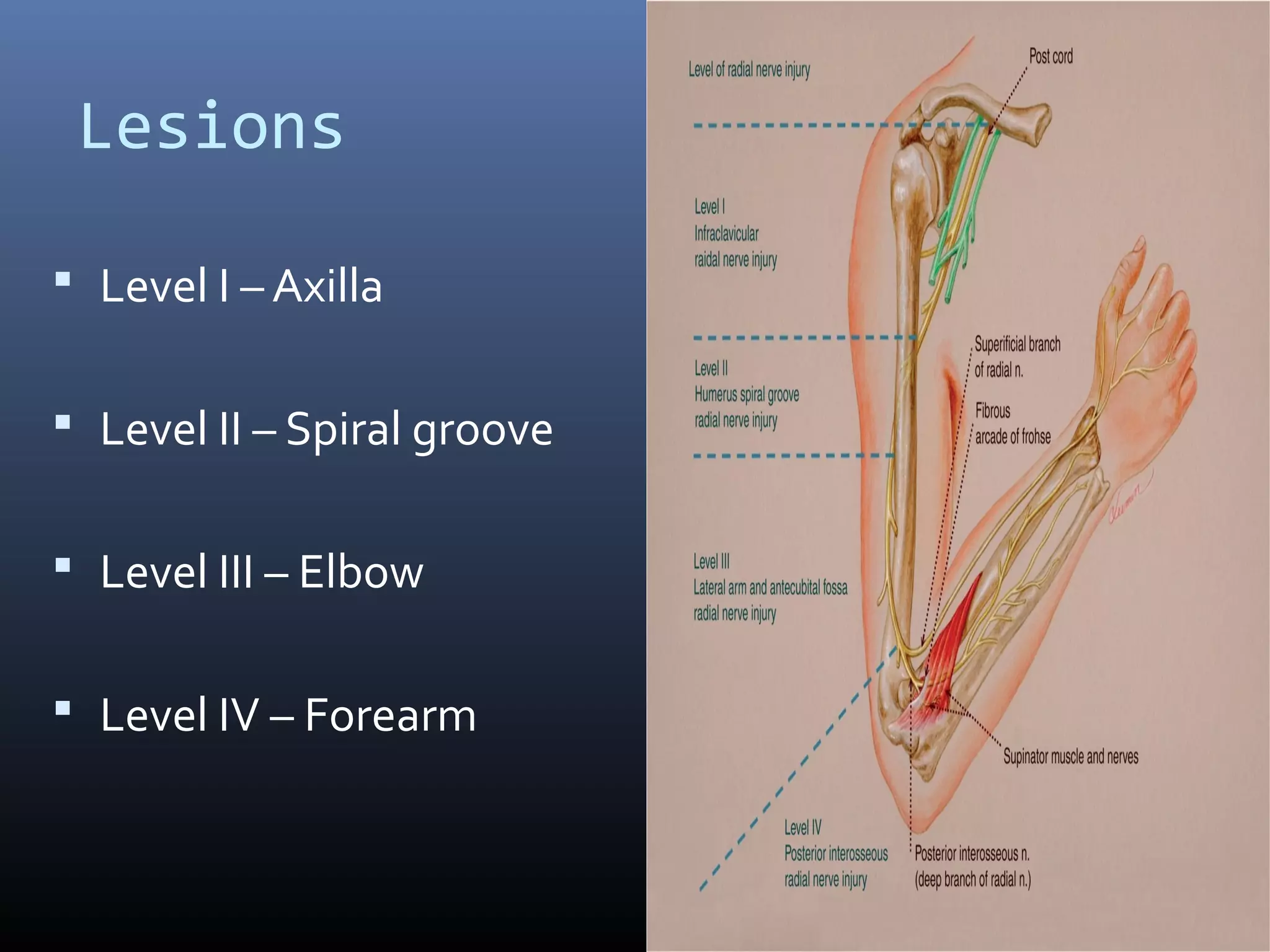
Lesions
 Level I – Axilla
 Level II – Spiral groove
 Level III – Elbow
 Level IV – Forearm
Axilla
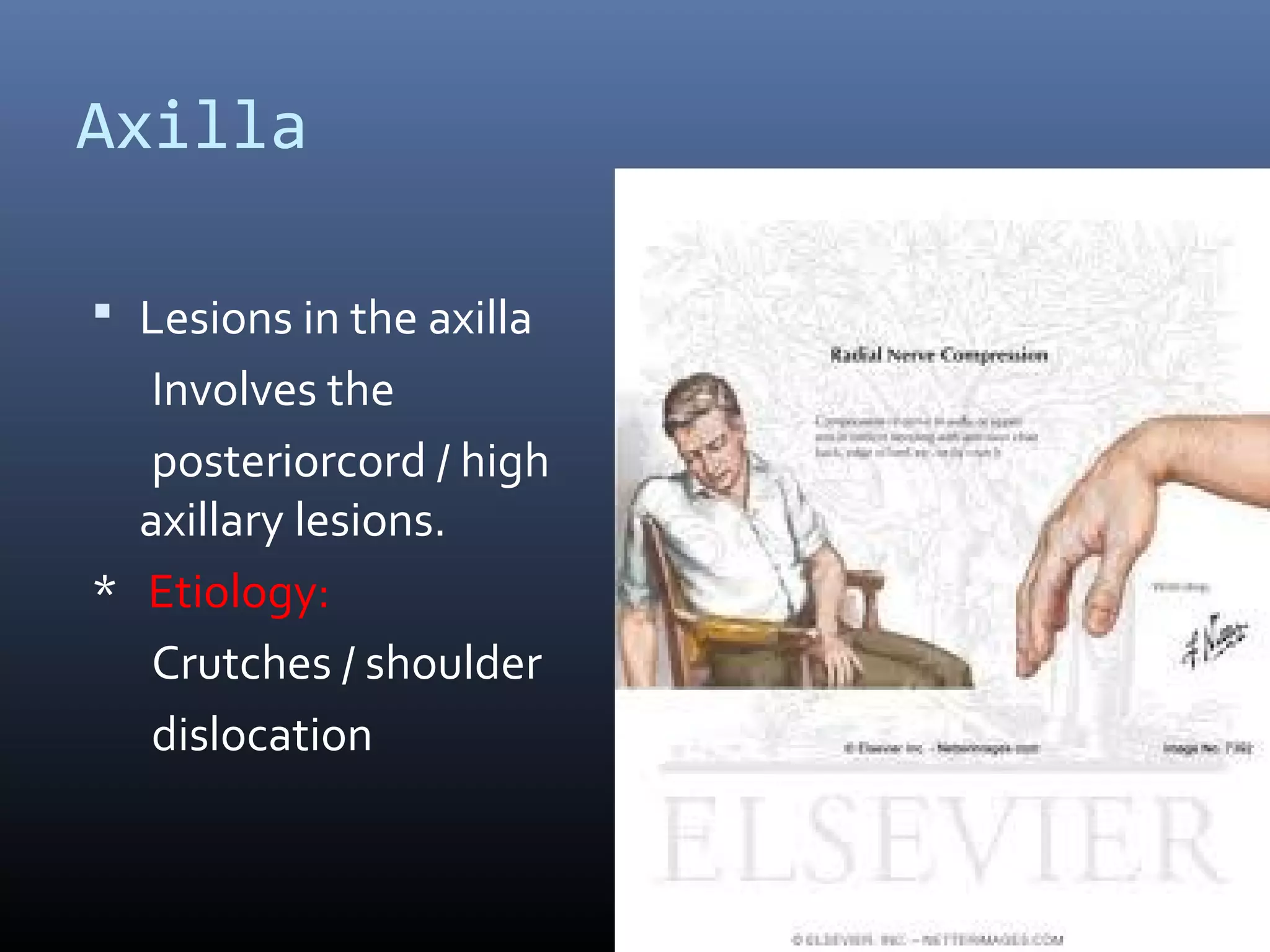
 Lesions in the axilla
Involves the
posteriorcord / high
axillary lesions.
* Etiology:
Crutches / shoulder
dislocation
Position
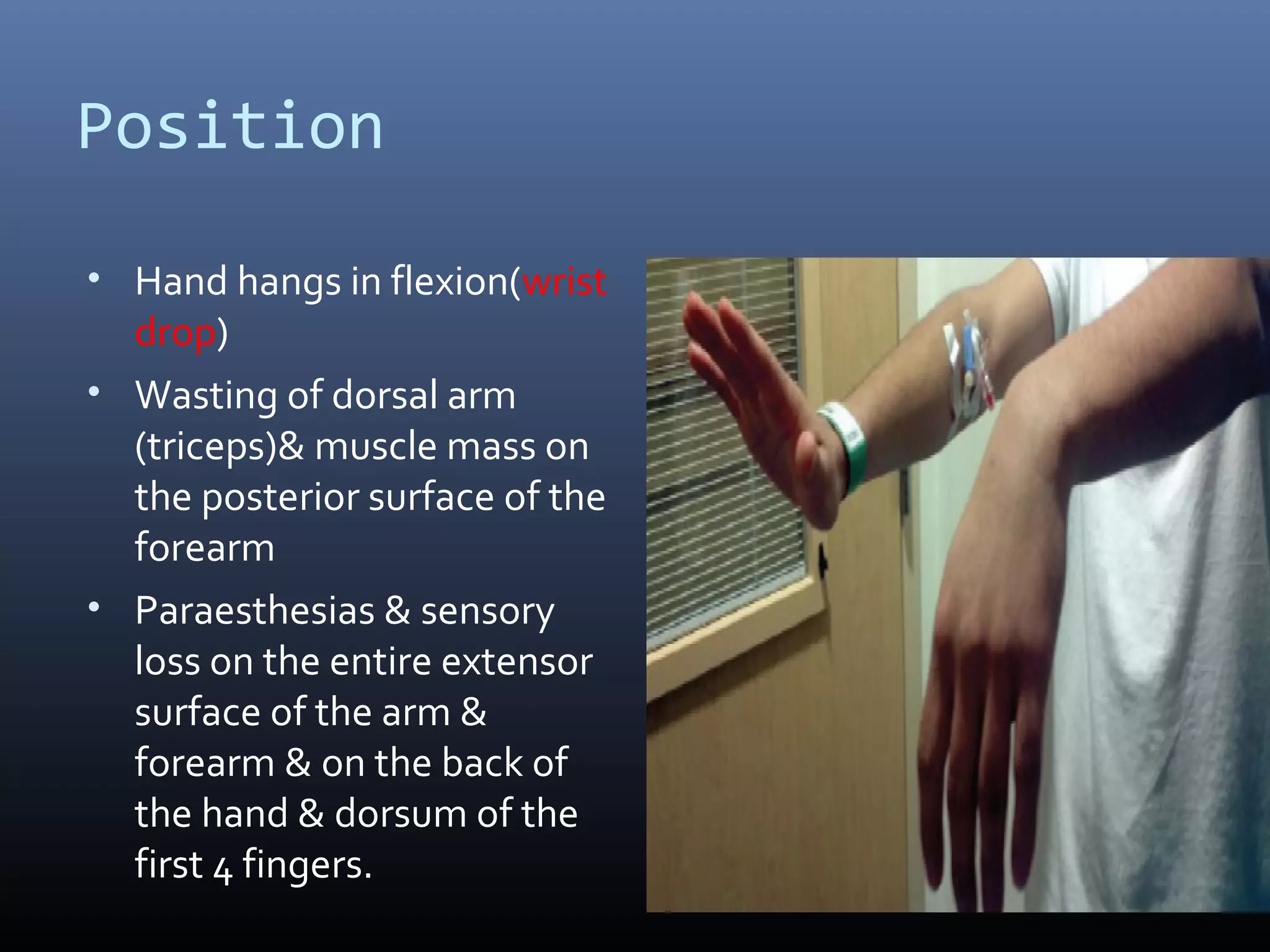
• Hand hangs in flexion(wrist
drop)
• Wasting of dorsal arm
(triceps)& muscle mass on
the posterior surface of the
forearm
• Paraesthesias & sensory
loss on the entire extensor
surface of the arm &
forearm & on the back of
the hand & dorsum of the
first 4 fingers.
Spiral Groove
 Etiologies
Humeral factures/Compressive
lesions / Saturday night palsy
Entrapment by tendinous arch
of lateral head of triceps
muscle/damaged after arm
excercise .
Soldiers developing palsies at
the lateral border of humerus
after military shooting training
 Sensibility on the
extensor aspect of arm
is spared .
 Sensibility on the
extensor aspect of
forearm may or may
not be spared.
 Wrist drop + / No loss
of elbow extension
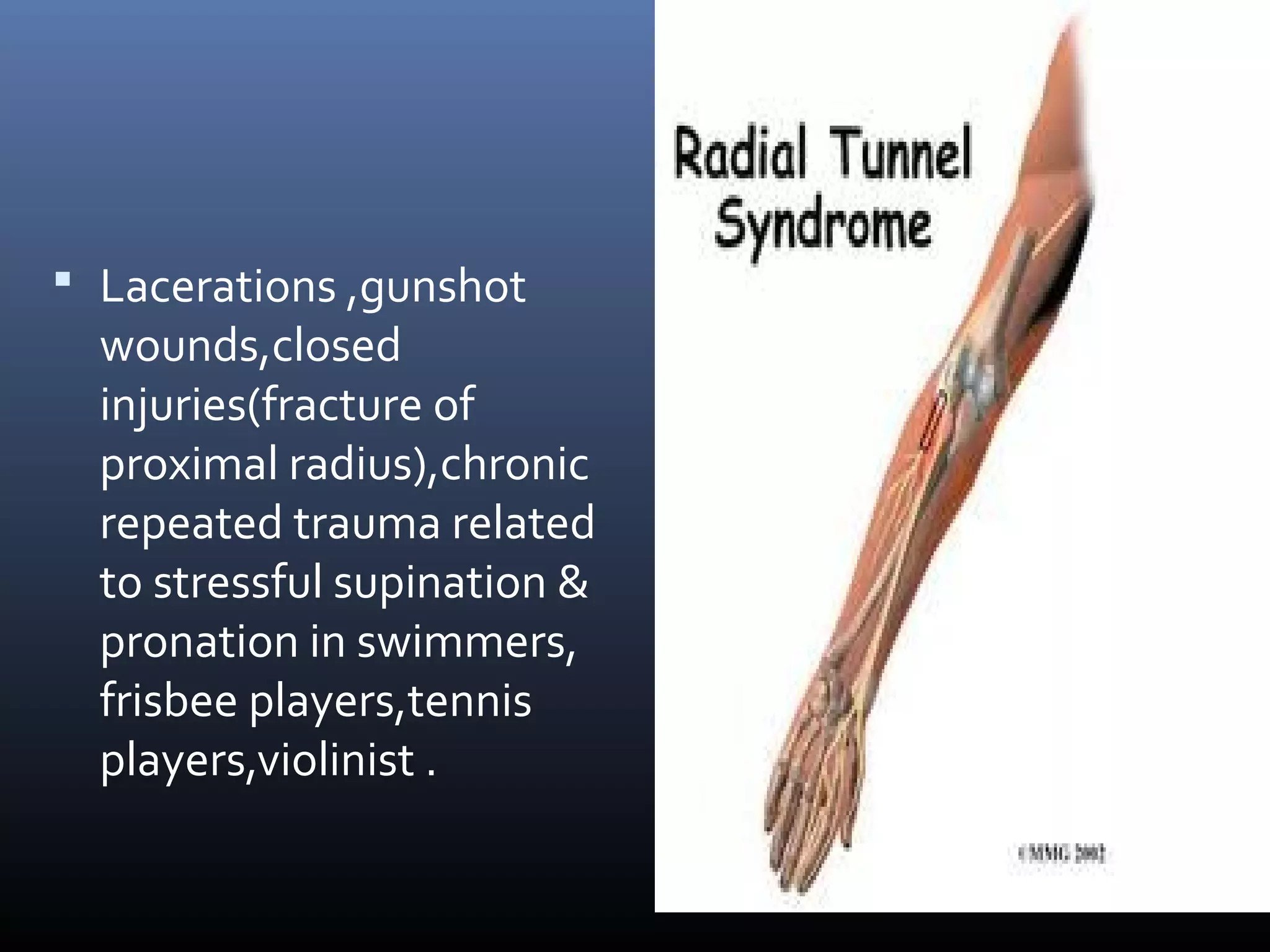
Elbow – Radial Tunnel Syn.
• Involvement of the
PIN.
• Etiologies
A constricting band at
the radiohumeral joint
capsule.
 Lacerations ,gunshot
wounds,closed
injuries(fracture of
proximal radius),chronic
repeated trauma related
to stressful supination &
pronation in swimmers,
frisbee players,tennis
players,violinist .
Position
 Atrophy & paresis of
the ECU,ED,Extensor
digiti minimi
APL,EPL,EPB &
extensor indices.
 Extensor carpi radialis
is intact.
• Drop finger deformity
Difficulty in extending
the MCP of all five
fingers
 Partial wrist drop
 No sensory loss
 The wrist deviates
radially,when the
patient makes a fist.
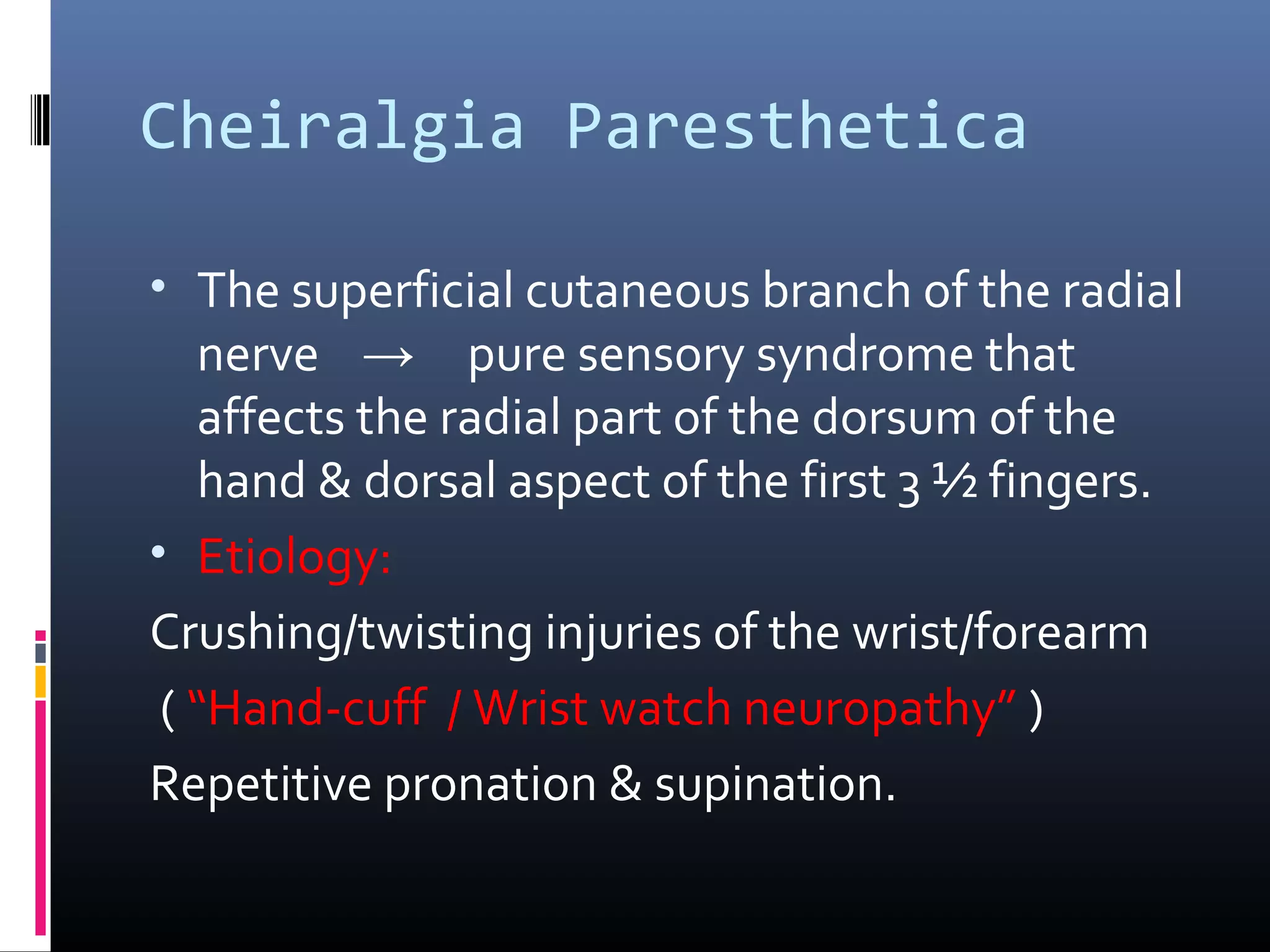
Cheiralgia Paresthetica
• The superficial cutaneous branch of the radial
nerve → pure sensory syndrome that
affects the radial part of the dorsum of the
hand & dorsal aspect of the first 3 ½ fingers.
• Etiology:
Crushing/twisting injuries of the wrist/forearm
( “Hand-cuff / Wrist watch neuropathy” )
Repetitive pronation & supination.
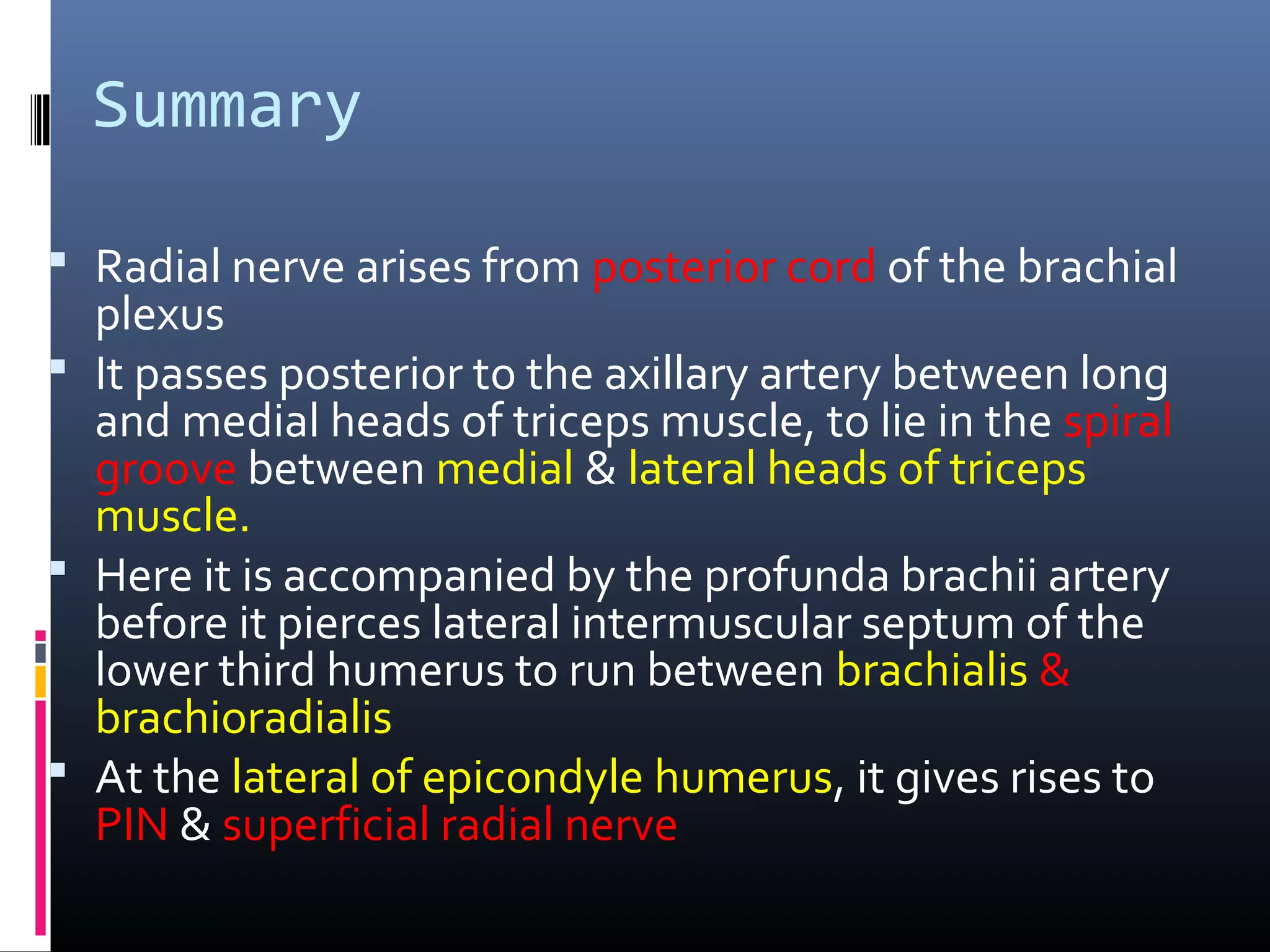
Summary
 Radial nerve arises from posterior cord of the brachial
plexus
 It passes posterior to the axillary artery between long
and medial heads of triceps muscle, to lie in the spiral
groove between medial & lateral heads of triceps
muscle.
 Here it is accompanied by the profunda brachii artery
before it pierces lateral intermuscular septum of the
lower third humerus to run between brachialis &
brachioradialis
 At the lateral of epicondyle humerus, it gives rises to
PIN & superficial radial nerve
 Radial nerve supply all the extensor muscles of
forearm & arm. However it also supply
brachioradialis, which is flexor of elbow when
forearm pronated.
 Damage to the nerve in the spiral groove causes
wrist drop but no loss of elbow extension, as fibres of
triceps remain intact proximal to this site.
 Only damage in the axilla will causes loss of elbow
extension & wrist drop
 Damage to posterior interosseus nerve (PIN) does
not cause wrist drop because extensor carpi radialis
longus receives its innervation from the main radial
nerve
 Pin only causes inability to extend
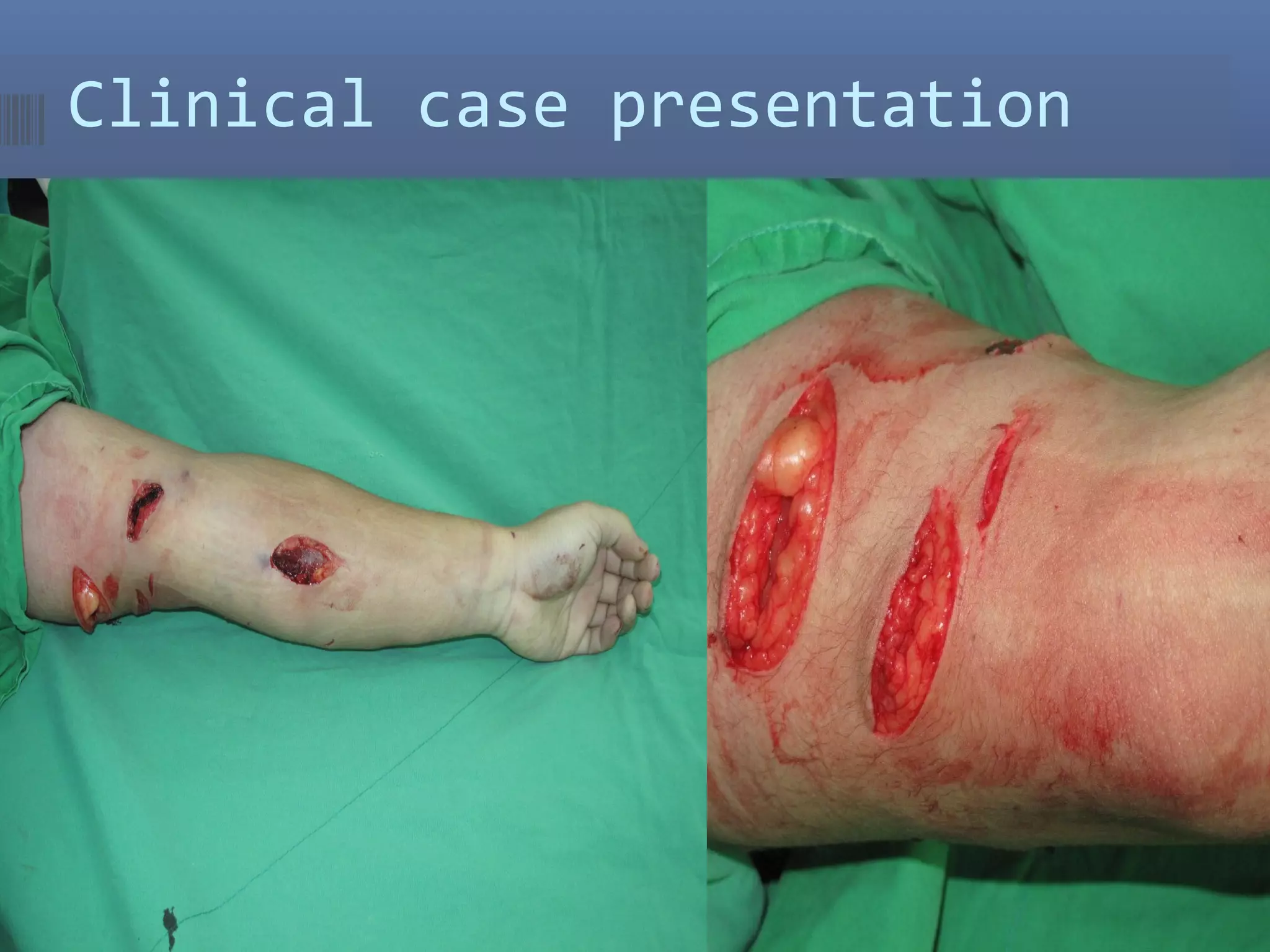
Clinical case presentation
Radial nerve - Course & Relations / Applied Anatomy

Radial nerve - Course & Relations / Applied Anatomy

  • 1.
    RADIAL NERVE -ANATOMY  DR.Murali.M.S;M.B.A Prof. of Surgery D Y Patil Medical College Mauritius.
  • 2.
    Objectives  Origin  Course& Relations  Branches  Distribution  Applied Anatomy
  • 3.
    Radial Nerve  Originatesas the terminal branch of the posterior cord of the brachial plexus  Roots from C5, 6, 7, 8, & T1.  Largest branch of brachial plexus  It is primarily a motor nerve
  • 6.
    Course – RN– Ant.view  It commences its decent into the arm by passing anterior to the latissimus insertion and dives into the triceps to lie on the posterior surface of the humerus
  • 7.
  • 8.
    Course of RadialNerve  Largest terminal branch of posterior cord  Enters posterior aspect of humerus through lower triangular interval  Teres major (superior)  Long head triceps (medial)  Humerus (lateral)  Gives posterior cutaneous nerve of arm in axilla
  • 9.
    Course of RadialNerve  It lies on the surface of the medial head of the triceps, rather than the bony surface – of the humerus and does not do so until it crosses to the lateral aspect of the humerus along the spiral groove
  • 10.
    Course of RN  Comes to lie in distal part of spiral groove with profundi brachii artery  Beneath lateral head of triceps and proximal to origin of medial head  Gives branches to triceps, anconeus and inferior lateral cutaneous nerve of arm
  • 11.
    Course of RadialNerve  The lower portion of the radial nerve crosses the midline at an average of 15 cm from the distal articular surface and pierces the lateral intermuscular septum at approximately 8-12cm from the lateral epicondyle
  • 13.
    Course of RadialNerve  Enters the forearm anterior to lateral epicondyle  More specifically over articulation between capitulum and radial head  At some point 1-3cm above & distal - LE & deep to BR divides into:  Superficial radial  PIN
  • 14.
    Course of RadialNerve  In anterior compartment of arm lies between brachialis and brachioradialis  At its division – closely related to radial recurrent artery
  • 16.
    Course of Superficial R.Nerve Runs down the forearm along the lat.border of BR with radial artery on its ulnar side in the middle 1/3 of forearm  Passes posteriorly through tendon of BR proximal to radial styloid.
  • 17.
    Course of Superficial R.Nerve Passes over tendons of snuffbox  Terminates as cutaneous branches to dorsum of hand and lateral 3 1/2 digits short of nailbeds
  • 19.
    Course – PI N  The PIN continues down the forearm diving between the heads of supinator and then emerging to split into several branches that supply the extensors of the wrist and hand
  • 21.
    Posterior Interosseous Nerve After exiting the supinator divides into deep and superficial muscular branches  Superficial  EDC, ECU, EDM  Deep  APL, EPL, EPB, EI
  • 26.
  • 27.
    Lesions  Level I– Axilla  Level II – Spiral groove  Level III – Elbow  Level IV – Forearm
  • 28.
    Axilla  Lesions inthe axilla Involves the posteriorcord / high axillary lesions. * Etiology: Crutches / shoulder dislocation
  • 29.
    Position • Hand hangsin flexion(wrist drop) • Wasting of dorsal arm (triceps)& muscle mass on the posterior surface of the forearm • Paraesthesias & sensory loss on the entire extensor surface of the arm & forearm & on the back of the hand & dorsum of the first 4 fingers.
  • 30.
    Spiral Groove  Etiologies Humeralfactures/Compressive lesions / Saturday night palsy Entrapment by tendinous arch of lateral head of triceps muscle/damaged after arm excercise . Soldiers developing palsies at the lateral border of humerus after military shooting training  Sensibility on the extensor aspect of arm is spared .  Sensibility on the extensor aspect of forearm may or may not be spared.  Wrist drop + / No loss of elbow extension
  • 32.
    Elbow – RadialTunnel Syn. • Involvement of the PIN. • Etiologies A constricting band at the radiohumeral joint capsule.
  • 33.
     Lacerations ,gunshot wounds,closed injuries(fractureof proximal radius),chronic repeated trauma related to stressful supination & pronation in swimmers, frisbee players,tennis players,violinist .
  • 34.
    Position  Atrophy &paresis of the ECU,ED,Extensor digiti minimi APL,EPL,EPB & extensor indices.  Extensor carpi radialis is intact. • Drop finger deformity Difficulty in extending the MCP of all five fingers  Partial wrist drop  No sensory loss  The wrist deviates radially,when the patient makes a fist.
  • 35.
    Cheiralgia Paresthetica • Thesuperficial cutaneous branch of the radial nerve → pure sensory syndrome that affects the radial part of the dorsum of the hand & dorsal aspect of the first 3 ½ fingers. • Etiology: Crushing/twisting injuries of the wrist/forearm ( “Hand-cuff / Wrist watch neuropathy” ) Repetitive pronation & supination.
  • 37.
    Summary  Radial nervearises from posterior cord of the brachial plexus  It passes posterior to the axillary artery between long and medial heads of triceps muscle, to lie in the spiral groove between medial & lateral heads of triceps muscle.  Here it is accompanied by the profunda brachii artery before it pierces lateral intermuscular septum of the lower third humerus to run between brachialis & brachioradialis  At the lateral of epicondyle humerus, it gives rises to PIN & superficial radial nerve
  • 38.
     Radial nervesupply all the extensor muscles of forearm & arm. However it also supply brachioradialis, which is flexor of elbow when forearm pronated.  Damage to the nerve in the spiral groove causes wrist drop but no loss of elbow extension, as fibres of triceps remain intact proximal to this site.  Only damage in the axilla will causes loss of elbow extension & wrist drop  Damage to posterior interosseus nerve (PIN) does not cause wrist drop because extensor carpi radialis longus receives its innervation from the main radial nerve  Pin only causes inability to extend
  • 39.