1
RADIAL NERVE
2
Extensor group of muscles
RIGHT FOREARM
3
Extensor group of muscles
Anconeus, Supinator
Thumb muscles
Msls from Common Ext origin
4
RADIAL NERVE
5
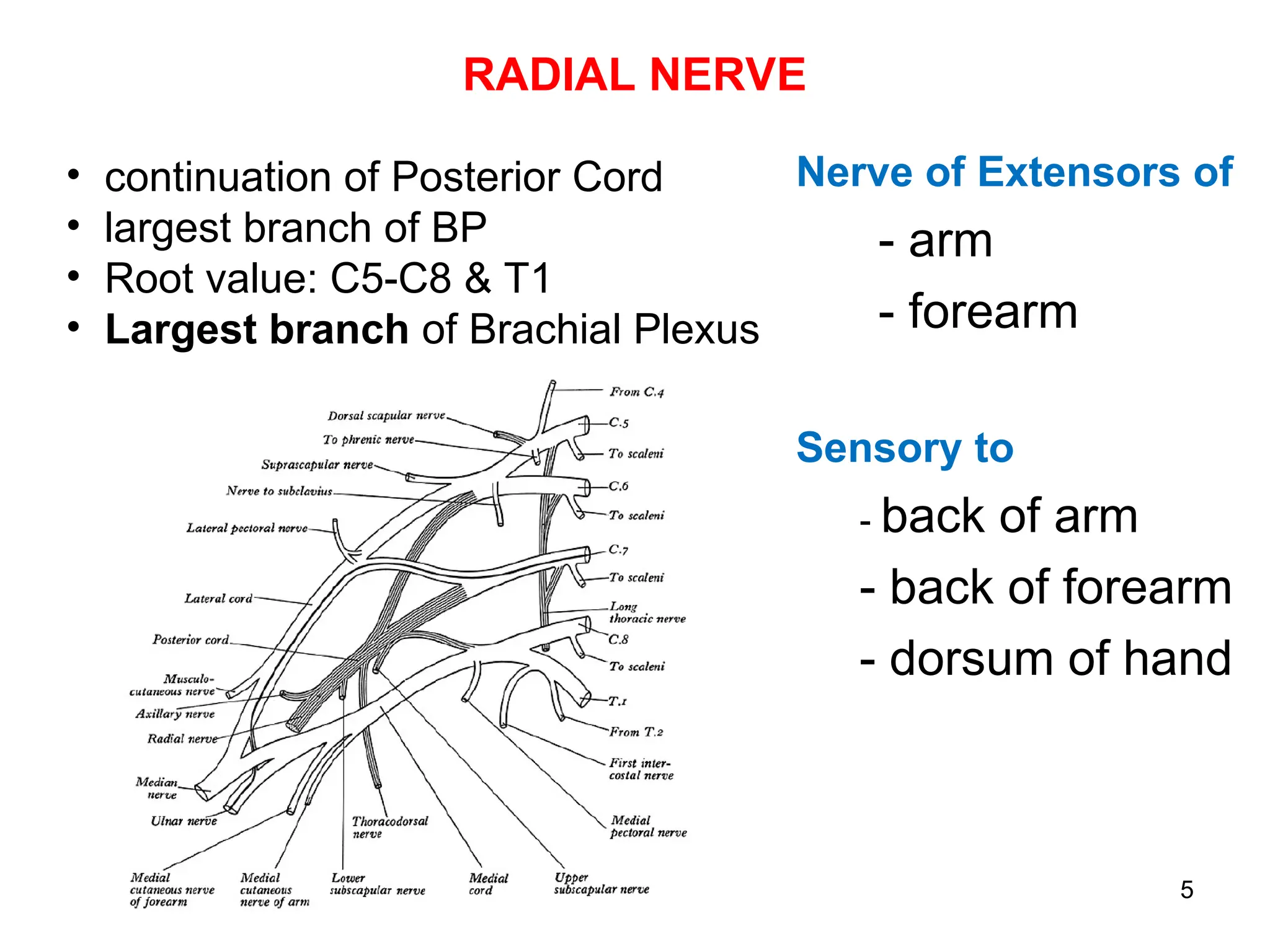
RADIAL NERVE
Nerve of Extensors of
- arm
- forearm
Sensory to
- back of arm
- back of forearm
- dorsum of hand
• continuation of Posterior Cord
• largest branch of BP
• Root value: C5-C8 & T1
• Largest branch of Brachial Plexus
6
RADIAL NERVE: COURSE
Descends
–behind 3rd
part
of Axillary artery
&
–later behind
brachial art.
7
In axilla
anterior to
Subscapularis
& tendons of
LD & T Major
8
Leaves axilla
thru triangular
space along with
Profunda brachii
9
10
arm
At first Lies bt long &
medial heads of
Triceps.
Passes obliquely and
enters spiral groove
across post surf of
humerus bt lateral &
medial heads of
Triceps. Here it covered
by lat head.
Enter anterior
compartment
11
Showing relation of
radial nerve to
humerus and
vessels
12
RADIAL NERVE: COURSE con’td
Descends
– bt Brachialis & Brachioradialis (proximally)
– and ECRL (distally)
Anterior to lateral Epicondyle-
– Divides into terminal branches:
a) Superficial branch
b) Posterior Interosseous nerve (Deep
br)
13
14
Ant. to lat. Epicondyle –
Divides into terminal
branches :
•
Post. Interosseous nerve
(Deep branch)
•
Superficial branch
15
Superficial branch
– descends along
radial border of
forearm.
– Crosses anatomical
snuff box
– Reach back of hand
– Sensory to
• dorsum of hand (lat. 3
1/2)
• small area over palm.
• Lateral 3 1/2 fingers
short of nail beds
Flexor aspect
Anatomical snuff box
16
17
Deep branch
– Pierces Supinator
– enters extensor Compt
of forearm.
Flexor aspect
18
Deep branch
Supplies extensors of
forearm.
Supinator
ECRB, (BR, ECRL??)
ED,
EDM,
ECU,
AbPL, EPB, EPL,
EI
19
20
21
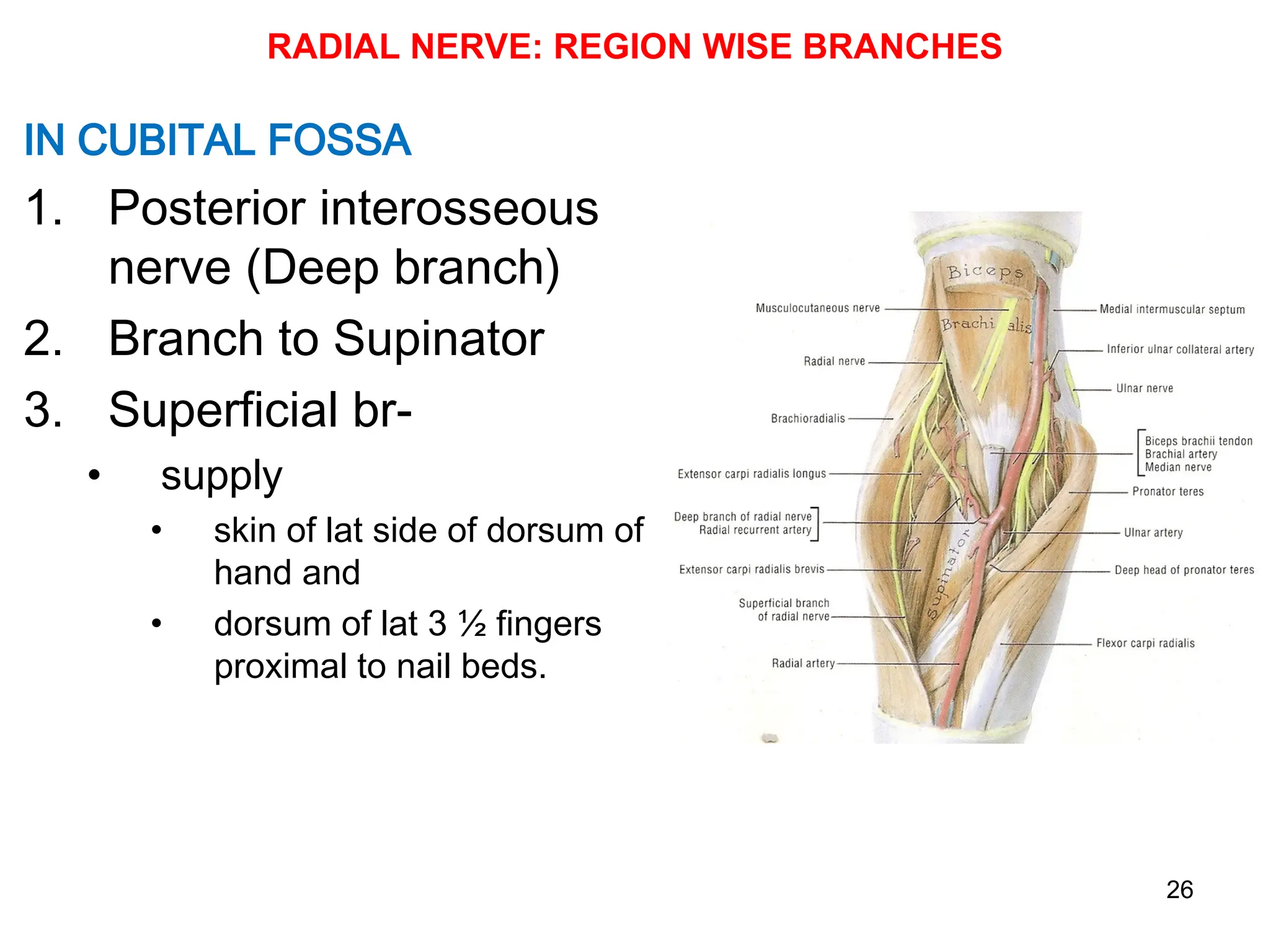
RADIAL NERVE: REGION WISE BRANCHES
IN AXILLA
1. Post Cutaneous N of arm
2. Nerve to Triceps
– Long, Medial and
– Lateral Head
3. Anconeus
22
Branches to triceps
Triceps supplied by 4
branches from radial N.
• Medial head : 2 br,
• long head : 1 br,
• lateral head : 1 br
– Br given out before it
enters radial groove.
– In fracture shaft of
humerus – triceps
usually escapes injury
because br given
higher up
IN SPIRAL GROOVE
1. Lower lat cut N of arm
2. Post cut N of forearm
23
24
BEYOND RADIAL GROOVE
(Above lateral Epicondyle)
– Brachialis Lateral part
– Brachioradialis
– Extensor Carpi Radialis
Longus (ECRL)
– Elbow joint
– Then it divides into two
branches
25
26
RADIAL NERVE: REGION WISE BRANCHES
IN CUBITAL FOSSA
1. Posterior interosseous
nerve (Deep branch)
2. Branch to Supinator
3. Superficial br-
• supply
• skin of lat side of dorsum of
hand and
• dorsum of lat 3 ½ fingers
proximal to nail beds.
27
RADIAL NERVE: BRANCHES
Branches
1. Muscular
2. Cutaneous
3. Articular
1. Muscular
• Long, medial and lateral head of triceps
• Anconeus
• Extensor muscles
2. Cutaneous branch
• Posterior cut N of arm
• Lower lateral cut N of arm
• Posterior cut N of forearm
• Superficial br of radial (terminal)
3. Articular br
• Elbow jt
• Wrist and intercarpal
28
RADIAL NERVE : APPLIED
studied under
1. Injury to N in axilla
2. Injury of N in spiral groove
3. Injury of Deep branch – Post interosseous N
4. Injury to superficial br
29
RADIAL NERVE : APPLIED
1. Injury at axilla
• Causes
1. Extra long crutches (CRUTCH PALSY)
2. Fracture dislocation of upper humerus
3. During reduction of shoulder dislocation
• Symptoms
a) Motor:
– All extensors of wrist, elbow, finger paralyzed.
Unopposed action of flexors
– WRIST DROP
– Fingers can be extended (extension of IP jts) –
• done by lumbricals and interosseous (supplied by median/ulnar N)
– Inability to grip objects firmly.
• (flexors working with decreased mechanical advantage, b’coz extension
at wrist is essential for stretching prior to flexion of digits)
30
WRIST DROP
unopposed
action of
flexors at wrist
and elbow.
31
WRIST DROP
unopposed
action of
flexors at
wrist and
elbow.
32
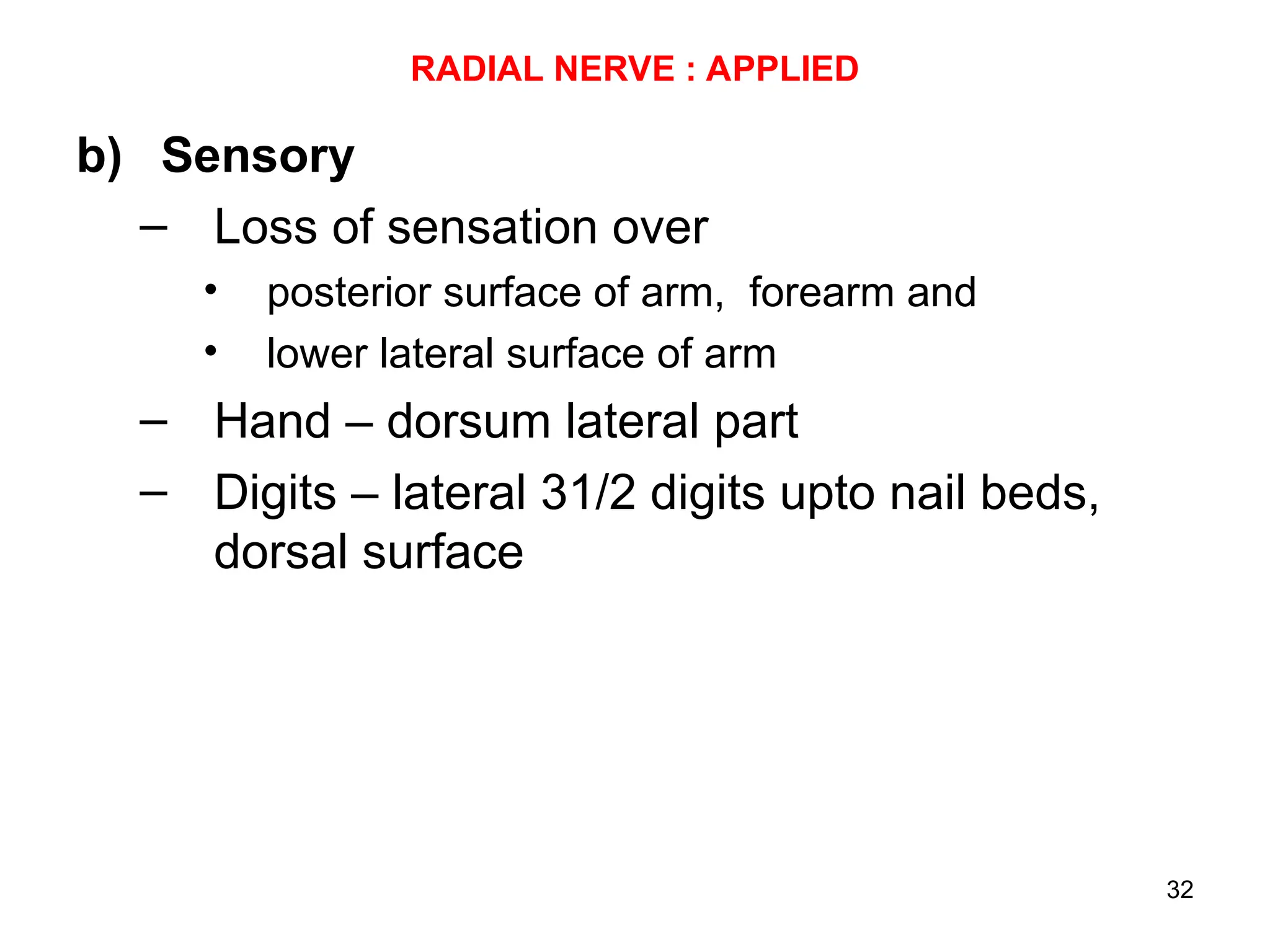
RADIAL NERVE : APPLIED
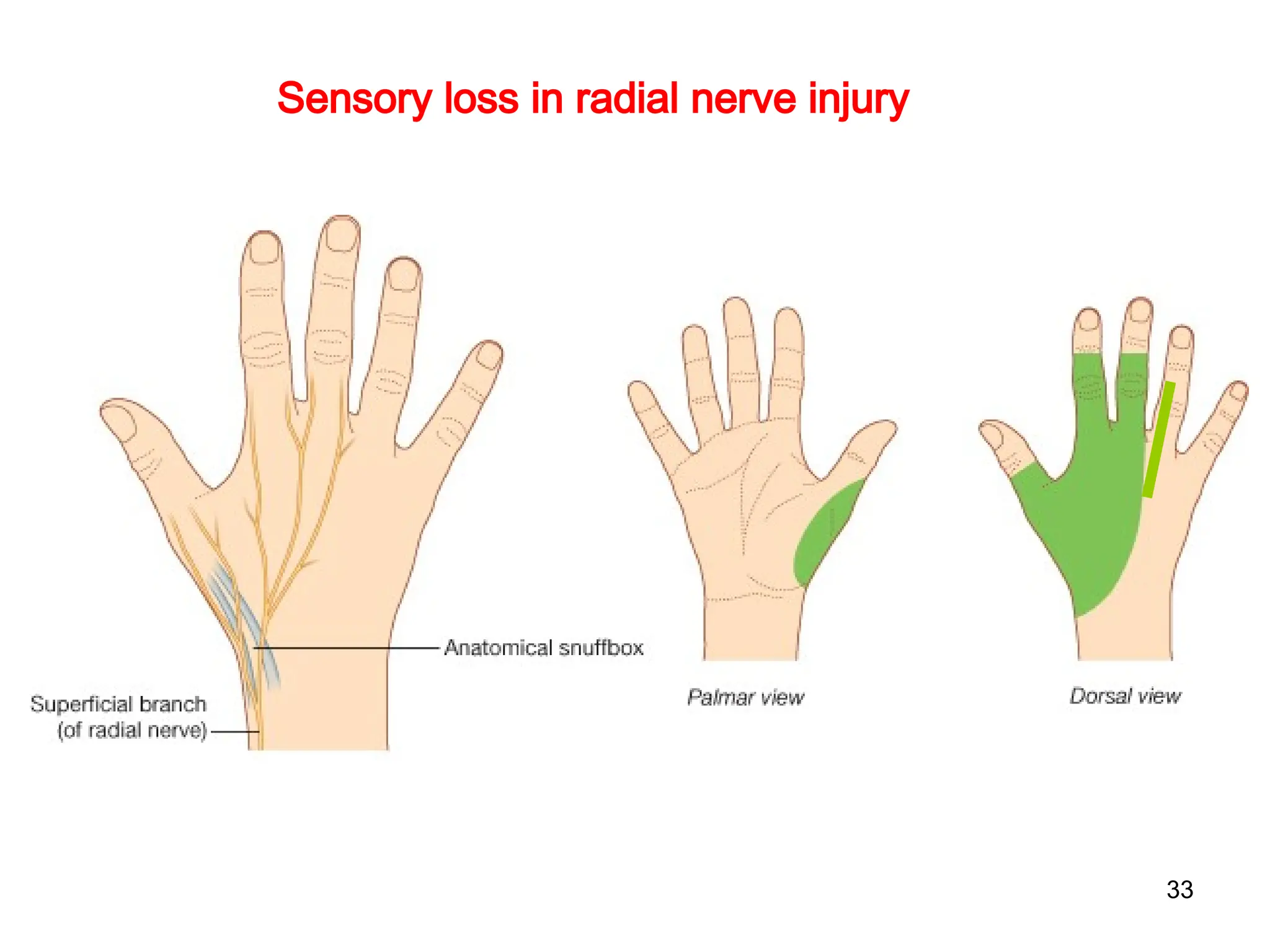
b) Sensory
– Loss of sensation over
• posterior surface of arm, forearm and
• lower lateral surface of arm
– Hand – dorsum lateral part
– Digits – lateral 31/2 digits upto nail beds,
dorsal surface
33
Sensory loss in radial nerve injury
34
RADIAL NERVE : APPLIED
2. Injury of N in Spiral groove
• Causes
– Fracture of middle shaft of humerus
– Pressure on Nerve – Saturday Night palsy
– Operating table edge
– Prolonged use of tourniquet
a) Motor
– Triceps not affected, WHY ???
• Extension of elbow not impaired
– WRIST DROP
b) Sensory
– Back of forearm,
– dorsum of hand- lateral part
– Digits – lateral 31/2 upto nailbed
35
RADIAL NERVE : APPLIED
3. Injury to Deep br – Posterior interosseous N
• Causes
– Fracture of upper radius
– Dislocation of head of radius
– Penetrating wound of upper forearm
• Motor
– Brachioradialis, ECRL escapes injury.
– Other extensors paralyzed
– Effect at wrist :
• Extension possible but with radial deviation
• ( be’coz ECRL escapes injury, ECU, ECRB paralyzed)
• No sensory loss
– (Deep br purely motor)
36
RADIAL NERVE : APPLIED
4. Injury at Superficial br
• Superficial br superficially present on wrist
• Causes
– Compression by
• Tight bracelets, watch straps, plaster casts, hand cuffs etc
a) No motor loss
b) Sensory loss
– Hand – dorsum lateral ½
– Digits – dorsum lateral 31/2 up to nail beds
– Sensory loss may be minimal and may present only on dorsum of
knuckle of index finger
Summary
– If triceps paralyzed – injury at axilla
– BR paralyzed with normal triceps – injury at radial groove
– If BR and triceps both normal – injury beyond lateral epicondyle
37
thankyou

5-radial Nerve.pptddfffttrrrrreerrrrgghfrg

  • 1.
  • 2.
    2 Extensor group ofmuscles RIGHT FOREARM
  • 3.
    3 Extensor group ofmuscles Anconeus, Supinator Thumb muscles Msls from Common Ext origin
  • 4.
  • 5.
    5 RADIAL NERVE Nerve ofExtensors of - arm - forearm Sensory to - back of arm - back of forearm - dorsum of hand • continuation of Posterior Cord • largest branch of BP • Root value: C5-C8 & T1 • Largest branch of Brachial Plexus
  • 6.
    6 RADIAL NERVE: COURSE Descends –behind3rd part of Axillary artery & –later behind brachial art.
  • 7.
  • 8.
    8 Leaves axilla thru triangular spacealong with Profunda brachii
  • 9.
  • 10.
    10 arm At first Liesbt long & medial heads of Triceps. Passes obliquely and enters spiral groove across post surf of humerus bt lateral & medial heads of Triceps. Here it covered by lat head. Enter anterior compartment
  • 11.
    11 Showing relation of radialnerve to humerus and vessels
  • 12.
    12 RADIAL NERVE: COURSEcon’td Descends – bt Brachialis & Brachioradialis (proximally) – and ECRL (distally) Anterior to lateral Epicondyle- – Divides into terminal branches: a) Superficial branch b) Posterior Interosseous nerve (Deep br)
  • 13.
  • 14.
    14 Ant. to lat.Epicondyle – Divides into terminal branches : • Post. Interosseous nerve (Deep branch) • Superficial branch
  • 15.
    15 Superficial branch – descendsalong radial border of forearm. – Crosses anatomical snuff box – Reach back of hand – Sensory to • dorsum of hand (lat. 3 1/2) • small area over palm. • Lateral 3 1/2 fingers short of nail beds Flexor aspect
  • 16.
  • 17.
    17 Deep branch – PiercesSupinator – enters extensor Compt of forearm. Flexor aspect
  • 18.
    18 Deep branch Supplies extensorsof forearm. Supinator ECRB, (BR, ECRL??) ED, EDM, ECU, AbPL, EPB, EPL, EI
  • 19.
  • 20.
  • 21.
    21 RADIAL NERVE: REGIONWISE BRANCHES IN AXILLA 1. Post Cutaneous N of arm 2. Nerve to Triceps – Long, Medial and – Lateral Head 3. Anconeus
  • 22.
    22 Branches to triceps Tricepssupplied by 4 branches from radial N. • Medial head : 2 br, • long head : 1 br, • lateral head : 1 br – Br given out before it enters radial groove. – In fracture shaft of humerus – triceps usually escapes injury because br given higher up
  • 23.
    IN SPIRAL GROOVE 1.Lower lat cut N of arm 2. Post cut N of forearm 23
  • 24.
    24 BEYOND RADIAL GROOVE (Abovelateral Epicondyle) – Brachialis Lateral part – Brachioradialis – Extensor Carpi Radialis Longus (ECRL) – Elbow joint – Then it divides into two branches
  • 25.
  • 26.
    26 RADIAL NERVE: REGIONWISE BRANCHES IN CUBITAL FOSSA 1. Posterior interosseous nerve (Deep branch) 2. Branch to Supinator 3. Superficial br- • supply • skin of lat side of dorsum of hand and • dorsum of lat 3 ½ fingers proximal to nail beds.
  • 27.
    27 RADIAL NERVE: BRANCHES Branches 1.Muscular 2. Cutaneous 3. Articular 1. Muscular • Long, medial and lateral head of triceps • Anconeus • Extensor muscles 2. Cutaneous branch • Posterior cut N of arm • Lower lateral cut N of arm • Posterior cut N of forearm • Superficial br of radial (terminal) 3. Articular br • Elbow jt • Wrist and intercarpal
  • 28.
    28 RADIAL NERVE :APPLIED studied under 1. Injury to N in axilla 2. Injury of N in spiral groove 3. Injury of Deep branch – Post interosseous N 4. Injury to superficial br
  • 29.
    29 RADIAL NERVE :APPLIED 1. Injury at axilla • Causes 1. Extra long crutches (CRUTCH PALSY) 2. Fracture dislocation of upper humerus 3. During reduction of shoulder dislocation • Symptoms a) Motor: – All extensors of wrist, elbow, finger paralyzed. Unopposed action of flexors – WRIST DROP – Fingers can be extended (extension of IP jts) – • done by lumbricals and interosseous (supplied by median/ulnar N) – Inability to grip objects firmly. • (flexors working with decreased mechanical advantage, b’coz extension at wrist is essential for stretching prior to flexion of digits)
  • 30.
  • 31.
  • 32.
    32 RADIAL NERVE :APPLIED b) Sensory – Loss of sensation over • posterior surface of arm, forearm and • lower lateral surface of arm – Hand – dorsum lateral part – Digits – lateral 31/2 digits upto nail beds, dorsal surface
  • 33.
    33 Sensory loss inradial nerve injury
  • 34.
    34 RADIAL NERVE :APPLIED 2. Injury of N in Spiral groove • Causes – Fracture of middle shaft of humerus – Pressure on Nerve – Saturday Night palsy – Operating table edge – Prolonged use of tourniquet a) Motor – Triceps not affected, WHY ??? • Extension of elbow not impaired – WRIST DROP b) Sensory – Back of forearm, – dorsum of hand- lateral part – Digits – lateral 31/2 upto nailbed
  • 35.
    35 RADIAL NERVE :APPLIED 3. Injury to Deep br – Posterior interosseous N • Causes – Fracture of upper radius – Dislocation of head of radius – Penetrating wound of upper forearm • Motor – Brachioradialis, ECRL escapes injury. – Other extensors paralyzed – Effect at wrist : • Extension possible but with radial deviation • ( be’coz ECRL escapes injury, ECU, ECRB paralyzed) • No sensory loss – (Deep br purely motor)
  • 36.
    36 RADIAL NERVE :APPLIED 4. Injury at Superficial br • Superficial br superficially present on wrist • Causes – Compression by • Tight bracelets, watch straps, plaster casts, hand cuffs etc a) No motor loss b) Sensory loss – Hand – dorsum lateral ½ – Digits – dorsum lateral 31/2 up to nail beds – Sensory loss may be minimal and may present only on dorsum of knuckle of index finger Summary – If triceps paralyzed – injury at axilla – BR paralyzed with normal triceps – injury at radial groove – If BR and triceps both normal – injury beyond lateral epicondyle
  • 37.