Kushal kumar
Anatomy
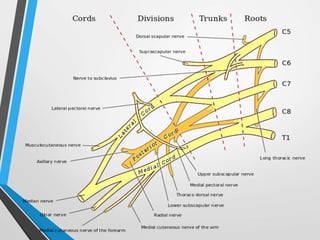
• Ulnar Nerve is one of the terminal branches of brachial
plexus.
• It is the continuation of medial cord of brachial plexus which
arises from the anterior division of the lower trunk.
• The fibers of ulnar nerve arise from the eight cervical and first
thoracic nerve, so the root value of ulnar nerve is C8 andT1.
These (C8,T1) coordinate to form the lower trunk of brachial
plexus.
Origin of the Ulnar Nerve
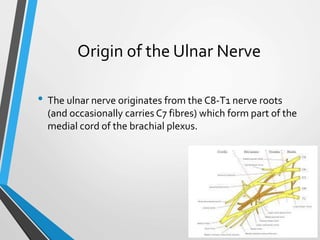
• The ulnar nerve originates from the C8-T1 nerve roots
(and occasionally carries C7 fibres) which form part of the
medial cord of the brachial plexus.
Course of Ulnar Nerve
In the Axilla
• It descends on the medial side of the 3rd part of axillary
artery between it and axillary vein.
In the Arm
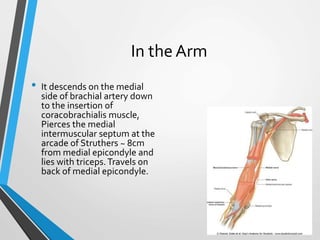
• It descends on the medial
side of brachial artery down
to the insertion of
coracobrachialis muscle,
Pierces the medial
intermuscular septum at the
arcade of Struthers ~ 8cm
from medial epicondyle and
lies with triceps.Travels on
back of medial epicondyle.
At the Elbow
• It reaches the back of
med.epicondyle to enter the
forearm between 2 heads of
flexor carpi ulnaris and here it is
accompanied by branch of ulnar
collateral arteries.
In the Forearm
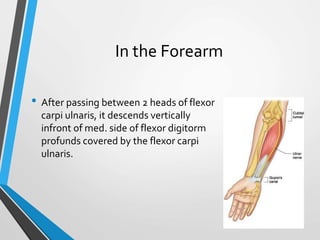
• After passing between 2 heads of flexor
carpi ulnaris, it descends vertically
infront of med. side of flexor digitorm
profunds covered by the flexor carpi
ulnaris.
In the Hand
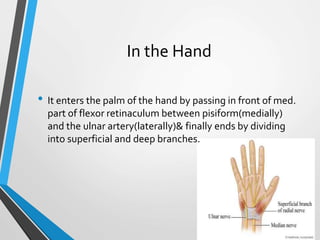
• It enters the palm of the hand by passing in front of med.
part of flexor retinaculum between pisiform(medially)
and the ulnar artery(laterally)& finally ends by dividing
into superficial and deep branches.
Branches of Ulnar Nerve
At the Elbow
• The nerve gives branches to the Flexor Carpi Ulnaris and
the medial half of the Flexor digitorum profundus.
In the Forearm
• The Ulnar Nerve divides into Dorsal and palmar
cutaneous branches.
• The Palmar cutaneous branch of
the Ulnar Nerve provides
sensation to the palm of the
hand.
• The Finger sensation is provided
by the superficial branch.
• The Dorsal cutaneous branch of
the Ulnar Nerve gives innervation
to the medial dorsal aspect of the
hand and the one and a Half
Fingers.
In the hand
• The Nerve further divides into superficial and deep
branches.
• The superficial branch of the Ulnar nerve divides into
Palmer digital nerves after it passes under and supplies
the Palmaris brevis muscle.
• The Deep branch of the Ulnar nerve innervates the three
hypothenar muscles , the medial two lumbricals , the
seven interossei , the adductor pollicis and the deep head
of flexor pollicis brevis.
Ulnar innervated muscles
Forearm:
• Flexor Carpi Ulnaris (C7, C8,T1)
• Flexor Digitorum Profundus III
& IV (C7, C8)
Thenar:
• Hypothenar Muscles (C8,T1)
• Adductor Pollicis (C8,T1)
• Flexor Pollicis Brevis (C8,T1)
Fingers:
• Palmer Interosseous (C8,T1)
• Dorsal Interosseous (C8,T1)
• III & IV Lumbricles (C8,T1)
Digiti Minimi:
• Abductor Digiti Minimi (Quinti)
(C8,T1)
• Opponens Dgiti Minimi (C8-T1)
• Flexor Digiti Minimi. : ( C8-T1)
• The ulnar nerve is responsible for the pain, or 'funny bone', sensation
that occurs if the elbow bone is suddenly struck.
• Continual pressure on the elbow or inner forearm may cause
damage. Injury can also occur from elbow fractures or dislocations.
• Damage to the ulnar nerve causes problems with sensation and
mobility in the wrist and the hand.
• In a patient with ulnar nerve damage, some of the fingers may
become locked into a flexed position.This is sometimes nicknamed
"claw hand.
• "Wrist movement is also often observed to be weaker with damaged
ulnar nerves.
Ulnar Nerve Entrapment
• The Ulnar Nerve can
become pinched in
different locations .
• 1-Thoracic outlet syndrome
.
• 2-cubital tunnel syndrome .
• 3-UlnarTunnel syndrome .
Common sites of ulnar nerve injury
The ulnar nerve is most commonly injured
• At the elbow, where it lies behind the medial epicondyle.
The injuries at the elbow are usually associated with
fractures of the medial epicondyle.
• At the wrist, where it lies with the ulnar artery in front of
the flexor retinaculum.The superficial position of the
nerve at the wrist makes it vulnerable to damage from
cuts and stab wounds.
Ulnar Nerve injuries at elbow
CubitalTunnel Syndrome
• Causes of Ulnar Nerve entrapment around the cubital tunnel :
1.CubitusValgus :
Deformity in which the elbow is turned outward
2.Spur :
A spur on the Medial Epicondyle
Clinical Features
Motor:
• The flexor carpi ulnaris and the medial half of the flexor
digitorum profundus muscles are paralyzed.
• The paralysis of the flexor carpi ulnaris can be observed by
asking the patient to make a tightly clenched fist.
• Normally, the synergistic action of the flexor carpi ulnaris
tendon can be observed as it passes to the pisiform bone; the
tightening of the tendon will be absent if the muscle is
paralyzed.
• The profundus tendons to the ring and little fingers will
be functionless,
• Flexion of the wrist joint will result in abduction, owing to
paralysis of the flexor carpi ulnaris.
• The medial border of the front of the forearm will show
flattening owing to the wasting of the underlying ulnaris
and profundus muscles.
• The small muscles of the hand will be paralyzed, except
the muscles of the thenar eminence and the first two
lumbricals, which are supplied by the median nerve.
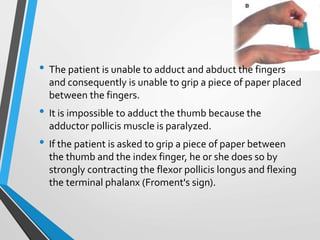
• The patient is unable to adduct and abduct the fingers
and consequently is unable to grip a piece of paper placed
between the fingers.
• It is impossible to adduct the thumb because the
adductor pollicis muscle is paralyzed.
• If the patient is asked to grip a piece of paper between
the thumb and the index finger, he or she does so by
strongly contracting the flexor pollicis longus and flexing
the terminal phalanx (Froment's sign).
Book test
• The metacarpophalangeal joints become hyperextended
because of the paralysis of the lumbrical and interosseous
muscles, which normally flex these joints.
• The interphalangeal joints are flexed, owing again to the
paralysis of the lumbrical and interosseous muscles,
which normally extend these joints through the extensor
expansion.
• The flexion deformity at the interphalangeal joints of the
fourth and fifth fingers is obvious because the first and second
lumbrical muscles of the index and middle fingers are not
paralyzed.
• In long-standing cases the hand assumes the characteristic
claw deformity
• Wasting of the paralyzed muscles results in flattening of the
hypothenar eminence and loss of the convex curve to the
medial border of the hand.
• Examination of the dorsum of the hand will show hollowing
between the metacarpal bones caused by wasting of the dorsal
interosseous muscles.
Sensory:
• Loss of skin sensation will be observed
over the anterior and posterior surfaces
of the medial third of the hand and the
medial one and a half fingers.
Vasomotor Changes:
• The skin areas involved in sensory loss are warmer and
drier than normal because of the arteriolar dilatation and
absence of sweating resulting from loss of sympathetic
control
Ulnar Nerve injuries at wrist
Guyon’s Canal Syndrome
• Sometimes called Guyon's
tunnel syndrome
• Is a common nerve compression
affecting the ulnar nerve as it
passes through a tunnel in the
wrist called Guyon's canal.
• Flexor carpi ulnaris:
• Abductor digiti minimi:
• Egawa'sTest (a)
• CardTest (b)
• Adductor pollicis: book test
Ulnar Nerve and clinical features

Ulnar Nerve and clinical features

  • 1.
  • 3.
    Anatomy • Ulnar Nerveis one of the terminal branches of brachial plexus. • It is the continuation of medial cord of brachial plexus which arises from the anterior division of the lower trunk. • The fibers of ulnar nerve arise from the eight cervical and first thoracic nerve, so the root value of ulnar nerve is C8 andT1. These (C8,T1) coordinate to form the lower trunk of brachial plexus.
  • 4.
    Origin of theUlnar Nerve • The ulnar nerve originates from the C8-T1 nerve roots (and occasionally carries C7 fibres) which form part of the medial cord of the brachial plexus.
  • 5.
  • 6.
    In the Axilla •It descends on the medial side of the 3rd part of axillary artery between it and axillary vein.
  • 7.
    In the Arm •It descends on the medial side of brachial artery down to the insertion of coracobrachialis muscle, Pierces the medial intermuscular septum at the arcade of Struthers ~ 8cm from medial epicondyle and lies with triceps.Travels on back of medial epicondyle.
  • 9.
    At the Elbow •It reaches the back of med.epicondyle to enter the forearm between 2 heads of flexor carpi ulnaris and here it is accompanied by branch of ulnar collateral arteries.
  • 10.
    In the Forearm •After passing between 2 heads of flexor carpi ulnaris, it descends vertically infront of med. side of flexor digitorm profunds covered by the flexor carpi ulnaris.
  • 12.
    In the Hand •It enters the palm of the hand by passing in front of med. part of flexor retinaculum between pisiform(medially) and the ulnar artery(laterally)& finally ends by dividing into superficial and deep branches.
  • 14.
  • 15.
    At the Elbow •The nerve gives branches to the Flexor Carpi Ulnaris and the medial half of the Flexor digitorum profundus.
  • 16.
    In the Forearm •The Ulnar Nerve divides into Dorsal and palmar cutaneous branches.
  • 17.
    • The Palmarcutaneous branch of the Ulnar Nerve provides sensation to the palm of the hand. • The Finger sensation is provided by the superficial branch.
  • 18.
    • The Dorsalcutaneous branch of the Ulnar Nerve gives innervation to the medial dorsal aspect of the hand and the one and a Half Fingers.
  • 19.
    In the hand •The Nerve further divides into superficial and deep branches.
  • 20.
    • The superficialbranch of the Ulnar nerve divides into Palmer digital nerves after it passes under and supplies the Palmaris brevis muscle.
  • 21.
    • The Deepbranch of the Ulnar nerve innervates the three hypothenar muscles , the medial two lumbricals , the seven interossei , the adductor pollicis and the deep head of flexor pollicis brevis.
  • 22.
    Ulnar innervated muscles Forearm: •Flexor Carpi Ulnaris (C7, C8,T1) • Flexor Digitorum Profundus III & IV (C7, C8) Thenar: • Hypothenar Muscles (C8,T1) • Adductor Pollicis (C8,T1) • Flexor Pollicis Brevis (C8,T1) Fingers: • Palmer Interosseous (C8,T1) • Dorsal Interosseous (C8,T1) • III & IV Lumbricles (C8,T1) Digiti Minimi: • Abductor Digiti Minimi (Quinti) (C8,T1) • Opponens Dgiti Minimi (C8-T1) • Flexor Digiti Minimi. : ( C8-T1)
  • 23.
    • The ulnarnerve is responsible for the pain, or 'funny bone', sensation that occurs if the elbow bone is suddenly struck. • Continual pressure on the elbow or inner forearm may cause damage. Injury can also occur from elbow fractures or dislocations. • Damage to the ulnar nerve causes problems with sensation and mobility in the wrist and the hand. • In a patient with ulnar nerve damage, some of the fingers may become locked into a flexed position.This is sometimes nicknamed "claw hand. • "Wrist movement is also often observed to be weaker with damaged ulnar nerves.
  • 24.
    Ulnar Nerve Entrapment •The Ulnar Nerve can become pinched in different locations . • 1-Thoracic outlet syndrome . • 2-cubital tunnel syndrome . • 3-UlnarTunnel syndrome .
  • 25.
    Common sites ofulnar nerve injury The ulnar nerve is most commonly injured • At the elbow, where it lies behind the medial epicondyle. The injuries at the elbow are usually associated with fractures of the medial epicondyle. • At the wrist, where it lies with the ulnar artery in front of the flexor retinaculum.The superficial position of the nerve at the wrist makes it vulnerable to damage from cuts and stab wounds.
  • 26.
    Ulnar Nerve injuriesat elbow CubitalTunnel Syndrome • Causes of Ulnar Nerve entrapment around the cubital tunnel : 1.CubitusValgus : Deformity in which the elbow is turned outward 2.Spur : A spur on the Medial Epicondyle
  • 27.
    Clinical Features Motor: • Theflexor carpi ulnaris and the medial half of the flexor digitorum profundus muscles are paralyzed. • The paralysis of the flexor carpi ulnaris can be observed by asking the patient to make a tightly clenched fist. • Normally, the synergistic action of the flexor carpi ulnaris tendon can be observed as it passes to the pisiform bone; the tightening of the tendon will be absent if the muscle is paralyzed.
  • 28.
    • The profundustendons to the ring and little fingers will be functionless, • Flexion of the wrist joint will result in abduction, owing to paralysis of the flexor carpi ulnaris. • The medial border of the front of the forearm will show flattening owing to the wasting of the underlying ulnaris and profundus muscles. • The small muscles of the hand will be paralyzed, except the muscles of the thenar eminence and the first two lumbricals, which are supplied by the median nerve.
  • 29.
    • The patientis unable to adduct and abduct the fingers and consequently is unable to grip a piece of paper placed between the fingers. • It is impossible to adduct the thumb because the adductor pollicis muscle is paralyzed. • If the patient is asked to grip a piece of paper between the thumb and the index finger, he or she does so by strongly contracting the flexor pollicis longus and flexing the terminal phalanx (Froment's sign).
  • 30.
  • 31.
    • The metacarpophalangealjoints become hyperextended because of the paralysis of the lumbrical and interosseous muscles, which normally flex these joints. • The interphalangeal joints are flexed, owing again to the paralysis of the lumbrical and interosseous muscles, which normally extend these joints through the extensor expansion.
  • 32.
    • The flexiondeformity at the interphalangeal joints of the fourth and fifth fingers is obvious because the first and second lumbrical muscles of the index and middle fingers are not paralyzed. • In long-standing cases the hand assumes the characteristic claw deformity • Wasting of the paralyzed muscles results in flattening of the hypothenar eminence and loss of the convex curve to the medial border of the hand. • Examination of the dorsum of the hand will show hollowing between the metacarpal bones caused by wasting of the dorsal interosseous muscles.
  • 33.
    Sensory: • Loss ofskin sensation will be observed over the anterior and posterior surfaces of the medial third of the hand and the medial one and a half fingers.
  • 34.
    Vasomotor Changes: • Theskin areas involved in sensory loss are warmer and drier than normal because of the arteriolar dilatation and absence of sweating resulting from loss of sympathetic control
  • 35.
    Ulnar Nerve injuriesat wrist Guyon’s Canal Syndrome • Sometimes called Guyon's tunnel syndrome • Is a common nerve compression affecting the ulnar nerve as it passes through a tunnel in the wrist called Guyon's canal.
  • 36.
    • Flexor carpiulnaris: • Abductor digiti minimi: • Egawa'sTest (a) • CardTest (b) • Adductor pollicis: book test