Introduction
Organization of the nervous system
Lippincott’s pharmacology 4th
edition
Drugs Act on Autonomic nervous system
Drugs that produce Parasympathetic like actions
= Parasympathomimetics = Cholinergics
 Drugs that oppose Parasympathetic =
Parasympatholytic = Anticholinergics
Drugs that produce sympathetic like action =
Sympathomimetics = Adrenergics
 Drugs that oppose sympathetic =
Sympatholytics = Antiadrenergics
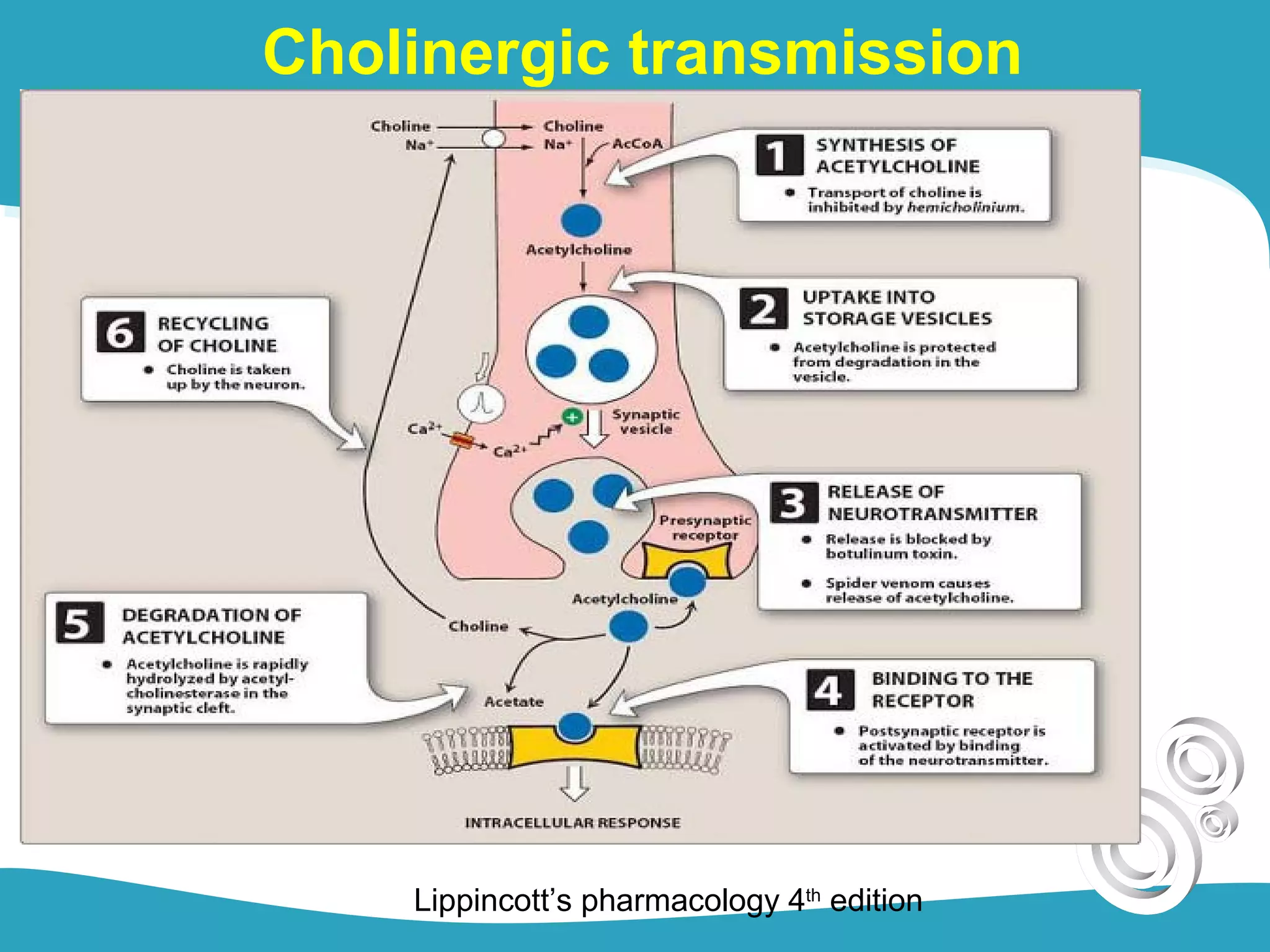
Cholinergic transmission
Lippincott’s pharmacology 4th
edition
Cholinoceptors
• Muscarinic receptors: 3 subtypes are well defined
pharmalogically M1, M2 M3 found on ganglia of the
peripheral nervous system and on the autonomic
effector organs, such as the heart, smooth muscle,
brain, and exocrine glands
• Nicotinic receptors (N) present in
autonomic ganglia
adrenal medulla
neuromuscular junction
Drugs that stimulate muscarinic receptors
Direct Parasympathomimetics
Indirect Parasympathomimetics (Anti-cholinesterases)
Direct Parasympathomimetics: They stimulate the
muscarinic receptors directly.
Indirect Parasympathomimetics (Anti-cholinesterases): They
inhibit cholinesterase enzyme leading to accumulation of
endogenous acetylcholine at both muscarinic and nicotinic
receptors
Mechanism of action
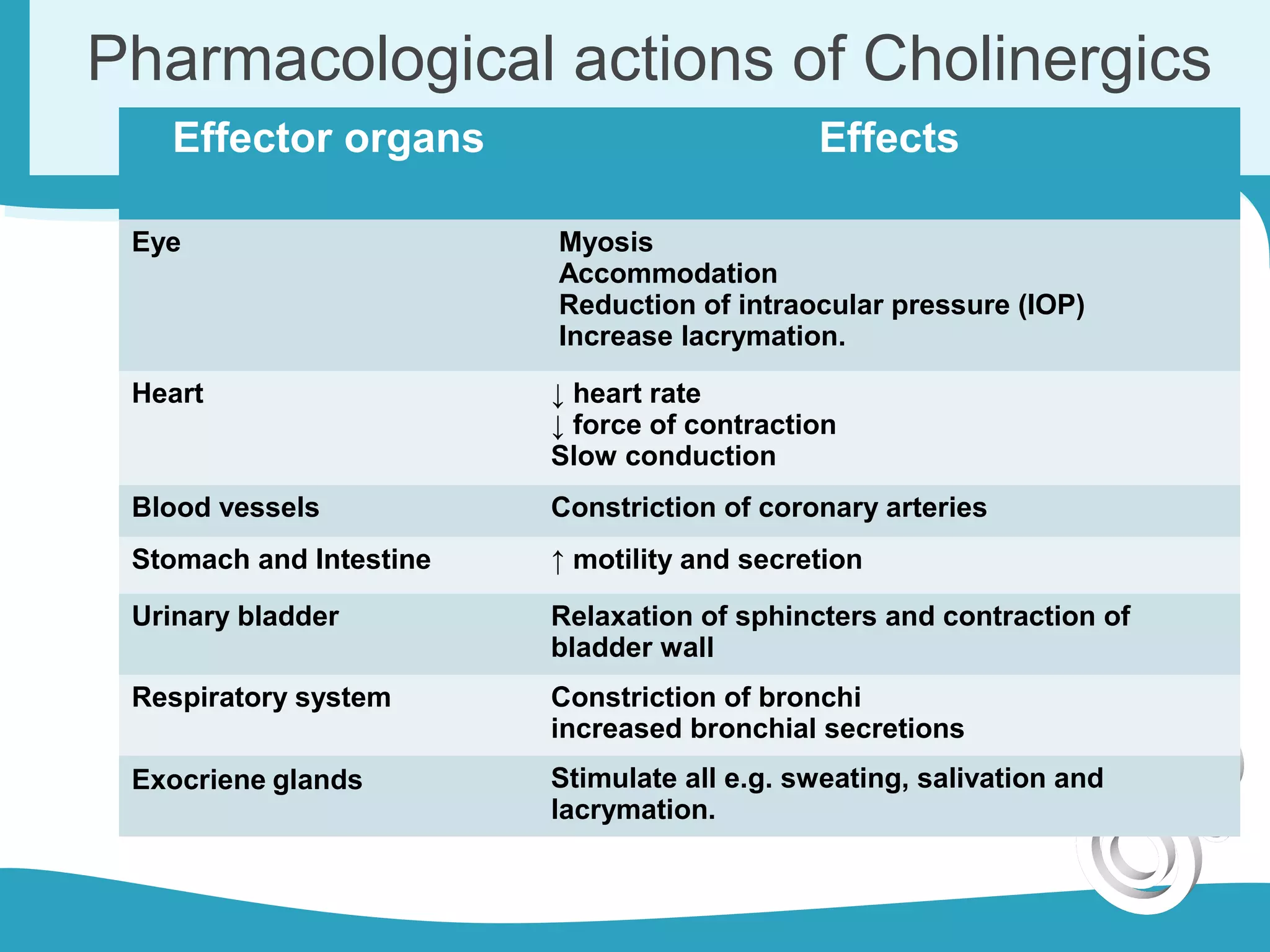
Pharmacological actions of Cholinergics
Effector organs Effects
Eye Myosis
Accommodation
Reduction of intraocular pressure (IOP)
Increase lacrymation.
Heart ↓ heart rate
↓ force of contraction
Slow conduction
Blood vessels Constriction of coronary arteries
Stomach and Intestine ↑ motility and secretion
Urinary bladder Relaxation of sphincters and contraction of
bladder wall
Respiratory system Constriction of bronchi
increased bronchial secretions
Exocriene glands Stimulate all e.g. sweating, salivation and
lacrymation.
Direct cholinergic
agentsAcetyl-choline is It is a natural direct parasympathomimetic.
stimulates directly both muscarinic & nicotinic receptors
important physiologically, it is not used clinically because its
actions are very brief because of rapid hydrolysis
Methacholine more selective on cardiovascular system
.Weak nicotinic effect.
Carbachol : has muscarinic and nicotinic but it is mainly
selective on EYE, gastrointestinal tract and urinary tract
Bethanichol
Actions: No nicotinic action, but only muscarinic action which
is mainly selective on gastrointestinal tract , and urinary
system.
Pilocarpine
Direct muscarinic agonist specific on eye and secretions . Very
weak nicotinic action
Reversible
anticholinesterases
Physostigmine has muscarinic action most specific on eye
and CNS stimulation
Neostigmine It produces both nicotinic and muscarinic actions
but it is more active on the nicotinic receptors of the N-M
junction. Its muscarinic actions are more specific on the
gastrointestinal and urinary tracts. No CNS action
Generic name Indication
Methacholine paroxysmal atrial tachycardia and peripheral
vascular disease
Carbachol Glucoma
Post-operative paralytic ileus
Post- operative retention of urine
Bethanechol Post-operative paralytic ileus
Post- operative retention of urine
Pilocarpine Glucoma
physostigmine Glucoma
Anti-cholinergic poisoning
Neostigmin Myasthenia gravis
Reversal of neuromuscular blockade
Urine retention
Cholinergic agents
indications
cholinergic agents
Adverse effects
• Muscarinic:
◆ Miosis, lacrymation, salivation, sweating
◆ Urgency and spontaneous micturition
◆ Bronchospasm and increased bronchial secretion.
◆ Bradycardia and hypotension.
◆ Colic, vomiting, diarrhea, hyperacidity & peptic ulcer
• Nicotinic: skeletal muscle twitches followed by paralysis
Contraindication
• Bronchial asthma
• Peptic ulcer
• Coronary insufficiency
• Thyrotoxicosis
• Mechanical obstruction of the GIT and urinary bladder
THANK YOUTHANK YOU

3.cholinergic drugs

  • 2.
    Introduction Organization of thenervous system Lippincott’s pharmacology 4th edition
  • 3.
    Drugs Act onAutonomic nervous system Drugs that produce Parasympathetic like actions = Parasympathomimetics = Cholinergics  Drugs that oppose Parasympathetic = Parasympatholytic = Anticholinergics Drugs that produce sympathetic like action = Sympathomimetics = Adrenergics  Drugs that oppose sympathetic = Sympatholytics = Antiadrenergics
  • 4.
  • 5.
    Cholinoceptors • Muscarinic receptors:3 subtypes are well defined pharmalogically M1, M2 M3 found on ganglia of the peripheral nervous system and on the autonomic effector organs, such as the heart, smooth muscle, brain, and exocrine glands • Nicotinic receptors (N) present in autonomic ganglia adrenal medulla neuromuscular junction
  • 6.
    Drugs that stimulatemuscarinic receptors Direct Parasympathomimetics Indirect Parasympathomimetics (Anti-cholinesterases) Direct Parasympathomimetics: They stimulate the muscarinic receptors directly. Indirect Parasympathomimetics (Anti-cholinesterases): They inhibit cholinesterase enzyme leading to accumulation of endogenous acetylcholine at both muscarinic and nicotinic receptors Mechanism of action
  • 8.
    Pharmacological actions ofCholinergics Effector organs Effects Eye Myosis Accommodation Reduction of intraocular pressure (IOP) Increase lacrymation. Heart ↓ heart rate ↓ force of contraction Slow conduction Blood vessels Constriction of coronary arteries Stomach and Intestine ↑ motility and secretion Urinary bladder Relaxation of sphincters and contraction of bladder wall Respiratory system Constriction of bronchi increased bronchial secretions Exocriene glands Stimulate all e.g. sweating, salivation and lacrymation.
  • 9.
    Direct cholinergic agentsAcetyl-choline isIt is a natural direct parasympathomimetic. stimulates directly both muscarinic & nicotinic receptors important physiologically, it is not used clinically because its actions are very brief because of rapid hydrolysis Methacholine more selective on cardiovascular system .Weak nicotinic effect. Carbachol : has muscarinic and nicotinic but it is mainly selective on EYE, gastrointestinal tract and urinary tract Bethanichol Actions: No nicotinic action, but only muscarinic action which is mainly selective on gastrointestinal tract , and urinary system. Pilocarpine Direct muscarinic agonist specific on eye and secretions . Very weak nicotinic action
  • 10.
    Reversible anticholinesterases Physostigmine has muscarinicaction most specific on eye and CNS stimulation Neostigmine It produces both nicotinic and muscarinic actions but it is more active on the nicotinic receptors of the N-M junction. Its muscarinic actions are more specific on the gastrointestinal and urinary tracts. No CNS action
  • 11.
    Generic name Indication Methacholineparoxysmal atrial tachycardia and peripheral vascular disease Carbachol Glucoma Post-operative paralytic ileus Post- operative retention of urine Bethanechol Post-operative paralytic ileus Post- operative retention of urine Pilocarpine Glucoma physostigmine Glucoma Anti-cholinergic poisoning Neostigmin Myasthenia gravis Reversal of neuromuscular blockade Urine retention Cholinergic agents indications
  • 12.
    cholinergic agents Adverse effects •Muscarinic: ◆ Miosis, lacrymation, salivation, sweating ◆ Urgency and spontaneous micturition ◆ Bronchospasm and increased bronchial secretion. ◆ Bradycardia and hypotension. ◆ Colic, vomiting, diarrhea, hyperacidity & peptic ulcer • Nicotinic: skeletal muscle twitches followed by paralysis Contraindication • Bronchial asthma • Peptic ulcer • Coronary insufficiency • Thyrotoxicosis • Mechanical obstruction of the GIT and urinary bladder
  • 13.