Seminar on Cholinergic DrugsSeminar on Cholinergic Drugs
(Medicinal chemistry)(Medicinal chemistry)
Guided ByGuided By : Mr.P.Prasanna Raja: Mr.P.Prasanna Raja
Presented ByPresented By : B.Bharath kumar: B.Bharath kumar
IntroductionIntroduction
• Drugs affecting the ANS are divided intoDrugs affecting the ANS are divided into
two groups . According to the type oftwo groups . According to the type of
neurons involved in their mechanism ofneurons involved in their mechanism of
actionaction
Cholinergics – Acts on the receptors stimulatedCholinergics – Acts on the receptors stimulated
by Achby Ach
Adrenergics - Acts on the receptors stimulatedAdrenergics - Acts on the receptors stimulated
by Norepinephrineby Norepinephrine
Cholinergic agentsCholinergic agents
• Cholinergic agents are the drugs that eitherCholinergic agents are the drugs that either
directly or indirectly produce effect similar todirectly or indirectly produce effect similar to
those elicited by Acetylcholinethose elicited by Acetylcholine
• Dale while studying the pharmacological actionsDale while studying the pharmacological actions
of Ach distinguished two types of activities whichof Ach distinguished two types of activities which
he designated as muscarinic and nicotiniche designated as muscarinic and nicotinic
Synthesis of AchSynthesis of Ach
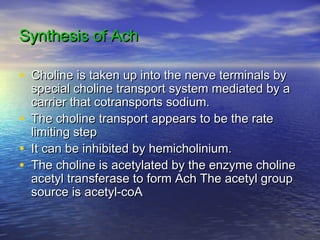
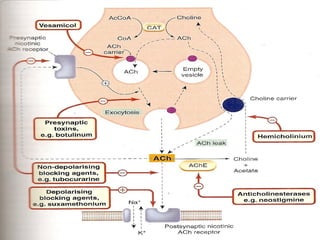
• Choline is taken up into the nerve terminals byCholine is taken up into the nerve terminals by
special choline transport system mediated by aspecial choline transport system mediated by a
carrier that cotransports sodium.carrier that cotransports sodium.
• The choline transport appears to be the rateThe choline transport appears to be the rate
limiting steplimiting step
• It can be inhibited by hemicholinium.It can be inhibited by hemicholinium.
• The choline is acetylated by the enzyme cholineThe choline is acetylated by the enzyme choline
acetyl transferase to form Ach The acetyl groupacetyl transferase to form Ach The acetyl group
source is acetyl-coAsource is acetyl-coA
Storage and Release of achStorage and Release of ach
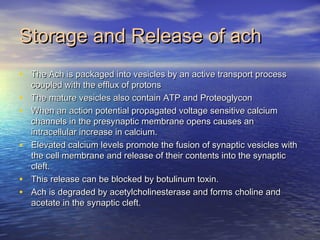
• The Ach is packaged into vesicles by an active transport processThe Ach is packaged into vesicles by an active transport process
coupled with the efflux of protonscoupled with the efflux of protons
• The mature vesicles also contain ATP and ProteoglyconThe mature vesicles also contain ATP and Proteoglycon
• When an action potential propagated voltage sensitive calciumWhen an action potential propagated voltage sensitive calcium
channels in the presynaptic membrane opens causes anchannels in the presynaptic membrane opens causes an
intracellular increase in calcium.intracellular increase in calcium.
• Elevated calcium levels promote the fusion of synaptic vesicles withElevated calcium levels promote the fusion of synaptic vesicles with
the cell membrane and release of their contents into the synapticthe cell membrane and release of their contents into the synaptic
cleft.cleft.
• This release can be blocked by botulinum toxin.This release can be blocked by botulinum toxin.
• Ach is degraded by acetylcholinesterase and forms choline andAch is degraded by acetylcholinesterase and forms choline and
acetate in the synaptic cleft.acetate in the synaptic cleft.
CholinoceptorsCholinoceptors
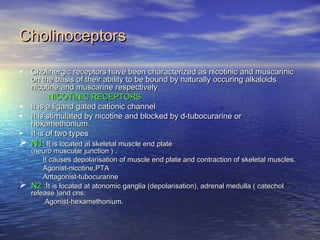
• Cholinergic receptors have been characterized as nicotinic and muscarinicCholinergic receptors have been characterized as nicotinic and muscarinic
on the basis of their ability to be bound by naturally occuring alkaloidson the basis of their ability to be bound by naturally occuring alkaloids
nicotine and muscarine respectivelynicotine and muscarine respectively
NICOTINIC RECEPTORSNICOTINIC RECEPTORS
• It is a ligand gated cationic channelIt is a ligand gated cationic channel
• It is stimulated by nicotine and blocked by d-tubocurarine orIt is stimulated by nicotine and blocked by d-tubocurarine or
hexamethonium.hexamethonium.
• It is of two typesIt is of two types
 N1N1: It is located at skeletal muscle end plate: It is located at skeletal muscle end plate
(neuro muscular junction ) .(neuro muscular junction ) .
It causes depolarisation of muscle end plate and contraction of skeletal muscles.It causes depolarisation of muscle end plate and contraction of skeletal muscles.
Agonist-nicotine,PTAAgonist-nicotine,PTA
Antagonist-tubocurarineAntagonist-tubocurarine
 N2 :N2 :IIt is located at atonomic ganglia (depolarisation), adrenal medulla ( catecholt is located at atonomic ganglia (depolarisation), adrenal medulla ( catechol
release )and cns.release )and cns.
Agonist-hexamethonium.Agonist-hexamethonium.
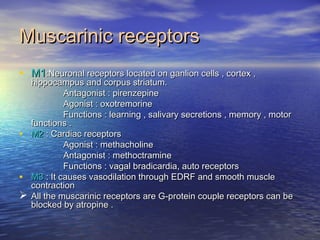
Muscarinic receptorsMuscarinic receptors
• M1M1:Neuronal receptors located on ganlion cells , cortex ,:Neuronal receptors located on ganlion cells , cortex ,
hippocampus and corpus striatum.hippocampus and corpus striatum.
Antagonist : pirenzepineAntagonist : pirenzepine
Agonist : oxotremorineAgonist : oxotremorine
Functions : learning , salivary secretions , memory , motorFunctions : learning , salivary secretions , memory , motor
functions .functions .
• M2M2 : Cardiac receptors: Cardiac receptors
Agonist : methacholineAgonist : methacholine
Antagonist : methoctramineAntagonist : methoctramine
Functions : vagal bradicardia, auto receptorsFunctions : vagal bradicardia, auto receptors
• M3M3 : It causes vasodilation through EDRF and smooth muscle: It causes vasodilation through EDRF and smooth muscle
contractioncontraction
 All the muscarinic receptors are G-protein couple receptors can beAll the muscarinic receptors are G-protein couple receptors can be
blocked by atropine .blocked by atropine .
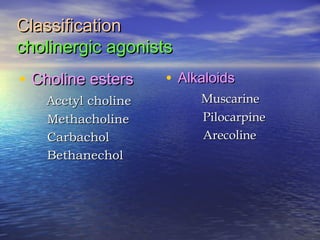
ClassificationClassification
cholinergic agonistscholinergic agonists
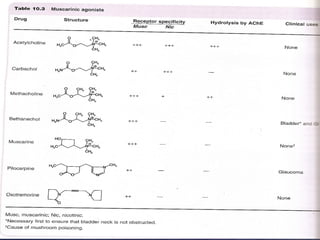
• Choline estersCholine esters
Acetyl cholineAcetyl choline
MethacholineMethacholine
CarbacholCarbachol
BethanecholBethanechol
• AlkaloidsAlkaloids
MuscarineMuscarine
PilocarpinePilocarpine
ArecolineArecoline
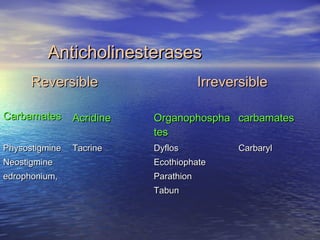
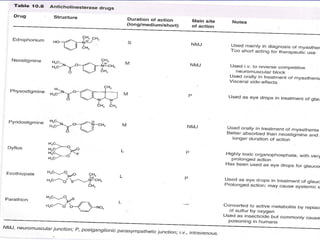
AnticholinesterasesAnticholinesterases
ReversibleReversible IrreversibleIrreversible
CarbamatesCarbamates AcridineAcridine OrganophosphaOrganophospha
testes
carbamatescarbamates
PhysostigminePhysostigmine
NeostigmineNeostigmine
edrophonium,edrophonium,
TacrineTacrine DyflosDyflos
EcothiophateEcothiophate
ParathionParathion
TabunTabun
CarbarylCarbaryl
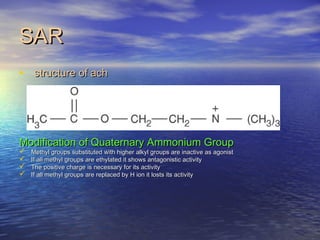
SARSAR
• structure of achstructure of ach
Modification of Quaternary Ammonium GroupModification of Quaternary Ammonium Group
 Methyl groups substituted with higher alkyl groups are inactive as agonistMethyl groups substituted with higher alkyl groups are inactive as agonist
 If all methyl groups are ethylated it shows antagonistic activityIf all methyl groups are ethylated it shows antagonistic activity
 The positive charge is necessary for its activityThe positive charge is necessary for its activity
 If all methyl groups are replaced by H ion it losts its activityIf all methyl groups are replaced by H ion it losts its activity
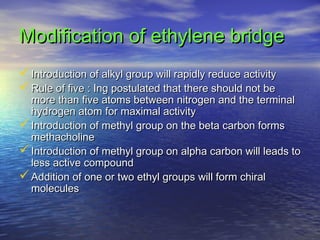
Modification of ethylene bridgeModification of ethylene bridge
 Introduction of alkyl group will rapidly reduce activityIntroduction of alkyl group will rapidly reduce activity
 Rule of five : Ing postulated that there should not beRule of five : Ing postulated that there should not be
more than five atoms between nitrogen and the terminalmore than five atoms between nitrogen and the terminal
hydrogen atom for maximal activityhydrogen atom for maximal activity
 Introduction of methyl group on the beta carbon formsIntroduction of methyl group on the beta carbon forms
methacholinemethacholine
 Introduction of methyl group on alpha carbon will leads toIntroduction of methyl group on alpha carbon will leads to
less active compoundless active compound
 Addition of one or two ethyl groups will form chiralAddition of one or two ethyl groups will form chiral
moleculesmolecules
Modification of acloxy groupModification of acloxy group
• As predicted by the rule of five If the acetylAs predicted by the rule of five If the acetyl
group is replased by higher homologues thegroup is replased by higher homologues the
resulting esters are less potent and instead theyresulting esters are less potent and instead they
have antagonistic activityhave antagonistic activity
• The esters derived from carbamic acid areThe esters derived from carbamic acid are
referred to as carbamates and they are morereferred to as carbamates and they are more
stable than carboxylate esters to hydrolysisstable than carboxylate esters to hydrolysis
Ex: carbacholEx: carbachol
• Carbachol is less hydrolyzed by AchE, gastricCarbachol is less hydrolyzed by AchE, gastric
acid and butyryl cholinesterase so it can beacid and butyryl cholinesterase so it can be
given orallygiven orally
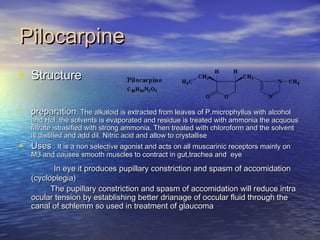
PilocarpinePilocarpine
• StructureStructure
• preparationpreparation: The alkaloid is extracted from leaves of P.microphyllus with alcohol: The alkaloid is extracted from leaves of P.microphyllus with alcohol
and Hcl .the solvents is evaporated and residue is treated with ammonia the acquousand Hcl .the solvents is evaporated and residue is treated with ammonia the acquous
filtrate isbasified with strong ammonia. Then treated with chloroform and the solventfiltrate isbasified with strong ammonia. Then treated with chloroform and the solvent
is distilled and add dil. Nitric acid and allow to crystalliseis distilled and add dil. Nitric acid and allow to crystallise
• UsesUses : It is a non selective agonist and acts on all muscarinic receptors mainly on: It is a non selective agonist and acts on all muscarinic receptors mainly on
M3 and causes smooth muscles to contract in gut,trachea and eyeM3 and causes smooth muscles to contract in gut,trachea and eye
In eye it produces pupillary constriction and spasm of accomidationIn eye it produces pupillary constriction and spasm of accomidation
(cycloplegia)(cycloplegia)
The pupillary constriction and spasm of accomidation will reduce intraThe pupillary constriction and spasm of accomidation will reduce intra
ocular tension by establishing better drianage of occular fluid through theocular tension by establishing better drianage of occular fluid through the
canal of schlemm so used in treatment of glaucomacanal of schlemm so used in treatment of glaucoma
CarbacholCarbachol
• StructureStructure
• Ethanaminium 2-[(aminocarbonyl) oxy]- N, N, N-Ethanaminium 2-[(aminocarbonyl) oxy]- N, N, N-
trimethyl-chloridetrimethyl-chloride
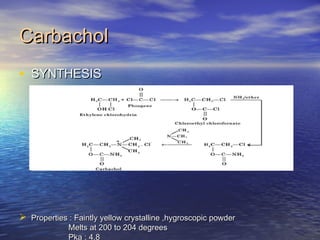
CarbacholCarbachol
• SYNTHESISSYNTHESIS
 Properties : Faintly yellow crystalline ,hygroscopic powderProperties : Faintly yellow crystalline ,hygroscopic powder
Melts at 200 to 204 degreesMelts at 200 to 204 degrees
Pka : 4.8
Uses of CarbacholUses of Carbachol
• Narrow angle glaucomaNarrow angle glaucoma
• To induce miosis prior to occularTo induce miosis prior to occular
surgerysurgery
• It is less suceptible to hydrolysis so itIt is less suceptible to hydrolysis so it
is more stable in aqueous solutionis more stable in aqueous solution
CONCLUSIONCONCLUSION
• The cholinergic drugs are the drugs thatThe cholinergic drugs are the drugs that
mimics the actions of the parasympatheticmimics the actions of the parasympathetic
system and used in treating manysystem and used in treating many
diseases like glaucoma , xerostomia ,diseases like glaucoma , xerostomia ,
myasthenia gravis etcmyasthenia gravis etc
REFERENCESREFERENCES
1) Text book of Medicinal chemistry by William O1) Text book of Medicinal chemistry by William O
Foye,Lea febiger, PhiladelphiaFoye,Lea febiger, Philadelphia
2) wilson and giswolds organic Medicinal2) wilson and giswolds organic Medicinal
Chemistry and Pharmaceutical chemistry by J HChemistry and Pharmaceutical chemistry by J H
Block and J M BealeBlock and J M Beale
3) S.N.Pandeya text book of medicinal chemistry3) S.N.Pandeya text book of medicinal chemistry
4) Text book of Pharmacology by Rang and Dale4) Text book of Pharmacology by Rang and Dale
Cholinergic drugs ppt

Cholinergic drugs ppt

  • 1.
    Seminar on CholinergicDrugsSeminar on Cholinergic Drugs (Medicinal chemistry)(Medicinal chemistry) Guided ByGuided By : Mr.P.Prasanna Raja: Mr.P.Prasanna Raja Presented ByPresented By : B.Bharath kumar: B.Bharath kumar
  • 2.
    IntroductionIntroduction • Drugs affectingthe ANS are divided intoDrugs affecting the ANS are divided into two groups . According to the type oftwo groups . According to the type of neurons involved in their mechanism ofneurons involved in their mechanism of actionaction Cholinergics – Acts on the receptors stimulatedCholinergics – Acts on the receptors stimulated by Achby Ach Adrenergics - Acts on the receptors stimulatedAdrenergics - Acts on the receptors stimulated by Norepinephrineby Norepinephrine
  • 3.
    Cholinergic agentsCholinergic agents •Cholinergic agents are the drugs that eitherCholinergic agents are the drugs that either directly or indirectly produce effect similar todirectly or indirectly produce effect similar to those elicited by Acetylcholinethose elicited by Acetylcholine • Dale while studying the pharmacological actionsDale while studying the pharmacological actions of Ach distinguished two types of activities whichof Ach distinguished two types of activities which he designated as muscarinic and nicotiniche designated as muscarinic and nicotinic
  • 4.
    Synthesis of AchSynthesisof Ach • Choline is taken up into the nerve terminals byCholine is taken up into the nerve terminals by special choline transport system mediated by aspecial choline transport system mediated by a carrier that cotransports sodium.carrier that cotransports sodium. • The choline transport appears to be the rateThe choline transport appears to be the rate limiting steplimiting step • It can be inhibited by hemicholinium.It can be inhibited by hemicholinium. • The choline is acetylated by the enzyme cholineThe choline is acetylated by the enzyme choline acetyl transferase to form Ach The acetyl groupacetyl transferase to form Ach The acetyl group source is acetyl-coAsource is acetyl-coA
  • 5.
    Storage and Releaseof achStorage and Release of ach • The Ach is packaged into vesicles by an active transport processThe Ach is packaged into vesicles by an active transport process coupled with the efflux of protonscoupled with the efflux of protons • The mature vesicles also contain ATP and ProteoglyconThe mature vesicles also contain ATP and Proteoglycon • When an action potential propagated voltage sensitive calciumWhen an action potential propagated voltage sensitive calcium channels in the presynaptic membrane opens causes anchannels in the presynaptic membrane opens causes an intracellular increase in calcium.intracellular increase in calcium. • Elevated calcium levels promote the fusion of synaptic vesicles withElevated calcium levels promote the fusion of synaptic vesicles with the cell membrane and release of their contents into the synapticthe cell membrane and release of their contents into the synaptic cleft.cleft. • This release can be blocked by botulinum toxin.This release can be blocked by botulinum toxin. • Ach is degraded by acetylcholinesterase and forms choline andAch is degraded by acetylcholinesterase and forms choline and acetate in the synaptic cleft.acetate in the synaptic cleft.
  • 7.
    CholinoceptorsCholinoceptors • Cholinergic receptorshave been characterized as nicotinic and muscarinicCholinergic receptors have been characterized as nicotinic and muscarinic on the basis of their ability to be bound by naturally occuring alkaloidson the basis of their ability to be bound by naturally occuring alkaloids nicotine and muscarine respectivelynicotine and muscarine respectively NICOTINIC RECEPTORSNICOTINIC RECEPTORS • It is a ligand gated cationic channelIt is a ligand gated cationic channel • It is stimulated by nicotine and blocked by d-tubocurarine orIt is stimulated by nicotine and blocked by d-tubocurarine or hexamethonium.hexamethonium. • It is of two typesIt is of two types  N1N1: It is located at skeletal muscle end plate: It is located at skeletal muscle end plate (neuro muscular junction ) .(neuro muscular junction ) . It causes depolarisation of muscle end plate and contraction of skeletal muscles.It causes depolarisation of muscle end plate and contraction of skeletal muscles. Agonist-nicotine,PTAAgonist-nicotine,PTA Antagonist-tubocurarineAntagonist-tubocurarine  N2 :N2 :IIt is located at atonomic ganglia (depolarisation), adrenal medulla ( catecholt is located at atonomic ganglia (depolarisation), adrenal medulla ( catechol release )and cns.release )and cns. Agonist-hexamethonium.Agonist-hexamethonium.
  • 8.
    Muscarinic receptorsMuscarinic receptors •M1M1:Neuronal receptors located on ganlion cells , cortex ,:Neuronal receptors located on ganlion cells , cortex , hippocampus and corpus striatum.hippocampus and corpus striatum. Antagonist : pirenzepineAntagonist : pirenzepine Agonist : oxotremorineAgonist : oxotremorine Functions : learning , salivary secretions , memory , motorFunctions : learning , salivary secretions , memory , motor functions .functions . • M2M2 : Cardiac receptors: Cardiac receptors Agonist : methacholineAgonist : methacholine Antagonist : methoctramineAntagonist : methoctramine Functions : vagal bradicardia, auto receptorsFunctions : vagal bradicardia, auto receptors • M3M3 : It causes vasodilation through EDRF and smooth muscle: It causes vasodilation through EDRF and smooth muscle contractioncontraction  All the muscarinic receptors are G-protein couple receptors can beAll the muscarinic receptors are G-protein couple receptors can be blocked by atropine .blocked by atropine .
  • 9.
    ClassificationClassification cholinergic agonistscholinergic agonists •Choline estersCholine esters Acetyl cholineAcetyl choline MethacholineMethacholine CarbacholCarbachol BethanecholBethanechol • AlkaloidsAlkaloids MuscarineMuscarine PilocarpinePilocarpine ArecolineArecoline
  • 11.
    AnticholinesterasesAnticholinesterases ReversibleReversible IrreversibleIrreversible CarbamatesCarbamates AcridineAcridineOrganophosphaOrganophospha testes carbamatescarbamates PhysostigminePhysostigmine NeostigmineNeostigmine edrophonium,edrophonium, TacrineTacrine DyflosDyflos EcothiophateEcothiophate ParathionParathion TabunTabun CarbarylCarbaryl
  • 13.
    SARSAR • structure ofachstructure of ach Modification of Quaternary Ammonium GroupModification of Quaternary Ammonium Group  Methyl groups substituted with higher alkyl groups are inactive as agonistMethyl groups substituted with higher alkyl groups are inactive as agonist  If all methyl groups are ethylated it shows antagonistic activityIf all methyl groups are ethylated it shows antagonistic activity  The positive charge is necessary for its activityThe positive charge is necessary for its activity  If all methyl groups are replaced by H ion it losts its activityIf all methyl groups are replaced by H ion it losts its activity
  • 14.
    Modification of ethylenebridgeModification of ethylene bridge  Introduction of alkyl group will rapidly reduce activityIntroduction of alkyl group will rapidly reduce activity  Rule of five : Ing postulated that there should not beRule of five : Ing postulated that there should not be more than five atoms between nitrogen and the terminalmore than five atoms between nitrogen and the terminal hydrogen atom for maximal activityhydrogen atom for maximal activity  Introduction of methyl group on the beta carbon formsIntroduction of methyl group on the beta carbon forms methacholinemethacholine  Introduction of methyl group on alpha carbon will leads toIntroduction of methyl group on alpha carbon will leads to less active compoundless active compound  Addition of one or two ethyl groups will form chiralAddition of one or two ethyl groups will form chiral moleculesmolecules
  • 15.
    Modification of acloxygroupModification of acloxy group • As predicted by the rule of five If the acetylAs predicted by the rule of five If the acetyl group is replased by higher homologues thegroup is replased by higher homologues the resulting esters are less potent and instead theyresulting esters are less potent and instead they have antagonistic activityhave antagonistic activity • The esters derived from carbamic acid areThe esters derived from carbamic acid are referred to as carbamates and they are morereferred to as carbamates and they are more stable than carboxylate esters to hydrolysisstable than carboxylate esters to hydrolysis Ex: carbacholEx: carbachol • Carbachol is less hydrolyzed by AchE, gastricCarbachol is less hydrolyzed by AchE, gastric acid and butyryl cholinesterase so it can beacid and butyryl cholinesterase so it can be given orallygiven orally
  • 16.
    PilocarpinePilocarpine • StructureStructure • preparationpreparation:The alkaloid is extracted from leaves of P.microphyllus with alcohol: The alkaloid is extracted from leaves of P.microphyllus with alcohol and Hcl .the solvents is evaporated and residue is treated with ammonia the acquousand Hcl .the solvents is evaporated and residue is treated with ammonia the acquous filtrate isbasified with strong ammonia. Then treated with chloroform and the solventfiltrate isbasified with strong ammonia. Then treated with chloroform and the solvent is distilled and add dil. Nitric acid and allow to crystalliseis distilled and add dil. Nitric acid and allow to crystallise • UsesUses : It is a non selective agonist and acts on all muscarinic receptors mainly on: It is a non selective agonist and acts on all muscarinic receptors mainly on M3 and causes smooth muscles to contract in gut,trachea and eyeM3 and causes smooth muscles to contract in gut,trachea and eye In eye it produces pupillary constriction and spasm of accomidationIn eye it produces pupillary constriction and spasm of accomidation (cycloplegia)(cycloplegia) The pupillary constriction and spasm of accomidation will reduce intraThe pupillary constriction and spasm of accomidation will reduce intra ocular tension by establishing better drianage of occular fluid through theocular tension by establishing better drianage of occular fluid through the canal of schlemm so used in treatment of glaucomacanal of schlemm so used in treatment of glaucoma
  • 17.
    CarbacholCarbachol • StructureStructure • Ethanaminium2-[(aminocarbonyl) oxy]- N, N, N-Ethanaminium 2-[(aminocarbonyl) oxy]- N, N, N- trimethyl-chloridetrimethyl-chloride
  • 18.
    CarbacholCarbachol • SYNTHESISSYNTHESIS  Properties: Faintly yellow crystalline ,hygroscopic powderProperties : Faintly yellow crystalline ,hygroscopic powder Melts at 200 to 204 degreesMelts at 200 to 204 degrees Pka : 4.8
  • 19.
    Uses of CarbacholUsesof Carbachol • Narrow angle glaucomaNarrow angle glaucoma • To induce miosis prior to occularTo induce miosis prior to occular surgerysurgery • It is less suceptible to hydrolysis so itIt is less suceptible to hydrolysis so it is more stable in aqueous solutionis more stable in aqueous solution
  • 20.
    CONCLUSIONCONCLUSION • The cholinergicdrugs are the drugs thatThe cholinergic drugs are the drugs that mimics the actions of the parasympatheticmimics the actions of the parasympathetic system and used in treating manysystem and used in treating many diseases like glaucoma , xerostomia ,diseases like glaucoma , xerostomia , myasthenia gravis etcmyasthenia gravis etc
  • 21.
    REFERENCESREFERENCES 1) Text bookof Medicinal chemistry by William O1) Text book of Medicinal chemistry by William O Foye,Lea febiger, PhiladelphiaFoye,Lea febiger, Philadelphia 2) wilson and giswolds organic Medicinal2) wilson and giswolds organic Medicinal Chemistry and Pharmaceutical chemistry by J HChemistry and Pharmaceutical chemistry by J H Block and J M BealeBlock and J M Beale 3) S.N.Pandeya text book of medicinal chemistry3) S.N.Pandeya text book of medicinal chemistry 4) Text book of Pharmacology by Rang and Dale4) Text book of Pharmacology by Rang and Dale