Dr Heba A. Mahmoud
General anesthesia induced by inhalation or
intravenous injection of various anesthetic drugs
 it renders patients analgesic, amnesic, and
unconscious, and provides muscle relaxation
 These desired effects are not produced safely by
a single anesthetic
 A combination of drugs is necessary to produce
all of these desired effects sought with
anesthesia
Balanced anesthesia approach to meet the patient
anesthetic needs.
It involve the induction of anesthesia with a
combination of drugs.
It take each drug’s beneficial effects while minimizing
each agent’s adverse effects.
A state of light anesthesia not deep enough to permit
surgical operation.
Diazepam slowly intravenous
Thiopental sodium rectally
Basal anesthesia
The depth of anesthesia has been
divided into four sequential stages:
Stage 1: Analgesia (induction )
Stage 2:Excitement
Stage 3:Surgical anesthesia
Stage 4: Medullary paralysis
Lippincott’s pharmacology 4th edition
 Stop anesthetic
 Artificial respiration
 Analeptic drugs (drugs stimulate medullary
centers ) e.g. doxapram IV infusion
Inhalation anesthetics
Gases: nitrous oxide
Volatile liquids: halothane , enflurane desflurane,
isoflurane and sevoflurane
Intravenous anesthetics
 Ultrashort acting barbiturates e.g. thiopental sodium
 Benzodiazepines Diazepam, lorazepam and Midazolam
 Ketamine
 Etomidate.
 Propofol.
 Opioid analgesics
general anesthetics
Mechanism of action
 No specific receptor has been identified
 The focus is now on interactions of the inhaled anesthetics with
proteins comprising ion channels. E.g., the general anesthetics
increase the sensitivity of the GABAA receptors to the
neurotransmitter, GABA. →↓Postsynaptic neuronal excitability
 Other receptors are also affected by volatile anesthetics; e.g., the
activity of the inhibitory glycine receptors in the spinal motor
neurons is increased.
 In addition, the inhalation anesthetics block the excitatory
postsynaptic current of the nicotinic receptors.
Gases
Nitrous oxide
Weak anesthetic (Low potency)
Has rapid induction and recovery
Good analgesic and sedative properties
No skeletal muscle relaxant properties
Exposure to nitrous oxide for long periods cause
vitamin B 12 deficiency and megaloplastic anemia
Uses -Minor operation
-obstetric analgesia
-combined with other anesthetics to enhance
its effects
Inhalation anesthetics
Halothane
Is the prototype to which newer inhalation
anesthetics have been compared
General anesthetic with rapid induction and rapid
recovery
Has moderate analgesic and skeletal muscle
relaxant action
nonexplosive
Non-irritant to respiratory tract &produce
bronchodilatation
• Hypotension, bradycardia and cardiac arrhythmias.
• Post operative nausea and vomiting
• Respiratory depression and hypoventilation.
• Hepatotoxicity (halothan hepatitis) rarely .
• Malignant hyperthermia may occur with halothane
Halothane drug interaction
Halothane sensitizes the myocardium to the effects
of sympathomimetics. These agents may Produce
serious cardiac arrhythmias in the presence of
halothane
Halothane adverse effects
Relatively rapid induction and recovery
Produces good analgesia, skeletal muscle relaxation
No sensitization of heart to catecholamines.
No hepatotoxicity
Disadvantages
At high concentration produces CNS stimulation
(convulsion)
Similar to enflurane but it is irritating to the airway and can
cause laryngospasm and excessive secretions
Similar to enflurane but it produces concentration-
dependent hypotension
rapid uptake without irritating the airway during Induction
it may prove to be nephrotoxic.
Lippincott’s pharmacology 4th edition
 They have rapid induction and recovery
 No analgesic and no skeletal muscle relaxation
 They include:
 Ultrashort acting barbiturates
 Etomidate.
 Propofol.
 Benzodiazepines
 Ketamine
 Opioid analgesics
•Rapid induction
•Short duration of action
•Repeated injection lead to prolongation of its duration of action
Ultrashort- acting barbiturates
THIOPENTAL SODIUM
induction of anesthesia
anesthersia short operative procedures
anticonvulsant
Hypotention
Respiratory depression
Bronchospasm in asthmatics
Necrosis and ulceration if injected around the vein
Arterial spasm, thrombosis and gangrene if injected into the artery
No cardiovascular and respiratory depression
Uses
 Induction of anesthesia
 Permit anesthesia for short operative procedures
Etomidate
propofol
an intravenous sedative/hypnotic used in the induction
or maintenance of anesthesia.
Rapid onset of anesthesia and very fast recovery
Benzodiazepines are sedative hypnotic drugs
Diazepam, lorazepam and Midazolam
Characters of anesthesia:
produces rapid induction and short duration.
unconsciousness’ with amnesia
Uses
Short procedures
Basal anesthesia
Preanesthetic medication
Benzodiazepines
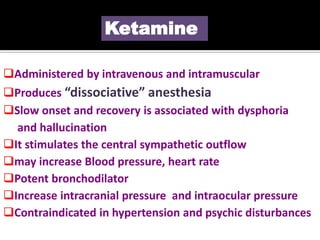
Ketamine
Administered by intravenous and intramuscular
Produces “dissociative” anesthesia
Slow onset and recovery is associated with dysphoria
and hallucination
It stimulates the central sympathetic outflow
may increase Blood pressure, heart rate
Potent bronchodilator
Increase intracranial pressure and intraocular pressure
Contraindicated in hypertension and psychic disturbances
Morphine, meperidine , and fentanyl
Employed as supplements during general anesthesia
Very large doses of opioids may be infused to obtain
anesthesia
Opioids can cause hypotension, respiratory depression
,Muscle rigidity and post anesthetic nausea and
vomiting
Opioid analgesics
Drugs given before administration of anesthesia in
order to
Decrease anxiety.
Provide amnesia for the preoperative period
Relieve of preoperative pain if it present.
Reduce the requirement for an anesthetic agent.
Minimize undesirable side effects associated with
some of these agents (Salivation, bradycardia,
coughing, vomiting) = produce vagolytic effect.
Reduce the volume and acidity of gastric contents.
Preanesthetic medication usually require the use
of two or three drugs together
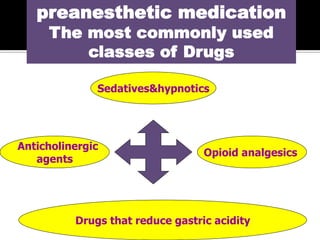
preanestheticmedication
Opioid analgesics
Drugs that reduce gastric acidity
Anticholinergic
agents
Sedatives&hypnotics
preanesthetic medication
The most commonly used
classes of Drugs
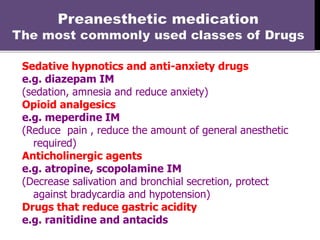
Sedative hypnotics and anti-anxiety drugs
e.g. diazepam IM
(sedation, amnesia and reduce anxiety)
Opioid analgesics
e.g. meperdine IM
(Reduce pain , reduce the amount of general anesthetic
required)
Anticholinergic agents
e.g. atropine, scopolamine IM
(Decrease salivation and bronchial secretion, protect
against bradycardia and hypotension)
Drugs that reduce gastric acidity
e.g. ranitidine and antacids
Thank you

3.general anesth

  • 1.
    Dr Heba A.Mahmoud
  • 2.
    General anesthesia inducedby inhalation or intravenous injection of various anesthetic drugs  it renders patients analgesic, amnesic, and unconscious, and provides muscle relaxation  These desired effects are not produced safely by a single anesthetic  A combination of drugs is necessary to produce all of these desired effects sought with anesthesia
  • 3.
    Balanced anesthesia approachto meet the patient anesthetic needs. It involve the induction of anesthesia with a combination of drugs. It take each drug’s beneficial effects while minimizing each agent’s adverse effects.
  • 4.
    A state oflight anesthesia not deep enough to permit surgical operation. Diazepam slowly intravenous Thiopental sodium rectally Basal anesthesia
  • 5.
    The depth ofanesthesia has been divided into four sequential stages: Stage 1: Analgesia (induction ) Stage 2:Excitement Stage 3:Surgical anesthesia Stage 4: Medullary paralysis Lippincott’s pharmacology 4th edition
  • 6.
     Stop anesthetic Artificial respiration  Analeptic drugs (drugs stimulate medullary centers ) e.g. doxapram IV infusion
  • 7.
    Inhalation anesthetics Gases: nitrousoxide Volatile liquids: halothane , enflurane desflurane, isoflurane and sevoflurane Intravenous anesthetics  Ultrashort acting barbiturates e.g. thiopental sodium  Benzodiazepines Diazepam, lorazepam and Midazolam  Ketamine  Etomidate.  Propofol.  Opioid analgesics general anesthetics
  • 8.
    Mechanism of action No specific receptor has been identified  The focus is now on interactions of the inhaled anesthetics with proteins comprising ion channels. E.g., the general anesthetics increase the sensitivity of the GABAA receptors to the neurotransmitter, GABA. →↓Postsynaptic neuronal excitability  Other receptors are also affected by volatile anesthetics; e.g., the activity of the inhibitory glycine receptors in the spinal motor neurons is increased.  In addition, the inhalation anesthetics block the excitatory postsynaptic current of the nicotinic receptors.
  • 9.
    Gases Nitrous oxide Weak anesthetic(Low potency) Has rapid induction and recovery Good analgesic and sedative properties No skeletal muscle relaxant properties Exposure to nitrous oxide for long periods cause vitamin B 12 deficiency and megaloplastic anemia Uses -Minor operation -obstetric analgesia -combined with other anesthetics to enhance its effects Inhalation anesthetics
  • 10.
    Halothane Is the prototypeto which newer inhalation anesthetics have been compared General anesthetic with rapid induction and rapid recovery Has moderate analgesic and skeletal muscle relaxant action nonexplosive Non-irritant to respiratory tract &produce bronchodilatation
  • 11.
    • Hypotension, bradycardiaand cardiac arrhythmias. • Post operative nausea and vomiting • Respiratory depression and hypoventilation. • Hepatotoxicity (halothan hepatitis) rarely . • Malignant hyperthermia may occur with halothane Halothane drug interaction Halothane sensitizes the myocardium to the effects of sympathomimetics. These agents may Produce serious cardiac arrhythmias in the presence of halothane Halothane adverse effects
  • 12.
    Relatively rapid inductionand recovery Produces good analgesia, skeletal muscle relaxation No sensitization of heart to catecholamines. No hepatotoxicity Disadvantages At high concentration produces CNS stimulation (convulsion)
  • 13.
    Similar to enfluranebut it is irritating to the airway and can cause laryngospasm and excessive secretions Similar to enflurane but it produces concentration- dependent hypotension rapid uptake without irritating the airway during Induction it may prove to be nephrotoxic.
  • 14.
  • 15.
     They haverapid induction and recovery  No analgesic and no skeletal muscle relaxation  They include:  Ultrashort acting barbiturates  Etomidate.  Propofol.  Benzodiazepines  Ketamine  Opioid analgesics
  • 16.
    •Rapid induction •Short durationof action •Repeated injection lead to prolongation of its duration of action Ultrashort- acting barbiturates THIOPENTAL SODIUM induction of anesthesia anesthersia short operative procedures anticonvulsant Hypotention Respiratory depression Bronchospasm in asthmatics Necrosis and ulceration if injected around the vein Arterial spasm, thrombosis and gangrene if injected into the artery
  • 17.
    No cardiovascular andrespiratory depression Uses  Induction of anesthesia  Permit anesthesia for short operative procedures Etomidate propofol an intravenous sedative/hypnotic used in the induction or maintenance of anesthesia. Rapid onset of anesthesia and very fast recovery
  • 18.
    Benzodiazepines are sedativehypnotic drugs Diazepam, lorazepam and Midazolam Characters of anesthesia: produces rapid induction and short duration. unconsciousness’ with amnesia Uses Short procedures Basal anesthesia Preanesthetic medication Benzodiazepines
  • 19.
    Ketamine Administered by intravenousand intramuscular Produces “dissociative” anesthesia Slow onset and recovery is associated with dysphoria and hallucination It stimulates the central sympathetic outflow may increase Blood pressure, heart rate Potent bronchodilator Increase intracranial pressure and intraocular pressure Contraindicated in hypertension and psychic disturbances
  • 20.
    Morphine, meperidine ,and fentanyl Employed as supplements during general anesthesia Very large doses of opioids may be infused to obtain anesthesia Opioids can cause hypotension, respiratory depression ,Muscle rigidity and post anesthetic nausea and vomiting Opioid analgesics
  • 21.
    Drugs given beforeadministration of anesthesia in order to Decrease anxiety. Provide amnesia for the preoperative period Relieve of preoperative pain if it present. Reduce the requirement for an anesthetic agent. Minimize undesirable side effects associated with some of these agents (Salivation, bradycardia, coughing, vomiting) = produce vagolytic effect. Reduce the volume and acidity of gastric contents. Preanesthetic medication usually require the use of two or three drugs together preanestheticmedication
  • 22.
    Opioid analgesics Drugs thatreduce gastric acidity Anticholinergic agents Sedatives&hypnotics preanesthetic medication The most commonly used classes of Drugs
  • 23.
    Sedative hypnotics andanti-anxiety drugs e.g. diazepam IM (sedation, amnesia and reduce anxiety) Opioid analgesics e.g. meperdine IM (Reduce pain , reduce the amount of general anesthetic required) Anticholinergic agents e.g. atropine, scopolamine IM (Decrease salivation and bronchial secretion, protect against bradycardia and hypotension) Drugs that reduce gastric acidity e.g. ranitidine and antacids
  • 24.