CHOLINERGIC DRUGS
(Cholinomimetic, Parasympathomimetic)
PREPARED BY: JEGAN.S.NADAR
ANS-INTRODUCTION
Efferent neurons:
• The ANS carries nerve impulses from the CNS to the effector organs by way of two
types of efferent neurons: the preganglionic neurons and the postganglionic neurons
• The cell body of the first nerve cell, the pre-ganglionic neuron, is located within the
CNS.
• The preganglionic neurons emerge from the brainstem or spinal cord and make a
synaptic connection in ganglia
• The cell body of the postganglionic neuron originates in the ganglion and terminates
on effector organs, such as smooth muscles of the viscera, cardiac muscle, and the
exocrine glands. Jegan
Jegan
The Afferent neurons:
• The afferent neurons (fibers) of the ANS are important in the reflex
regulation of this system (for example, by sensing pressure in the carotid
sinus and aortic arch) and in signaling the CNS to influence the efferent
branch of the system to respond.
Jegan
The efferent ANS
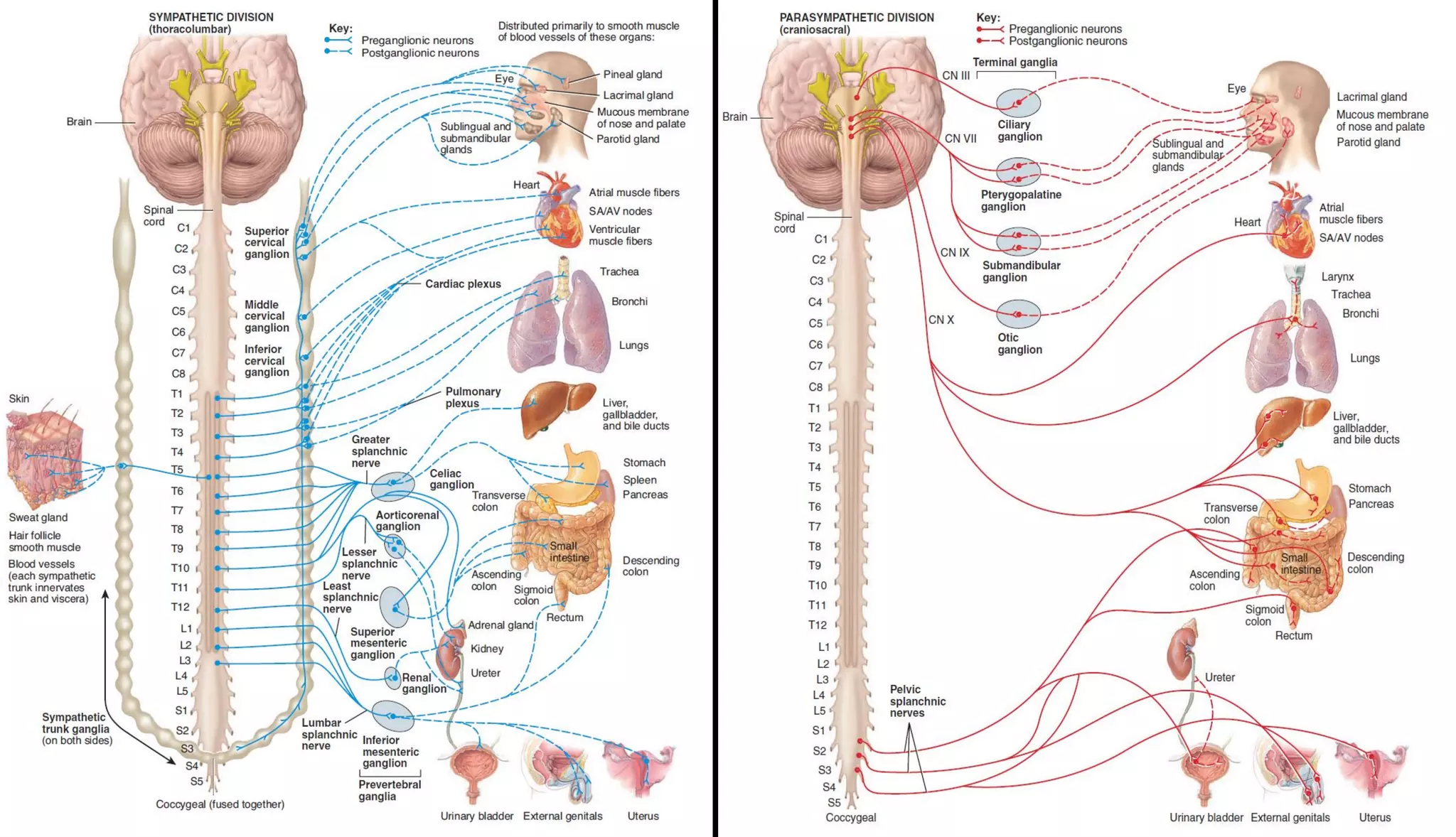
• The efferent ANS is divided into the sympathetic and the parasympathetic
nervous systems, as well as the enteric nervous system
• Anatomically, the sympathetic and the parasympathetic neurons originate
in the CNS and emerge from two different spinal cord regions
Jegan
• The preganglionic neurons of the sympathetic system come from the
thoracic and lumbar regions (T1 to L2) of the spinal cord, and they synapse
in two cord-like chains of ganglia.
• The parasympathetic preganglionic fibers arise from cranial nerves III
(oculomotor), VII (facial), IX (glossopharyngeal), and X (vagus), as well as
from the sacral region (S2 to S4) of the spinal cord and synapse in ganglia
near or on the effector organs
Jegan
`
Jegan
• The preganglionic neurons of the sympathetic system come from the
thoracic and lumbar regions (T1 to L2) of the spinal cord, and they synapse
in two cord-like chains of ganglia.
• The parasympathetic preganglionic fibers arise from cranial nerves III
(oculomotor), VII (facial), IX (glossopharyngeal), and X (vagus), as well as
from the sacral region (S2 to S4) of the spinal cord and synapse in ganglia
near or on the effector organs
Jegan
Types of neurotransmitters
• Although over 50 signal molecules in the nervous system have been
identified, norepinephrine (and the closely related epinephrine),
acetylcholine, dopamine, serotonin, histamine, glutamate, and γ-
aminobutyric acid are most commonly involved in the actions of
therapeutically useful drugs.
• Acetylcholine and norepinephrine are the primary chemical signals in the
ANS
Jegan
Acetylcholine
• The autonomic nerve fibers can be divided into two groups based on the type
of neurotransmitter released.
• If transmission is mediated by acetylcholine, the neuron is termed cholinergic.
• Acetylcholine mediates the transmission of nerve impulses across autonomic
ganglia in both the sympathetic and parasympathetic nervous systems.
• It is the neurotransmitter at the adrenal medulla
• In the somatic nervous system, transmission at the neuromuscular junction is
also cholinergic.
Jegan
Norepinephrine and epinephrine
• When norepinephrine and epinephrine are the neurotransmitters, the
fiber is termed adrenergic
• In the sympathetic system, norepinephrine mediates the transmission of
nerve impulses from autonomic postganglionic nerves to effector organs.
Jegan
CHOLINERGIC SYSTEM
CHOLINERGIC SYSTEM
• The preganglionic fibers terminating in the adrenal medulla, the autonomic
ganglia (both parasympathetic and sympathetic), and the postganglionic fibers
of the parasympathetic division use ACh as a neurotransmitter
Neurotransmission at cholinergic neurons
It involves six sequential steps:
• 1) synthesis,
• 2) storage,
• 3) release,
• 4) binding of ACh to a receptor,
• 5) degradation of the neurotransmitter in the synaptic cleft
• 6) recycling of choline and acetate
Jegan
Jegan
CHOLINERGIC RECEPTORS (CHOLINOCEPTORS)
• Two families of cholinoceptors, designated muscarinic and
nicotinic receptors, can be distinguished
Jegan
Muscarinic receptors
• Muscarinic receptors belong to the class of G protein–coupled receptors
(metabotropic receptors)
• These receptors, in addition to binding ACh, also recognize muscarine, an
alkaloid that is present in certain poisonous mushrooms
• There are five subclasses of muscarinic receptors.
• However, only M1, M2, and M3 receptors have been functionally
characterized.
Jegan
Jegan
Nicotinic receptors
• These receptors, in addition to binding ACh, also recognize nicotine but show
only a weak affinity for muscarine
• The nicotinic receptor is composed of five subunits, and it functions as a ligand-
gated ion channel.
• Nicotine at low concentration stimulates the receptor, whereas nicotine at high
concentration blocks the receptor.
• Nicotinic receptors are located in the CNS, the adrenal medulla, autonomic
ganglia, and the neuromuscular junction (NMJ) in skeletal muscles.
• Those at the NMJ are sometimes designated Nm, and the others, Nn.
Jegan
• Immediately after release, Ach is hydrolyzed by the enzyme cholinesterase and choline is
recycled. A specific (Acetylcholinesterase—AChE or true cholinesterase) and a
nonspecific (Butyrylcholinesterase—BuChE or pseudocholinesterase) type of enzyme
occurs in the body Jegan
CHOLINERGIC DRUGS
(Cholinomimetic, Parasympathomimetic)
Jegan
CHOLINERGIC DRUGS
(Cholinomimetic, Parasympathomimetic)
• These are drugs which produce actions similar to that of ACh, either by
directly interacting with cholinergic receptors (cholinergic agonists) or by
increasing availability of ACh at these sites.
Jegan
CHOLINOMIMETIC
DRUGS
DIRECT
CHOLINE ESTERS
ACETYLCHOLINE
METHACHOLINE
CARBACHOL
BETHANECHOL
ALKALOIDS
MUSCARINE
PILOCARPINE
ARECOLINE
INDIRECT
REVERSIBLE
PHYSOSTIGMINE
NEOSTIGMINE
PYRIDOSTIGMINE
GALANTAMINE
IRREVERSIBLE
ECHOTHIOPHATE
PARATHION
MALATHIONE
TABUN
Jegan
ACETYLCHOLINE
• Depending on the type of receptor through which it is mediated, the peripheral
actions of ACh are classified as muscarinic or nicotinic.
A. MUSCARINIC ACTIONS
1.Heart
• SA Node
Depresses SA nodes
Decrease impulse generation
Causes bradycardia and can lead to cardiac arrest
Jegan
• Atria
 Decrease in contractile strength
• AV Node
 Refractory period (RP) is increased and conduction is slowed
 Decrease in conduction velocity
• Ventricle
 Ventricular contractility is also decreased but
 the effect is not marked
Jegan
2. Blood vessels
• Acetylcholine dilates the blood vessels mainly of skin and the mucous
membrane
• Ach acts on M3 receptor located on endothelial cells of vessel walls
• Activation of this receptor causes release of endothelium dependent releasing
factor (EDRF) ie. NO
• NO causes vasodilation
• Stimulation of cholinergic nerves to the penis causes erection by releasing
NO and dilating cavernosal vessels through M3 receptors
Jegan
3.Smooth Muscle
• Smooth muscle in most organs is contracted (mainly through M3 receptors).
• GIT-
• Tone and peristalsis in the gastrointestinal tract is increased and sphincters
relax
• Rapid propulsion of intestinal contents and evacuation of bowel
• Gall bladder-
• contracts smooth muscle of gall bladder
• Extrusion of bile from gall bladder
Jegan
• Ureter-
• The detrusor muscle contracts while the bladder trigone and sphincter
relaxes
• voiding of bladder.
• Bronchi-
• Bronchial muscles constrict
• Bronchospasm -precipitation of an attack of bronchial asthma
Jegan
4. Glands
• Secretion from all parasympathetically innervated glands is increased via M3
and some M2 receptors:
• Increased sweating, salivation, lacrimation, tracheobronchial and gastri
secretion.
5. Eye
• Contraction of circular muscle of iris miosis.
• Contraction of ciliary muscle spasm of accommodation,
increased outflow facility, reduction in intraocular tension
Jegan
B. NICOTINIC ACTION
1.Autonomic ganglia
• Both sympathetic and parasympathetic ganglia are stimulated
• It results in increased output of Ach and NA from postganglionic sympathetic
and para sympathetic nerve endings respectively.
• NA causes vasoconstriction in arteries and increases force of contraction of
heart
• Blood pressure rises
2.Skeletal muscle
• By acting on neuromuscular junction causes contraction of skeletal muscle
• High conc. Of Ach can cause paralysis of skeletal muscle
Jegan
ADVERSE EFFECT
CHOLINESTERASE INHIBITORS
• INDIRECT-ACTING CHOLINERGIC AGONISTS: ANTICHOLINESTERASE AGENTS
(REVERSIBLE)
INDIRECT
REVERSIBLE
PHYSOSTIGMINE
NEOSTIGMINE
PYRIDOSTIGMINE
GALANTAMINE
IRREVERSIBLE
ECHOTHIOPHATE
PARATHION
MALATHIONE
TABUN Jegan
MECHANISM OF ACTION
• AChE is an enzyme that specifically cleaves ACh to acetate and choline and, thus,
terminates its actions.
• It is located both pre- and postsynaptically in the nerve terminal
• Inhibitors of Ach (anticholinesterase agents or cholinesterase inhibitors) indirectly
provide a cholinergic action by preventing the degradation of ACh.
• This results in an accumulation of ACh in the synaptic space.
• Therefore, these drugs can provoke a response at all cholinoceptors in the body,
including both muscarinic and nicotinic receptors of the ANS, as well as at the NMJ
and in the brain.
Jegan
Jegan
PHYSOSTIGMINE
• Physostigmine is a nitrogenous carbamic acid ester
found naturally in plants and is a tertiary amine
• It is a substrate for AChE, and it forms a relatively
stable carbamoylated intermediate with the
enzyme, which then becomes reversibly
inactivated.
• The result is potentiation of cholinergic activity
throughout the body.
• Physostigmine has a wide range of effects as a result of its action and stimulates not only the
muscarinic and nicotinic sites of the ANS but also the nicotinic receptors of the NMJ.
• Its duration of action is about 30 minutes to 2 hours
ADVERSE EFFECT
• The effects of physostigmine on the
CNS may lead to convulsions
• Bradycardia and a fall in cardiac
output
• Paralysis of skeletal muscle.
However, these effects are rarely
seen with therapeutic doses.
Jegan
NEOSTIGMINE
• Neostigmine is a synthetic compound that is also a
carbamic acid ester, and it reversibly inhibits AChE
in a manner similar to that of physostigmine.
• Neostigmine has an intermediate duration of
action, usually 30 minutes to 2 hours
ADVERSE EFFECTS
• Salivation,
• Flushing,
• Decreased blood pressure,
• Nausea,
• Abdominal pain,
• Diarrhea, and
• Bronchospasm.
• Neostigmine does not
cause CNS side effects
USE
Neostigmine is used to
manage symptoms of
myasthenia gravis.
CONTRAINDICATION
contraindicated when
intestinal or urinary
bladder obstruction is
present.
Jegan
Thank You

Cholinergic drugs

  • 1.
  • 3.
    ANS-INTRODUCTION Efferent neurons: • TheANS carries nerve impulses from the CNS to the effector organs by way of two types of efferent neurons: the preganglionic neurons and the postganglionic neurons • The cell body of the first nerve cell, the pre-ganglionic neuron, is located within the CNS. • The preganglionic neurons emerge from the brainstem or spinal cord and make a synaptic connection in ganglia • The cell body of the postganglionic neuron originates in the ganglion and terminates on effector organs, such as smooth muscles of the viscera, cardiac muscle, and the exocrine glands. Jegan
  • 4.
  • 5.
    The Afferent neurons: •The afferent neurons (fibers) of the ANS are important in the reflex regulation of this system (for example, by sensing pressure in the carotid sinus and aortic arch) and in signaling the CNS to influence the efferent branch of the system to respond. Jegan
  • 6.
    The efferent ANS •The efferent ANS is divided into the sympathetic and the parasympathetic nervous systems, as well as the enteric nervous system • Anatomically, the sympathetic and the parasympathetic neurons originate in the CNS and emerge from two different spinal cord regions Jegan
  • 7.
    • The preganglionicneurons of the sympathetic system come from the thoracic and lumbar regions (T1 to L2) of the spinal cord, and they synapse in two cord-like chains of ganglia. • The parasympathetic preganglionic fibers arise from cranial nerves III (oculomotor), VII (facial), IX (glossopharyngeal), and X (vagus), as well as from the sacral region (S2 to S4) of the spinal cord and synapse in ganglia near or on the effector organs Jegan
  • 8.
  • 10.
  • 11.
    • The preganglionicneurons of the sympathetic system come from the thoracic and lumbar regions (T1 to L2) of the spinal cord, and they synapse in two cord-like chains of ganglia. • The parasympathetic preganglionic fibers arise from cranial nerves III (oculomotor), VII (facial), IX (glossopharyngeal), and X (vagus), as well as from the sacral region (S2 to S4) of the spinal cord and synapse in ganglia near or on the effector organs Jegan
  • 12.
    Types of neurotransmitters •Although over 50 signal molecules in the nervous system have been identified, norepinephrine (and the closely related epinephrine), acetylcholine, dopamine, serotonin, histamine, glutamate, and γ- aminobutyric acid are most commonly involved in the actions of therapeutically useful drugs. • Acetylcholine and norepinephrine are the primary chemical signals in the ANS Jegan
  • 13.
    Acetylcholine • The autonomicnerve fibers can be divided into two groups based on the type of neurotransmitter released. • If transmission is mediated by acetylcholine, the neuron is termed cholinergic. • Acetylcholine mediates the transmission of nerve impulses across autonomic ganglia in both the sympathetic and parasympathetic nervous systems. • It is the neurotransmitter at the adrenal medulla • In the somatic nervous system, transmission at the neuromuscular junction is also cholinergic. Jegan
  • 14.
    Norepinephrine and epinephrine •When norepinephrine and epinephrine are the neurotransmitters, the fiber is termed adrenergic • In the sympathetic system, norepinephrine mediates the transmission of nerve impulses from autonomic postganglionic nerves to effector organs. Jegan
  • 15.
  • 16.
    CHOLINERGIC SYSTEM • Thepreganglionic fibers terminating in the adrenal medulla, the autonomic ganglia (both parasympathetic and sympathetic), and the postganglionic fibers of the parasympathetic division use ACh as a neurotransmitter Neurotransmission at cholinergic neurons It involves six sequential steps: • 1) synthesis, • 2) storage, • 3) release, • 4) binding of ACh to a receptor, • 5) degradation of the neurotransmitter in the synaptic cleft • 6) recycling of choline and acetate Jegan
  • 17.
  • 18.
    CHOLINERGIC RECEPTORS (CHOLINOCEPTORS) •Two families of cholinoceptors, designated muscarinic and nicotinic receptors, can be distinguished Jegan
  • 20.
    Muscarinic receptors • Muscarinicreceptors belong to the class of G protein–coupled receptors (metabotropic receptors) • These receptors, in addition to binding ACh, also recognize muscarine, an alkaloid that is present in certain poisonous mushrooms • There are five subclasses of muscarinic receptors. • However, only M1, M2, and M3 receptors have been functionally characterized. Jegan
  • 21.
  • 22.
    Nicotinic receptors • Thesereceptors, in addition to binding ACh, also recognize nicotine but show only a weak affinity for muscarine • The nicotinic receptor is composed of five subunits, and it functions as a ligand- gated ion channel. • Nicotine at low concentration stimulates the receptor, whereas nicotine at high concentration blocks the receptor. • Nicotinic receptors are located in the CNS, the adrenal medulla, autonomic ganglia, and the neuromuscular junction (NMJ) in skeletal muscles. • Those at the NMJ are sometimes designated Nm, and the others, Nn. Jegan
  • 23.
    • Immediately afterrelease, Ach is hydrolyzed by the enzyme cholinesterase and choline is recycled. A specific (Acetylcholinesterase—AChE or true cholinesterase) and a nonspecific (Butyrylcholinesterase—BuChE or pseudocholinesterase) type of enzyme occurs in the body Jegan
  • 24.
  • 25.
    CHOLINERGIC DRUGS (Cholinomimetic, Parasympathomimetic) •These are drugs which produce actions similar to that of ACh, either by directly interacting with cholinergic receptors (cholinergic agonists) or by increasing availability of ACh at these sites. Jegan
  • 26.
  • 27.
    ACETYLCHOLINE • Depending onthe type of receptor through which it is mediated, the peripheral actions of ACh are classified as muscarinic or nicotinic. A. MUSCARINIC ACTIONS 1.Heart • SA Node Depresses SA nodes Decrease impulse generation Causes bradycardia and can lead to cardiac arrest Jegan
  • 28.
    • Atria  Decreasein contractile strength • AV Node  Refractory period (RP) is increased and conduction is slowed  Decrease in conduction velocity • Ventricle  Ventricular contractility is also decreased but  the effect is not marked Jegan
  • 29.
    2. Blood vessels •Acetylcholine dilates the blood vessels mainly of skin and the mucous membrane • Ach acts on M3 receptor located on endothelial cells of vessel walls • Activation of this receptor causes release of endothelium dependent releasing factor (EDRF) ie. NO • NO causes vasodilation • Stimulation of cholinergic nerves to the penis causes erection by releasing NO and dilating cavernosal vessels through M3 receptors Jegan
  • 30.
    3.Smooth Muscle • Smoothmuscle in most organs is contracted (mainly through M3 receptors). • GIT- • Tone and peristalsis in the gastrointestinal tract is increased and sphincters relax • Rapid propulsion of intestinal contents and evacuation of bowel • Gall bladder- • contracts smooth muscle of gall bladder • Extrusion of bile from gall bladder Jegan
  • 31.
    • Ureter- • Thedetrusor muscle contracts while the bladder trigone and sphincter relaxes • voiding of bladder. • Bronchi- • Bronchial muscles constrict • Bronchospasm -precipitation of an attack of bronchial asthma Jegan
  • 32.
    4. Glands • Secretionfrom all parasympathetically innervated glands is increased via M3 and some M2 receptors: • Increased sweating, salivation, lacrimation, tracheobronchial and gastri secretion. 5. Eye • Contraction of circular muscle of iris miosis. • Contraction of ciliary muscle spasm of accommodation, increased outflow facility, reduction in intraocular tension Jegan
  • 33.
    B. NICOTINIC ACTION 1.Autonomicganglia • Both sympathetic and parasympathetic ganglia are stimulated • It results in increased output of Ach and NA from postganglionic sympathetic and para sympathetic nerve endings respectively. • NA causes vasoconstriction in arteries and increases force of contraction of heart • Blood pressure rises 2.Skeletal muscle • By acting on neuromuscular junction causes contraction of skeletal muscle • High conc. Of Ach can cause paralysis of skeletal muscle Jegan
  • 39.
  • 41.
    CHOLINESTERASE INHIBITORS • INDIRECT-ACTINGCHOLINERGIC AGONISTS: ANTICHOLINESTERASE AGENTS (REVERSIBLE) INDIRECT REVERSIBLE PHYSOSTIGMINE NEOSTIGMINE PYRIDOSTIGMINE GALANTAMINE IRREVERSIBLE ECHOTHIOPHATE PARATHION MALATHIONE TABUN Jegan
  • 42.
    MECHANISM OF ACTION •AChE is an enzyme that specifically cleaves ACh to acetate and choline and, thus, terminates its actions. • It is located both pre- and postsynaptically in the nerve terminal • Inhibitors of Ach (anticholinesterase agents or cholinesterase inhibitors) indirectly provide a cholinergic action by preventing the degradation of ACh. • This results in an accumulation of ACh in the synaptic space. • Therefore, these drugs can provoke a response at all cholinoceptors in the body, including both muscarinic and nicotinic receptors of the ANS, as well as at the NMJ and in the brain. Jegan
  • 43.
  • 44.
    PHYSOSTIGMINE • Physostigmine isa nitrogenous carbamic acid ester found naturally in plants and is a tertiary amine • It is a substrate for AChE, and it forms a relatively stable carbamoylated intermediate with the enzyme, which then becomes reversibly inactivated. • The result is potentiation of cholinergic activity throughout the body. • Physostigmine has a wide range of effects as a result of its action and stimulates not only the muscarinic and nicotinic sites of the ANS but also the nicotinic receptors of the NMJ. • Its duration of action is about 30 minutes to 2 hours ADVERSE EFFECT • The effects of physostigmine on the CNS may lead to convulsions • Bradycardia and a fall in cardiac output • Paralysis of skeletal muscle. However, these effects are rarely seen with therapeutic doses. Jegan
  • 45.
    NEOSTIGMINE • Neostigmine isa synthetic compound that is also a carbamic acid ester, and it reversibly inhibits AChE in a manner similar to that of physostigmine. • Neostigmine has an intermediate duration of action, usually 30 minutes to 2 hours ADVERSE EFFECTS • Salivation, • Flushing, • Decreased blood pressure, • Nausea, • Abdominal pain, • Diarrhea, and • Bronchospasm. • Neostigmine does not cause CNS side effects USE Neostigmine is used to manage symptoms of myasthenia gravis. CONTRAINDICATION contraindicated when intestinal or urinary bladder obstruction is present. Jegan
  • 46.