Benzodiazepines work by binding to GABAA receptors, increasing the frequency that chloride channels open. This allows more chloride ions to enter neurons, making them less likely to fire. They are well-absorbed orally and bind strongly to plasma proteins. Hepatic metabolism and urinary excretion eliminate most benzodiazepines. Duration of action ranges from less than 5 hours to over 24 hours, determining each drug's uses. Benzodiazepines are effective for treating anxiety disorders, muscle spasms, inducing amnesia, seizures, and sleep disorders. Adverse effects include daytime drowsiness, ataxia, respiratory depression, lowered blood pressure, and paradoxical excitement.
MECHANISM OF ACTION
•Benzodiazepines bind to a regulatory site
(benzodiazepine receptor), on the GABAA receptor.
• As a result, there is increase in the frequency of
opening of γ-aminobutyric acid (GABA)-activated
chloride channels.
• Consequently there is increased chloride ion
conductance which facilitates the inhibitory actions of
GABA.
3.
PHARMACOKINETICS
ABSORPTION AND DISTRIBUTION
•Benzodiazepines are well absorbed when given orally, usually
giving a peak plasma concentration in about 1 hour.
• Some (e.g. oxazepam, lorazepam) are absorbed more slowly.
• They bind strongly to plasma protein.
• Their high lipid solubility causes many of them to accumulate
gradually in body fat.
4.
METABOLISM AND EXCRETION
•Hepatic breakdown accounts for the clearance of all benzodiazepines.
• The patterns and rates of metabolism depend on the individual drugs.
• Most benzodiazepines go through microsomal oxidation (phase I
reactions), including N- dealkylation and aliphatic hydroxylation
catalyzed by cytochrome P450 isozymes, especially CYP3A4.
• The metabolites are then conjugated (phase II reactions) to form
glucuronides that are excreted in the urine.
5.
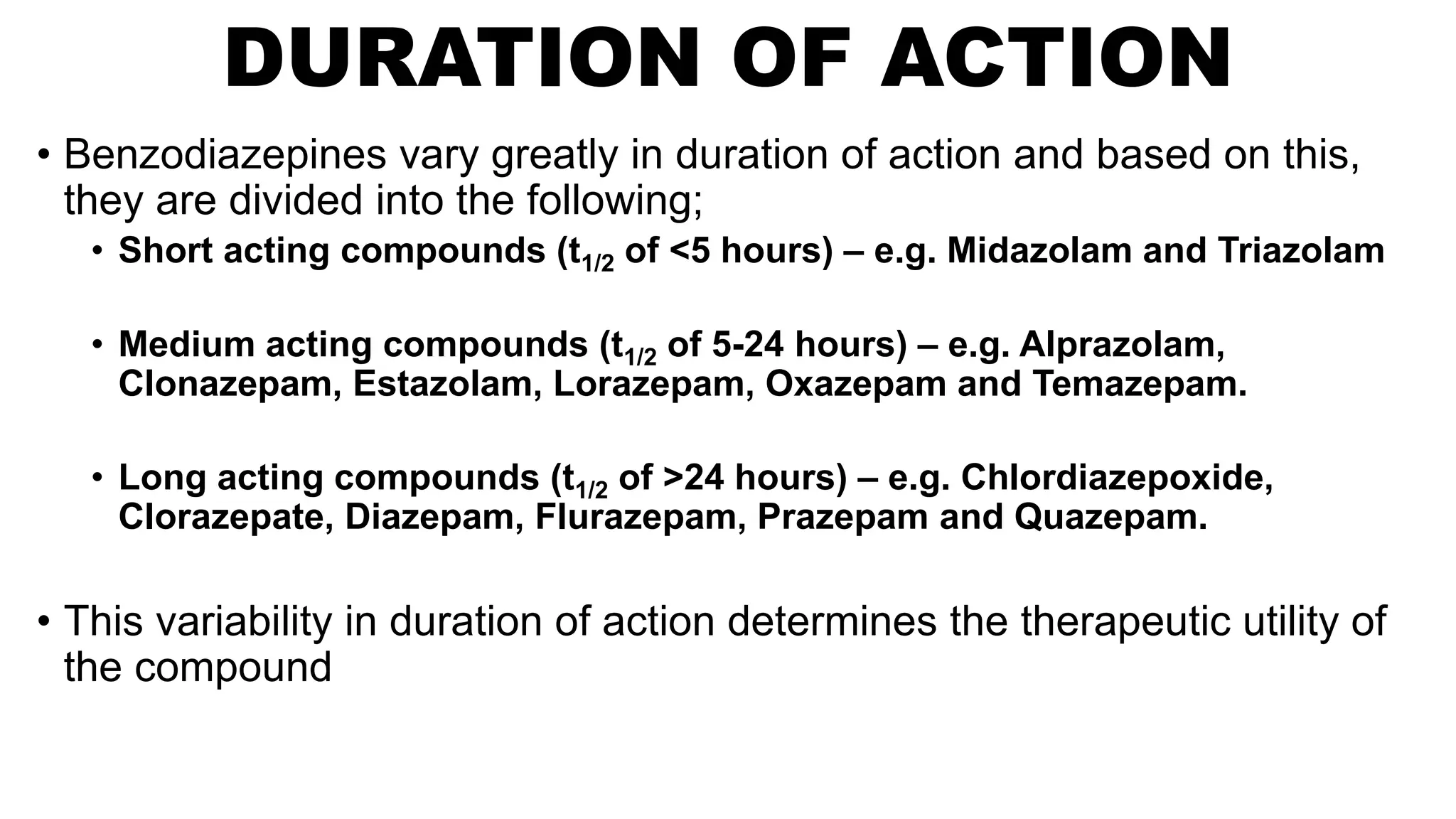
DURATION OF ACTION
•Benzodiazepines vary greatly in duration of action and based on this,
they are divided into the following;
• Short acting compounds (t1/2 of <5 hours) – e.g. Midazolam and Triazolam
• Medium acting compounds (t1/2 of 5-24 hours) – e.g. Alprazolam,
Clonazepam, Estazolam, Lorazepam, Oxazepam and Temazepam.
• Long acting compounds (t1/2 of >24 hours) – e.g. Chlordiazepoxide,
Clorazepate, Diazepam, Flurazepam, Prazepam and Quazepam.
• This variability in duration of action determines the therapeutic utility of
the compound
6.
THERAPEUTIC USES
Treatment ofanxiety disorders
• Benzodiazepines are effective for the treatment of the anxiety
symptoms secondary to panic disorder, generalized anxiety disorder,
social anxiety disorder, performance anxiety, posttraumatic stress
disorder, obsessive compulsive disorder, and the extreme anxiety
sometimes encountered with specific phobias.
Muscular relaxants
• Diazepam is useful in the treatment of skeletal muscle spasms, such as
occur in muscle strain, and in treating spasticity from degenerative
disorders, such as multiple sclerosis and cerebral palsy.
Induction of anterograde amnesia
• The shorter-acting agents are often used as premedication for anxiety-
provoking and unpleasant procedures, such as endoscopic,
bronchoscopic, and certain dental procedures as well as angioplasty.
7.
Treatment of seizures
•Clonazepam is occasionally used in the treatment of certain types of
epilepsy.
• Diazepam and lorazepam are the drugs of choice in ending grand mal
epileptic seizures and status epilepticus.
• Chlordiazepoxide, clorazepate, diazepam, and oxazepam are useful in
the acute treatment of alcohol withdrawal and decreasing the risk of
withdrawal-related seizures.
Induction of sedation, hypnosis and treatment of sleep
disorders
• Not all benzodiazepines are useful as hypnotic agents, although all
have sedative or calming effects. In treatment of insomnia, they tend to
decrease the latency to sleep onset and increase Stage II of non-rapid
eye movement (REM) sleep
8.
ADVERSE EFFECTS
• Daytimedrowsiness, sedation, and ataxia impair judgment and
interfere with motor skills, particularly in the elderly.
• In the elderly, overuse of benzodiazepines is the most common
cause of reversible confusion and amnesia as well as a cause of
blurred vision, hypotension, tremor, and constipation.
• Respiratory depression at higher than hypnotic doses, which is
exaggerated in patients with COPD or obstructive sleep apnea.
• When given IV, it may decrease blood pressure and heart rate in
patients with impaired cardiovascular function.
• On rare occasions they cause paradoxical excitement.