Dr. John W. Alden Managing Partner Capability Measurement, LLC Measuring Process Maturity:  The Business Process Maturity Model Welcome   to Transformation and Innovation 2007  The Business Transformation Conference Welcome
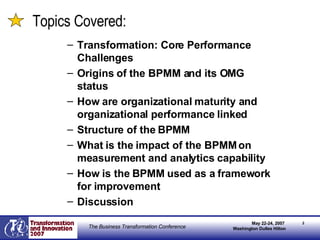
Topics Covered: Transformation: Core Performance Challenges Origins of the BPMM and its OMG status How are organizational maturity and organizational performance linked Structure of the BPMM What is the impact of the BPMM on measurement and analytics capability How is the BPMM used as a framework for improvement Discussion
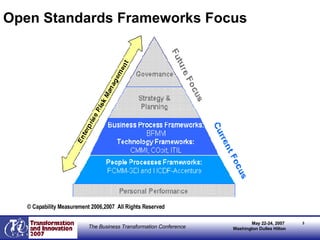
Open Standards Frameworks Focus © Capability Measurement 2006,2007  All Rights Reserved
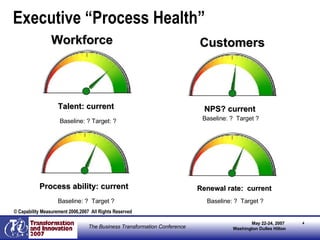
Executive “Process Health”  Workforce  Talent: current Baseline: ? Target: ? Customers NPS? current Process ability: current Baseline: ?  Target ?  Renewal rate:  current Baseline: ?  Target ?  Baseline: ?  Target ?  © Capability Measurement 2006,2007  All Rights Reserved
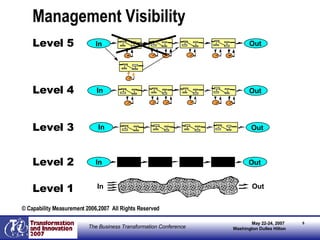
Management Visibility © Capability Measurement 2006,2007  All Rights Reserved In Out Level 1 In Out Level 2 In Out Level 3 In Out Level 4 In Out Level 5
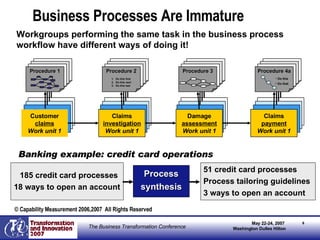
Business Processes Are Immature Customer  claims Work unit 1 Claims  investigation Work unit 1 Damage  assessment Work unit 1 Claims  payment   Work unit 1 Workgroups performing the same task in the business process workflow have different ways of doing it! Banking example: credit card operations © Capability Measurement 2006,2007  All Rights Reserved Customer  claims Work Unit 1 Claims  investigation Work Unit 1 Damage  assessment Work Unit 1 Claims  payment   Work Unit 1 Customer  claims Work Unit 1 Claims  investigation Work Unit 1 Damage  assessment Work Unit 1 Claims  payment   Work Unit 1 Customer  claims Work Unit 1 Claims  investigation Work Unit 1 Damage  assessment Work Unit 1 Claims  payment   Work Unit 1 Procedure 1 Do this Do that Procedure 4a Procedure 3 Do this first Do this next Do this last Procedure 2 185 credit card processes  18 ways to open an account 51 credit card processes Process tailoring guidelines 3 ways to open an account Process synthesis
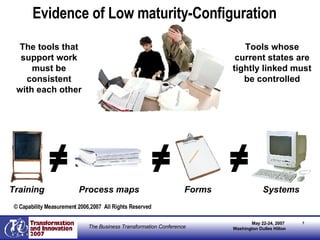
Evidence of Low maturity-Configuration  Tools whose current states are tightly linked must be controlled © Capability Measurement 2006,2007  All Rights Reserved The tools that support work must be consistent with each other ≠ ≠ ≠ Training Process maps Forms Systems
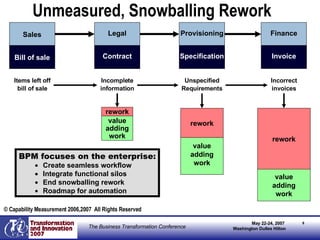
Unmeasured, Snowballing Rework BPM focuses on the enterprise: Create seamless workflow Integrate functional silos End snowballing rework Roadmap for automation © Capability Measurement 2006,2007  All Rights Reserved Items left off bill of sale Sales Bill of sale Incomplete information Legal Contract rework value adding work Unspecified Requirements Provisioning Specification value adding work rework Finance Invoice Incorrect invoices value adding work rework
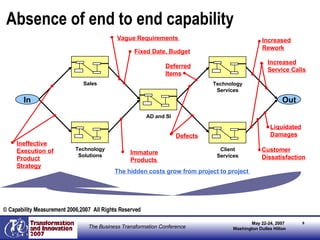
Absence of end to end capability In Out Immature Products  Fixed Date, Budget Vague Requirements  Defects Deferred Items Ineffective Execution of Product Strategy Customer Dissatisfaction Liquidated Damages Increased Service Calls Increased Rework The hidden costs grow from project to project  © Capability Measurement 2006,2007  All Rights Reserved Technology Solutions Sales AD and SI Client Services Technology Services
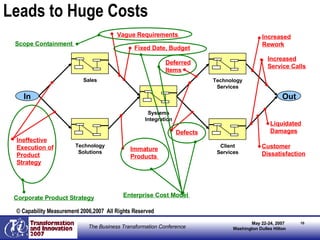
Leads to Huge Costs In Out Immature Products  Fixed Date, Budget Vague Requirements  Defects Deferred Items Ineffective Execution of Product Strategy Customer Dissatisfaction Liquidated Damages Increased Service Calls Increased Rework Scope Containment  Enterprise Cost Model  Corporate Product Strategy © Capability Measurement 2006,2007  All Rights Reserved Technology Solutions Sales Systems Integration Client Services Technology Services
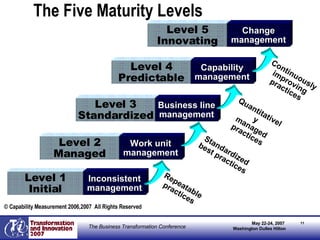
The Five Maturity Levels Repeatable practices Standardized best practices Quantitatively managed practices Continuously improving practices © Capability Measurement 2006,2007  All Rights Reserved Level 1 Initial Inconsistent management Level 2 Managed Work unit management Level 3 Standardized Business line management Level 4 Predictable Capability management Level 5 Innovating Change management
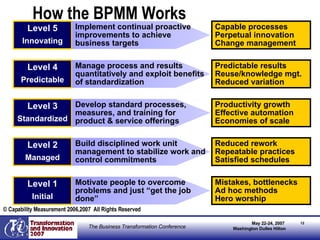
How the BPMM Works © Capability Measurement 2006,2007  All Rights Reserved Level 5 Innovating Implement continual proactive improvements to achieve business targets Capable processes Perpetual innovation Change management Level 4 Predictable Manage process and results quantitatively and exploit benefits of standardization Predictable results Reuse/knowledge mgt. Reduced variation Level 3 Standardized Develop standard processes, measures, and training for product & service offerings Productivity growth Effective automation Economies of scale Level 2 Managed Build disciplined work unit management to stabilize work and control commitments Reduced rework Repeatable practices Satisfied schedules Level 1 Initial Motivate people to overcome problems and just “get the job done” Mistakes, bottlenecks Ad hoc methods Hero worship
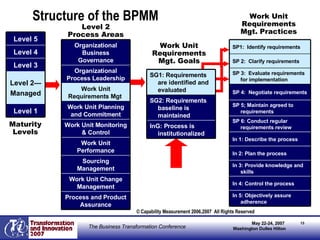
Structure of the BPMM Maturity Levels Level 2 Process Areas Work Unit Requirements Mgt. Goals Work Unit Requirements Mgt. Practices © Capability Measurement 2006,2007  All Rights Reserved Level 1 Level 2 — Managed Level 3 Level 4 Level 5 Organizational Business Governance Process and Product Assurance Work Unit Change Management Sourcing Management Work Unit Performance Work Unit Monitoring & Control Work Unit Planning and Commitment Work Unit Requirements Mgt . Organizational Process Leadership InG: Process is institutionalized SG2: Requirements baseline is maintained SG1: Requirements are identified and evaluated In 5: Objectively assure adherence In 4: Control the process In 3: Provide knowledge and skills In 2: Plan the process In 1: Describe the process SP 6: Conduct regular requirements review SP 5; Maintain agreed to requirements SP 4:  Negotiate requirements SP 3:  Evaluate requirements for implementation SP 2:  Clarify requirements SP1:  Identify requirements
Institutionalizing Practices “ The practices for  [process_area] are institutionalized. ” Process  Area Specific Practices (Implementation) © Capability   Measurement   2006,2007  All Rights Reserved Monitoring & Control Process Assurance Process Planning Skills & Training Process Description
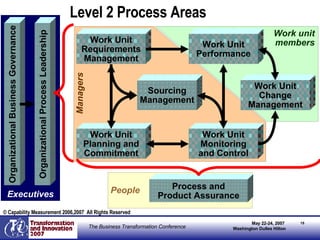
Level 2 Process Areas Work Unit Requirements Management © Capability Measurement 2006,2007  All Rights Reserved People Work unit members Executives Managers Work Unit Planning and Commitment Work Unit Monitoring and Control Work Unit Performance Sourcing Management Process and Product Assurance Work Unit Change Management Organizational Process Leadership Organizational Business Governance
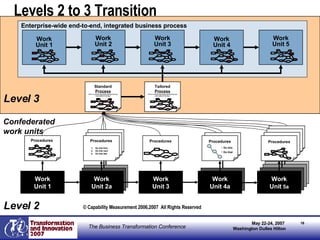
Levels 2 to 3 Transition © Capability Measurement 2006,2007  All Rights Reserved Standard Process This is a process description derived from the local method of doing it Level 3 Tailored Process This is a process description derived from the local method of doing it Work Unit 1 Work Unit 2 Work Unit 3 Work Unit 4 Work Unit 5 Enterprise-wide end-to-end, integrated business process Work Unit 5 Procedures Work Unit 5 Procedures Work Unit 5 Procedures Work Unit 4 Do this Do that Procedures Work Unit 2 Do this first Do this next Do this last Procedures Work Unit 2 Do this first Do this next Do this last Procedures Confederated work units Work Unit 1 Procedures Work Unit 2a Do this first Do this next Do this last Procedures Work Unit 3 Procedures Work Unit 4a Do this Do that Procedures Work Unit  5a Procedures Level 2
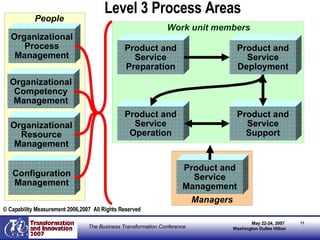
Level 3 Process Areas © Capability Measurement 2006,2007  All Rights Reserved Work unit members Managers  People Product and Service Preparation Product and Service Deployment Product and Service Operation Product and Service Support Product and Service Management Organizational Process Management Organizational Competency Management Organizational Resource Management Configuration Management
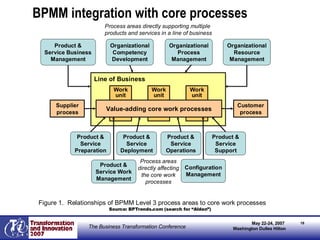
BPMM integration with core processes Source: BPTrends.com (search for “Alden”)
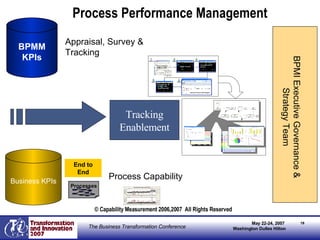
Process Performance Management End to End BPMM KPIs Business KPIs Appraisal, Survey & Tracking Process Capability BPMI Executive Governance & Strategy Team © Capability Measurement 2006,2007  All Rights Reserved Tracking Enablement Processes
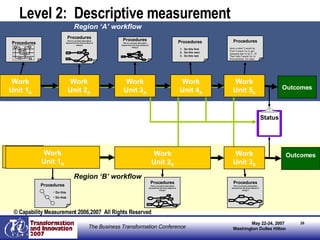
Level 2:  Descriptive measurement Work Unit 1 B Work Unit 1 B Work Unit 2 B Work Unit 3 B Work Unit 1 A Work Unit 2 A Work Unit 3 A Work Unit 4 A Work Unit 5 A Region ‘A’ workflow Region ‘B’ workflow Outcomes Outcomes © Capability Measurement 2006,2007  All Rights Reserved Status Procedures This is a process description derived from the local method of doing it Procedures This is a process description derived from the local method of doing it Procedures This is a process description derived from the local method of doing it Do this Do that Procedures Procedures Procedures Here is what I would do.  First I would try to get Someone else to do it.  If That fails I would try to Procrastinate  for days.  Do this first Do this next Do this last Procedures Procedures This is a process description derived from the local method of doing it
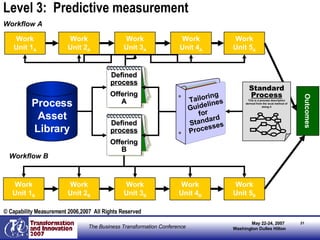
Level 3:  Predictive measurement Work Unit 1 B Work Unit 2 B Work Unit 3 B Work Unit 4 B Work Unit 5 B Work Unit 1 A Work Unit 2 A Work Unit 3 A Work Unit 4 A Work Unit 5 A Workflow A Workflow B Outcomes © Capability Measurement 2006,2007  All Rights Reserved Standard Process This is a process description derived from the local method of doing it Process Asset Library Tailoring Guidelines for Standard Processes Defined  process Offering A Defined  process Offering B
Dramatic Improvements with standards *Based on Bill Curtis extrapolations of SEI certified and other published research © Capability Measurement 2006,2007  All Rights Reserved >4X 3-4X 2X 1.5X X Productivity > 30% 90+% 1/10 X + 3% 6% Level 4 > 50% occasional negligible negligible Component reuse 99% 80% 60% < 30% Pretest defect detection 1/100 X 1/4 X ½ X X Delivered defects + 1% + 5% + 10% to  + 20% +30% to >100% Estimating accuracy 3% 10% 20% 40% Rework Level 5 Level 3 Level 2 Level 1 Baseline Benefit
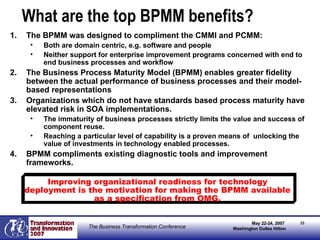
What are the top BPMM benefits? The BPMM was designed to compliment the CMMI and PCMM: Both are domain centric, e.g. software and people Neither support for enterprise improvement programs concerned with end to end business processes and workflow The Business Process Maturity Model (BPMM) enables greater fidelity between the actual performance of business processes and their model-based representations Organizations which do not have standards based process maturity have elevated risk in SOA implementations. The immaturity of business processes strictly limits the value and success of component reuse. Reaching a particular level of capability is a proven means of  unlocking the value of investments in technology enabled processes. BPMM compliments existing diagnostic tools and improvement frameworks. Improving organizational readiness for technology deployment is the motivation for making the BPMM available as a specification from OMG.
Thank  Y Dr. John W. Alden Managing Partner Capability Measurement, LLC 410-456-8951 [email_address] ou Thank  Y ou

Measuring Process Maturity: The Business Process Maturity Model

  • 1.
    Dr. John W.Alden Managing Partner Capability Measurement, LLC Measuring Process Maturity: The Business Process Maturity Model Welcome to Transformation and Innovation 2007 The Business Transformation Conference Welcome
  • 2.
    Topics Covered: Transformation:Core Performance Challenges Origins of the BPMM and its OMG status How are organizational maturity and organizational performance linked Structure of the BPMM What is the impact of the BPMM on measurement and analytics capability How is the BPMM used as a framework for improvement Discussion
  • 3.
    Open Standards FrameworksFocus © Capability Measurement 2006,2007 All Rights Reserved
  • 4.
    Executive “Process Health” Workforce Talent: current Baseline: ? Target: ? Customers NPS? current Process ability: current Baseline: ? Target ? Renewal rate: current Baseline: ? Target ? Baseline: ? Target ? © Capability Measurement 2006,2007 All Rights Reserved
  • 5.
    Management Visibility ©Capability Measurement 2006,2007 All Rights Reserved In Out Level 1 In Out Level 2 In Out Level 3 In Out Level 4 In Out Level 5
  • 6.
    Business Processes AreImmature Customer claims Work unit 1 Claims investigation Work unit 1 Damage assessment Work unit 1 Claims payment Work unit 1 Workgroups performing the same task in the business process workflow have different ways of doing it! Banking example: credit card operations © Capability Measurement 2006,2007 All Rights Reserved Customer claims Work Unit 1 Claims investigation Work Unit 1 Damage assessment Work Unit 1 Claims payment Work Unit 1 Customer claims Work Unit 1 Claims investigation Work Unit 1 Damage assessment Work Unit 1 Claims payment Work Unit 1 Customer claims Work Unit 1 Claims investigation Work Unit 1 Damage assessment Work Unit 1 Claims payment Work Unit 1 Procedure 1 Do this Do that Procedure 4a Procedure 3 Do this first Do this next Do this last Procedure 2 185 credit card processes 18 ways to open an account 51 credit card processes Process tailoring guidelines 3 ways to open an account Process synthesis
  • 7.
    Evidence of Lowmaturity-Configuration Tools whose current states are tightly linked must be controlled © Capability Measurement 2006,2007 All Rights Reserved The tools that support work must be consistent with each other ≠ ≠ ≠ Training Process maps Forms Systems
  • 8.
    Unmeasured, Snowballing ReworkBPM focuses on the enterprise: Create seamless workflow Integrate functional silos End snowballing rework Roadmap for automation © Capability Measurement 2006,2007 All Rights Reserved Items left off bill of sale Sales Bill of sale Incomplete information Legal Contract rework value adding work Unspecified Requirements Provisioning Specification value adding work rework Finance Invoice Incorrect invoices value adding work rework
  • 9.
    Absence of endto end capability In Out Immature Products Fixed Date, Budget Vague Requirements Defects Deferred Items Ineffective Execution of Product Strategy Customer Dissatisfaction Liquidated Damages Increased Service Calls Increased Rework The hidden costs grow from project to project © Capability Measurement 2006,2007 All Rights Reserved Technology Solutions Sales AD and SI Client Services Technology Services
  • 10.
    Leads to HugeCosts In Out Immature Products Fixed Date, Budget Vague Requirements Defects Deferred Items Ineffective Execution of Product Strategy Customer Dissatisfaction Liquidated Damages Increased Service Calls Increased Rework Scope Containment Enterprise Cost Model Corporate Product Strategy © Capability Measurement 2006,2007 All Rights Reserved Technology Solutions Sales Systems Integration Client Services Technology Services
  • 11.
    The Five MaturityLevels Repeatable practices Standardized best practices Quantitatively managed practices Continuously improving practices © Capability Measurement 2006,2007 All Rights Reserved Level 1 Initial Inconsistent management Level 2 Managed Work unit management Level 3 Standardized Business line management Level 4 Predictable Capability management Level 5 Innovating Change management
  • 12.
    How the BPMMWorks © Capability Measurement 2006,2007 All Rights Reserved Level 5 Innovating Implement continual proactive improvements to achieve business targets Capable processes Perpetual innovation Change management Level 4 Predictable Manage process and results quantitatively and exploit benefits of standardization Predictable results Reuse/knowledge mgt. Reduced variation Level 3 Standardized Develop standard processes, measures, and training for product & service offerings Productivity growth Effective automation Economies of scale Level 2 Managed Build disciplined work unit management to stabilize work and control commitments Reduced rework Repeatable practices Satisfied schedules Level 1 Initial Motivate people to overcome problems and just “get the job done” Mistakes, bottlenecks Ad hoc methods Hero worship
  • 13.
    Structure of theBPMM Maturity Levels Level 2 Process Areas Work Unit Requirements Mgt. Goals Work Unit Requirements Mgt. Practices © Capability Measurement 2006,2007 All Rights Reserved Level 1 Level 2 — Managed Level 3 Level 4 Level 5 Organizational Business Governance Process and Product Assurance Work Unit Change Management Sourcing Management Work Unit Performance Work Unit Monitoring & Control Work Unit Planning and Commitment Work Unit Requirements Mgt . Organizational Process Leadership InG: Process is institutionalized SG2: Requirements baseline is maintained SG1: Requirements are identified and evaluated In 5: Objectively assure adherence In 4: Control the process In 3: Provide knowledge and skills In 2: Plan the process In 1: Describe the process SP 6: Conduct regular requirements review SP 5; Maintain agreed to requirements SP 4: Negotiate requirements SP 3: Evaluate requirements for implementation SP 2: Clarify requirements SP1: Identify requirements
  • 14.
    Institutionalizing Practices “The practices for [process_area] are institutionalized. ” Process Area Specific Practices (Implementation) © Capability Measurement 2006,2007 All Rights Reserved Monitoring & Control Process Assurance Process Planning Skills & Training Process Description
  • 15.
    Level 2 ProcessAreas Work Unit Requirements Management © Capability Measurement 2006,2007 All Rights Reserved People Work unit members Executives Managers Work Unit Planning and Commitment Work Unit Monitoring and Control Work Unit Performance Sourcing Management Process and Product Assurance Work Unit Change Management Organizational Process Leadership Organizational Business Governance
  • 16.
    Levels 2 to3 Transition © Capability Measurement 2006,2007 All Rights Reserved Standard Process This is a process description derived from the local method of doing it Level 3 Tailored Process This is a process description derived from the local method of doing it Work Unit 1 Work Unit 2 Work Unit 3 Work Unit 4 Work Unit 5 Enterprise-wide end-to-end, integrated business process Work Unit 5 Procedures Work Unit 5 Procedures Work Unit 5 Procedures Work Unit 4 Do this Do that Procedures Work Unit 2 Do this first Do this next Do this last Procedures Work Unit 2 Do this first Do this next Do this last Procedures Confederated work units Work Unit 1 Procedures Work Unit 2a Do this first Do this next Do this last Procedures Work Unit 3 Procedures Work Unit 4a Do this Do that Procedures Work Unit 5a Procedures Level 2
  • 17.
    Level 3 ProcessAreas © Capability Measurement 2006,2007 All Rights Reserved Work unit members Managers People Product and Service Preparation Product and Service Deployment Product and Service Operation Product and Service Support Product and Service Management Organizational Process Management Organizational Competency Management Organizational Resource Management Configuration Management
  • 18.
    BPMM integration withcore processes Source: BPTrends.com (search for “Alden”)
  • 19.
    Process Performance ManagementEnd to End BPMM KPIs Business KPIs Appraisal, Survey & Tracking Process Capability BPMI Executive Governance & Strategy Team © Capability Measurement 2006,2007 All Rights Reserved Tracking Enablement Processes
  • 20.
    Level 2: Descriptive measurement Work Unit 1 B Work Unit 1 B Work Unit 2 B Work Unit 3 B Work Unit 1 A Work Unit 2 A Work Unit 3 A Work Unit 4 A Work Unit 5 A Region ‘A’ workflow Region ‘B’ workflow Outcomes Outcomes © Capability Measurement 2006,2007 All Rights Reserved Status Procedures This is a process description derived from the local method of doing it Procedures This is a process description derived from the local method of doing it Procedures This is a process description derived from the local method of doing it Do this Do that Procedures Procedures Procedures Here is what I would do. First I would try to get Someone else to do it. If That fails I would try to Procrastinate for days. Do this first Do this next Do this last Procedures Procedures This is a process description derived from the local method of doing it
  • 21.
    Level 3: Predictive measurement Work Unit 1 B Work Unit 2 B Work Unit 3 B Work Unit 4 B Work Unit 5 B Work Unit 1 A Work Unit 2 A Work Unit 3 A Work Unit 4 A Work Unit 5 A Workflow A Workflow B Outcomes © Capability Measurement 2006,2007 All Rights Reserved Standard Process This is a process description derived from the local method of doing it Process Asset Library Tailoring Guidelines for Standard Processes Defined process Offering A Defined process Offering B
  • 22.
    Dramatic Improvements withstandards *Based on Bill Curtis extrapolations of SEI certified and other published research © Capability Measurement 2006,2007 All Rights Reserved >4X 3-4X 2X 1.5X X Productivity > 30% 90+% 1/10 X + 3% 6% Level 4 > 50% occasional negligible negligible Component reuse 99% 80% 60% < 30% Pretest defect detection 1/100 X 1/4 X ½ X X Delivered defects + 1% + 5% + 10% to + 20% +30% to >100% Estimating accuracy 3% 10% 20% 40% Rework Level 5 Level 3 Level 2 Level 1 Baseline Benefit
  • 23.
    What are thetop BPMM benefits? The BPMM was designed to compliment the CMMI and PCMM: Both are domain centric, e.g. software and people Neither support for enterprise improvement programs concerned with end to end business processes and workflow The Business Process Maturity Model (BPMM) enables greater fidelity between the actual performance of business processes and their model-based representations Organizations which do not have standards based process maturity have elevated risk in SOA implementations. The immaturity of business processes strictly limits the value and success of component reuse. Reaching a particular level of capability is a proven means of unlocking the value of investments in technology enabled processes. BPMM compliments existing diagnostic tools and improvement frameworks. Improving organizational readiness for technology deployment is the motivation for making the BPMM available as a specification from OMG.
  • 24.
    Thank YDr. John W. Alden Managing Partner Capability Measurement, LLC 410-456-8951 [email_address] ou Thank Y ou