Robert Cain Director of Product Management HandySoft Global Corporation SessionTitle: The Fundamentals of BPM Innovation in Telecommunications   Welcome   to Transformation and Innovation 2007  The Business Transformation Conference Welcome
Agenda Background Goals Barriers & Obstacles Key Business Innovation Strategy Technology Innovation Strategy Software Selection Criteria Core Process Classification, Analysis and Prioritization Implementation Process Highlight: Customer Care Process Competitive Advantage Sustaining Innovation
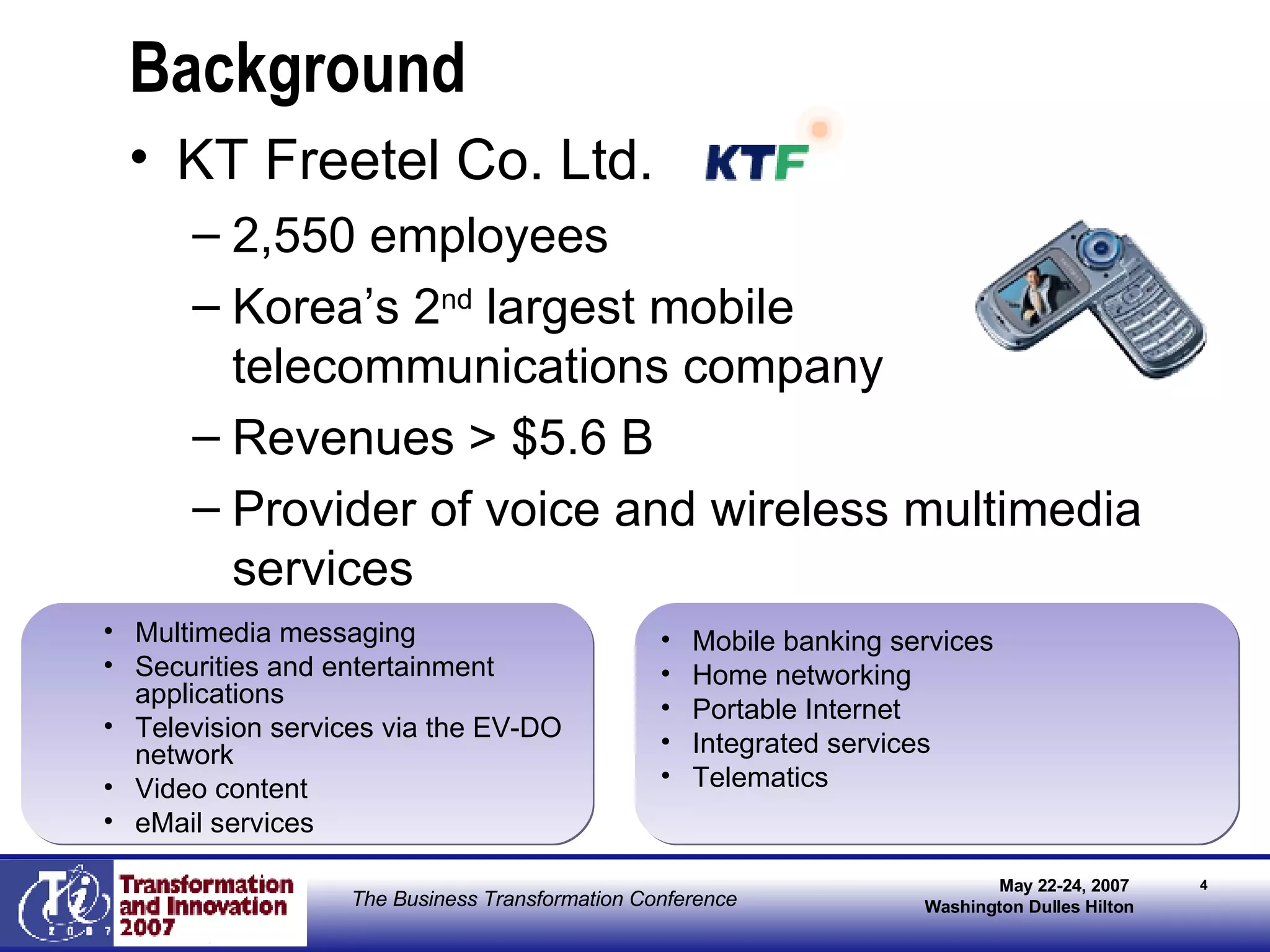
Background KT Freetel Co. Ltd. 2,550 employees Korea’s 2 nd  largest mobile telecommunications company Revenues > $5.6 B Provider of voice and wireless multimedia services Mobile banking services Home networking Portable Internet Integrated services Telematics Multimedia messaging  Securities and entertainment applications Television services via the EV-DO network Video content eMail services
Background BPM Investment Started in 1999 targeting: IT development  Operations Management Current Status: Straddles 15 business units Aligns 28 core business processes & 77 subprocess with those units
Agenda Background Goals Barriers & Obstacles Key Business Innovation Strategy Technology Innovation Strategy Software Selection Criteria Core Process Classification, Analysis and Prioritization Implementation  Process Highlight: Customer Care Process Competitive Advantage Sustaining Innovation
Goals (50,000’) Become industry leader Adapt to rapid change and growth in Telecom market Introduce a BPM system to provide customer oriented services through systemic, standardized and efficient practices.
Goals (500’) Set realistic expectations of what a BPM solution can offer No MAGIC BULLET solution Standardize Core Business Processes Automate Applicable Processes Embrace a BPM and Workflow Platform Make it visible as an enterprise asset Promote process standardization throughout the organization.
Agenda Background Goals Barriers & Obstacles Key Business Innovation Strategy Technology Innovation Strategy Software Selection Criteria Core Process Classification, Analysis and Prioritization Implementation Process Highlight: Customer Care Process Competitive Advantage Sustaining Innovation
Barriers & Obstacles Overwhelming! Identify and organize to provide focus: Business Information Systems Organization
Barriers & Obstacles Business Knowledge Worker Stovepipe Where ever lack of standardized work methods exist, daily operations become dependent upon individual experience and knowledge  Errors are waiting in the wind. Lack of Commitment to Continuous Process Improvement Common process goals are not shared among team members.
Barriers & Obstacles Business Lack of Process Visibility Most employees don’t understand what “They can Change” if they don’t see or understand it. Lack of Strategic Process Change Management Most employees wouldn’t know how to suggest a change if they could change something.
Barriers & Obstacles Information Systems Increase customer numbers while maintaining existing customers. Infrastructure decisions are often in-flexible CRM and CTI technology-based call centers were built using independent, commercially available technologies. Eventually short term decisions become a burden In this case the call center system could not deal with the dynamic and rapidly changing business environment. Never ending Integration Key to survival!! Desperate need for an integrated, process-based application.
Barriers & Obstacles Organization Significant growth over very short periods of time.  Fear of the unknown How can you organize what you don’t know exists? Many new processes that need to be standardized are discovered that were unknown need to be standardized that were unknown during conception of organization’s original vision. Lack of Team Cooperation on Processes Tough! Cooperation among teams is vital to make processes more flexible and rational.
Barriers & Obstacles Specific to KTF Operations management processes were not standardized Heavy reliance on individual institutional knowledge and experience to conduct business. Constant errors in daily execution of these processes, as well as limited visibility into the status of those processes required KTF to examine BPM.
Agenda Background Goals Barriers & Obstacles Key Business Innovation Strategy Technology Innovation Strategy Software Selection Criteria Core Process Classification, Analysis and Prioritization Implementation Process Highlight: Customer Care Process Competitive Advantage Sustaining Innovation
Key Business Innovation Strategy Core Process Standardization and Build-Up Identify and share processes among team members. Minimize work errors through process standardization. Facilitate transition of work.
Key Business Innovation Strategy Process Improvement through Work Management History Pinpoint and solve process problems through work management history that includes monitoring and statistical indices. Secure business transparency through process monitoring. Test work performance through development of a process management index.
Agenda Background Goals Barriers & Obstacles Key Business Innovation Strategy Technology Innovation Strategy Software Selection Criteria Core Process Classification, Analysis and Prioritization Implementation Process Highlight: Customer Care Process Competitive Advantage Sustaining Innovation
Technology Innovation Strategy Core Process Automation and Management Create a faster work process by setting up a Work-Portal with current work status and To Do List. Maximize work efficiency by changing the system from a pull method to a push method.
Technology Innovation Strategy Core Process Automation and Management (Cont.) Prevent work delays in advance by setting up a real-time monitoring system to check work progress. Shorten work hours. Reduce simple/redundant work.
Technology Innovation Strategy Process-Centered Rearrangement of Resources Secure agility and flexibility through a safe transition from the existing systems into the new process-centered system including integration with and connection to a transactional system. Strengthen cooperation among team members through process-centered work. Set up an efficient management base to discern and align major IT and human resources.
Agenda Background Goals Barriers & Obstacles Key Business Innovation Strategy Technology Innovation Strategy Software Selection Criteria Core Process Classification, Analysis and Prioritization Implementation Expected Improvements Competitive Advantage Sustaining Innovation
Software Selection Criteria General Vendor Criteria Is it a Web-based workflow system created by a vendor that is a recognized expert in the fields of workflow and BPM? Is the platform based on global standards?  Does the vendor have stable financials so as to provide continuous technical support and upgrades?  Does a vendor have a future roadmap and related products or solutions that can expand the BPM platform? Is system maintenance and upgrade easy? Does the vendor promptly address user demands for product upgrades?  Does the platform provide for easy automation of business processes in diverse businesses in the domestic environment?  Are there any sample processes?  Is the platform made by a company with diverse work experience and know-how? Is the product made by a company that has stringent quality management and supply standards?
Software Selection Criteria Scalability, Stability & Integration Criteria Does the vendor have a customer installation similar in size and scale to your company?  Is scalability and stability of the platform verified, including number of users, system environment, performance, functionality, and stability? Does the platform have a verified Application Program Interface (API) that can stably connect with other IT systems?
Software Selection Criteria Features & Functions Criteria Does the platform provide functions that can satisfy various workflow & BPM demands? Is process monitoring possible in various forms? Even if a process is ongoing, can you easily change a process template that can change the ongoing process?  Does the platform support diverse workflow management and work distribution function?  Does the platform provide various statistical management and analysis reports?  Does the platform provide a convenient and easy-to-use development environment? Is it easy to manage organizational charts such as setting up TFT or temporary teams and eliminating the team at anytime if necessary?
Agenda Background Goals Barriers & Obstacles Key Business Innovation Strategy Technology Innovation Strategy Software Selection Criteria   Core Process Classification, Analysis and Prioritization Implementation Process Highlight: Customer Care Process Competitive Advantage Sustaining Innovation
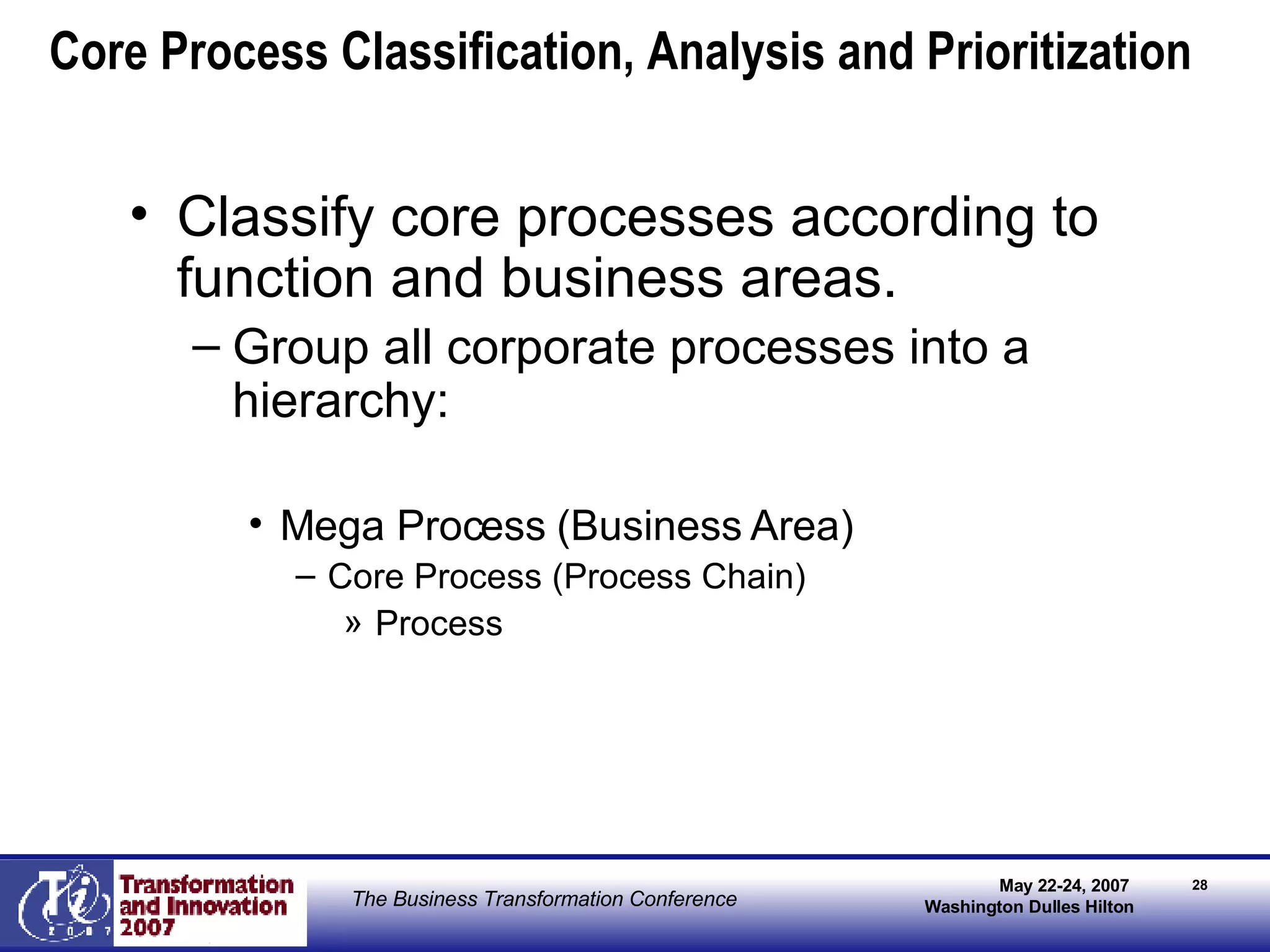
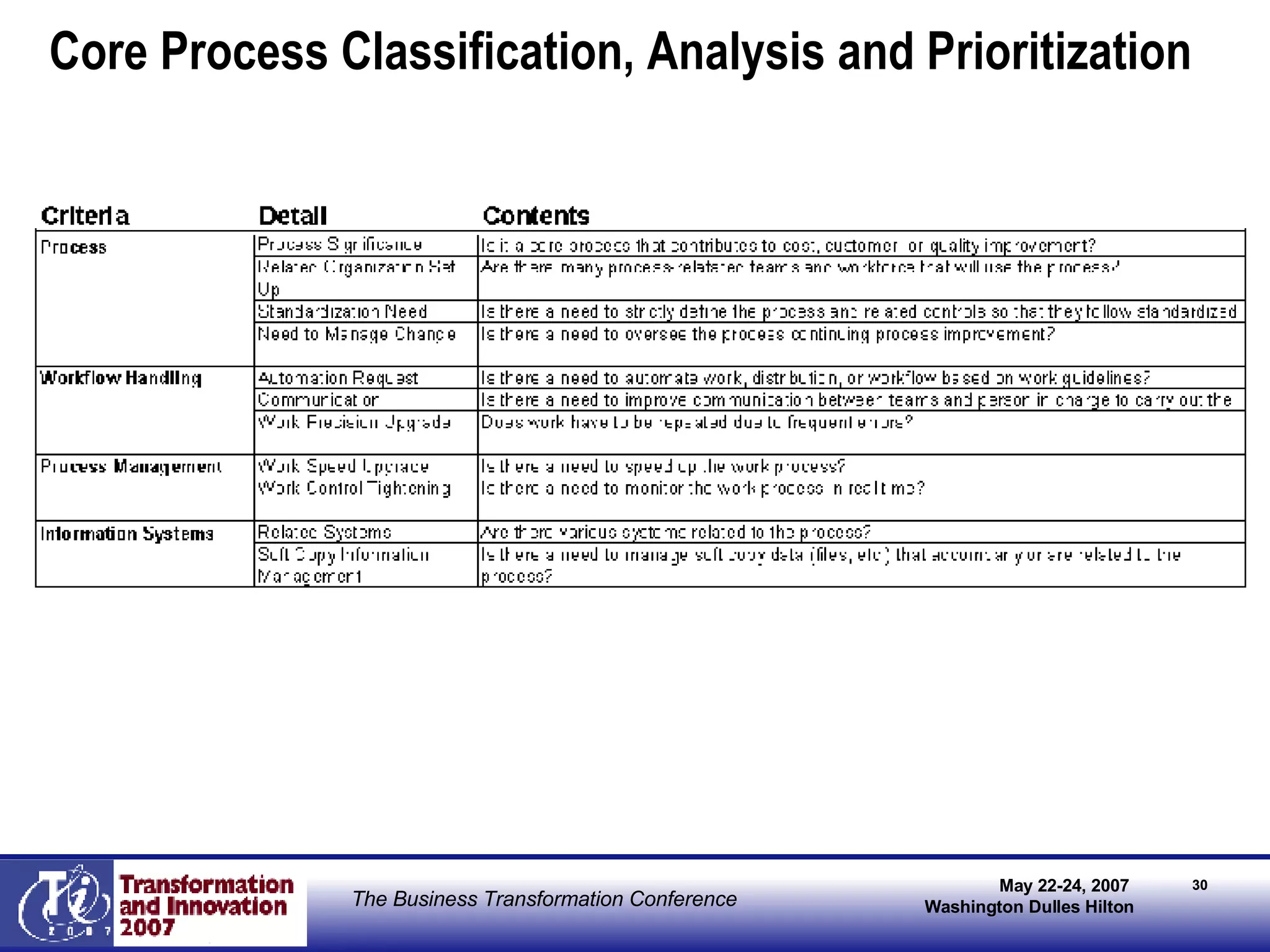
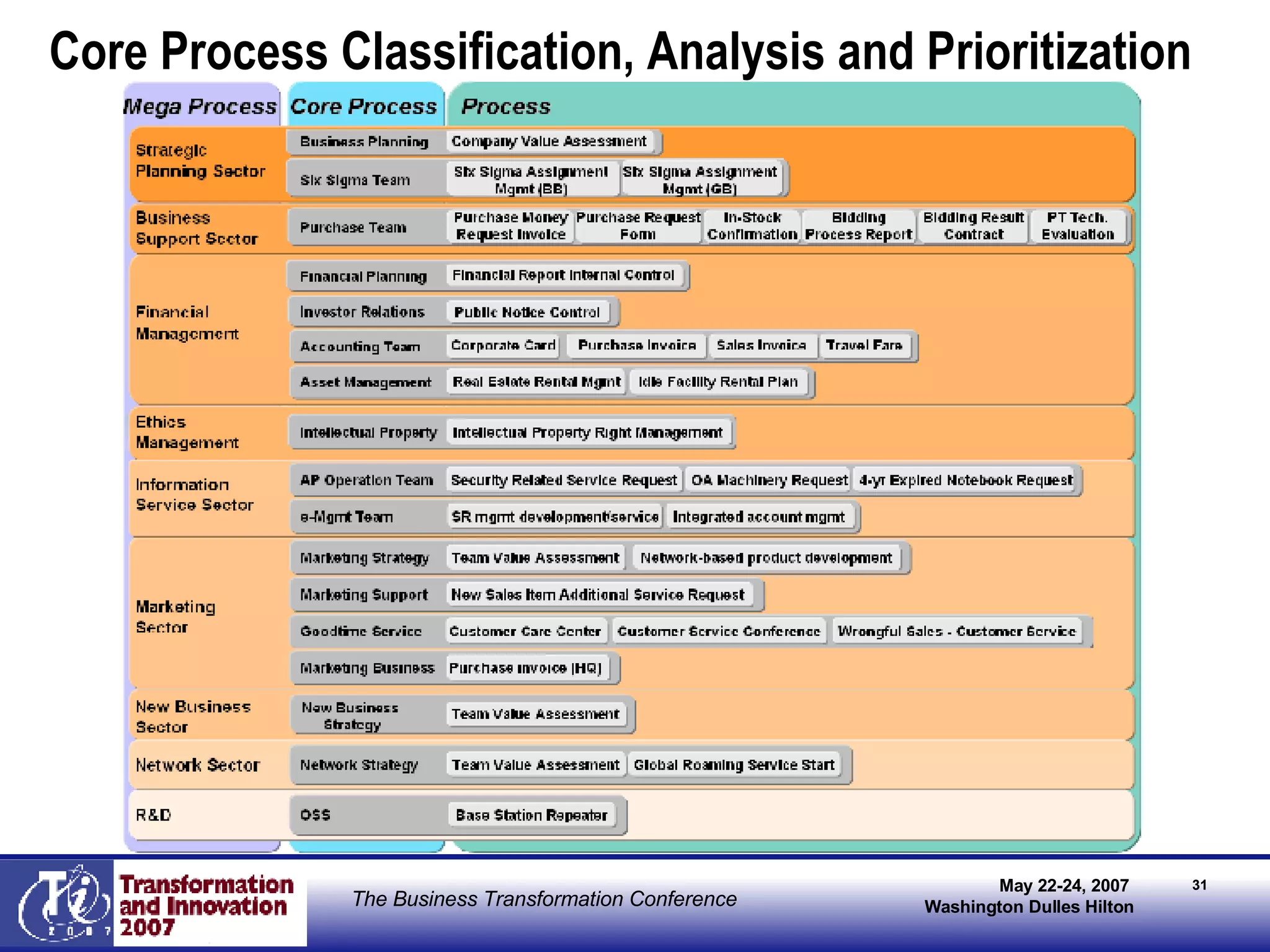
Core Process Classification, Analysis and Prioritization Classify core processes according to function and business areas. Group all corporate processes into a hierarchy: Mega Process (Business Area) Core Process (Process Chain) Process
Develop a criteria for identifying and selecting core processes Core Process Classification, Analysis and Prioritization
Core Process Classification, Analysis and Prioritization
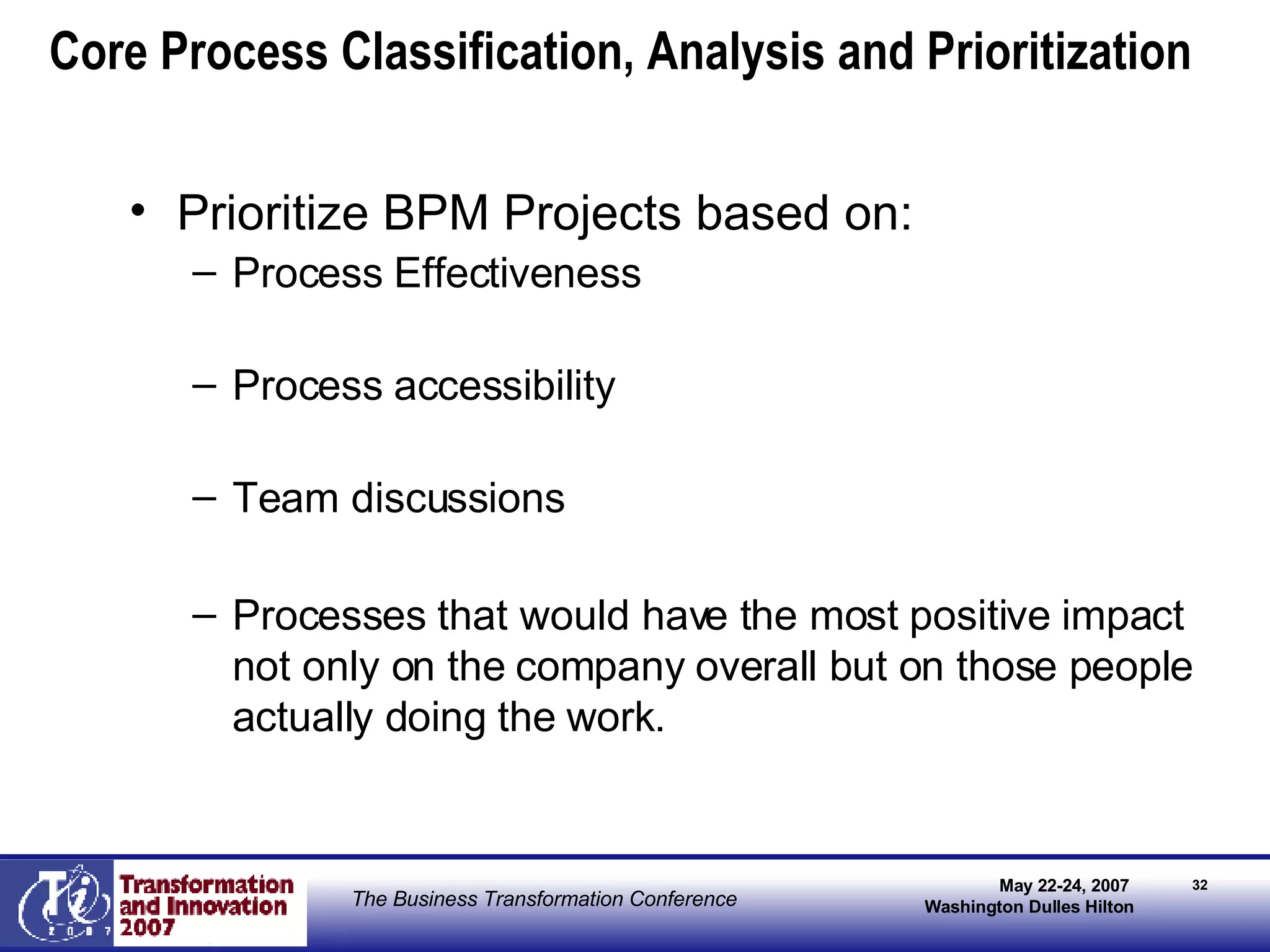
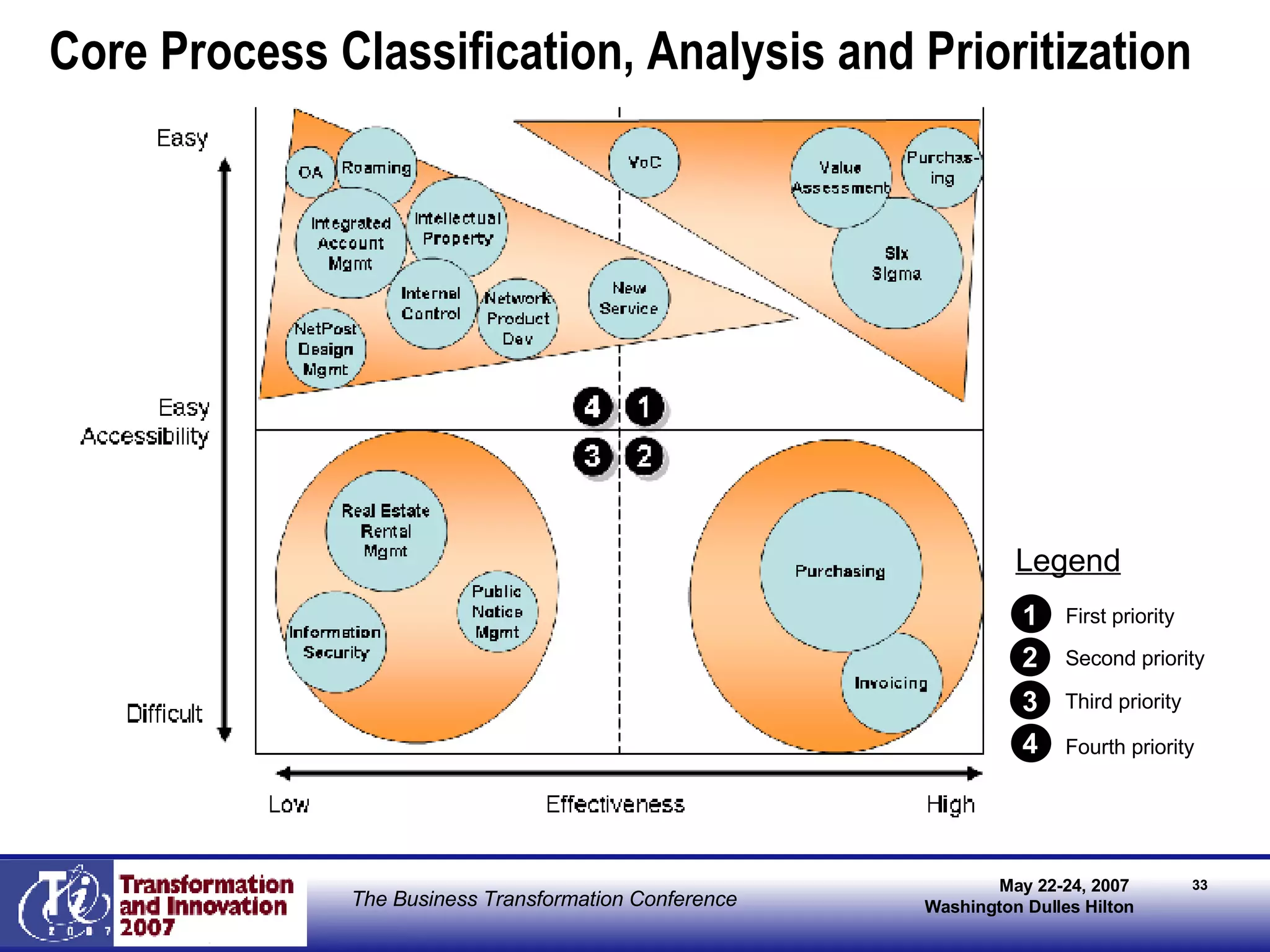
Prioritize BPM Projects based on: Process Effectiveness  Process accessibility Team discussions Processes that would have the most positive impact not only on the company overall but on those people actually doing the work. Core Process Classification, Analysis and Prioritization
Core Process Classification, Analysis and Prioritization Legend First priority Second priority Third priority Fourth priority 1 2 3 4
Agenda Background Goals Barriers & Obstacles Key Business Innovation Strategy Technology Innovation Strategy Software Selection Criteria   Core Process Classification, Analysis and Prioritization Implementation Expected Improvements Competitive Advantage Sustaining Innovation
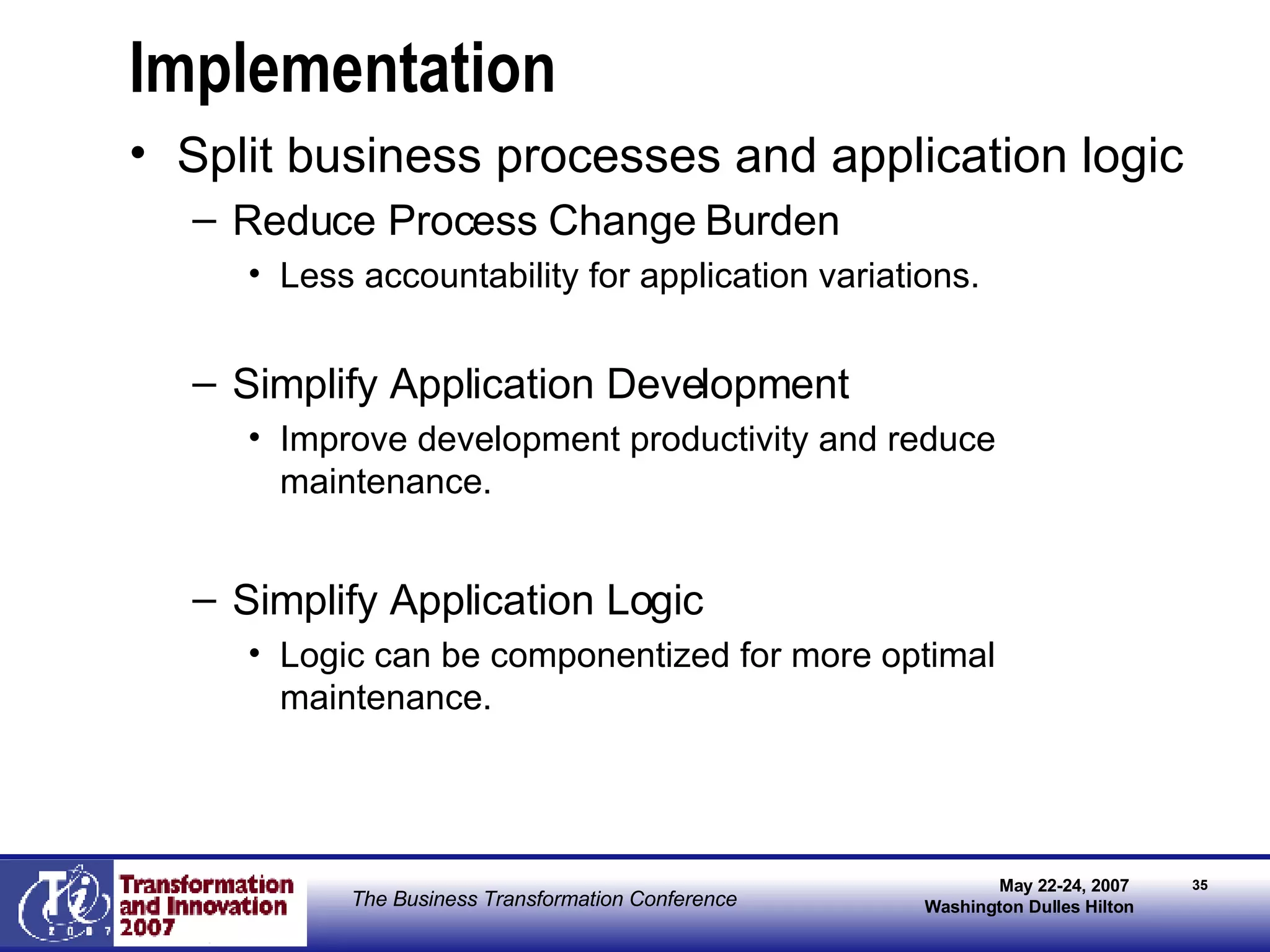
Implementation Split business processes and application logic Reduce Process Change Burden Less accountability for application variations. Simplify Application Development Improve development productivity and reduce maintenance.  Simplify Application Logic  Logic can be componentized for more optimal maintenance.
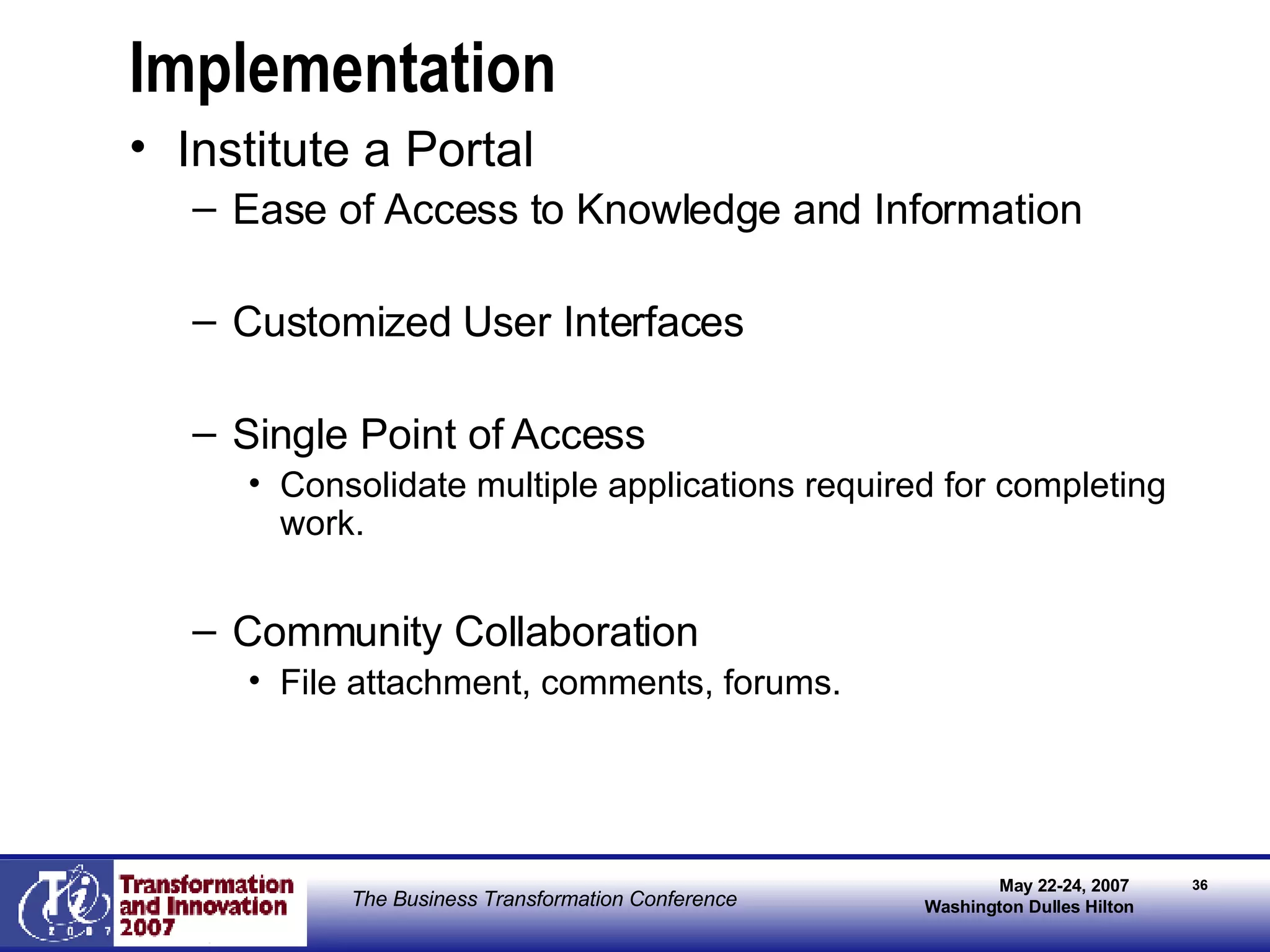
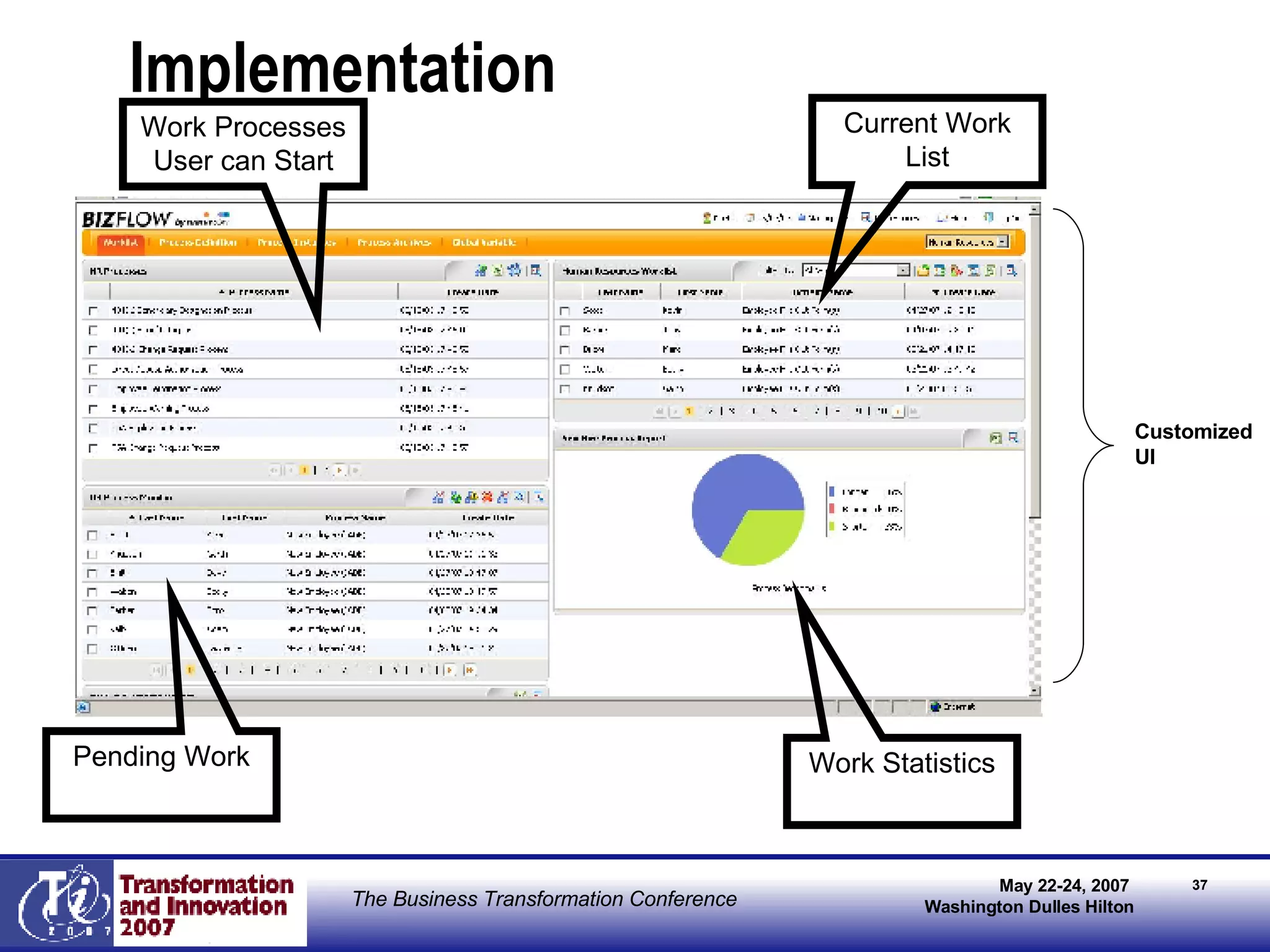
Implementation Institute a Portal Ease of Access to Knowledge and Information Customized User Interfaces  Single Point of Access Consolidate multiple applications required for completing work. Community Collaboration File attachment, comments, forums.
Implementation Current Work List Work Statistics Pending Work Work Processes User can Start Customized UI
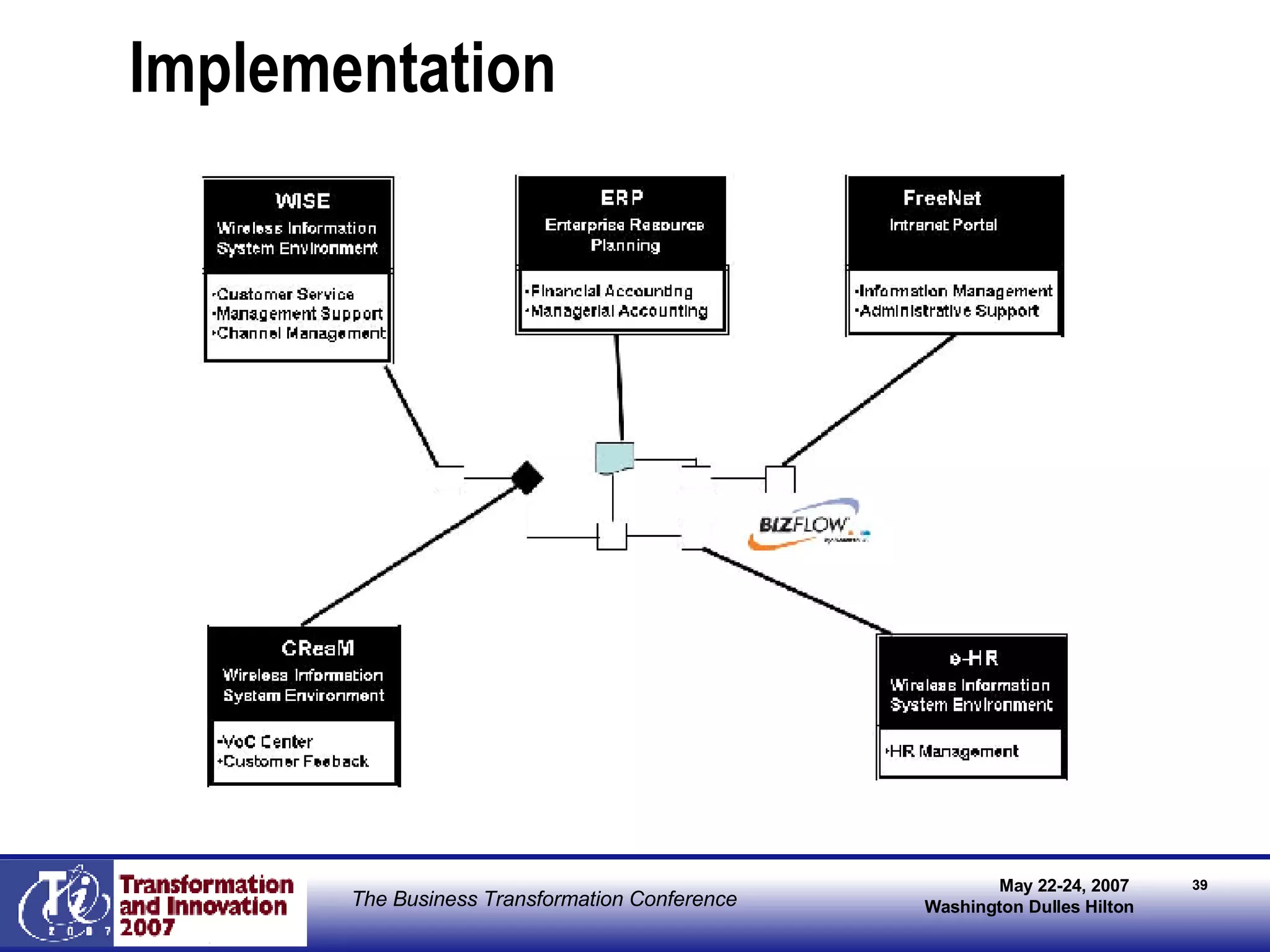
Implementation Center all Systems on BPM & Workflow For example KTF utilized: ERP (SAP) FreeNet (Enterprise Knowledge Portal) Intranet e-HR, CReaM (CRM) other systems as stove-piped technologies.  All the distinct systems are now centered on BPM & Workflow.
Implementation
Agenda Background Goals Barriers & Obstacles Key Business Innovation Strategy Technology Innovation Strategy Software Selection Criteria   Core Process Classification, Analysis and Prioritization Implementation Process Highlight: Customer Care Process  Competitive Advantage Sustaining Innovation
Process Highlight: Automated Customer Care Process Management Benefits Standardization of customer care process: Eliminated the arbitrary prioritization of employee worklists.  Increased the efficiency of work processing Minimized educational training for new workers. Provided visibility into the customer care process  Critical customer satisfaction goals.
Process Highlight: Automated Customer Care Process Management Benefits Better customer profile Increased customer data collection  Classify data as a complaining customer, or VIP, and the system can come up with a strategic marketing plan for each customer. Customer care-related teams operate within a unified communication platform.
Call Center Benefits Absolute guarantee that registration of feedback on customer care process is transferred to IT team. Customer feedback can be updated using prior customer care knowledge. Process Highlight: Automated Customer Care Process
IT Benefits Excessive use of automated service is prevented. Visibility customer service routing. Employee evaluations based on customer care performance. Process Highlight: Automated Customer Care Process
Customers Fast feedback and response to customer complaints. Improved customer service. Process Highlight: Automated Customer Care Process
Agenda Background Goals Barriers & Obstacles Key Business Innovation Strategy Technology Innovation Strategy Software Selection Criteria   Core Process Classification, Analysis and Prioritization Implementation Process Highlight: Customer Care Process  Competitive Advantage Sustaining Innovation
Competitive Advantage Measured as: Quantitative Effects of BPM & Workflow Initiatives Qualitative Effects of BPM & Workflow Initiatives Work Process Standardization Work Process Status Monitoring Improvements Statistical Data
Competitive Advantage Quantitative Effects of BPM & Workflow Initiatives Reduction in work cycle times. Elimination of work delays automatic work notification. Minimized paperwork Use of electronic data (invoices, purchase request forms, order forms, etc.) resulting in minimized paperwork. Elimination of redundant data input Electronic document transfer prevented redundant input of identical data.
Competitive Advantage Quantitative Effects of BPM & Workflow Initiatives (Cont’d) Better collaboration between related departments. Real-time, step-by-step management. Increased worker productivity. Reduction in claim response times. Faster and Educated Process Modifications  Process designs can be easily understood and changed quickly and easily in the work environment.
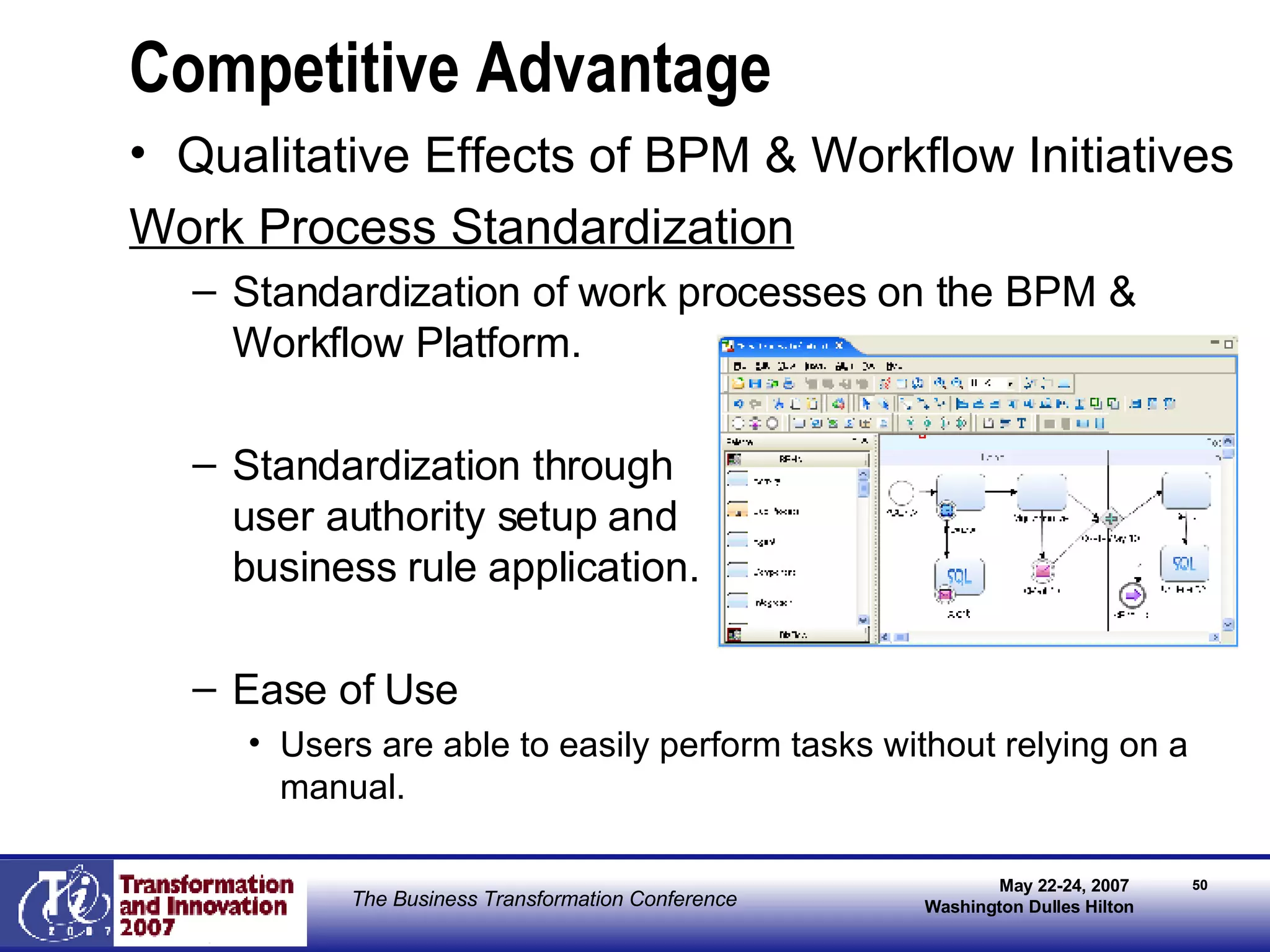
Competitive Advantage Qualitative Effects of BPM & Workflow Initiatives Work Process Standardization Standardization of work processes on the BPM & Workflow Platform. Standardization through  user authority setup and  business rule application. Ease of Use Users are able to easily perform tasks without relying on a manual.
Competitive Advantage Qualitative Effects of BPM & Workflow Initiatives Work Process Standardization Visibility Process participants can observe work through a standard process (from start to finish) and clearly see the object and contents of the work. Exception Handling Automatically flagged  Follow-up measures are automatically initiated according to pre-defined business rules.
Competitive Advantage Qualitative Effects of BPM & Workflow Initiatives Work Process Status Monitoring Improvements Work transparency Instant access to work details and based on defined process. Better Management Visibility Process monitoring, automatic work notification Continuous Status Availability Due date, emergency, delay, etc., available continuously. Real-Time Customer Support Customer requests .
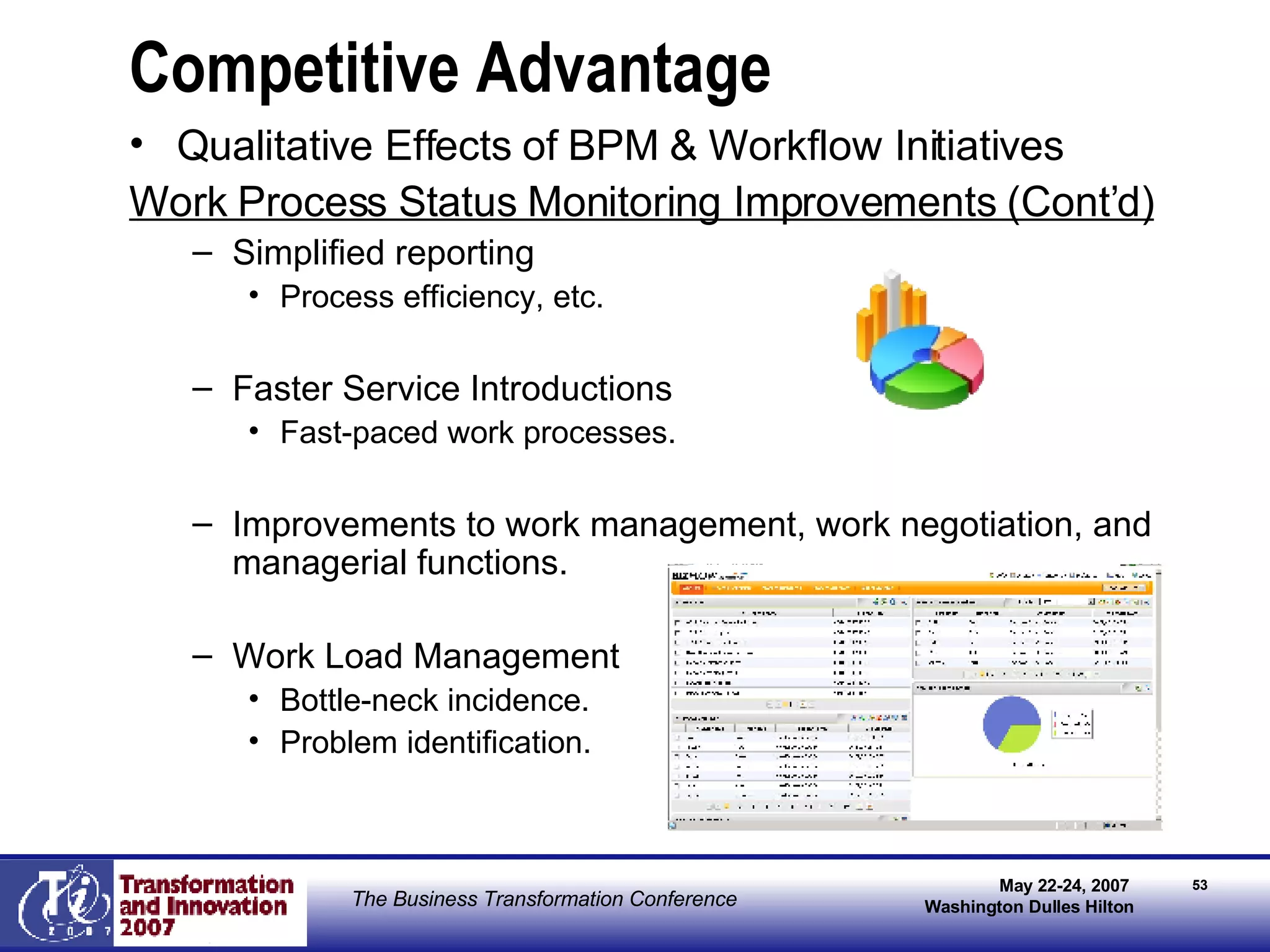
Competitive Advantage Qualitative Effects of BPM & Workflow Initiatives Work Process Status Monitoring Improvements (Cont’d) Simplified reporting Process efficiency, etc. Faster Service Introductions Fast-paced work processes. Improvements to work management, work negotiation, and managerial functions. Work Load Management Bottle-neck incidence.  Problem identification.
Agenda Background Goals Barriers & Obstacles Key Business Innovation Strategy Technology Innovation Strategy Software Selection Criteria   Core Process Classification, Analysis and Prioritization Implementation Process Highlight: Customer Care Process Competitive Advantage Sustaining Innovation
Sustaining Innovation •  Continuously monitor operations, and incorporate user demands in order to maximize applications through exhaustive analyses. •  Further expand BPM & Workflow to the cut-off process between core systems. Monitor & improve existing processes. •  Create and manage an expert group in each core area to activate culture and cooperation around the BPM & WorkFlow solution.
Sustaining Innovation •  Continuous promotion of BPM & WorkFlow solution benefits. Establish and leverage expert BPM & Workflow group  carry out process optimization through process data collection. •  Establish strategic goals and CSFs (Critical Success Factors) based on KPIs (Key Performance Indicators) linked with processes and continuously analyze process performance. •  Employee performance Customer service, quality, cycle times, and costs.
Sustaining Innovation •  Define the knowledge required for each process, and find out from where the knowledge comes. Then supply the knowledge just-in-time at point of need. Accumulate the results of the process to create a useful knowledge base for the organization. •  Audit and monitor Internal Controls •  Establish Early Risk Warning system for operational risk management.
Thank  Y Robert Cain Director of Product Management HandySoft Global Corporation Contact Information: 703-442-5600 [email_address] ou Thank  Y ou

The Fundamentals Of BPM Innovation In Telecommunications

  • 1.
    Robert Cain Directorof Product Management HandySoft Global Corporation SessionTitle: The Fundamentals of BPM Innovation in Telecommunications Welcome to Transformation and Innovation 2007 The Business Transformation Conference Welcome
  • 2.
    Agenda Background GoalsBarriers & Obstacles Key Business Innovation Strategy Technology Innovation Strategy Software Selection Criteria Core Process Classification, Analysis and Prioritization Implementation Process Highlight: Customer Care Process Competitive Advantage Sustaining Innovation
  • 3.
    Agenda Background GoalsBarriers & Obstacles Key Business Innovation Strategy Technology Innovation Strategy Software Selection Criteria Core Process Classification, Analysis and Prioritization Implementation Process Highlight: Customer Care Process Competitive Advantage Sustaining Innovation
  • 4.
    Background KT FreetelCo. Ltd. 2,550 employees Korea’s 2 nd largest mobile telecommunications company Revenues > $5.6 B Provider of voice and wireless multimedia services Mobile banking services Home networking Portable Internet Integrated services Telematics Multimedia messaging Securities and entertainment applications Television services via the EV-DO network Video content eMail services
  • 5.
    Background BPM InvestmentStarted in 1999 targeting: IT development Operations Management Current Status: Straddles 15 business units Aligns 28 core business processes & 77 subprocess with those units
  • 6.
    Agenda Background GoalsBarriers & Obstacles Key Business Innovation Strategy Technology Innovation Strategy Software Selection Criteria Core Process Classification, Analysis and Prioritization Implementation Process Highlight: Customer Care Process Competitive Advantage Sustaining Innovation
  • 7.
    Goals (50,000’) Becomeindustry leader Adapt to rapid change and growth in Telecom market Introduce a BPM system to provide customer oriented services through systemic, standardized and efficient practices.
  • 8.
    Goals (500’) Setrealistic expectations of what a BPM solution can offer No MAGIC BULLET solution Standardize Core Business Processes Automate Applicable Processes Embrace a BPM and Workflow Platform Make it visible as an enterprise asset Promote process standardization throughout the organization.
  • 9.
    Agenda Background GoalsBarriers & Obstacles Key Business Innovation Strategy Technology Innovation Strategy Software Selection Criteria Core Process Classification, Analysis and Prioritization Implementation Process Highlight: Customer Care Process Competitive Advantage Sustaining Innovation
  • 10.
    Barriers & ObstaclesOverwhelming! Identify and organize to provide focus: Business Information Systems Organization
  • 11.
    Barriers & ObstaclesBusiness Knowledge Worker Stovepipe Where ever lack of standardized work methods exist, daily operations become dependent upon individual experience and knowledge Errors are waiting in the wind. Lack of Commitment to Continuous Process Improvement Common process goals are not shared among team members.
  • 12.
    Barriers & ObstaclesBusiness Lack of Process Visibility Most employees don’t understand what “They can Change” if they don’t see or understand it. Lack of Strategic Process Change Management Most employees wouldn’t know how to suggest a change if they could change something.
  • 13.
    Barriers & ObstaclesInformation Systems Increase customer numbers while maintaining existing customers. Infrastructure decisions are often in-flexible CRM and CTI technology-based call centers were built using independent, commercially available technologies. Eventually short term decisions become a burden In this case the call center system could not deal with the dynamic and rapidly changing business environment. Never ending Integration Key to survival!! Desperate need for an integrated, process-based application.
  • 14.
    Barriers & ObstaclesOrganization Significant growth over very short periods of time. Fear of the unknown How can you organize what you don’t know exists? Many new processes that need to be standardized are discovered that were unknown need to be standardized that were unknown during conception of organization’s original vision. Lack of Team Cooperation on Processes Tough! Cooperation among teams is vital to make processes more flexible and rational.
  • 15.
    Barriers & ObstaclesSpecific to KTF Operations management processes were not standardized Heavy reliance on individual institutional knowledge and experience to conduct business. Constant errors in daily execution of these processes, as well as limited visibility into the status of those processes required KTF to examine BPM.
  • 16.
    Agenda Background GoalsBarriers & Obstacles Key Business Innovation Strategy Technology Innovation Strategy Software Selection Criteria Core Process Classification, Analysis and Prioritization Implementation Process Highlight: Customer Care Process Competitive Advantage Sustaining Innovation
  • 17.
    Key Business InnovationStrategy Core Process Standardization and Build-Up Identify and share processes among team members. Minimize work errors through process standardization. Facilitate transition of work.
  • 18.
    Key Business InnovationStrategy Process Improvement through Work Management History Pinpoint and solve process problems through work management history that includes monitoring and statistical indices. Secure business transparency through process monitoring. Test work performance through development of a process management index.
  • 19.
    Agenda Background GoalsBarriers & Obstacles Key Business Innovation Strategy Technology Innovation Strategy Software Selection Criteria Core Process Classification, Analysis and Prioritization Implementation Process Highlight: Customer Care Process Competitive Advantage Sustaining Innovation
  • 20.
    Technology Innovation StrategyCore Process Automation and Management Create a faster work process by setting up a Work-Portal with current work status and To Do List. Maximize work efficiency by changing the system from a pull method to a push method.
  • 21.
    Technology Innovation StrategyCore Process Automation and Management (Cont.) Prevent work delays in advance by setting up a real-time monitoring system to check work progress. Shorten work hours. Reduce simple/redundant work.
  • 22.
    Technology Innovation StrategyProcess-Centered Rearrangement of Resources Secure agility and flexibility through a safe transition from the existing systems into the new process-centered system including integration with and connection to a transactional system. Strengthen cooperation among team members through process-centered work. Set up an efficient management base to discern and align major IT and human resources.
  • 23.
    Agenda Background GoalsBarriers & Obstacles Key Business Innovation Strategy Technology Innovation Strategy Software Selection Criteria Core Process Classification, Analysis and Prioritization Implementation Expected Improvements Competitive Advantage Sustaining Innovation
  • 24.
    Software Selection CriteriaGeneral Vendor Criteria Is it a Web-based workflow system created by a vendor that is a recognized expert in the fields of workflow and BPM? Is the platform based on global standards? Does the vendor have stable financials so as to provide continuous technical support and upgrades? Does a vendor have a future roadmap and related products or solutions that can expand the BPM platform? Is system maintenance and upgrade easy? Does the vendor promptly address user demands for product upgrades? Does the platform provide for easy automation of business processes in diverse businesses in the domestic environment? Are there any sample processes? Is the platform made by a company with diverse work experience and know-how? Is the product made by a company that has stringent quality management and supply standards?
  • 25.
    Software Selection CriteriaScalability, Stability & Integration Criteria Does the vendor have a customer installation similar in size and scale to your company? Is scalability and stability of the platform verified, including number of users, system environment, performance, functionality, and stability? Does the platform have a verified Application Program Interface (API) that can stably connect with other IT systems?
  • 26.
    Software Selection CriteriaFeatures & Functions Criteria Does the platform provide functions that can satisfy various workflow & BPM demands? Is process monitoring possible in various forms? Even if a process is ongoing, can you easily change a process template that can change the ongoing process? Does the platform support diverse workflow management and work distribution function? Does the platform provide various statistical management and analysis reports? Does the platform provide a convenient and easy-to-use development environment? Is it easy to manage organizational charts such as setting up TFT or temporary teams and eliminating the team at anytime if necessary?
  • 27.
    Agenda Background GoalsBarriers & Obstacles Key Business Innovation Strategy Technology Innovation Strategy Software Selection Criteria Core Process Classification, Analysis and Prioritization Implementation Process Highlight: Customer Care Process Competitive Advantage Sustaining Innovation
  • 28.
    Core Process Classification,Analysis and Prioritization Classify core processes according to function and business areas. Group all corporate processes into a hierarchy: Mega Process (Business Area) Core Process (Process Chain) Process
  • 29.
    Develop a criteriafor identifying and selecting core processes Core Process Classification, Analysis and Prioritization
  • 30.
    Core Process Classification,Analysis and Prioritization
  • 31.
    Core Process Classification,Analysis and Prioritization
  • 32.
    Prioritize BPM Projectsbased on: Process Effectiveness Process accessibility Team discussions Processes that would have the most positive impact not only on the company overall but on those people actually doing the work. Core Process Classification, Analysis and Prioritization
  • 33.
    Core Process Classification,Analysis and Prioritization Legend First priority Second priority Third priority Fourth priority 1 2 3 4
  • 34.
    Agenda Background GoalsBarriers & Obstacles Key Business Innovation Strategy Technology Innovation Strategy Software Selection Criteria Core Process Classification, Analysis and Prioritization Implementation Expected Improvements Competitive Advantage Sustaining Innovation
  • 35.
    Implementation Split businessprocesses and application logic Reduce Process Change Burden Less accountability for application variations. Simplify Application Development Improve development productivity and reduce maintenance. Simplify Application Logic Logic can be componentized for more optimal maintenance.
  • 36.
    Implementation Institute aPortal Ease of Access to Knowledge and Information Customized User Interfaces Single Point of Access Consolidate multiple applications required for completing work. Community Collaboration File attachment, comments, forums.
  • 37.
    Implementation Current WorkList Work Statistics Pending Work Work Processes User can Start Customized UI
  • 38.
    Implementation Center allSystems on BPM & Workflow For example KTF utilized: ERP (SAP) FreeNet (Enterprise Knowledge Portal) Intranet e-HR, CReaM (CRM) other systems as stove-piped technologies. All the distinct systems are now centered on BPM & Workflow.
  • 39.
  • 40.
    Agenda Background GoalsBarriers & Obstacles Key Business Innovation Strategy Technology Innovation Strategy Software Selection Criteria Core Process Classification, Analysis and Prioritization Implementation Process Highlight: Customer Care Process Competitive Advantage Sustaining Innovation
  • 41.
    Process Highlight: AutomatedCustomer Care Process Management Benefits Standardization of customer care process: Eliminated the arbitrary prioritization of employee worklists. Increased the efficiency of work processing Minimized educational training for new workers. Provided visibility into the customer care process Critical customer satisfaction goals.
  • 42.
    Process Highlight: AutomatedCustomer Care Process Management Benefits Better customer profile Increased customer data collection Classify data as a complaining customer, or VIP, and the system can come up with a strategic marketing plan for each customer. Customer care-related teams operate within a unified communication platform.
  • 43.
    Call Center BenefitsAbsolute guarantee that registration of feedback on customer care process is transferred to IT team. Customer feedback can be updated using prior customer care knowledge. Process Highlight: Automated Customer Care Process
  • 44.
    IT Benefits Excessiveuse of automated service is prevented. Visibility customer service routing. Employee evaluations based on customer care performance. Process Highlight: Automated Customer Care Process
  • 45.
    Customers Fast feedbackand response to customer complaints. Improved customer service. Process Highlight: Automated Customer Care Process
  • 46.
    Agenda Background GoalsBarriers & Obstacles Key Business Innovation Strategy Technology Innovation Strategy Software Selection Criteria Core Process Classification, Analysis and Prioritization Implementation Process Highlight: Customer Care Process Competitive Advantage Sustaining Innovation
  • 47.
    Competitive Advantage Measuredas: Quantitative Effects of BPM & Workflow Initiatives Qualitative Effects of BPM & Workflow Initiatives Work Process Standardization Work Process Status Monitoring Improvements Statistical Data
  • 48.
    Competitive Advantage QuantitativeEffects of BPM & Workflow Initiatives Reduction in work cycle times. Elimination of work delays automatic work notification. Minimized paperwork Use of electronic data (invoices, purchase request forms, order forms, etc.) resulting in minimized paperwork. Elimination of redundant data input Electronic document transfer prevented redundant input of identical data.
  • 49.
    Competitive Advantage QuantitativeEffects of BPM & Workflow Initiatives (Cont’d) Better collaboration between related departments. Real-time, step-by-step management. Increased worker productivity. Reduction in claim response times. Faster and Educated Process Modifications Process designs can be easily understood and changed quickly and easily in the work environment.
  • 50.
    Competitive Advantage QualitativeEffects of BPM & Workflow Initiatives Work Process Standardization Standardization of work processes on the BPM & Workflow Platform. Standardization through user authority setup and business rule application. Ease of Use Users are able to easily perform tasks without relying on a manual.
  • 51.
    Competitive Advantage QualitativeEffects of BPM & Workflow Initiatives Work Process Standardization Visibility Process participants can observe work through a standard process (from start to finish) and clearly see the object and contents of the work. Exception Handling Automatically flagged Follow-up measures are automatically initiated according to pre-defined business rules.
  • 52.
    Competitive Advantage QualitativeEffects of BPM & Workflow Initiatives Work Process Status Monitoring Improvements Work transparency Instant access to work details and based on defined process. Better Management Visibility Process monitoring, automatic work notification Continuous Status Availability Due date, emergency, delay, etc., available continuously. Real-Time Customer Support Customer requests .
  • 53.
    Competitive Advantage QualitativeEffects of BPM & Workflow Initiatives Work Process Status Monitoring Improvements (Cont’d) Simplified reporting Process efficiency, etc. Faster Service Introductions Fast-paced work processes. Improvements to work management, work negotiation, and managerial functions. Work Load Management Bottle-neck incidence. Problem identification.
  • 54.
    Agenda Background GoalsBarriers & Obstacles Key Business Innovation Strategy Technology Innovation Strategy Software Selection Criteria Core Process Classification, Analysis and Prioritization Implementation Process Highlight: Customer Care Process Competitive Advantage Sustaining Innovation
  • 55.
    Sustaining Innovation • Continuously monitor operations, and incorporate user demands in order to maximize applications through exhaustive analyses. • Further expand BPM & Workflow to the cut-off process between core systems. Monitor & improve existing processes. • Create and manage an expert group in each core area to activate culture and cooperation around the BPM & WorkFlow solution.
  • 56.
    Sustaining Innovation • Continuous promotion of BPM & WorkFlow solution benefits. Establish and leverage expert BPM & Workflow group carry out process optimization through process data collection. • Establish strategic goals and CSFs (Critical Success Factors) based on KPIs (Key Performance Indicators) linked with processes and continuously analyze process performance. • Employee performance Customer service, quality, cycle times, and costs.
  • 57.
    Sustaining Innovation • Define the knowledge required for each process, and find out from where the knowledge comes. Then supply the knowledge just-in-time at point of need. Accumulate the results of the process to create a useful knowledge base for the organization. • Audit and monitor Internal Controls • Establish Early Risk Warning system for operational risk management.
  • 58.
    Thank YRobert Cain Director of Product Management HandySoft Global Corporation Contact Information: 703-442-5600 [email_address] ou Thank Y ou