SOURCE:
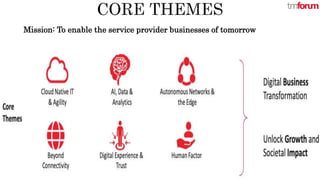
Mission: To enable the service provider businesses of tomorrow
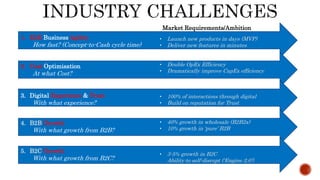
1. E2E Business Agility
How fast? (Concept-to-Cash cycle time)
2. Cost Optimisation
At what Cost?
3. Digital Experience & Trust
With what experience?
4. B2B Growth
With what growth from B2B?
5. B2C Growth
With what growth from B2C?
Market Requirements/Ambition
• Launch new products in days (MVP)
• Deliver new features in minutes
• Double OpEx Efficiency
• Dramatically improve CapEx efficiency
• 100% of interactions through digital
• Build on reputation for Trust
• 40% growth in wholesale (B2B2x)
• 10% growth in ‘pure’ B2B
• 3-5% growth in B2C
Ability to self-disrupt (‘Engine 2.0’)
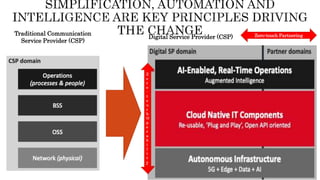
Z
e
r
o
-
t
o
u
c
h
O
p
e
r
a
b
i
l
i
t
y
er op erabili
ty
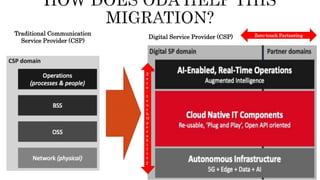
Zero-touch Partnering
Traditional Communication
Service Provider (CSP)
Digital Service Provider (CSP)
A blueprint for intelligent operations fit for the 5G era
 Provides a migration path from legacy systems and
processes to modular, cloud native software
orchestrated using AI
Practical tools
 ODF comprises tools, code, knowledge and standards
(machine-readable assets, not just documents)
 Delivering business value for TM Forum members
today
 Accelerating concept-to-cash, eliminating IT &
network costs, enhancing digital customer
experience
 Developed through TM Forum’s collaboration
programs
 Created and used by leading service providers and
software companies, building on TM Forum’s
established standards
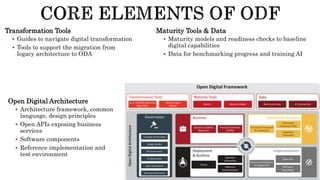
Open Digital Architecture
 Architecture framework, common
language, design principles
 Open APIs exposing business
services
 Software components
 Reference implementation and
test environment
Maturity Tools & Data
 Maturity models and readiness checks to baseline
digital capabilities
 Data for benchmarking progress and training AI
Transformation Tools
 Guides to navigate digital transformation
 Tools to support the migration from
legacy architecture to ODA
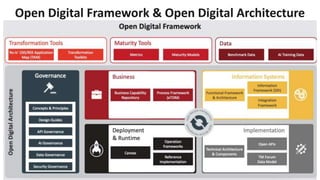
Open Digital Framework & Open Digital Architecture
 ODA is a complete enterprise architecture blueprint for open digital
platforms, replacing traditional operational and business support
systems
 Comprises standardized, reusable, cloud native software components
organized into loosely coupled domains
 Components connect via standardized Open APIs which:
 ‒ Provide zero-touch interoperability (plug-&-play components)
 ‒ Expose business capabilities for zero-touch partnering
 ODA transforms business agility with simpler IT solutions that are
easier and cheaper to deploy, integrate & upgrade
 Built by industry agreement
 TM Forum members are actively developing the ODA standards,
leveraging mature, proven TM Forum assets
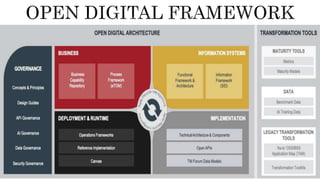
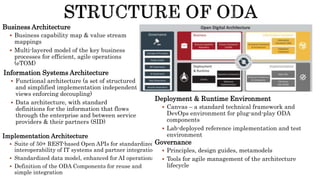
Business Architecture
 Business capability map & value stream
mappings
 Multi-layered model of the key business
processes for efficient, agile operations
(eTOM)
Information Systems Architecture
 Functional architecture (a set of structured
and simplified implementation independent
views enforcing decoupling)
 Data architecture, with standard
definitions for the information that flows
through the enterprise and between service
providers & their partners (SID)
Implementation Architecture
 Suite of 50+ REST-based Open APIs for standardized
interoperability of IT systems and partner integration
 Standardized data model, enhanced for AI operations
 Definition of the ODA Components for reuse and
simple integration
Deployment & Runtime Environment
 Canvas – a standard technical framework and
DevOps environment for plug-and-play ODA
components
 Lab-deployed reference implementation and test
environment
Governance
 Principles, design guides, metamodels
 Tools for agile management of the architecture
lifecycle
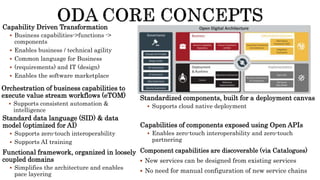
Capability Driven Transformation
 Business capabilities->functions ->
components
 Enables business / technical agility
 Common language for Business
 (requirements) and IT (design)
 Enables the software marketplace
Standardized components, built for a deployment canvas
 Supports cloud native deployment
Orchestration of business capabilities to
execute value stream workflows (eTOM)
 Supports consistent automation &
intelligence
Standard data language (SID) & data
model (optimized for AI)
 Supports zero-touch interoperability
 Supports AI training
Functional framework, organized in loosely
coupled domains
 Simplifies the architecture and enables
pace layering
Capabilities of components exposed using Open APIs
 Enables zero-touch interoperability and zero-touch
partnering
Component capabilities are discoverable (via Catalogues)
 New services can be designed from existing services
 No need for manual configuration of new service chains
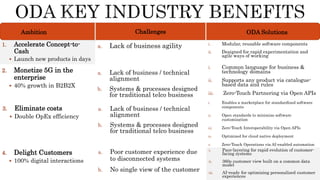
1. Accelerate Concept-to-
Cash
 Launch new products in days
Ambition Challenges ODA Solutions
a. Lack of business agility i. Modular, reusable software components
ii. Designed for rapid experimentation and
agile ways of working
2. Monetize 5G in the
enterprise
 40% growth in B2B2X
a. Lack of business / technical
alignment
b. Systems & processes designed
for traditional telco business
i. Common language for business &
technology domains
ii. Supports any product via catalogue-
based data and rules
iii. Zero-Touch Partnering via Open APIs
3. Eliminate costs
 Double OpEx efficiency
a. Lack of business / technical
alignment
b. Systems & processes designed
for traditional telco business
i. Enables a marketplace for standardized software
components
ii. Open standards to minimize software
customization
iii. Zero-Touch Interoperability via Open APIs
iv. Optimized for cloud native deployment
v. Zero-Touch Operations via AI-enabled automation
4. Delight Customers
 100% digital interactions
a. Poor customer experience due
to disconnected systems
b. No single view of the customer
i. Pace-layering for rapid evolution of customer-
facing systems
ii. 360o customer view built on a common data
model
iii. AI-ready for optimizing personalized customer
experiences
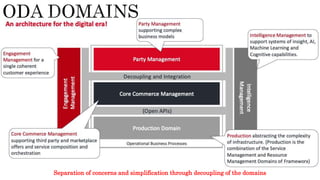
Components are organized into
loosely coupled domains
 Decoupling of the domains simplifies
the architecture and enables separation
of concerns
 Each domain can change at its own pace
without affecting other domains (pace-
layering)
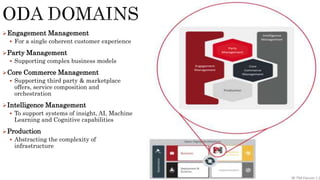
 Business functions of the domains are
exposed via Open APIs
Engagement Management
 For a single coherent customer experience
Party Management
 Supporting complex business models
Core Commerce Management
 Supporting third party & marketplace
offers, service composition and
orchestration
Intelligence Management
 To support systems of insight, AI, Machine
Learning and Cognitive capabilities
Production
 Abstracting the complexity of
infrastructure
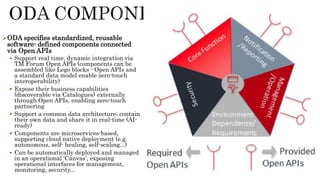
ODA specifies standardized, reusable
software- defined components connected
via Open APIs
 Support real time, dynamic integration via
TM Forum Open APIs (components can be
assembled like Lego blocks - Open APIs and
a standard data model enable zero-touch
interoperability)
 Expose their business capabilities
(discoverable via Catalogues) externally
through Open APIs, enabling zero-touch
partnering
 Support a common data architecture; contain
their own data and share it in real-time (AI-
ready)
 Components are microservices-based,
supporting cloud native deployment (e.g.
autonomous, self- healing, self-scaling...)
 Can be automatically deployed and managed
in an operational ‘Canvas’, exposing
operational interfaces for management,
monitoring, security...
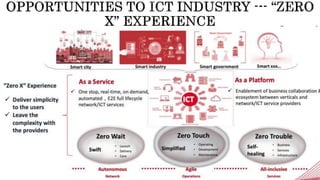
Z
e
r
o
-
t
o
u
c
h
O
p
e
r
a
b
i
l
i
t
y
er op erabili
ty
Zero-touch Partnering
Traditional Communication
Service Provider (CSP)
Digital Service Provider (CSP)
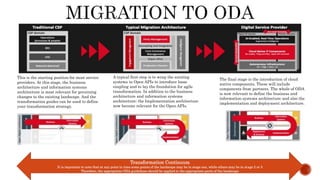
This is the starting position for most service
providers. At this stage, the business
architecture and information systems
architecture is most relevant for governing
changes to the existing landscape. And the
transformation guides can be used to define
your transformation strategy.
A typical first step is to wrap the existing
systems in Open APIs to introduce loose
coupling and to lay the foundation for agile
transformation. In addition to the business
architecture and information systems
architecture; the Implementation architecture
now become relevant for the Open APIs.
The final stage is the introduction of cloud
native components. These will include
components from partners. The whole of ODA
is now relevant to define the business and
information systems architecture and also the
implementation and deployment architecture.
Transformation Continuum
It is important to note that at any point in time some points of the landscape may be in stage one, while others may be in stage 2 or 3
Therefore, the appropriate ODA guidelines should be applied to the appropriate parts of the landscape
Separation of concerns and simplification through decoupling of the domains
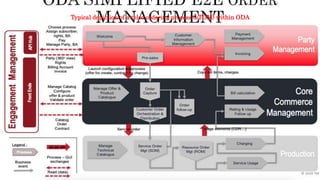
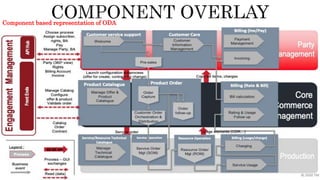
Typical depiction of a telco ordering process (eTOM) within ODA
Component based representation of ODA
Architectural innovation to solve the structural problems
Networks need the freedom to act independently, to govern themselves and to control their behaviour
through previously defined policies, it means self-governing, with no external humans or machine are
acting upon them.
The Autonomous Networks consist of a simplified network architecture, virtualized components,
automating agents, intelligent decision engines and present self dynamic capabilities to create
intelligent business and network operations based on closed-loops.
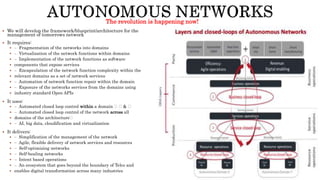
 We will develop the framework/blueprint/architecture for the
management of tomorrows network
 It requires:
 ‒ Fragmentation of the networks into domains
 ‒ Virtualization of the network functions within domains
 ‒ Implementation of the network functions as software
 components that expose services
 ‒ Encapsulation of the network function complexity within the
 relevant domains as a set of network services
 ‒ Automation of network function repair within the domain
 ‒ Exposure of the networks services from the domains using
 industry standard Open APIs
 It uses:
 ‒ Automated closed loop control within a domain &
 ‒ Automated closed loop control of the network across all
 domains of the architecture
 ‒ AI, big data, cloudification and virtualization
 It delivers:
 ‒ Simplification of the management of the network
 ‒ Agile, flexible delivery of network services and resources
 ‒ Self-optimizing networks
 ‒ Self-healing networks
 ‒ Intent based operations
 ‒ An ecosystem that goes beyond the boundary of Telco and
 enables digital transformation across many industries
The revolution is happening now!
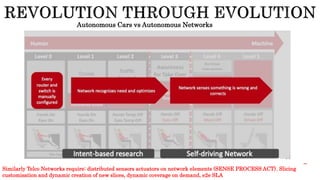
Similarly Telco Networks require: distributed sensors actuators on network elements (SENSE PROCESS ACT), Slicing
customisation and dynamic creation of new slices, dynamic coverage on demand, e2e SLA
Autonomous Cars vs Autonomous Networks
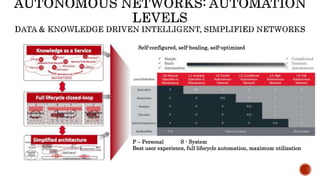
P – Personal S - System
Best user experience, full lifecycle automation, maximum utilization
Self-configured, self-healing, self-optimized
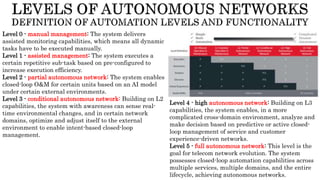
Level 0 - manual management: The system delivers
assisted monitoring capabilities, which means all dynamic
tasks have to be executed manually.
Level 1 - assisted management: The system executes a
certain repetitive sub-task based on pre-configured to
increase execution efficiency.
Level 2 - partial autonomous network: The system enables
closed-loop O&M for certain units based on an AI model
under certain external environments.
Level 3 - conditional autonomous network: Building on L2
capabilities, the system with awareness can sense real-
time environmental changes, and in certain network
domains, optimize and adjust itself to the external
environment to enable intent-based closed-loop
management.
Level 4 - high autonomous network: Building on L3
capabilities, the system enables, in a more
complicated cross-domain environment, analyze and
make decision based on predictive or active closed-
loop management of service and customer
experience-driven networks.
Level 5 - full autonomous network: This level is the
goal for telecom network evolution. The system
possesses closed-loop automation capabilities across
multiple services, multiple domains, and the entire
lifecycle, achieving autonomous networks.
 “Softwarization” of the Network
 Transforming the network layer through
virtualization
 Telstra have mapped their entire network to a
set of operational Domains
 Each Domain has a Catalogue of the services it
supports
 Each Domain exposes a well-defined standard
set of services to the order delivery orchestrator
so that products and offers can be composed
with minimal dependencies on the network
resources
 Telstra will manage the lifecycles of these
network services autonomously using the
customer’s intent, policy, closed control loops,
data analytics and machine learning.
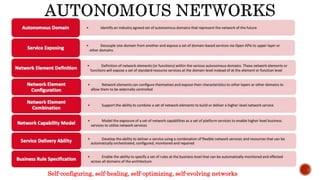
A set of autonomous domains that represent networks of
the future
Self-configuring, self-healing, self-optimizing, self-evolving networks
Open Digital Framework from TMFORUM

Open Digital Framework from TMFORUM

  • 1.
  • 2.
    Mission: To enablethe service provider businesses of tomorrow
  • 3.
    1. E2E BusinessAgility How fast? (Concept-to-Cash cycle time) 2. Cost Optimisation At what Cost? 3. Digital Experience & Trust With what experience? 4. B2B Growth With what growth from B2B? 5. B2C Growth With what growth from B2C? Market Requirements/Ambition • Launch new products in days (MVP) • Deliver new features in minutes • Double OpEx Efficiency • Dramatically improve CapEx efficiency • 100% of interactions through digital • Build on reputation for Trust • 40% growth in wholesale (B2B2x) • 10% growth in ‘pure’ B2B • 3-5% growth in B2C Ability to self-disrupt (‘Engine 2.0’)
  • 4.
    Z e r o - t o u c h O p e r a b i l i t y er op erabili ty Zero-touchPartnering Traditional Communication Service Provider (CSP) Digital Service Provider (CSP)
  • 6.
    A blueprint forintelligent operations fit for the 5G era  Provides a migration path from legacy systems and processes to modular, cloud native software orchestrated using AI Practical tools  ODF comprises tools, code, knowledge and standards (machine-readable assets, not just documents)  Delivering business value for TM Forum members today  Accelerating concept-to-cash, eliminating IT & network costs, enhancing digital customer experience  Developed through TM Forum’s collaboration programs  Created and used by leading service providers and software companies, building on TM Forum’s established standards
  • 8.
    Open Digital Architecture Architecture framework, common language, design principles  Open APIs exposing business services  Software components  Reference implementation and test environment Maturity Tools & Data  Maturity models and readiness checks to baseline digital capabilities  Data for benchmarking progress and training AI Transformation Tools  Guides to navigate digital transformation  Tools to support the migration from legacy architecture to ODA
  • 9.
    Open Digital Framework& Open Digital Architecture
  • 10.
     ODA isa complete enterprise architecture blueprint for open digital platforms, replacing traditional operational and business support systems  Comprises standardized, reusable, cloud native software components organized into loosely coupled domains  Components connect via standardized Open APIs which:  ‒ Provide zero-touch interoperability (plug-&-play components)  ‒ Expose business capabilities for zero-touch partnering  ODA transforms business agility with simpler IT solutions that are easier and cheaper to deploy, integrate & upgrade  Built by industry agreement  TM Forum members are actively developing the ODA standards, leveraging mature, proven TM Forum assets
  • 11.
    Business Architecture  Businesscapability map & value stream mappings  Multi-layered model of the key business processes for efficient, agile operations (eTOM) Information Systems Architecture  Functional architecture (a set of structured and simplified implementation independent views enforcing decoupling)  Data architecture, with standard definitions for the information that flows through the enterprise and between service providers & their partners (SID) Implementation Architecture  Suite of 50+ REST-based Open APIs for standardized interoperability of IT systems and partner integration  Standardized data model, enhanced for AI operations  Definition of the ODA Components for reuse and simple integration Deployment & Runtime Environment  Canvas – a standard technical framework and DevOps environment for plug-and-play ODA components  Lab-deployed reference implementation and test environment Governance  Principles, design guides, metamodels  Tools for agile management of the architecture lifecycle
  • 12.
    Capability Driven Transformation Business capabilities->functions -> components  Enables business / technical agility  Common language for Business  (requirements) and IT (design)  Enables the software marketplace Standardized components, built for a deployment canvas  Supports cloud native deployment Orchestration of business capabilities to execute value stream workflows (eTOM)  Supports consistent automation & intelligence Standard data language (SID) & data model (optimized for AI)  Supports zero-touch interoperability  Supports AI training Functional framework, organized in loosely coupled domains  Simplifies the architecture and enables pace layering Capabilities of components exposed using Open APIs  Enables zero-touch interoperability and zero-touch partnering Component capabilities are discoverable (via Catalogues)  New services can be designed from existing services  No need for manual configuration of new service chains
  • 13.
    1. Accelerate Concept-to- Cash Launch new products in days Ambition Challenges ODA Solutions a. Lack of business agility i. Modular, reusable software components ii. Designed for rapid experimentation and agile ways of working 2. Monetize 5G in the enterprise  40% growth in B2B2X a. Lack of business / technical alignment b. Systems & processes designed for traditional telco business i. Common language for business & technology domains ii. Supports any product via catalogue- based data and rules iii. Zero-Touch Partnering via Open APIs 3. Eliminate costs  Double OpEx efficiency a. Lack of business / technical alignment b. Systems & processes designed for traditional telco business i. Enables a marketplace for standardized software components ii. Open standards to minimize software customization iii. Zero-Touch Interoperability via Open APIs iv. Optimized for cloud native deployment v. Zero-Touch Operations via AI-enabled automation 4. Delight Customers  100% digital interactions a. Poor customer experience due to disconnected systems b. No single view of the customer i. Pace-layering for rapid evolution of customer- facing systems ii. 360o customer view built on a common data model iii. AI-ready for optimizing personalized customer experiences
  • 14.
    Components are organizedinto loosely coupled domains  Decoupling of the domains simplifies the architecture and enables separation of concerns  Each domain can change at its own pace without affecting other domains (pace- layering)  Business functions of the domains are exposed via Open APIs
  • 15.
    Engagement Management  Fora single coherent customer experience Party Management  Supporting complex business models Core Commerce Management  Supporting third party & marketplace offers, service composition and orchestration Intelligence Management  To support systems of insight, AI, Machine Learning and Cognitive capabilities Production  Abstracting the complexity of infrastructure
  • 16.
    ODA specifies standardized,reusable software- defined components connected via Open APIs  Support real time, dynamic integration via TM Forum Open APIs (components can be assembled like Lego blocks - Open APIs and a standard data model enable zero-touch interoperability)  Expose their business capabilities (discoverable via Catalogues) externally through Open APIs, enabling zero-touch partnering  Support a common data architecture; contain their own data and share it in real-time (AI- ready)  Components are microservices-based, supporting cloud native deployment (e.g. autonomous, self- healing, self-scaling...)  Can be automatically deployed and managed in an operational ‘Canvas’, exposing operational interfaces for management, monitoring, security...
  • 19.
    Z e r o - t o u c h O p e r a b i l i t y er op erabili ty Zero-touchPartnering Traditional Communication Service Provider (CSP) Digital Service Provider (CSP)
  • 20.
    This is thestarting position for most service providers. At this stage, the business architecture and information systems architecture is most relevant for governing changes to the existing landscape. And the transformation guides can be used to define your transformation strategy. A typical first step is to wrap the existing systems in Open APIs to introduce loose coupling and to lay the foundation for agile transformation. In addition to the business architecture and information systems architecture; the Implementation architecture now become relevant for the Open APIs. The final stage is the introduction of cloud native components. These will include components from partners. The whole of ODA is now relevant to define the business and information systems architecture and also the implementation and deployment architecture. Transformation Continuum It is important to note that at any point in time some points of the landscape may be in stage one, while others may be in stage 2 or 3 Therefore, the appropriate ODA guidelines should be applied to the appropriate parts of the landscape
  • 21.
    Separation of concernsand simplification through decoupling of the domains
  • 22.
    Typical depiction ofa telco ordering process (eTOM) within ODA
  • 23.
  • 25.
    Architectural innovation tosolve the structural problems Networks need the freedom to act independently, to govern themselves and to control their behaviour through previously defined policies, it means self-governing, with no external humans or machine are acting upon them. The Autonomous Networks consist of a simplified network architecture, virtualized components, automating agents, intelligent decision engines and present self dynamic capabilities to create intelligent business and network operations based on closed-loops.
  • 27.
     We willdevelop the framework/blueprint/architecture for the management of tomorrows network  It requires:  ‒ Fragmentation of the networks into domains  ‒ Virtualization of the network functions within domains  ‒ Implementation of the network functions as software  components that expose services  ‒ Encapsulation of the network function complexity within the  relevant domains as a set of network services  ‒ Automation of network function repair within the domain  ‒ Exposure of the networks services from the domains using  industry standard Open APIs  It uses:  ‒ Automated closed loop control within a domain &  ‒ Automated closed loop control of the network across all  domains of the architecture  ‒ AI, big data, cloudification and virtualization  It delivers:  ‒ Simplification of the management of the network  ‒ Agile, flexible delivery of network services and resources  ‒ Self-optimizing networks  ‒ Self-healing networks  ‒ Intent based operations  ‒ An ecosystem that goes beyond the boundary of Telco and  enables digital transformation across many industries The revolution is happening now!
  • 28.
    Similarly Telco Networksrequire: distributed sensors actuators on network elements (SENSE PROCESS ACT), Slicing customisation and dynamic creation of new slices, dynamic coverage on demand, e2e SLA Autonomous Cars vs Autonomous Networks
  • 29.
    P – PersonalS - System Best user experience, full lifecycle automation, maximum utilization Self-configured, self-healing, self-optimized
  • 30.
    Level 0 -manual management: The system delivers assisted monitoring capabilities, which means all dynamic tasks have to be executed manually. Level 1 - assisted management: The system executes a certain repetitive sub-task based on pre-configured to increase execution efficiency. Level 2 - partial autonomous network: The system enables closed-loop O&M for certain units based on an AI model under certain external environments. Level 3 - conditional autonomous network: Building on L2 capabilities, the system with awareness can sense real- time environmental changes, and in certain network domains, optimize and adjust itself to the external environment to enable intent-based closed-loop management. Level 4 - high autonomous network: Building on L3 capabilities, the system enables, in a more complicated cross-domain environment, analyze and make decision based on predictive or active closed- loop management of service and customer experience-driven networks. Level 5 - full autonomous network: This level is the goal for telecom network evolution. The system possesses closed-loop automation capabilities across multiple services, multiple domains, and the entire lifecycle, achieving autonomous networks.
  • 31.
     “Softwarization” ofthe Network  Transforming the network layer through virtualization  Telstra have mapped their entire network to a set of operational Domains  Each Domain has a Catalogue of the services it supports  Each Domain exposes a well-defined standard set of services to the order delivery orchestrator so that products and offers can be composed with minimal dependencies on the network resources  Telstra will manage the lifecycles of these network services autonomously using the customer’s intent, policy, closed control loops, data analytics and machine learning. A set of autonomous domains that represent networks of the future
  • 32.