BPM Implementation - Success Criteria and Best Practice Alan McSweeney
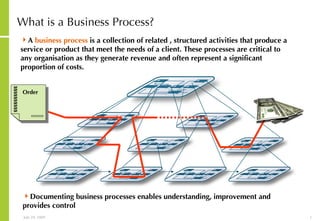
What is a Business Process? A  business process  is a collection of related , structured activities that produce a service or product that meet the needs of a client. These processes are critical to any organisation as they generate revenue and often represent a significant proportion of costs. Documenting business processes enables understanding, improvement and provides control Order
What is Business Process Management (BPM)? Business Process Management (BPM) is a method of efficiently aligning an organisation with the wants and needs of clients It is a complete management approach that promotes business effectiveness and efficiency while striving for innovation, flexibility and integration with technology As organisations look to achieve their objectives, BPM attempts to continuously improve processes - the process to define, measure and improve your processes – a ‘process optimisation' process
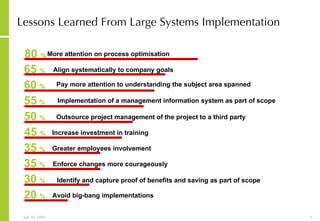
Lessons Learned From Large Systems Implementation 80  %  65   % 60   % 50   % 45   % 35   % 35   % 30   % 20   % More attention on process optimisation Align systematically to company goals Pay more attention to understanding the subject area spanned Outsource project management of the project to a third party Increase investment in training Greater employees involvement Enforce changes more courageously Identify and capture proof of benefits and saving as part of scope Avoid big-bang implementations 55   % Implementation of a management information system as part of scope
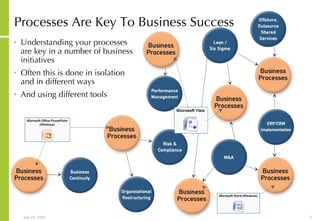
Processes Are Key To Business Success Understanding your processes are key in a number of business initiatives Often this is done in isolation and in different ways And using different tools
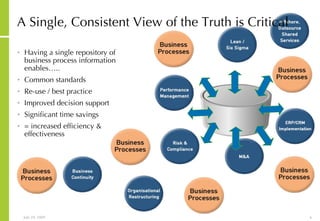
A Single, Consistent View of the Truth is Critical Having a single repository of business process information enables…..  Common standards Re-use / best practice Improved decision support Significant time savings = increased efficiency & effectiveness
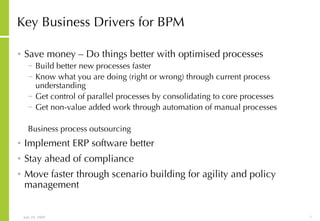
Key Business Drivers for BPM Save money – Do things better with optimised processes Build better new processes faster Know what you are doing (right or wrong) through current process understanding Get control of parallel processes by consolidating to core processes Get non-value added work through automation of manual processes Business process outsourcing Implement ERP software better Stay ahead of compliance Move faster through scenario building for agility and policy management
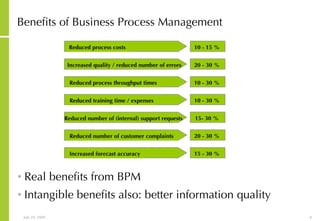
Benefits of Business Process Management Real benefits from BPM Intangible benefits also: better information quality Reduced process costs   Increased quality / reduced number of errors Reduced process throughput times   Reduced training time / expenses Reduced number of (internal) support requests Reduced number of customer complaints   Increased forecast accuracy   10 - 15 %   10 - 30 %   20 - 30 %   10 - 30 %   15- 30 %   20 - 30 %   15 - 30 %
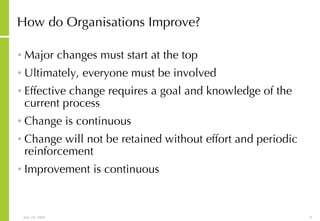
How do Organisations Improve? Major changes must start at the top Ultimately, everyone must be involved Effective change requires a goal and knowledge of the current process Change is continuous Change will not be retained without effort and periodic reinforcement Improvement is continuous
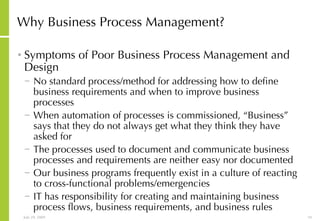
Why Business Process Management? Symptoms of Poor Business Process Management and Design No standard process/method for addressing how to define business requirements and when to improve business processes  When automation of processes is commissioned, “Business” says that they do not always get what they think they have asked for The processes used to document and communicate business processes and requirements are neither easy nor documented Our business programs frequently exist in a culture of reacting to cross-functional problems/emergencies IT has responsibility for creating and maintaining business process flows, business requirements, and business rules
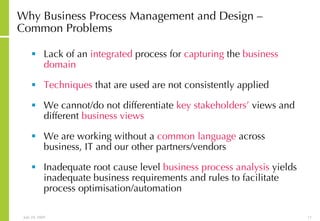
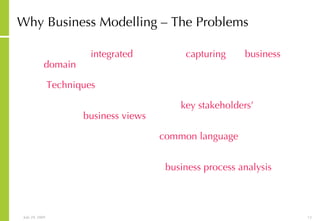
Why Business Process Management and Design – Common Problems Lack of an  integrated  process for  capturing  the  business domain Techniques  that are used are not consistently applied We cannot/do not differentiate  key stakeholders’  views and different  business views We are working without a  common language   across business, IT and our other partners/vendors Inadequate root cause level  business process analysis  yields inadequate business requirements and rules to facilitate process optimisation/automation
Why Business Modelling – The Problems Lack of an   integrated   process for   capturing   the   business domain Techniques   that are used are not consistently applied We cannot/do not differentiate   key stakeholders’   views and different   business views We are working without a   common language   across business, IT   and our other partners/vendors Inadequate root cause level   business process analysis   yields   inadequate business requirements and rules to facilitate process  optimisation/automation
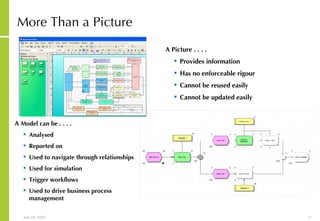
More Than a Picture A Picture . . . . Provides information Has no enforceable rigour Cannot be reused easily Cannot be updated easily A  Model can be . . . . Analysed Reported on Used to navigate through relationships Used for simulation Trigger workflows Used to drive business process management
Finding the Right Project Key characteristics of right project The process or project is related to a key business issue You have/can get customer input on the issue Management assigns this project a high priority Process owner and key stakeholders are defined The problem is stated as a target or need and NOT a solution The sponsor of this project can commit time and resources to this project The business process(es) will not be changed by another initiative at any time in the near future Focus on: Which process is the most critical  Which process contributes the most  Ensure the benefits of an improvement project do not degrade over time
Critical Success Factors  Linked to business strategies and goals Linked to customer value Ability to implement incremental value added change Ability to track results and measure success Ability to be aligned with the business
Successful Business Process Analysis, Design and Implementation Projects Have  Understood the Business Architecture – Business Process, Metrics, Strategy and Goals  Engaged stakeholders and defined process ownership Taken an iterative and incremental approach Tackled the right project at the right time Implemented internal and external standards and the right level of governance Understood the role of information Incorporated process improvement Achieve business results with a series of small successes
Do Not Ignore Organisational Change The failure to manage the human side of business changes is a major contributor to the reasons programme, projects and initiatives fail Organisations may not have the experience necessary to manage the speed and complexity of the large-scale changes Managers are all too frequently concerned with tactical, operational issues and have not had the time to consider organisational changes
Process Analysis within Service Orientation Process Driven Integration Services Based Integration Cut integration costs and reduce development  New Business Initiatives Agility, Growth – New Products and Services Increased Delivery Channels Process Improvement Optimising business processes Straight Through Processing IT Regeneration Enterprise IT Architecture – Aligning more with Business Legacy Replacement Extending the Enterprise Partnering, B2B
Intelligent Use of BPM Help prioritising intelligent cuts: via a business process architecture and a good process measurement system Process Optimisation: BPM teams can quickly examine processes and suggest changes to eliminate waste Good BPM teams can almost always identify some quick changes that will save 10-30%
Intelligent Use of BPM Reorganisations Changes in status also require that new processes and business rules be implemented throughout the organisation  Additional Regulation New regulations require new practices and new business rules
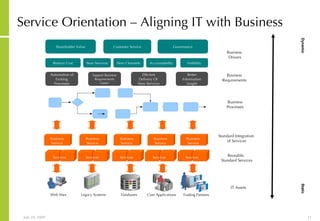
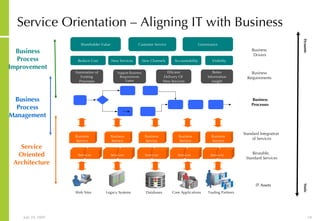
Service Orientation – Aligning IT with Business Dynamic  Static AR IT Assets Accountability Reduce Cost New Channels Visibility New Services Customer Service Shareholder Value Governance Business  Drivers Business Requirements Better Information insight Support Business Requirements Faster Efficient Delivery Of  New Services Automation of Existing Processes Reusable,  Standard Services Standard Integration  of Services Business Processes Services Services Services Services Business Service Business Service Business Service Business Service Services Business Service Trading Partners Legacy Systems Web Sites Databases Core Applications
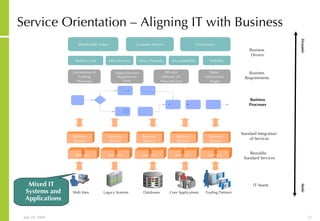
Service Orientation – Aligning IT with Business Dynamic  Static AR Accountability Reduce Cost New Channels Visibility New Services Customer Service Shareholder Value Governance Business  Drivers Business Requirements Better Information insight Support Business Requirements Faster Efficient Delivery Of  New Services Automation of Existing Processes Reusable,  Standard Services Standard Integration  of Services Business Processes Services Services Services Services Business Service Business Service Business Service Business Service Services Business Service IT Assets Trading Partners Legacy Systems Web Sites Databases Core Applications Mixed IT Systems and Applications
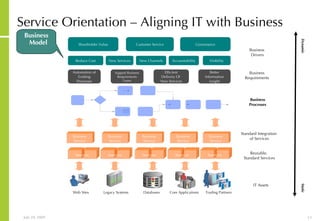
Service Orientation – Aligning IT with Business Dynamic  Static AR Reusable,  Standard Services Standard Integration  of Services Business Processes Services Services Services Services Business Service Business Service Business Service Business Service Services Business Service IT Assets Trading Partners Legacy Systems Web Sites Databases Core Applications Accountability Reduce Cost New Channels Visibility New Services Customer Service Shareholder Value Governance Business  Drivers Business Requirements Better Information insight Support Business Requirements Faster Efficient Delivery Of  New Services Automation of Existing Processes Business Model
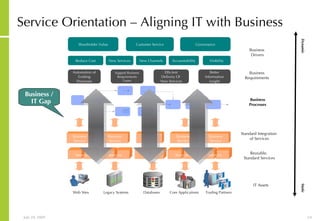
Service Orientation – Aligning IT with Business Dynamic  Static AR Reusable,  Standard Services Standard Integration  of Services Business Processes Services Services Services Services Business Service Business Service Business Service Business Service Services Business Service IT Assets Trading Partners Legacy Systems Web Sites Databases Core Applications Accountability Reduce Cost New Channels Visibility New Services Customer Service Shareholder Value Governance Business  Drivers Business Requirements Better Information insight Support Business Requirements Faster Efficient Delivery Of  New Services Automation of Existing Processes Business / IT Gap
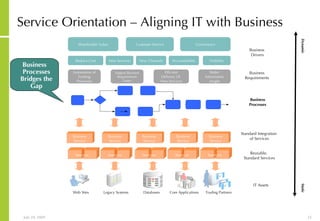
Service Orientation – Aligning IT with Business Dynamic  Static AR IT Assets Accountability Reduce Cost New Channels Visibility New Services Customer Service Shareholder Value Governance Business  Drivers Business Requirements Better Information insight Support Business Requirements Faster Efficient Delivery Of  New Services Automation of Existing Processes Reusable,  Standard Services Standard Integration  of Services Business Processes Services Services Services Services Business Service Business Service Business Service Business Service Services Business Service Trading Partners Legacy Systems Web Sites Databases Core Applications Business Processes Bridges the Gap
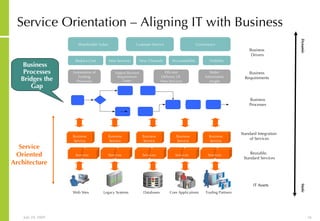
Service Orientation – Aligning IT with Business Dynamic  Static AR IT Assets Accountability Reduce Cost New Channels Visibility New Services Customer Service Shareholder Value Governance Business  Drivers Business Requirements Better Information insight Support Business Requirements Faster Efficient Delivery Of  New Services Automation of Existing Processes Reusable,  Standard Services Standard Integration  of Services Business Processes Services Services Services Services Business Service Business Service Business Service Business Service Services Business Service Service Oriented Architecture IT Assets Trading Partners Legacy Systems Web Sites Databases Core Applications Business Processes Bridges the Gap
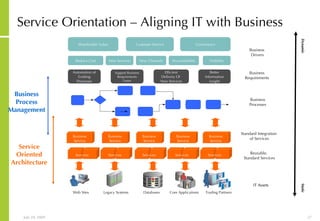
Service Orientation – Aligning IT with Business Dynamic  Static AR IT Assets Accountability Reduce Cost New Channels Visibility New Services Customer Service Shareholder Value Governance Business  Drivers Reusable,  Standard Services Standard Integration  of Services Business Processes Services Services Services Services Business Service Business Service Business Service Business Service Services Business Service Service Oriented Architecture IT Assets Trading Partners Legacy Systems Web Sites Databases Core Applications Business Requirements Better Information insight Support Business Requirements Faster Efficient Delivery Of  New Services Automation of Existing Processes Business Process Management
Service Orientation – Aligning IT with Business Dynamic  Static AR IT Assets Reusable,  Standard Services Standard Integration  of Services Business Processes Services Services Services Services Business Service Business Service Business Service Business Service Services Business Service Service Oriented Architecture IT Assets Trading Partners Legacy Systems Web Sites Databases Core Applications Business Requirements Better Information insight Support Business Requirements Faster Efficient Delivery Of  New Services Automation of Existing Processes Business Process Management Accountability Reduce Cost New Channels Visibility New Services Customer Service Shareholder Value Governance Business  Drivers Business Process Improvement
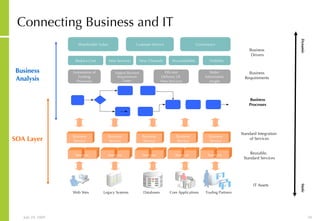
Connecting Business and IT Dynamic  Static IT Assets Accountability Reduce Cost New Channels Visibility New Services Customer Service Shareholder Value Governance Business  Drivers Business Requirements Better Information insight Support Business Requirements Faster Efficient Delivery Of  New Services Automation of Existing Processes Reusable,  Standard Services Standard Integration  of Services Business Processes Services Services Services Services Business Service Business Service Business Service Business Service Services Business Service Trading Partners Legacy Systems Web Sites Databases Core Applications Business Analysis SOA Layer
Business Challenges Business is facing Global business competition Rapid innovation and fast-changing business requirements Regulatory compliance challenges Increasing cost pressures Technology’s typical response Slow delivery times High maintenance costs Brittle solutions Stove piped functional applications Redundant development efforts and operations Redundant and costly investment in multiple technical solutions Can technology be realigned to support the needs of business?
More Information Alan McSweeney [email_address]

Bpm Implementation Success Criteria And Best Practice

  • 1.
    BPM Implementation -Success Criteria and Best Practice Alan McSweeney
  • 2.
    What is aBusiness Process? A business process is a collection of related , structured activities that produce a service or product that meet the needs of a client. These processes are critical to any organisation as they generate revenue and often represent a significant proportion of costs. Documenting business processes enables understanding, improvement and provides control Order
  • 3.
    What is BusinessProcess Management (BPM)? Business Process Management (BPM) is a method of efficiently aligning an organisation with the wants and needs of clients It is a complete management approach that promotes business effectiveness and efficiency while striving for innovation, flexibility and integration with technology As organisations look to achieve their objectives, BPM attempts to continuously improve processes - the process to define, measure and improve your processes – a ‘process optimisation' process
  • 4.
    Lessons Learned FromLarge Systems Implementation 80 % 65 % 60 % 50 % 45 % 35 % 35 % 30 % 20 % More attention on process optimisation Align systematically to company goals Pay more attention to understanding the subject area spanned Outsource project management of the project to a third party Increase investment in training Greater employees involvement Enforce changes more courageously Identify and capture proof of benefits and saving as part of scope Avoid big-bang implementations 55 % Implementation of a management information system as part of scope
  • 5.
    Processes Are KeyTo Business Success Understanding your processes are key in a number of business initiatives Often this is done in isolation and in different ways And using different tools
  • 6.
    A Single, ConsistentView of the Truth is Critical Having a single repository of business process information enables….. Common standards Re-use / best practice Improved decision support Significant time savings = increased efficiency & effectiveness
  • 7.
    Key Business Driversfor BPM Save money – Do things better with optimised processes Build better new processes faster Know what you are doing (right or wrong) through current process understanding Get control of parallel processes by consolidating to core processes Get non-value added work through automation of manual processes Business process outsourcing Implement ERP software better Stay ahead of compliance Move faster through scenario building for agility and policy management
  • 8.
    Benefits of BusinessProcess Management Real benefits from BPM Intangible benefits also: better information quality Reduced process costs Increased quality / reduced number of errors Reduced process throughput times Reduced training time / expenses Reduced number of (internal) support requests Reduced number of customer complaints Increased forecast accuracy 10 - 15 % 10 - 30 % 20 - 30 % 10 - 30 % 15- 30 % 20 - 30 % 15 - 30 %
  • 9.
    How do OrganisationsImprove? Major changes must start at the top Ultimately, everyone must be involved Effective change requires a goal and knowledge of the current process Change is continuous Change will not be retained without effort and periodic reinforcement Improvement is continuous
  • 10.
    Why Business ProcessManagement? Symptoms of Poor Business Process Management and Design No standard process/method for addressing how to define business requirements and when to improve business processes When automation of processes is commissioned, “Business” says that they do not always get what they think they have asked for The processes used to document and communicate business processes and requirements are neither easy nor documented Our business programs frequently exist in a culture of reacting to cross-functional problems/emergencies IT has responsibility for creating and maintaining business process flows, business requirements, and business rules
  • 11.
    Why Business ProcessManagement and Design – Common Problems Lack of an integrated process for capturing the business domain Techniques that are used are not consistently applied We cannot/do not differentiate key stakeholders’ views and different business views We are working without a common language across business, IT and our other partners/vendors Inadequate root cause level business process analysis yields inadequate business requirements and rules to facilitate process optimisation/automation
  • 12.
    Why Business Modelling– The Problems Lack of an integrated process for capturing the business domain Techniques that are used are not consistently applied We cannot/do not differentiate key stakeholders’ views and different business views We are working without a common language across business, IT and our other partners/vendors Inadequate root cause level business process analysis yields inadequate business requirements and rules to facilitate process optimisation/automation
  • 13.
    More Than aPicture A Picture . . . . Provides information Has no enforceable rigour Cannot be reused easily Cannot be updated easily A Model can be . . . . Analysed Reported on Used to navigate through relationships Used for simulation Trigger workflows Used to drive business process management
  • 14.
    Finding the RightProject Key characteristics of right project The process or project is related to a key business issue You have/can get customer input on the issue Management assigns this project a high priority Process owner and key stakeholders are defined The problem is stated as a target or need and NOT a solution The sponsor of this project can commit time and resources to this project The business process(es) will not be changed by another initiative at any time in the near future Focus on: Which process is the most critical Which process contributes the most Ensure the benefits of an improvement project do not degrade over time
  • 15.
    Critical Success Factors Linked to business strategies and goals Linked to customer value Ability to implement incremental value added change Ability to track results and measure success Ability to be aligned with the business
  • 16.
    Successful Business ProcessAnalysis, Design and Implementation Projects Have Understood the Business Architecture – Business Process, Metrics, Strategy and Goals Engaged stakeholders and defined process ownership Taken an iterative and incremental approach Tackled the right project at the right time Implemented internal and external standards and the right level of governance Understood the role of information Incorporated process improvement Achieve business results with a series of small successes
  • 17.
    Do Not IgnoreOrganisational Change The failure to manage the human side of business changes is a major contributor to the reasons programme, projects and initiatives fail Organisations may not have the experience necessary to manage the speed and complexity of the large-scale changes Managers are all too frequently concerned with tactical, operational issues and have not had the time to consider organisational changes
  • 18.
    Process Analysis withinService Orientation Process Driven Integration Services Based Integration Cut integration costs and reduce development New Business Initiatives Agility, Growth – New Products and Services Increased Delivery Channels Process Improvement Optimising business processes Straight Through Processing IT Regeneration Enterprise IT Architecture – Aligning more with Business Legacy Replacement Extending the Enterprise Partnering, B2B
  • 19.
    Intelligent Use ofBPM Help prioritising intelligent cuts: via a business process architecture and a good process measurement system Process Optimisation: BPM teams can quickly examine processes and suggest changes to eliminate waste Good BPM teams can almost always identify some quick changes that will save 10-30%
  • 20.
    Intelligent Use ofBPM Reorganisations Changes in status also require that new processes and business rules be implemented throughout the organisation Additional Regulation New regulations require new practices and new business rules
  • 21.
    Service Orientation –Aligning IT with Business Dynamic Static AR IT Assets Accountability Reduce Cost New Channels Visibility New Services Customer Service Shareholder Value Governance Business Drivers Business Requirements Better Information insight Support Business Requirements Faster Efficient Delivery Of New Services Automation of Existing Processes Reusable, Standard Services Standard Integration of Services Business Processes Services Services Services Services Business Service Business Service Business Service Business Service Services Business Service Trading Partners Legacy Systems Web Sites Databases Core Applications
  • 22.
    Service Orientation –Aligning IT with Business Dynamic Static AR Accountability Reduce Cost New Channels Visibility New Services Customer Service Shareholder Value Governance Business Drivers Business Requirements Better Information insight Support Business Requirements Faster Efficient Delivery Of New Services Automation of Existing Processes Reusable, Standard Services Standard Integration of Services Business Processes Services Services Services Services Business Service Business Service Business Service Business Service Services Business Service IT Assets Trading Partners Legacy Systems Web Sites Databases Core Applications Mixed IT Systems and Applications
  • 23.
    Service Orientation –Aligning IT with Business Dynamic Static AR Reusable, Standard Services Standard Integration of Services Business Processes Services Services Services Services Business Service Business Service Business Service Business Service Services Business Service IT Assets Trading Partners Legacy Systems Web Sites Databases Core Applications Accountability Reduce Cost New Channels Visibility New Services Customer Service Shareholder Value Governance Business Drivers Business Requirements Better Information insight Support Business Requirements Faster Efficient Delivery Of New Services Automation of Existing Processes Business Model
  • 24.
    Service Orientation –Aligning IT with Business Dynamic Static AR Reusable, Standard Services Standard Integration of Services Business Processes Services Services Services Services Business Service Business Service Business Service Business Service Services Business Service IT Assets Trading Partners Legacy Systems Web Sites Databases Core Applications Accountability Reduce Cost New Channels Visibility New Services Customer Service Shareholder Value Governance Business Drivers Business Requirements Better Information insight Support Business Requirements Faster Efficient Delivery Of New Services Automation of Existing Processes Business / IT Gap
  • 25.
    Service Orientation –Aligning IT with Business Dynamic Static AR IT Assets Accountability Reduce Cost New Channels Visibility New Services Customer Service Shareholder Value Governance Business Drivers Business Requirements Better Information insight Support Business Requirements Faster Efficient Delivery Of New Services Automation of Existing Processes Reusable, Standard Services Standard Integration of Services Business Processes Services Services Services Services Business Service Business Service Business Service Business Service Services Business Service Trading Partners Legacy Systems Web Sites Databases Core Applications Business Processes Bridges the Gap
  • 26.
    Service Orientation –Aligning IT with Business Dynamic Static AR IT Assets Accountability Reduce Cost New Channels Visibility New Services Customer Service Shareholder Value Governance Business Drivers Business Requirements Better Information insight Support Business Requirements Faster Efficient Delivery Of New Services Automation of Existing Processes Reusable, Standard Services Standard Integration of Services Business Processes Services Services Services Services Business Service Business Service Business Service Business Service Services Business Service Service Oriented Architecture IT Assets Trading Partners Legacy Systems Web Sites Databases Core Applications Business Processes Bridges the Gap
  • 27.
    Service Orientation –Aligning IT with Business Dynamic Static AR IT Assets Accountability Reduce Cost New Channels Visibility New Services Customer Service Shareholder Value Governance Business Drivers Reusable, Standard Services Standard Integration of Services Business Processes Services Services Services Services Business Service Business Service Business Service Business Service Services Business Service Service Oriented Architecture IT Assets Trading Partners Legacy Systems Web Sites Databases Core Applications Business Requirements Better Information insight Support Business Requirements Faster Efficient Delivery Of New Services Automation of Existing Processes Business Process Management
  • 28.
    Service Orientation –Aligning IT with Business Dynamic Static AR IT Assets Reusable, Standard Services Standard Integration of Services Business Processes Services Services Services Services Business Service Business Service Business Service Business Service Services Business Service Service Oriented Architecture IT Assets Trading Partners Legacy Systems Web Sites Databases Core Applications Business Requirements Better Information insight Support Business Requirements Faster Efficient Delivery Of New Services Automation of Existing Processes Business Process Management Accountability Reduce Cost New Channels Visibility New Services Customer Service Shareholder Value Governance Business Drivers Business Process Improvement
  • 29.
    Connecting Business andIT Dynamic Static IT Assets Accountability Reduce Cost New Channels Visibility New Services Customer Service Shareholder Value Governance Business Drivers Business Requirements Better Information insight Support Business Requirements Faster Efficient Delivery Of New Services Automation of Existing Processes Reusable, Standard Services Standard Integration of Services Business Processes Services Services Services Services Business Service Business Service Business Service Business Service Services Business Service Trading Partners Legacy Systems Web Sites Databases Core Applications Business Analysis SOA Layer
  • 30.
    Business Challenges Businessis facing Global business competition Rapid innovation and fast-changing business requirements Regulatory compliance challenges Increasing cost pressures Technology’s typical response Slow delivery times High maintenance costs Brittle solutions Stove piped functional applications Redundant development efforts and operations Redundant and costly investment in multiple technical solutions Can technology be realigned to support the needs of business?
  • 31.
    More Information AlanMcSweeney [email_address]

Editor's Notes

  • #3 A business process can be decomposed into several sub-processes, which have their own attributes, but also contribute to achieving the goal of the super-process. The analysis of business processes typically includes the modelling of processes and sub-processes down to activity level.
  • #9 Can we link this slide 11
  • #11 Solution Architecture Blueprint develops a comprehensive specification of the essential aspects of an information system within a particular context. Allows the designers to make tradeoffs in development and product / technology selections Covers the system’s purpose, functions, interfaces with elements in the system’s environment, constituent components and their relationships, principles of operation, properties, and means of construction and test Makes it possible to plan and execute a successful project