Implementing
BUSINESS PROCESS
MODEL AND NOTATION (BPMN) 2.0
with Microsoft Visio
Developed and Lead by Goutama Bachtiar
March 2015
Image: jcosd.com
Session Agenda
• Understanding BPMN 2.0
• Valuing BPMN Concepts and High Level Map
• Exploring Microsoft Visio 2003 Professional Edition
• Utilizing BPMN Methods and Style
• Comprehending Pools, Subprocesses, and
Hierarchical Modeling
• Valuing Collaboration and a "Complete" Top-Level
Diagram
• Leveraging Events Overview and Using Timer Events
• Sending, Receiving, and Using Message Events
March 2015BPMN 2.0 2
Session Agenda (cont’d)
• Using Error, Event
Subprocesses, and the
Other Level 2 Events
• Working with Branching
and Merging
• Utilizing Iteration
• Following the Rules and
Next Steps
• Validating BPMN Diagram
• Navigating BPMN
Certification
March 2015BPMN 2.0 3
Understanding BPMN 2.0
What is BPMN all about?
• A graphical notation to facilitate the
understanding of the performance collaborations
and business transactions inside and between
the organizations.
• Objective:
To ensure businesses and human resources
understand themselves
Enable organizations to adjust to new internal
and B2B business circumstances quickly
March 2015BPMN 2.0 5
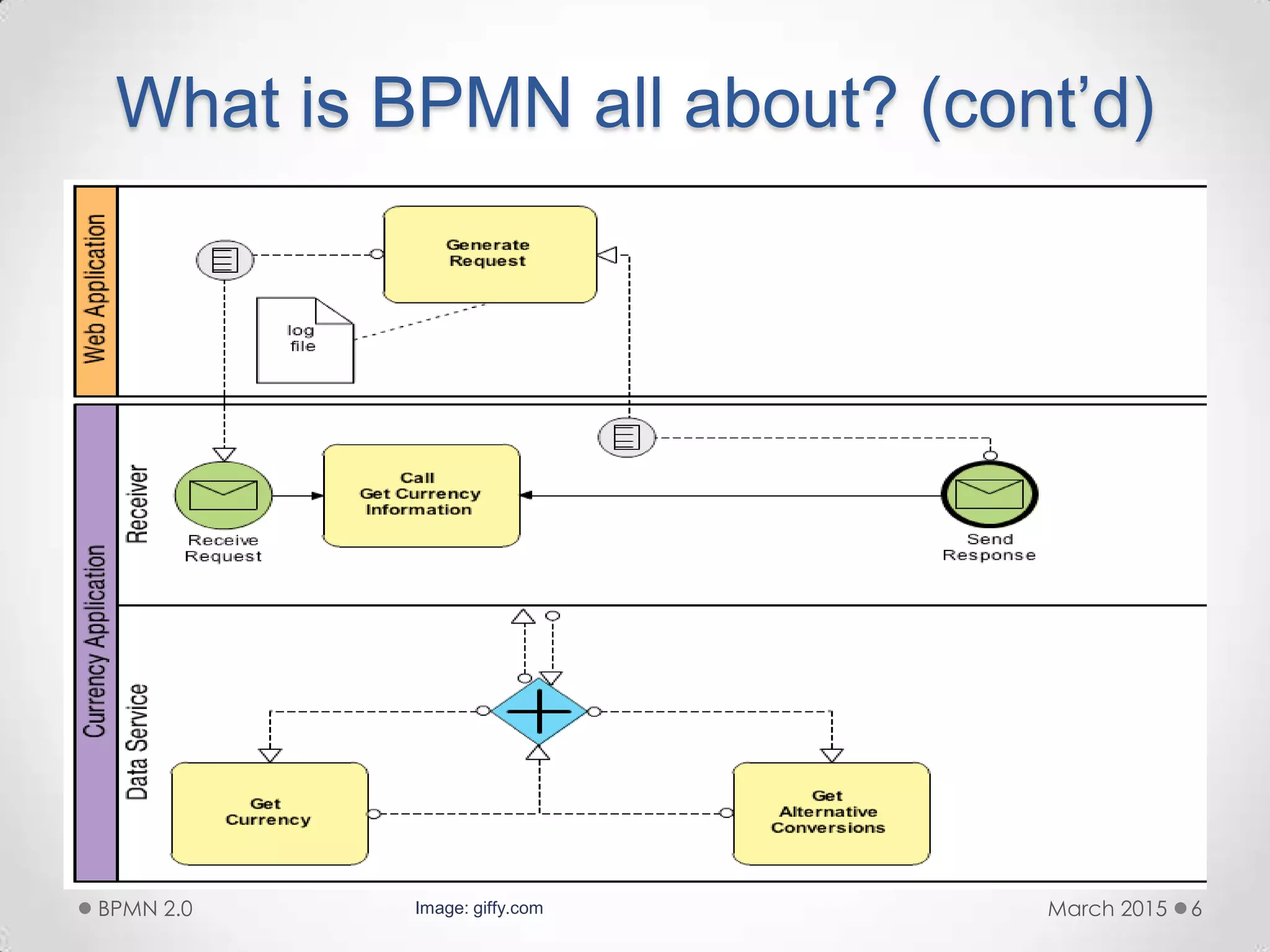
What is BPMN all about? (cont’d)
March 2015BPMN 2.0 6Image: giffy.com
Start with BPM First
• Definition
Business Process Management is Management and
improvement of an organization end-to-end enterprise
business processes.
• Some point of views
A process of managing your business processes.
A management discipline.
A technology or set of technologies.
A rapid application development framework.
• Objectives
Clarity on strategic direction
Alignment of the organizational resources
Increased discipline in daily operations
March 2015BPMN 2.0 7
Open Management Group
• OMG is an international, open membership, not-for-profit
computer industry standards consortium (www.omg.org).
• Task Forces develop modeling and integration standards
for a wide range of technologies.
• OMG's Model Driven Architecture (MDA) supports
complete application lifecycle from design, development
and deployment, maintenance and evolution.
• Modeling standards
Unified Modeling Language (UML)
BPMN
Systems Modeling Language (OMG SysML)
March 2015BPMN 2.0 8
Open Management Group (cont’d)
• Objective
Enable powerful visual design for software structure and
behavior, processes in software and business.
• Middleware standards and profiles based on Common Object
Request Broker Architecture (CORBA) and support a wide
variety of industries.
March 2015BPMN 2.0 9
Process Improvements
• Target inefficient or ineffective
processes in delivering what customers
require.
• Efficient is when the resources
consumed at the minimum possible
levels.
• Effective is able to deliver products or
services according to specifications.
March 2015BPMN 2.0 10
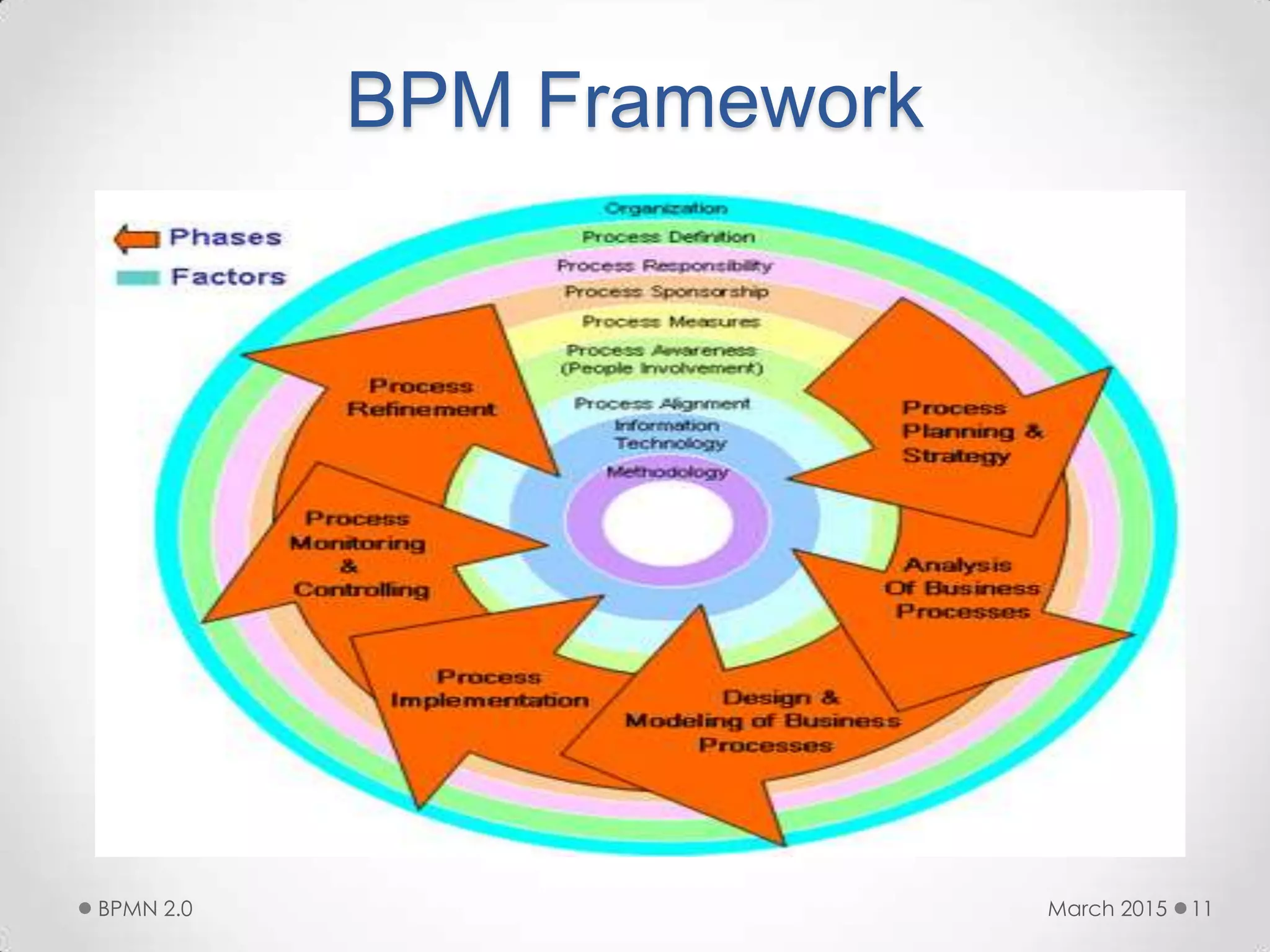
BPM Framework
March 2015BPMN 2.0 11
Benefits of BPM
• Using process-enabled achievement of strategic
objectives.
• Accelerating time to market.
• Delivering improvements in cost, productivity, timeliness
and quality.
• Improving customer service levels and increasing
customer satisfaction.
• Transferring knowledge to ensure that customer teams
achieve the necessary competence and autonomy to
maintain and develop future capabilities.
March 2015BPMN 2.0 12
Benefits of BPM
• Simplifying business processes to drive effectiveness,
efficiencies and agility.
• Managing risks and meeting compliance regulations.
• Providing greater visibility into your organizational
performance.
• Introducing new process designs faster.
• Reducing costs.
• Generating new revenue streams.
• Improving existing revenue streams.
March 2015BPMN 2.0 13
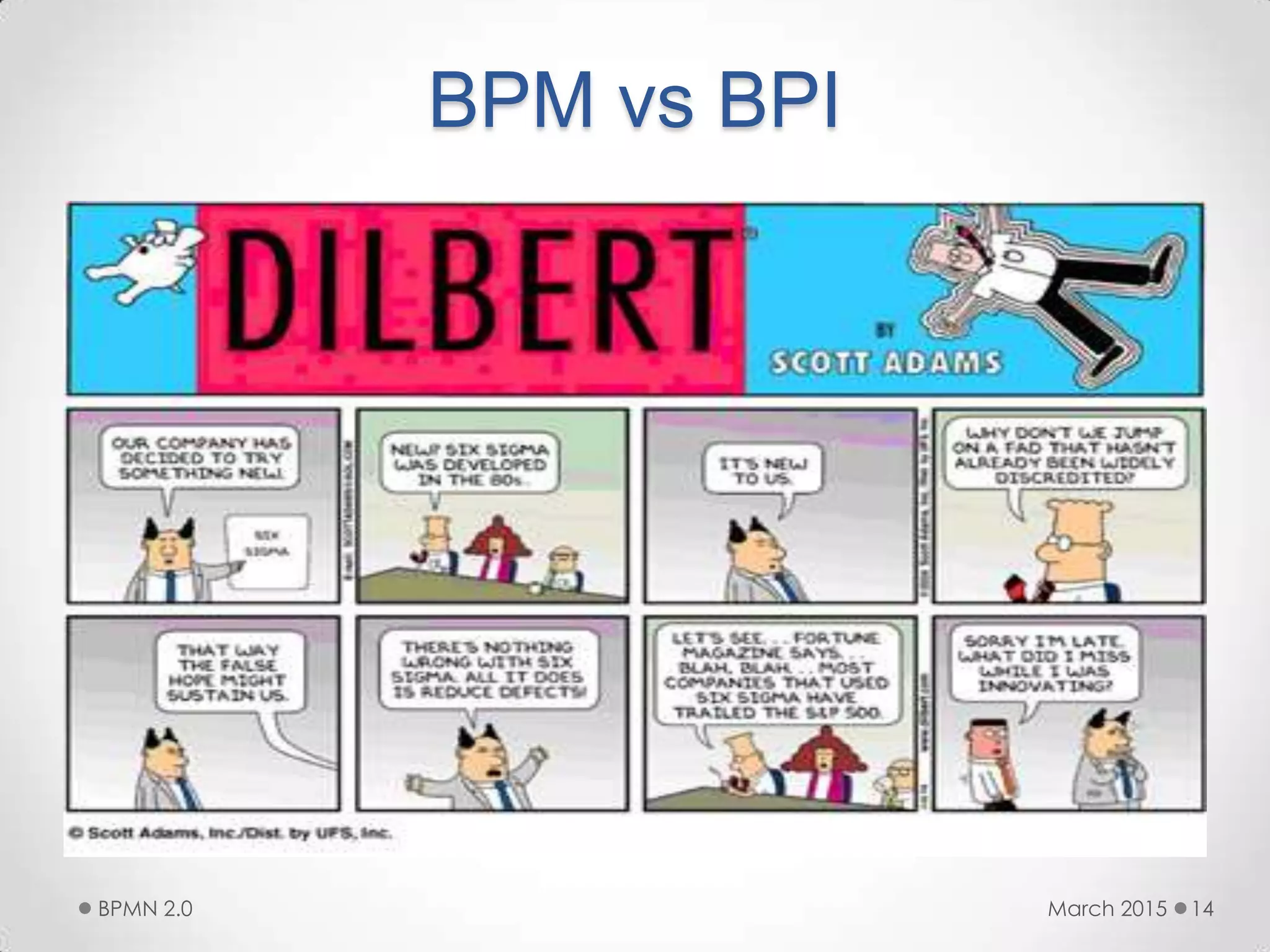
BPM vs BPI
March 2015BPMN 2.0 14
BPM vs BPI
BPI
• Initiatives typically imply projects.
• A set of one-time unique improvements in redesigning or
fixing a process.
• Common methodologies: Six Sigma, Lean, Total Quality
Management (TQM) and Business Process Reengineering
(BPR).
BPM
• Ongoing commitment to meeting organization's performance
goals by managing its processes.
• A continuous, feedback loop to ensure organization's
business processes aligned to strategy and expectations.
• May employ common BPI methodologies but it does not
imply organization is committed to BPM practice.
March 2015BPMN 2.0 15
Steps in Implementing BPM
• Aligning Processes with Business Strategy
• Discovering and Modeling Processes
• Measuring Processes
• Analyzing and Benchmarking Processes
• Harvesting Policies and Rules
• Improving Processes
• Managing the Changing of a Culture
• Governance and Decision Making
• Deploying Technology
March 2015BPMN 2.0 16
BPM Approach
• Traditional:
Capturing processes from organization perspective,
not from customer’s
Start to finish without a focus on outputs which are
more important to the customer.
Lack of understanding of the customer's expectation
New:
Start from end to beginning.
Identify customer
Identify outputs of interest to the customer
Identify customer's expectation (time, cost and
quality)
March 2015BPMN 2.0 17
BPM Approach In Details
• Peel away top-level complexity by creating hierarchical
levels on the sub-processes.
• Be mindful each sub-process must have a customer, an
output and a customer expectation (time, cost and
quality).
• Determine and measure the performance metrics.
• Examples of the metrics:
o Cycle time
o Defect rate
o Stock-out
o Variance to promise date
o Variance to promise budget.
March 2015BPMN 2.0 18
Valuing BPMN Concepts and High
Level Map
BPMN Users
• High level for business users
Should be able to easily read and understand a
BPMN business process diagram.
• Lower level for process implementers
Adorn a business process diagram with further detail
in order to represent the process in a physical
implementation.
BPMN is targeted at users, vendors and service providers
that need to communicate business processes in a
standard manner.
March 2015BPMN 2.0 20
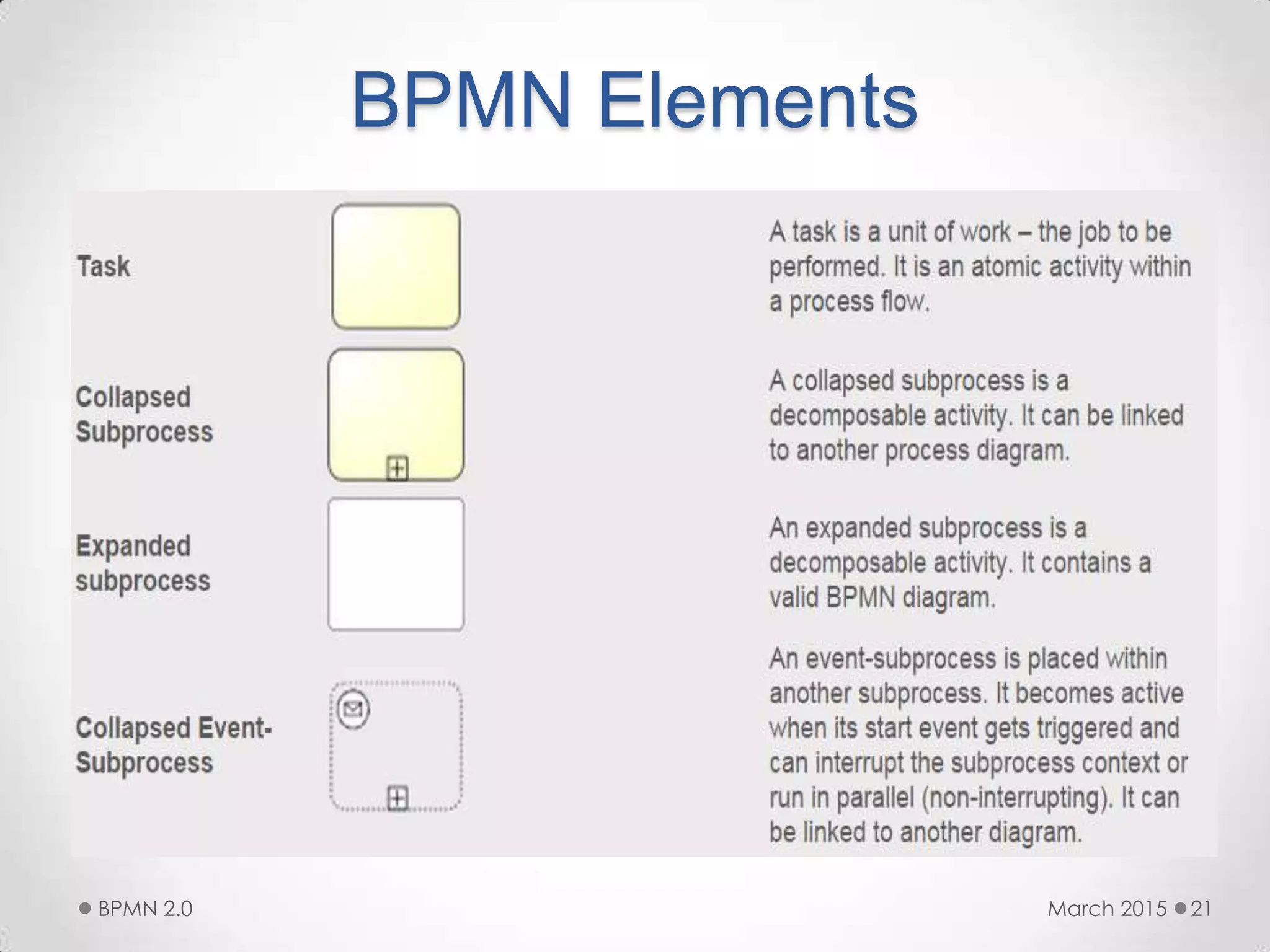
BPMN Elements
March 2015BPMN 2.0 21
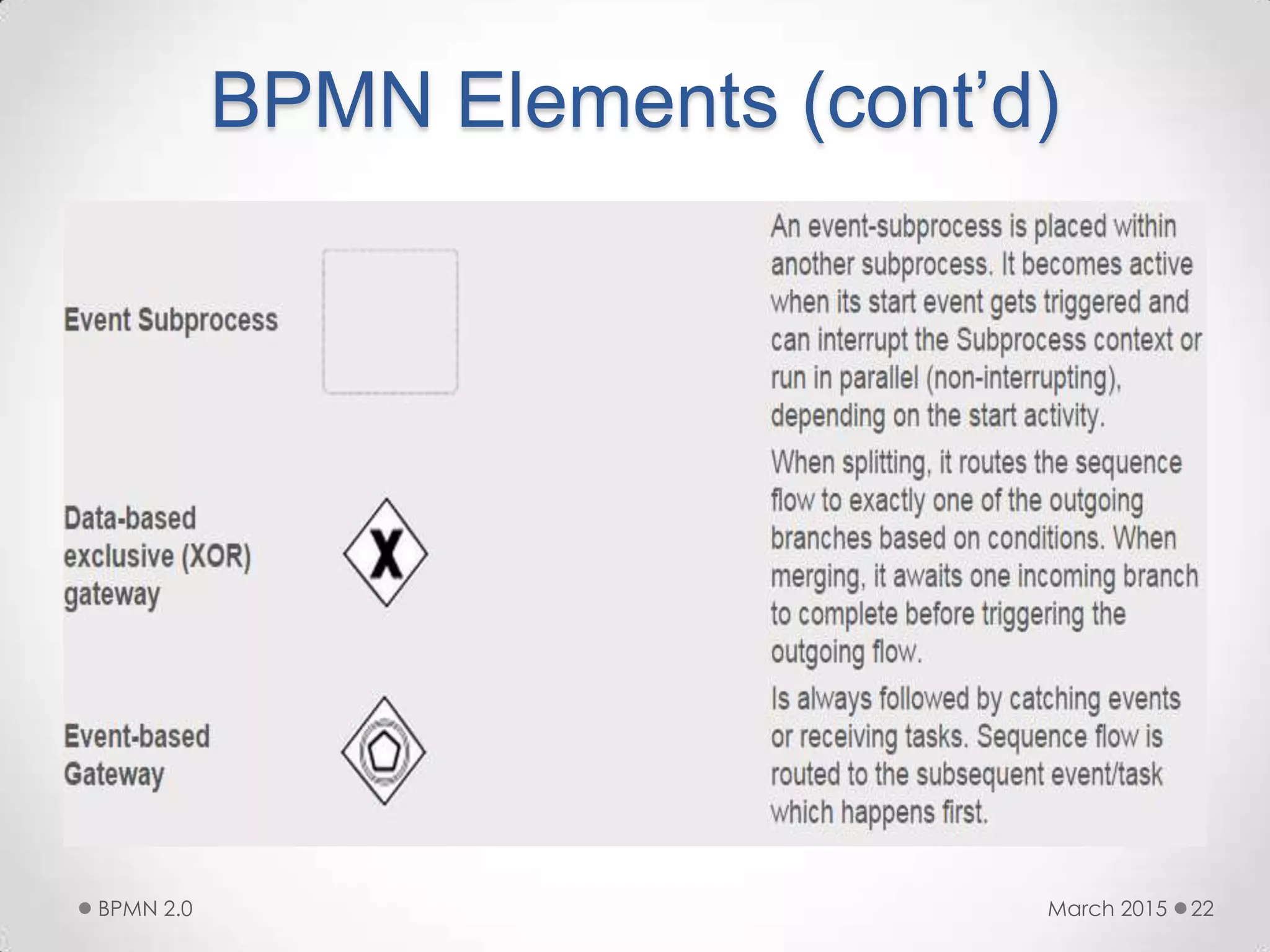
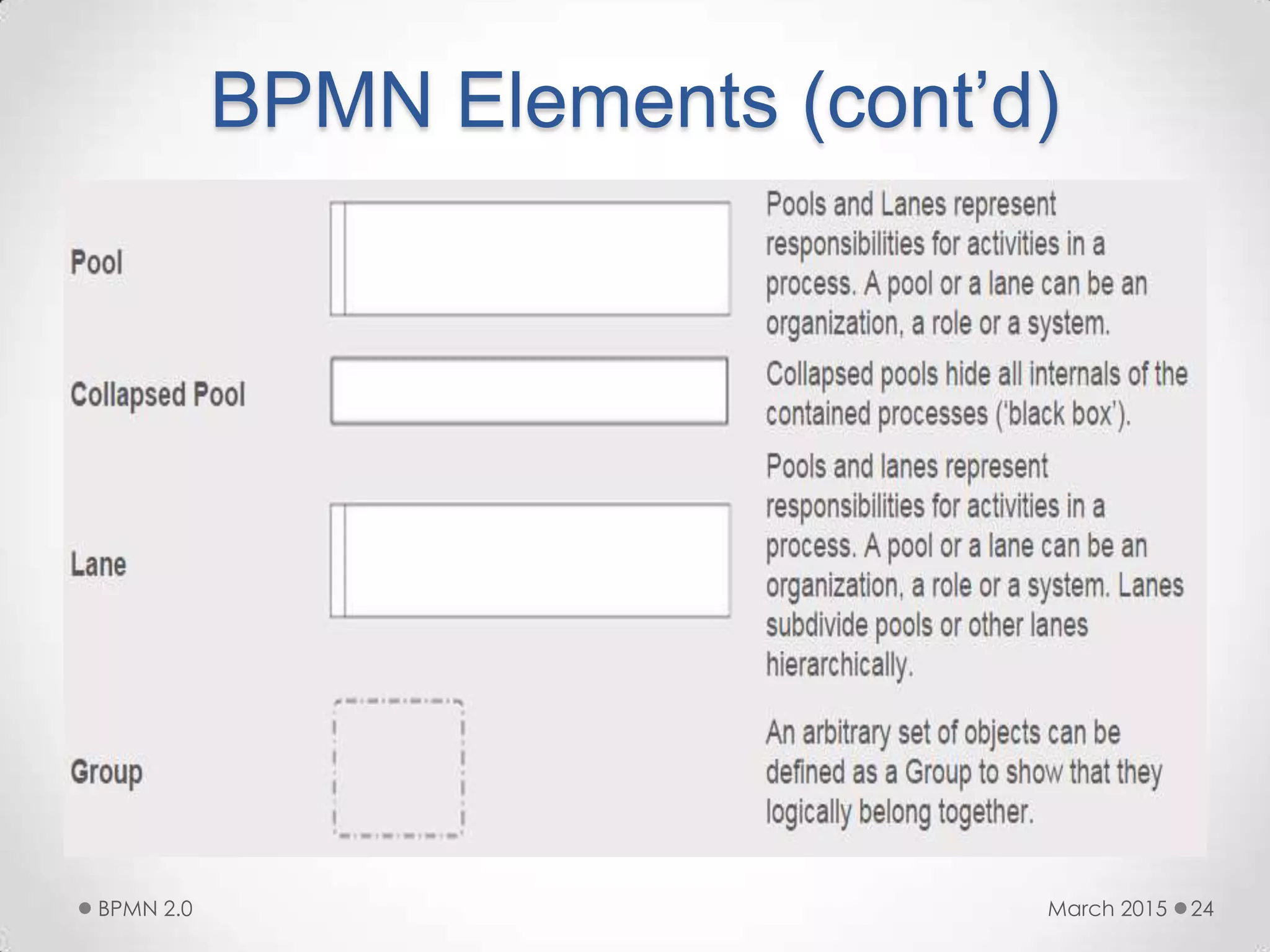
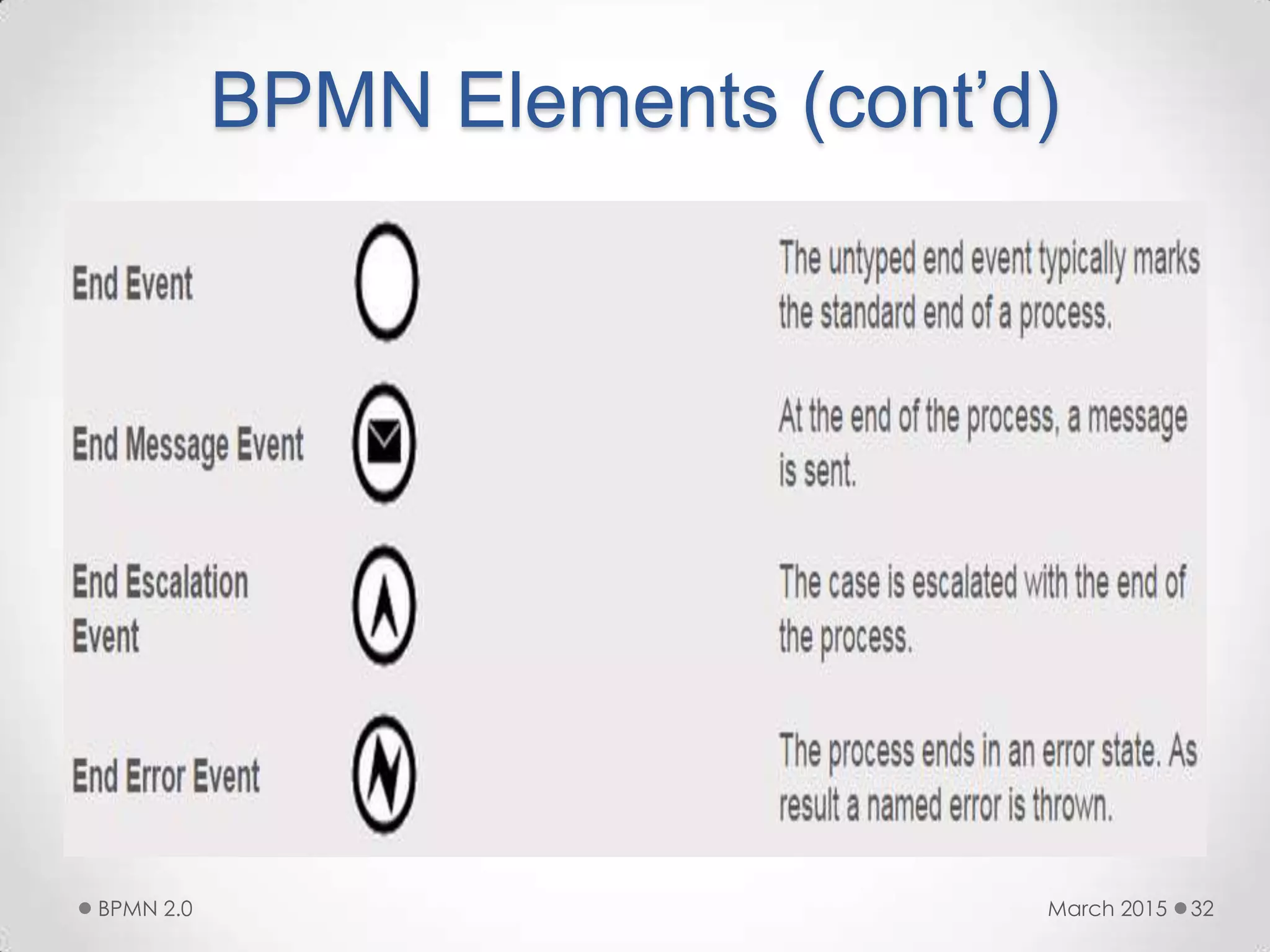
BPMN Elements (cont’d)
March 2015BPMN 2.0 22
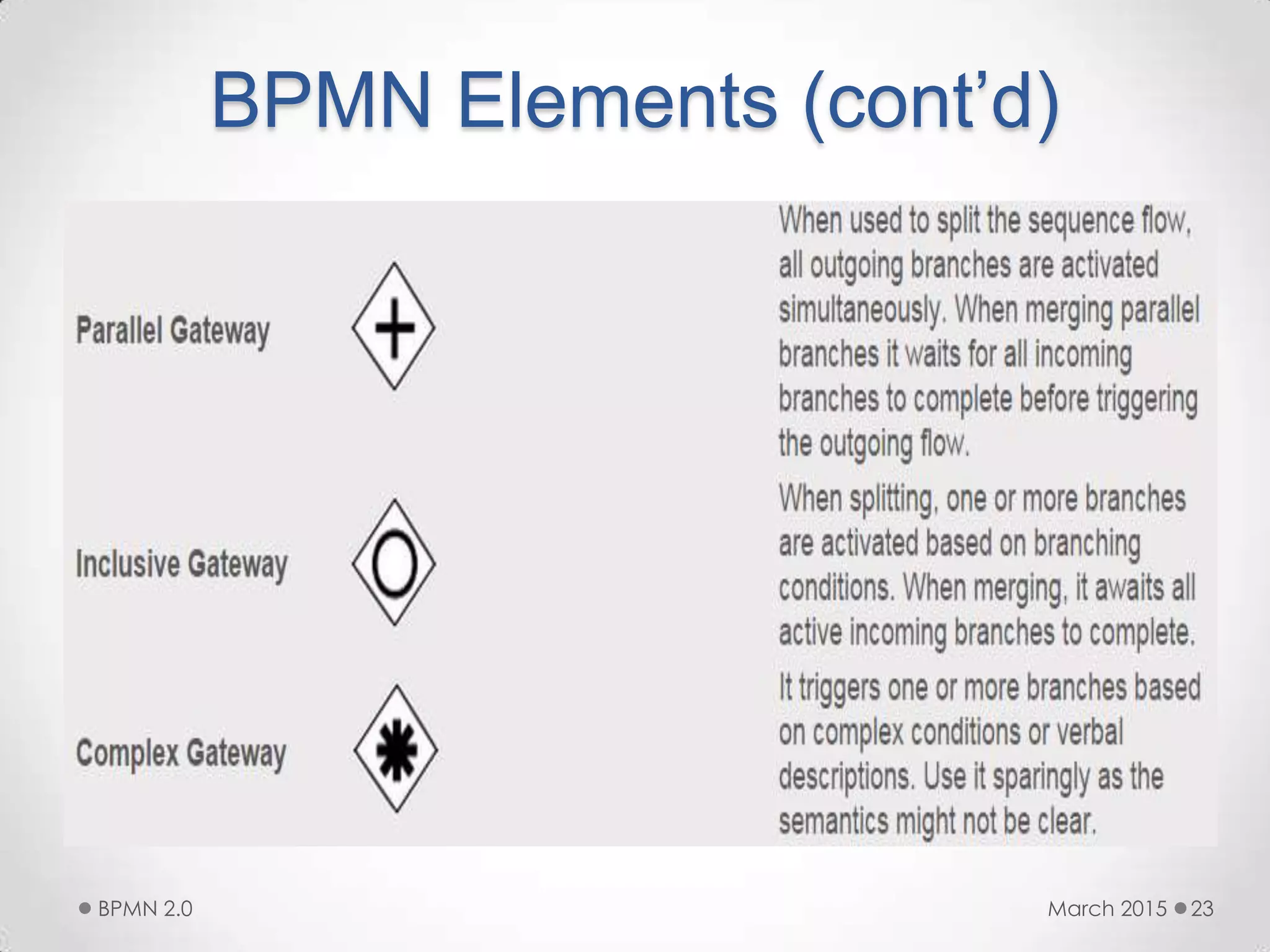
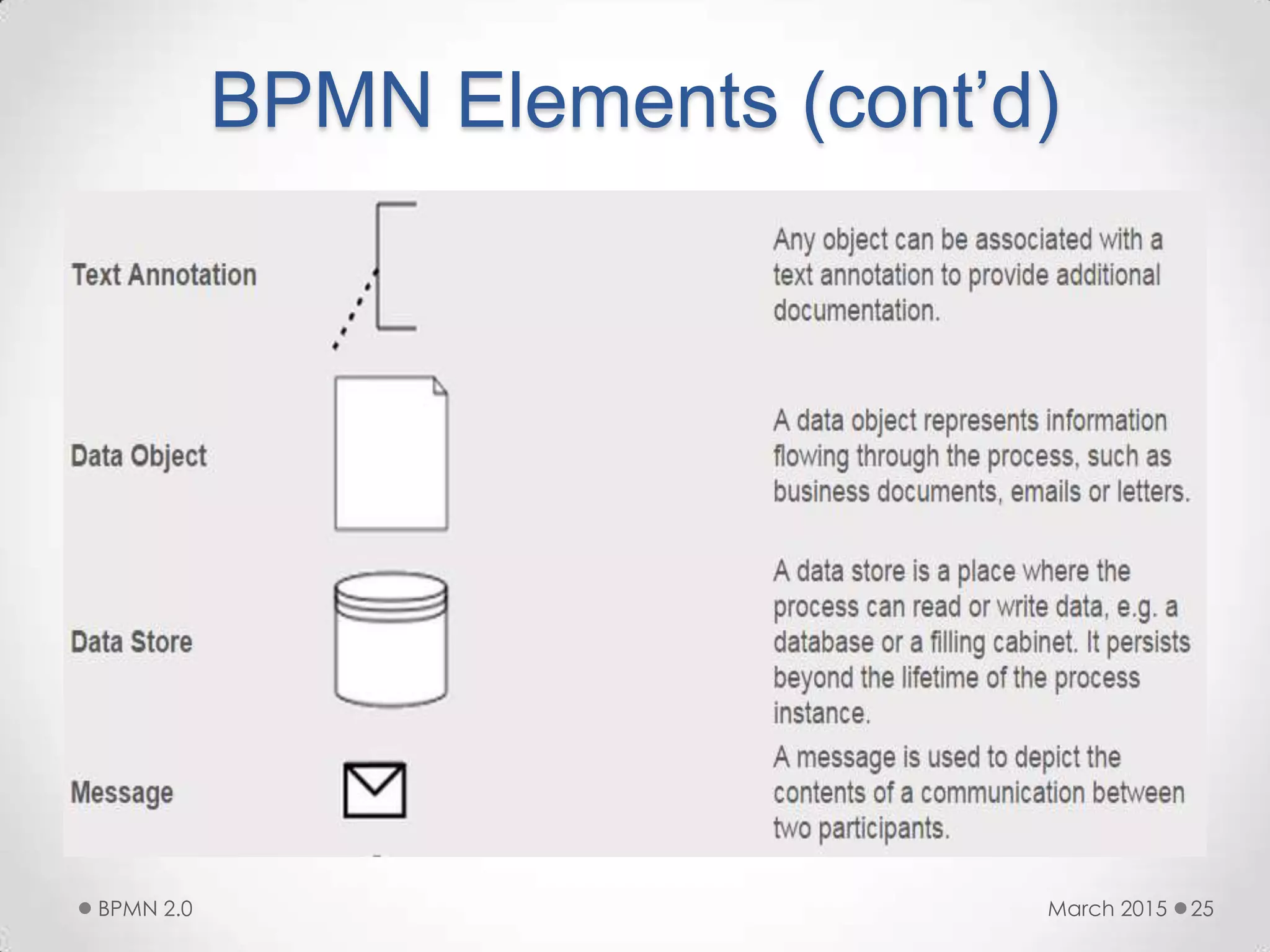
BPMN Elements (cont’d)
March 2015BPMN 2.0 23
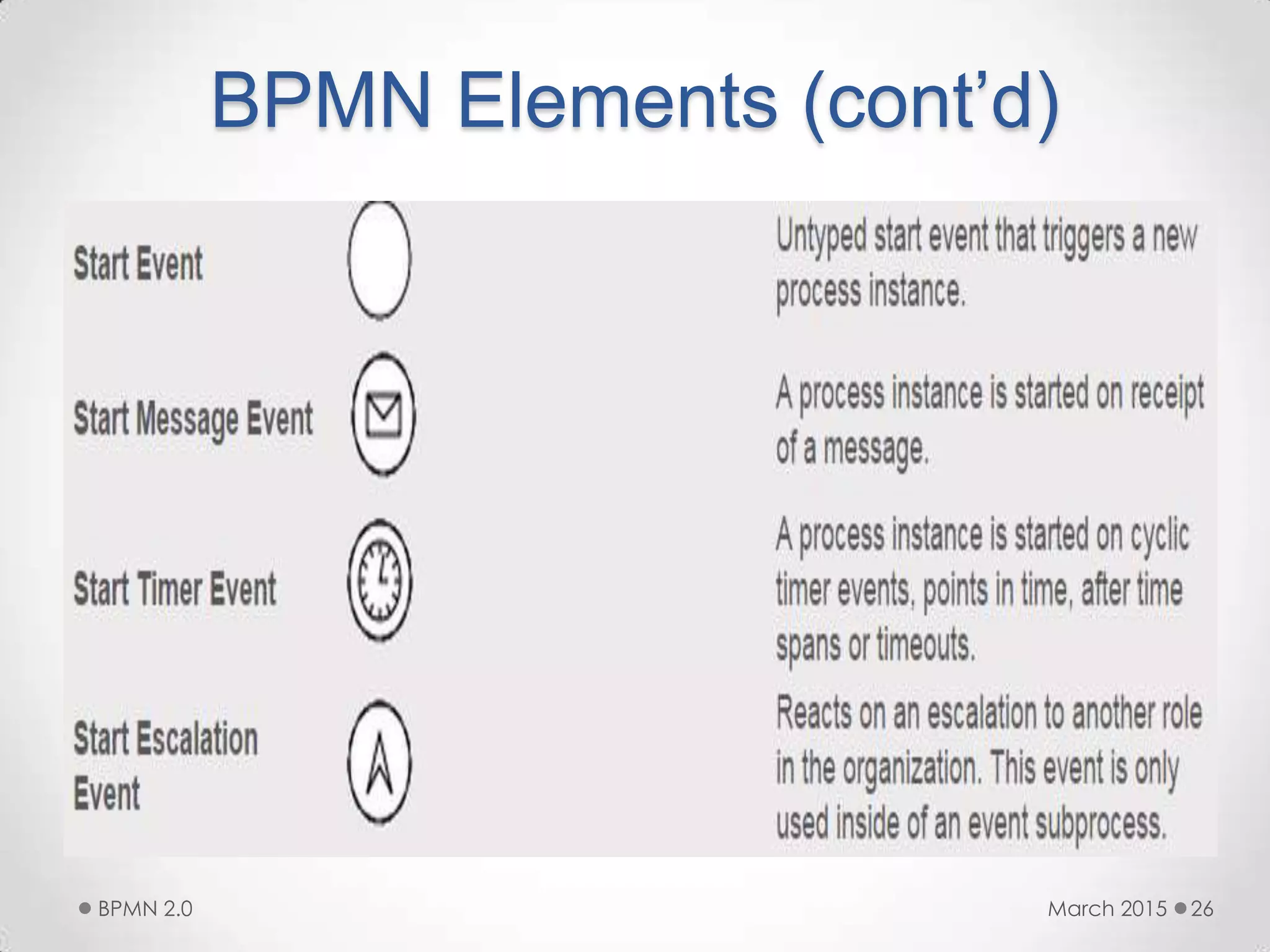
BPMN Elements (cont’d)
March 2015BPMN 2.0 24
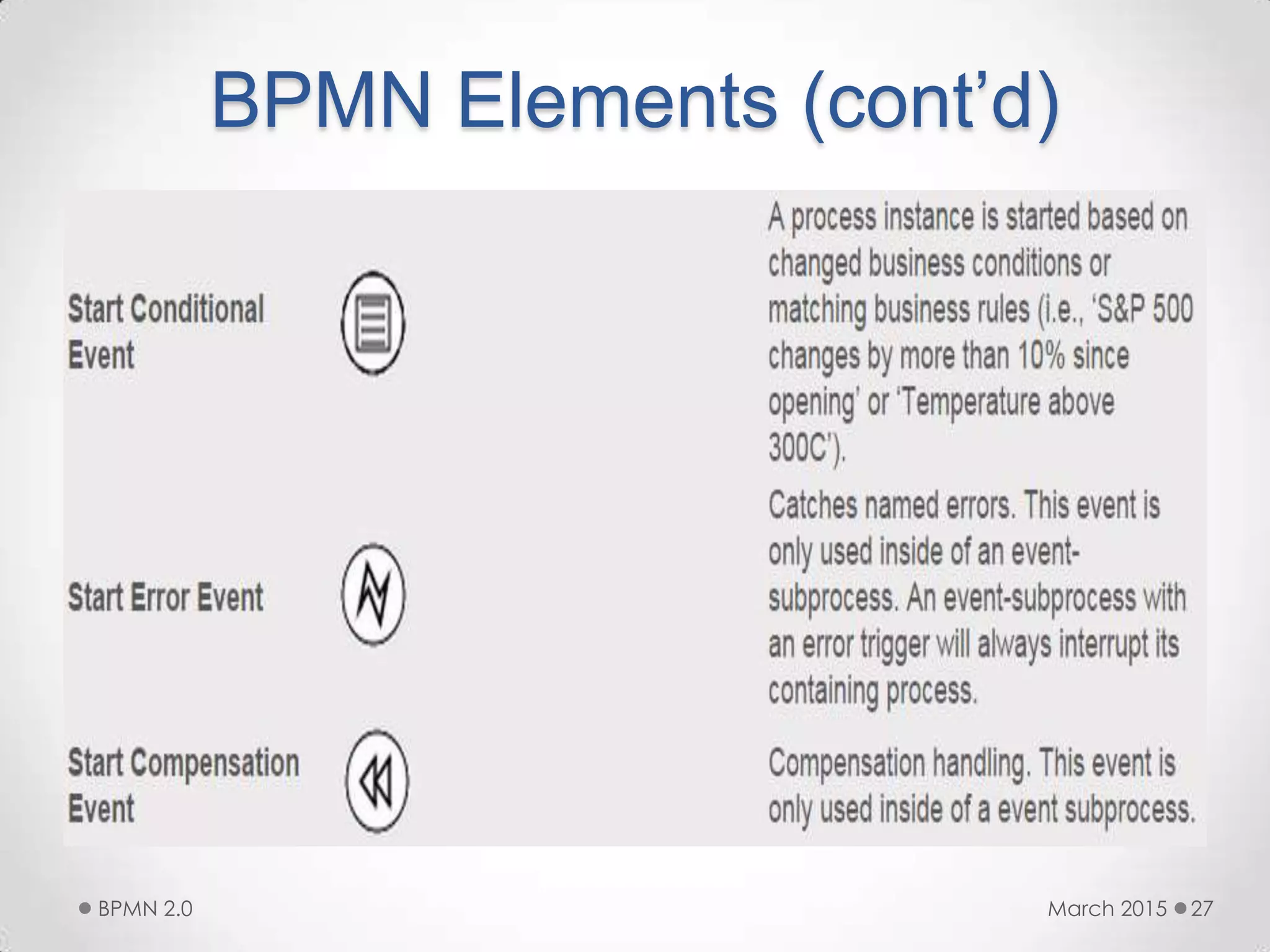
BPMN Elements (cont’d)
March 2015BPMN 2.0 25
BPMN Elements (cont’d)
March 2015BPMN 2.0 26
BPMN Elements (cont’d)
March 2015BPMN 2.0 27
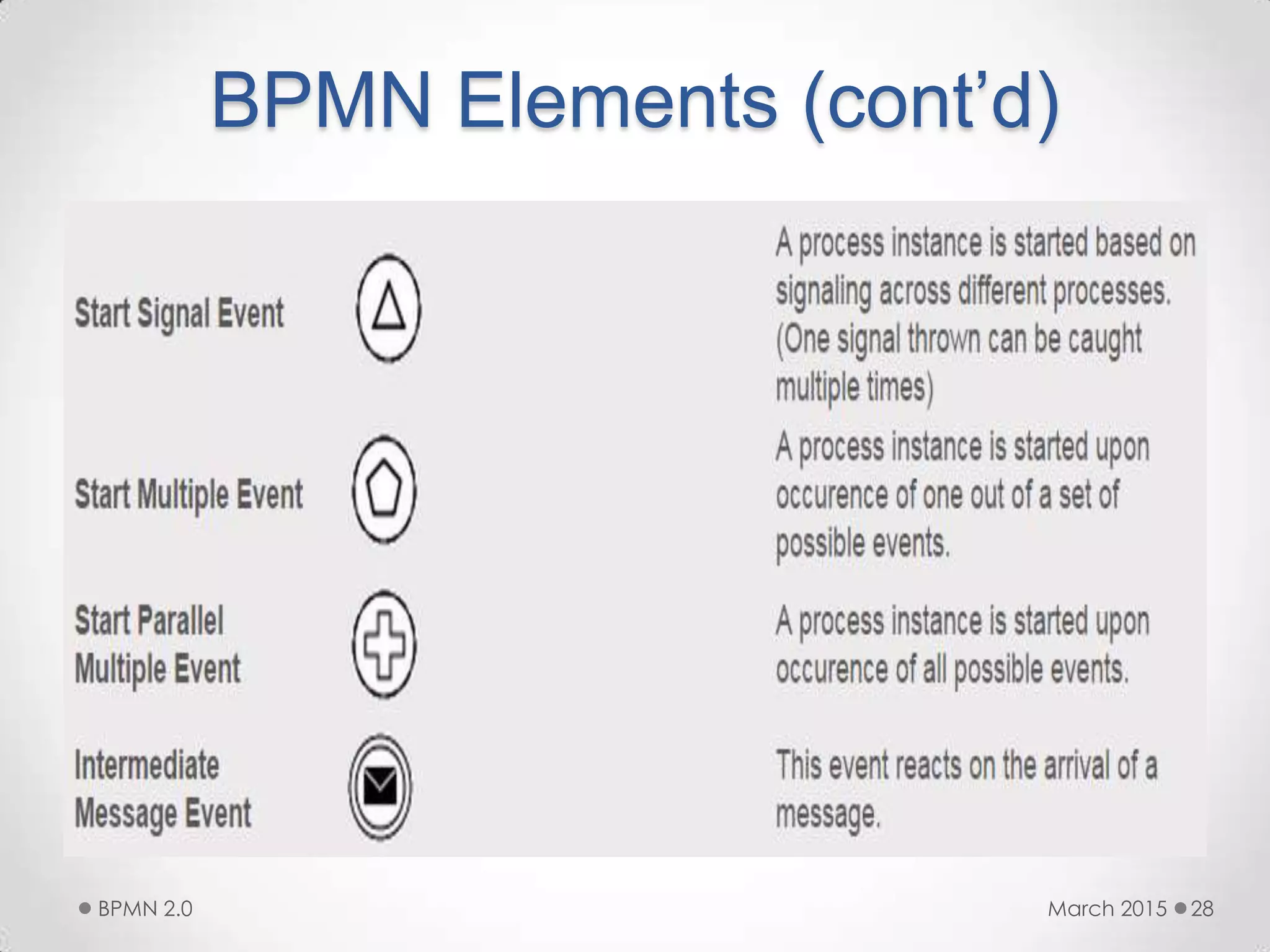
BPMN Elements (cont’d)
March 2015BPMN 2.0 28
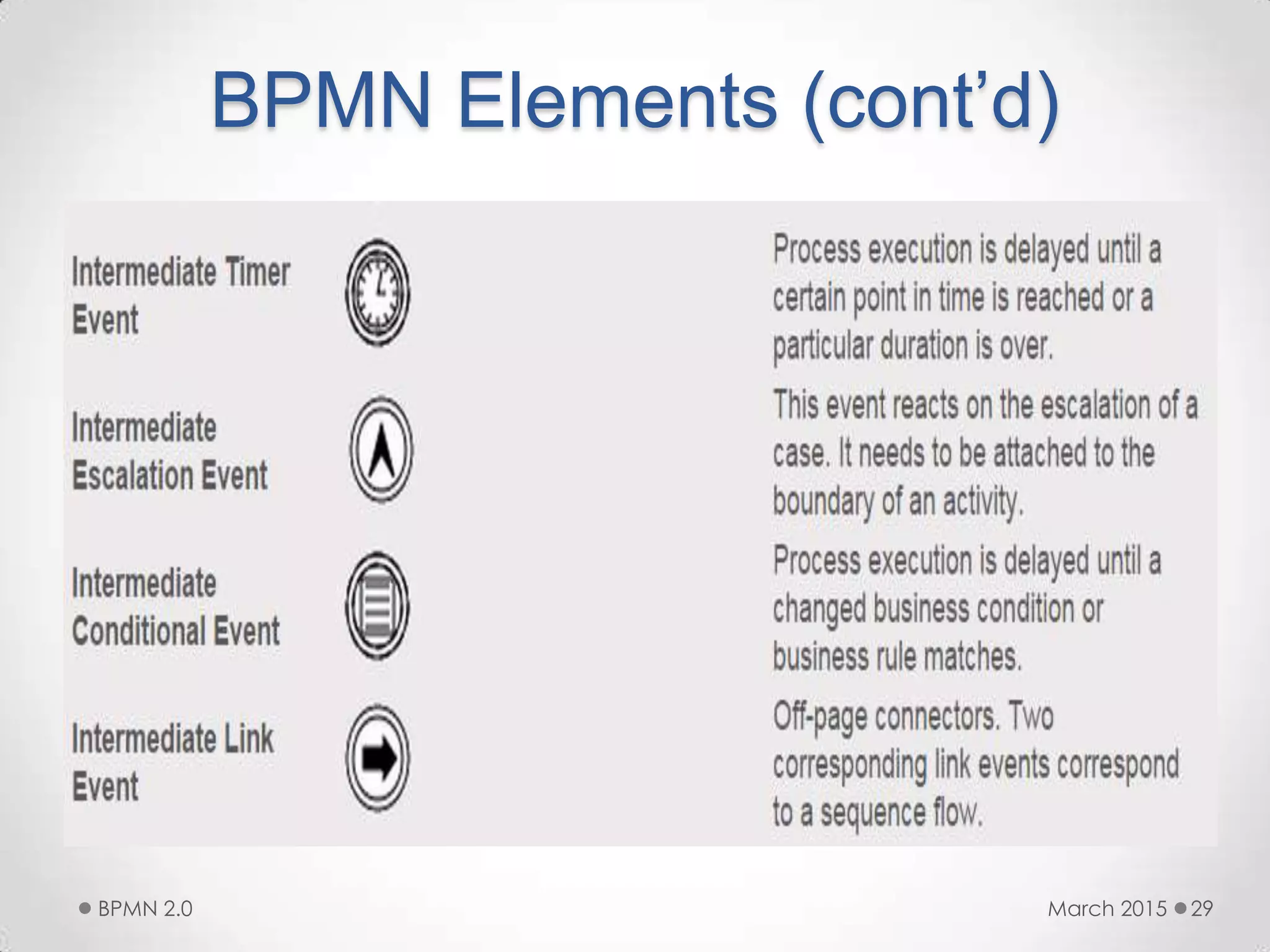
BPMN Elements (cont’d)
March 2015BPMN 2.0 29
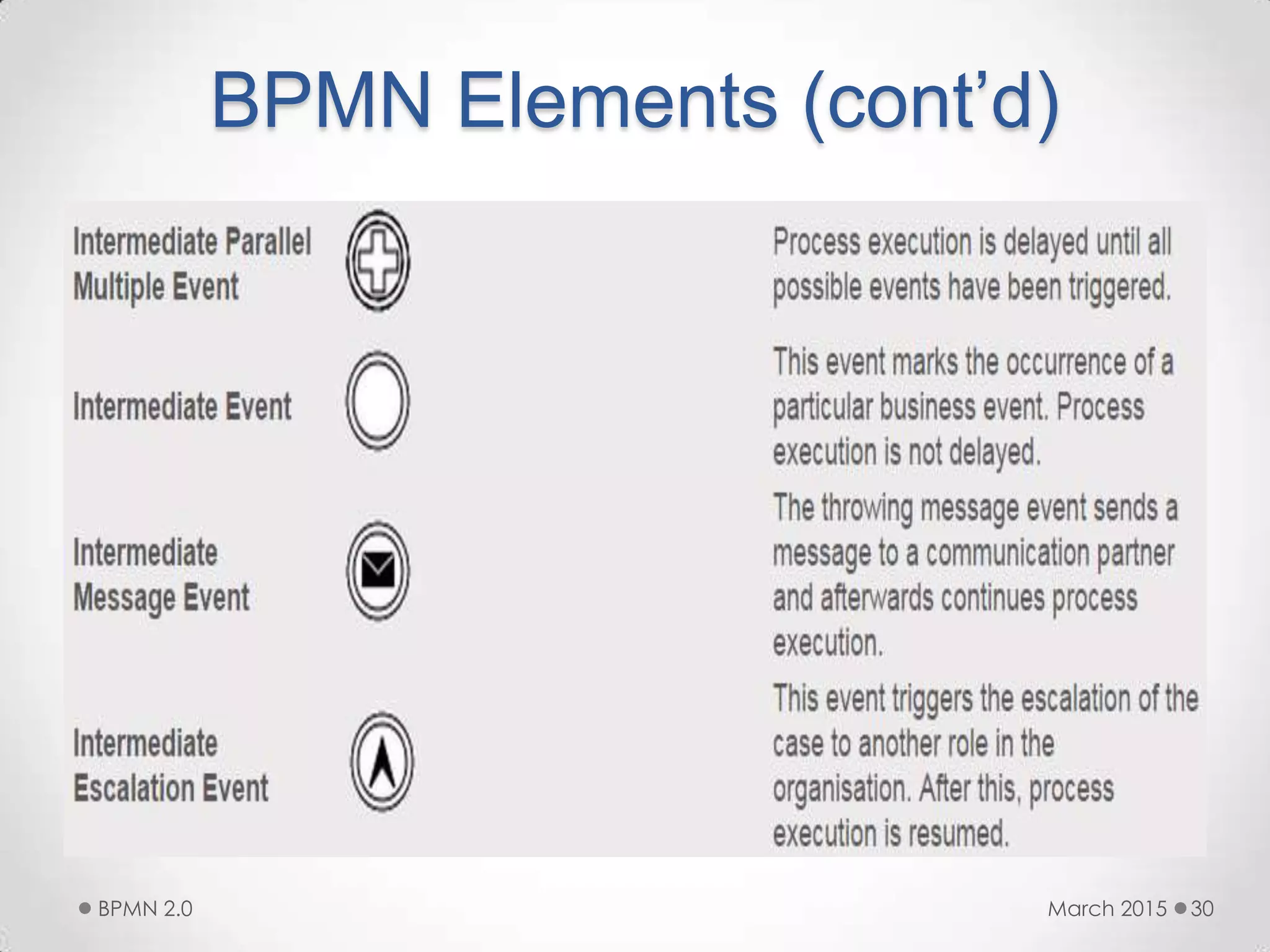
BPMN Elements (cont’d)
March 2015BPMN 2.0 30
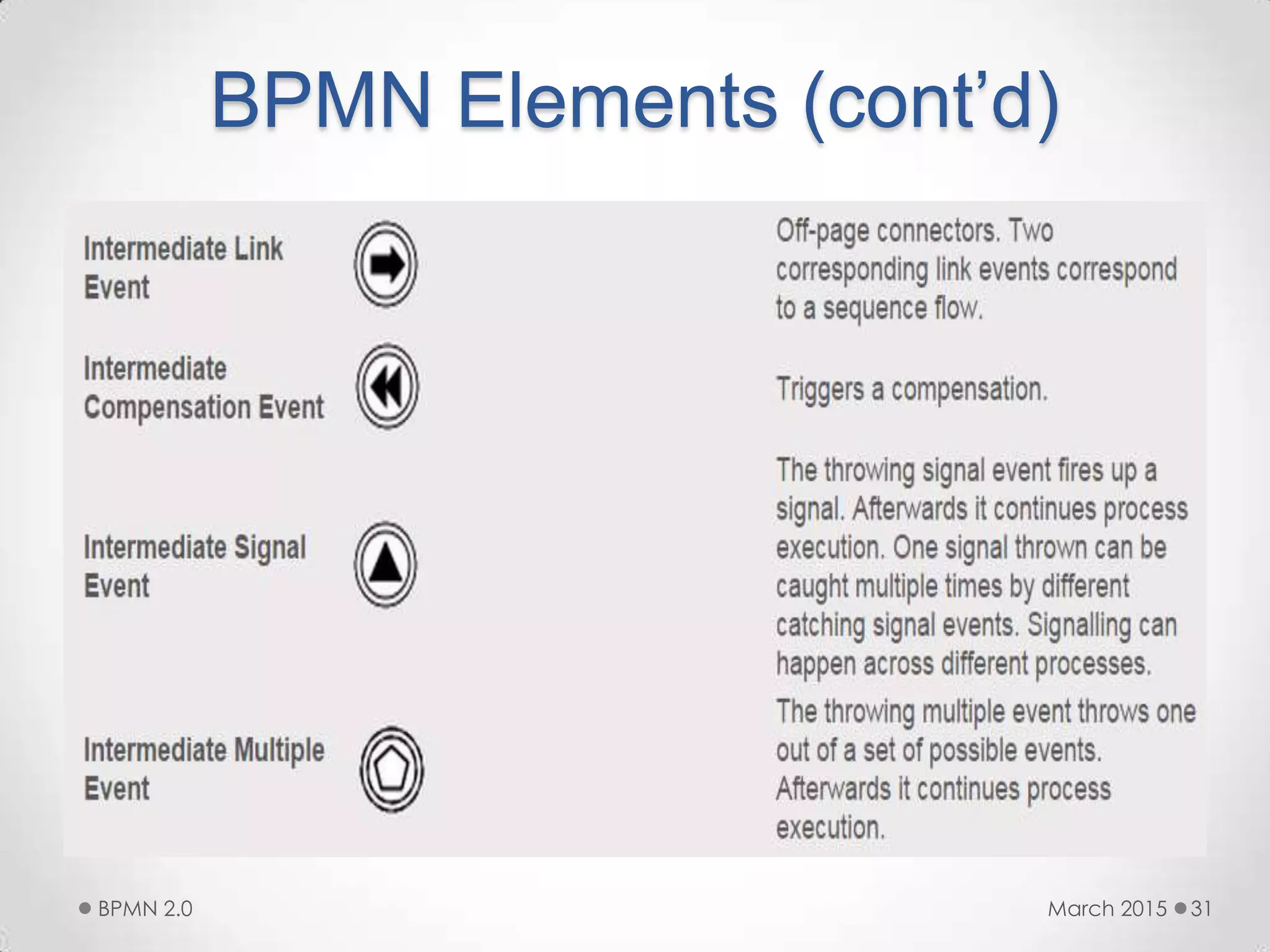
BPMN Elements (cont’d)
March 2015BPMN 2.0 31
BPMN Elements (cont’d)
March 2015BPMN 2.0 32
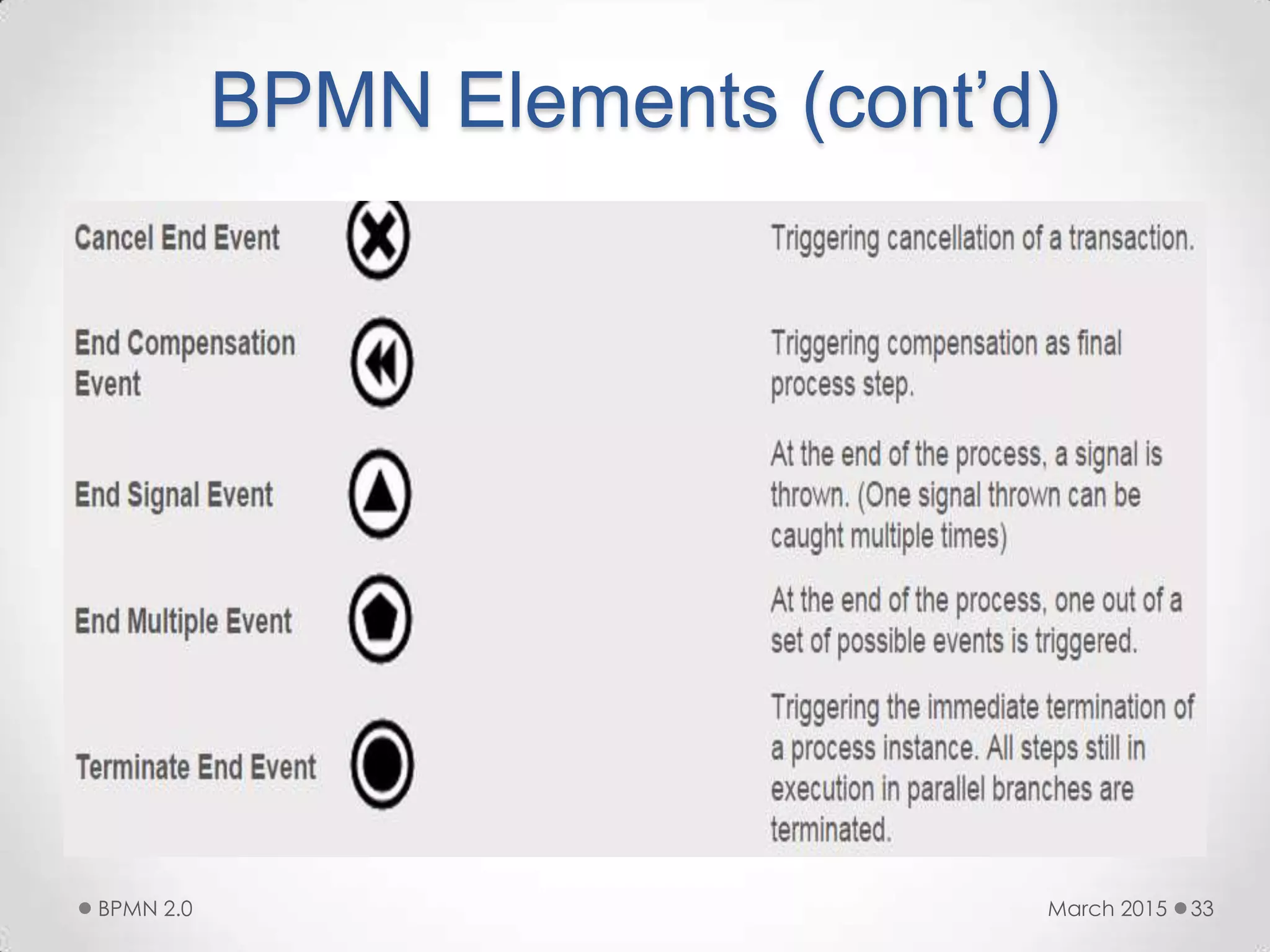
BPMN Elements (cont’d)
March 2015BPMN 2.0 33
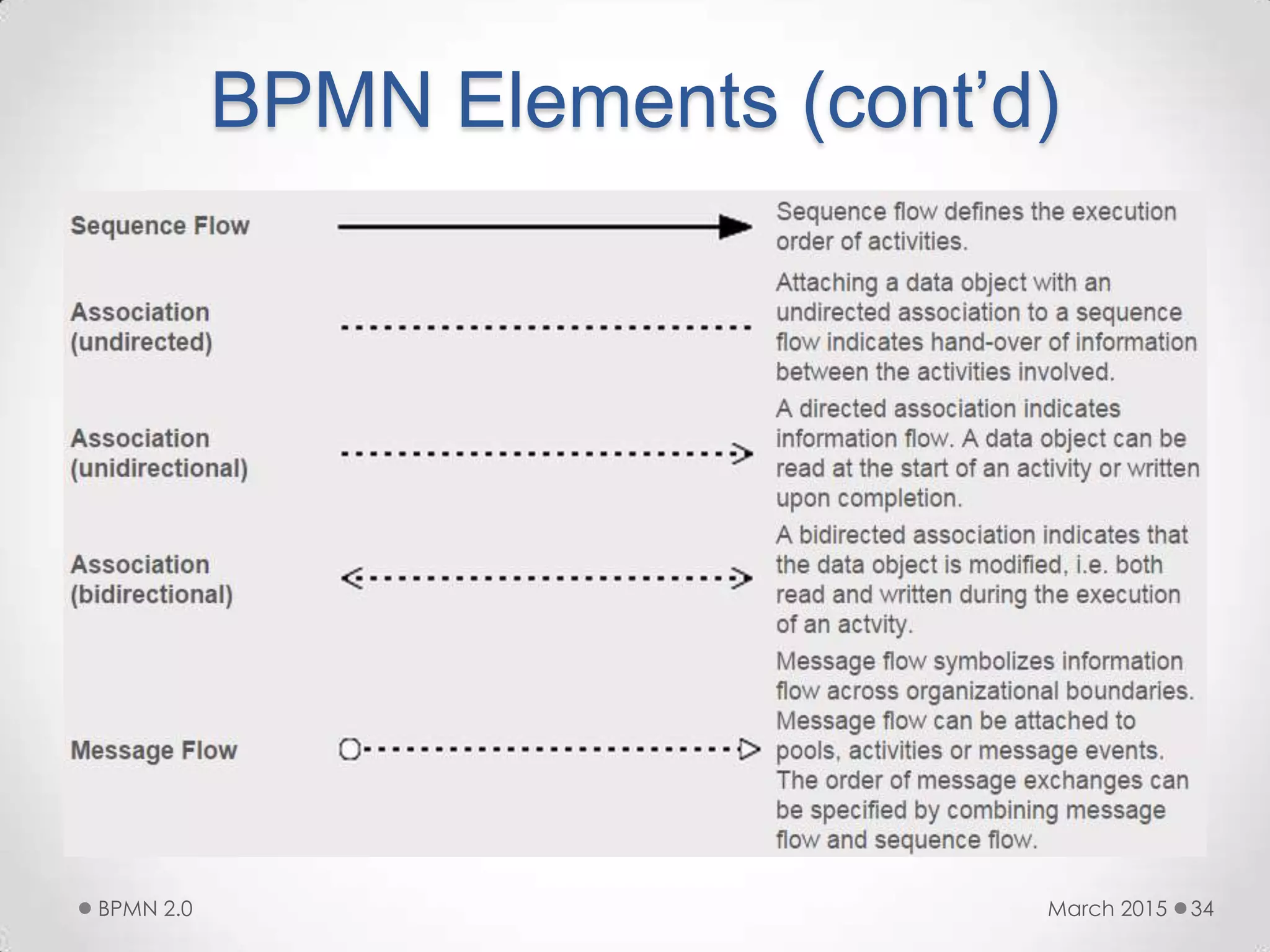
BPMN Elements (cont’d)
March 2015BPMN 2.0 34
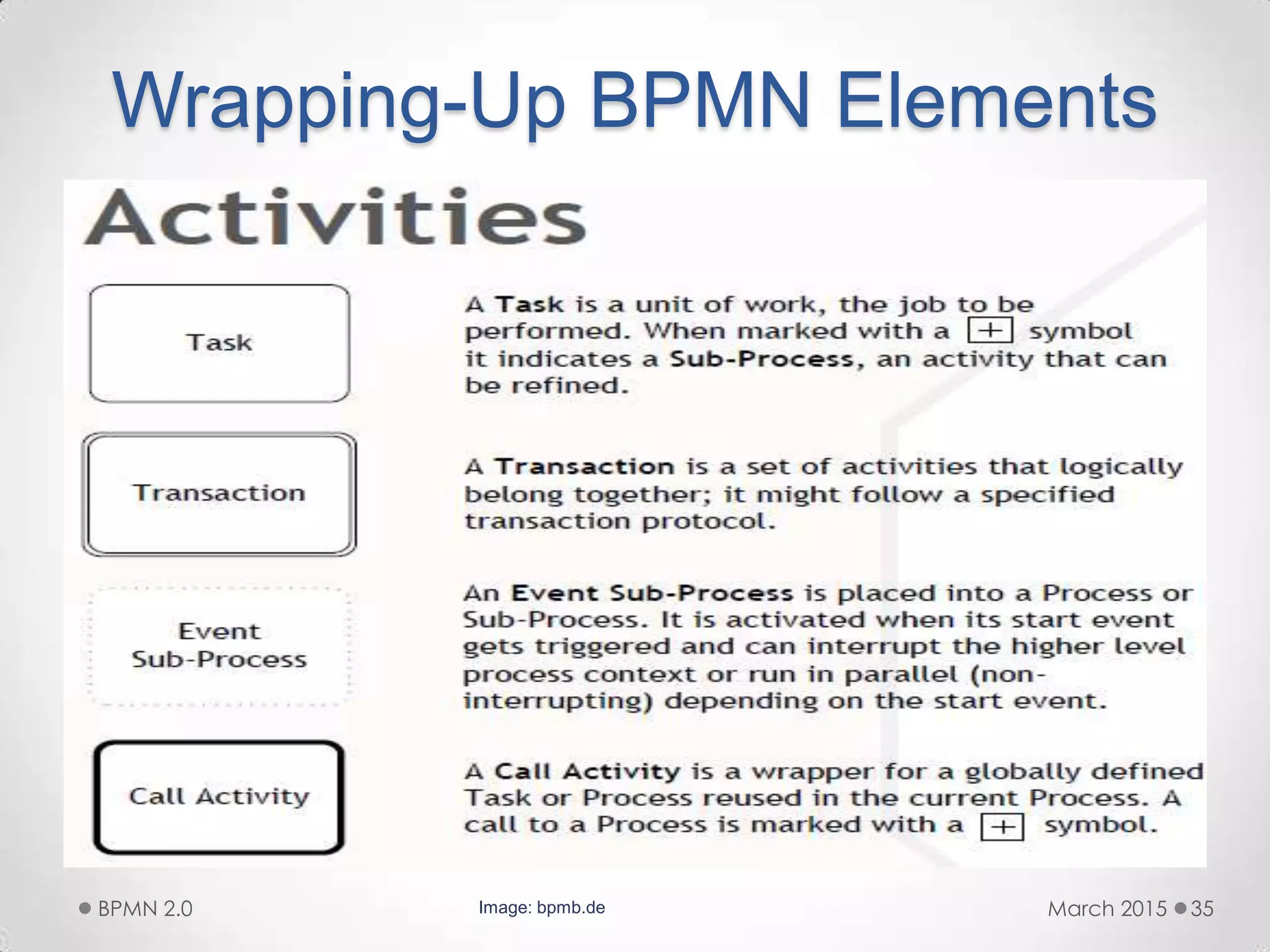
Wrapping-Up BPMN Elements
March 2015BPMN 2.0 35Image: bpmb.de
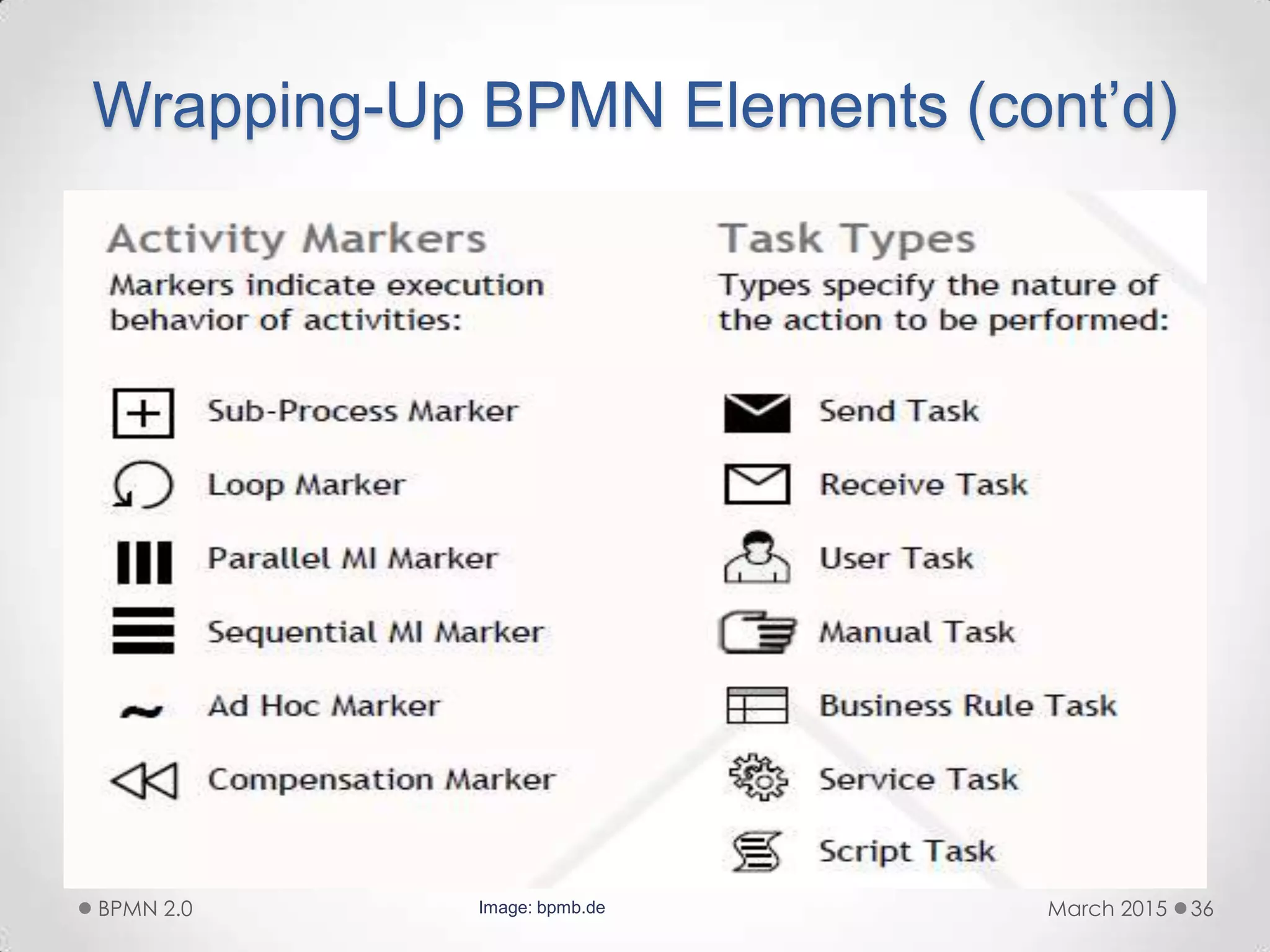
Wrapping-Up BPMN Elements (cont’d)
March 2015BPMN 2.0 36Image: bpmb.de
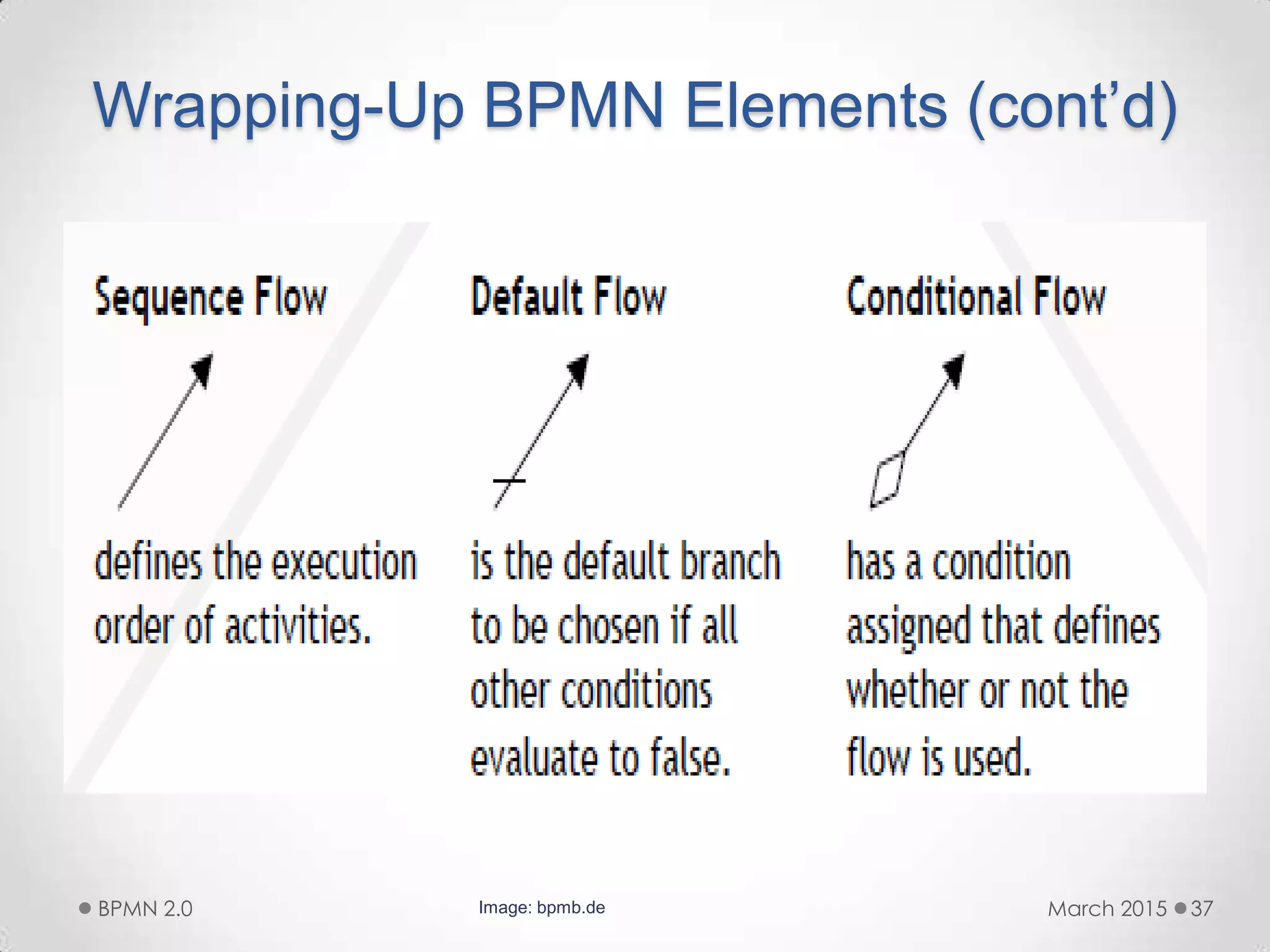
Wrapping-Up BPMN Elements (cont’d)
March 2015BPMN 2.0 37Image: bpmb.de
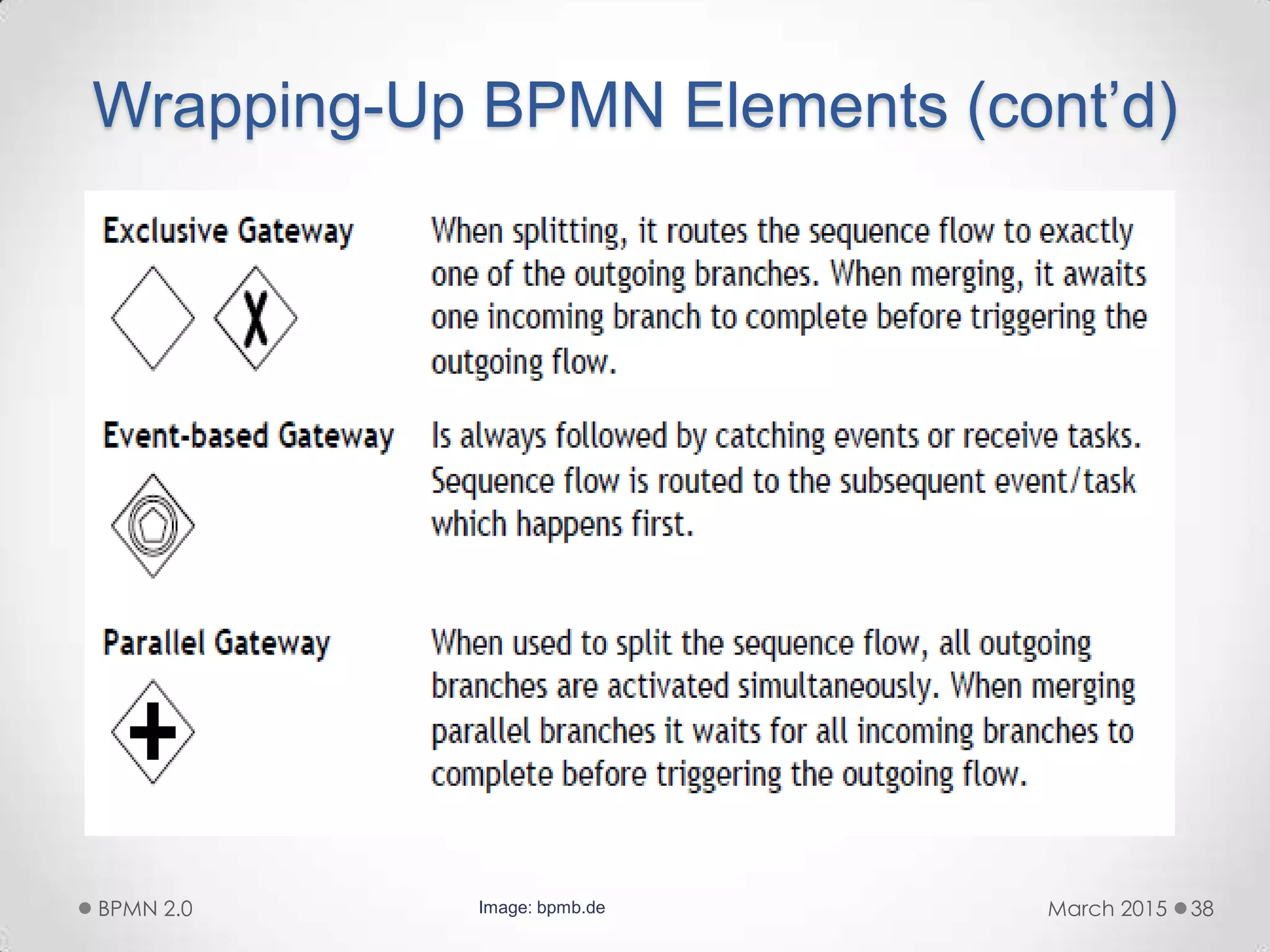
Wrapping-Up BPMN Elements (cont’d)
March 2015BPMN 2.0 38Image: bpmb.de
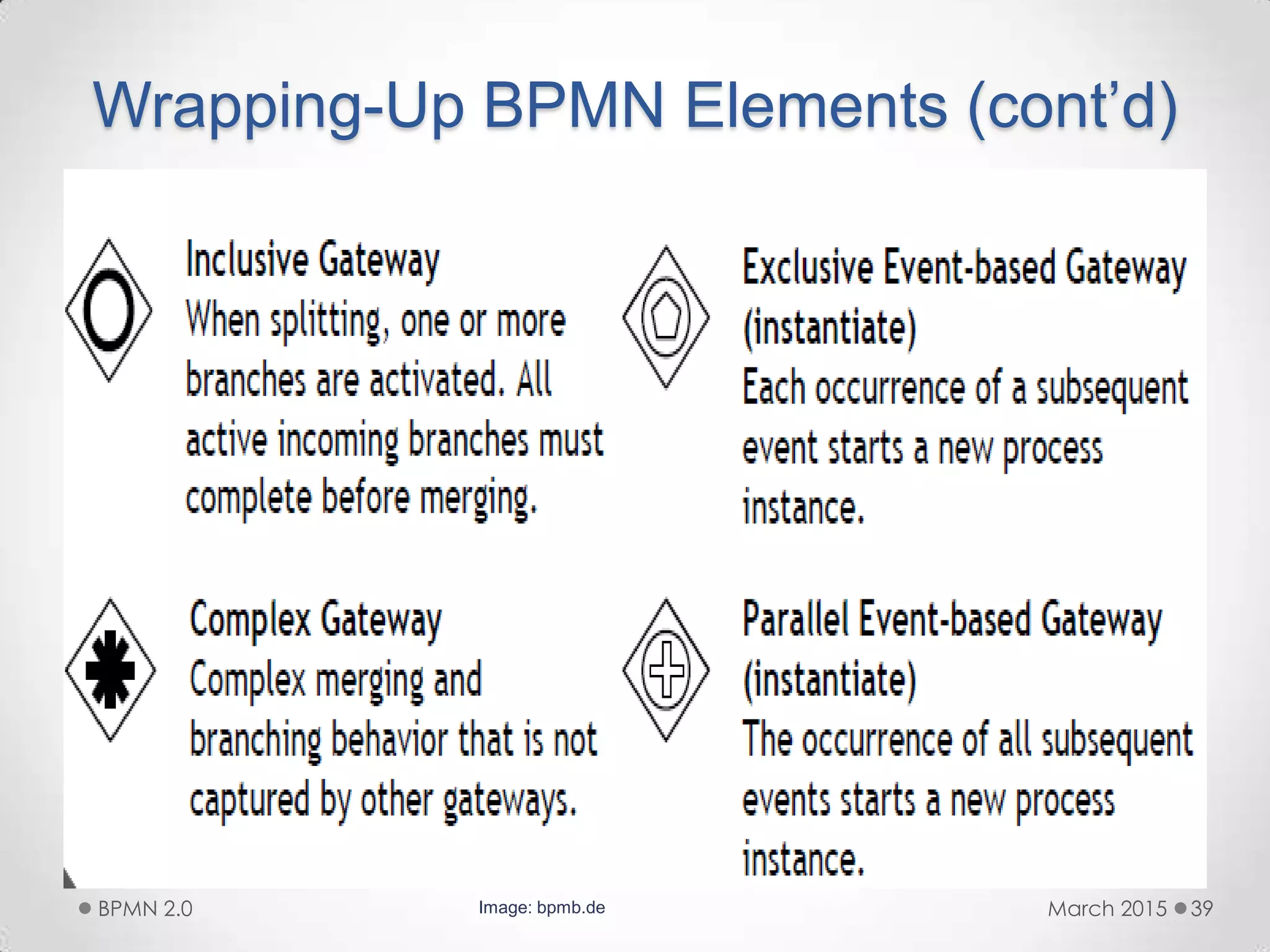
Wrapping-Up BPMN Elements (cont’d)
March 2015BPMN 2.0 39Image: bpmb.de
Wrapping-Up BPMN Elements (cont’d)
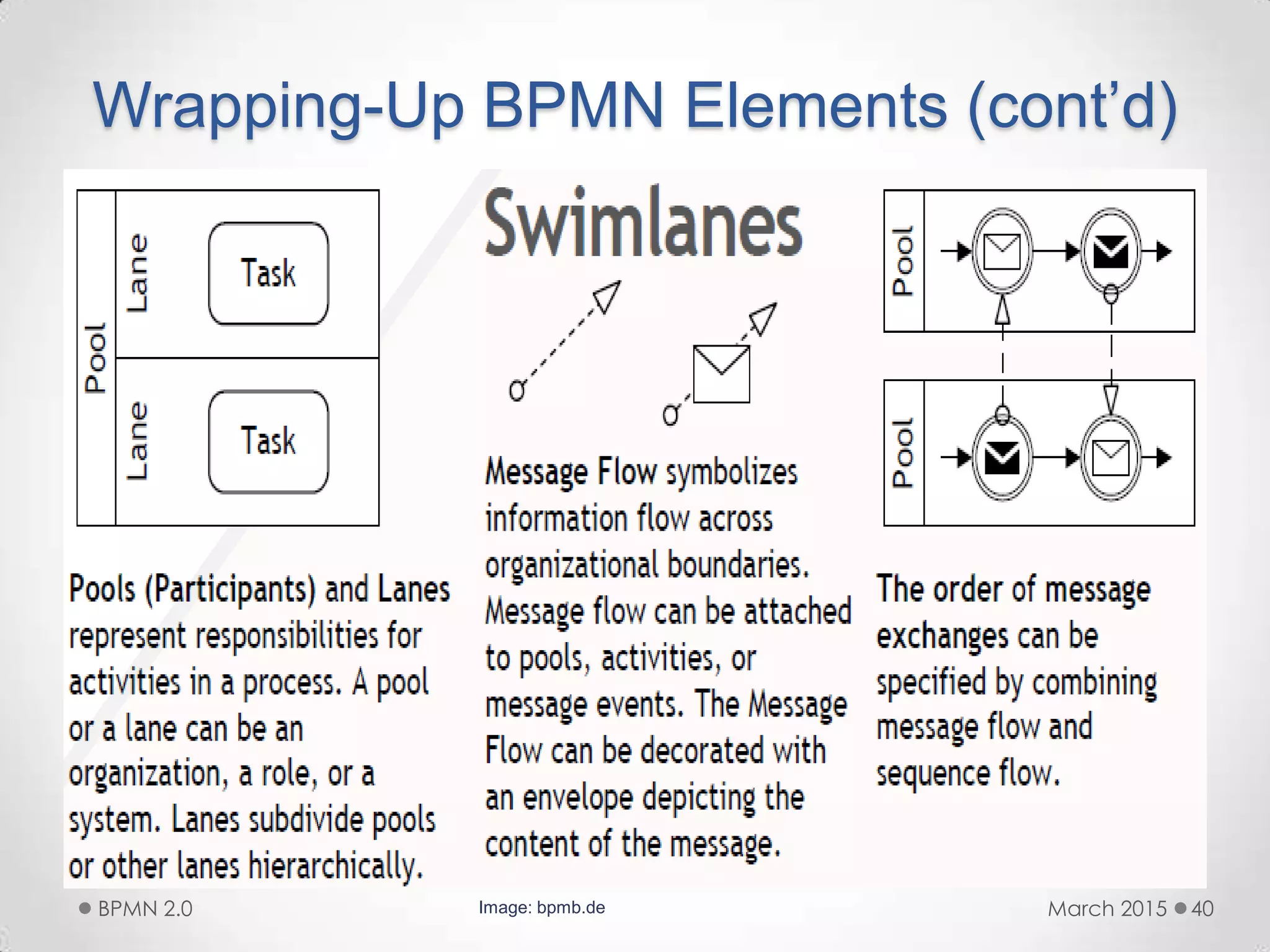
March 2015BPMN 2.0 40Image: bpmb.de
Wrapping-Up BPMN Elements (cont’d)
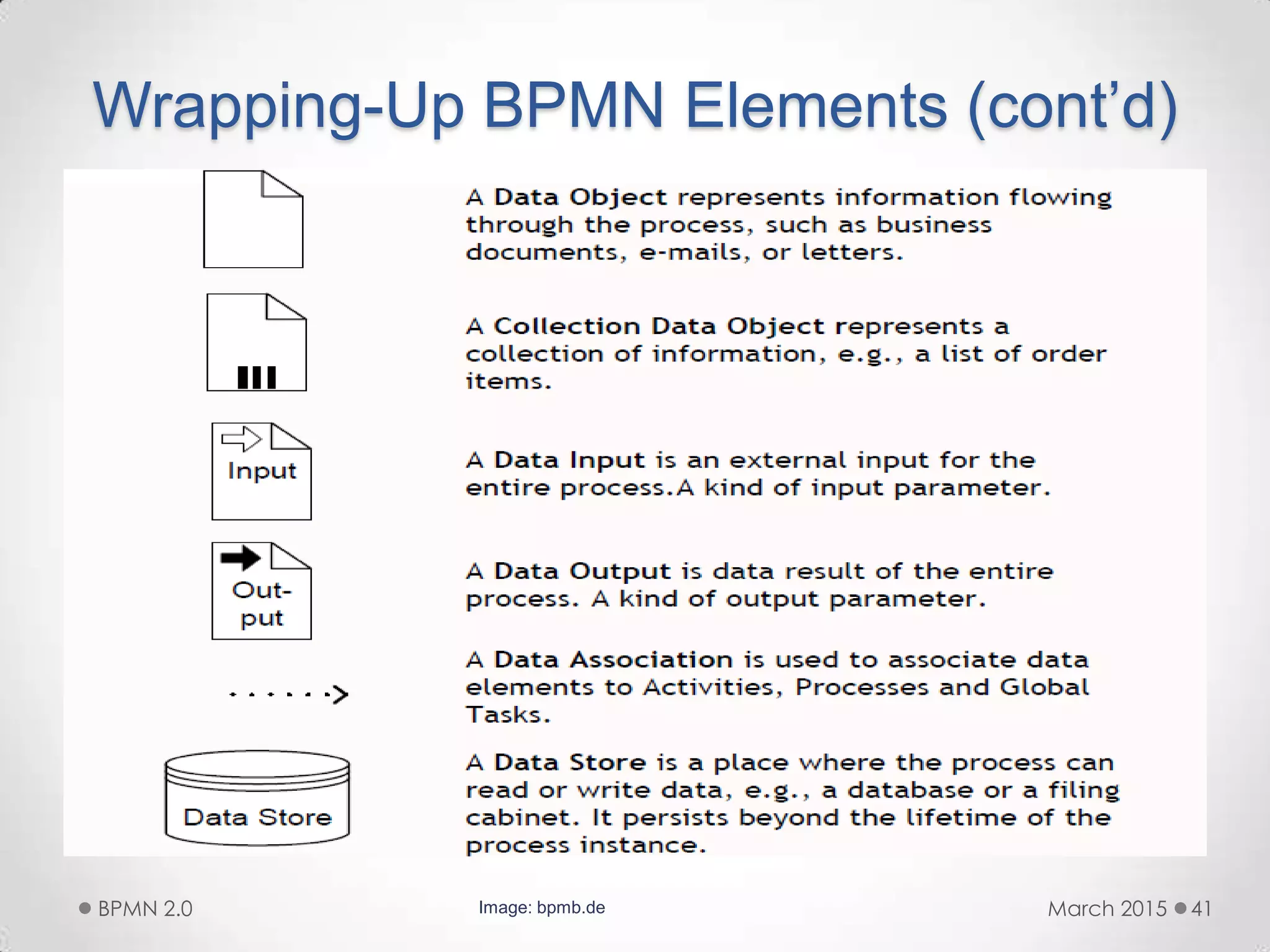
March 2015BPMN 2.0 41Image: bpmb.de
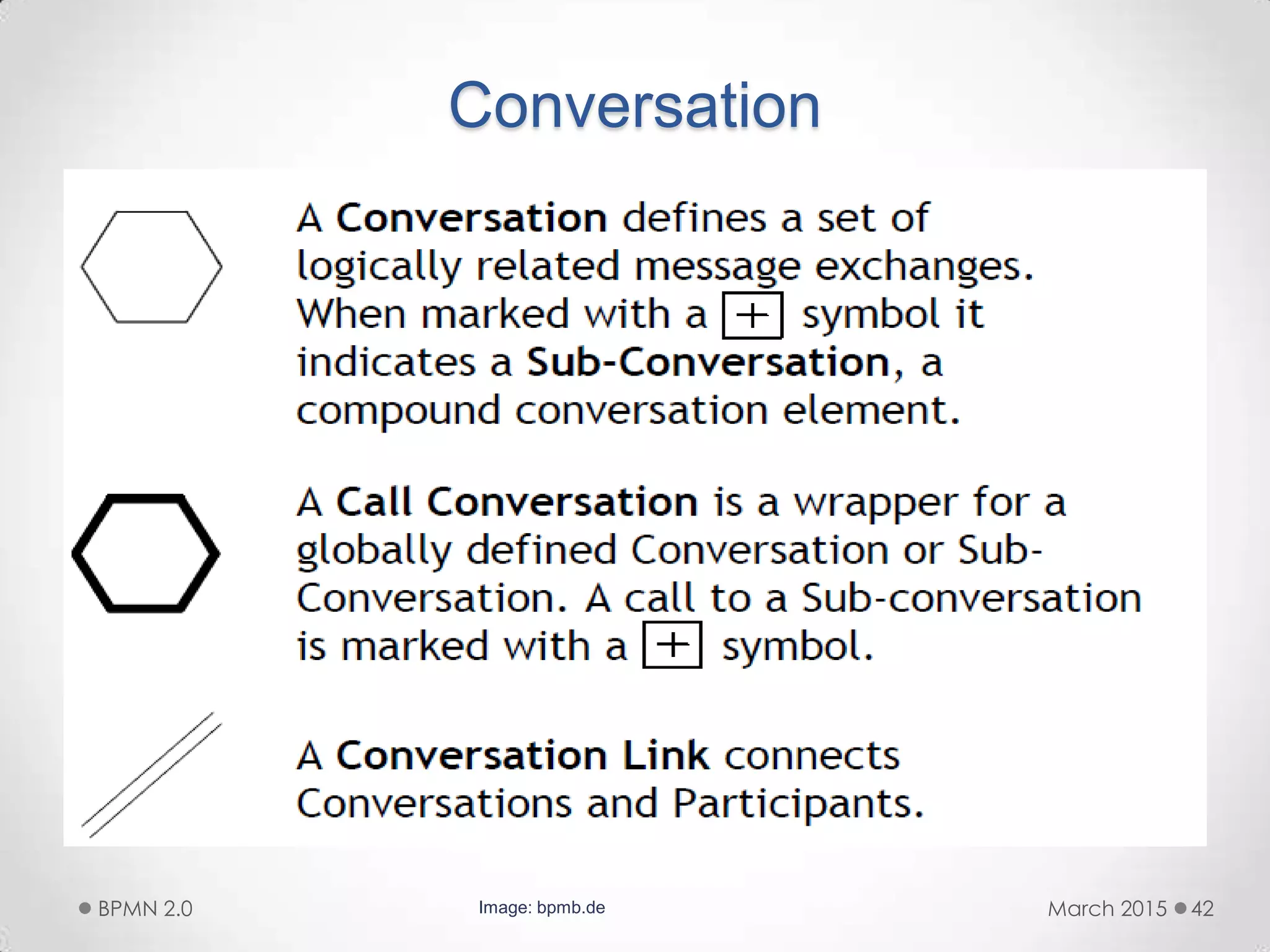
Conversation
March 2015BPMN 2.0 42Image: bpmb.de
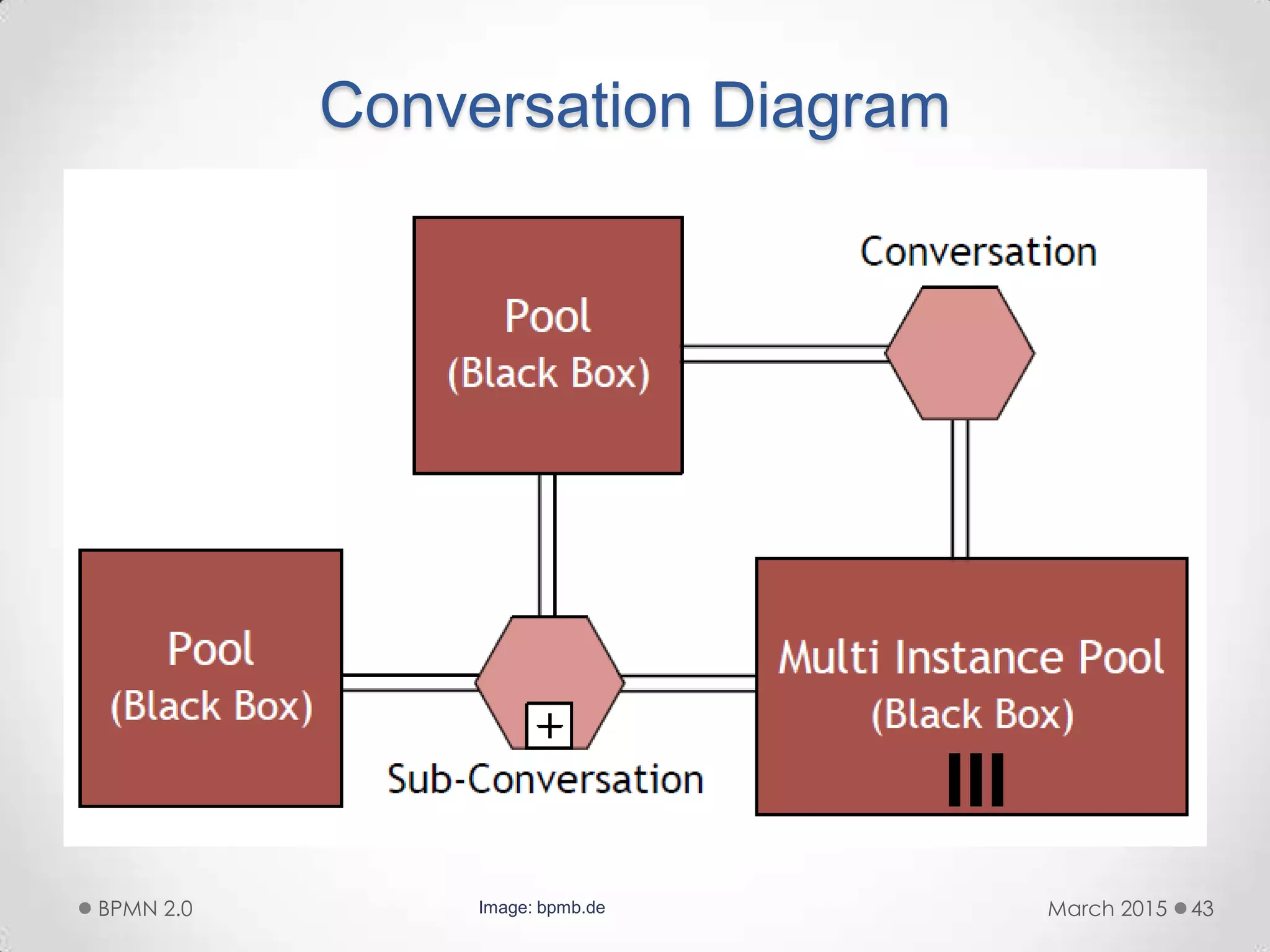
Conversation Diagram
March 2015BPMN 2.0 43Image: bpmb.de
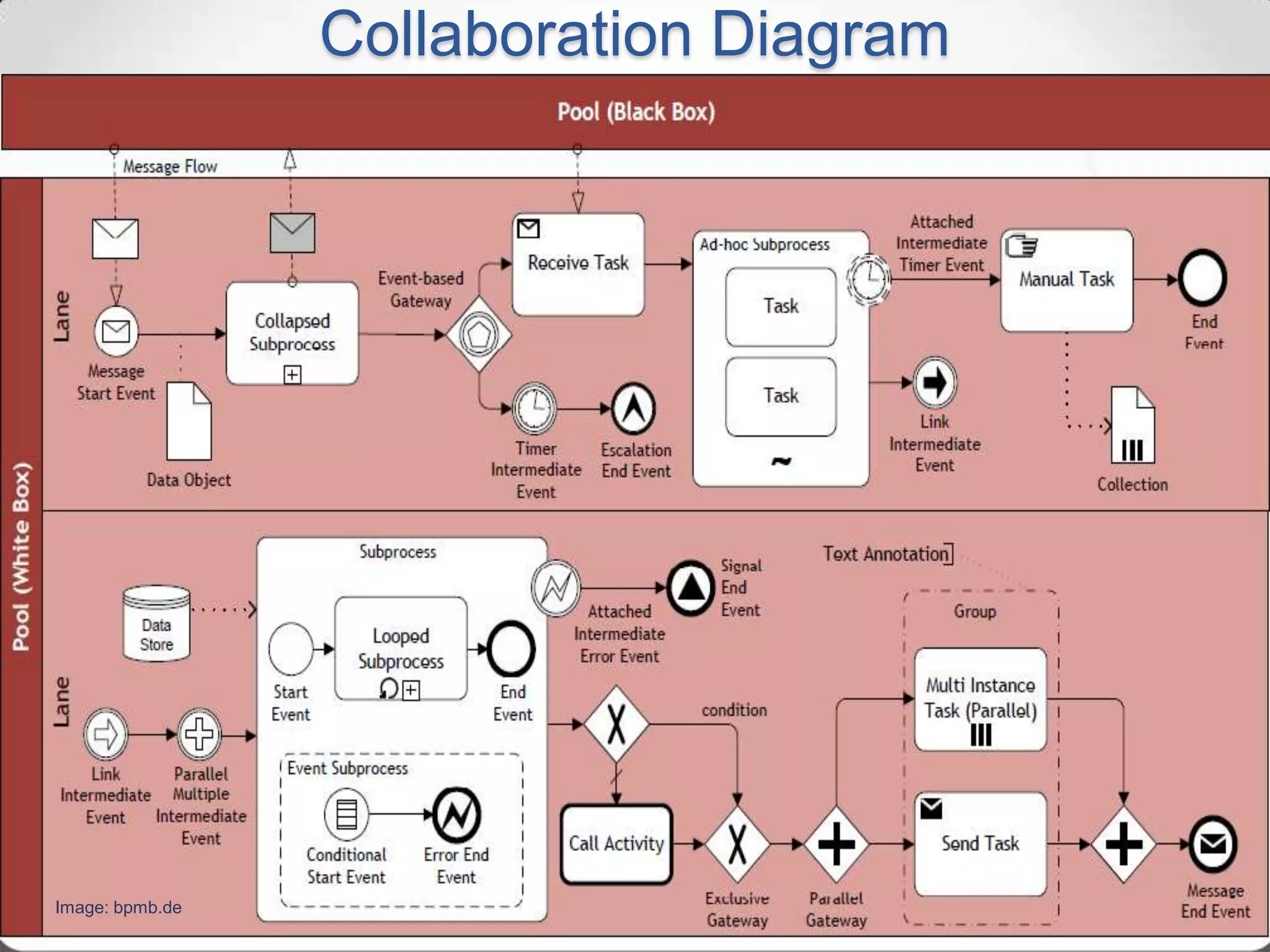
Collaboration Diagram
March 2015BPMN 2.0 44Image: bpmb.de
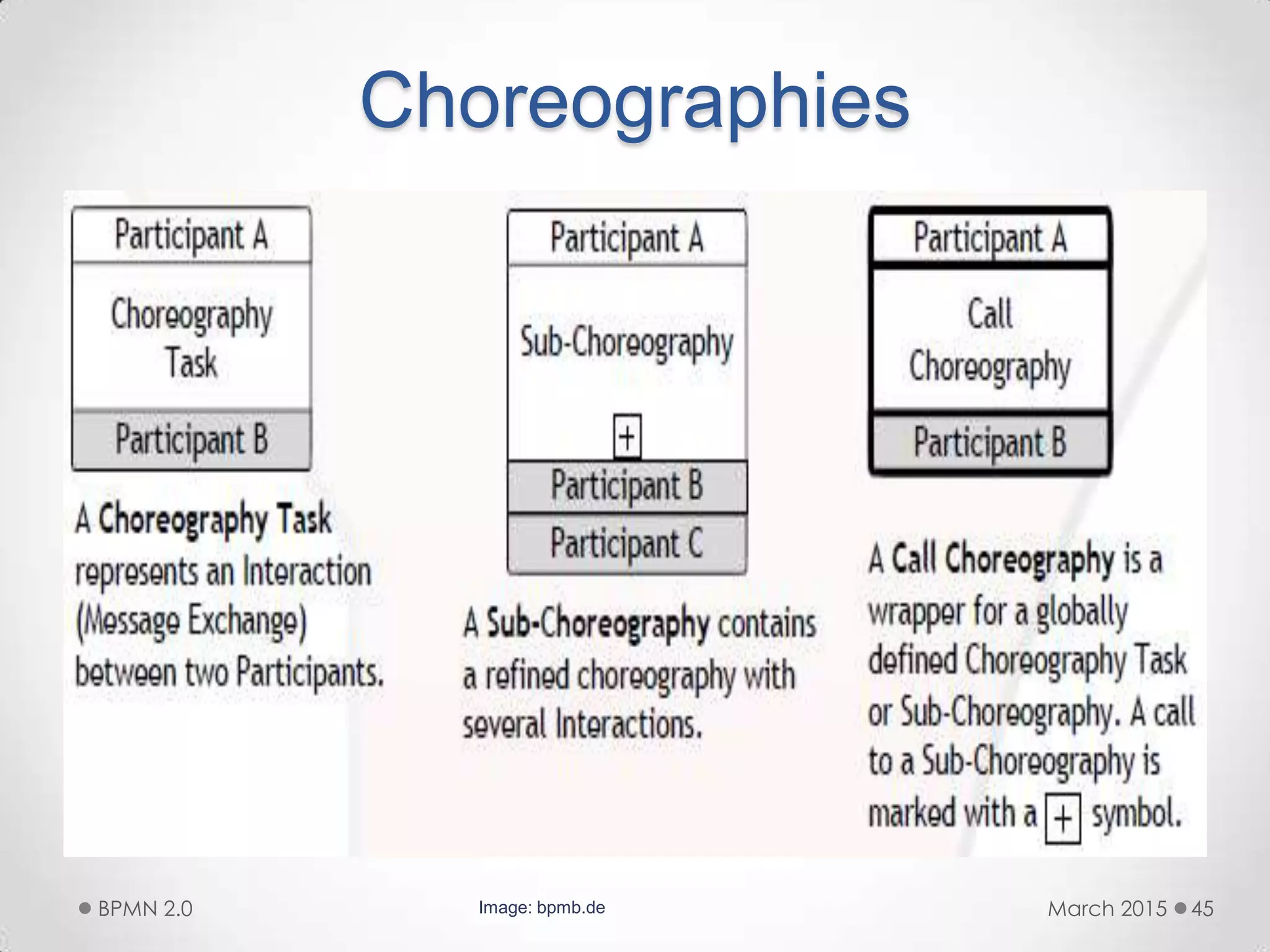
Choreographies
March 2015BPMN 2.0 45Image: bpmb.de
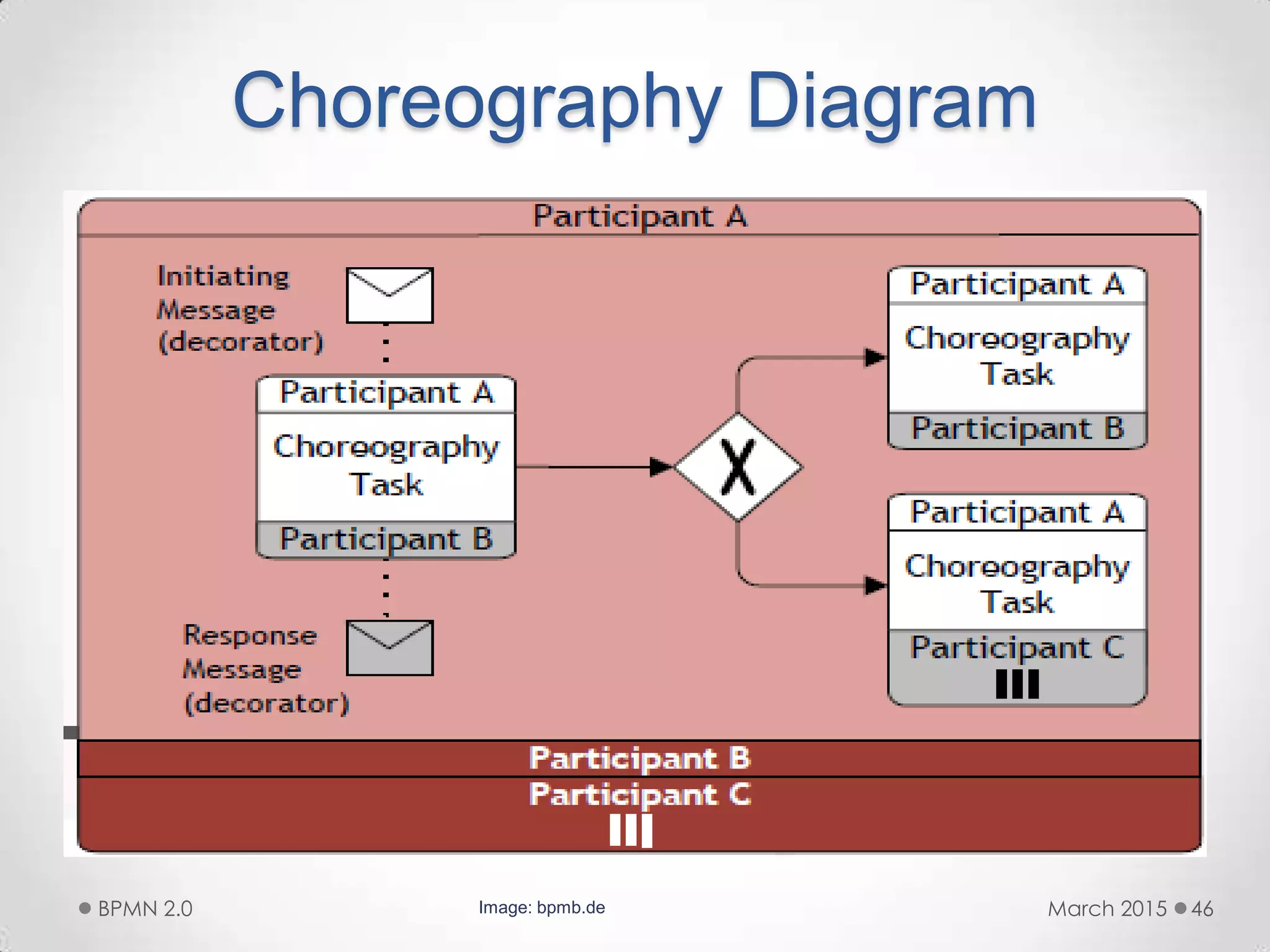
Choreography Diagram
March 2015BPMN 2.0 46Image: bpmb.de
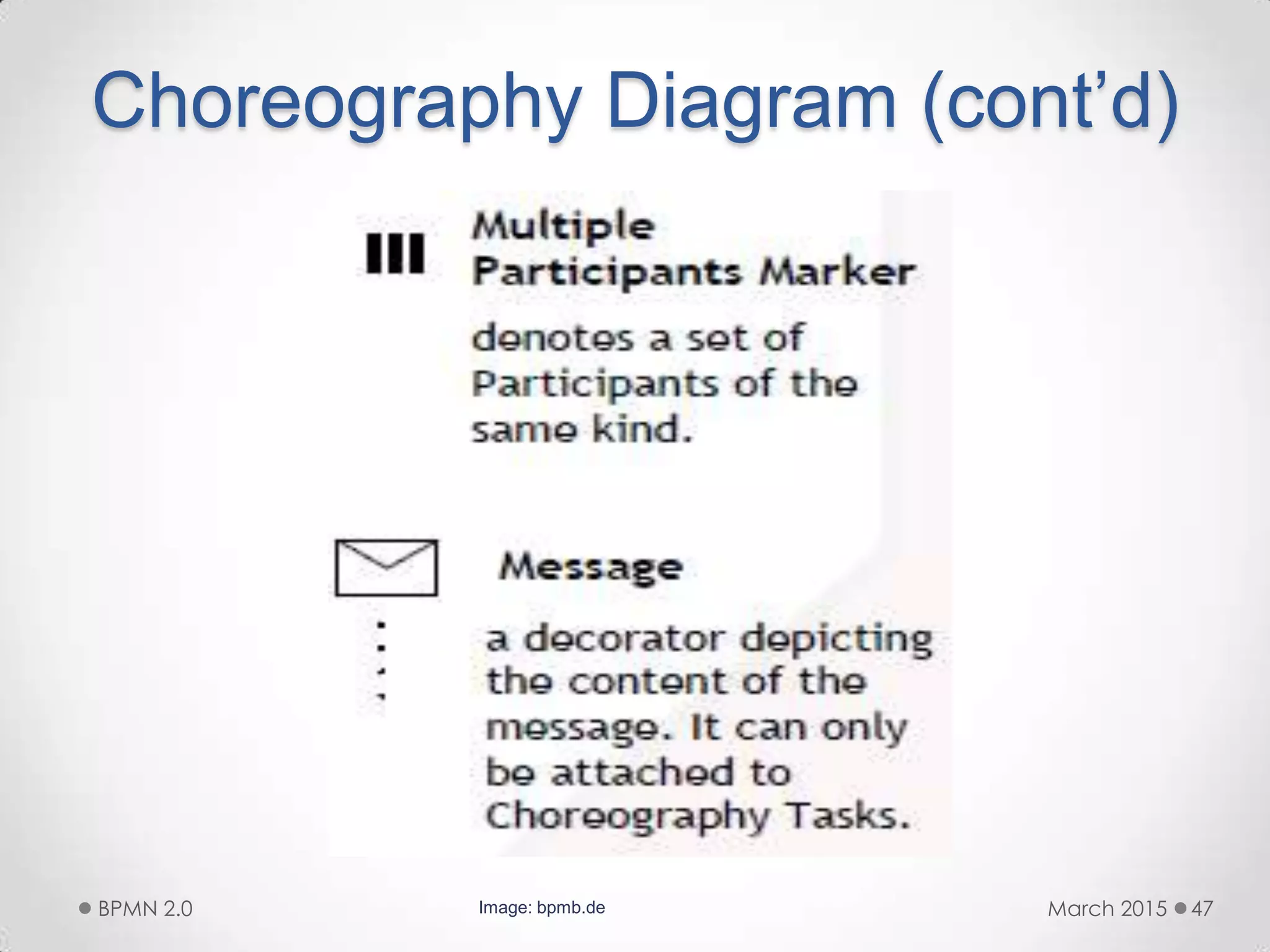
Choreography Diagram (cont’d)
March 2015BPMN 2.0 47Image: bpmb.de
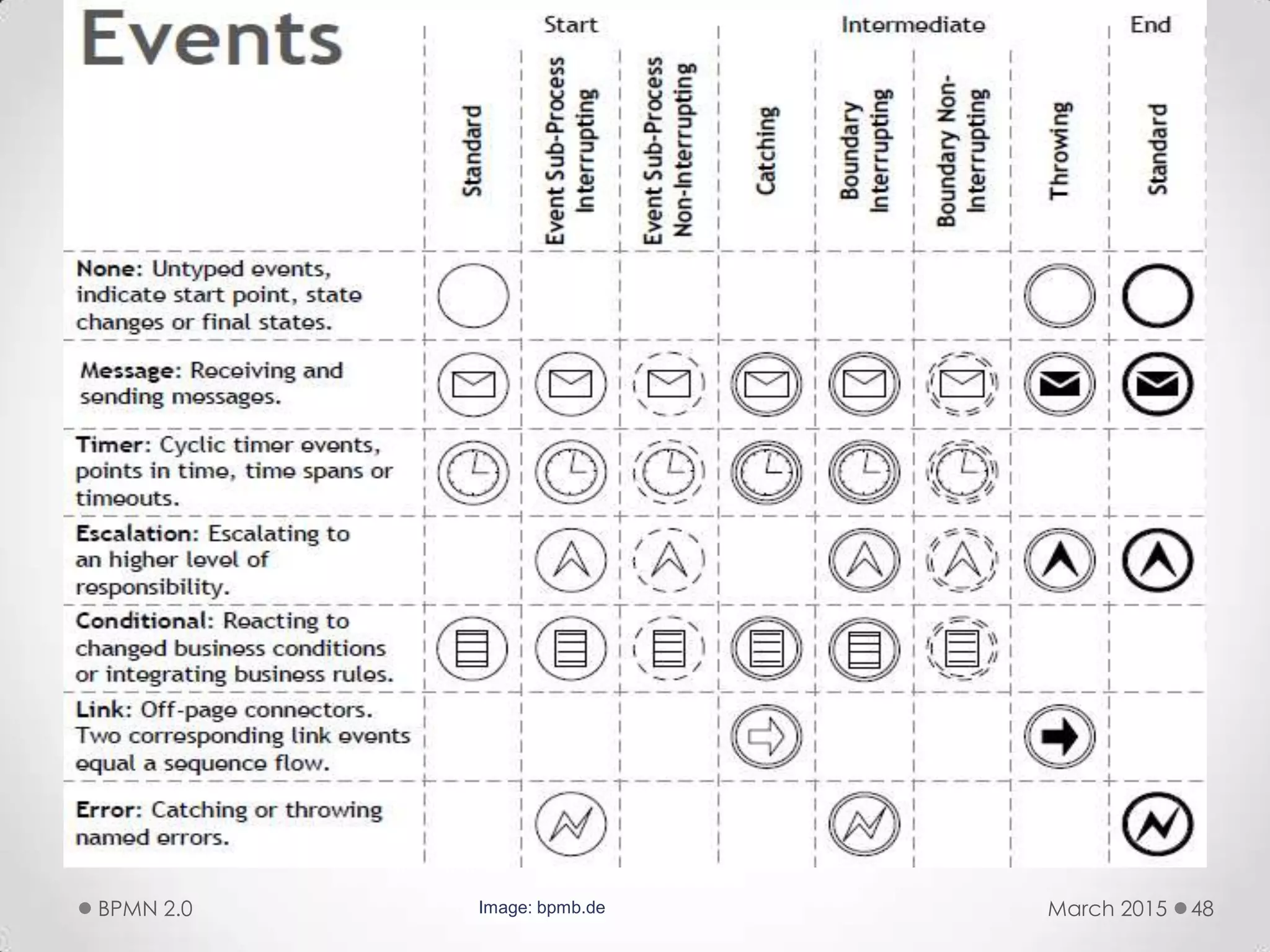
March 2015BPMN 2.0 48Image: bpmb.de
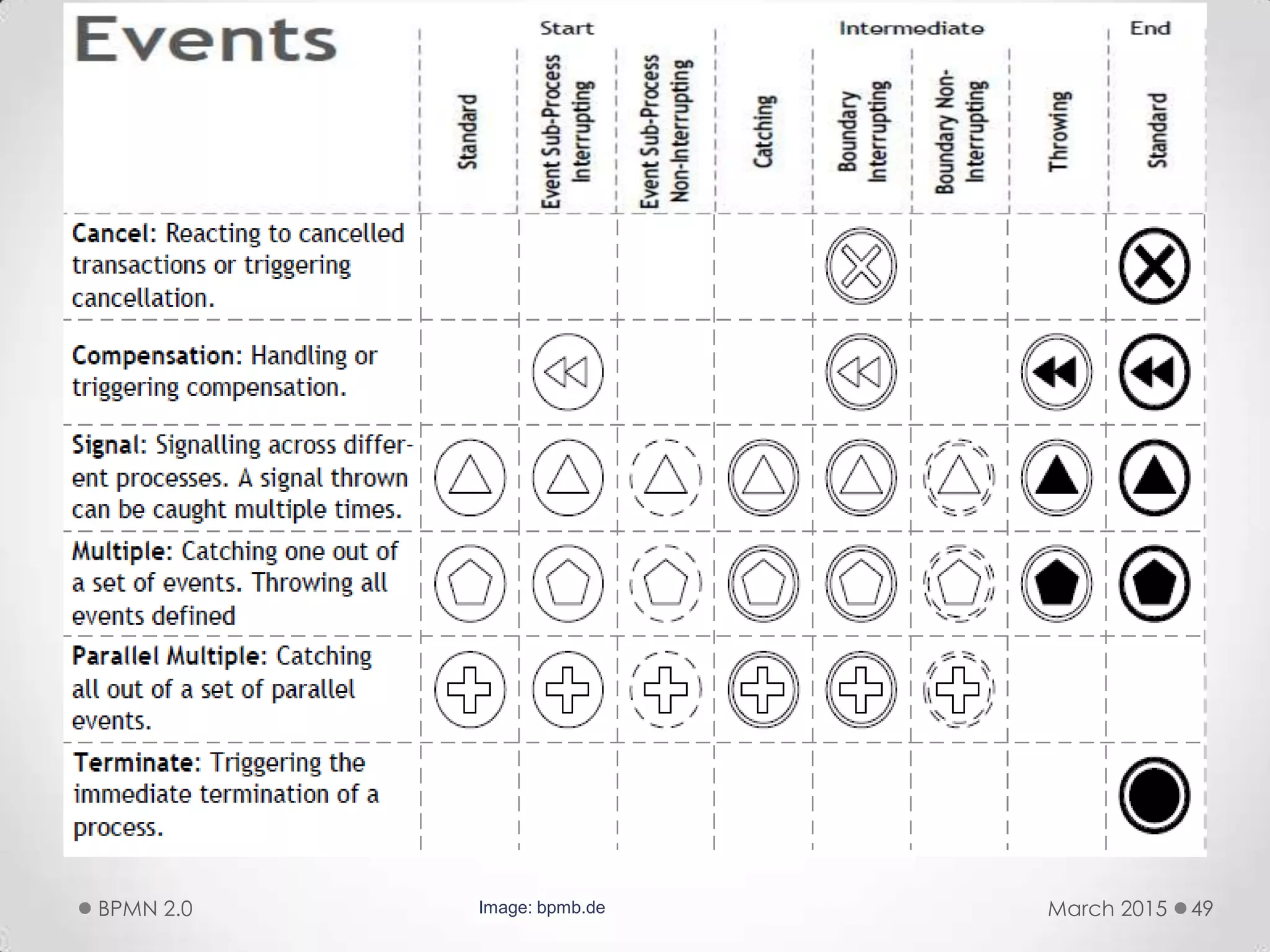
March 2015BPMN 2.0 49Image: bpmb.de
Simple BPMN Flow
• Naming Tasks: the [verb] + [object] pattern i.e. "acquire groceries," not "first take care of
shopping for groceries."
• Naming Events: something already happened regardless of the process (catching events)
or process result (throwing events).
The [object] and make the [verb] passive in voice.
March 2015BPMN 2.0 50
Simple BPMN Flow
• Naming Tasks: the [verb] + [object] pattern i.e. "acquire groceries," not "first take care of
shopping for groceries."
• Naming Events: something already happened regardless of the process (catching events)
or process result (throwing events).
The [object] and make the [verb] passive in voice.
March 2015BPMN 2.0 51
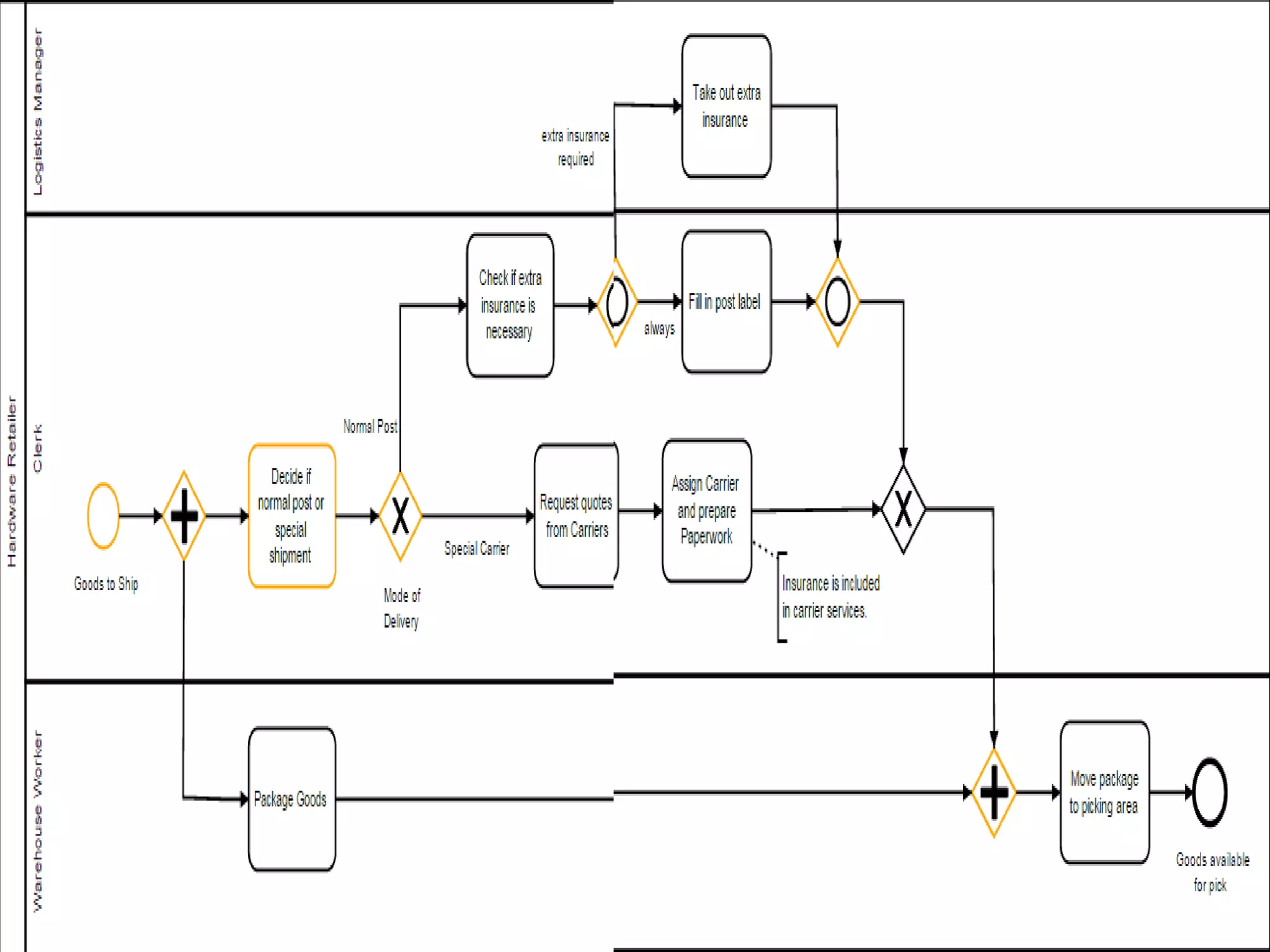
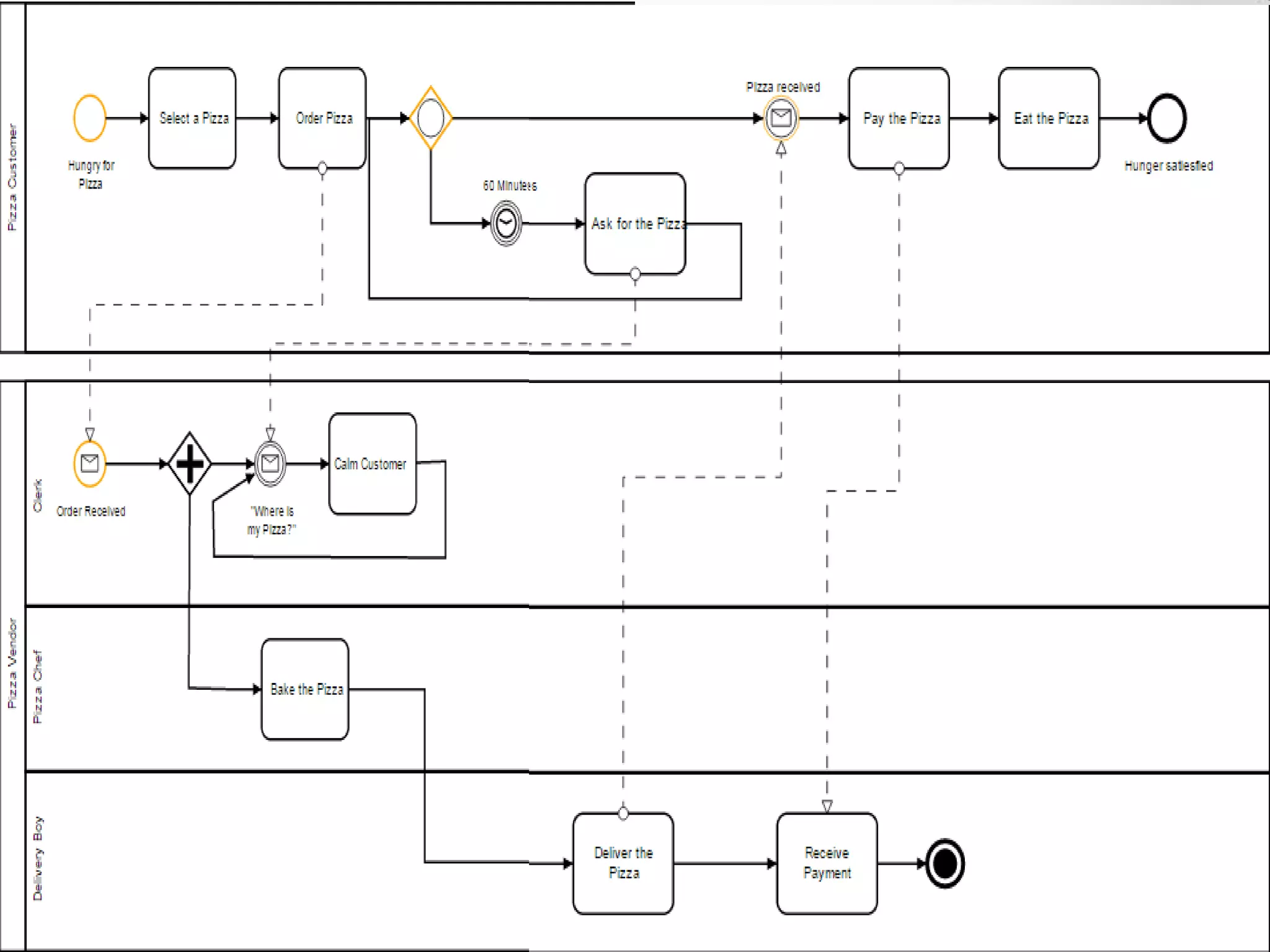
Another Examples
• Let’s take a look at the next slides.
March 2015BPMN 2.0 52
March 2015BPMN 2.0 53
March 2015BPMN 2.0 54
Exploring Microsoft Visio 2013
Professional Edition
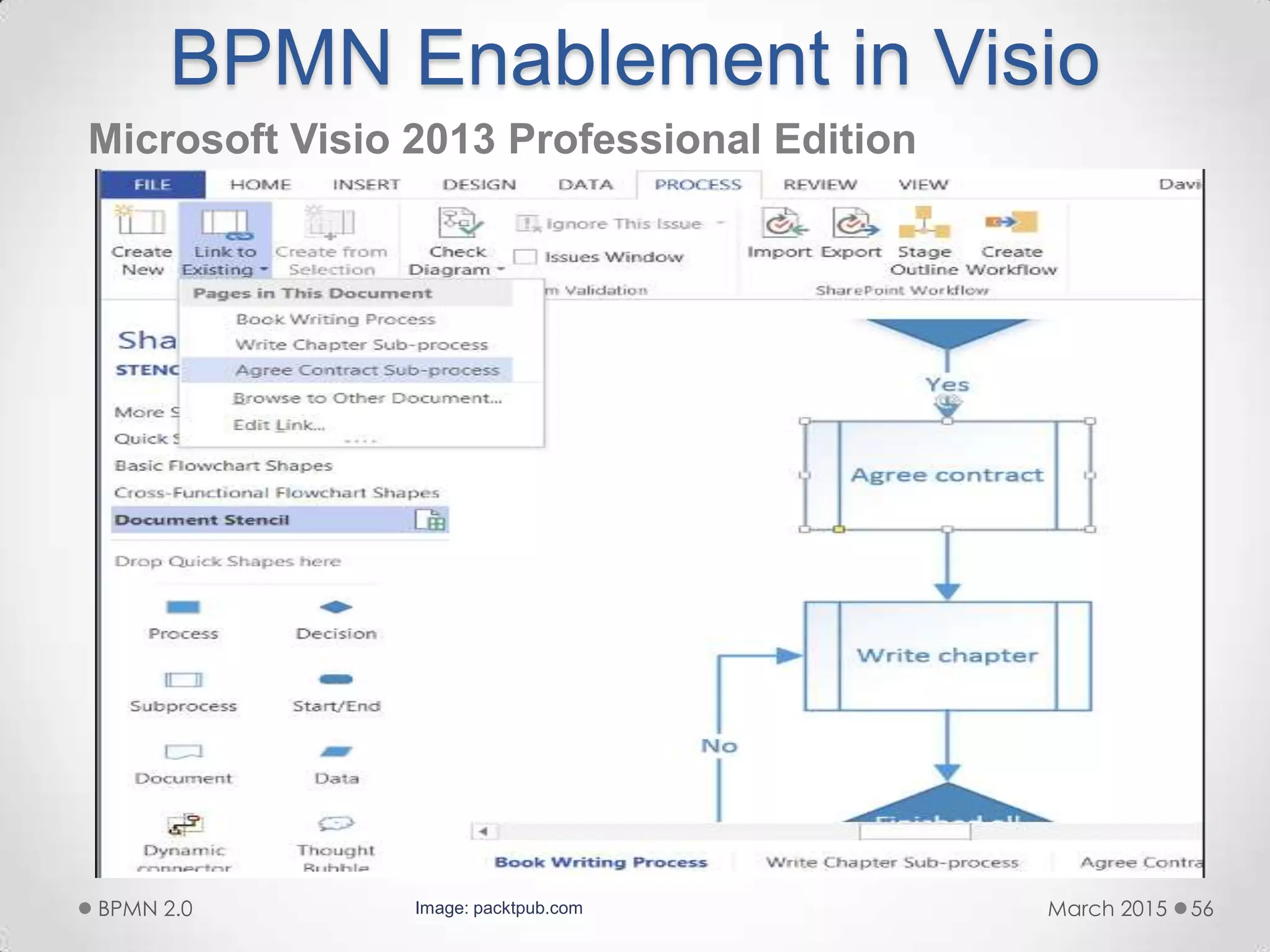
BPMN Enablement in Visio
Microsoft Visio 2013 Professional Edition
March 2015BPMN 2.0 56Image: packtpub.com
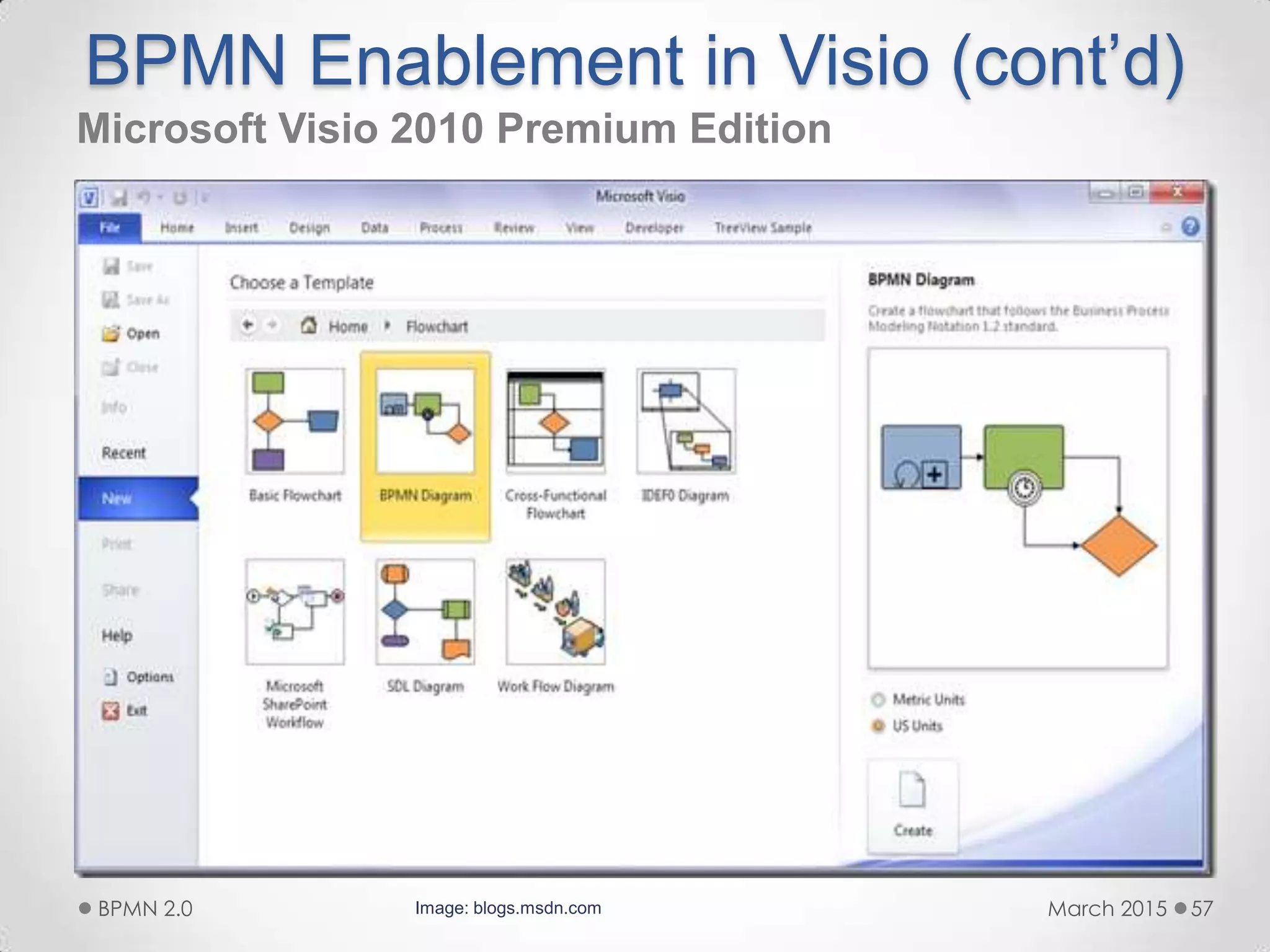
BPMN Enablement in Visio (cont’d)
Microsoft Visio 2010 Premium Edition
March 2015BPMN 2.0 57Image: blogs.msdn.com
Themes, Effects and Variants
March 2015BPMN 2.0 58
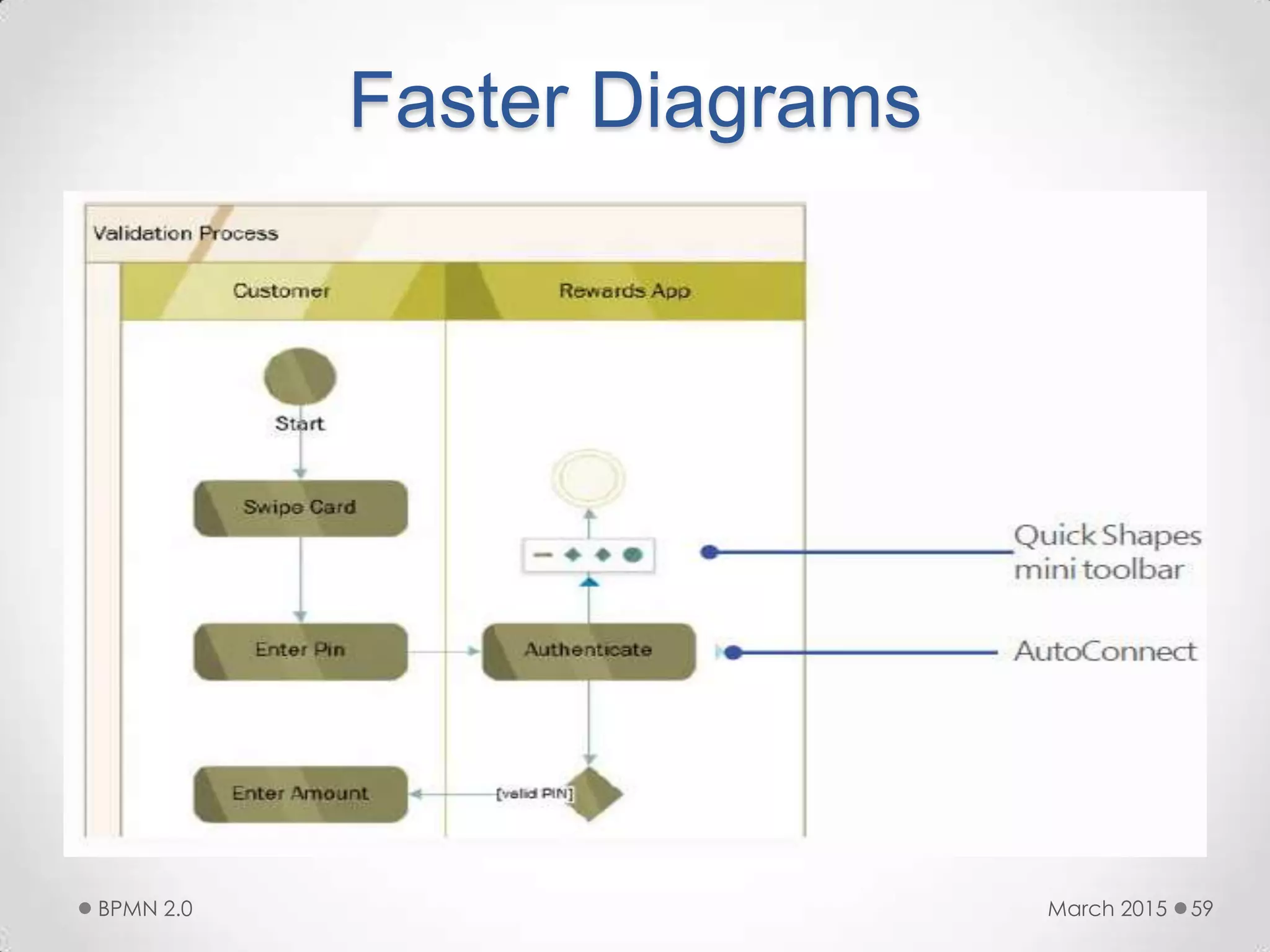
Faster Diagrams
March 2015BPMN 2.0 59
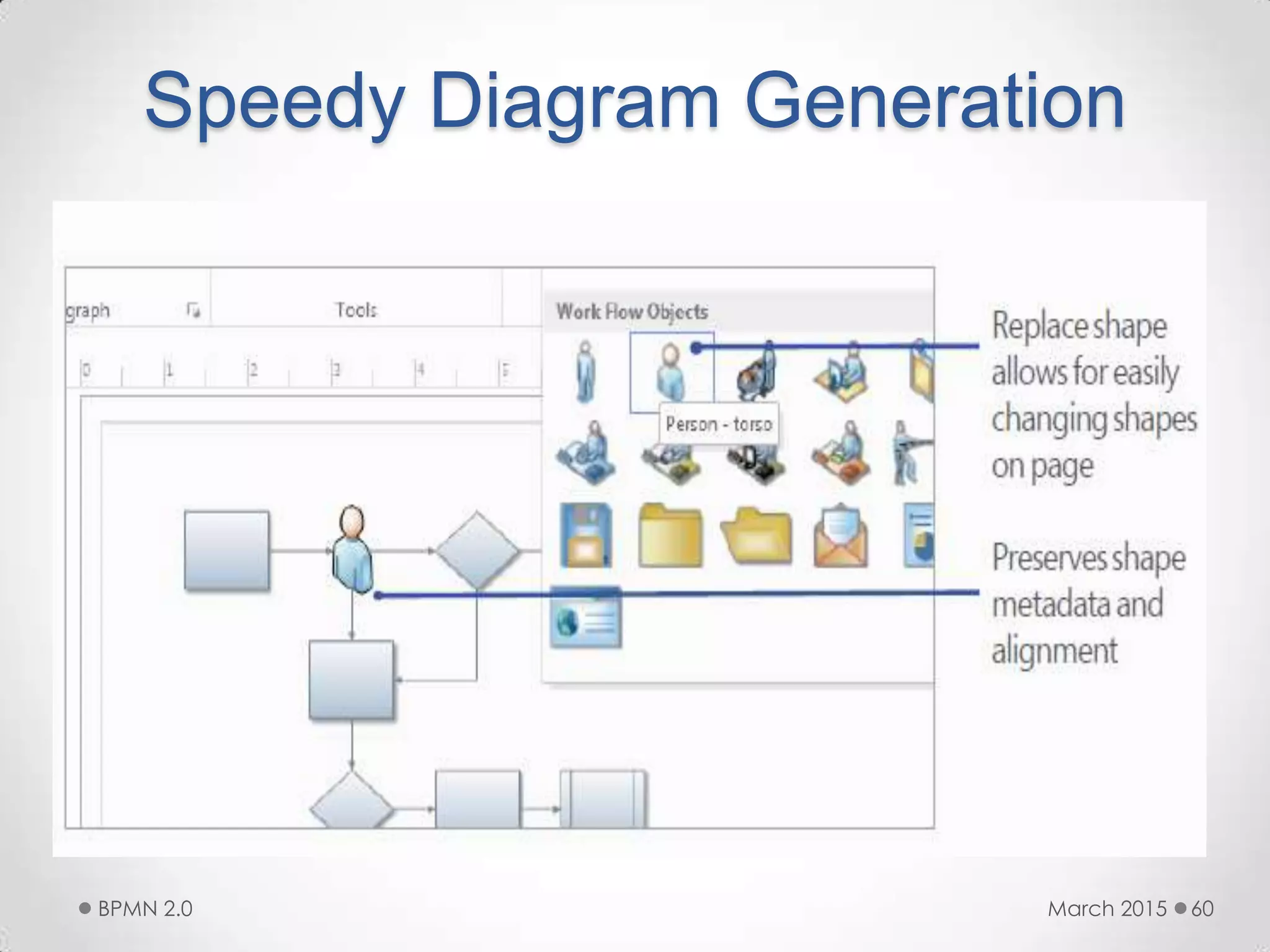
Speedy Diagram Generation
March 2015BPMN 2.0 60
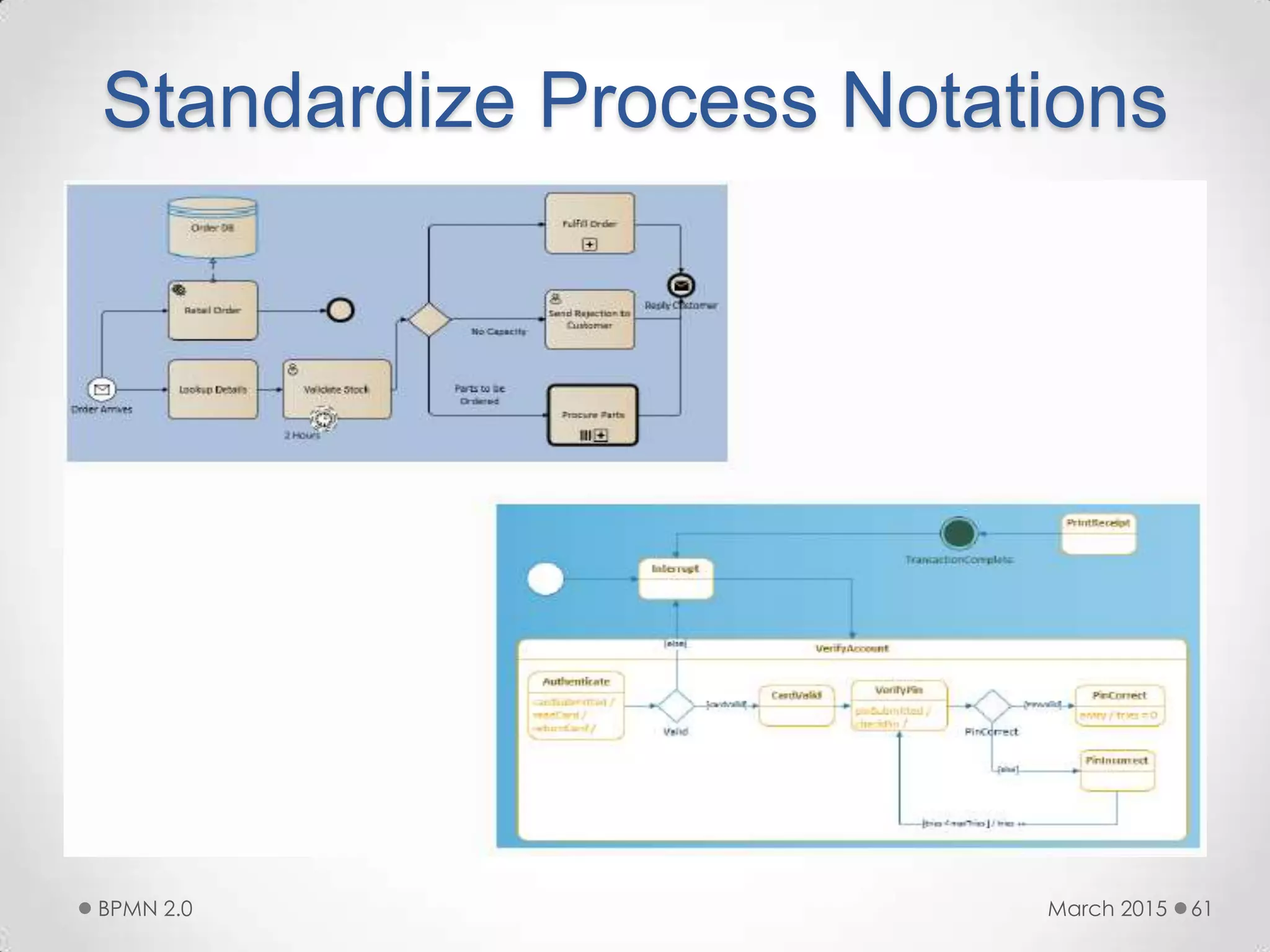
Standardize Process Notations
March 2015BPMN 2.0 61
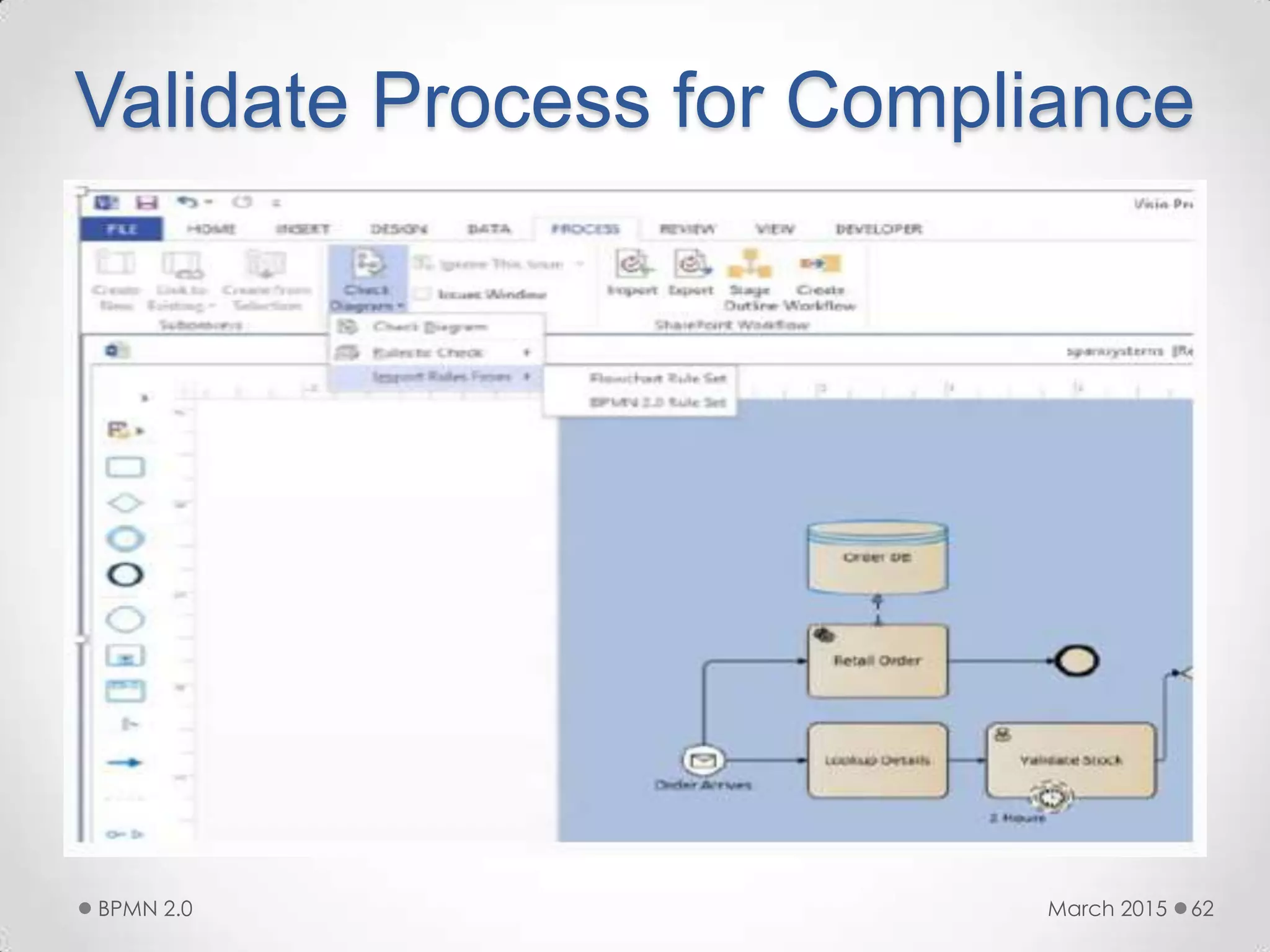
Validate Process for Compliance
March 2015BPMN 2.0 62
Diagram Anywhere
March 2015BPMN 2.0 63
More Shapes to Support
• 36 Task shapes and 108 variations on the
Task shape not shown.
• 64 types of Collapsed Sub-Process and 64
types of Expanded Sub-Process shapes.
• In total, Visio support about 360
graphically different BPMN shapes.
March 2015BPMN 2.0 64
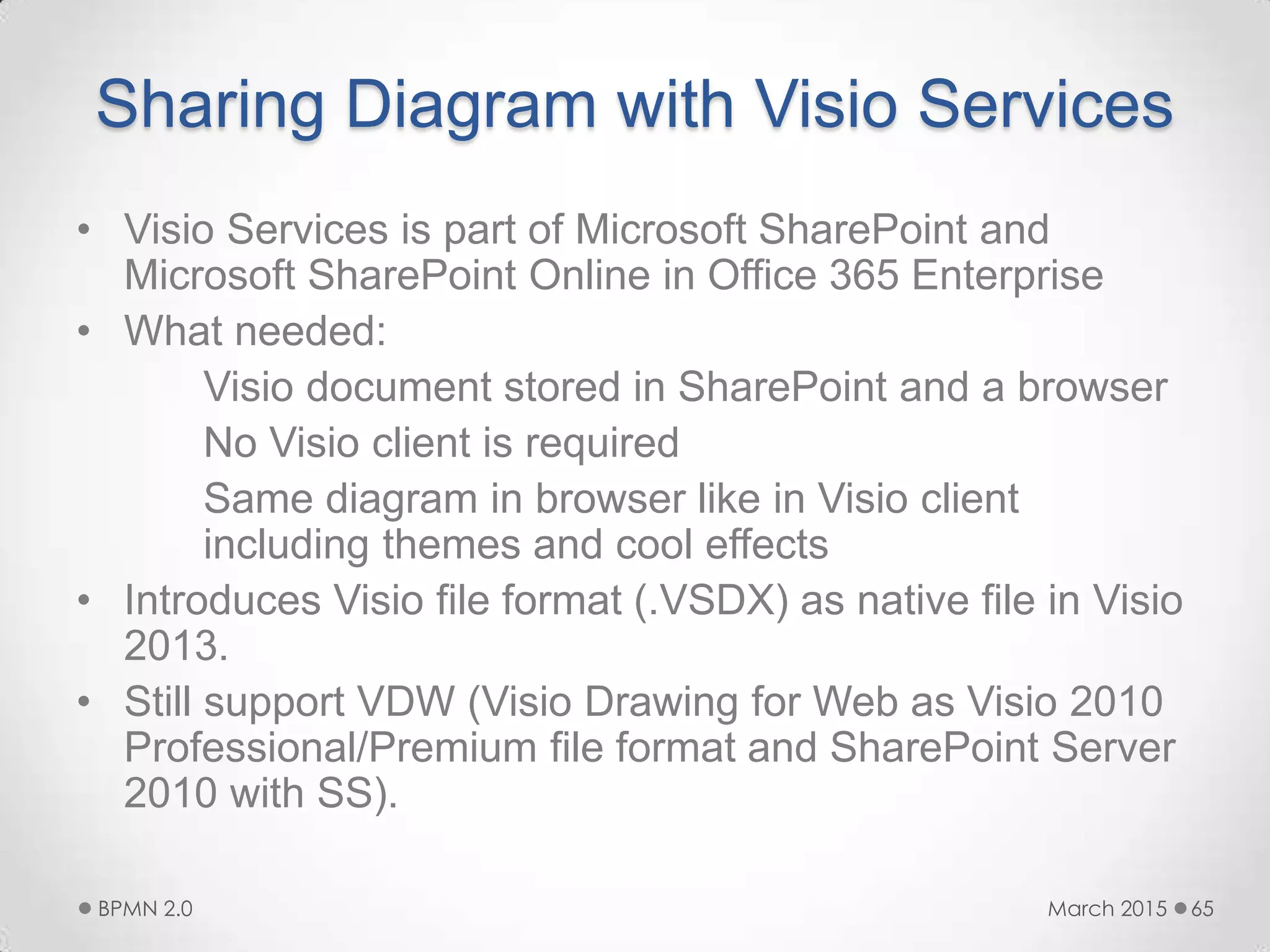
Sharing Diagram with Visio Services
• Visio Services is part of Microsoft SharePoint and
Microsoft SharePoint Online in Office 365 Enterprise
• What needed:
Visio document stored in SharePoint and a browser
No Visio client is required
Same diagram in browser like in Visio client
including themes and cool effects
• Introduces Visio file format (.VSDX) as native file in Visio
2013.
• Still support VDW (Visio Drawing for Web as Visio 2010
Professional/Premium file format and SharePoint Server
2010 with SS).
March 2015BPMN 2.0 65
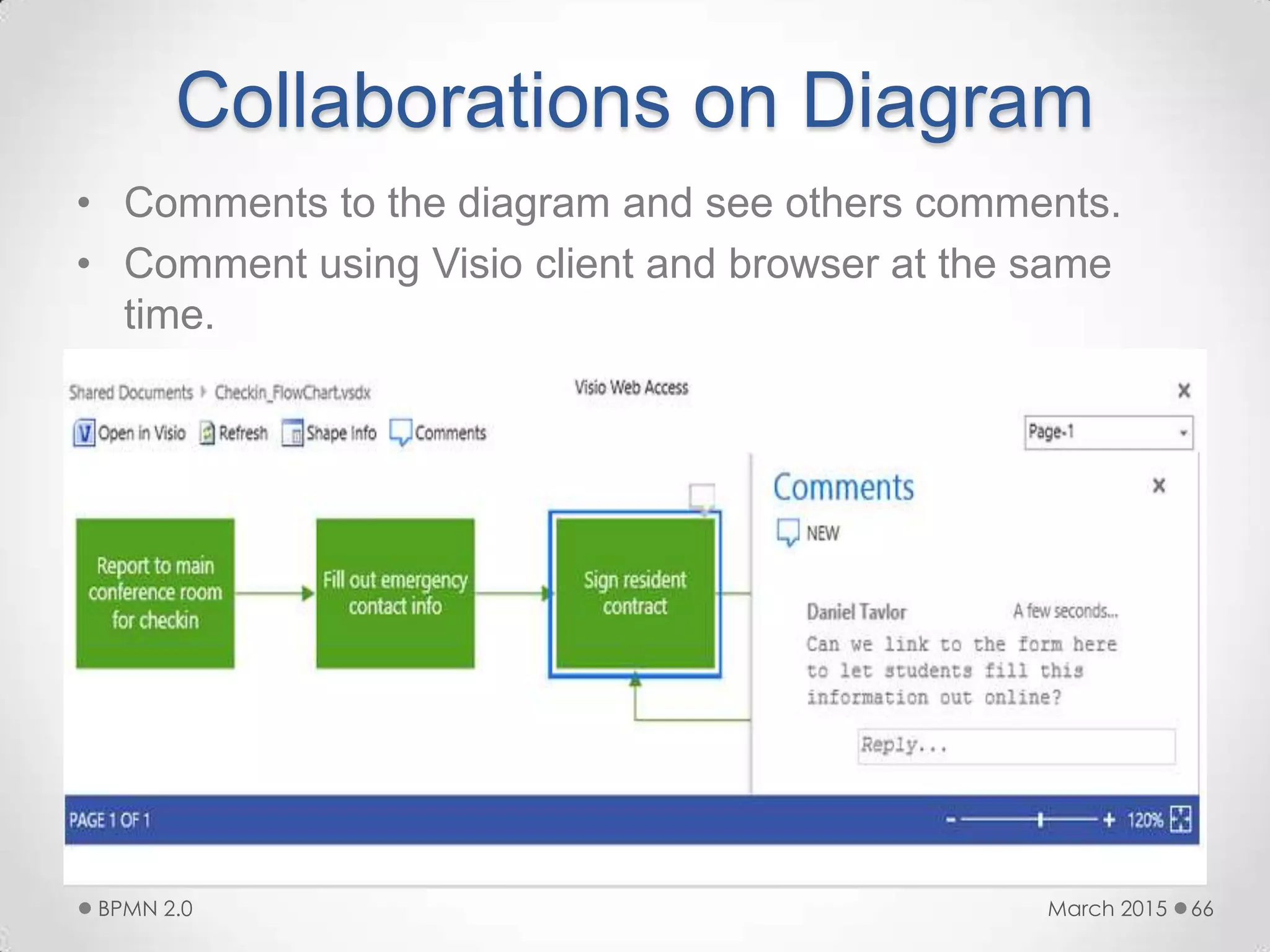
Collaborations on Diagram
• Comments to the diagram and see others comments.
• Comment using Visio client and browser at the same
time.
March 2015BPMN 2.0 66
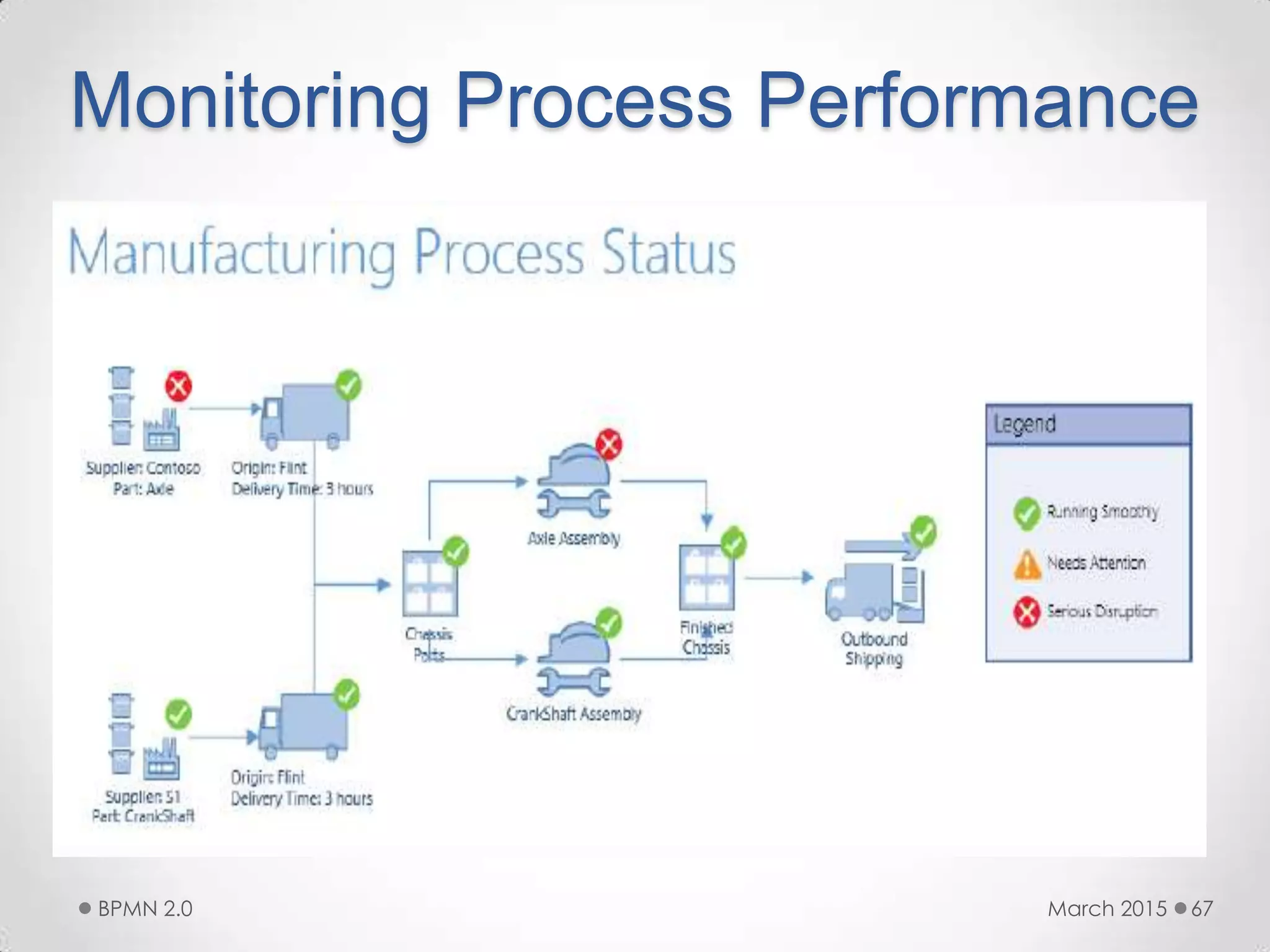
Monitoring Process Performance
March 2015BPMN 2.0 67
Utilizing BPMN Methods and Style
Comprehending Pools,
Subprocesses, and Hierarchical
Modeling
Valuing Collaboration and a
"Complete" Top-Level Diagram
Leveraging Events Overview and
Using Timer Events
Sending, Receiving, and Using
Message Events
Using Error, Event Subprocesses,
and the Other Level 2 Events
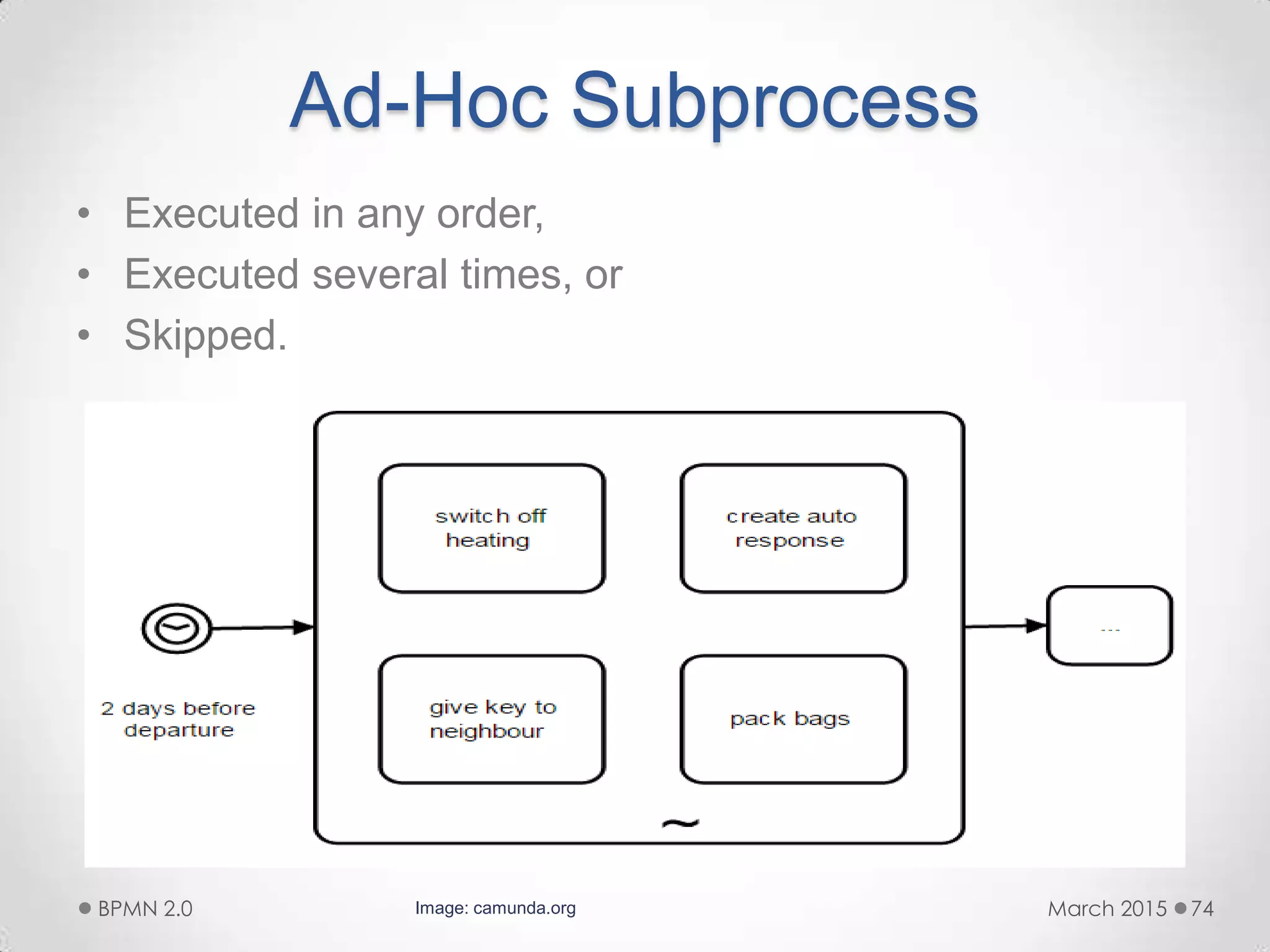
Ad-Hoc Subprocess
• Executed in any order,
• Executed several times, or
• Skipped.
March 2015BPMN 2.0 74Image: camunda.org
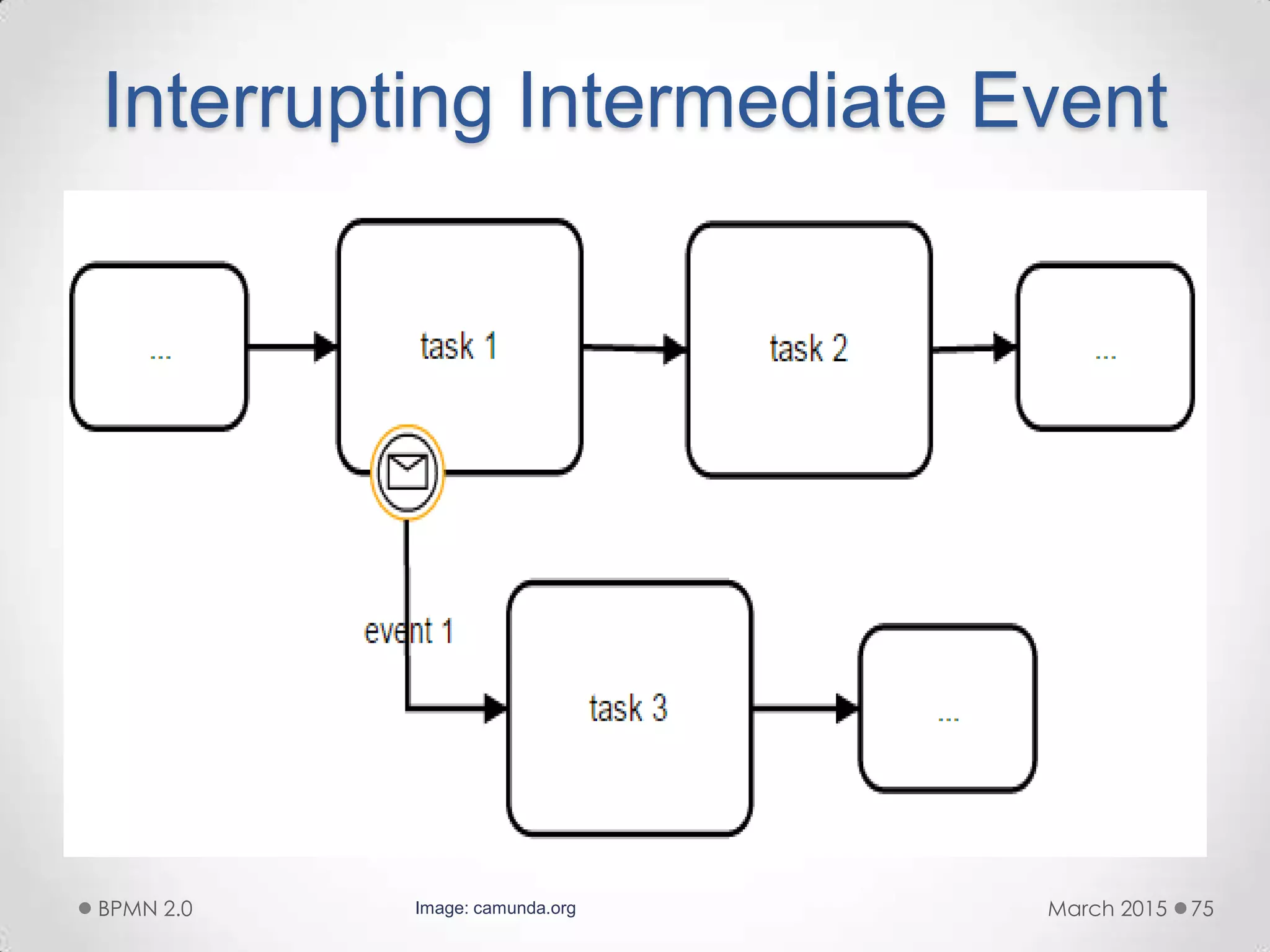
Interrupting Intermediate Event
March 2015BPMN 2.0 75Image: camunda.org
Interrupting Intermediate Event (cont’d)
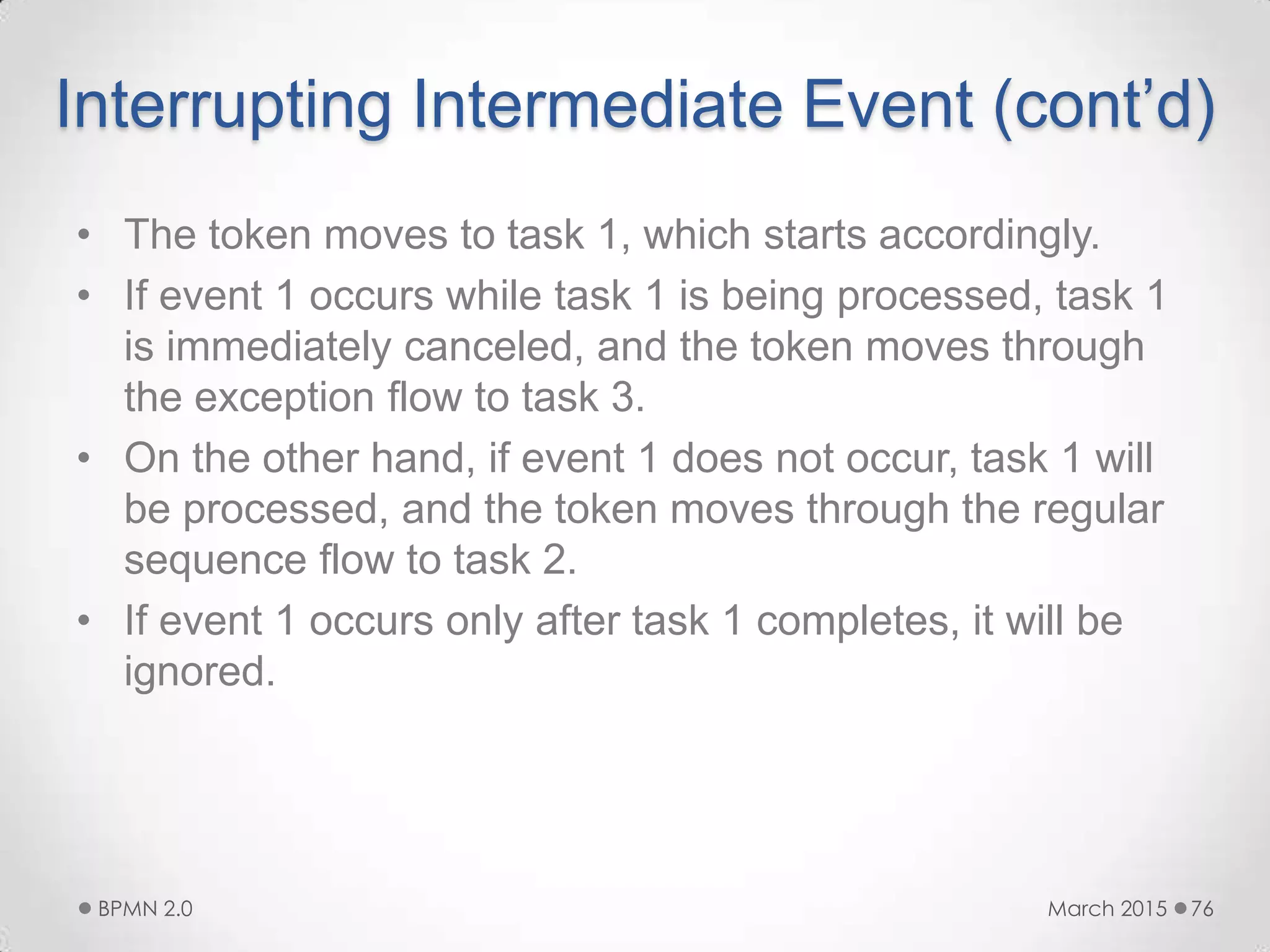
• The token moves to task 1, which starts accordingly.
• If event 1 occurs while task 1 is being processed, task 1
is immediately canceled, and the token moves through
the exception flow to task 3.
• On the other hand, if event 1 does not occur, task 1 will
be processed, and the token moves through the regular
sequence flow to task 2.
• If event 1 occurs only after task 1 completes, it will be
ignored.
March 2015BPMN 2.0 76
Non-Interrupting Intermediate Event
March 2015BPMN 2.0 77Image: camunda.org
Non-Interrupting Intermediate Event (cont’d)
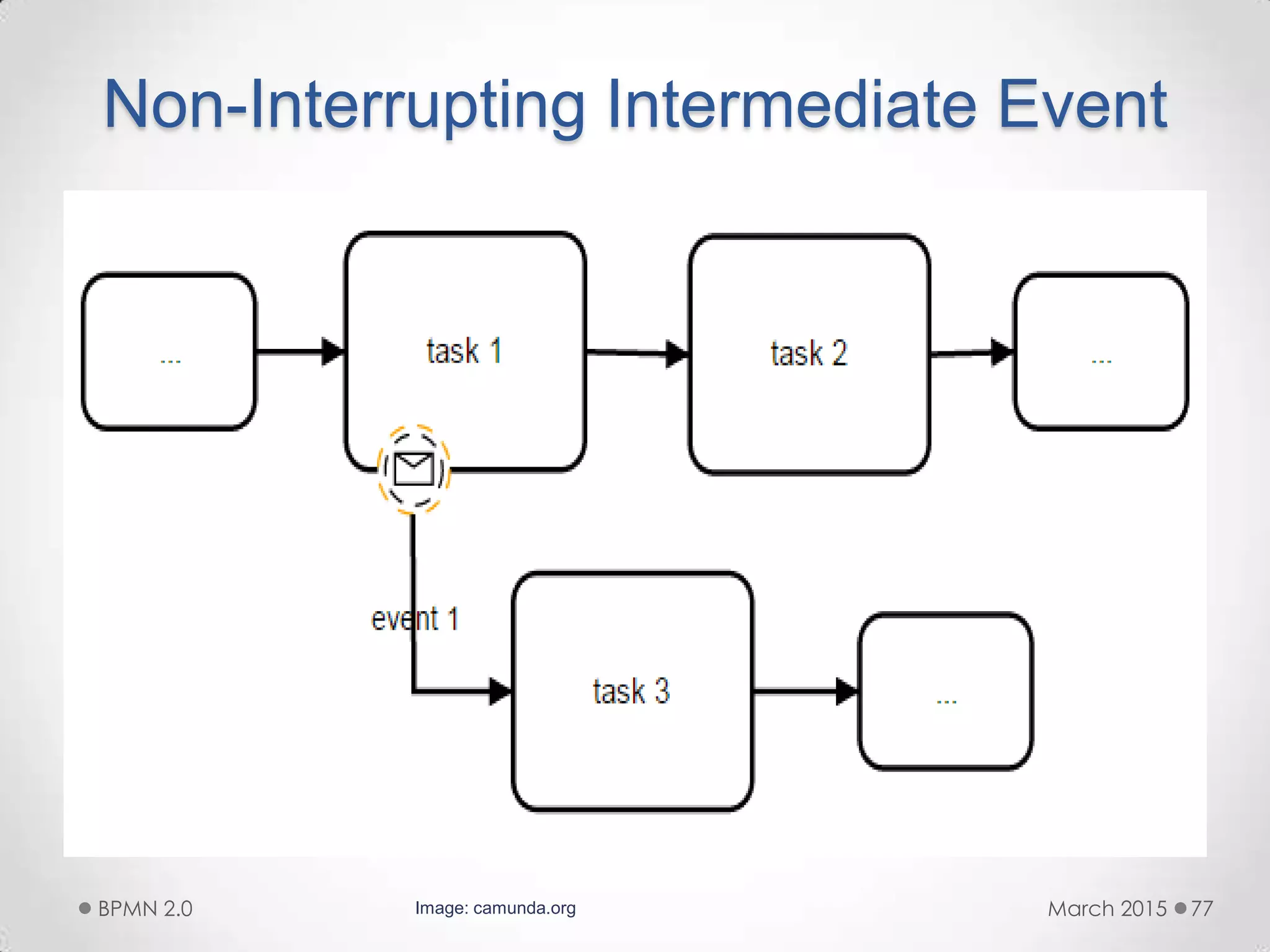
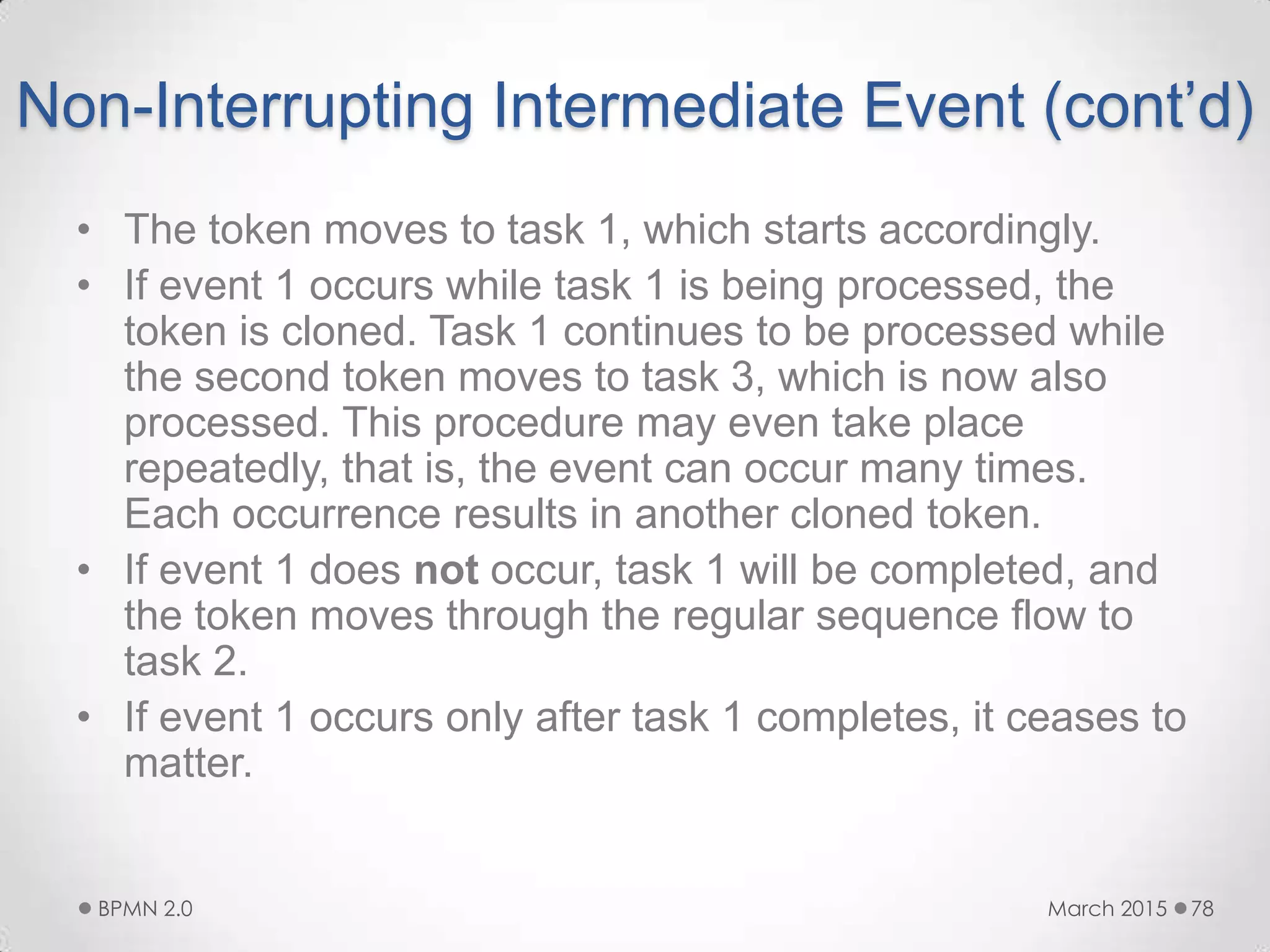
• The token moves to task 1, which starts accordingly.
• If event 1 occurs while task 1 is being processed, the
token is cloned. Task 1 continues to be processed while
the second token moves to task 3, which is now also
processed. This procedure may even take place
repeatedly, that is, the event can occur many times.
Each occurrence results in another cloned token.
• If event 1 does not occur, task 1 will be completed, and
the token moves through the regular sequence flow to
task 2.
• If event 1 occurs only after task 1 completes, it ceases to
matter.
March 2015BPMN 2.0 78
Signal
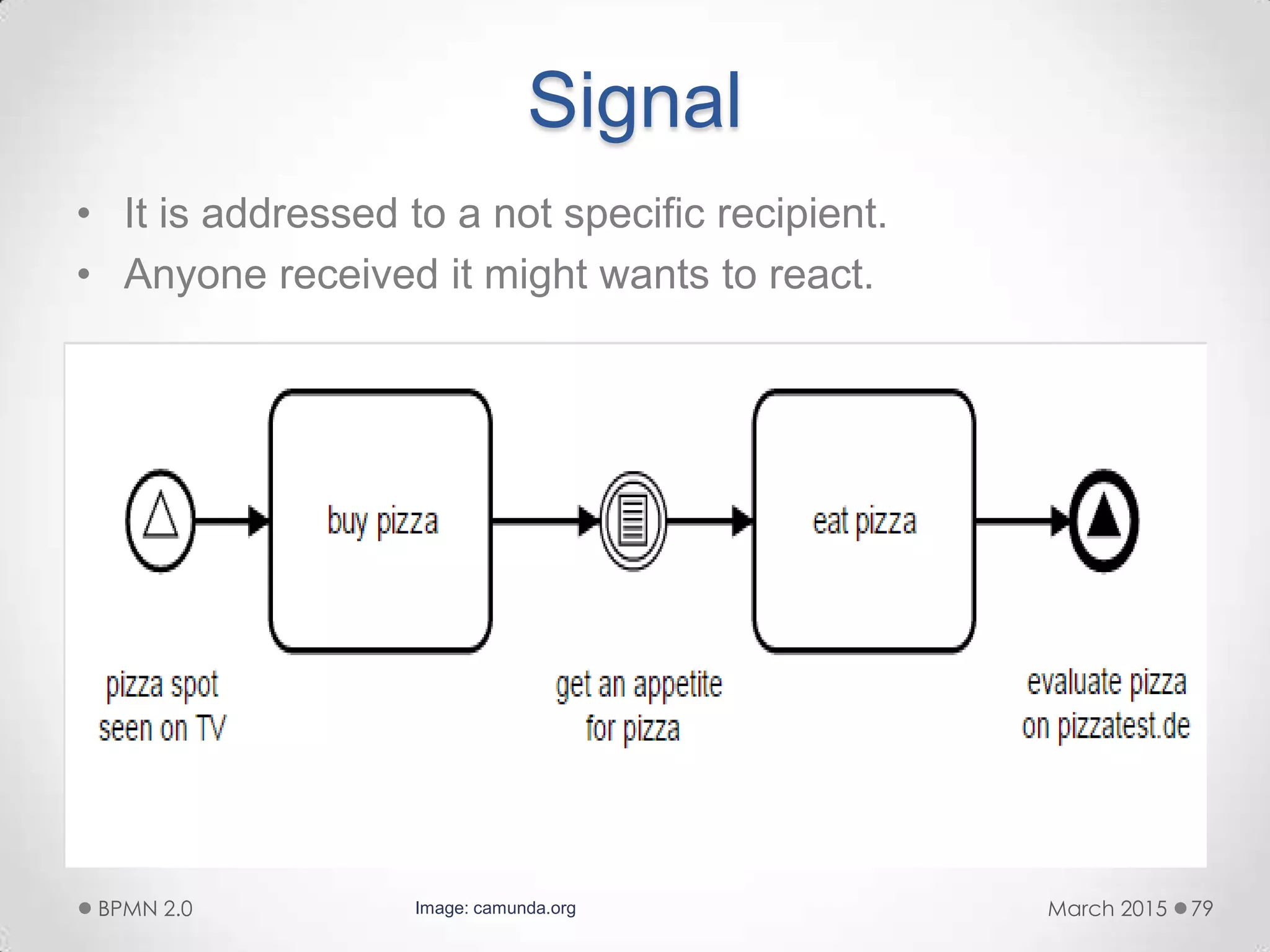
• It is addressed to a not specific recipient.
• Anyone received it might wants to react.
March 2015BPMN 2.0 79Image: camunda.org
Working with Branching and Merging
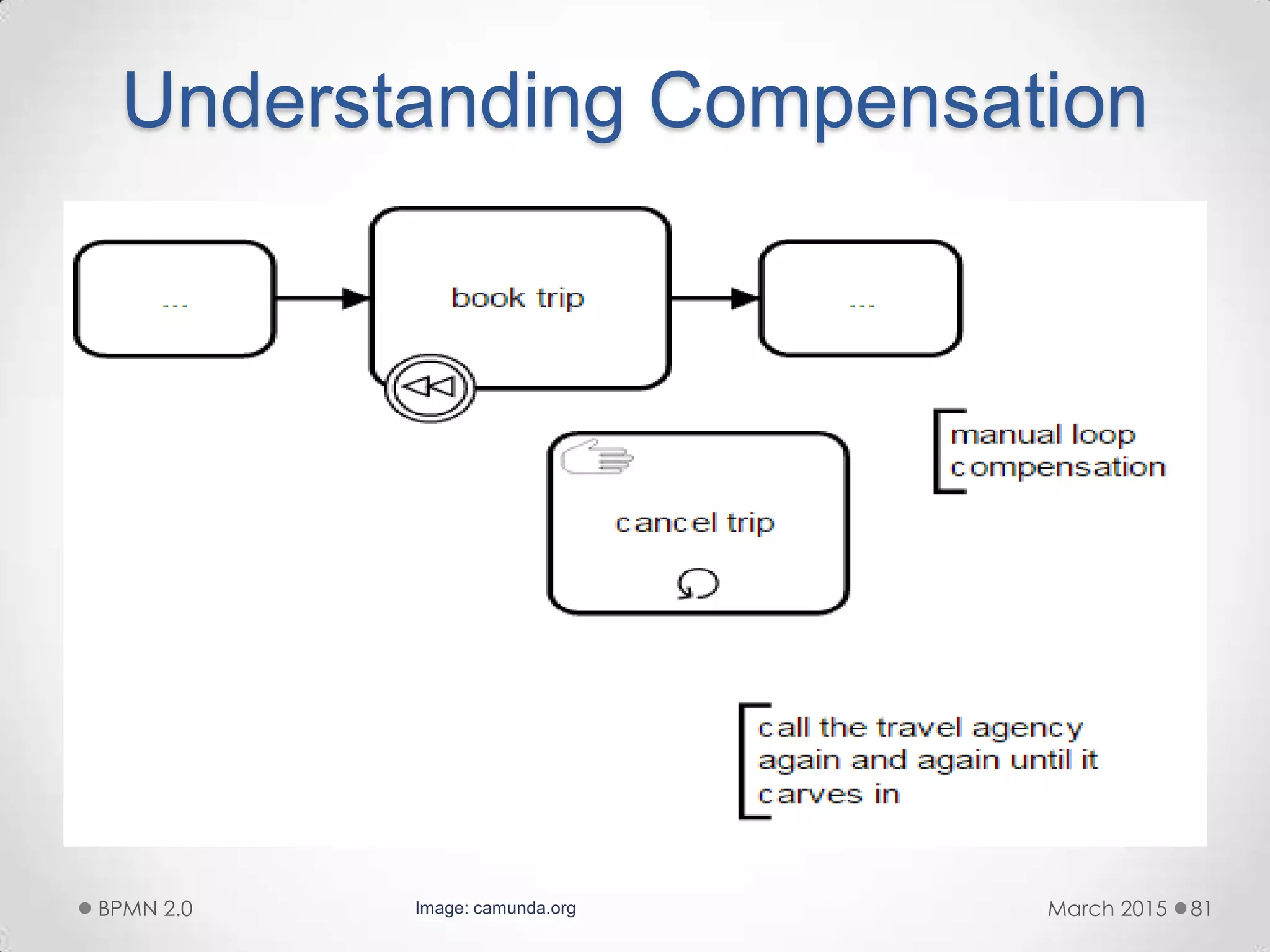
Understanding Compensation
March 2015BPMN 2.0 81Image: camunda.org
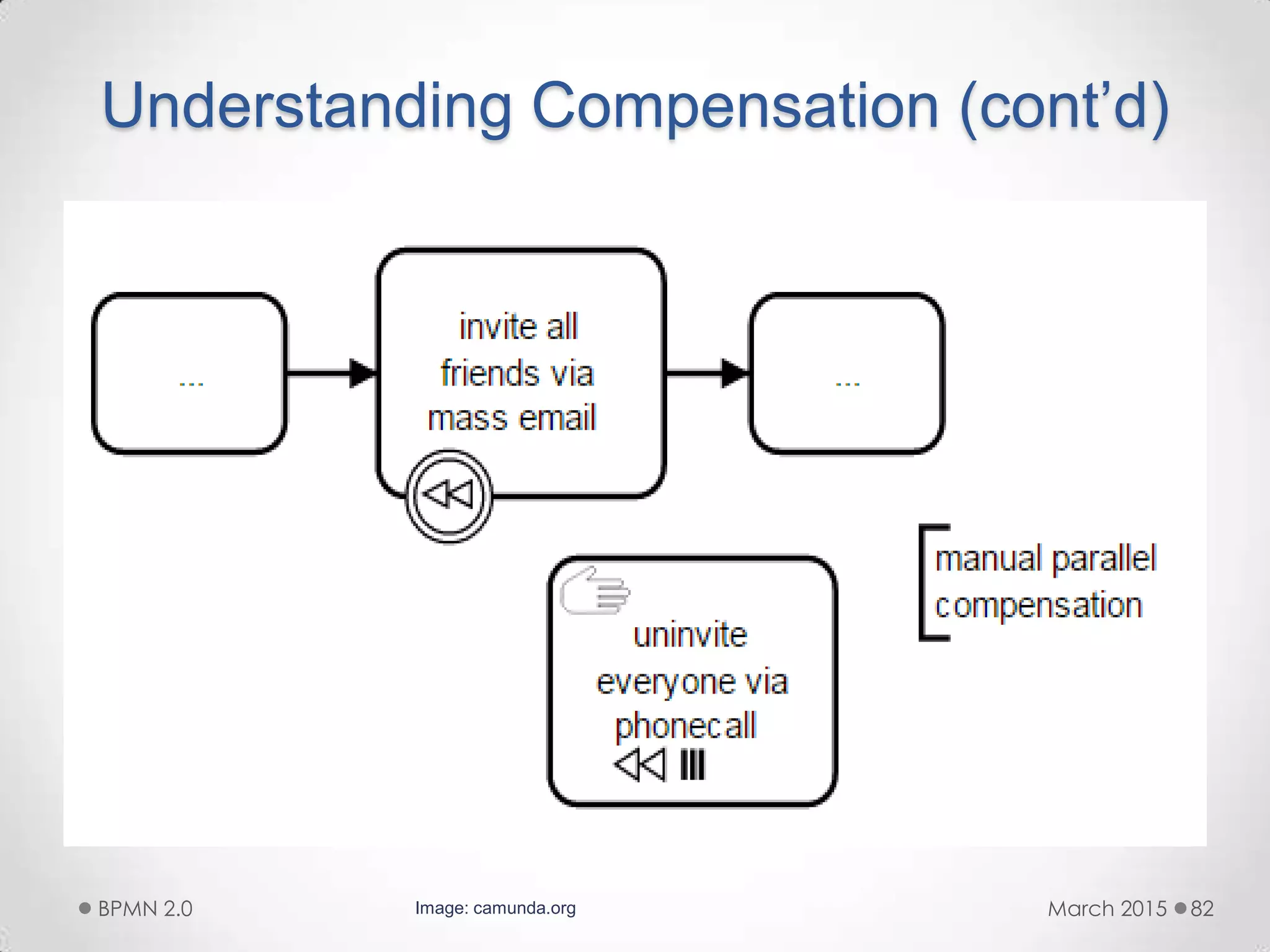
Understanding Compensation (cont’d)
March 2015BPMN 2.0 82Image: camunda.org
Utilizing Iteration
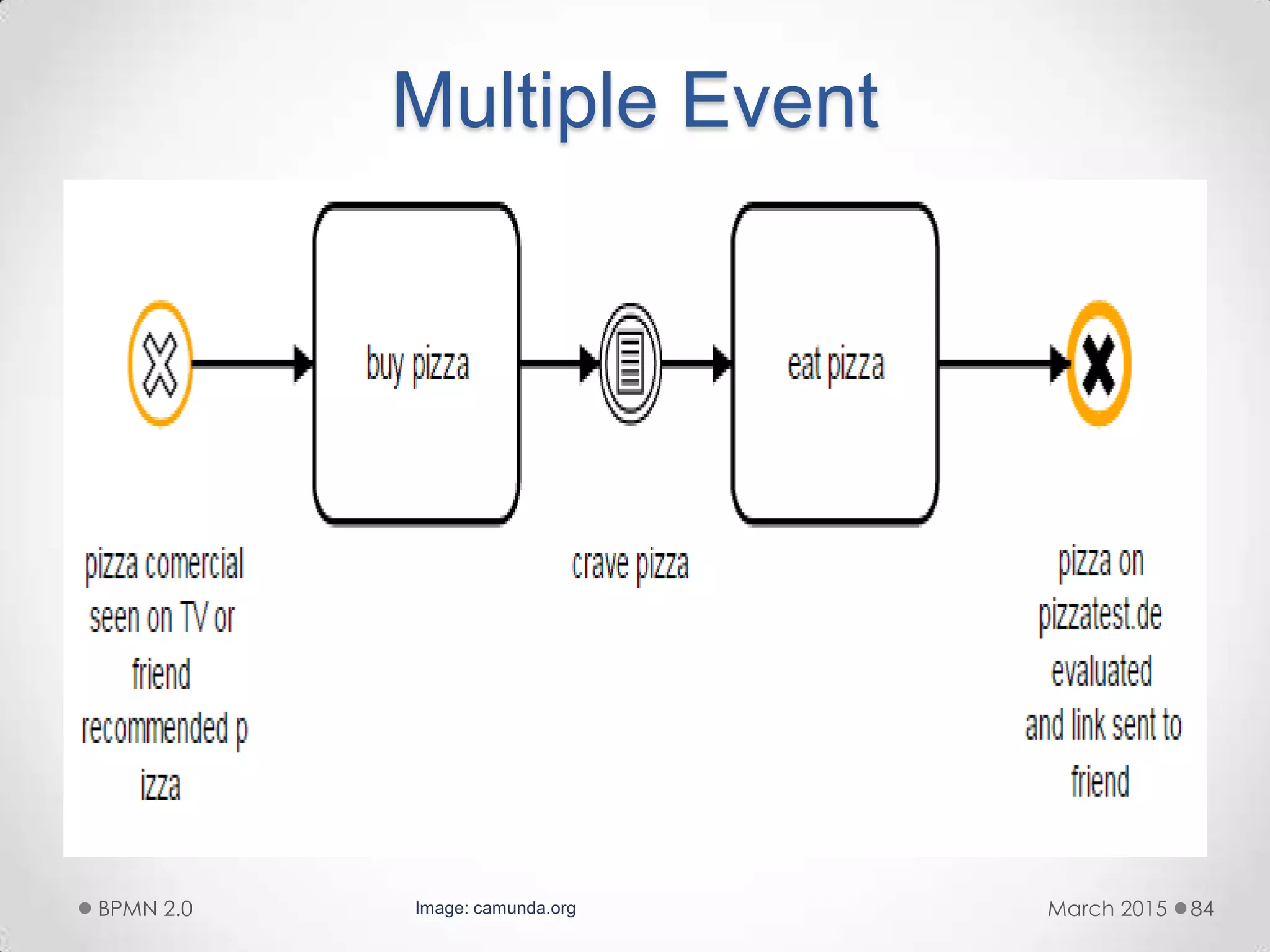
Multiple Event
March 2015BPMN 2.0 84Image: camunda.org
Following the Rules and the Next
Steps
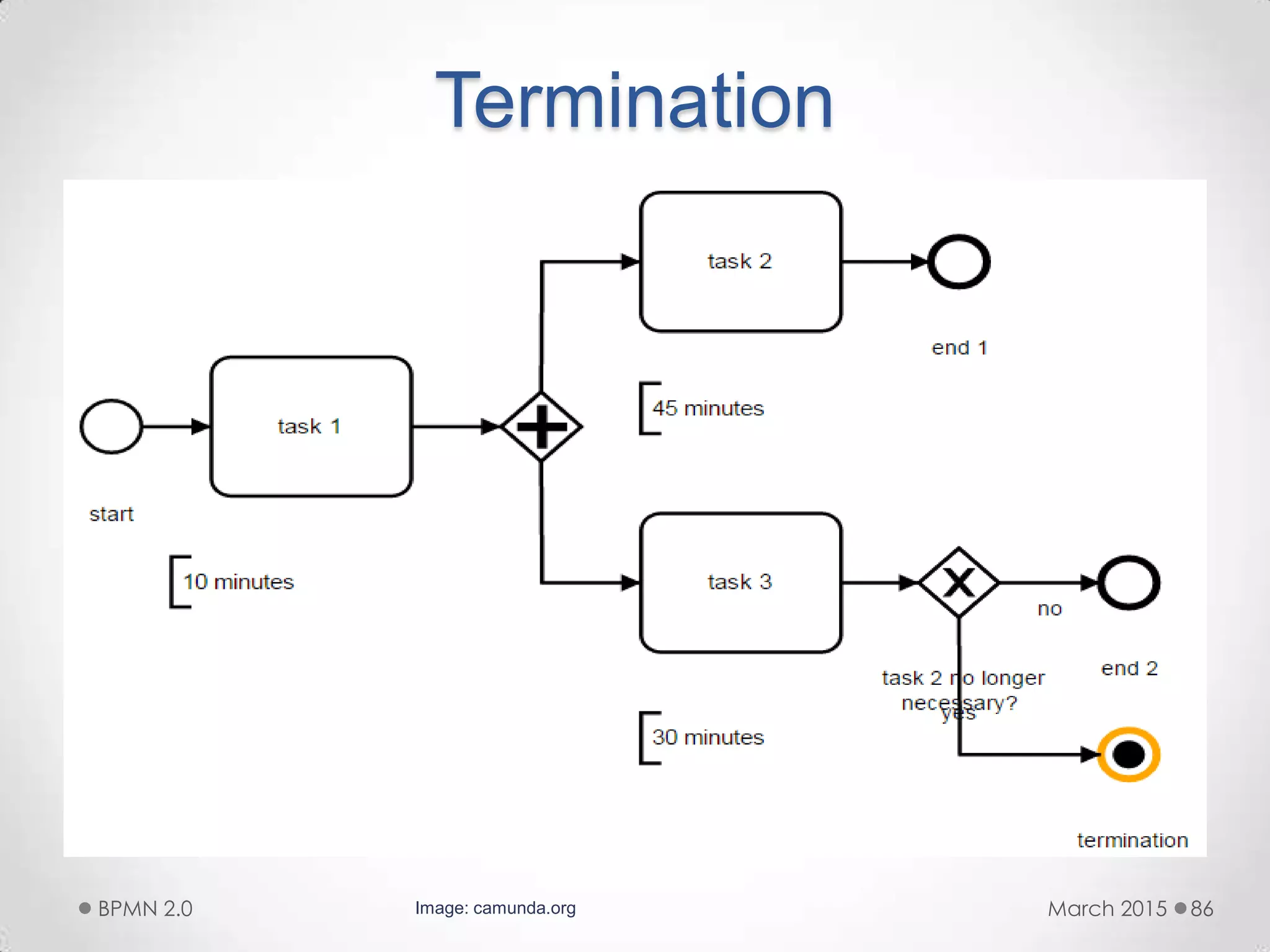
Termination
March 2015BPMN 2.0 86Image: camunda.org
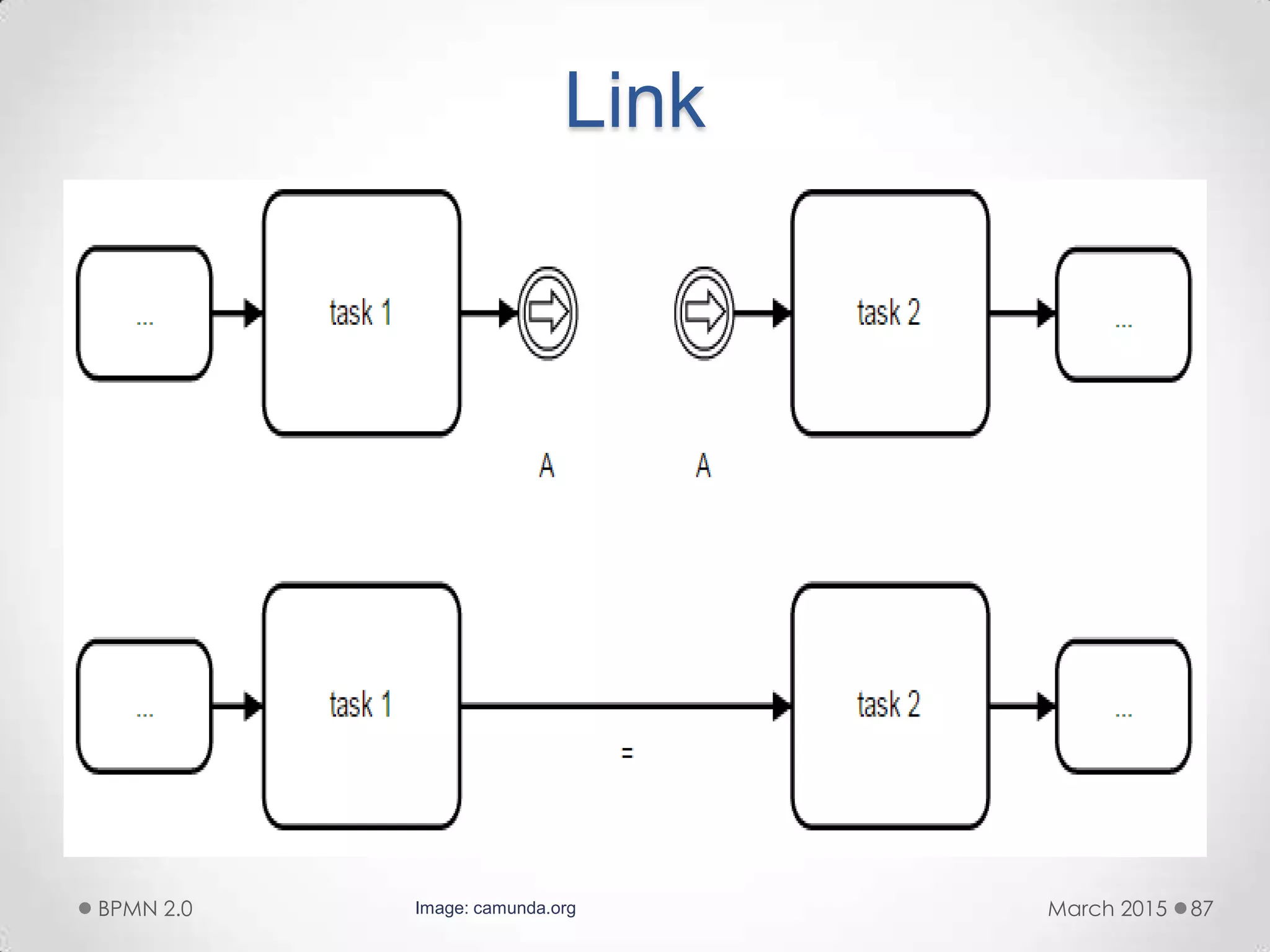
Link
March 2015BPMN 2.0 87Image: camunda.org
Validating BPMN Diagram
Why and How To Do It?
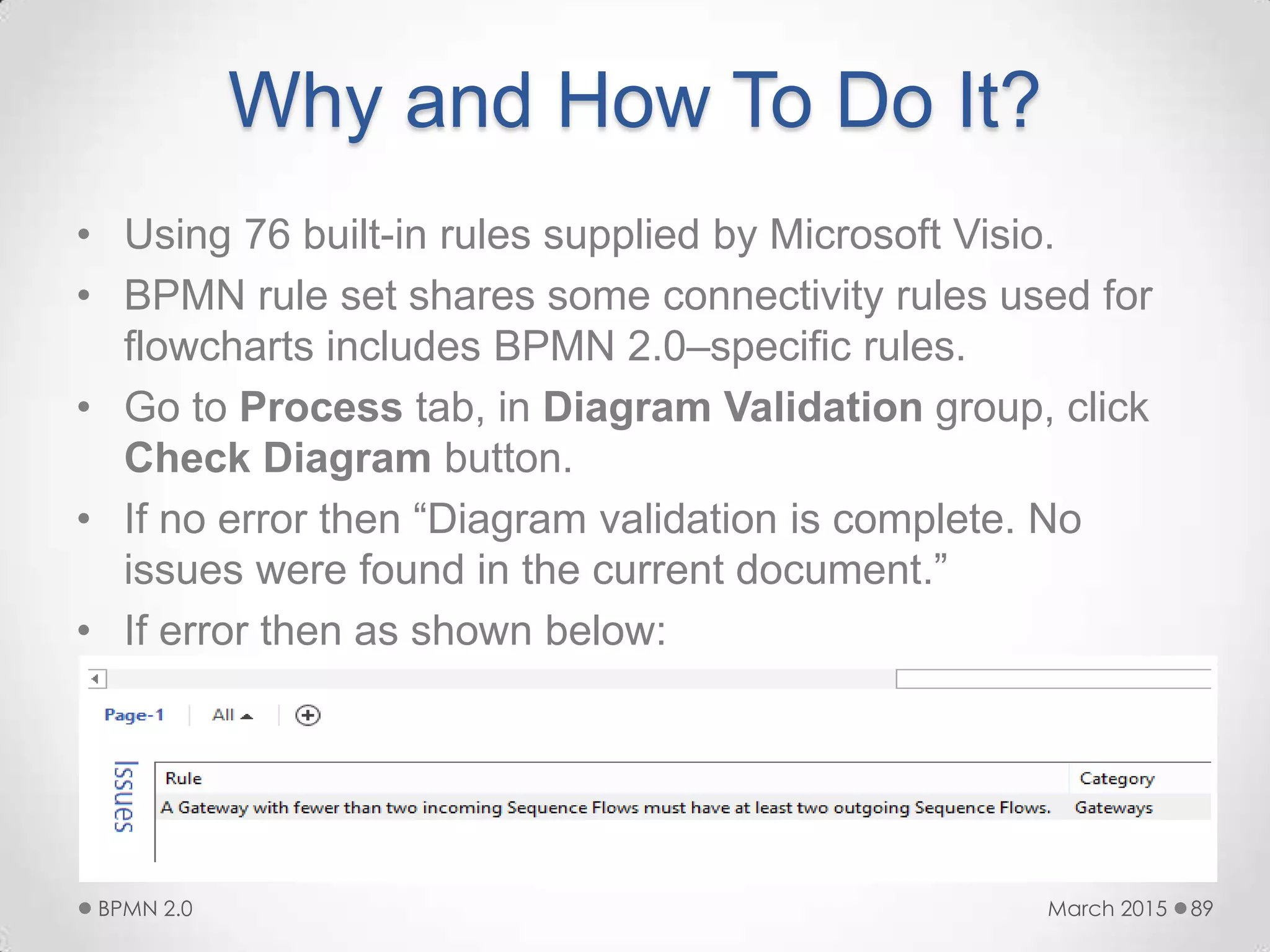
• Using 76 built-in rules supplied by Microsoft Visio.
• BPMN rule set shares some connectivity rules used for
flowcharts includes BPMN 2.0–specific rules.
• Go to Process tab, in Diagram Validation group, click
Check Diagram button.
• If no error then “Diagram validation is complete. No
issues were found in the current document.”
• If error then as shown below:
March 2015BPMN 2.0 89
Navigating BPMN Certification
What It Is All About
• Name
Object Management Group (OMG) Certified Expert in
BPM 2 (shortly known as OCEB 2).
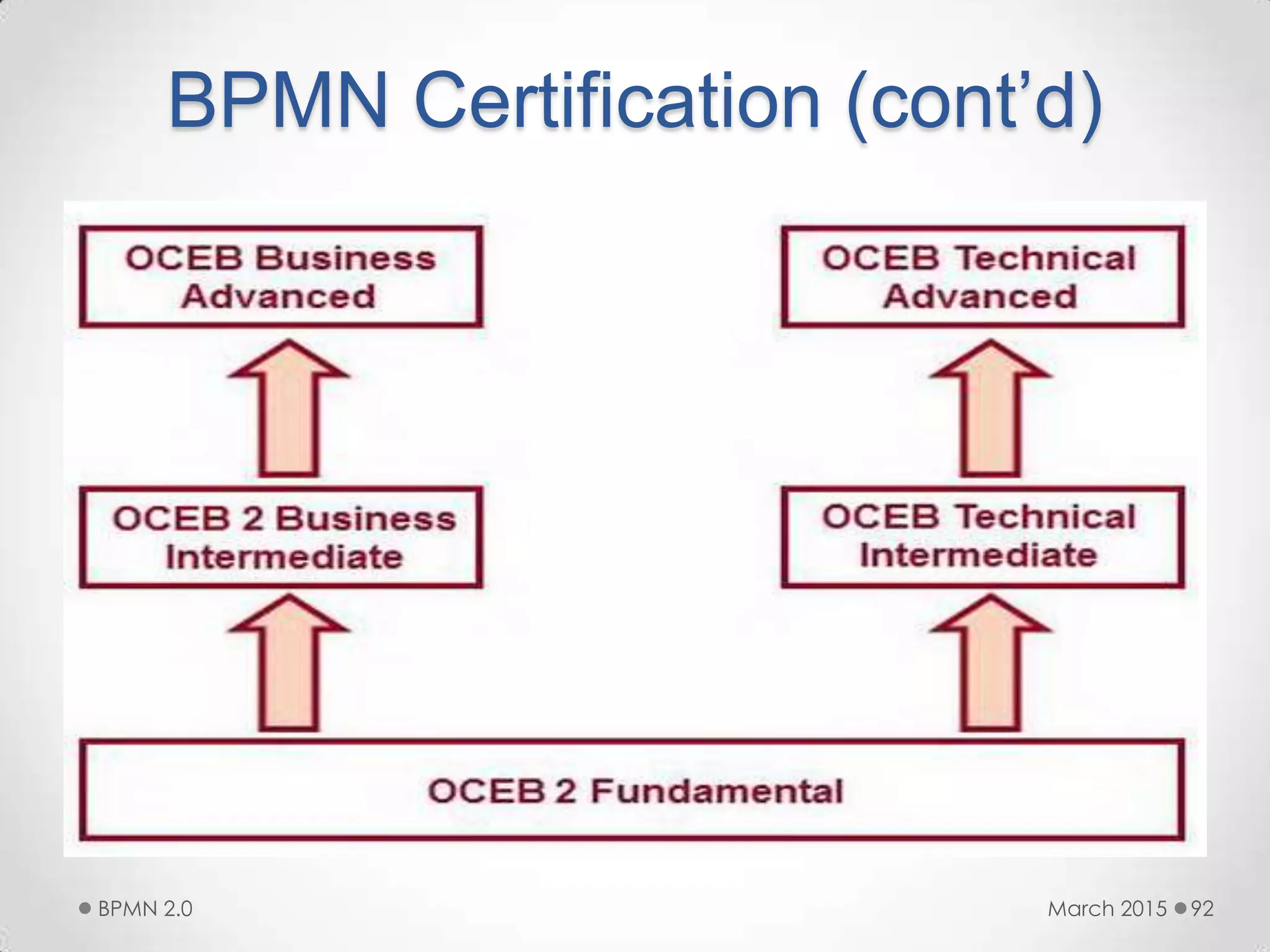
• Consists of five examinations
Fundamental level
Expert level (Business and the other Technically-
Oriented)
• 25 experts from top BPM companies and well-known
independent consultants design OCEB topical coverage
and wrote the exam questions.
• All tests shall be taken at PearsonVUE Testing Centre
March 2015BPMN 2.0 91
BPMN Certification (cont’d)
March 2015BPMN 2.0 92
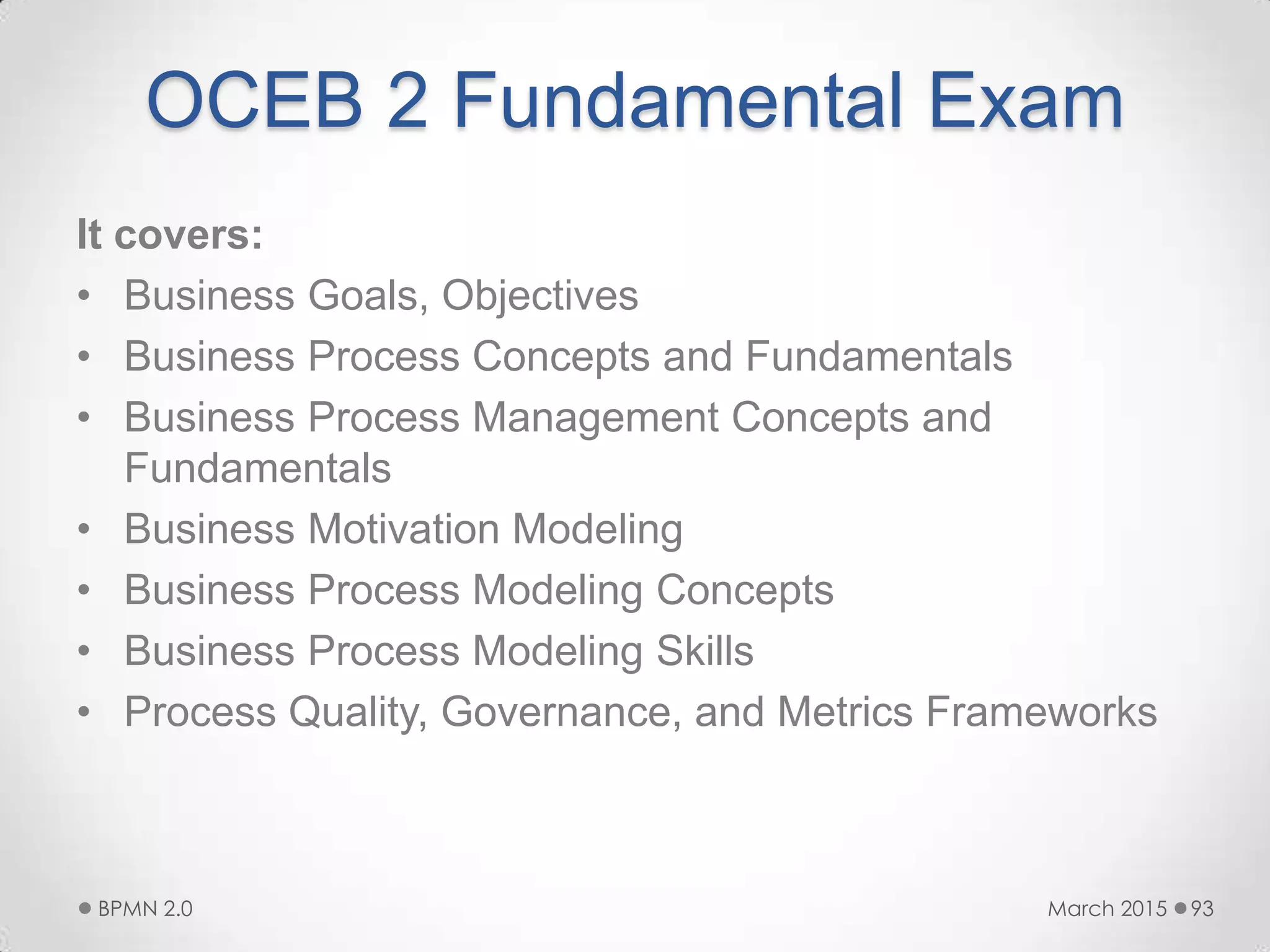
OCEB 2 Fundamental Exam
It covers:
• Business Goals, Objectives
• Business Process Concepts and Fundamentals
• Business Process Management Concepts and
Fundamentals
• Business Motivation Modeling
• Business Process Modeling Concepts
• Business Process Modeling Skills
• Process Quality, Governance, and Metrics Frameworks
March 2015BPMN 2.0 93
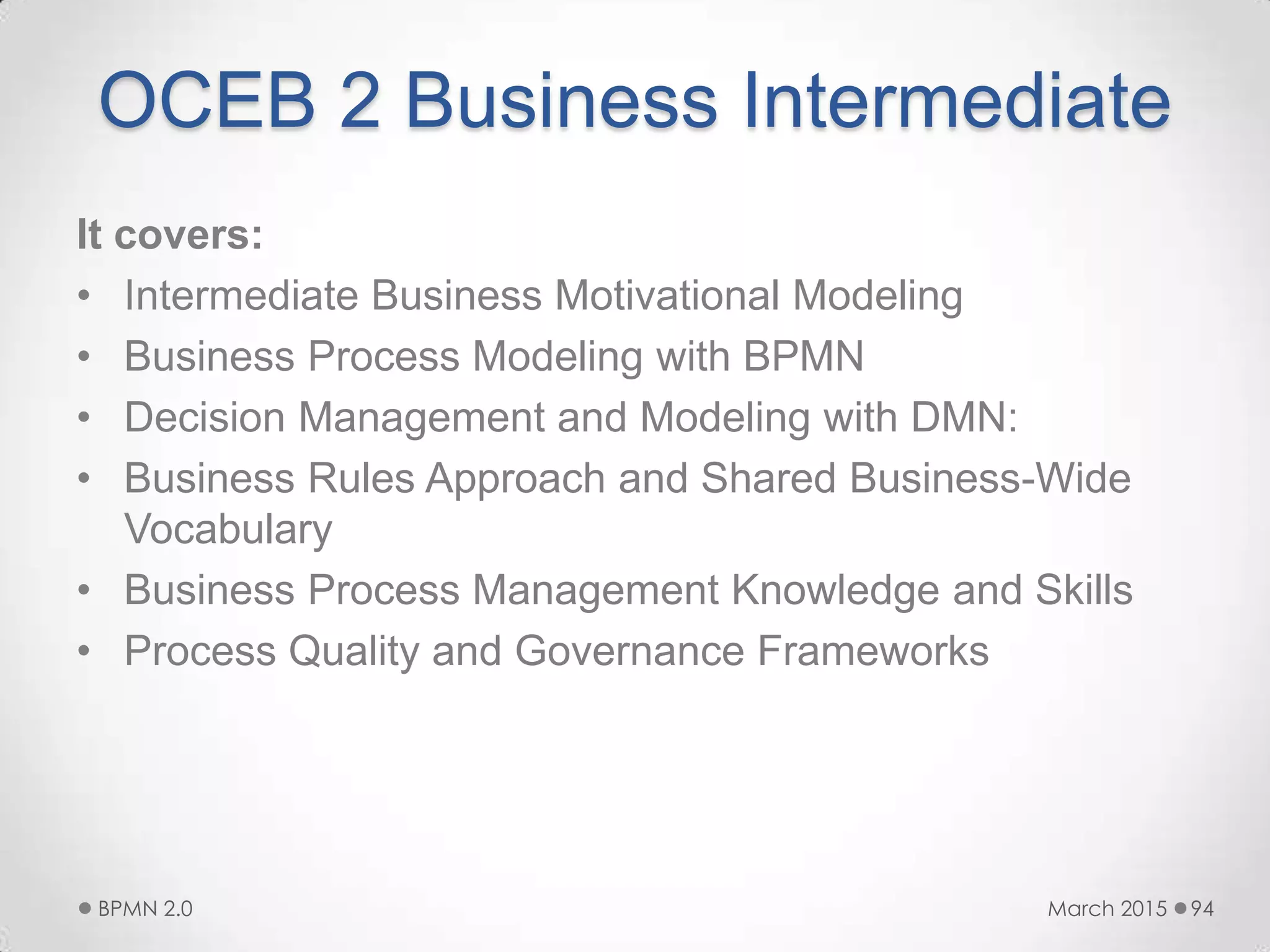
OCEB 2 Business Intermediate
It covers:
• Intermediate Business Motivational Modeling
• Business Process Modeling with BPMN
• Decision Management and Modeling with DMN:
• Business Rules Approach and Shared Business-Wide
Vocabulary
• Business Process Management Knowledge and Skills
• Process Quality and Governance Frameworks
March 2015BPMN 2.0 94
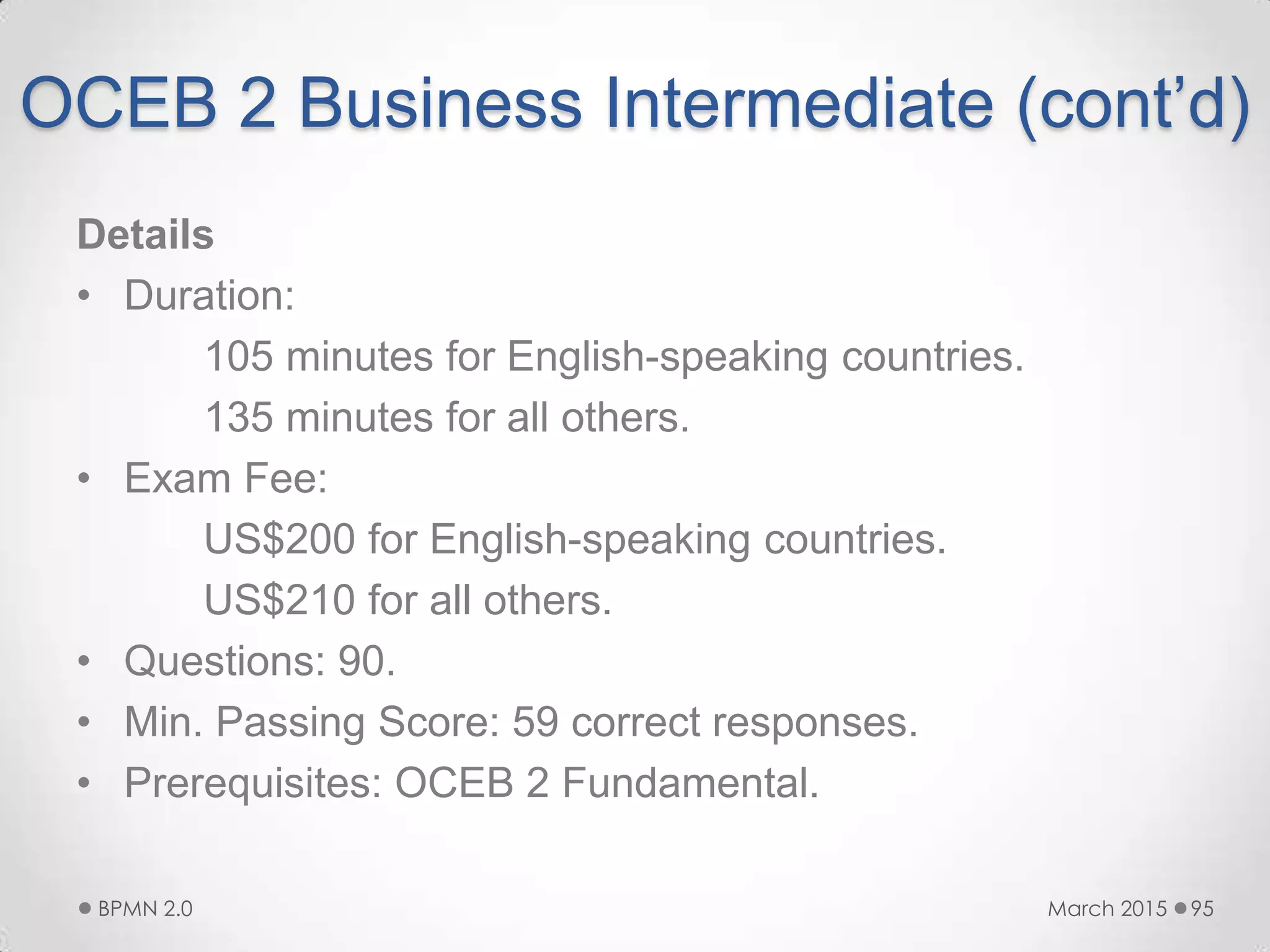
OCEB 2 Business Intermediate (cont’d)
Details
• Duration:
105 minutes for English-speaking countries.
135 minutes for all others.
• Exam Fee:
US$200 for English-speaking countries.
US$210 for all others.
• Questions: 90.
• Min. Passing Score: 59 correct responses.
• Prerequisites: OCEB 2 Fundamental.
March 2015BPMN 2.0 95
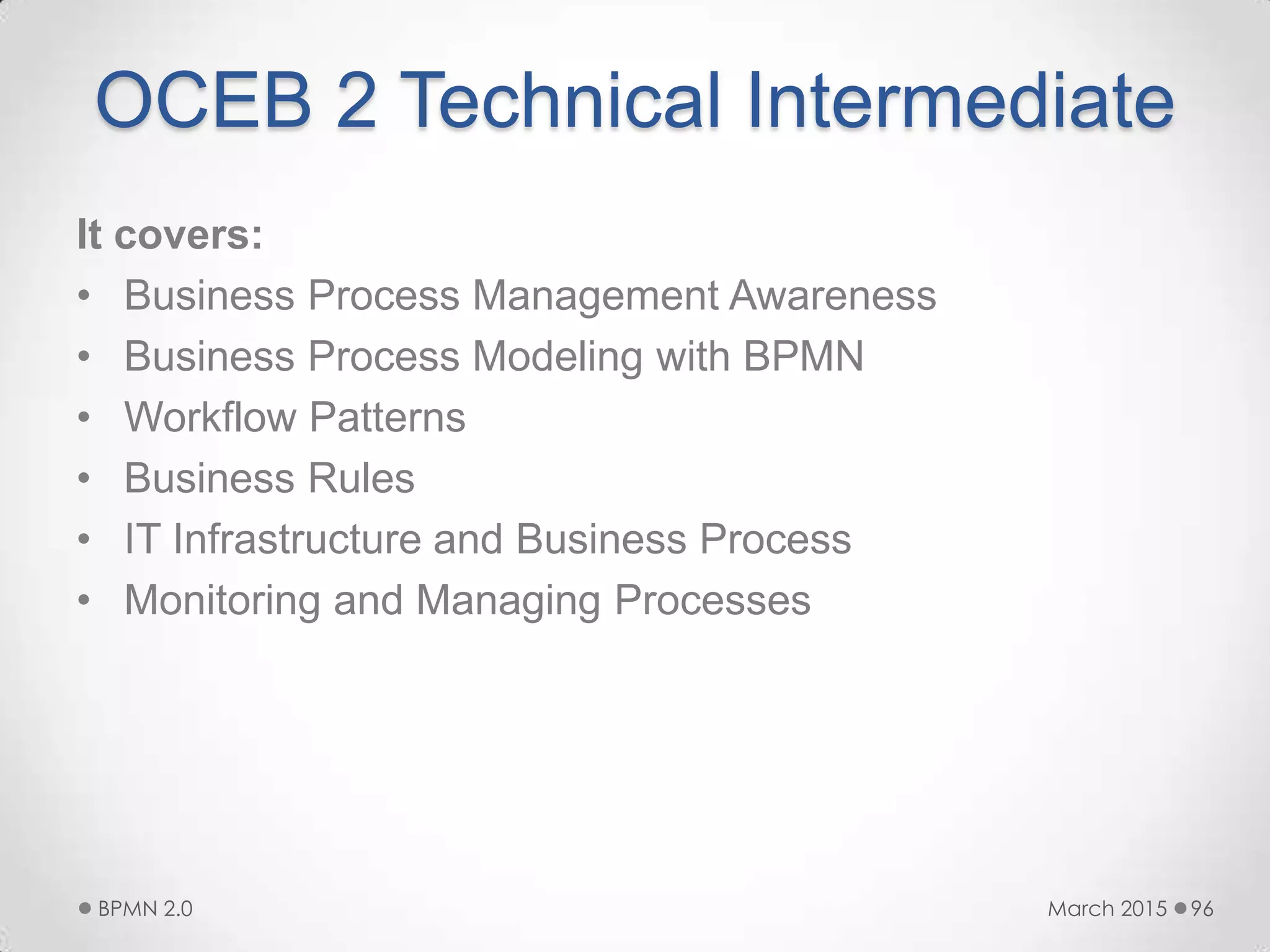
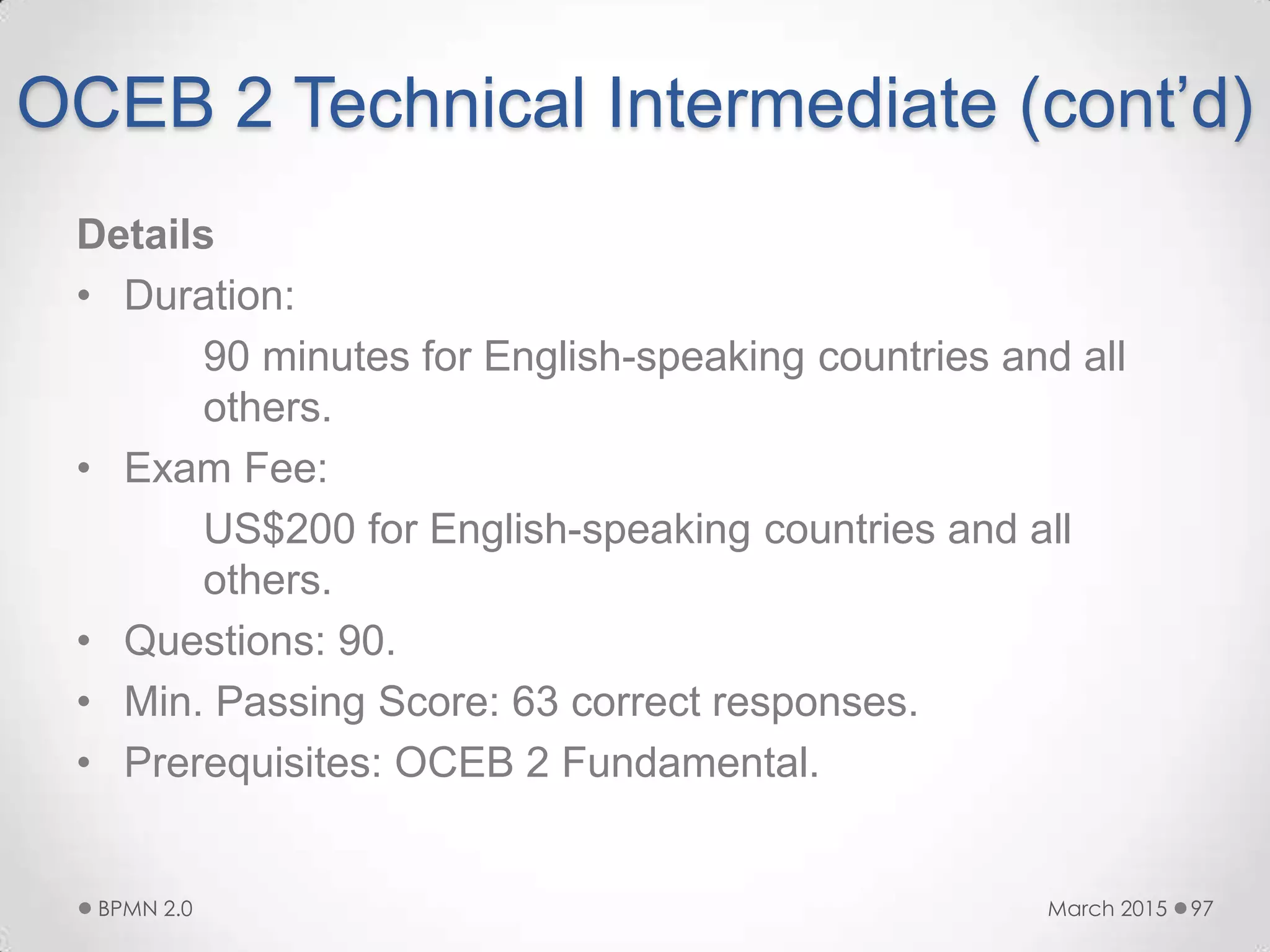
OCEB 2 Technical Intermediate
It covers:
• Business Process Management Awareness
• Business Process Modeling with BPMN
• Workflow Patterns
• Business Rules
• IT Infrastructure and Business Process
• Monitoring and Managing Processes
March 2015BPMN 2.0 96
OCEB 2 Technical Intermediate (cont’d)
Details
• Duration:
90 minutes for English-speaking countries and all
others.
• Exam Fee:
US$200 for English-speaking countries and all
others.
• Questions: 90.
• Min. Passing Score: 63 correct responses.
• Prerequisites: OCEB 2 Fundamental.
March 2015BPMN 2.0 97
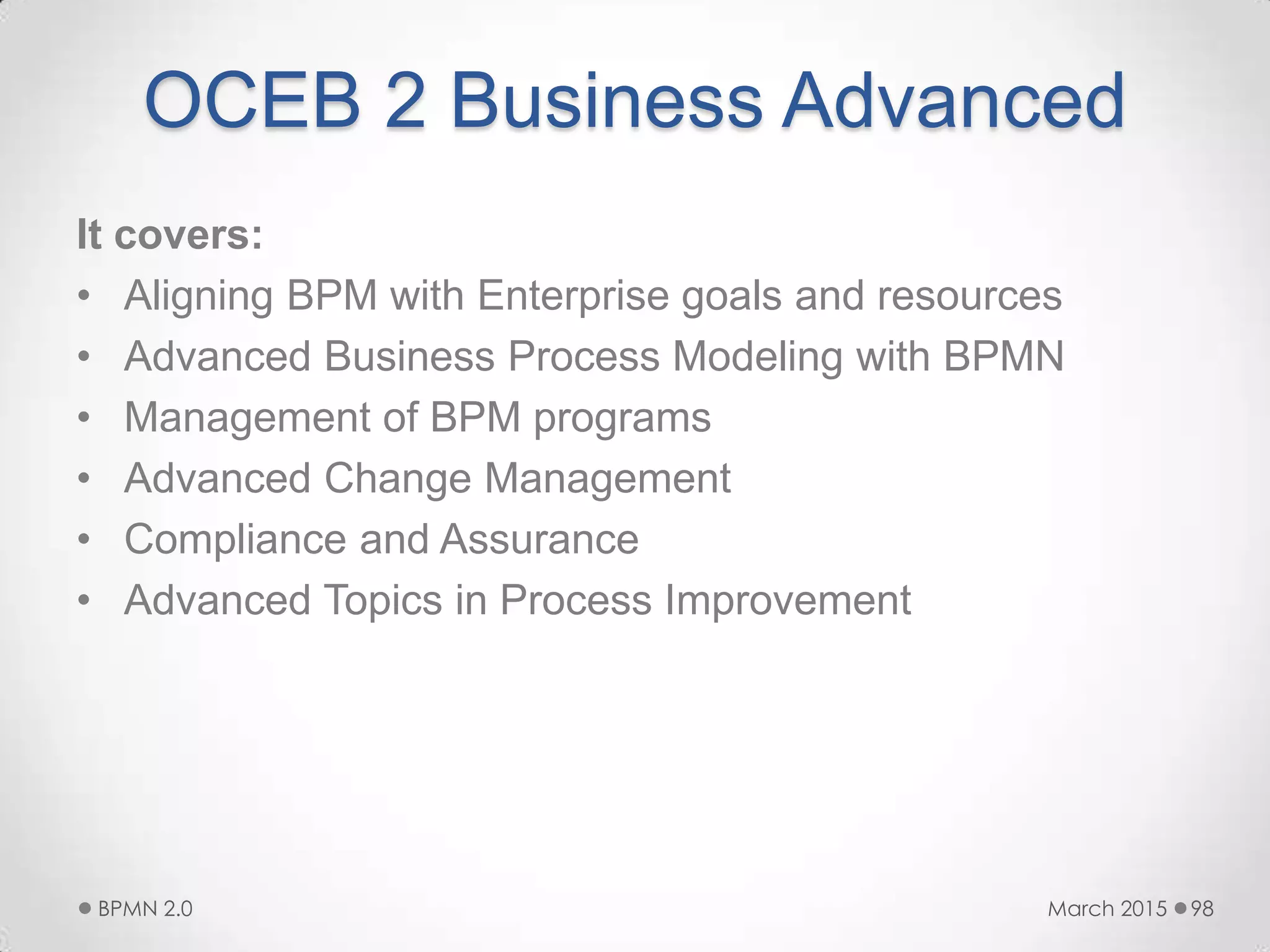
OCEB 2 Business Advanced
It covers:
• Aligning BPM with Enterprise goals and resources
• Advanced Business Process Modeling with BPMN
• Management of BPM programs
• Advanced Change Management
• Compliance and Assurance
• Advanced Topics in Process Improvement
March 2015BPMN 2.0 98
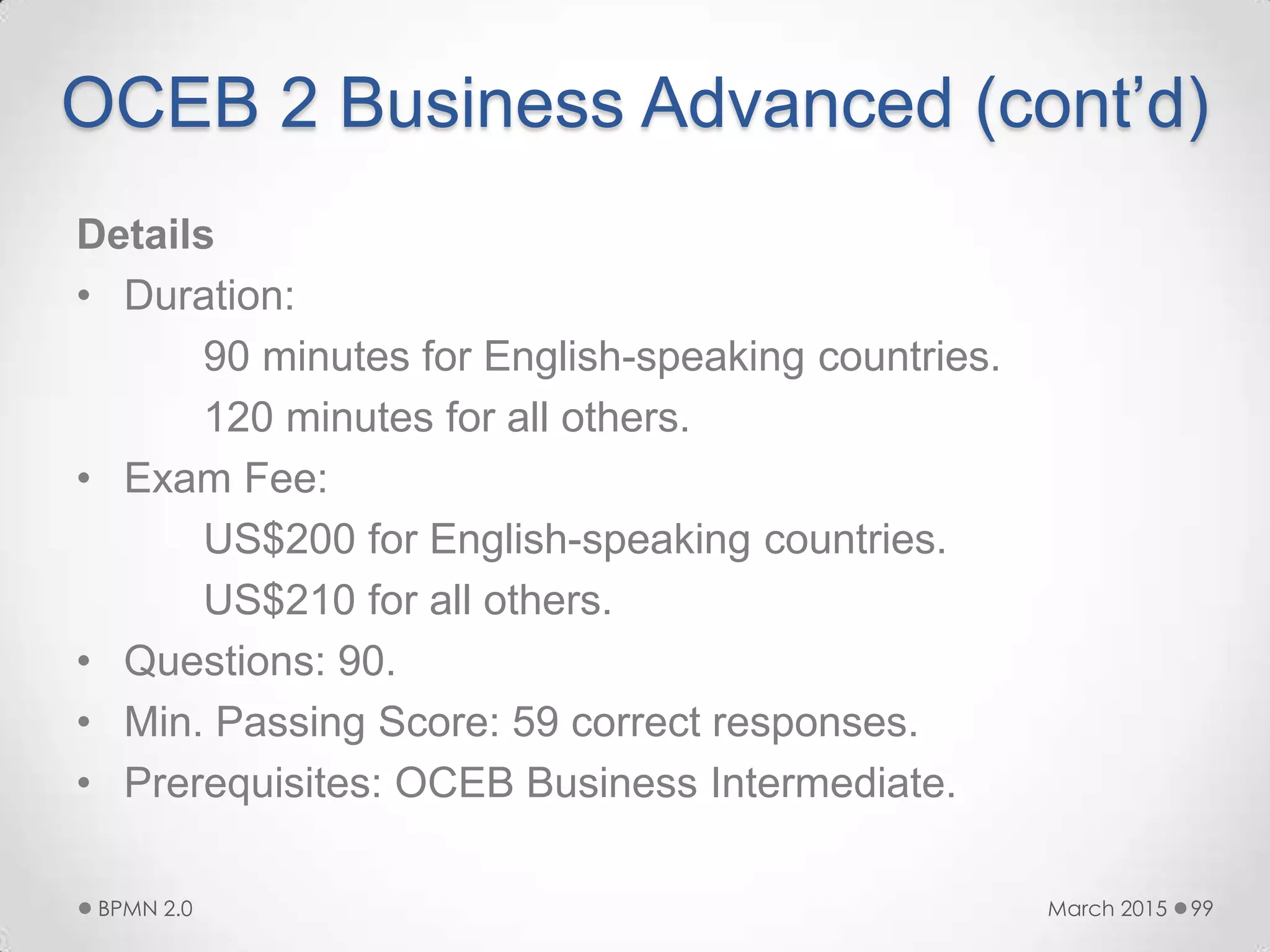
OCEB 2 Business Advanced (cont’d)
Details
• Duration:
90 minutes for English-speaking countries.
120 minutes for all others.
• Exam Fee:
US$200 for English-speaking countries.
US$210 for all others.
• Questions: 90.
• Min. Passing Score: 59 correct responses.
• Prerequisites: OCEB Business Intermediate.
March 2015BPMN 2.0 99
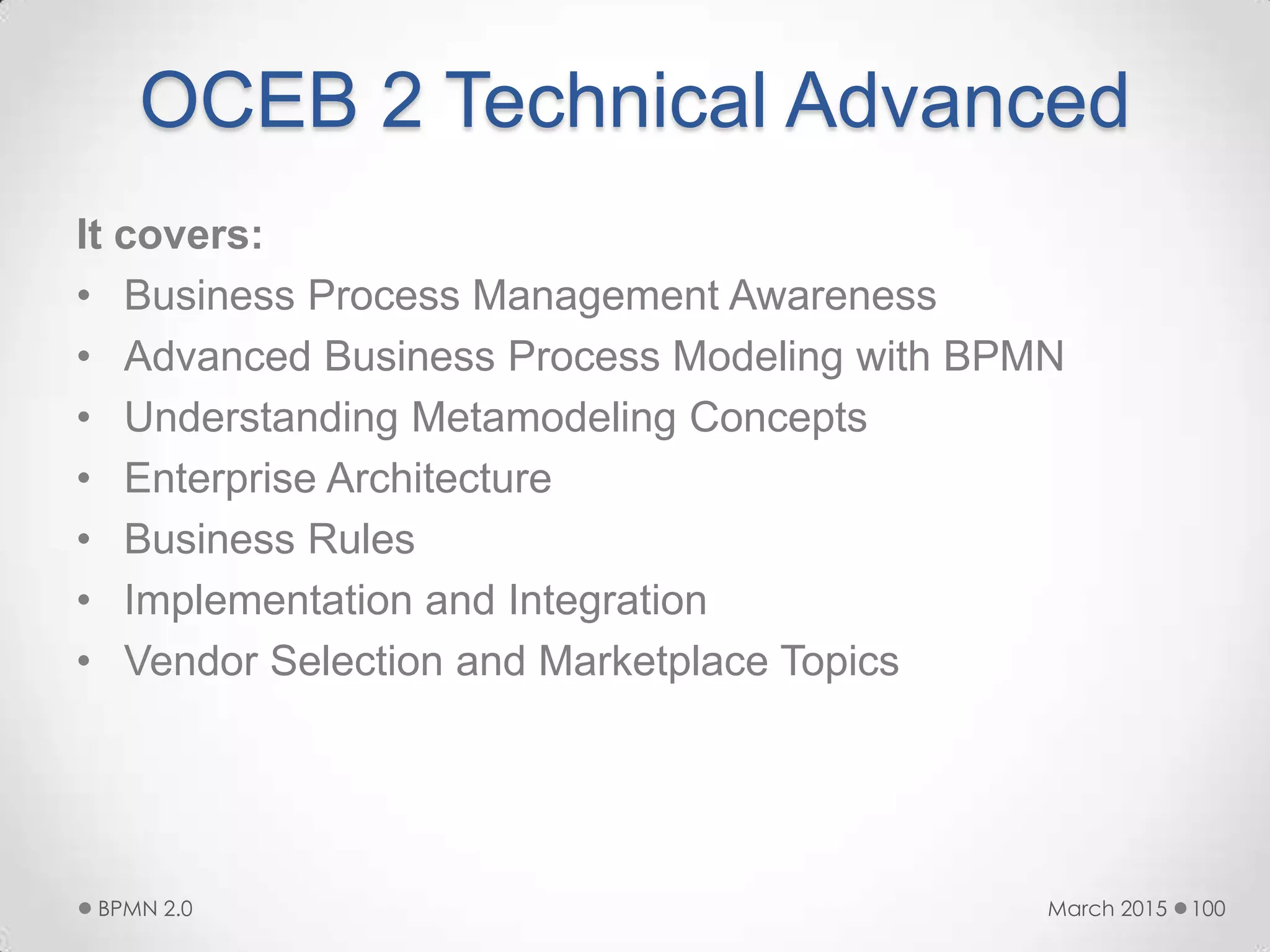
OCEB 2 Technical Advanced
It covers:
• Business Process Management Awareness
• Advanced Business Process Modeling with BPMN
• Understanding Metamodeling Concepts
• Enterprise Architecture
• Business Rules
• Implementation and Integration
• Vendor Selection and Marketplace Topics
March 2015BPMN 2.0 100
OCEB 2 Technical Advanced (cont’d)
Details
• Duration:
90 minutes for English-speaking countries and all
others.
• Exam Fee:
US$200 for English-speaking countries and all
others.
• Questions: 90.
• Min. Passing Score: 70 correct responses.
• Prerequisites: OCEB Technical Intermediate.
March 2015BPMN 2.0 101
Image: newyork.com
102
image: hyattplacewaikikibeach.com

Implementing BPMN 2.0 with Microsoft Visio

  • 1.
    Implementing BUSINESS PROCESS MODEL ANDNOTATION (BPMN) 2.0 with Microsoft Visio Developed and Lead by Goutama Bachtiar March 2015 Image: jcosd.com
  • 2.
    Session Agenda • UnderstandingBPMN 2.0 • Valuing BPMN Concepts and High Level Map • Exploring Microsoft Visio 2003 Professional Edition • Utilizing BPMN Methods and Style • Comprehending Pools, Subprocesses, and Hierarchical Modeling • Valuing Collaboration and a "Complete" Top-Level Diagram • Leveraging Events Overview and Using Timer Events • Sending, Receiving, and Using Message Events March 2015BPMN 2.0 2
  • 3.
    Session Agenda (cont’d) •Using Error, Event Subprocesses, and the Other Level 2 Events • Working with Branching and Merging • Utilizing Iteration • Following the Rules and Next Steps • Validating BPMN Diagram • Navigating BPMN Certification March 2015BPMN 2.0 3
  • 4.
  • 5.
    What is BPMNall about? • A graphical notation to facilitate the understanding of the performance collaborations and business transactions inside and between the organizations. • Objective: To ensure businesses and human resources understand themselves Enable organizations to adjust to new internal and B2B business circumstances quickly March 2015BPMN 2.0 5
  • 6.
    What is BPMNall about? (cont’d) March 2015BPMN 2.0 6Image: giffy.com
  • 7.
    Start with BPMFirst • Definition Business Process Management is Management and improvement of an organization end-to-end enterprise business processes. • Some point of views A process of managing your business processes. A management discipline. A technology or set of technologies. A rapid application development framework. • Objectives Clarity on strategic direction Alignment of the organizational resources Increased discipline in daily operations March 2015BPMN 2.0 7
  • 8.
    Open Management Group •OMG is an international, open membership, not-for-profit computer industry standards consortium (www.omg.org). • Task Forces develop modeling and integration standards for a wide range of technologies. • OMG's Model Driven Architecture (MDA) supports complete application lifecycle from design, development and deployment, maintenance and evolution. • Modeling standards Unified Modeling Language (UML) BPMN Systems Modeling Language (OMG SysML) March 2015BPMN 2.0 8
  • 9.
    Open Management Group(cont’d) • Objective Enable powerful visual design for software structure and behavior, processes in software and business. • Middleware standards and profiles based on Common Object Request Broker Architecture (CORBA) and support a wide variety of industries. March 2015BPMN 2.0 9
  • 10.
    Process Improvements • Targetinefficient or ineffective processes in delivering what customers require. • Efficient is when the resources consumed at the minimum possible levels. • Effective is able to deliver products or services according to specifications. March 2015BPMN 2.0 10
  • 11.
  • 12.
    Benefits of BPM •Using process-enabled achievement of strategic objectives. • Accelerating time to market. • Delivering improvements in cost, productivity, timeliness and quality. • Improving customer service levels and increasing customer satisfaction. • Transferring knowledge to ensure that customer teams achieve the necessary competence and autonomy to maintain and develop future capabilities. March 2015BPMN 2.0 12
  • 13.
    Benefits of BPM •Simplifying business processes to drive effectiveness, efficiencies and agility. • Managing risks and meeting compliance regulations. • Providing greater visibility into your organizational performance. • Introducing new process designs faster. • Reducing costs. • Generating new revenue streams. • Improving existing revenue streams. March 2015BPMN 2.0 13
  • 14.
    BPM vs BPI March2015BPMN 2.0 14
  • 15.
    BPM vs BPI BPI •Initiatives typically imply projects. • A set of one-time unique improvements in redesigning or fixing a process. • Common methodologies: Six Sigma, Lean, Total Quality Management (TQM) and Business Process Reengineering (BPR). BPM • Ongoing commitment to meeting organization's performance goals by managing its processes. • A continuous, feedback loop to ensure organization's business processes aligned to strategy and expectations. • May employ common BPI methodologies but it does not imply organization is committed to BPM practice. March 2015BPMN 2.0 15
  • 16.
    Steps in ImplementingBPM • Aligning Processes with Business Strategy • Discovering and Modeling Processes • Measuring Processes • Analyzing and Benchmarking Processes • Harvesting Policies and Rules • Improving Processes • Managing the Changing of a Culture • Governance and Decision Making • Deploying Technology March 2015BPMN 2.0 16
  • 17.
    BPM Approach • Traditional: Capturingprocesses from organization perspective, not from customer’s Start to finish without a focus on outputs which are more important to the customer. Lack of understanding of the customer's expectation New: Start from end to beginning. Identify customer Identify outputs of interest to the customer Identify customer's expectation (time, cost and quality) March 2015BPMN 2.0 17
  • 18.
    BPM Approach InDetails • Peel away top-level complexity by creating hierarchical levels on the sub-processes. • Be mindful each sub-process must have a customer, an output and a customer expectation (time, cost and quality). • Determine and measure the performance metrics. • Examples of the metrics: o Cycle time o Defect rate o Stock-out o Variance to promise date o Variance to promise budget. March 2015BPMN 2.0 18
  • 19.
    Valuing BPMN Conceptsand High Level Map
  • 20.
    BPMN Users • Highlevel for business users Should be able to easily read and understand a BPMN business process diagram. • Lower level for process implementers Adorn a business process diagram with further detail in order to represent the process in a physical implementation. BPMN is targeted at users, vendors and service providers that need to communicate business processes in a standard manner. March 2015BPMN 2.0 20
  • 21.
  • 22.
  • 23.
  • 24.
  • 25.
  • 26.
  • 27.
  • 28.
  • 29.
  • 30.
  • 31.
  • 32.
  • 33.
  • 34.
  • 35.
    Wrapping-Up BPMN Elements March2015BPMN 2.0 35Image: bpmb.de
  • 36.
    Wrapping-Up BPMN Elements(cont’d) March 2015BPMN 2.0 36Image: bpmb.de
  • 37.
    Wrapping-Up BPMN Elements(cont’d) March 2015BPMN 2.0 37Image: bpmb.de
  • 38.
    Wrapping-Up BPMN Elements(cont’d) March 2015BPMN 2.0 38Image: bpmb.de
  • 39.
    Wrapping-Up BPMN Elements(cont’d) March 2015BPMN 2.0 39Image: bpmb.de
  • 40.
    Wrapping-Up BPMN Elements(cont’d) March 2015BPMN 2.0 40Image: bpmb.de
  • 41.
    Wrapping-Up BPMN Elements(cont’d) March 2015BPMN 2.0 41Image: bpmb.de
  • 42.
  • 43.
  • 44.
  • 45.
  • 46.
  • 47.
    Choreography Diagram (cont’d) March2015BPMN 2.0 47Image: bpmb.de
  • 48.
    March 2015BPMN 2.048Image: bpmb.de
  • 49.
    March 2015BPMN 2.049Image: bpmb.de
  • 50.
    Simple BPMN Flow •Naming Tasks: the [verb] + [object] pattern i.e. "acquire groceries," not "first take care of shopping for groceries." • Naming Events: something already happened regardless of the process (catching events) or process result (throwing events). The [object] and make the [verb] passive in voice. March 2015BPMN 2.0 50
  • 51.
    Simple BPMN Flow •Naming Tasks: the [verb] + [object] pattern i.e. "acquire groceries," not "first take care of shopping for groceries." • Naming Events: something already happened regardless of the process (catching events) or process result (throwing events). The [object] and make the [verb] passive in voice. March 2015BPMN 2.0 51
  • 52.
    Another Examples • Let’stake a look at the next slides. March 2015BPMN 2.0 52
  • 53.
  • 54.
  • 55.
    Exploring Microsoft Visio2013 Professional Edition
  • 56.
    BPMN Enablement inVisio Microsoft Visio 2013 Professional Edition March 2015BPMN 2.0 56Image: packtpub.com
  • 57.
    BPMN Enablement inVisio (cont’d) Microsoft Visio 2010 Premium Edition March 2015BPMN 2.0 57Image: blogs.msdn.com
  • 58.
    Themes, Effects andVariants March 2015BPMN 2.0 58
  • 59.
  • 60.
  • 61.
  • 62.
    Validate Process forCompliance March 2015BPMN 2.0 62
  • 63.
  • 64.
    More Shapes toSupport • 36 Task shapes and 108 variations on the Task shape not shown. • 64 types of Collapsed Sub-Process and 64 types of Expanded Sub-Process shapes. • In total, Visio support about 360 graphically different BPMN shapes. March 2015BPMN 2.0 64
  • 65.
    Sharing Diagram withVisio Services • Visio Services is part of Microsoft SharePoint and Microsoft SharePoint Online in Office 365 Enterprise • What needed: Visio document stored in SharePoint and a browser No Visio client is required Same diagram in browser like in Visio client including themes and cool effects • Introduces Visio file format (.VSDX) as native file in Visio 2013. • Still support VDW (Visio Drawing for Web as Visio 2010 Professional/Premium file format and SharePoint Server 2010 with SS). March 2015BPMN 2.0 65
  • 66.
    Collaborations on Diagram •Comments to the diagram and see others comments. • Comment using Visio client and browser at the same time. March 2015BPMN 2.0 66
  • 67.
  • 68.
  • 69.
  • 70.
    Valuing Collaboration anda "Complete" Top-Level Diagram
  • 71.
    Leveraging Events Overviewand Using Timer Events
  • 72.
    Sending, Receiving, andUsing Message Events
  • 73.
    Using Error, EventSubprocesses, and the Other Level 2 Events
  • 74.
    Ad-Hoc Subprocess • Executedin any order, • Executed several times, or • Skipped. March 2015BPMN 2.0 74Image: camunda.org
  • 75.
    Interrupting Intermediate Event March2015BPMN 2.0 75Image: camunda.org
  • 76.
    Interrupting Intermediate Event(cont’d) • The token moves to task 1, which starts accordingly. • If event 1 occurs while task 1 is being processed, task 1 is immediately canceled, and the token moves through the exception flow to task 3. • On the other hand, if event 1 does not occur, task 1 will be processed, and the token moves through the regular sequence flow to task 2. • If event 1 occurs only after task 1 completes, it will be ignored. March 2015BPMN 2.0 76
  • 77.
    Non-Interrupting Intermediate Event March2015BPMN 2.0 77Image: camunda.org
  • 78.
    Non-Interrupting Intermediate Event(cont’d) • The token moves to task 1, which starts accordingly. • If event 1 occurs while task 1 is being processed, the token is cloned. Task 1 continues to be processed while the second token moves to task 3, which is now also processed. This procedure may even take place repeatedly, that is, the event can occur many times. Each occurrence results in another cloned token. • If event 1 does not occur, task 1 will be completed, and the token moves through the regular sequence flow to task 2. • If event 1 occurs only after task 1 completes, it ceases to matter. March 2015BPMN 2.0 78
  • 79.
    Signal • It isaddressed to a not specific recipient. • Anyone received it might wants to react. March 2015BPMN 2.0 79Image: camunda.org
  • 80.
  • 81.
  • 82.
    Understanding Compensation (cont’d) March2015BPMN 2.0 82Image: camunda.org
  • 83.
  • 84.
    Multiple Event March 2015BPMN2.0 84Image: camunda.org
  • 85.
    Following the Rulesand the Next Steps
  • 86.
    Termination March 2015BPMN 2.086Image: camunda.org
  • 87.
    Link March 2015BPMN 2.087Image: camunda.org
  • 88.
  • 89.
    Why and HowTo Do It? • Using 76 built-in rules supplied by Microsoft Visio. • BPMN rule set shares some connectivity rules used for flowcharts includes BPMN 2.0–specific rules. • Go to Process tab, in Diagram Validation group, click Check Diagram button. • If no error then “Diagram validation is complete. No issues were found in the current document.” • If error then as shown below: March 2015BPMN 2.0 89
  • 90.
  • 91.
    What It IsAll About • Name Object Management Group (OMG) Certified Expert in BPM 2 (shortly known as OCEB 2). • Consists of five examinations Fundamental level Expert level (Business and the other Technically- Oriented) • 25 experts from top BPM companies and well-known independent consultants design OCEB topical coverage and wrote the exam questions. • All tests shall be taken at PearsonVUE Testing Centre March 2015BPMN 2.0 91
  • 92.
  • 93.
    OCEB 2 FundamentalExam It covers: • Business Goals, Objectives • Business Process Concepts and Fundamentals • Business Process Management Concepts and Fundamentals • Business Motivation Modeling • Business Process Modeling Concepts • Business Process Modeling Skills • Process Quality, Governance, and Metrics Frameworks March 2015BPMN 2.0 93
  • 94.
    OCEB 2 BusinessIntermediate It covers: • Intermediate Business Motivational Modeling • Business Process Modeling with BPMN • Decision Management and Modeling with DMN: • Business Rules Approach and Shared Business-Wide Vocabulary • Business Process Management Knowledge and Skills • Process Quality and Governance Frameworks March 2015BPMN 2.0 94
  • 95.
    OCEB 2 BusinessIntermediate (cont’d) Details • Duration: 105 minutes for English-speaking countries. 135 minutes for all others. • Exam Fee: US$200 for English-speaking countries. US$210 for all others. • Questions: 90. • Min. Passing Score: 59 correct responses. • Prerequisites: OCEB 2 Fundamental. March 2015BPMN 2.0 95
  • 96.
    OCEB 2 TechnicalIntermediate It covers: • Business Process Management Awareness • Business Process Modeling with BPMN • Workflow Patterns • Business Rules • IT Infrastructure and Business Process • Monitoring and Managing Processes March 2015BPMN 2.0 96
  • 97.
    OCEB 2 TechnicalIntermediate (cont’d) Details • Duration: 90 minutes for English-speaking countries and all others. • Exam Fee: US$200 for English-speaking countries and all others. • Questions: 90. • Min. Passing Score: 63 correct responses. • Prerequisites: OCEB 2 Fundamental. March 2015BPMN 2.0 97
  • 98.
    OCEB 2 BusinessAdvanced It covers: • Aligning BPM with Enterprise goals and resources • Advanced Business Process Modeling with BPMN • Management of BPM programs • Advanced Change Management • Compliance and Assurance • Advanced Topics in Process Improvement March 2015BPMN 2.0 98
  • 99.
    OCEB 2 BusinessAdvanced (cont’d) Details • Duration: 90 minutes for English-speaking countries. 120 minutes for all others. • Exam Fee: US$200 for English-speaking countries. US$210 for all others. • Questions: 90. • Min. Passing Score: 59 correct responses. • Prerequisites: OCEB Business Intermediate. March 2015BPMN 2.0 99
  • 100.
    OCEB 2 TechnicalAdvanced It covers: • Business Process Management Awareness • Advanced Business Process Modeling with BPMN • Understanding Metamodeling Concepts • Enterprise Architecture • Business Rules • Implementation and Integration • Vendor Selection and Marketplace Topics March 2015BPMN 2.0 100
  • 101.
    OCEB 2 TechnicalAdvanced (cont’d) Details • Duration: 90 minutes for English-speaking countries and all others. • Exam Fee: US$200 for English-speaking countries and all others. • Questions: 90. • Min. Passing Score: 70 correct responses. • Prerequisites: OCEB Technical Intermediate. March 2015BPMN 2.0 101
  • 102.
  • 103.