
Jürgen Kress | Oracle Matthias Ziegler | Accenture BPM Business Value Patterns
Agenda Introduction BPM Business Value Case Studies
Who are we? Dr. Matthias Ziegler is a senior manager and master technology architect at Accenture. He leads the BPM Automation group in Austria, Switzerland and Germany and the Architecture Innovation team, which pioneers emerging technologies at our clients.  Jürgen Kress responsible for SOA & BPM partner adoption at Oracle EMEA. He is the founder of the Oracle SOA & BPM Partner Community and the global Partner Advisory Council with more than 3000 members from all over the world. Jürgen hosts the community with monthly newsletters, webcasts and quarterly events. Supplemented by many web 2.0 tools like discussion forums, online communities, blogs, twitter and wikis.
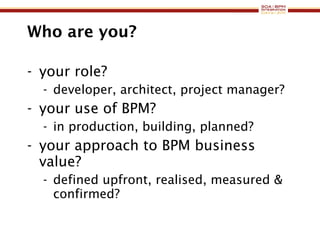
Who are you? your role? developer, architect, project manager? your use of BPM? in production, building, planned? your approach to BPM business value? defined upfront, realised, measured & confirmed?
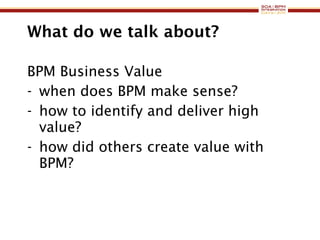
What do we talk about? BPM Business Value when does BPM make sense? how to identify and deliver high value? how did others create value with BPM?
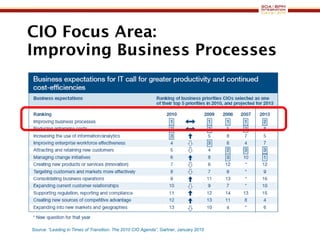
CIO Focus Area:  Improving Business Processes Source:  “Leading in Times of Transition: The 2010 CIO Agenda” , Gartner, January 2010
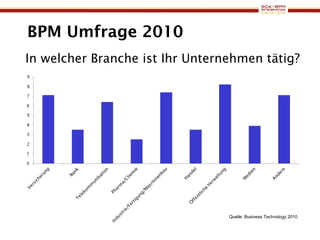
BPM Umfrage 2010 In welcher Branche ist Ihr Unternehmen tätig? Quelle: Business Technology 2010
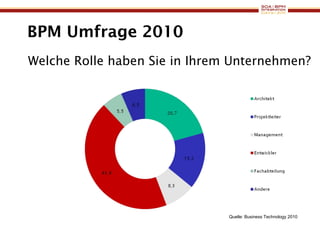
BPM Umfrage 2010 Welche Rolle haben Sie in Ihrem Unternehmen? Quelle: Business Technology 2010
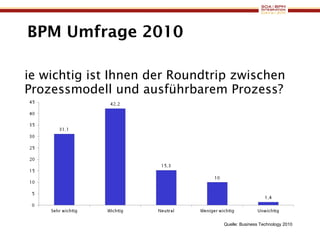
BPM Umfrage 2010 Wie wichtig ist Ihnen der Roundtrip zwischen Prozessmodell und ausführbarem Prozess? Quelle: Business Technology 2010
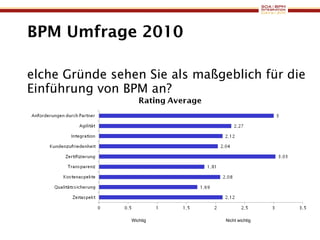
BPM Umfrage 2010 Welche Gründe sehen Sie als maßgeblich für die Einführung von BPM an? Wichtig  Nicht wichtig
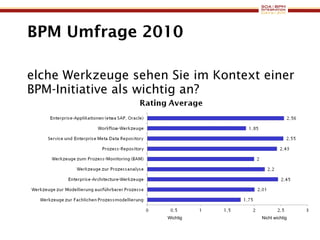
BPM Umfrage 2010 Welche Werkzeuge sehen Sie im Kontext einer BPM-Initiative als wichtig an? Wichtig  Nicht wichtig
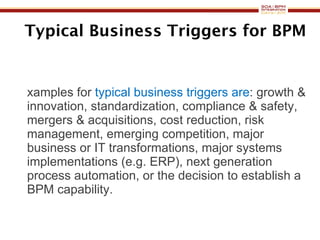
Typical Business Triggers for BPM Examples for  typical business triggers are : growth & innovation, standardization, compliance & safety, mergers & acquisitions, cost reduction, risk management, emerging competition, major business or IT transformations, major systems implementations (e.g. ERP), next generation process automation, or the decision to establish a BPM capability.
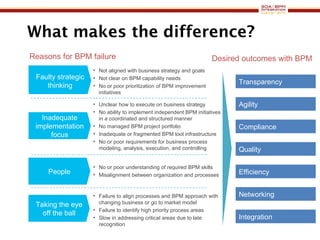
What makes the difference? Transparency Agility Compliance Quality Efficiency Networking Integration Reasons for BPM failure Desired outcomes with BPM Faulty strategic thinking Faulty strategic thinking Not aligned with business strategy and goals Not clear on BPM capability needs No or poor prioritization of BPM improvement initiatives Inadequate implementation focus Unclear how to execute on business strategy No ability to implement independent BPM initiatives in a coordinated and structured manner No managed BPM project portfolio Inadequate or fragmented BPM tool infrastructure  No or poor requirements for business process modeling, analysis, execution, and controlling People No or poor understanding of required BPM skills Misalignment between organization and processes  Taking the eye off the ball Failure to align processes and BPM approach with changing business or go to market model Failure to identify high priority process areas Slow in addressing critical areas due to late recognition
Agenda Introduction BPM Business Value Case Studies
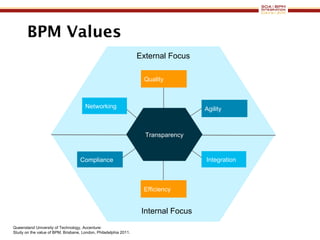
BPM Values Quality Efficiency  Agility Networking Transparency Integration Compliance Queensland University of Technology, Accenture:  Study on the value of BPM, Brisbane, London, Philadelphia 2011. Internal Focus External Focus
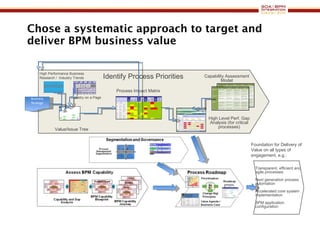
Chose a systematic approach to target and deliver BPM business value Identify Process Priorities High Level Perf. Gap Analysis (for critical processes) Value/Issue Tree Process Impact Matrix Capability Assessment Model High Performance Business Research /  Industry Trends Business Strategy Industry on a Page Foundation for Delivery of Value on all types of engagement, e.g.: Transparent, efficient and agile processes Next generation process automation Accelerated core system implementation BPM application configuration
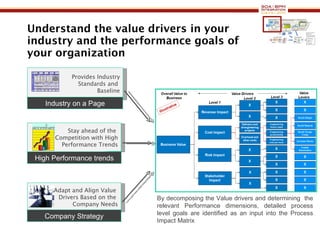
Understand the value drivers in your industry and the performance goals of your organization Adapt and Align Value  Drivers Based on the  Company Needs Provides Industry  Standards and  Baseline Stay ahead of the  Competition with High Performance Trends Industry on a Page High Performance trends Company Strategy By decomposing the Value drivers and determining  the relevant Performance dimensions, detailed process level goals are identified as an input into the Process Impact Matrix
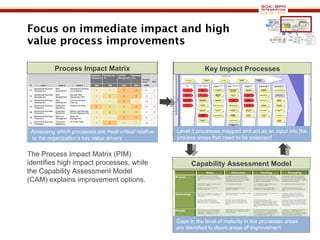
Focus on immediate impact and high value process improvements Process Impact Matrix Capability Assessment Model Key Impact Processes Assessing which processes are most critical relative  to the organization’s key value drivers Gaps in the level of maturity in the processes areas are identified to deem areas of improvement Level 3 processes mapped and act as an input into the process areas that need to be assessed  The Process Impact Matrix (PIM)  identifies high impact processes, while  the Capability Assessment Model  (CAM) explains improvement options.
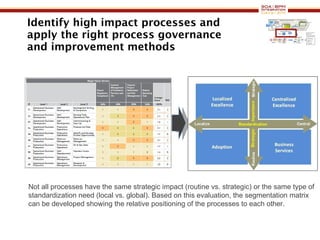
Identify high impact processes and  apply the right process governance  and improvement methods Not all processes have the same strategic impact (routine vs. strategic) or the same type of standardization need (local vs. global). Based on this evaluation, the segmentation matrix can be developed showing the relative positioning of the processes to each other.
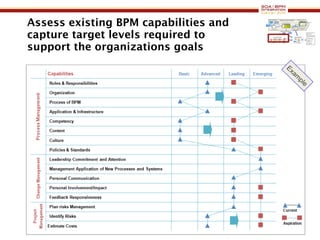
Assess existing BPM capabilities and capture target levels required to support the organizations goals Example
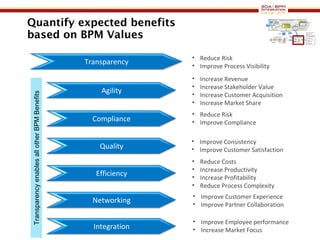
Quantify expected benefits  based on BPM Values Reduce Risk Improve Process Visibility Increase Revenue Increase Stakeholder Value Increase Customer Acquisition Increase Market Share Reduce Costs Increase Productivity Increase Profitability Reduce Process Complexity Improve Consistency Improve Customer Satisfaction Reduce Risk Improve Compliance Improve Customer Experience Improve Partner Collaboration Improve Employee performance Increase Market Focus Transparency enables all other BPM Benefits Transparency Agility Compliance Quality Efficiency Networking Integration
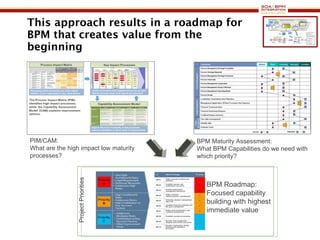
This approach results in a roadmap for BPM that creates value from the beginning BPM Maturity Assessment: What BPM Capabilities do we need with which priority? PIM/CAM: What are the high impact low maturity processes? Project Priorities BPM Roadmap: Focused capability building with highest immediate value
Agenda Introduction BPM Business Value Case Studies
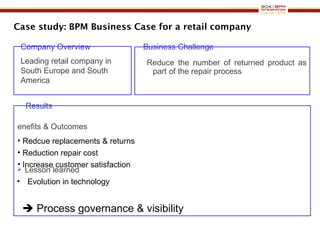
Reduce the number of returned product as part of the repair process  Lesson learned Evolution in technology Results Leading retail company in South Europe and South America Benefits & Outcomes Redcue replacements & returns Reduction repair cost Increase customer satisfaction Company Overview Business Challenge Case study: BPM Business Case for a  retail company    Process governance & visibility
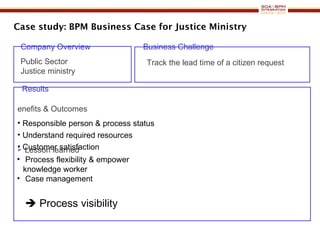
Track the lead time of a citizen request  Lesson learned Process flexibility & empower knowledge worker Case management Results Public Sector Justice ministry  Benefits & Outcomes Responsible person & process status Understand required resources Customer satisfaction Company Overview Business Challenge Case study: BPM Business Case for  Justice Ministry    Process visibility
Questions & Contact Jürgen Kress Oracle EMEA SOA & BPM Partner Adoption Tel. +49 89 1430-1479 E-Mail: juergen.kress@oracle.com Dr. Matthias Ziegler Accenture Senior Manager & Master Technology Architect Tel. +49 (89) 93081-68792 E-Mail: matthias.ziegler@accenture.com

BPM Business Value Patterns

  • 1.
    Jürgen Kress |Oracle Matthias Ziegler | Accenture BPM Business Value Patterns
  • 2.
    Agenda Introduction BPMBusiness Value Case Studies
  • 3.
    Who are we?Dr. Matthias Ziegler is a senior manager and master technology architect at Accenture. He leads the BPM Automation group in Austria, Switzerland and Germany and the Architecture Innovation team, which pioneers emerging technologies at our clients. Jürgen Kress responsible for SOA & BPM partner adoption at Oracle EMEA. He is the founder of the Oracle SOA & BPM Partner Community and the global Partner Advisory Council with more than 3000 members from all over the world. Jürgen hosts the community with monthly newsletters, webcasts and quarterly events. Supplemented by many web 2.0 tools like discussion forums, online communities, blogs, twitter and wikis.
  • 4.
    Who are you?your role? developer, architect, project manager? your use of BPM? in production, building, planned? your approach to BPM business value? defined upfront, realised, measured & confirmed?
  • 5.
    What do wetalk about? BPM Business Value when does BPM make sense? how to identify and deliver high value? how did others create value with BPM?
  • 6.
    CIO Focus Area: Improving Business Processes Source: “Leading in Times of Transition: The 2010 CIO Agenda” , Gartner, January 2010
  • 7.
    BPM Umfrage 2010In welcher Branche ist Ihr Unternehmen tätig? Quelle: Business Technology 2010
  • 8.
    BPM Umfrage 2010Welche Rolle haben Sie in Ihrem Unternehmen? Quelle: Business Technology 2010
  • 9.
    BPM Umfrage 2010Wie wichtig ist Ihnen der Roundtrip zwischen Prozessmodell und ausführbarem Prozess? Quelle: Business Technology 2010
  • 10.
    BPM Umfrage 2010Welche Gründe sehen Sie als maßgeblich für die Einführung von BPM an? Wichtig Nicht wichtig
  • 11.
    BPM Umfrage 2010Welche Werkzeuge sehen Sie im Kontext einer BPM-Initiative als wichtig an? Wichtig Nicht wichtig
  • 12.
    Typical Business Triggersfor BPM Examples for typical business triggers are : growth & innovation, standardization, compliance & safety, mergers & acquisitions, cost reduction, risk management, emerging competition, major business or IT transformations, major systems implementations (e.g. ERP), next generation process automation, or the decision to establish a BPM capability.
  • 13.
    What makes thedifference? Transparency Agility Compliance Quality Efficiency Networking Integration Reasons for BPM failure Desired outcomes with BPM Faulty strategic thinking Faulty strategic thinking Not aligned with business strategy and goals Not clear on BPM capability needs No or poor prioritization of BPM improvement initiatives Inadequate implementation focus Unclear how to execute on business strategy No ability to implement independent BPM initiatives in a coordinated and structured manner No managed BPM project portfolio Inadequate or fragmented BPM tool infrastructure No or poor requirements for business process modeling, analysis, execution, and controlling People No or poor understanding of required BPM skills Misalignment between organization and processes Taking the eye off the ball Failure to align processes and BPM approach with changing business or go to market model Failure to identify high priority process areas Slow in addressing critical areas due to late recognition
  • 14.
    Agenda Introduction BPMBusiness Value Case Studies
  • 15.
    BPM Values QualityEfficiency Agility Networking Transparency Integration Compliance Queensland University of Technology, Accenture: Study on the value of BPM, Brisbane, London, Philadelphia 2011. Internal Focus External Focus
  • 16.
    Chose a systematicapproach to target and deliver BPM business value Identify Process Priorities High Level Perf. Gap Analysis (for critical processes) Value/Issue Tree Process Impact Matrix Capability Assessment Model High Performance Business Research / Industry Trends Business Strategy Industry on a Page Foundation for Delivery of Value on all types of engagement, e.g.: Transparent, efficient and agile processes Next generation process automation Accelerated core system implementation BPM application configuration
  • 17.
    Understand the valuedrivers in your industry and the performance goals of your organization Adapt and Align Value Drivers Based on the Company Needs Provides Industry Standards and Baseline Stay ahead of the Competition with High Performance Trends Industry on a Page High Performance trends Company Strategy By decomposing the Value drivers and determining the relevant Performance dimensions, detailed process level goals are identified as an input into the Process Impact Matrix
  • 18.
    Focus on immediateimpact and high value process improvements Process Impact Matrix Capability Assessment Model Key Impact Processes Assessing which processes are most critical relative to the organization’s key value drivers Gaps in the level of maturity in the processes areas are identified to deem areas of improvement Level 3 processes mapped and act as an input into the process areas that need to be assessed The Process Impact Matrix (PIM) identifies high impact processes, while the Capability Assessment Model (CAM) explains improvement options.
  • 19.
    Identify high impactprocesses and apply the right process governance and improvement methods Not all processes have the same strategic impact (routine vs. strategic) or the same type of standardization need (local vs. global). Based on this evaluation, the segmentation matrix can be developed showing the relative positioning of the processes to each other.
  • 20.
    Assess existing BPMcapabilities and capture target levels required to support the organizations goals Example
  • 21.
    Quantify expected benefits based on BPM Values Reduce Risk Improve Process Visibility Increase Revenue Increase Stakeholder Value Increase Customer Acquisition Increase Market Share Reduce Costs Increase Productivity Increase Profitability Reduce Process Complexity Improve Consistency Improve Customer Satisfaction Reduce Risk Improve Compliance Improve Customer Experience Improve Partner Collaboration Improve Employee performance Increase Market Focus Transparency enables all other BPM Benefits Transparency Agility Compliance Quality Efficiency Networking Integration
  • 22.
    This approach resultsin a roadmap for BPM that creates value from the beginning BPM Maturity Assessment: What BPM Capabilities do we need with which priority? PIM/CAM: What are the high impact low maturity processes? Project Priorities BPM Roadmap: Focused capability building with highest immediate value
  • 23.
    Agenda Introduction BPMBusiness Value Case Studies
  • 24.
    Reduce the numberof returned product as part of the repair process Lesson learned Evolution in technology Results Leading retail company in South Europe and South America Benefits & Outcomes Redcue replacements & returns Reduction repair cost Increase customer satisfaction Company Overview Business Challenge Case study: BPM Business Case for a retail company  Process governance & visibility
  • 25.
    Track the leadtime of a citizen request Lesson learned Process flexibility & empower knowledge worker Case management Results Public Sector Justice ministry Benefits & Outcomes Responsible person & process status Understand required resources Customer satisfaction Company Overview Business Challenge Case study: BPM Business Case for Justice Ministry  Process visibility
  • 26.
    Questions & ContactJürgen Kress Oracle EMEA SOA & BPM Partner Adoption Tel. +49 89 1430-1479 E-Mail: juergen.kress@oracle.com Dr. Matthias Ziegler Accenture Senior Manager & Master Technology Architect Tel. +49 (89) 93081-68792 E-Mail: matthias.ziegler@accenture.com

Editor's Notes

  • #14 Start: „Wir haben jetzt verschiedene Gründe und Anlässe kennengelernt, warum Unternehmen in BPM einsteigen. Doch viele scheitern. Woran liegt es? Unsere Nachforschungen und Erfahrung mit Kunden rund um den Globus ergeben folgende Gründe ...“ Hand over to next chapter: „So, how do you make sure that you reach the desired outcomes of your BPM implementation. Let me explain how we do that at Accenture ...“
  • #16 Let me first recap what values we found to be created by BPM based on a study we did together with the Queensland University of Technology in Australia. Beispiele: Efficiency: Service Organisation: 40 mio $ Cost reduction über 4 Jahre, nicht sofort sichtbar nach draussen, interne Sicht Quality: Bank, Kreditvergabe -> Hauskauf; Versicherung: Claims Handling, vom Posteingang zum eigentlichen Schadenfall (Kundensicht) Agility: Versicherung, Schadenfälle nach einem Tornado 2x so hoch, Beschleunigung des Meldeprozesses Compliance: Bank, Sarbanes-Oaxley, Prozessbeschreibungen, isoliert, andere Values nicht beachtet, mußten für Process Improvement Activities später umgeschrieben werden Integration: staatliche Behörde, Prozesse so zuschneiden, dass interessante Rollen für Graduates rauskommen, einfache Prozessdoku Networking: green processes, process costing, environmental impact costing, or Social Media integration, working with partners and customers Effizienz und Compliance waren die wichtigsten -> verpassen of andere für das Unternehmen strategisch wichtige Ziele
  • #20 Typical processes: - centralized excellence: mega customer management, pricing - localized excellence: local supply chain - businenss services: finance & accounting adoption: local taxes, customs clearing
  • #23 Handover: „... now let‘s look at a few examples how this approach was used for some of our clients and how it worked out for them“