

Rework Reduction
Through the Use of
Construction Lean Improvement Program (CLIP)
a Case Study in New Australian Embassy in Jakarta (AEJ) -
Leighton Contractors Indonesia & Total Bangun Persada
Joint Operation
Firdaus Basbeth
DMB Student of University of Padjadjaran Bandung
QIK 2014 International Conference
Ascot House Melbourne February 21 2014
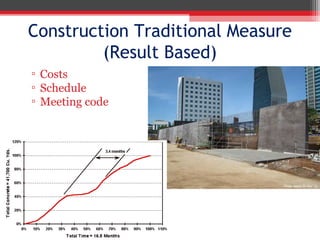
Construction Traditional Measure
(Result Based)
▫ Costs
▫ Schedule
▫ Meeting code
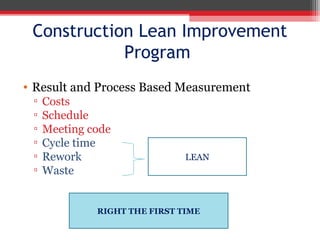
Construction Lean Improvement
Program
• Result and Process Based Measurement
▫ Costs
▫ Schedule
▫ Meeting code
▫ Cycle time
▫ Rework
▫ Waste
LEAN
RIGHT THE FIRST TIME
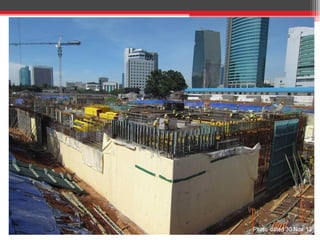
Chancery and Staff Residence, Jakarta
Project Description
The project is Total plot area 40,000m2, total covered floor area 50,106m2 of
which 43,500m2 is building and 6,600m2 is pergola and parking. The scope of
work includes Partial Design, Engineering, • Procurement, Testing and
Inspection, Construction a Compound, consisting of:
o Basement, plus 5 floor chancery building of approximately 26,700m2,
o Head of Mission residence,
o 32 number staff residences,
o Swimming pool,
o Recreation facilities,
o Guard houses,
o Ancillary service buildings,
o Landscaping,
o Security walls,
o All associated works in accordance with drawings, specifications.
The construction duration is 36 months until 2016. It is still ongoing and under
close monitoring by project management.
INTRODUCTION
• Construction traditional measure (Result Based)
vs Performance Measurement System (Process
Based)
• Construction Lean Improvement Program
▫ Lean Thinking
▫ Seven Waste
▫ 5S
▫ Labor Competency Issue
▫ First Inspection Method
LITERATURE REVIEW
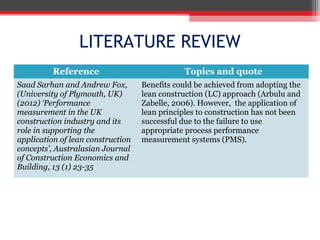
Reference Topics and quote
Saad Sarhan and Andrew Fox,
(University of Plymouth, UK)
(2012) ‘Performance
measurement in the UK
construction industry and its
role in supporting the
application of lean construction
concepts’, Australasian Journal
of Construction Economics and
Building, 13 (1) 23-35
Benefits could be achieved from adopting the
lean construction (LC) approach (Arbulu and
Zabelle, 2006). However, the application of
lean principles to construction has not been
successful due to the failure to use
appropriate process performance
measurement systems (PMS).
LITERATURE REVIEW
Reference Topics and quote
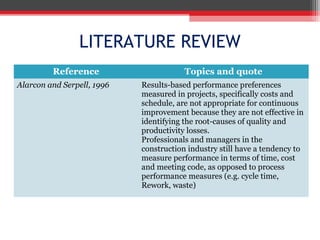
Alarcon and Serpell, 1996 Results-based performance preferences
measured in projects, specifically costs and
schedule, are not appropriate for continuous
improvement because they are not effective in
identifying the root-causes of quality and
productivity losses.
Professionals and managers in the
construction industry still have a tendency to
measure performance in terms of time, cost
and meeting code, as opposed to process
performance measures (e.g. cycle time,
Rework, waste)
LITERATURE REVIEW
Reference Topics and quote
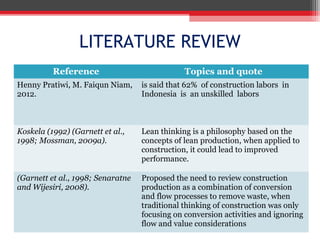
Henny Pratiwi, M. Faiqun Niam,
2012.
is said that 62% of construction labors in
Indonesia is an unskilled labors
Koskela (1992) (Garnett et al.,
1998; Mossman, 2009a).
Lean thinking is a philosophy based on the
concepts of lean production, when applied to
construction, it could lead to improved
performance.
(Garnett et al., 1998; Senaratne
and Wijesiri, 2008).
Proposed the need to review construction
production as a combination of conversion
and flow processes to remove waste, when
traditional thinking of construction was only
focusing on conversion activities and ignoring
flow and value considerations
LITERATURE REVIEW
Reference Topics and quote
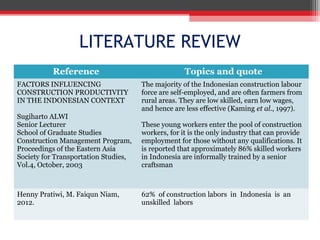
FACTORS INFLUENCING
CONSTRUCTION PRODUCTIVITY
IN THE INDONESIAN CONTEXT
Sugiharto ALWI
Senior Lecturer
School of Graduate Studies
Construction Management Program,
Proceedings of the Eastern Asia
Society for Transportation Studies,
Vol.4, October, 2003
The majority of the Indonesian construction labour
force are self-employed, and are often farmers from
rural areas. They are low skilled, earn low wages,
and hence are less effective (Kaming et al., 1997).
These young workers enter the pool of construction
workers, for it is the only industry that can provide
employment for those without any qualifications. It
is reported that approximately 86% skilled workers
in Indonesia are informally trained by a senior
craftsman
Henny Pratiwi, M. Faiqun Niam,
2012.
62% of construction labors in Indonesia is an
unskilled labors
Lean Thinking
Lean thinking is a philosophy based on the
concepts of lean production.
Lean is focused on the achievement of three key
outcomes:
1. Maximizing value from the view of the
customer
2. Eliminating waste (non-value adding
processes)
3. Creating smooth and reliable flow of activity.
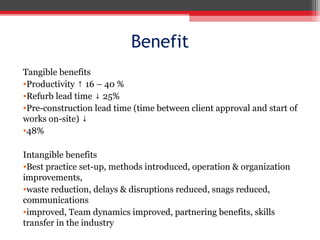
Benefit
Tangible benefits
•Productivity 16 – 40 %↑
•Refurb lead time 25%↓
•Pre-construction lead time (time between client approval and start of
works on-site) ↓
•48%
Intangible benefits
•Best practice set-up, methods introduced, operation & organization
improvements,
•waste reduction, delays & disruptions reduced, snags reduced,
communications
•improved, Team dynamics improved, partnering benefits, skills
transfer in the industry
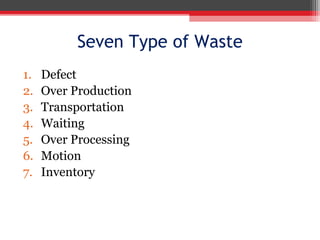
Seven Type of Waste
1. Defect
2. Over Production
3. Transportation
4. Waiting
5. Over Processing
6. Motion
7. Inventory
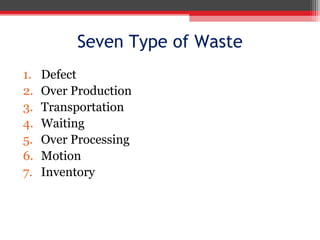
Seven Type of Waste
1. Defect
2. Over Production
3. Transportation
4. Waiting
5. Over Processing
6. Motion
7. Inventory
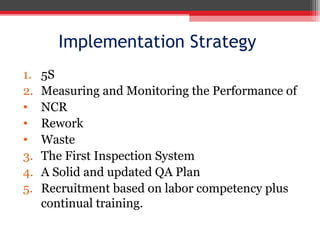
Implementation Strategy
1. 5S
2. Measuring and Monitoring the Performance of
• NCR
• Rework
• Waste
3. The First Inspection System
4. A Solid and updated QA Plan
5. Recruitment based on labor competency plus
continual training.
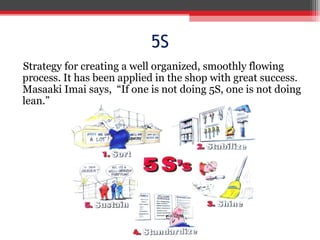
5S
Strategy for creating a well organized, smoothly flowing
process. It has been applied in the shop with great success.
Masaaki Imai says, “If one is not doing 5S, one is not doing
lean.”
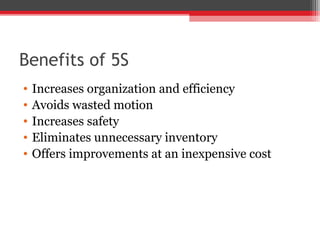
Benefits of 5S
• Increases organization and efficiency
• Avoids wasted motion
• Increases safety
• Eliminates unnecessary inventory
• Offers improvements at an inexpensive cost
METHOD
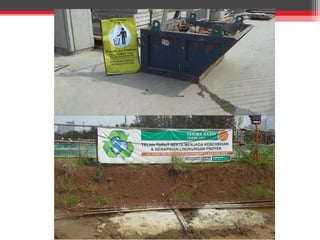
The research is a Case Study in Leighton
Contractors Indonesia in New Australian Embassy
Project (2013 – 2016)
Primary and Secondary Data are gathered using
both qualitative and quantitative approaches, and
interview
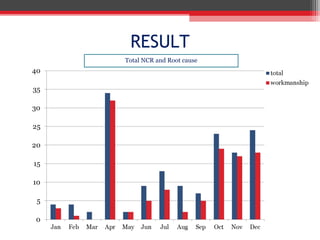
RESULT
Total NCR and Root cause
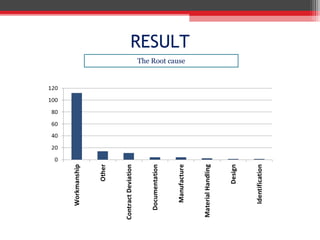
RESULT
The Root cause
RESULT
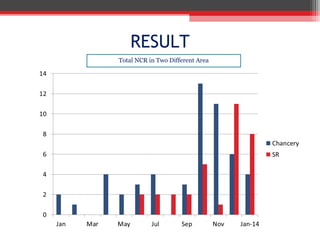
Total NCR in Two Different Area
RESULT
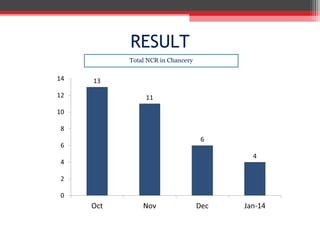
Total NCR in Chancery
DISCUSSION
• In the construction industry, defect or rework is a challenge that
affects the productivity of a project. Additional resources are
required ie: labor, materials, and energy beyond what is budgeted
had the work been done right the first time – not to mentioned
potential risk with respect to quality and safety.
• The New Australian Embassy Project has in place and continually
updates their Quality Plan. Improvement activities can be seen from
the frequency of Non Conformance Report.(Rework required.)
Training to up skill labor to LCI standards, Internal Quality Audits,
and increased management attention has been a focus the last 6
months.
DISCUSSION
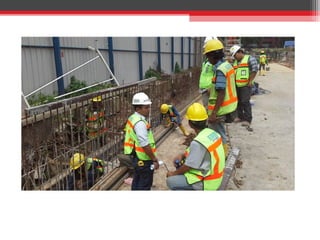
• The New Autralian Embassy in Jakarta (AEJ) implemented the First
Inspector System (FIS) – by putting full responsibility of the quality
of product delivered to the supervisor and foreman, so by the time
the quality inspector come to check the work, the variation from
specification will be the minimum. The results have seen the non-
conformance reports reduce by 57%. The saving for the project is
USD$20,000 or Rupiah 240mil.
DISCUSSION
• The Construction Lean Improvement Program Works in Chancery
Area in the Project. Suggestion to be Implemented in some others
construction areas in the Project, with the additional strategy of : 5S,
First Inspector System, Performance Monitoring (Process Based)
Continual Training on the Labor to maintaining quality of the
product.
• Buy in from Project Manager and its implementation strategy need
to be in the first place – stated in Quality Plan.
DISCUSSION
Rework / NCR Reduction in CLIP include the following
processes:
•Rework tracking and main cause classification: detecting and
identifying the rework that occurs and captured, investigate the causes
in a database that used collaboratively by the client, contractors and
designer.
•Corrective action : developing options and actions that will bring
about changes in the project management system with the goal of
eliminating the root cause and reducing construction rework
•Evaluation of the effectiveness of the corrective action taken.
33
Thank youThank you

Rework Reduction in Construction Project

  • 1.
    Rework Reduction Through theUse of Construction Lean Improvement Program (CLIP) a Case Study in New Australian Embassy in Jakarta (AEJ) - Leighton Contractors Indonesia & Total Bangun Persada Joint Operation Firdaus Basbeth DMB Student of University of Padjadjaran Bandung QIK 2014 International Conference Ascot House Melbourne February 21 2014
  • 3.
    Construction Traditional Measure (ResultBased) ▫ Costs ▫ Schedule ▫ Meeting code
  • 4.
    Construction Lean Improvement Program •Result and Process Based Measurement ▫ Costs ▫ Schedule ▫ Meeting code ▫ Cycle time ▫ Rework ▫ Waste LEAN RIGHT THE FIRST TIME
  • 5.
    Chancery and StaffResidence, Jakarta Project Description The project is Total plot area 40,000m2, total covered floor area 50,106m2 of which 43,500m2 is building and 6,600m2 is pergola and parking. The scope of work includes Partial Design, Engineering, • Procurement, Testing and Inspection, Construction a Compound, consisting of: o Basement, plus 5 floor chancery building of approximately 26,700m2, o Head of Mission residence, o 32 number staff residences, o Swimming pool, o Recreation facilities, o Guard houses, o Ancillary service buildings, o Landscaping, o Security walls, o All associated works in accordance with drawings, specifications. The construction duration is 36 months until 2016. It is still ongoing and under close monitoring by project management.
  • 6.
    INTRODUCTION • Construction traditionalmeasure (Result Based) vs Performance Measurement System (Process Based) • Construction Lean Improvement Program ▫ Lean Thinking ▫ Seven Waste ▫ 5S ▫ Labor Competency Issue ▫ First Inspection Method
  • 7.
    LITERATURE REVIEW Reference Topicsand quote Saad Sarhan and Andrew Fox, (University of Plymouth, UK) (2012) ‘Performance measurement in the UK construction industry and its role in supporting the application of lean construction concepts’, Australasian Journal of Construction Economics and Building, 13 (1) 23-35 Benefits could be achieved from adopting the lean construction (LC) approach (Arbulu and Zabelle, 2006). However, the application of lean principles to construction has not been successful due to the failure to use appropriate process performance measurement systems (PMS).
  • 8.
    LITERATURE REVIEW Reference Topicsand quote Alarcon and Serpell, 1996 Results-based performance preferences measured in projects, specifically costs and schedule, are not appropriate for continuous improvement because they are not effective in identifying the root-causes of quality and productivity losses. Professionals and managers in the construction industry still have a tendency to measure performance in terms of time, cost and meeting code, as opposed to process performance measures (e.g. cycle time, Rework, waste)
  • 9.
    LITERATURE REVIEW Reference Topicsand quote Henny Pratiwi, M. Faiqun Niam, 2012. is said that 62% of construction labors in Indonesia is an unskilled labors Koskela (1992) (Garnett et al., 1998; Mossman, 2009a). Lean thinking is a philosophy based on the concepts of lean production, when applied to construction, it could lead to improved performance. (Garnett et al., 1998; Senaratne and Wijesiri, 2008). Proposed the need to review construction production as a combination of conversion and flow processes to remove waste, when traditional thinking of construction was only focusing on conversion activities and ignoring flow and value considerations
  • 10.
    LITERATURE REVIEW Reference Topicsand quote FACTORS INFLUENCING CONSTRUCTION PRODUCTIVITY IN THE INDONESIAN CONTEXT Sugiharto ALWI Senior Lecturer School of Graduate Studies Construction Management Program, Proceedings of the Eastern Asia Society for Transportation Studies, Vol.4, October, 2003 The majority of the Indonesian construction labour force are self-employed, and are often farmers from rural areas. They are low skilled, earn low wages, and hence are less effective (Kaming et al., 1997). These young workers enter the pool of construction workers, for it is the only industry that can provide employment for those without any qualifications. It is reported that approximately 86% skilled workers in Indonesia are informally trained by a senior craftsman Henny Pratiwi, M. Faiqun Niam, 2012. 62% of construction labors in Indonesia is an unskilled labors
  • 11.
    Lean Thinking Lean thinkingis a philosophy based on the concepts of lean production. Lean is focused on the achievement of three key outcomes: 1. Maximizing value from the view of the customer 2. Eliminating waste (non-value adding processes) 3. Creating smooth and reliable flow of activity.
  • 12.
    Benefit Tangible benefits •Productivity 16– 40 %↑ •Refurb lead time 25%↓ •Pre-construction lead time (time between client approval and start of works on-site) ↓ •48% Intangible benefits •Best practice set-up, methods introduced, operation & organization improvements, •waste reduction, delays & disruptions reduced, snags reduced, communications •improved, Team dynamics improved, partnering benefits, skills transfer in the industry
  • 13.
    Seven Type ofWaste 1. Defect 2. Over Production 3. Transportation 4. Waiting 5. Over Processing 6. Motion 7. Inventory
  • 14.
    Seven Type ofWaste 1. Defect 2. Over Production 3. Transportation 4. Waiting 5. Over Processing 6. Motion 7. Inventory
  • 15.
    Implementation Strategy 1. 5S 2.Measuring and Monitoring the Performance of • NCR • Rework • Waste 3. The First Inspection System 4. A Solid and updated QA Plan 5. Recruitment based on labor competency plus continual training.
  • 16.
    5S Strategy for creatinga well organized, smoothly flowing process. It has been applied in the shop with great success. Masaaki Imai says, “If one is not doing 5S, one is not doing lean.”
  • 17.
    Benefits of 5S •Increases organization and efficiency • Avoids wasted motion • Increases safety • Eliminates unnecessary inventory • Offers improvements at an inexpensive cost
  • 18.
    METHOD The research isa Case Study in Leighton Contractors Indonesia in New Australian Embassy Project (2013 – 2016) Primary and Secondary Data are gathered using both qualitative and quantitative approaches, and interview
  • 19.
  • 20.
  • 21.
    RESULT Total NCR inTwo Different Area
  • 22.
  • 23.
    DISCUSSION • In theconstruction industry, defect or rework is a challenge that affects the productivity of a project. Additional resources are required ie: labor, materials, and energy beyond what is budgeted had the work been done right the first time – not to mentioned potential risk with respect to quality and safety. • The New Australian Embassy Project has in place and continually updates their Quality Plan. Improvement activities can be seen from the frequency of Non Conformance Report.(Rework required.) Training to up skill labor to LCI standards, Internal Quality Audits, and increased management attention has been a focus the last 6 months.
  • 24.
    DISCUSSION • The NewAutralian Embassy in Jakarta (AEJ) implemented the First Inspector System (FIS) – by putting full responsibility of the quality of product delivered to the supervisor and foreman, so by the time the quality inspector come to check the work, the variation from specification will be the minimum. The results have seen the non- conformance reports reduce by 57%. The saving for the project is USD$20,000 or Rupiah 240mil.
  • 25.
    DISCUSSION • The ConstructionLean Improvement Program Works in Chancery Area in the Project. Suggestion to be Implemented in some others construction areas in the Project, with the additional strategy of : 5S, First Inspector System, Performance Monitoring (Process Based) Continual Training on the Labor to maintaining quality of the product. • Buy in from Project Manager and its implementation strategy need to be in the first place – stated in Quality Plan.
  • 26.
    DISCUSSION Rework / NCRReduction in CLIP include the following processes: •Rework tracking and main cause classification: detecting and identifying the rework that occurs and captured, investigate the causes in a database that used collaboratively by the client, contractors and designer. •Corrective action : developing options and actions that will bring about changes in the project management system with the goal of eliminating the root cause and reducing construction rework •Evaluation of the effectiveness of the corrective action taken.
  • 33.