Business Architecture Patterns
A. Samarin
“BPM in Practice” conference
Vilnius, October 2013
About me
• An enterprise architect
– from a programmer to a systems architect
– have created systems which work without me

• WHY I do what I do
– I believe that many improvements (“sooner, better, cheaper, more
flexible”) in operational excellence and strategy execution are
achievable with reasonable efforts and commodity tools

• HOW I do what I do
– architecting the synergy between technologies, tools and best
practices for client’s unique case and transfer the knowledge

• WHAT is the result of my work for clients
– more coordination, less routine work, less stress, higher
performance, higher security, less risk, higher predictability of
results, better operations, and liberating the business potentials
© A. Samarin 2013

“BPM in Practice” conference v2

2
A system of actionable patterns
• Although core business processes in each enterprise are
unique, they are constructed from typical business
working practices
• The system is aimed at formalising and perfecting these
working practices as actionable patterns
• Some of these patterns are expressed in executable BPMN
thus making them available for businesses via modern
BPM tools

© A. Samarin 2013

“BPM in Practice” conference v2

3
Agenda
• Strategy TO Portfolio (STOP)
• Anisotropically Decentralised Organisation (ADO)
• Maturity Of Process Systems (MOPS)

• Customer eXperience As A Process (CXAAP)
• Platform-Enabled Agile Solutions (PEAS)
• Structuring IT Organisation (SITO)

• Submission Interface (SI)
• Decomposition in patterns (DIP)
• Make Your Logic Explicit (MYLO)
• Strategy Implementation Chain (SIC)
© A. Samarin 2013

“BPM in Practice” conference v2

4
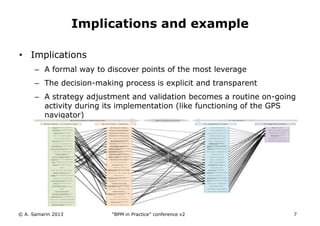
Strategy To Portfolio (STOP)
• Business concern
– dealing with the project portfolio during evolution of the strategy:
intended, emerging and realised

• Logic
– explicitly linking strategic objectives, initiatives, business
capabilities, IT capabilities, IT tools and projects
– add priorities
© A. Samarin 2013

“BPM in Practice” conference v2

5
Logic
Business demand

Business
strategic
objectives

Governance

Business
initiatives
(business-specific
demand)

1
1
2
3

5

Manage
Business
business by
capabilities
(business- processes
generic
demand)

2->5

1
2

4

2
Business priority

© A. Samarin 2013

Manage
processes

IT
capabilities
(IT-generic
supply)

2->5
2->4

5
4

1->3

3
2

4

2->4

1->3
3

2

5

IT supply

3
4

1->4

Requested maturity

3
4

3

2->4

4

3->4

4

Maturity improvement

“BPM in Practice” conference v2

Roadmap
IT tools
BPM suite
programmes
(IT-specific
(from AS-IS
supply)
to TO-BE)

3->5

1

3->4

2

1->4

3

3->4

4

2->4

4

Programme priority

6
Implications and example
• Implications
– A formal way to discover points of the most leverage
– The decision-making process is explicit and transparent
– A strategy adjustment and validation becomes a routine on-going
activity during its implementation (like functioning of the GPS
navigator)

© A. Samarin 2013

“BPM in Practice” conference v2

7
Anisotropically Decentralised
Organisation (ADO)
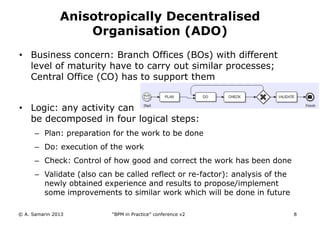
• Business concern: Branch Offices (BOs) with different
level of maturity have to carry out similar processes;
Central Office (CO) has to support them
• Logic: any activity can
be decomposed in four logical steps:
– Plan: preparation for the work to be done

– Do: execution of the work
– Check: Control of how good and correct the work has been done
– Validate (also can be called reflect or re-factor): analysis of the
newly obtained experience and results to propose/implement
some improvements to similar work which will be done in future
© A. Samarin 2013

“BPM in Practice” conference v2

8
Logic
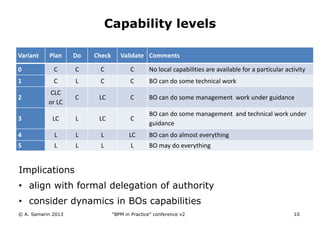
• Possible combinations for each step are:
– [C] fully centrally (i.e. no delegation)
– [L] fully locally (i.e. complete delegation)
– [LC] with central post-control
– [CL] with central pre-advice
– [CLC] with central pre-advice and post-control

• Available combination for particular activities
– Plan – C, L, LC, CL, CLC
– Do – C, L (actual work can be done only at one place)
– Check – C, L, LC
– Validate – C, L, LC
© A. Samarin 2013

“BPM in Practice” conference v2

9
Capability levels
Variant

Plan

Do

Check

Validate Comments

0

C

C

C

C

No local capabilities are available for a particular activity

1

C

L

C

C

BO can do some technical work

2

CLC
or LC

C

LC

C

BO can do some management work under guidance

3

LC

L

LC

C

BO can do some management and technical work under
guidance

4

L

L

L

LC

BO can do almost everything

5

L

L

L

L

BO may do everything

Implications

• align with formal delegation of authority
• consider dynamics in BOs capabilities
© A. Samarin 2013

“BPM in Practice” conference v2

10
Maturity Of Process System (MOPS)
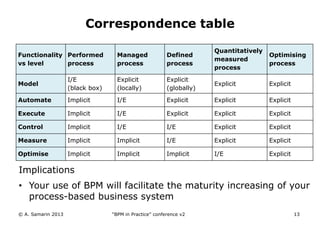
• Business concern: You want to reach a particular level of
maturity (in accordance with CMMI ) of a process-based
business system - what BPM functionality will help you?
• Logic: Levels of maturity are well-known
1.

A performed process is a process that accomplishes the work necessary
to produce work products

2.

A managed process is a performed process that is planned and executed
in accordance with some policies

3.

A defined process is a managed process that is tailored from the
organization’s set of standard processes

4.

A quantitatively managed process is a defined process that is controlled
using statistical and other quantitative techniques

5.

An optimizing process is a quantitatively managed process that is
changed and adapted to meet relevant current and projected business
objectives

© A. Samarin 2013

“BPM in Practice” conference v2

11
Logic
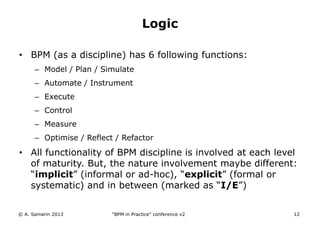
• BPM (as a discipline) has 6 following functions:
– Model / Plan / Simulate
– Automate / Instrument
– Execute
– Control
– Measure
– Optimise / Reflect / Refactor

• All functionality of BPM discipline is involved at each level
of maturity. But, the nature involvement maybe different:
“implicit” (informal or ad-hoc), “explicit” (formal or
systematic) and in between (marked as “I/E”)
© A. Samarin 2013

“BPM in Practice” conference v2

12
Correspondence table
Functionality Performed
vs level
process

Managed
process

Defined
process

Quantitatively
measured
process

Optimising
process

Model

I/E
(black box)

Explicit
(locally)

Explicit
(globally)

Explicit

Explicit

Automate

Implicit

I/E

Explicit

Explicit

Explicit

Execute

Implicit

I/E

Explicit

Explicit

Explicit

Control

Implicit

I/E

I/E

Explicit

Explicit

Measure

Implicit

Implicit

I/E

Explicit

Explicit

Optimise

Implicit

Implicit

Implicit

I/E

Explicit

Implications

• Your use of BPM will facilitate the maturity increasing of your
process-based business system
© A. Samarin 2013

“BPM in Practice” conference v2

13
Customer eXperience As A Process
(CXAAP)
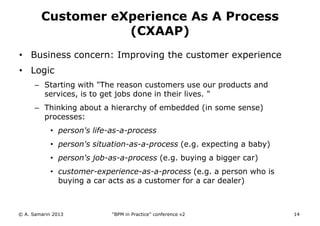
• Business concern: Improving the customer experience
• Logic
– Starting with "The reason customers use our products and
services, is to get jobs done in their lives. "
– Thinking about a hierarchy of embedded (in some sense)
processes:
• person's life-as-a-process

• person's situation-as-a-process (e.g. expecting a baby)
• person's job-as-a-process (e.g. buying a bigger car)
• customer-experience-as-a-process (e.g. a person who is
buying a car acts as a customer for a car dealer)

© A. Samarin 2013

“BPM in Practice” conference v2

14
Logic and implications
• Logic
– If your products and services fit better into those processes (i.e.
reduce the hassle for a customer) then they will be more
attractive for customers

• Implications
– Ask right questions: not “now many floors do you want in your
new house”, but "Do your parents visit?" "How many kids do you
want?" "How long do you want to stay in this place?
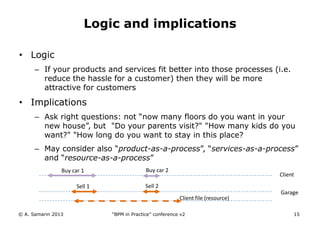
– May consider also “product-as-a-process”, “services-as-a-process”
and “resource-as-a-process”
Buy car 1
Sell 1

Buy car 2

Client

Sell 2
Client file (resource)

© A. Samarin 2013

“BPM in Practice” conference v2

Garage

15
Platform-Enabled Agile Solutions (PEAS)
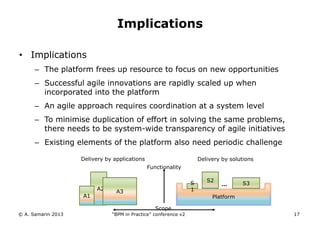
• Business concern: How to deliver many similar
applications for various highly-diverse clients; define
everything up-front is not possible (typical BPM project)
• Logic
– Developing individual applications will bring a lot of duplications
– The provisioning of solutions should be carried out incrementally
with the pace of the target client

– Consider a platform
1. must standardise and simplify core elements of future
enterprise-wide system
2. for any elements outside the platform, new opportunities
should be explored using agile principles
© A. Samarin 2013

“BPM in Practice” conference v2

16
Implications
• Implications
– The platform frees up resource to focus on new opportunities
– Successful agile innovations are rapidly scaled up when
incorporated into the platform
– An agile approach requires coordination at a system level
– To minimise duplication of effort in solving the same problems,
there needs to be system-wide transparency of agile initiatives
– Existing elements of the platform also need periodic challenge
Delivery by applications

Delivery by solutions
Functionality

A2
A1
© A. Samarin 2013

S
1

A3

S2

…

S3

Platform
Scope

“BPM in Practice” conference v2

17
Example – replacing 23 electronic
publishing applications
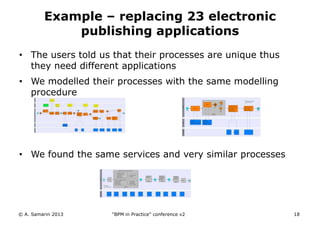
• The users told us that their processes are unique thus
they need different applications
• We modelled their processes with the same modelling
procedure

• We found the same services and very similar processes

© A. Samarin 2013

“BPM in Practice” conference v2

18
Structure IT Organisation (SITO)
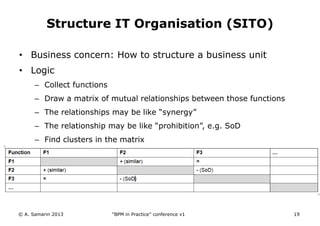
• Business concern: How to structure a business unit
• Logic
– Collect functions
– Draw a matrix of mutual relationships between those functions
– The relationships may be like “synergy”
– The relationship may be like “prohibition”, e.g. SoD
– Find clusters in the matrix

© A. Samarin 2013

“BPM in Practice” conference v1

19
Example of rules
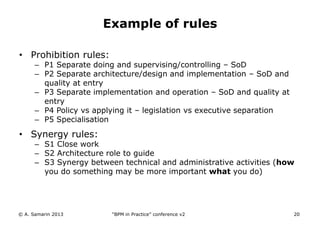
• Prohibition rules:

– P1 Separate doing and supervising/controlling – SoD
– P2 Separate architecture/design and implementation – SoD and
quality at entry
– P3 Separate implementation and operation – SoD and quality at
entry
– P4 Policy vs applying it – legislation vs executive separation
– P5 Specialisation

• Synergy rules:

– S1 Close work
– S2 Architecture role to guide
– S3 Synergy between technical and administrative activities (how
you do something may be more important what you do)

© A. Samarin 2013

“BPM in Practice” conference v2

20
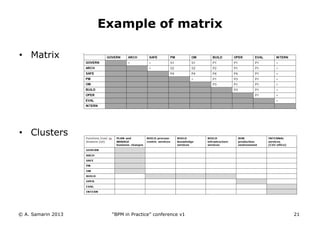
Example of matrix
• Matrix

• Clusters

© A. Samarin 2013

“BPM in Practice” conference v1

21
Submission Interface (SI)
• Business concern: Interactions between two independent
parties
• Logic
– Partner submits some documents (including forms) to
administration
– Administration checks those documents
– Administration may request partner to provide more documents or
to carry out some corrections
– Administration checks those documents again
– And so on

© A. Samarin 2013

“BPM in Practice” conference v2

22
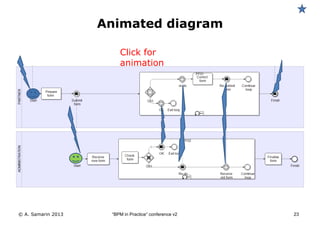
Animated diagram
Click for
animation

© A. Samarin 2013

“BPM in Practice” conference v2

23
Decomposition In Patterns (DIP)
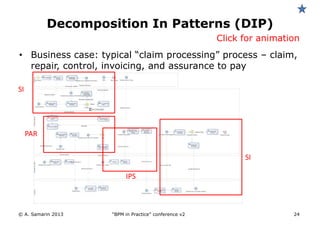
Click for animation

• Business case: typical “claim processing” process – claim,
repair, control, invoicing, and assurance to pay
SI

PAR
SI
IPS

© A. Samarin 2013

“BPM in Practice” conference v2

24
Make Your Logic Explicit (MYLO)
• Business concern: Decision-making is perceived to be too
personalised
• Logic
– Make you decision logic explicit as possible before approaching the
decision itself
– The decision logic must be understandable by all stakeholders of
this decision
– They should be able to execute this decision logic

• Implications
– The business logic will take the decision - not you or other person
– The explicit logic acts as a “lubricator”

© A. Samarin 2013

“BPM in Practice” conference v2

25
Strategy Implementation Chain (SIC)
• Combining some patterns from other patterns

© A. Samarin 2013

“BPM in Practice” conference v2

26
Thanks
• QUESTIONS?

• Personal website: http://www.samarin.biz
• Blog http://improving-bpm-systems.blogspot.com
• LinkedIn: http://www.linkedin.com/in/alexandersamarin

• E-mail: alexandre.samarine@gmail.com
• Twitter: @samarin
• Book: www.samarin.biz/book

© A. Samarin 2013

“BPM in Practice” conference v2

27

Business Architecture Patterns (BPM in Practice conference)

  • 1.
    Business Architecture Patterns A.Samarin “BPM in Practice” conference Vilnius, October 2013
  • 2.
    About me • Anenterprise architect – from a programmer to a systems architect – have created systems which work without me • WHY I do what I do – I believe that many improvements (“sooner, better, cheaper, more flexible”) in operational excellence and strategy execution are achievable with reasonable efforts and commodity tools • HOW I do what I do – architecting the synergy between technologies, tools and best practices for client’s unique case and transfer the knowledge • WHAT is the result of my work for clients – more coordination, less routine work, less stress, higher performance, higher security, less risk, higher predictability of results, better operations, and liberating the business potentials © A. Samarin 2013 “BPM in Practice” conference v2 2
  • 3.
    A system ofactionable patterns • Although core business processes in each enterprise are unique, they are constructed from typical business working practices • The system is aimed at formalising and perfecting these working practices as actionable patterns • Some of these patterns are expressed in executable BPMN thus making them available for businesses via modern BPM tools © A. Samarin 2013 “BPM in Practice” conference v2 3
  • 4.
    Agenda • Strategy TOPortfolio (STOP) • Anisotropically Decentralised Organisation (ADO) • Maturity Of Process Systems (MOPS) • Customer eXperience As A Process (CXAAP) • Platform-Enabled Agile Solutions (PEAS) • Structuring IT Organisation (SITO) • Submission Interface (SI) • Decomposition in patterns (DIP) • Make Your Logic Explicit (MYLO) • Strategy Implementation Chain (SIC) © A. Samarin 2013 “BPM in Practice” conference v2 4
  • 5.
    Strategy To Portfolio(STOP) • Business concern – dealing with the project portfolio during evolution of the strategy: intended, emerging and realised • Logic – explicitly linking strategic objectives, initiatives, business capabilities, IT capabilities, IT tools and projects – add priorities © A. Samarin 2013 “BPM in Practice” conference v2 5
  • 6.
    Logic Business demand Business strategic objectives Governance Business initiatives (business-specific demand) 1 1 2 3 5 Manage Business business by capabilities (business-processes generic demand) 2->5 1 2 4 2 Business priority © A. Samarin 2013 Manage processes IT capabilities (IT-generic supply) 2->5 2->4 5 4 1->3 3 2 4 2->4 1->3 3 2 5 IT supply 3 4 1->4 Requested maturity 3 4 3 2->4 4 3->4 4 Maturity improvement “BPM in Practice” conference v2 Roadmap IT tools BPM suite programmes (IT-specific (from AS-IS supply) to TO-BE) 3->5 1 3->4 2 1->4 3 3->4 4 2->4 4 Programme priority 6
  • 7.
    Implications and example •Implications – A formal way to discover points of the most leverage – The decision-making process is explicit and transparent – A strategy adjustment and validation becomes a routine on-going activity during its implementation (like functioning of the GPS navigator) © A. Samarin 2013 “BPM in Practice” conference v2 7
  • 8.
    Anisotropically Decentralised Organisation (ADO) •Business concern: Branch Offices (BOs) with different level of maturity have to carry out similar processes; Central Office (CO) has to support them • Logic: any activity can be decomposed in four logical steps: – Plan: preparation for the work to be done – Do: execution of the work – Check: Control of how good and correct the work has been done – Validate (also can be called reflect or re-factor): analysis of the newly obtained experience and results to propose/implement some improvements to similar work which will be done in future © A. Samarin 2013 “BPM in Practice” conference v2 8
  • 9.
    Logic • Possible combinationsfor each step are: – [C] fully centrally (i.e. no delegation) – [L] fully locally (i.e. complete delegation) – [LC] with central post-control – [CL] with central pre-advice – [CLC] with central pre-advice and post-control • Available combination for particular activities – Plan – C, L, LC, CL, CLC – Do – C, L (actual work can be done only at one place) – Check – C, L, LC – Validate – C, L, LC © A. Samarin 2013 “BPM in Practice” conference v2 9
  • 10.
    Capability levels Variant Plan Do Check Validate Comments 0 C C C C Nolocal capabilities are available for a particular activity 1 C L C C BO can do some technical work 2 CLC or LC C LC C BO can do some management work under guidance 3 LC L LC C BO can do some management and technical work under guidance 4 L L L LC BO can do almost everything 5 L L L L BO may do everything Implications • align with formal delegation of authority • consider dynamics in BOs capabilities © A. Samarin 2013 “BPM in Practice” conference v2 10
  • 11.
    Maturity Of ProcessSystem (MOPS) • Business concern: You want to reach a particular level of maturity (in accordance with CMMI ) of a process-based business system - what BPM functionality will help you? • Logic: Levels of maturity are well-known 1. A performed process is a process that accomplishes the work necessary to produce work products 2. A managed process is a performed process that is planned and executed in accordance with some policies 3. A defined process is a managed process that is tailored from the organization’s set of standard processes 4. A quantitatively managed process is a defined process that is controlled using statistical and other quantitative techniques 5. An optimizing process is a quantitatively managed process that is changed and adapted to meet relevant current and projected business objectives © A. Samarin 2013 “BPM in Practice” conference v2 11
  • 12.
    Logic • BPM (asa discipline) has 6 following functions: – Model / Plan / Simulate – Automate / Instrument – Execute – Control – Measure – Optimise / Reflect / Refactor • All functionality of BPM discipline is involved at each level of maturity. But, the nature involvement maybe different: “implicit” (informal or ad-hoc), “explicit” (formal or systematic) and in between (marked as “I/E”) © A. Samarin 2013 “BPM in Practice” conference v2 12
  • 13.
    Correspondence table Functionality Performed vslevel process Managed process Defined process Quantitatively measured process Optimising process Model I/E (black box) Explicit (locally) Explicit (globally) Explicit Explicit Automate Implicit I/E Explicit Explicit Explicit Execute Implicit I/E Explicit Explicit Explicit Control Implicit I/E I/E Explicit Explicit Measure Implicit Implicit I/E Explicit Explicit Optimise Implicit Implicit Implicit I/E Explicit Implications • Your use of BPM will facilitate the maturity increasing of your process-based business system © A. Samarin 2013 “BPM in Practice” conference v2 13
  • 14.
    Customer eXperience AsA Process (CXAAP) • Business concern: Improving the customer experience • Logic – Starting with "The reason customers use our products and services, is to get jobs done in their lives. " – Thinking about a hierarchy of embedded (in some sense) processes: • person's life-as-a-process • person's situation-as-a-process (e.g. expecting a baby) • person's job-as-a-process (e.g. buying a bigger car) • customer-experience-as-a-process (e.g. a person who is buying a car acts as a customer for a car dealer) © A. Samarin 2013 “BPM in Practice” conference v2 14
  • 15.
    Logic and implications •Logic – If your products and services fit better into those processes (i.e. reduce the hassle for a customer) then they will be more attractive for customers • Implications – Ask right questions: not “now many floors do you want in your new house”, but "Do your parents visit?" "How many kids do you want?" "How long do you want to stay in this place? – May consider also “product-as-a-process”, “services-as-a-process” and “resource-as-a-process” Buy car 1 Sell 1 Buy car 2 Client Sell 2 Client file (resource) © A. Samarin 2013 “BPM in Practice” conference v2 Garage 15
  • 16.
    Platform-Enabled Agile Solutions(PEAS) • Business concern: How to deliver many similar applications for various highly-diverse clients; define everything up-front is not possible (typical BPM project) • Logic – Developing individual applications will bring a lot of duplications – The provisioning of solutions should be carried out incrementally with the pace of the target client – Consider a platform 1. must standardise and simplify core elements of future enterprise-wide system 2. for any elements outside the platform, new opportunities should be explored using agile principles © A. Samarin 2013 “BPM in Practice” conference v2 16
  • 17.
    Implications • Implications – Theplatform frees up resource to focus on new opportunities – Successful agile innovations are rapidly scaled up when incorporated into the platform – An agile approach requires coordination at a system level – To minimise duplication of effort in solving the same problems, there needs to be system-wide transparency of agile initiatives – Existing elements of the platform also need periodic challenge Delivery by applications Delivery by solutions Functionality A2 A1 © A. Samarin 2013 S 1 A3 S2 … S3 Platform Scope “BPM in Practice” conference v2 17
  • 18.
    Example – replacing23 electronic publishing applications • The users told us that their processes are unique thus they need different applications • We modelled their processes with the same modelling procedure • We found the same services and very similar processes © A. Samarin 2013 “BPM in Practice” conference v2 18
  • 19.
    Structure IT Organisation(SITO) • Business concern: How to structure a business unit • Logic – Collect functions – Draw a matrix of mutual relationships between those functions – The relationships may be like “synergy” – The relationship may be like “prohibition”, e.g. SoD – Find clusters in the matrix © A. Samarin 2013 “BPM in Practice” conference v1 19
  • 20.
    Example of rules •Prohibition rules: – P1 Separate doing and supervising/controlling – SoD – P2 Separate architecture/design and implementation – SoD and quality at entry – P3 Separate implementation and operation – SoD and quality at entry – P4 Policy vs applying it – legislation vs executive separation – P5 Specialisation • Synergy rules: – S1 Close work – S2 Architecture role to guide – S3 Synergy between technical and administrative activities (how you do something may be more important what you do) © A. Samarin 2013 “BPM in Practice” conference v2 20
  • 21.
    Example of matrix •Matrix • Clusters © A. Samarin 2013 “BPM in Practice” conference v1 21
  • 22.
    Submission Interface (SI) •Business concern: Interactions between two independent parties • Logic – Partner submits some documents (including forms) to administration – Administration checks those documents – Administration may request partner to provide more documents or to carry out some corrections – Administration checks those documents again – And so on © A. Samarin 2013 “BPM in Practice” conference v2 22
  • 23.
    Animated diagram Click for animation ©A. Samarin 2013 “BPM in Practice” conference v2 23
  • 24.
    Decomposition In Patterns(DIP) Click for animation • Business case: typical “claim processing” process – claim, repair, control, invoicing, and assurance to pay SI PAR SI IPS © A. Samarin 2013 “BPM in Practice” conference v2 24
  • 25.
    Make Your LogicExplicit (MYLO) • Business concern: Decision-making is perceived to be too personalised • Logic – Make you decision logic explicit as possible before approaching the decision itself – The decision logic must be understandable by all stakeholders of this decision – They should be able to execute this decision logic • Implications – The business logic will take the decision - not you or other person – The explicit logic acts as a “lubricator” © A. Samarin 2013 “BPM in Practice” conference v2 25
  • 26.
    Strategy Implementation Chain(SIC) • Combining some patterns from other patterns © A. Samarin 2013 “BPM in Practice” conference v2 26
  • 27.
    Thanks • QUESTIONS? • Personalwebsite: http://www.samarin.biz • Blog http://improving-bpm-systems.blogspot.com • LinkedIn: http://www.linkedin.com/in/alexandersamarin • E-mail: alexandre.samarine@gmail.com • Twitter: @samarin • Book: www.samarin.biz/book © A. Samarin 2013 “BPM in Practice” conference v2 27