Agile Project Management
for PMPs
Mapping from the PMBOK® Guide to
Agile Practices
Michele Sliger
michele@sligerconsulting.com
2© 2009 Sliger Consulting, Inc.
Michele Sliger
Sliger Consulting, Inc.
www.sligerconsulting.com
 Over 20 years of software
development experience, with the
last 8 in Agile
 Certified Scrum Trainer
 BS-MIS, MBA, PMP
 Co-author of The Software
Project Manager’s Bridge to
Agility, part of Addison-Wesley’s
Agile Software Development
series
3© 2009 Sliger Consulting, Inc.
What we’ll cover….
•  Brief Overview of Agile
•  Acceptance of Agile by the PMI
•  Traditional vs. Agile
•  Mapping to Agile Practices:
–  Integration Project Management
–  Scope Project Management
–  Quality Project Management
•  How Your Role Will Change
•  Where to Find More Information
4© 2009 Sliger Consulting, Inc.
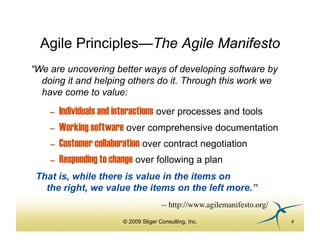
Agile Principles—The Agile Manifesto
–  Individuals and interactions over processes and tools
–  Working software over comprehensive documentation
–  Customer collaboration over contract negotiation
–  Responding to change over following a plan
That is, while there is value in the items on
the right, we value the items on the left more.”
“We are uncovering better ways of developing software by
doing it and helping others do it. Through this work we
have come to value:
-- http://www.agilemanifesto.org/
5© 2009 Sliger Consulting, Inc.
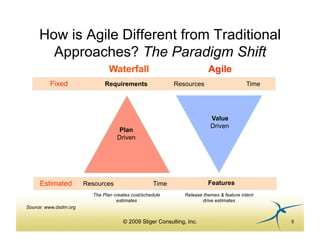
How is Agile Different from Traditional
Approaches? The Paradigm Shift
Fixed
Estimated
Requirements
TimeResources
Time
Features
Plan
Driven
Value
Driven
The Plan creates cost/schedule
estimates
Release themes & feature intent
drive estimates
Waterfall Agile
Resources
Source: www.dsdm.org
6© 2009 Sliger Consulting, Inc.
Agile Frameworks
•  Scrum (Ken Schwaber)
•  XP (Kent Beck)
•  Lean Software Development (Mary
Poppendieck)
•  Crystal (Alistair Cockburn)
•  Dynamic System Development
Method (Dane Faulkner)
•  Adaptive Software Development
(Jim Highsmith)
•  Feature Driven Development (Jeff
DeLuca)
7
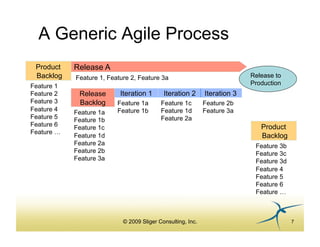
A Generic Agile Process
Release A
Feature 1, Feature 2, Feature 3a
Iteration 1 Iteration 2 Iteration 3
Feature 1a
Feature 1b
Feature 1c
Feature 1d
Feature 2a
Feature 2b
Feature 3a
Product
Backlog
Feature 1
Feature 2
Feature 3
Feature 4
Feature 5
Feature 6
Feature …
Release
Backlog
Feature 1a
Feature 1b
Feature 1c
Feature 1d
Feature 2a
Feature 2b
Feature 3a
© 2009 Sliger Consulting, Inc.
Product
Backlog
Feature 3b
Feature 3c
Feature 3d
Feature 4
Feature 5
Feature 6
Feature …
Release to
Production
8© 2009 Sliger Consulting, Inc.
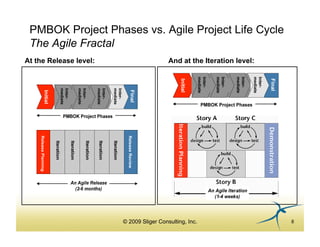
PMBOK Project Phases vs. Agile Project Life Cycle
The Agile Fractal
At the Release level: And at the Iteration level:
9© 2009 Sliger Consulting, Inc.
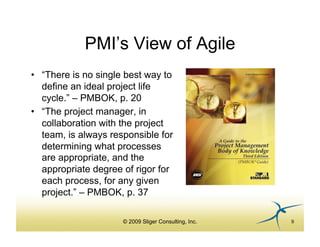
PMI’s View of Agile
•  “There is no single best way to
define an ideal project life
cycle.” – PMBOK, p. 20
•  “The project manager, in
collaboration with the project
team, is always responsible for
determining what processes
are appropriate, and the
appropriate degree of rigor for
each process, for any given
project.” – PMBOK, p. 37
10
PMI Agile Forum
•  SIGs now Virtual Community Programs
•  http://finance.groups.yahoo.com/group/
pmiagile/
•  http://agile-pm.pbworks.com/FrontPage
•  In the midst of a soft launch
•  Steering Committee: Jesse Fewell, David Prior,
Michele Sliger, Sellers Smith, George Schlitz,
Mike Griffiths, Ainsley Nies, Rodney Bodamer,
Katie Playfair, Patricia Reed
© 2009 Sliger Consulting, Inc.
11© 2009 Sliger Consulting, Inc.
Traditional vs. Agile Project Management
Traditional:
•  Plan what you expect to
happen
•  Enforce that what
happens is the same as
what is planned
–  Directive management
–  Control, control, control
•  Use change control to
manage change
–  Change Control Board
–  Defect Management
Agile:
Plan what you expect to
happen with detail
appropriate to the horizon
“Control” is through inspection
and adaptation
–  Reviews and Retrospectives
–  Self-Organizing Teams
Use Agile practices to manage
change:
–  Continuous feedback loops
–  Iterative and incremental
development
–  Prioritized backlogs
12© 2009 Sliger Consulting, Inc.
13© 2009 Sliger Consulting, Inc.
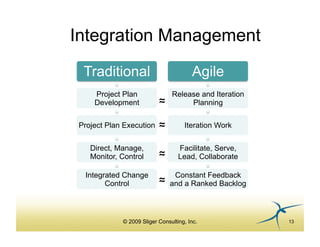
Integration Management
Traditional
Project Plan
Development
Project Plan Execution
Direct, Manage,
Monitor, Control
Integrated Change
Control
Agile
Release and Iteration
Planning
Iteration Work
Facilitate, Serve,
Lead, Collaborate
Constant Feedback
and a Ranked Backlog≈
≈
≈
≈
14© 2009 Sliger Consulting, Inc.
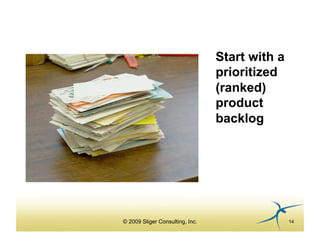
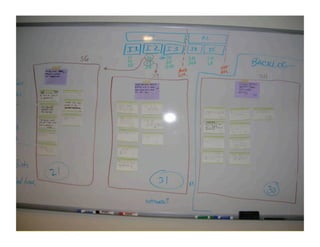
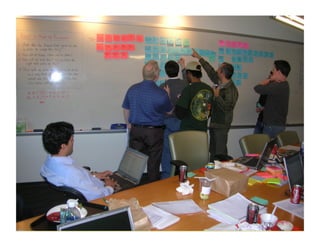
Start with a
prioritized
(ranked)
product
backlog
15
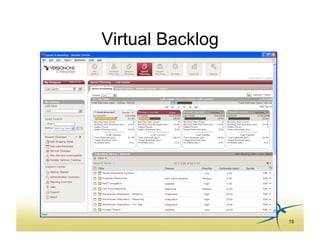
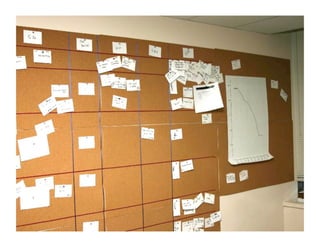
Virtual Backlog
16© 2009 Sliger Consulting, Inc.
17© 2009 Sliger Consulting, Inc.
18© 2009 Sliger Consulting, Inc.
19© 2009 Sliger Consulting, Inc.
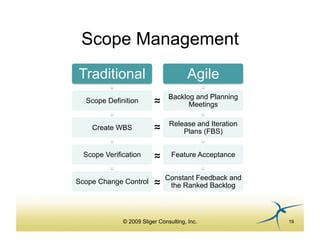
Scope Management
Traditional
Scope Definition
Create WBS
Scope Verification
Scope Change Control
Agile
Backlog and Planning
Meetings
Release and Iteration
Plans (FBS)
Feature Acceptance
Constant Feedback and
the Ranked Backlog≈
≈
≈
≈
20© 2009 Sliger Consulting, Inc.
21© 2009 Sliger Consulting, Inc.
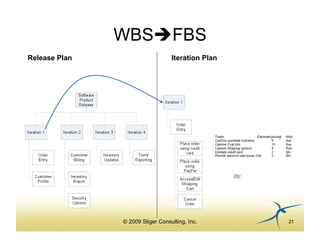
WBSFBS
Release Plan Iteration Plan
22© 2009 Sliger Consulting, Inc.
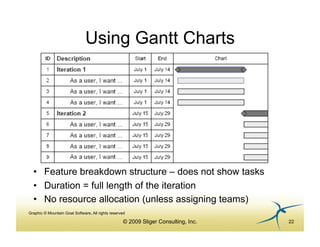
Using Gantt Charts
•  Feature breakdown structure – does not show tasks
•  Duration = full length of the iteration
•  No resource allocation (unless assigning teams)
Graphic © Mountain Goat Software, All rights reserved
23© 2009 Sliger Consulting, Inc.
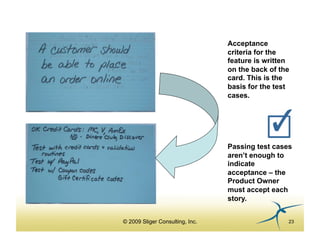
Acceptance
criteria for the
feature is written
on the back of the
card. This is the
basis for the test
cases.
Passing test cases
aren’t enough to
indicate
acceptance – the
Product Owner
must accept each
story.
24© 2009 Sliger Consulting, Inc.
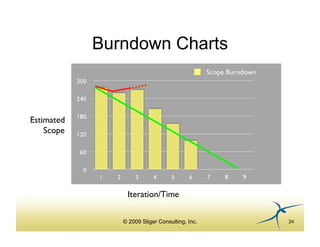
Burndown Charts
Iteration/Time
Estimated
Scope
25© 2009 Sliger Consulting, Inc.
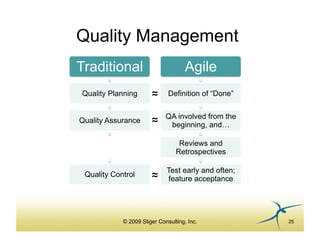
Quality Management
Traditional
Quality Planning
Quality Assurance
Quality Control
Agile
Definition of “Done”
QA involved from the
beginning, and…
Reviews and
Retrospectives
Test early and often;
feature acceptance≈
≈
≈
26
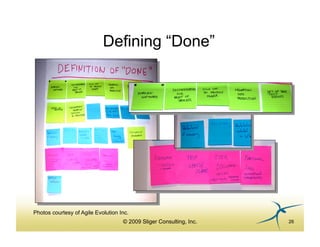
Defining “Done”
Photos courtesy of Agile Evolution Inc.
© 2009 Sliger Consulting, Inc.
27© 2009 Sliger Consulting, Inc.
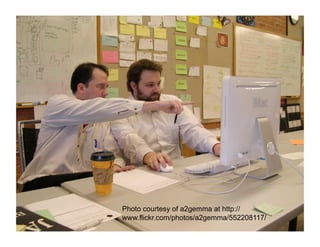
Photo courtesy of a2gemma at http://
www.flickr.com/photos/a2gemma/552208117/
28© 2009 Sliger Consulting, Inc.
29© 2009 Sliger Consulting, Inc.
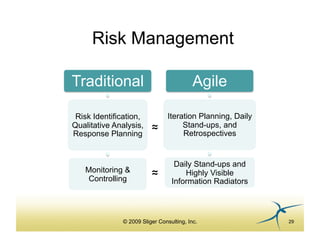
Risk Management
Traditional
Risk Identification,
Qualitative Analysis,
Response Planning
Monitoring 
Controlling
Agile
Iteration Planning, Daily
Stand-ups, and
Retrospectives
Daily Stand-ups and
Highly Visible
Information Radiators
≈
≈
30© 2009 Sliger Consulting, Inc.
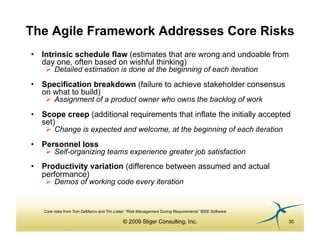
The Agile Framework Addresses Core Risks
•  Intrinsic schedule flaw (estimates that are wrong and undoable from
day one, often based on wishful thinking)
  Detailed estimation is done at the beginning of each iteration
•  Specification breakdown (failure to achieve stakeholder consensus
on what to build)
  Assignment of a product owner who owns the backlog of work
•  Scope creep (additional requirements that inflate the initially accepted
set)
  Change is expected and welcome, at the beginning of each iteration
•  Personnel loss
  Self-organizing teams experience greater job satisfaction
•  Productivity variation (difference between assumed and actual
performance)
  Demos of working code every iteration
Core risks from Tom DeMarco and Tim Lister: “Risk Management During Requirements” IEEE Software
31
Let’s Review
•  Project planning is broken out into multiple
levels of planning: we looked at quarterly/
release planning, iteration planning, and daily
planning
•  Facilitating and coaching a team helps them
to make the best decisions—and frees you to
focus on strategic and organizational issues
•  The ranked backlog, owned by the business,
is the primary means of change control
© 2009 Sliger Consulting, Inc.
32
Let’s Review
•  Scope is defined at a granularity that is
appropriate for the time horizon
•  Scope is verified by the acceptance of
each feature by the product owner
•  Work Breakdown Structures become
Feature Breakdown Structures
•  Gantt charts are not typically used; instead
burndown charts help us to track progress
© 2009 Sliger Consulting, Inc.
33
Let’s Review
•  Test-driven development and cross-
functional teams help to bring quality
assurance and planning activities up to the
beginning of the project, and continue
throughout the project
•  Bugs are found and fixed in the iteration;
features are then accepted by the product
owner
© 2009 Sliger Consulting, Inc.
34
Let’s Review
•  The very nature of the agile framework
allows core risks to be addressed by the
team throughout the project
•  Highly visible information radiators and
constant feedback cycles help teams to
identify and monitor potential risks, and
respond effectively once the risk event
occurs
© 2009 Sliger Consulting, Inc.
Your New Role as a
Servant Leader
36© 2009 Sliger Consulting, Inc.
Your Responsibilities
Safeguard the Process:
•  Facilitate meetings
•  Remove roadblocks
•  Protect the team from distractions
•  Help people communicate
•  Act as the team’s memory
–  Remind the team of the overall vision
–  Remind the team of the purpose of the process
–  Remind the team of decisions they agreed to
•  Be the voice of reality
–  Ask the team to explain things to you if it doesn’t look like what
they’re doing makes any sense
–  Keep velocity estimates in check
–  Bring the probability of unfinished features to their attention
–  Keep metrics
37© 2009 Sliger Consulting, Inc.
Your Responsibilities
Communications:
•  Mediate team disputes
•  Be the first rung in the escalation ladder
•  Negotiate with those outside the team
•  Provide highly visible information radiators
–  And formally report on progress
•  Manage external dependencies
•  Coordinate with others on releases
38© 2009 Sliger Consulting, Inc.
Your Responsibilities
Build a community:
•  Create a safe environment that fosters collaborative
decision-making and encourages experimentation
•  Maintain an environment that supports high productivity
•  Serve as a liaison and ambassador and advocate
•  Participate in organizational change
•  Share your experiences with others
39© 2009 Sliger Consulting, Inc.
You Do NOT…
•  Own the product backlog—the product owner
does
•  Own the estimates—the delivery team does
•  Make delivery decisions—you facilitate this
activity for the team, and instead make decisions
regarding project administration and strategic
and organizational issue resolution
•  Make product decisions—the customer or
product owner does, or his/her proxy
•  Have to have all the answers—ask the team!
© 2005 Rally SDC
Where to Find More Information
41
Upcoming Related Events
•  May 29 Agilepalooza in San Francisco, CA
http://www.agilepalooza.com/
•  June 8-12 Better Software Conference in
Las Vegas, NV
http://www.sqe.com/BetterSoftwareConf/
•  July 22-24 CSM for Professional Project
Managers in Boston, MA
Watch for it here:
http://www.scrumalliance.org/courses
•  August 23-28 Agile2009 Conference
http://www.agile2009.org
© 2009 Sliger Consulting, Inc.
42© 2009 Sliger Consulting, Inc.
Free Online Resources
•  www.agilealliance.org
•  www.apln.org
•  www.scrumalliance.org
•  www.sligerconsulting.com
•  http://finance.groups.yahoo.com/group/pmiagile/
•  http://groups.yahoo.com/group/scrumdevelopment/
•  http://finance.groups.yahoo.com/group/
agileprojectmanagement/
43© 2009 Sliger Consulting, Inc.
Additional Resources
•  “Stretching Agile to Fit CMMI Level 3,” an experience report by
David J. Anderson:
http://www.agilemanagement.net/Articles/Papers/
StretchingAgiletoFitCMMIL.html
Books:
•  The Software Project Manager’s Bridge to Agility by Michele Sliger
and Stacia Broderick
•  Lean Thinking by James P. Womack and Daniel T. Jones
•  Implementing Lean Software Development by Mary and Tom
Poppendieck
•  Agile Project Management with Scrum by Ken Schwaber
•  Scaling Software Agility by Dean Leffingwell
•  Behind Closed Doors by Esther Derby and Johanna Rothman
•  Collaboration Explained by Jean Tabaka
•  Agile Estimating and Planning and User Stories Applied by Mike
Cohn
Thank you!
michele@sligerconsulting.com
Visit www.sligerconsulting.com for more information on
this and other agile training and coaching offerings

Agile Project Management for PMP's

  • 1.
    Agile Project Management forPMPs Mapping from the PMBOK® Guide to Agile Practices Michele Sliger michele@sligerconsulting.com
  • 2.
    2© 2009 SligerConsulting, Inc. Michele Sliger Sliger Consulting, Inc. www.sligerconsulting.com  Over 20 years of software development experience, with the last 8 in Agile  Certified Scrum Trainer  BS-MIS, MBA, PMP  Co-author of The Software Project Manager’s Bridge to Agility, part of Addison-Wesley’s Agile Software Development series
  • 3.
    3© 2009 SligerConsulting, Inc. What we’ll cover…. •  Brief Overview of Agile •  Acceptance of Agile by the PMI •  Traditional vs. Agile •  Mapping to Agile Practices: –  Integration Project Management –  Scope Project Management –  Quality Project Management •  How Your Role Will Change •  Where to Find More Information
  • 4.
    4© 2009 SligerConsulting, Inc. Agile Principles—The Agile Manifesto –  Individuals and interactions over processes and tools –  Working software over comprehensive documentation –  Customer collaboration over contract negotiation –  Responding to change over following a plan That is, while there is value in the items on the right, we value the items on the left more.” “We are uncovering better ways of developing software by doing it and helping others do it. Through this work we have come to value: -- http://www.agilemanifesto.org/
  • 5.
    5© 2009 SligerConsulting, Inc. How is Agile Different from Traditional Approaches? The Paradigm Shift Fixed Estimated Requirements TimeResources Time Features Plan Driven Value Driven The Plan creates cost/schedule estimates Release themes & feature intent drive estimates Waterfall Agile Resources Source: www.dsdm.org
  • 6.
    6© 2009 SligerConsulting, Inc. Agile Frameworks •  Scrum (Ken Schwaber) •  XP (Kent Beck) •  Lean Software Development (Mary Poppendieck) •  Crystal (Alistair Cockburn) •  Dynamic System Development Method (Dane Faulkner) •  Adaptive Software Development (Jim Highsmith) •  Feature Driven Development (Jeff DeLuca)
  • 7.
    7 A Generic AgileProcess Release A Feature 1, Feature 2, Feature 3a Iteration 1 Iteration 2 Iteration 3 Feature 1a Feature 1b Feature 1c Feature 1d Feature 2a Feature 2b Feature 3a Product Backlog Feature 1 Feature 2 Feature 3 Feature 4 Feature 5 Feature 6 Feature … Release Backlog Feature 1a Feature 1b Feature 1c Feature 1d Feature 2a Feature 2b Feature 3a © 2009 Sliger Consulting, Inc. Product Backlog Feature 3b Feature 3c Feature 3d Feature 4 Feature 5 Feature 6 Feature … Release to Production
  • 8.
    8© 2009 SligerConsulting, Inc. PMBOK Project Phases vs. Agile Project Life Cycle The Agile Fractal At the Release level: And at the Iteration level:
  • 9.
    9© 2009 SligerConsulting, Inc. PMI’s View of Agile •  “There is no single best way to define an ideal project life cycle.” – PMBOK, p. 20 •  “The project manager, in collaboration with the project team, is always responsible for determining what processes are appropriate, and the appropriate degree of rigor for each process, for any given project.” – PMBOK, p. 37
  • 10.
    10 PMI Agile Forum • SIGs now Virtual Community Programs •  http://finance.groups.yahoo.com/group/ pmiagile/ •  http://agile-pm.pbworks.com/FrontPage •  In the midst of a soft launch •  Steering Committee: Jesse Fewell, David Prior, Michele Sliger, Sellers Smith, George Schlitz, Mike Griffiths, Ainsley Nies, Rodney Bodamer, Katie Playfair, Patricia Reed © 2009 Sliger Consulting, Inc.
  • 11.
    11© 2009 SligerConsulting, Inc. Traditional vs. Agile Project Management Traditional: •  Plan what you expect to happen •  Enforce that what happens is the same as what is planned –  Directive management –  Control, control, control •  Use change control to manage change –  Change Control Board –  Defect Management Agile: Plan what you expect to happen with detail appropriate to the horizon “Control” is through inspection and adaptation –  Reviews and Retrospectives –  Self-Organizing Teams Use Agile practices to manage change: –  Continuous feedback loops –  Iterative and incremental development –  Prioritized backlogs
  • 12.
    12© 2009 SligerConsulting, Inc.
  • 13.
    13© 2009 SligerConsulting, Inc. Integration Management Traditional Project Plan Development Project Plan Execution Direct, Manage, Monitor, Control Integrated Change Control Agile Release and Iteration Planning Iteration Work Facilitate, Serve, Lead, Collaborate Constant Feedback and a Ranked Backlog≈ ≈ ≈ ≈
  • 14.
    14© 2009 SligerConsulting, Inc. Start with a prioritized (ranked) product backlog
  • 15.
  • 16.
    16© 2009 SligerConsulting, Inc.
  • 17.
    17© 2009 SligerConsulting, Inc.
  • 18.
    18© 2009 SligerConsulting, Inc.
  • 19.
    19© 2009 SligerConsulting, Inc. Scope Management Traditional Scope Definition Create WBS Scope Verification Scope Change Control Agile Backlog and Planning Meetings Release and Iteration Plans (FBS) Feature Acceptance Constant Feedback and the Ranked Backlog≈ ≈ ≈ ≈
  • 20.
    20© 2009 SligerConsulting, Inc.
  • 21.
    21© 2009 SligerConsulting, Inc. WBSFBS Release Plan Iteration Plan
  • 22.
    22© 2009 SligerConsulting, Inc. Using Gantt Charts •  Feature breakdown structure – does not show tasks •  Duration = full length of the iteration •  No resource allocation (unless assigning teams) Graphic © Mountain Goat Software, All rights reserved
  • 23.
    23© 2009 SligerConsulting, Inc. Acceptance criteria for the feature is written on the back of the card. This is the basis for the test cases. Passing test cases aren’t enough to indicate acceptance – the Product Owner must accept each story.
  • 24.
    24© 2009 SligerConsulting, Inc. Burndown Charts Iteration/Time Estimated Scope
  • 25.
    25© 2009 SligerConsulting, Inc. Quality Management Traditional Quality Planning Quality Assurance Quality Control Agile Definition of “Done” QA involved from the beginning, and… Reviews and Retrospectives Test early and often; feature acceptance≈ ≈ ≈
  • 26.
    26 Defining “Done” Photos courtesyof Agile Evolution Inc. © 2009 Sliger Consulting, Inc.
  • 27.
    27© 2009 SligerConsulting, Inc. Photo courtesy of a2gemma at http:// www.flickr.com/photos/a2gemma/552208117/
  • 28.
    28© 2009 SligerConsulting, Inc.
  • 29.
    29© 2009 SligerConsulting, Inc. Risk Management Traditional Risk Identification, Qualitative Analysis, Response Planning Monitoring Controlling Agile Iteration Planning, Daily Stand-ups, and Retrospectives Daily Stand-ups and Highly Visible Information Radiators ≈ ≈
  • 30.
    30© 2009 SligerConsulting, Inc. The Agile Framework Addresses Core Risks •  Intrinsic schedule flaw (estimates that are wrong and undoable from day one, often based on wishful thinking)   Detailed estimation is done at the beginning of each iteration •  Specification breakdown (failure to achieve stakeholder consensus on what to build)   Assignment of a product owner who owns the backlog of work •  Scope creep (additional requirements that inflate the initially accepted set)   Change is expected and welcome, at the beginning of each iteration •  Personnel loss   Self-organizing teams experience greater job satisfaction •  Productivity variation (difference between assumed and actual performance)   Demos of working code every iteration Core risks from Tom DeMarco and Tim Lister: “Risk Management During Requirements” IEEE Software
  • 31.
    31 Let’s Review •  Projectplanning is broken out into multiple levels of planning: we looked at quarterly/ release planning, iteration planning, and daily planning •  Facilitating and coaching a team helps them to make the best decisions—and frees you to focus on strategic and organizational issues •  The ranked backlog, owned by the business, is the primary means of change control © 2009 Sliger Consulting, Inc.
  • 32.
    32 Let’s Review •  Scopeis defined at a granularity that is appropriate for the time horizon •  Scope is verified by the acceptance of each feature by the product owner •  Work Breakdown Structures become Feature Breakdown Structures •  Gantt charts are not typically used; instead burndown charts help us to track progress © 2009 Sliger Consulting, Inc.
  • 33.
    33 Let’s Review •  Test-drivendevelopment and cross- functional teams help to bring quality assurance and planning activities up to the beginning of the project, and continue throughout the project •  Bugs are found and fixed in the iteration; features are then accepted by the product owner © 2009 Sliger Consulting, Inc.
  • 34.
    34 Let’s Review •  Thevery nature of the agile framework allows core risks to be addressed by the team throughout the project •  Highly visible information radiators and constant feedback cycles help teams to identify and monitor potential risks, and respond effectively once the risk event occurs © 2009 Sliger Consulting, Inc.
  • 35.
    Your New Roleas a Servant Leader
  • 36.
    36© 2009 SligerConsulting, Inc. Your Responsibilities Safeguard the Process: •  Facilitate meetings •  Remove roadblocks •  Protect the team from distractions •  Help people communicate •  Act as the team’s memory –  Remind the team of the overall vision –  Remind the team of the purpose of the process –  Remind the team of decisions they agreed to •  Be the voice of reality –  Ask the team to explain things to you if it doesn’t look like what they’re doing makes any sense –  Keep velocity estimates in check –  Bring the probability of unfinished features to their attention –  Keep metrics
  • 37.
    37© 2009 SligerConsulting, Inc. Your Responsibilities Communications: •  Mediate team disputes •  Be the first rung in the escalation ladder •  Negotiate with those outside the team •  Provide highly visible information radiators –  And formally report on progress •  Manage external dependencies •  Coordinate with others on releases
  • 38.
    38© 2009 SligerConsulting, Inc. Your Responsibilities Build a community: •  Create a safe environment that fosters collaborative decision-making and encourages experimentation •  Maintain an environment that supports high productivity •  Serve as a liaison and ambassador and advocate •  Participate in organizational change •  Share your experiences with others
  • 39.
    39© 2009 SligerConsulting, Inc. You Do NOT… •  Own the product backlog—the product owner does •  Own the estimates—the delivery team does •  Make delivery decisions—you facilitate this activity for the team, and instead make decisions regarding project administration and strategic and organizational issue resolution •  Make product decisions—the customer or product owner does, or his/her proxy •  Have to have all the answers—ask the team!
  • 40.
    © 2005 RallySDC Where to Find More Information
  • 41.
    41 Upcoming Related Events • May 29 Agilepalooza in San Francisco, CA http://www.agilepalooza.com/ •  June 8-12 Better Software Conference in Las Vegas, NV http://www.sqe.com/BetterSoftwareConf/ •  July 22-24 CSM for Professional Project Managers in Boston, MA Watch for it here: http://www.scrumalliance.org/courses •  August 23-28 Agile2009 Conference http://www.agile2009.org © 2009 Sliger Consulting, Inc.
  • 42.
    42© 2009 SligerConsulting, Inc. Free Online Resources •  www.agilealliance.org •  www.apln.org •  www.scrumalliance.org •  www.sligerconsulting.com •  http://finance.groups.yahoo.com/group/pmiagile/ •  http://groups.yahoo.com/group/scrumdevelopment/ •  http://finance.groups.yahoo.com/group/ agileprojectmanagement/
  • 43.
    43© 2009 SligerConsulting, Inc. Additional Resources •  “Stretching Agile to Fit CMMI Level 3,” an experience report by David J. Anderson: http://www.agilemanagement.net/Articles/Papers/ StretchingAgiletoFitCMMIL.html Books: •  The Software Project Manager’s Bridge to Agility by Michele Sliger and Stacia Broderick •  Lean Thinking by James P. Womack and Daniel T. Jones •  Implementing Lean Software Development by Mary and Tom Poppendieck •  Agile Project Management with Scrum by Ken Schwaber •  Scaling Software Agility by Dean Leffingwell •  Behind Closed Doors by Esther Derby and Johanna Rothman •  Collaboration Explained by Jean Tabaka •  Agile Estimating and Planning and User Stories Applied by Mike Cohn
  • 44.
    Thank you! michele@sligerconsulting.com Visit www.sligerconsulting.comfor more information on this and other agile training and coaching offerings