Charles Popelka & Mark Nelson GSA & Mercator Group Improving Enterprise Performance Using a Business Process Improvement Discipline
Agenda Background Charter Project Management Team Strategy – Value Chain – Process - Workflow Common Process Improvement Teams Success Factors Lean Production – Six Sigma Techniques – Analysis and Quantifying Results BPMN Overview Outcomes of a Good Process Design Lessons Learned To-Date Next Steps
Background Presenters: Chuck Popelka: Office of Strategic Planning and Process  Improvement–FAS [email_address] Mark Nelson: Contractor – The Mercator Group [email_address] Federal Acquisition Service (FAS): GSA Federal Acquisition Service (FAS) provides federal customers with the products, services, and programs to meet their supply, service, procurement, vehicle purchasing and leasing, travel and transportation, and personal property management requirements
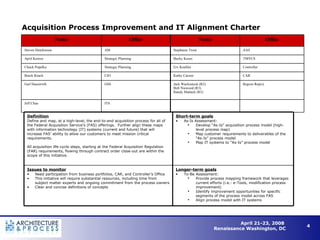
Acquisition Process Improvement and IT Alignment Charter ITS Jeff Chao Region Rep(s). Jack Wachsstock (R2) Bob Niewood (R3) Randy Matlack (R3) GSS Gail Hauswirth CAR Kathy Carson CIO Butch Roach Controller Erv Koehler Strategic Planning Chuck Popelka TMVCS Becky Koses Strategic Planning April Kestyn AAS Stephanie Trout AM Steven Hutchinson Office Name Office Name Longer-term goals To-Be Assessment: Provide process mapping framework that leverages current efforts (i.e.: e-Tools, modification process improvement)  Identify improvement opportunities for specific segments of the process model across FAS Align process model with IT systems Short-term goals As-Is Assessment: Develop “As-Is” acquisition process model (high-level process map) Map customer requirements to deliverables of the “As-Is” process model Map IT systems to “As-Is” process model Issues to monitor Need participation from business portfolios, CAR, and Controller’s Office This initiative will require substantial resources, including time from subject matter experts and ongoing commitment from the process owners Clear and concise definitions of concepts Definition Define and map, at a high-level, the end-to-end acquisition process for all of the Federal Acquisition Service’s (FAS) offerings.  Further align these maps with information technology (IT) systems (current and future) that will increase FAS’ ability to allow our customers to meet mission critical requirements. All acquisition life-cycle steps, starting at the Federal Acquisition Regulation (FAR) requirements, flowing through contract order close-out are within the scope of this initiative.
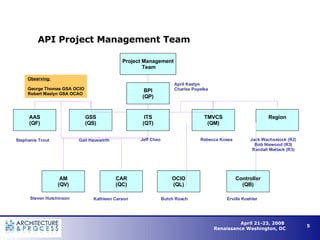
API Project Management Team   Project Management Team GSS (QS) AAS (QF) TMVCS (QM) OCIO (QL) CAR (QC) Controller (QB) BPI (QP) Region AM (QV) April Kestyn Charles Popelka Rebecca Koses Jack Wachsstock (R2) Bob Niewood (R3) Randall Matlack (R3) Jeff Chao Erville Koehler Kathleen Carson Butch Roach Stephanie Trout Gail Hauswirth Steven Hutchinson Observing: George Thomas GSA OCIO Robert Maslyn GSA OCAO ITS (QT)
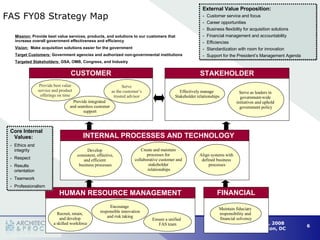
Mission:  Provide best value services, products, and solutions to our customers that increase overall government effectiveness and efficiency Vision:   Make acquisition solutions easier for the government Target Customers:  Government agencies and authorized non-governmental institutions Targeted Stakeholders:  GSA, OMB, Congress, and Industry FAS FY08 Strategy Map Align systems with  defined business  processes Create and maintain  processes for  collaborative customer and  stakeholder  relationships INTERNAL PROCESSES AND TECHNOLOGY CUSTOMER Provide integrated  and seamless customer support STAKEHOLDER HUMAN RESOURCE MANAGEMENT Recruit, retain,  and develop  a skilled   workforce Encourage  responsible innovation and risk taking FINANCIAL Serve  as the customer’s  trusted advisor  Maintain fiduciary  responsibility and  financial solvency Develop  consistent, effective,  and efficient  business processes  Ensure a unified  FAS team Core Internal Values: Ethics and integrity Respect Results orientation Teamwork Professionalism External Value Proposition: Customer service and focus Career opportunities Business flexibility for acquisition solutions Financial management and accountability Efficiencies Standardization with room for innovation Support for the President’s Management Agenda Serve as leaders in  government-wide  initiatives and uphold  government policy Effectively manage  Stakeholder relationships Provide best value  service and product  offerings on time
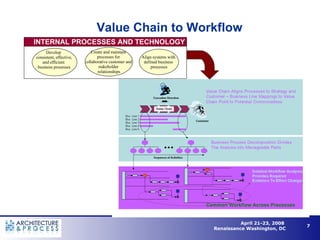
Value Chain to Workflow Align systems with  defined business  processes Create and maintain  processes for  collaborative customer and  stakeholder  relationships INTERNAL PROCESSES AND TECHNOLOGY Develop  consistent, effective,  and efficient  business processes
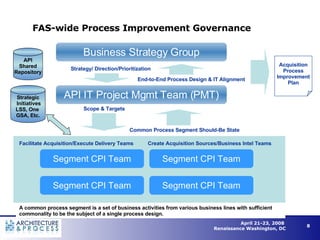
FAS-wide Process Improvement Governance Business Strategy Group API IT Project Mgmt Team (PMT) Segment CPI Team Segment CPI Team Segment CPI Team Segment CPI Team Strategy/ Direction/Prioritization End-to-End Process Design & IT Alignment Scope & Targets Common Process Segment Should-Be State Acquisition Process Improvement Plan API Shared Repository Facilitate Acquisition/Execute Delivery Teams  Create Acquisition Sources/Business Intel Teams A common process segment is a set of business activities from various business lines with sufficient commonality to be the subject of a single process design. Strategic Initiatives LSS, One  GSA, Etc.
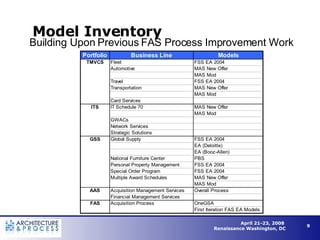
Model Inventory Building Upon Previous FAS Process Improvement Work
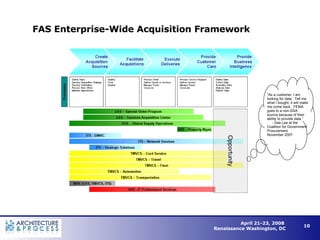
FAS Enterprise-Wide Acquisition Framework   “ As a customer, I am looking for data.  Tell me what I bought; it will make me come back.  FEMA goes to a non-GSA source because of their ability to provide data.” - Dee Lee at the Coalition for Government Procurement,  November 2007
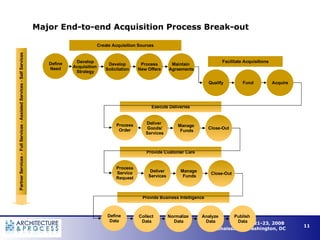
Major End-to-end Acquisition Process Break-out Create Acquisition Sources Define Need Develop Acquisition  Strategy Develop Solicitation Process New Offers Maintain  Agreements Facilitate Acquisitions Qualify Fund Acquire Execute Deliveries Process Order Deliver  Goods/ Services Manage  Funds Close-Out Provide Customer Care Process Service Request Deliver Services Manage  Funds Close-Out Provide Business Intelligence Define Data Collect  Data Normalize  Data Analyze  Data Publish  Data Partner Services -  Full Services - Assisted Services - Self Services
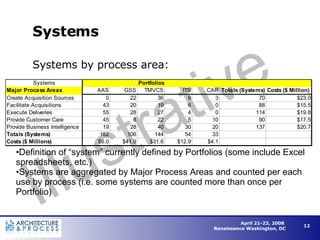
Systems Systems by process area: Illustrative Definition of “system” currently defined by Portfolios (some include Excel spreadsheets, etc.) Systems are aggregated by Major Process Areas and counted per each use by process (i.e. some systems are counted more than once per Portfolio)
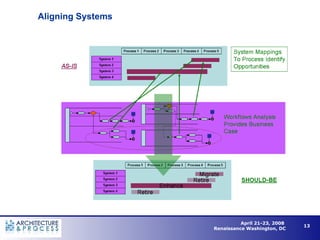
Aligning Systems
Common Process Team Kathy Jocoy Auburn, WA Nathan Stewart Kansas City, MO Chris Popp Donna Peck Fort Worth, TX Bob Niewood Randall Matlack Philadelphia, PA David Griffin San Diego, CA Team members from  each business line Crystal City, VA Willow Wood, VA Nationwide and FAS-wide Participation with 24 Members
People Building a shared vision for difficult change Representation and collaboration from each Portfolio and many regions is working towards the new FAS culture: A FAS common vocabulary is developing and a “glossary” of acronyms and common verbiage is being assembled Team members are considering the improvement process from an enterprise level and sharing their solutions aiding in the continuing effort at creating “One FAS” Solutions to several gaps currently exist in processes or systems within other Portfolios and Regions and these are being uncovered and benchmarked for reuse and promulgation Systems demonstrations are being scheduled to expose current IT solutions
Success Factors  – “How is our approach Different?” Ties FAS to executive level mandate with quantifiable targets: Clear and hard to ignore need for change Clear customer-focus in mandate Targeted Analysis (need to prioritize optimization targets): Focus on improvement target Focus on critical path items – pain points Integrated Approach: Addressing people, process, knowledge and technology as an integrated whole Utilizes new Industry-Standard Business Process Modeling Notation (BPMN) Small integrated common process teams with Region participation Executive direction and participation at key project points “ Fact-Based” for truer analysis: Lean-Six analysis techniques Informed by leading practices Quantifiable business drivers Risk-Reward Analysis  Application Rationalization Alignment of business strategy-process to technology  Simulation – Improved Visualization Accelerates Knowledge Capture and Validation
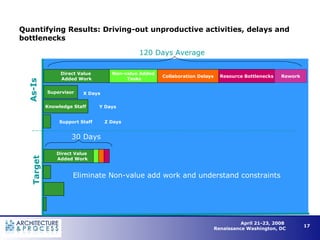
Quantifying Results: Driving-out unproductive activities, delays and bottlenecks As-Is Target Direct Value  Added Work Non-value Added Tasks Collaboration Delays Resource Bottlenecks 120 Days Average Supervisor Knowledge Staff X Days Y Days Z Days Direct Value  Added Work 30 Days Rework Support Staff Eliminate Non-value add work and understand constraints
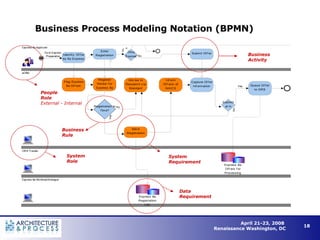
Business Process Modeling Notation (BPMN) System  Role System  Requirement Data Requirement People Role External - Internal Business Rule Business Activity
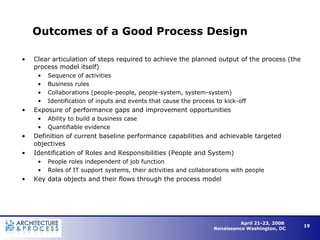
Outcomes of a Good Process Design Clear articulation of steps required to achieve the planned output of the process (the process model itself) Sequence of activities Business rules Collaborations (people-people, people-system, system-system) Identification of inputs and events that cause the process to kick-off Exposure of performance gaps and improvement opportunities Ability to build a business case Quantifiable evidence Definition of current baseline performance capabilities and achievable targeted objectives Identification of Roles and Responsibilities (People and System) People roles independent of job function Roles of IT support systems, their activities and collaborations with people Key data objects and their flows through the process model
Lessons Learned – To Date In some ways shooting for major transformation can be easier than pursuing incremental improvement; providing there is strong executive sponsorship Having the process metrics to support change is critical Definite “fear of technology” in FAS – need to collapse SDLC timeframes and achieve quick results Web conferencing worked well as a substitute to flying people in for face-to-face time BPMN proved to be a “natural language” for communicating with the stakeholders, and is the key linchpin between business requirements and technology enablement Business process analysis also exposed weaknesses in the overall way business is performed Use a tool – we used Proforma Provision Have a methodology (Mercator Group Workbook Approach) Break-down the stove-pipes with common process teams
Next Steps Project Management Team / Common Process Improvement Team Complete As-Is Analysis for Task Orders and Commodity purchases (Feb ’08) Conduct Gap Analysis and Create To-Be Deliverable (Mar ’08) Conduct Phase II (Create Acquisition Sources and Business Intelligence) (Jul ’08) Project Management Team recommends either implementation, business case development, or further analysis (Jul ’08) Complete IT Alignment Report (Aug ’08) Begin Task Order process system consolidation with improvements Integration of eConnect with the improved Task Order Management System Evaluate costs/benefits/risks of outsourcing SIP upload function
 
 
Thank  You! Chuck Popelka & Mark Nelson GSA & Mercator Group Contact Information: 703-605-2637 [email_address]

Improving Enterprise Performance using a Business Process Improvement Discipline

  • 1.
    Charles Popelka &Mark Nelson GSA & Mercator Group Improving Enterprise Performance Using a Business Process Improvement Discipline
  • 2.
    Agenda Background CharterProject Management Team Strategy – Value Chain – Process - Workflow Common Process Improvement Teams Success Factors Lean Production – Six Sigma Techniques – Analysis and Quantifying Results BPMN Overview Outcomes of a Good Process Design Lessons Learned To-Date Next Steps
  • 3.
    Background Presenters: ChuckPopelka: Office of Strategic Planning and Process Improvement–FAS [email_address] Mark Nelson: Contractor – The Mercator Group [email_address] Federal Acquisition Service (FAS): GSA Federal Acquisition Service (FAS) provides federal customers with the products, services, and programs to meet their supply, service, procurement, vehicle purchasing and leasing, travel and transportation, and personal property management requirements
  • 4.
    Acquisition Process Improvementand IT Alignment Charter ITS Jeff Chao Region Rep(s). Jack Wachsstock (R2) Bob Niewood (R3) Randy Matlack (R3) GSS Gail Hauswirth CAR Kathy Carson CIO Butch Roach Controller Erv Koehler Strategic Planning Chuck Popelka TMVCS Becky Koses Strategic Planning April Kestyn AAS Stephanie Trout AM Steven Hutchinson Office Name Office Name Longer-term goals To-Be Assessment: Provide process mapping framework that leverages current efforts (i.e.: e-Tools, modification process improvement) Identify improvement opportunities for specific segments of the process model across FAS Align process model with IT systems Short-term goals As-Is Assessment: Develop “As-Is” acquisition process model (high-level process map) Map customer requirements to deliverables of the “As-Is” process model Map IT systems to “As-Is” process model Issues to monitor Need participation from business portfolios, CAR, and Controller’s Office This initiative will require substantial resources, including time from subject matter experts and ongoing commitment from the process owners Clear and concise definitions of concepts Definition Define and map, at a high-level, the end-to-end acquisition process for all of the Federal Acquisition Service’s (FAS) offerings. Further align these maps with information technology (IT) systems (current and future) that will increase FAS’ ability to allow our customers to meet mission critical requirements. All acquisition life-cycle steps, starting at the Federal Acquisition Regulation (FAR) requirements, flowing through contract order close-out are within the scope of this initiative.
  • 5.
    API Project ManagementTeam Project Management Team GSS (QS) AAS (QF) TMVCS (QM) OCIO (QL) CAR (QC) Controller (QB) BPI (QP) Region AM (QV) April Kestyn Charles Popelka Rebecca Koses Jack Wachsstock (R2) Bob Niewood (R3) Randall Matlack (R3) Jeff Chao Erville Koehler Kathleen Carson Butch Roach Stephanie Trout Gail Hauswirth Steven Hutchinson Observing: George Thomas GSA OCIO Robert Maslyn GSA OCAO ITS (QT)
  • 6.
    Mission: Providebest value services, products, and solutions to our customers that increase overall government effectiveness and efficiency Vision: Make acquisition solutions easier for the government Target Customers: Government agencies and authorized non-governmental institutions Targeted Stakeholders: GSA, OMB, Congress, and Industry FAS FY08 Strategy Map Align systems with defined business processes Create and maintain processes for collaborative customer and stakeholder relationships INTERNAL PROCESSES AND TECHNOLOGY CUSTOMER Provide integrated and seamless customer support STAKEHOLDER HUMAN RESOURCE MANAGEMENT Recruit, retain, and develop a skilled workforce Encourage responsible innovation and risk taking FINANCIAL Serve as the customer’s trusted advisor Maintain fiduciary responsibility and financial solvency Develop consistent, effective, and efficient business processes Ensure a unified FAS team Core Internal Values: Ethics and integrity Respect Results orientation Teamwork Professionalism External Value Proposition: Customer service and focus Career opportunities Business flexibility for acquisition solutions Financial management and accountability Efficiencies Standardization with room for innovation Support for the President’s Management Agenda Serve as leaders in government-wide initiatives and uphold government policy Effectively manage Stakeholder relationships Provide best value service and product offerings on time
  • 7.
    Value Chain toWorkflow Align systems with defined business processes Create and maintain processes for collaborative customer and stakeholder relationships INTERNAL PROCESSES AND TECHNOLOGY Develop consistent, effective, and efficient business processes
  • 8.
    FAS-wide Process ImprovementGovernance Business Strategy Group API IT Project Mgmt Team (PMT) Segment CPI Team Segment CPI Team Segment CPI Team Segment CPI Team Strategy/ Direction/Prioritization End-to-End Process Design & IT Alignment Scope & Targets Common Process Segment Should-Be State Acquisition Process Improvement Plan API Shared Repository Facilitate Acquisition/Execute Delivery Teams Create Acquisition Sources/Business Intel Teams A common process segment is a set of business activities from various business lines with sufficient commonality to be the subject of a single process design. Strategic Initiatives LSS, One GSA, Etc.
  • 9.
    Model Inventory BuildingUpon Previous FAS Process Improvement Work
  • 10.
    FAS Enterprise-Wide AcquisitionFramework “ As a customer, I am looking for data. Tell me what I bought; it will make me come back. FEMA goes to a non-GSA source because of their ability to provide data.” - Dee Lee at the Coalition for Government Procurement, November 2007
  • 11.
    Major End-to-end AcquisitionProcess Break-out Create Acquisition Sources Define Need Develop Acquisition Strategy Develop Solicitation Process New Offers Maintain Agreements Facilitate Acquisitions Qualify Fund Acquire Execute Deliveries Process Order Deliver Goods/ Services Manage Funds Close-Out Provide Customer Care Process Service Request Deliver Services Manage Funds Close-Out Provide Business Intelligence Define Data Collect Data Normalize Data Analyze Data Publish Data Partner Services - Full Services - Assisted Services - Self Services
  • 12.
    Systems Systems byprocess area: Illustrative Definition of “system” currently defined by Portfolios (some include Excel spreadsheets, etc.) Systems are aggregated by Major Process Areas and counted per each use by process (i.e. some systems are counted more than once per Portfolio)
  • 13.
  • 14.
    Common Process TeamKathy Jocoy Auburn, WA Nathan Stewart Kansas City, MO Chris Popp Donna Peck Fort Worth, TX Bob Niewood Randall Matlack Philadelphia, PA David Griffin San Diego, CA Team members from each business line Crystal City, VA Willow Wood, VA Nationwide and FAS-wide Participation with 24 Members
  • 15.
    People Building ashared vision for difficult change Representation and collaboration from each Portfolio and many regions is working towards the new FAS culture: A FAS common vocabulary is developing and a “glossary” of acronyms and common verbiage is being assembled Team members are considering the improvement process from an enterprise level and sharing their solutions aiding in the continuing effort at creating “One FAS” Solutions to several gaps currently exist in processes or systems within other Portfolios and Regions and these are being uncovered and benchmarked for reuse and promulgation Systems demonstrations are being scheduled to expose current IT solutions
  • 16.
    Success Factors – “How is our approach Different?” Ties FAS to executive level mandate with quantifiable targets: Clear and hard to ignore need for change Clear customer-focus in mandate Targeted Analysis (need to prioritize optimization targets): Focus on improvement target Focus on critical path items – pain points Integrated Approach: Addressing people, process, knowledge and technology as an integrated whole Utilizes new Industry-Standard Business Process Modeling Notation (BPMN) Small integrated common process teams with Region participation Executive direction and participation at key project points “ Fact-Based” for truer analysis: Lean-Six analysis techniques Informed by leading practices Quantifiable business drivers Risk-Reward Analysis Application Rationalization Alignment of business strategy-process to technology Simulation – Improved Visualization Accelerates Knowledge Capture and Validation
  • 17.
    Quantifying Results: Driving-outunproductive activities, delays and bottlenecks As-Is Target Direct Value Added Work Non-value Added Tasks Collaboration Delays Resource Bottlenecks 120 Days Average Supervisor Knowledge Staff X Days Y Days Z Days Direct Value Added Work 30 Days Rework Support Staff Eliminate Non-value add work and understand constraints
  • 18.
    Business Process ModelingNotation (BPMN) System Role System Requirement Data Requirement People Role External - Internal Business Rule Business Activity
  • 19.
    Outcomes of aGood Process Design Clear articulation of steps required to achieve the planned output of the process (the process model itself) Sequence of activities Business rules Collaborations (people-people, people-system, system-system) Identification of inputs and events that cause the process to kick-off Exposure of performance gaps and improvement opportunities Ability to build a business case Quantifiable evidence Definition of current baseline performance capabilities and achievable targeted objectives Identification of Roles and Responsibilities (People and System) People roles independent of job function Roles of IT support systems, their activities and collaborations with people Key data objects and their flows through the process model
  • 20.
    Lessons Learned –To Date In some ways shooting for major transformation can be easier than pursuing incremental improvement; providing there is strong executive sponsorship Having the process metrics to support change is critical Definite “fear of technology” in FAS – need to collapse SDLC timeframes and achieve quick results Web conferencing worked well as a substitute to flying people in for face-to-face time BPMN proved to be a “natural language” for communicating with the stakeholders, and is the key linchpin between business requirements and technology enablement Business process analysis also exposed weaknesses in the overall way business is performed Use a tool – we used Proforma Provision Have a methodology (Mercator Group Workbook Approach) Break-down the stove-pipes with common process teams
  • 21.
    Next Steps ProjectManagement Team / Common Process Improvement Team Complete As-Is Analysis for Task Orders and Commodity purchases (Feb ’08) Conduct Gap Analysis and Create To-Be Deliverable (Mar ’08) Conduct Phase II (Create Acquisition Sources and Business Intelligence) (Jul ’08) Project Management Team recommends either implementation, business case development, or further analysis (Jul ’08) Complete IT Alignment Report (Aug ’08) Begin Task Order process system consolidation with improvements Integration of eConnect with the improved Task Order Management System Evaluate costs/benefits/risks of outsourcing SIP upload function
  • 22.
  • 23.
  • 24.
    Thank You!Chuck Popelka & Mark Nelson GSA & Mercator Group Contact Information: 703-605-2637 [email_address]