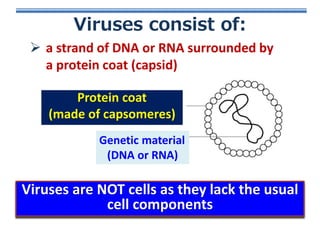
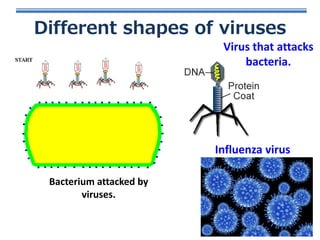
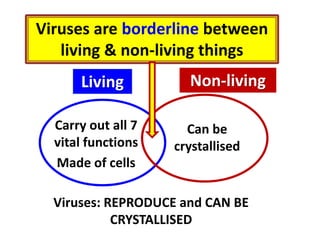
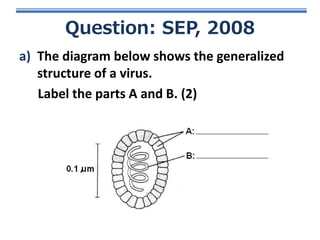
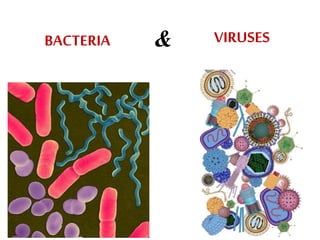
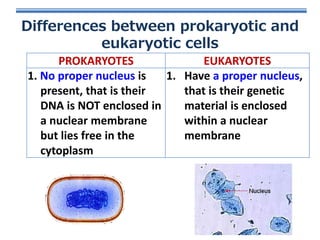
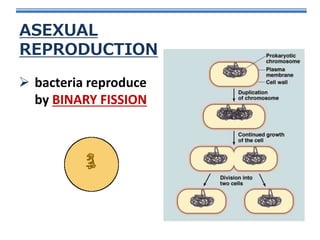
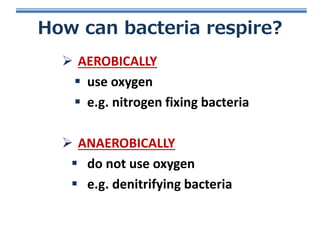
Bacteria and viruses are among the smallest organisms. Bacteria are classified as prokaryotes and have different shapes. They lack membrane-bound organelles and a nucleus. Bacteria reproduce through binary fission and can form spores. They are useful in food production and decay of organic matter but some cause diseases. Viruses are not living cells and are much smaller than bacteria. They contain genetic material surrounded by a protein coat and reproduce by infecting host cells.


![Structure of a bacterium
[learn to draw]
Slime capsule
Cell wall
Cell membrane
Chromosome /DNA
Food store/glycogen
granule
Cytoplasm
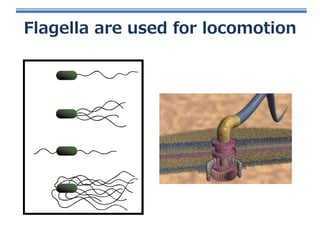
Flagella](https://image.slidesharecdn.com/bacteriaviruses-140308030849-phpapp02/85/Bacteria-viruses-6-320.jpg)


![SPORE FORMATION
bacteria produce a thick
protective wall around them in
adverse conditions e.g.
heat
drought
presence of poisons
they are now known as SPORES: can
survive for many years [anthrax spores,
1,300 years old can cause disease]
the wall breaks when favourable
conditions return](https://image.slidesharecdn.com/bacteriaviruses-140308030849-phpapp02/85/Bacteria-viruses-10-320.jpg)










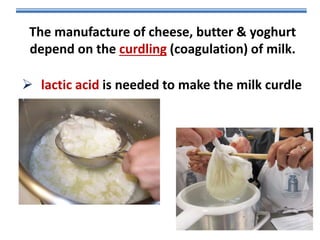
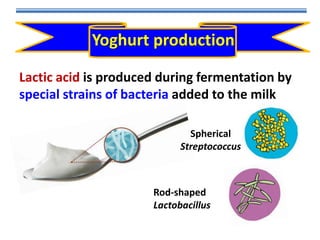
![7) Cheese, butter & yoghurt
making all require:
lactic
acid
bacteria
Bacteria convert
LACTOSE
[sugar in milk]
LACTIC ACID](https://image.slidesharecdn.com/bacteriaviruses-140308030849-phpapp02/85/Bacteria-viruses-35-320.jpg)



![Moulds in
press
[seen better in this
picture]](https://image.slidesharecdn.com/bacteriaviruses-140308030849-phpapp02/85/Bacteria-viruses-42-320.jpg)






![Question: [MAY, 2010]
Give a biological explanation for each of the
following statements:
In cheese making when the enzyme rennin is
added to milk, the temperature of the curding
(clotting) milk is kept in the region of 40C. (3)
Enzymes must be kept at their optimum
temperature to work fast.
Increasing the temperature above the optimum
denatures the enzyme and the reaction slows
down or even stops.](https://image.slidesharecdn.com/bacteriaviruses-140308030849-phpapp02/85/Bacteria-viruses-55-320.jpg)
![Question: [SEP, 2009]
A group of biology students investigated a type
of yoghurt. Some yoghurt samples were taken.
The pH of yoghurt samples was tested. Would
you expect the pH to be acidic, neutral or
alkaline? Give a reason for your answer. (3)
Acidic.
Bacteria change the sugar in milk called lactose
into lactic acid.](https://image.slidesharecdn.com/bacteriaviruses-140308030849-phpapp02/85/Bacteria-viruses-56-320.jpg)
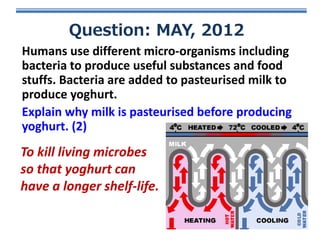
![Question: [MAY, 2010]
Give a biological explanation for the following
statement:
Bacteria are involved in making yoghurt. (5)
Certain types of bacteria are needed to make
yoghurt.
Bacteria change lactose into lactic acid by
fermentation.
The lactic acid makes the milk curdle.
Flavour , colouring & fruit may be added.](https://image.slidesharecdn.com/bacteriaviruses-140308030849-phpapp02/85/Bacteria-viruses-57-320.jpg)



![FOOD PRESERVATION
[this section acts as background knowledge
about bacteria].
1) COLD TREATMENT
freezing does not kill
microbes, but stops
them multiplying and
slows their action](https://image.slidesharecdn.com/bacteriaviruses-140308030849-phpapp02/85/Bacteria-viruses-63-320.jpg)