microorganisms

Bacteria, Fungi, and Virus
MICROORGANIS
     MS
Questions for Lesson About Bacteria
1. What is a bacterium?
2. What are the different types of bacteria?
3. How does bacterial cell differ from plant
   and animal cell?
4. What are the three kinds of bacteria
   according to the mode of respiration?
   Give an example of each kind.
5. How do autotrophic bacteria make food?
6. Where do bacteria use their endospore?
7. What are the three roles of bacteria?
Questions for Lesson About Fungi
1. How do fungi differ from plants?
2. What is the main component of a fungus
   cell wall?
3. Give examples of fungi.
4. What is the spore-producing structure of
   a fungus?
5. Write the chemical equation for alcoholic
   fermentation.
6. What kind of asexual reproduction is
   performed by unicellular fungi?
7. What are the three roles of fungi?
Kingdom Eubacteria (True Bacteria)
  Bacteria are located everywhere - air, water, land, and
            living organisms including people.
General Characteristics:
  1. All are unicellular (one-celled structural level)

  2. All are prokaryotic – cells that lack nucleus (no
     nuclear envelope) (PRO = NO nucleus)

  3. All have cell walls – NO cellulose in cell walls

  4. They can live in both aerobic (with O2) and
     anaerobic (without O2) environments
Bacteria are much larger in size than viruses.
Ex: Streptococcus   Ex: Lactobacillus   Ex: Spirillium
Seven Major Structures of a Bacterial Cell

•Capsule
•Cell wall
•Ribosomes
•Nucleoid
•Flagella
•Pilli
•Cytoplasm
Reproduction of Bacteria
•Binary Fission - the process of one organism
dividing into two organisms
•Fission is a type of asexual reproduction

•Asexual Reproduction - reproduction of a living
thing from only one parent

  How?...
  The one main (circular)
  chromosome makes a
  copy of itself then it
  divides into two.
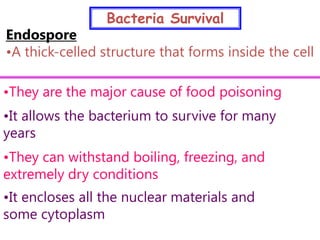
Bacteria Survival
Endospore
•A thick-celled structure that forms inside the cell

•They are the major cause of food poisoning
•It allows the bacterium to survive for many
years
•They can withstand boiling, freezing, and
extremely dry conditions
•It encloses all the nuclear materials and
some cytoplasm
Harmful Bacteria
• Some bacteria cause diseases

•Animals can pass diseases to humans

Communicable Disease
- Disease that is passed from one organism to another

This can happen in several ways:
•Air
•Touching clothing, food, silverware, or
toothbrush
•Drinking water that contains bacteria
Helpful Bacteria
•Decomposers help recycle nutrients into the soil
for other organisms to grow

•Bacteria grow in the stomach of a cow to break
down grass and hay

•Most are used to make antibiotics

•Some bacteria help make insulin

•They are used to make industrial chemicals
Helpful Bacteria
•Used to treat sewage

   Organic waste is consumed by the
   bacteria, used as nutrients by the bacteria,
   and is no longer present to produce odors,
   sludge, pollution, or unsightly mess.
•Foods like yogurt, cottage & Swiss cheese, sour cream, buttermilk are
made from bacteria that grows in milk
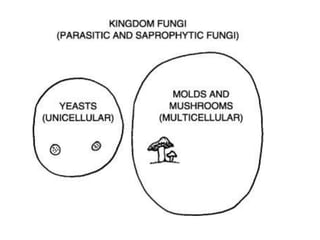
Characteristics of Fungi
• Eukaryotic (with membrane-bound
  organelles)
• Non-photosynthetic – unlike plants
• Most are multicellular
• Most are microscopic molds or
  yeasts
The study of fungi is known as MYCOLOGY.
Structure of a Fungi


Spore-producing
structure of fungi
Reproduction in Fungi
• Most fungi reproduce both
  sexually and asexually
• Asexual reproduction –
  production of various types
  of spores
Roles of Fungi
• Disease-causing agents


ATHLETE’S FOOT
Fungi decompose dead plant and
           animal matter.

•Called saprophytes,
 they act as recyclers of
 dead organic matter,
 obtaining food from
 this material.
Fungi in Industry
        (Biotechnology)
• Fungi produce many products
  used in the medical field such as
  penicillin, cephalosporin
  antibiotics, cortisone
• Yeast is used to make ethanol.
• Yeasts are known for making
  breads rise.
Viruses
Virus
– an infectious
biological particle
consisting of a
nucleic acid as a
genetic material and
a protein coat called
capsid
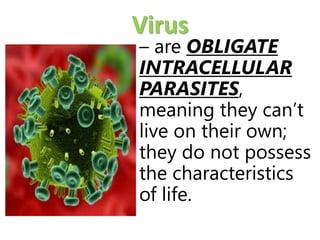
Virus
– are OBLIGATE
INTRACELLULAR
PARASITES,
meaning they can’t
live on their own;
they do not possess
the characteristics
of life.
Virus
They are considered
to be acellular –
meaning they do not
contain nor made up
of cells.
Some Human
Diseases Caused by
      Viruses
AIDS
Chicken Pox

Microorganisms

  • 1.
  • 2.
  • 3.
    Questions for LessonAbout Bacteria 1. What is a bacterium? 2. What are the different types of bacteria? 3. How does bacterial cell differ from plant and animal cell? 4. What are the three kinds of bacteria according to the mode of respiration? Give an example of each kind. 5. How do autotrophic bacteria make food? 6. Where do bacteria use their endospore? 7. What are the three roles of bacteria?
  • 4.
    Questions for LessonAbout Fungi 1. How do fungi differ from plants? 2. What is the main component of a fungus cell wall? 3. Give examples of fungi. 4. What is the spore-producing structure of a fungus? 5. Write the chemical equation for alcoholic fermentation. 6. What kind of asexual reproduction is performed by unicellular fungi? 7. What are the three roles of fungi?
  • 6.
    Kingdom Eubacteria (TrueBacteria) Bacteria are located everywhere - air, water, land, and living organisms including people. General Characteristics: 1. All are unicellular (one-celled structural level) 2. All are prokaryotic – cells that lack nucleus (no nuclear envelope) (PRO = NO nucleus) 3. All have cell walls – NO cellulose in cell walls 4. They can live in both aerobic (with O2) and anaerobic (without O2) environments
  • 7.
    Bacteria are muchlarger in size than viruses.
  • 8.
    Ex: Streptococcus Ex: Lactobacillus Ex: Spirillium
  • 9.
    Seven Major Structuresof a Bacterial Cell •Capsule •Cell wall •Ribosomes •Nucleoid •Flagella •Pilli •Cytoplasm
  • 10.
    Reproduction of Bacteria •BinaryFission - the process of one organism dividing into two organisms •Fission is a type of asexual reproduction •Asexual Reproduction - reproduction of a living thing from only one parent How?... The one main (circular) chromosome makes a copy of itself then it divides into two.
  • 11.
    Bacteria Survival Endospore •A thick-celledstructure that forms inside the cell •They are the major cause of food poisoning •It allows the bacterium to survive for many years •They can withstand boiling, freezing, and extremely dry conditions •It encloses all the nuclear materials and some cytoplasm
  • 12.
    Harmful Bacteria • Somebacteria cause diseases •Animals can pass diseases to humans Communicable Disease - Disease that is passed from one organism to another This can happen in several ways: •Air •Touching clothing, food, silverware, or toothbrush •Drinking water that contains bacteria
  • 13.
    Helpful Bacteria •Decomposers helprecycle nutrients into the soil for other organisms to grow •Bacteria grow in the stomach of a cow to break down grass and hay •Most are used to make antibiotics •Some bacteria help make insulin •They are used to make industrial chemicals
  • 14.
    Helpful Bacteria •Used totreat sewage Organic waste is consumed by the bacteria, used as nutrients by the bacteria, and is no longer present to produce odors, sludge, pollution, or unsightly mess. •Foods like yogurt, cottage & Swiss cheese, sour cream, buttermilk are made from bacteria that grows in milk
  • 16.
    Characteristics of Fungi •Eukaryotic (with membrane-bound organelles) • Non-photosynthetic – unlike plants • Most are multicellular • Most are microscopic molds or yeasts The study of fungi is known as MYCOLOGY.
  • 18.
    Structure of aFungi Spore-producing structure of fungi
  • 19.
    Reproduction in Fungi •Most fungi reproduce both sexually and asexually • Asexual reproduction – production of various types of spores
  • 20.
    Roles of Fungi •Disease-causing agents ATHLETE’S FOOT
  • 21.
    Fungi decompose deadplant and animal matter. •Called saprophytes, they act as recyclers of dead organic matter, obtaining food from this material.
  • 22.
    Fungi in Industry (Biotechnology) • Fungi produce many products used in the medical field such as penicillin, cephalosporin antibiotics, cortisone • Yeast is used to make ethanol. • Yeasts are known for making breads rise.
  • 23.
  • 24.
    Virus – an infectious biologicalparticle consisting of a nucleic acid as a genetic material and a protein coat called capsid
  • 25.
    Virus – are OBLIGATE INTRACELLULAR PARASITES, meaningthey can’t live on their own; they do not possess the characteristics of life.
  • 26.
    Virus They are considered tobe acellular – meaning they do not contain nor made up of cells.
  • 27.
  • 28.
  • 29.