Copyright 2011. PEER.tamu.edu
Pathogens
Think about it:
• What sicknesses have
you had?
• Can you name an
infectious disease that
causes people or animals
to die?
• What is an infectious
disease that has been in
the news recently?
Epidemiology
• The branch of medical science dealing with the
transmission and control of disease.
• There are human physicians that study
epidemiology and also veterinarians that study
animal epidemiology. Both of these types of
epidemiologists also deal with diseases that are
transmitted from humans to animals and from
animals to humans.
Infectious
Diseases are
Caused by
Pathogens
What’s a
pathogen?
• Pathogens are microbes (microscopic
living organisms) or other agents that
cause diseases.
• Example: Foot and mouth disease is a
highly contagious disease of cattle,
swine, and other cloven-hoofed animals.
– It is caused by a viral pathogen called
picornavirus.
– It causes blisters in the mouths and
hooves of animals.
What are Pathogens?
Not all microbes are pathogens
• There are many types of microbes that are
actually beneficial to animals.
• Examples include the symbiotic bacteria
found in the digestive system of cattle and
horses that help them digest cellulose in
roughage.
• There can be one trillion or more microbes in
1 ounce of rumen fluid from a cow!*
Common Types of Pathogens
Fungi
Bacteria
Viruses
Protozoa
Prions
Bacteria
• Bacteria are single celled
organisms that are
prokaryotic.
• There are countless
numbers of bacteria on the
Earth but less than 1% of
them cause diseases.
• Bacterial infections make
an animal noticeably sick.
• Bacteria reproduce rapidly
and many give off toxins
which damage body tissue.
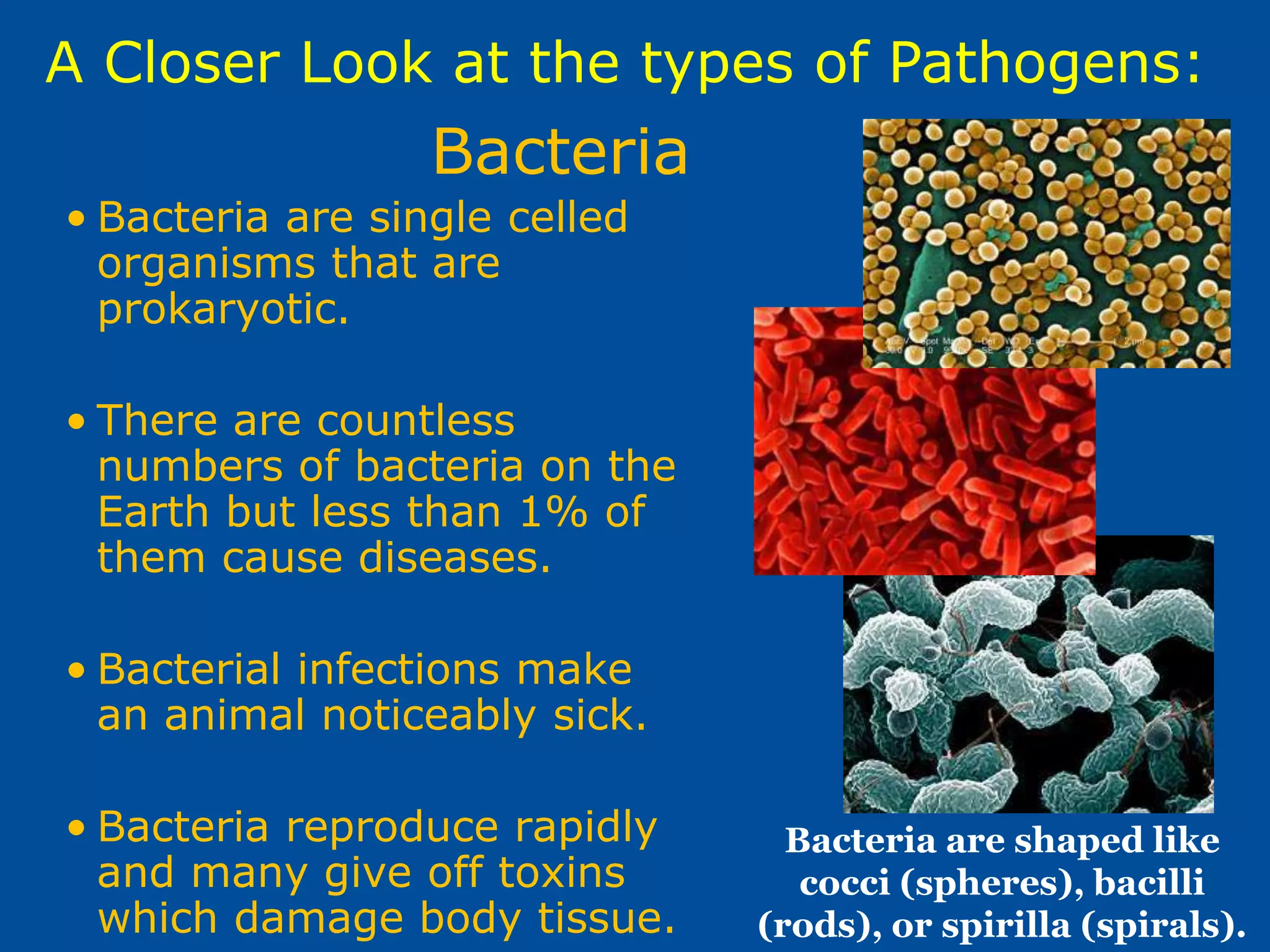
Bacteria are shaped like
cocci (spheres), bacilli
(rods), or spirilla (spirals).
A Closer Look at the types of Pathogens:
Bacteria
• Symptoms of bacterial infections
depend on the type of bacteria
but can include fever, pain,
swelling, vomiting, diarrhea,
formation of pus, and even
abortion.
• Body fluids can be sampled and
cultured to grow and identify the
bacterial pathogen.
• Antibiotics are the usual
treatment for bacterial infections,
but treatment can vary.
• Bacteria adapt quickly and may
become resistant to antibiotics.
Strangles in horses is caused by
Streptococcus equi bacteria
A positive culture for Streptococcus bacteria
A broad spectrum antibiotic
Common Bacterial Diseases
Disease Body System Symptoms Examples
Dermatitis Skin Inflammation, pruritus (itching)
skin lesions (bumps, blisters, scales,
crusts)
Staphylococcus aureus
Pyoderma Skin Purulent exudate (pus) from skin
lesions
Staphylococcus intermedius
Keratocunjunctivitis Eye Inflammation of cornea and
conjunctiva , pain, sensitivity to
sunlight, tears, squinting
“Pinkeye” is common name
Staphylococcus aureus
Otitis Externa Ear Inflammation of external ear canal
with reddening, drainage and itching
Staphylococcus
Rhinitis and Sinusitis Respiratory Inflammation of the membranes of
the nasal passages and sinuses.
Mucus nasal discharge, open-mouth
breathing, sneezing.
Strangles in horses caused by
Streptococcus equi
Pneumonia Respiratory Deep cough and difficulty breathing Staphylococcus aureus, including
methicillin-resistant S. aureus
(MRSA), Streptococcus species
Gastroenteritis Digestive Inflammation of stomach and
intestines, excessive salivation,
vomiting, diarrhea, straining,
abdominal pain.
Salmonellosis, colibacillosis,
eneterotoxemia
Metritis Reproductive Inflammation of uterus. Purulent
vaginal discharge, abortion,
premature birth.
Contagious Equine Metritis (CEM)
Abortion Reproductive Premature birth (expelling) of fetus
by pregnant female.
Brucellosis, leptospirosis and
camphylobacteriosis (vibriosis)
Mastitis Reproductive Inflammation of mammary gland or
udder tissue. Swollen, warm and
painful mammary glands.
Pseudomonas aeruginosa and
many other bacteria
Anthrax Skin, Digestive, Respiratory Sudden death in cattle
Varied in humans depending on
exposure method
Bacillus anthracis is reportable
disease responsible for outbreaks
in cattle. Zoonotic, possible
bioterrorism agent
Prions
• A prion is an infectious particle
(not a cell) made from an
abnormally folded protein found
on the surfaces of nerve cells.
• Prions are highly resistant to
heat, radiation, and disinfectants.
• The best known prion forms holes
in brain tissue, making the brain
look like Swiss cheese.
• The prion causes mad-cow
disease and may cause some
forms of Alzheimer's Disease.
Ribbon diagram
of prion*
Click here for PEER curriculum on proteins
Viruses
• A virus consists of a piece of
genetic material (RNA) housed
within a protective coat. Viruses
are not cells.
• The virus reproduces by
hijacking the cell of another
organism (host) and getting the
host cell to reproduce more
viruses.
• Most viruses cause disease and
are specific as to which type of
cell they will attack.
Rabies Virus
Viruses
• Symptoms of viral diseases are varied
and related to the types of tissues that
are infected. Viral diseases are
commonly associated with infections of
the skin, blood, liver, uterus, fetus,
brain, lungs, stomach, and intestines.
• Diagnosis is done by virus isolation,
ELISA* and PCR* testing. A decrease in
lymphocytes on a CBC can also indicate
a viral infection.
• Treatments are mainly supportive in
nature. This can include administering
fever reducers and allowing the animal
to rest. Antiviral medications are being
developed, but many are cost
prohibitive. Antibiotics kill bacteria and
have no effect on viruses.
Horses can be infected by at least
four different papilloma viruses
that cause warts
*See slide notes for more information
Common Viral Diseases
Disease Body System Symptoms Examples
Hepatitis General-many
organs involved
Vary from slight fever to
death
Infectious canine
hepatitis-
canine adenovirus 1
Anemia Blood Fever, weight loss,
abortion, low iron level in
blood
Equine infectious
anemia-equine
infectious anemia virus
Warts Skin Fibrous tumors of the skin
an mucous membranes
Papilloma virus
Pox Skin Skin lesions-bumps,
blisters, pustules, and
crusts
Cowpox
Pneumonia Respiratory Labored or “flank”
breathing, hard deep
cough, fever, leukocytosis
Bovine Respiratory
Disease (BRD)-
Mannheimia
haemolytica
There are MANY viruses
that cause Pneumonia
Abortion Reproductive Loss of fetus Equine
Rhinopneumonitis-
equine herpesvirus 1
Meningitis and
encephalitis
Nervous Invfammation of the brain
covering causing
blindness, paralysis,
wobbling, seizures, coma
and delirium
Encephalomyelitis,
distemper, parvovirus,
swine pseudorabies
Rabies Nervous Throat paralysis, behavior
change, change in bark
(dog), aggression in later
stages, lack of fear
Rabies virus
Typically fatal
Protozoa
• Protozoa are unicellular microbes
that can be parasites or predators
of other microbes. Many are
motile.
• Most need a moist environment to
live and many are transmitted
through water.
• Infections of small numbers of
protozoa are common, they are
seen quite often on microscopic
fecal examinations with the animal
showing no evidence of diseases.
• Infected animals are recognized as
carrier animals and as possible
sources of infection for susceptible
animals.
Protozoa found in human stool
sample
Giardia
Protozoa
• Symptoms vary considerably
depending on the protozoa involved
but often include intestinal
disorders such as diarrhea, weight
loss, and anorexia. Some protozoa
cause fever, flu-like symptoms, or
anemia.
• Diagnosis is conducted through
examination of blood, feces, or
urine for the presence of the
microscopic organisms. ELISA and
PCR tests can also be done.
• Many antiprotozoal agents are
available for treatment of protozoal
infections.
Direct fecal smear stained to detect
Cryptosporidium sp., a protozoan
parasite. (Source: CDC)
Toxoplasmosis is a zoonotic parasite
that causes disease in humans and
animals
Protozoal Diseases
Disease Body System Symptoms Examples
Giardiasis Digestive abdominal cramps, watery
diarrhea, vomiting, flatus
(gas), and fever
Giardia lamblia
Affects animals and
humans
Coccidiosis Digestive Thin, watery feces with
considerable amounts of
intestinal mucosa and
blood
Coccidia Eimeria and
Isospora, affects
animals and humans
Tricnomoniasis Reproductive venereal disease
characterized primarily by
early fetal death and
infertility
Tritrichomonas
Affects animals and
humans
Hexamitiasis Digestive Watery diarrhea, dry
unkempt feathers,
listlessness, and rapid
weight loss despite the fact
that the birds continue to
eat
Hexamita meleagridis
in turkeys and other
fowl
Toxoplasmosis Multiple Systems Cough, fever, loss of
appetite, and lethargy. Can
be passed to fetus
(congenital). Congenital
toxoplasmosis can damage
the baby's eyes, nervous
system, skin, and ears.
Toxoplasma gondii
Zoonotic, affects
animals and humans
Babesiosis Circulatory Fever, anemia, sudden
cardiac death
Malaria-like (Malaria is a
protozoal disease)
Babesia microti in
dogs transmitted by
ticks
Fungi
• A single or multi-cellular
microbe that can infect
various tissues in animals.
• Symptoms can include skin
lesions, hair loss and
respiratory or digestive
system disorders.
• Many antifungal drugs are
available and can be used
systemically as well as
orally.
Microsporum-the fungus that causes ringworm.
Fungi
• Diagnosis of fungal infections
may be done by examination of
skin lesions, fungal culture,
biopsies, skin immunologic
tests, or by blood tests.
• Treatment of skin lesions in the
patient usually includes a
combination of anti-fungal
drugs, topical medications and
anti-fungal medicated
shampoos for animals with skin
lesions.
• Systemic fungal diseases can
be serious and result in severe
tissue damage.
A horse with a severe case of ringworm,
which is cause by a fungus
Treatment includes bathing with
a medicated shampoo
Fungal Diseases
Disease System Symptom Examples
Dermatophytosis or
Ringworm
Skin Circular skin lesions with
hair loss, itching,
pruritus may or may not
be present
Microsporum canis in
dogs
Dermatophilosis or
Rain Gall/Rain Rot
Skin Lumpy, crusty, lesions
covered with hair that
can be pulled off
Dermatophilus
congolensis has a
variety of hosts-cattle,
sheep, goats, and horses
are affected most
frequently; and pigs,
dogs, and cats rarely
Aspergillosis Respiratory Fever, cough, chest pain
or breathlessness
Aspergillus fumigatus in
many species. Type of
mold.
Candidiasis or Yeast
Infection
Skin, Respiratory,
Digestive
Signs can be variable.
Diarrhea and listlesses
can be observed. Lesions
of the skin and mucosae
are generally single or
multiple, raised, circular,
white masses covered
with scabs.
Candida albicans in many
species.
Coccidiosis Digestive Diarrhea, dehydration,
hemorrhaging,
Eimeria and Isospora in
cattle, sheep, goats,
pigs, poultry, and rabbits
Quick Check #1:
1. What is a pathogen?
2. Name five kinds of pathogens.
3. How are these five kinds of pathogens
alike?
4. How are these five kinds of pathogens
different?
How Are Pathogens Spread?
• Pathogens can enter
the body through air,
food, water, sexual
interactions, skin
contact, blood
transfusions, etc.
• The body’s reaction to
an infection can vary
from a mild discomfort
to death.
Pathogen
For more on the immune
system, click here
Species Specificity
• Some infectious
diseases of animals
can be transferred
to humans.
• These are called
zoonotic diseases.
• All mammals can
transmit rabies but
raccoons and
skunks are the
most common
carriers.
I can transmit
Brucellosis
We can transmit lots
of infectious agents
including arena
viruses and hantavirus.
I can transmit
Ebola virus!
Think about it:
Where Do Pathogens Hide When
Not Infecting People and
Animals?
The soil
Bodies of water
Surfaces like farm equipment
The skin of people and animals
In the air
In body fluids
Where are
those
pathogens?
Do you know the difference
between “infectious” and
“contagious?”
Infectious: pathogen can invade
the body
Contagious: pathogen can be
spread from one animal to
another.
An animal that has
a contagious condition
will probably have to
be isolated from other
animals until it is
determined that it is
no longer contagious.
Quick Check #2
1. How can pathogens get in the body to
cause infection?
2. What is an infectious disease that can
be transmitted from an animal to a
human called?
3. Where are pathogens commonly found?
4. What’s the difference between being
infectious and being contagious?
Different infectious diseases
require different approaches for
prevention and control.
But for any disease, there are
three key steps for dealing
with it.
Three Key Steps
reak the cycle of transmission
ill the infectious agent
ncrease host resistance
Do you have some ideas on how to do these three things?
Vaccination
• Vaccination acts to increase the
host’s resistance to a pathogen.
• Vaccination is the administration of
a material that stimulates adaptive
immunity to a disease.
• Although it is not possible to devise
precise schedules for each vaccine,
certain principles are common to all
methods of active immunization.
• Newborn animals are passively
protected by maternal antibodies.
• If stimulation of immunity is
necessary at this stage, the
mother may be vaccinated during
late pregnancy.
• Because the exact time of loss of
maternal immunity cannot be
predicted, young animals are
often vaccinated at least twice to
ensure successful immunization.
Newborn animals acquire
immunity from nursing colostrum,
or the first milk produced by the
mother.
• The interval between vaccine doses depends on an
animal’s immunologic memory. The duration of this
memory depends on factors such as the nature of
the antigen, the use of live or dead organisms, and
the route of administration.
• Modern vaccines may induce immunity that persists
for an animal’s lifetime. Other vaccines may require
boosting only once every 2-3 years.
• Some vaccines, like Bordatella in dogs, are
recommended to be given every 6 months.
• Annual revaccination has been
the rule because this approach
is administratively simple and
has the advantage of ensuring
that an animal is regularly seen
by a veterinarian. It is likely
that this is more than sufficient
for most vaccines.
• The veterinarian in
a local area will be
most informed on
protocols for
vaccination.
PLEASE NOTE: Sample schedule only. Check with your local
veterinarian for a complete schedule for your area.
Some Current Research
Over-use of antibiotics has led to some bacteria
developing resistance. This is a big problem.
Scientists search for antibiotics that can replace
current ones to which bacteria have evolved
resistance.
Click here for more on antibiotic resistance
Delivery of nanoparticles to cells
to kill drug-resistant bacteria
• Nanoparticles are sized between 1
and 100 nanometers. Nanoparticles
are 100 times smaller than
bacteria.
• Antibiotics bound with nanoparticles
may be used one day to treat
infections, especially those that are
drug resistant.
• One study will allow nanoparticles
to be engineered as “small
machines that will carry large
numbers of antibiotic molecules to a
single bacterial cell, then release
and kill the cell.”
Artist’s rendition of nanoparticles
One New Strategy
•Many bacteria have genes
that can make products like
toxins or even antibiotics
against other bacteria.
•Forcing bacteria to grow
with another kind of bacteria
might cause them to start
secreting a new antibiotic to
kill off the competition.
•This new antibiotic could be
used to kill resistant
bacteria.
Staphylococcus aureus, cultured on an agar
plate for drug sensitivity test
Simple Dissolvable Patch for Vaccines
•Scientists have created a
dissolvable patch that is currently
being tested which will deliver
vaccine into the skin painlessly.
• Microscopic needles made from a
special blend of vinyl and freeze-
dried vaccine can be pressed against
the skin causing the needles to
dissolve in the body’s fluids.
•This eliminates risk of shared
needles and it can be easily
administered by health care
officials.
Edible Vaccines in Food
• Many studies are currently being
done to modify plants to contain
vaccines.
• Plant-based edible vaccines
would be safer, cheaper, and
could be grown—or freeze-dried
and shipped—anywhere.
• Vaccines delivered in food
trigger a two-way immune
response.
• Oral vaccines initiate a systemic
and mucosal immunity, which
fights infections in places where
germs first attack the body: in
the mucous membranes of the
nose, mouth, lungs, gut, and
genitals.
Using Plants to Make Vaccines
• Plants can be genetically modified to
produce vaccines as they grow.
• The process of growing the vaccine in a
plant is about three times faster, and
can cut costs by about 75 percent,
compared to conventional methods.
Quick Check #3
1. What are the three key steps for dealing
with infectious disease?
2. What is the purpose of vaccination?
3. What are some considerations when
designing a vaccination protocol?
4. What are some current areas of
research concerning vaccination and
treatment of infectious diseases?
Activity Time:
Model on Disease Spread
ACHOO!
References:
Veterinary Assistant Handbook
Floron C. Fairies, Jr.
Instructional Material Service
Texas A&M University
First Edition
Merck Veterinary Manual
http://www.merckvetmanual.com

Pathogens.ppt

  • 1.
  • 2.
    Think about it: •What sicknesses have you had? • Can you name an infectious disease that causes people or animals to die? • What is an infectious disease that has been in the news recently?
  • 3.
    Epidemiology • The branchof medical science dealing with the transmission and control of disease. • There are human physicians that study epidemiology and also veterinarians that study animal epidemiology. Both of these types of epidemiologists also deal with diseases that are transmitted from humans to animals and from animals to humans.
  • 4.
  • 5.
    • Pathogens aremicrobes (microscopic living organisms) or other agents that cause diseases. • Example: Foot and mouth disease is a highly contagious disease of cattle, swine, and other cloven-hoofed animals. – It is caused by a viral pathogen called picornavirus. – It causes blisters in the mouths and hooves of animals. What are Pathogens?
  • 6.
    Not all microbesare pathogens • There are many types of microbes that are actually beneficial to animals. • Examples include the symbiotic bacteria found in the digestive system of cattle and horses that help them digest cellulose in roughage. • There can be one trillion or more microbes in 1 ounce of rumen fluid from a cow!*
  • 7.
    Common Types ofPathogens Fungi Bacteria Viruses Protozoa Prions
  • 8.
    Bacteria • Bacteria aresingle celled organisms that are prokaryotic. • There are countless numbers of bacteria on the Earth but less than 1% of them cause diseases. • Bacterial infections make an animal noticeably sick. • Bacteria reproduce rapidly and many give off toxins which damage body tissue. Bacteria are shaped like cocci (spheres), bacilli (rods), or spirilla (spirals). A Closer Look at the types of Pathogens:
  • 9.
    Bacteria • Symptoms ofbacterial infections depend on the type of bacteria but can include fever, pain, swelling, vomiting, diarrhea, formation of pus, and even abortion. • Body fluids can be sampled and cultured to grow and identify the bacterial pathogen. • Antibiotics are the usual treatment for bacterial infections, but treatment can vary. • Bacteria adapt quickly and may become resistant to antibiotics. Strangles in horses is caused by Streptococcus equi bacteria A positive culture for Streptococcus bacteria A broad spectrum antibiotic
  • 10.
    Common Bacterial Diseases DiseaseBody System Symptoms Examples Dermatitis Skin Inflammation, pruritus (itching) skin lesions (bumps, blisters, scales, crusts) Staphylococcus aureus Pyoderma Skin Purulent exudate (pus) from skin lesions Staphylococcus intermedius Keratocunjunctivitis Eye Inflammation of cornea and conjunctiva , pain, sensitivity to sunlight, tears, squinting “Pinkeye” is common name Staphylococcus aureus Otitis Externa Ear Inflammation of external ear canal with reddening, drainage and itching Staphylococcus Rhinitis and Sinusitis Respiratory Inflammation of the membranes of the nasal passages and sinuses. Mucus nasal discharge, open-mouth breathing, sneezing. Strangles in horses caused by Streptococcus equi Pneumonia Respiratory Deep cough and difficulty breathing Staphylococcus aureus, including methicillin-resistant S. aureus (MRSA), Streptococcus species Gastroenteritis Digestive Inflammation of stomach and intestines, excessive salivation, vomiting, diarrhea, straining, abdominal pain. Salmonellosis, colibacillosis, eneterotoxemia Metritis Reproductive Inflammation of uterus. Purulent vaginal discharge, abortion, premature birth. Contagious Equine Metritis (CEM) Abortion Reproductive Premature birth (expelling) of fetus by pregnant female. Brucellosis, leptospirosis and camphylobacteriosis (vibriosis) Mastitis Reproductive Inflammation of mammary gland or udder tissue. Swollen, warm and painful mammary glands. Pseudomonas aeruginosa and many other bacteria Anthrax Skin, Digestive, Respiratory Sudden death in cattle Varied in humans depending on exposure method Bacillus anthracis is reportable disease responsible for outbreaks in cattle. Zoonotic, possible bioterrorism agent
  • 11.
    Prions • A prionis an infectious particle (not a cell) made from an abnormally folded protein found on the surfaces of nerve cells. • Prions are highly resistant to heat, radiation, and disinfectants. • The best known prion forms holes in brain tissue, making the brain look like Swiss cheese. • The prion causes mad-cow disease and may cause some forms of Alzheimer's Disease. Ribbon diagram of prion* Click here for PEER curriculum on proteins
  • 12.
    Viruses • A virusconsists of a piece of genetic material (RNA) housed within a protective coat. Viruses are not cells. • The virus reproduces by hijacking the cell of another organism (host) and getting the host cell to reproduce more viruses. • Most viruses cause disease and are specific as to which type of cell they will attack. Rabies Virus
  • 13.
    Viruses • Symptoms ofviral diseases are varied and related to the types of tissues that are infected. Viral diseases are commonly associated with infections of the skin, blood, liver, uterus, fetus, brain, lungs, stomach, and intestines. • Diagnosis is done by virus isolation, ELISA* and PCR* testing. A decrease in lymphocytes on a CBC can also indicate a viral infection. • Treatments are mainly supportive in nature. This can include administering fever reducers and allowing the animal to rest. Antiviral medications are being developed, but many are cost prohibitive. Antibiotics kill bacteria and have no effect on viruses. Horses can be infected by at least four different papilloma viruses that cause warts *See slide notes for more information
  • 14.
    Common Viral Diseases DiseaseBody System Symptoms Examples Hepatitis General-many organs involved Vary from slight fever to death Infectious canine hepatitis- canine adenovirus 1 Anemia Blood Fever, weight loss, abortion, low iron level in blood Equine infectious anemia-equine infectious anemia virus Warts Skin Fibrous tumors of the skin an mucous membranes Papilloma virus Pox Skin Skin lesions-bumps, blisters, pustules, and crusts Cowpox Pneumonia Respiratory Labored or “flank” breathing, hard deep cough, fever, leukocytosis Bovine Respiratory Disease (BRD)- Mannheimia haemolytica There are MANY viruses that cause Pneumonia Abortion Reproductive Loss of fetus Equine Rhinopneumonitis- equine herpesvirus 1 Meningitis and encephalitis Nervous Invfammation of the brain covering causing blindness, paralysis, wobbling, seizures, coma and delirium Encephalomyelitis, distemper, parvovirus, swine pseudorabies Rabies Nervous Throat paralysis, behavior change, change in bark (dog), aggression in later stages, lack of fear Rabies virus Typically fatal
  • 15.
    Protozoa • Protozoa areunicellular microbes that can be parasites or predators of other microbes. Many are motile. • Most need a moist environment to live and many are transmitted through water. • Infections of small numbers of protozoa are common, they are seen quite often on microscopic fecal examinations with the animal showing no evidence of diseases. • Infected animals are recognized as carrier animals and as possible sources of infection for susceptible animals. Protozoa found in human stool sample Giardia
  • 16.
    Protozoa • Symptoms varyconsiderably depending on the protozoa involved but often include intestinal disorders such as diarrhea, weight loss, and anorexia. Some protozoa cause fever, flu-like symptoms, or anemia. • Diagnosis is conducted through examination of blood, feces, or urine for the presence of the microscopic organisms. ELISA and PCR tests can also be done. • Many antiprotozoal agents are available for treatment of protozoal infections. Direct fecal smear stained to detect Cryptosporidium sp., a protozoan parasite. (Source: CDC) Toxoplasmosis is a zoonotic parasite that causes disease in humans and animals
  • 17.
    Protozoal Diseases Disease BodySystem Symptoms Examples Giardiasis Digestive abdominal cramps, watery diarrhea, vomiting, flatus (gas), and fever Giardia lamblia Affects animals and humans Coccidiosis Digestive Thin, watery feces with considerable amounts of intestinal mucosa and blood Coccidia Eimeria and Isospora, affects animals and humans Tricnomoniasis Reproductive venereal disease characterized primarily by early fetal death and infertility Tritrichomonas Affects animals and humans Hexamitiasis Digestive Watery diarrhea, dry unkempt feathers, listlessness, and rapid weight loss despite the fact that the birds continue to eat Hexamita meleagridis in turkeys and other fowl Toxoplasmosis Multiple Systems Cough, fever, loss of appetite, and lethargy. Can be passed to fetus (congenital). Congenital toxoplasmosis can damage the baby's eyes, nervous system, skin, and ears. Toxoplasma gondii Zoonotic, affects animals and humans Babesiosis Circulatory Fever, anemia, sudden cardiac death Malaria-like (Malaria is a protozoal disease) Babesia microti in dogs transmitted by ticks
  • 18.
    Fungi • A singleor multi-cellular microbe that can infect various tissues in animals. • Symptoms can include skin lesions, hair loss and respiratory or digestive system disorders. • Many antifungal drugs are available and can be used systemically as well as orally. Microsporum-the fungus that causes ringworm.
  • 19.
    Fungi • Diagnosis offungal infections may be done by examination of skin lesions, fungal culture, biopsies, skin immunologic tests, or by blood tests. • Treatment of skin lesions in the patient usually includes a combination of anti-fungal drugs, topical medications and anti-fungal medicated shampoos for animals with skin lesions. • Systemic fungal diseases can be serious and result in severe tissue damage. A horse with a severe case of ringworm, which is cause by a fungus Treatment includes bathing with a medicated shampoo
  • 20.
    Fungal Diseases Disease SystemSymptom Examples Dermatophytosis or Ringworm Skin Circular skin lesions with hair loss, itching, pruritus may or may not be present Microsporum canis in dogs Dermatophilosis or Rain Gall/Rain Rot Skin Lumpy, crusty, lesions covered with hair that can be pulled off Dermatophilus congolensis has a variety of hosts-cattle, sheep, goats, and horses are affected most frequently; and pigs, dogs, and cats rarely Aspergillosis Respiratory Fever, cough, chest pain or breathlessness Aspergillus fumigatus in many species. Type of mold. Candidiasis or Yeast Infection Skin, Respiratory, Digestive Signs can be variable. Diarrhea and listlesses can be observed. Lesions of the skin and mucosae are generally single or multiple, raised, circular, white masses covered with scabs. Candida albicans in many species. Coccidiosis Digestive Diarrhea, dehydration, hemorrhaging, Eimeria and Isospora in cattle, sheep, goats, pigs, poultry, and rabbits
  • 21.
    Quick Check #1: 1.What is a pathogen? 2. Name five kinds of pathogens. 3. How are these five kinds of pathogens alike? 4. How are these five kinds of pathogens different?
  • 22.
    How Are PathogensSpread? • Pathogens can enter the body through air, food, water, sexual interactions, skin contact, blood transfusions, etc. • The body’s reaction to an infection can vary from a mild discomfort to death. Pathogen For more on the immune system, click here
  • 23.
    Species Specificity • Someinfectious diseases of animals can be transferred to humans. • These are called zoonotic diseases. • All mammals can transmit rabies but raccoons and skunks are the most common carriers. I can transmit Brucellosis We can transmit lots of infectious agents including arena viruses and hantavirus. I can transmit Ebola virus!
  • 24.
    Think about it: WhereDo Pathogens Hide When Not Infecting People and Animals? The soil Bodies of water Surfaces like farm equipment The skin of people and animals In the air In body fluids Where are those pathogens?
  • 25.
    Do you knowthe difference between “infectious” and “contagious?” Infectious: pathogen can invade the body Contagious: pathogen can be spread from one animal to another. An animal that has a contagious condition will probably have to be isolated from other animals until it is determined that it is no longer contagious.
  • 26.
    Quick Check #2 1.How can pathogens get in the body to cause infection? 2. What is an infectious disease that can be transmitted from an animal to a human called? 3. Where are pathogens commonly found? 4. What’s the difference between being infectious and being contagious?
  • 27.
    Different infectious diseases requiredifferent approaches for prevention and control. But for any disease, there are three key steps for dealing with it.
  • 28.
    Three Key Steps reakthe cycle of transmission ill the infectious agent ncrease host resistance Do you have some ideas on how to do these three things?
  • 29.
    Vaccination • Vaccination actsto increase the host’s resistance to a pathogen. • Vaccination is the administration of a material that stimulates adaptive immunity to a disease. • Although it is not possible to devise precise schedules for each vaccine, certain principles are common to all methods of active immunization.
  • 30.
    • Newborn animalsare passively protected by maternal antibodies. • If stimulation of immunity is necessary at this stage, the mother may be vaccinated during late pregnancy. • Because the exact time of loss of maternal immunity cannot be predicted, young animals are often vaccinated at least twice to ensure successful immunization. Newborn animals acquire immunity from nursing colostrum, or the first milk produced by the mother.
  • 31.
    • The intervalbetween vaccine doses depends on an animal’s immunologic memory. The duration of this memory depends on factors such as the nature of the antigen, the use of live or dead organisms, and the route of administration. • Modern vaccines may induce immunity that persists for an animal’s lifetime. Other vaccines may require boosting only once every 2-3 years. • Some vaccines, like Bordatella in dogs, are recommended to be given every 6 months.
  • 32.
    • Annual revaccinationhas been the rule because this approach is administratively simple and has the advantage of ensuring that an animal is regularly seen by a veterinarian. It is likely that this is more than sufficient for most vaccines. • The veterinarian in a local area will be most informed on protocols for vaccination. PLEASE NOTE: Sample schedule only. Check with your local veterinarian for a complete schedule for your area.
  • 33.
    Some Current Research Over-useof antibiotics has led to some bacteria developing resistance. This is a big problem. Scientists search for antibiotics that can replace current ones to which bacteria have evolved resistance. Click here for more on antibiotic resistance
  • 34.
    Delivery of nanoparticlesto cells to kill drug-resistant bacteria • Nanoparticles are sized between 1 and 100 nanometers. Nanoparticles are 100 times smaller than bacteria. • Antibiotics bound with nanoparticles may be used one day to treat infections, especially those that are drug resistant. • One study will allow nanoparticles to be engineered as “small machines that will carry large numbers of antibiotic molecules to a single bacterial cell, then release and kill the cell.” Artist’s rendition of nanoparticles
  • 35.
    One New Strategy •Manybacteria have genes that can make products like toxins or even antibiotics against other bacteria. •Forcing bacteria to grow with another kind of bacteria might cause them to start secreting a new antibiotic to kill off the competition. •This new antibiotic could be used to kill resistant bacteria. Staphylococcus aureus, cultured on an agar plate for drug sensitivity test
  • 36.
    Simple Dissolvable Patchfor Vaccines •Scientists have created a dissolvable patch that is currently being tested which will deliver vaccine into the skin painlessly. • Microscopic needles made from a special blend of vinyl and freeze- dried vaccine can be pressed against the skin causing the needles to dissolve in the body’s fluids. •This eliminates risk of shared needles and it can be easily administered by health care officials.
  • 37.
    Edible Vaccines inFood • Many studies are currently being done to modify plants to contain vaccines. • Plant-based edible vaccines would be safer, cheaper, and could be grown—or freeze-dried and shipped—anywhere. • Vaccines delivered in food trigger a two-way immune response. • Oral vaccines initiate a systemic and mucosal immunity, which fights infections in places where germs first attack the body: in the mucous membranes of the nose, mouth, lungs, gut, and genitals.
  • 38.
    Using Plants toMake Vaccines • Plants can be genetically modified to produce vaccines as they grow. • The process of growing the vaccine in a plant is about three times faster, and can cut costs by about 75 percent, compared to conventional methods.
  • 39.
    Quick Check #3 1.What are the three key steps for dealing with infectious disease? 2. What is the purpose of vaccination? 3. What are some considerations when designing a vaccination protocol? 4. What are some current areas of research concerning vaccination and treatment of infectious diseases?
  • 40.
    Activity Time: Model onDisease Spread ACHOO!
  • 41.
    References: Veterinary Assistant Handbook FloronC. Fairies, Jr. Instructional Material Service Texas A&M University First Edition Merck Veterinary Manual http://www.merckvetmanual.com