Biotechnology Living factories
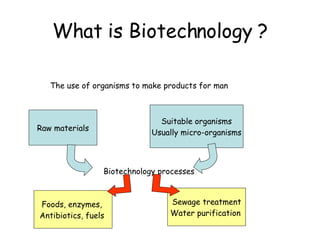
What is Biotechnology ? The use of organisms to make products for man Raw materials Suitable organisms Usually micro-organisms Biotechnology processes Foods, enzymes,  Antibiotics, fuels  Sewage treatment Water purification
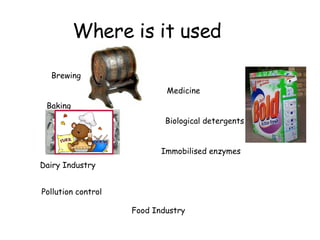
Where is it used Brewing Baking  Dairy Industry  Pollution control Food Industry Medicine  Biological detergents Immobilised enzymes
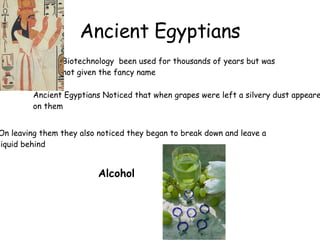
Ancient Egyptians Ancient Egyptians Noticed that when grapes were left a silvery dust appeared  on them On leaving them they also noticed they began to break down and leave a  liquid behind Alcohol Biotechnology  been used for thousands of years but was  not given the fancy name
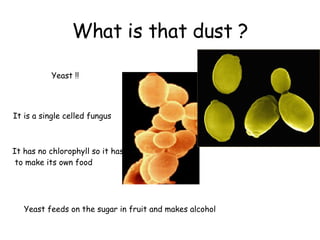
What is that dust ? Yeast !! It is a single celled fungus It has no chlorophyll so it has to make its own food Yeast feeds on the sugar in fruit and makes alcohol
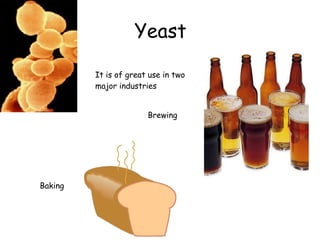
Yeast It is of great use in two  major industries Brewing Baking
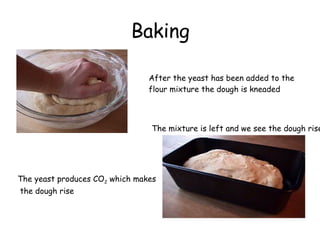
Baking After the yeast has been added to the  flour mixture the dough is kneaded The mixture is left and we see the dough rise The yeast produces CO 2  which makes the dough rise
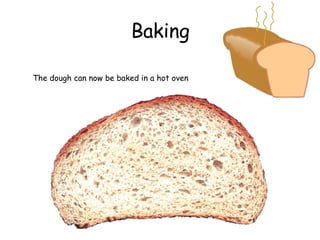
Baking The dough can now be baked in a hot oven
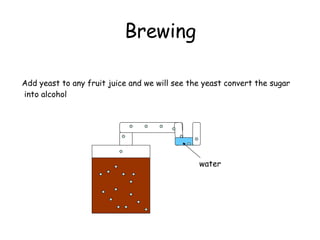
Brewing Add yeast to any fruit juice and we will see the yeast convert the sugar into alcohol water
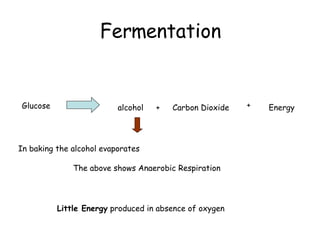
Fermentation Glucose alcohol + Carbon Dioxide + Energy In baking the alcohol evaporates The above shows Anaerobic Respiration Little Energy  produced in absence of oxygen
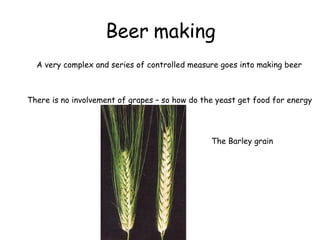
Beer making A very complex and series of controlled measure goes into making beer There is no involvement of grapes – so how do the yeast get food for energy The Barley grain
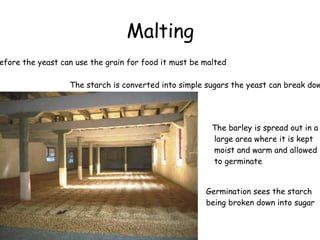
Malting Before the yeast can use the grain for food it must be malted The starch is converted into simple sugars the yeast can break down The barley is spread out in a large area where it is kept moist and warm and allowed to germinate Germination sees the starch  being broken down into sugar
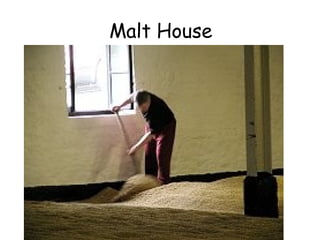
Malt House
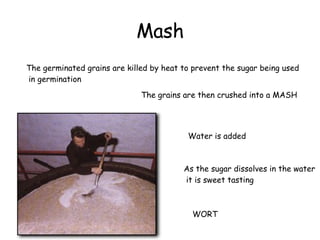
Mash The germinated grains are killed by heat to prevent the sugar being used in germination The grains are then crushed into a MASH Water is added  As the sugar dissolves in the water it is sweet tasting WORT
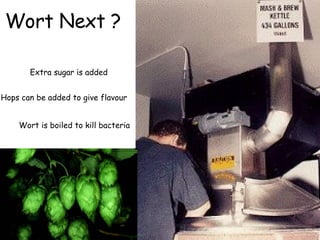
Wort Next ? Extra sugar is added Hops can be added to give flavour Wort is boiled to kill bacteria
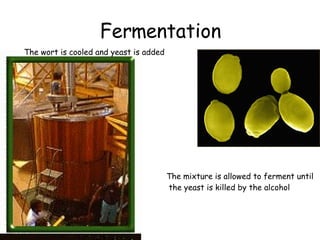
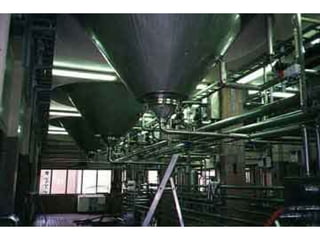
Fermentation The wort is cooled and yeast is added The mixture is allowed to ferment until the yeast is killed by the alcohol
 
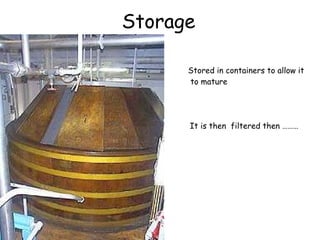
Storage Stored in containers to allow it to mature It is then  filtered then ………
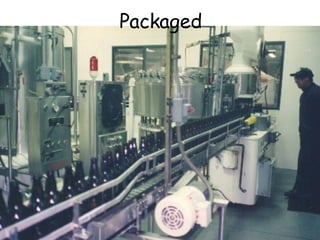
Packaged
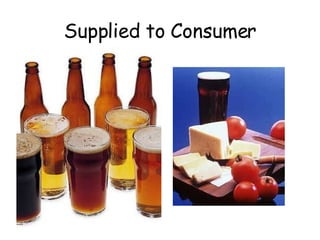
Supplied to Consumer
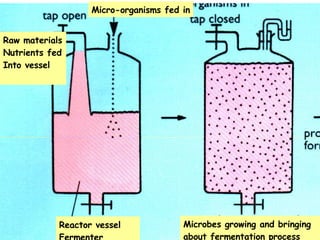
Batch Processing Raw materials Nutrients fed Into vessel Reactor vessel  Fermenter Microbes growing and bringing  about fermentation process Micro-organisms fed in
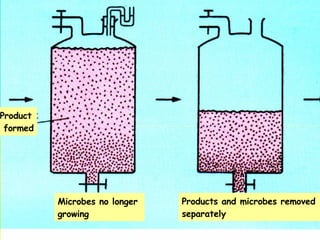
Product formed Microbes no longer  growing Products and microbes removed  separately
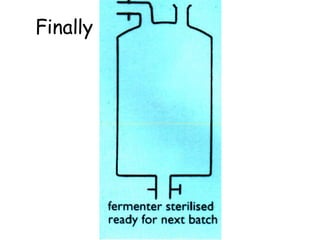
Finally
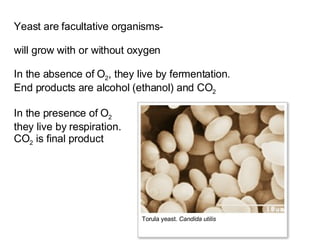
Yeast are facultative organisms-  will grow with or without oxygen  In the absence of O 2 , they live by fermentation.  End products are alcohol (ethanol) and CO 2   In the presence of O 2 they live by respiration.  CO 2  is final product Torula yeast.  Candida utilis
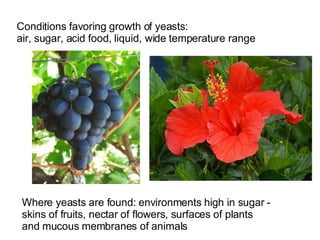
Conditions favoring growth of yeasts: air, sugar, acid food, liquid, wide temperature range Where yeasts are found: environments high in sugar - skins of fruits, nectar of flowers, surfaces of plants  and mucous membranes of animals
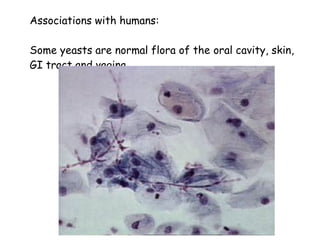
Associations with humans: Some yeasts are normal flora of the oral cavity, skin,  GI tract and vagina
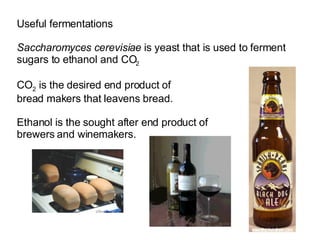
Useful fermentations Saccharomyces cerevisiae  is yeast that is used to ferment  sugars to ethanol and CO 2   CO 2  is the desired end product of  bread makers that leavens bread. Ethanol is the sought after end product of  brewers and winemakers.
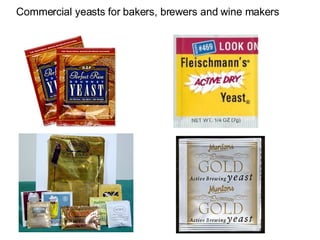
Commercial yeasts for bakers, brewers and wine makers
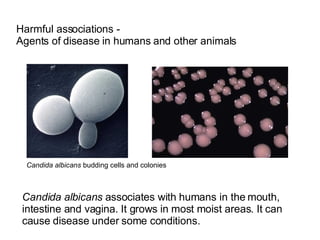
Harmful associations - Agents of disease in humans and other animals Candida albicans  associates with humans in the mouth, intestine and vagina. It grows in most moist areas. It can  cause disease under some conditions.  Candida albicans  budding cells and colonies
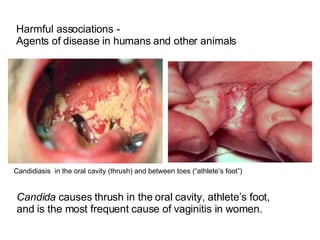
Harmful associations - Agents of disease in humans and other animals Candida  causes thrush in the oral cavity, athlete’s foot, and is the most frequent cause of vaginitis in women.  Candidiasis  in the oral cavity (thrush) and between toes (“athlete’s foot”)
Lactic Acid Bacteria The main bacteria used in manufacture of dairy products are commonly known as Lactic Acid Bacteria (LAB). The bacteria utilise the lactose in the milk to produce lactic acid.
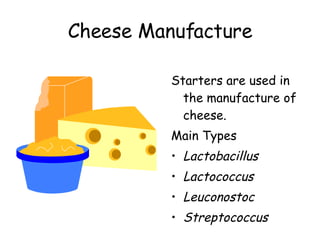
Cheese Manufacture Starters are used in the manufacture of cheese. Main Types Lactobacillus Lactococcus Leuconostoc Streptococcus
Role of Lactic Acid The fresh acidic flavour of unripened cheese Important to the formation and texturising of the curd. Produces volatile flavours  Synthesis of proteolytic and lipolytic enzymes - important in cheese ripening. May influence micro-flora.
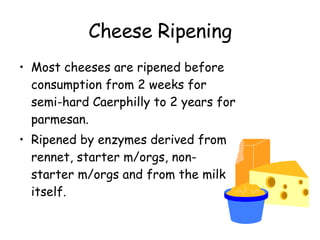
Cheese Ripening Most cheeses are ripened before consumption from 2 weeks for semi-hard Caerphilly to 2 years for parmesan.  Ripened by enzymes derived from rennet, starter m/orgs, non-starter m/orgs and from the milk itself.
How do you make cheese?   Normal produced from anaerobic fermentation from milk Involves fermentation of milk (lactose) by lactic acid bacteria (streptococcus)
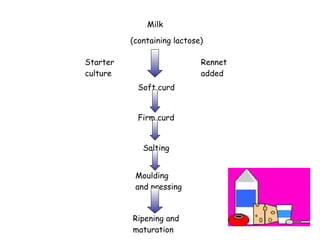
Milk (containing lactose) Starter culture  Rennet added  Soft curd  Firm curd  Salting  Moulding and pressing  Ripening and maturation
The production of cheese Cheese is produced from  Milk   ________ using anaerobic  bacteria. Anaerobic bacteria respire without using __  Oxygen   ______. The way in which cheese is made involves using a starter  _  Culture   ______ which is added to the milk and left for a few  hours to ferment at a temperature of _  37degrees   ____ C. The soft  curd is then _  Salted   ______, moulded and pressed to make the  final cheese.
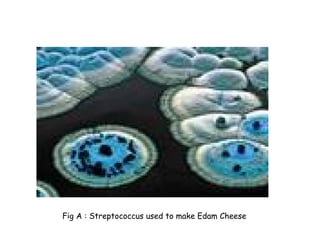
Fig A : Streptococcus used to make Edam Cheese
Yogurt A cultured dairy product Soured by LAB Role of LAB is to produce acid and flavour compounds. Mixed culture usually added to develop different flavour profiles within the product.
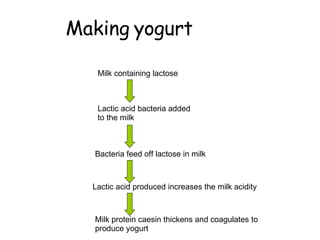
Making yogurt  Milk containing lactose  Lactic acid bacteria added to the milk  Bacteria feed off lactose in milk  Lactic acid produced increases the milk acidity  Milk protein caesin thickens and coagulates to produce yogurt
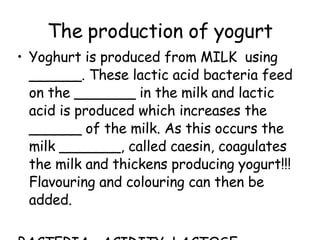
The production of yogurt Yoghurt is produced from MILK  using ______. These lactic acid bacteria feed on the _______ in the milk and lactic acid is produced which increases the ______ of the milk. As this occurs the milk _______, called caesin, coagulates the milk and thickens producing yogurt!!! Flavouring and colouring can then be added.  BACTERIA  ACIDITY  LACTOSE  THICKENS
SUMMARY…. The souring of milk is a fermentation process Fresh milk contains sugars(lactose)and some bacteria The bacteria feed on the sugars The lactose is converted into Lactic acid by BACTERIAL FERMENTATION The increased acidity makes the milk turn sour
Sub Topic B…Problems with profit and waste…
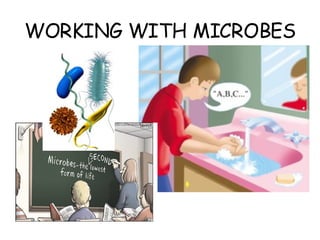
WORKING WITH MICROBES
Microbes can be harmful… Useful microbes like yeast and Lactic acid bacteria are not harmful to humans. Some types of microbe are harmful though… They cause diseases Scientists studying these harmful microbes MUST take precautions to STOP them escaping and contaminating equipment….
..Sterile conditions are VITAL…. Wear lab.coats,overalls,gloves and masks where necessary. Wash hands CAREFULLY. Sterilise equipment and work surfaces. No food or drinks in the lab. Careful disposal of microbes using HIGH TEMPERATURES. These precautions are needed in all biotechnological Processes to avoid contamination of pure cultures of other Microbes by unwanted types from the surroundings
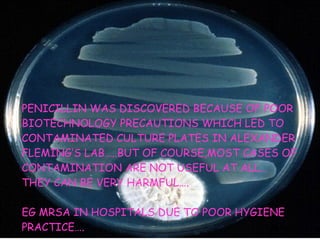
PENICILLIN WAS DISCOVERED BECAUSE OF POOR BIOTECHNOLOGY PRECAUTIONS WHICH LED TO  CONTAMINATED CULTURE PLATES IN ALEXANDER FLEMING’S LAB…..BUT OF COURSE,MOST CASES OF  CONTAMINATION ARE NOT USEFUL AT ALL… THEY CAN BE VERY HARMFUL…. EG MRSA IN HOSPITALS DUE TO POOR HYGIENE PRACTICE….
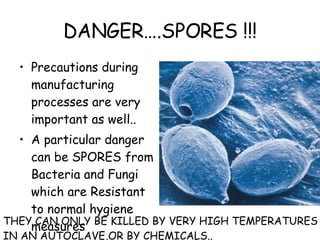
DANGER….SPORES !!! Precautions during manufacturing processes are very important as well.. A particular danger can be SPORES from Bacteria and Fungi which are Resistant to normal hygiene measures THEY CAN ONLY BE KILLED BY VERY HIGH TEMPERATURES IN AN AUTOCLAVE,OR BY CHEMICALS..
USING BACTERIA FOR DECOMPOSITION Decay is important as it recycles raw materials and gets rid of waste at the same time. Decay is the decomposition of ORGANIC matter by Micro-organisms They feed on the waste to provide themselves with ENERGY. During the process,both carbon and nitrogen are recycled DO YOU REMEMBER THE CARBON AND NITROGEN CYCLES ?????
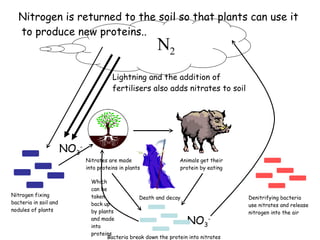
N 2 Nitrogen fixing bacteria in soil and nodules of plants Nitrates are made into proteins in plants NO 3 - Animals get their protein by eating Death and decay Bacteria break down the protein into nitrates NO 3 - Which can be taken back up by plants and made into proteins Denitrifying bacteria use nitrates and release nitrogen into the air Lightning and the addition of fertilisers also adds nitrates to soil Nitrogen is returned to the soil so that plants can use it to produce new proteins..
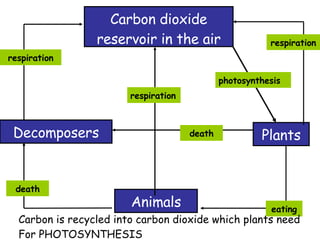
Carbon dioxide reservoir in the air Animals Decomposers Plants eating respiration respiration death death respiration photosynthesis Carbon is recycled into carbon dioxide which plants need For PHOTOSYNTHESIS
Kew Gardens compost heap… … Britains’ largest!
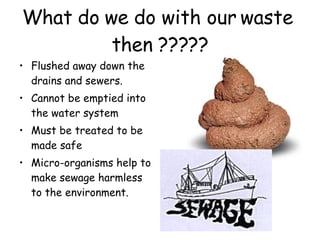
What do we do with our waste  then ????? Flushed away down the drains and sewers. Cannot be emptied into the water system Must be treated to be made safe Micro-organisms help to make sewage harmless to the environment.
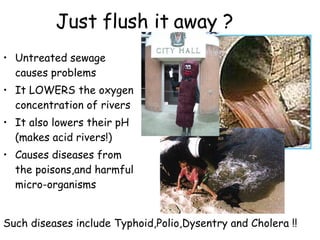
Just flush it away ? Untreated sewage causes problems It LOWERS the oxygen concentration of rivers It also lowers their pH (makes acid rivers!) Causes diseases from the poisons,and harmful micro-organisms Such diseases include Typhoid,Polio,Dysentry and Cholera !!
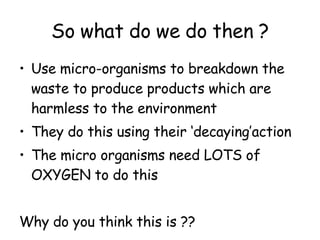
So what do we do then ? Use micro-organisms to breakdown the waste to produce products which are harmless to the environment They do this using their ‘decaying’action The micro organisms need LOTS of OXYGEN to do this Why do you think this is ??
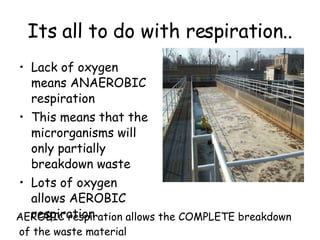
Its all to do with respiration.. Lack of oxygen means ANAEROBIC respiration This means that the microrganisms will only partially breakdown waste Lots of oxygen allows AEROBIC respiration AEROBIC respiration allows the COMPLETE breakdown of the waste material
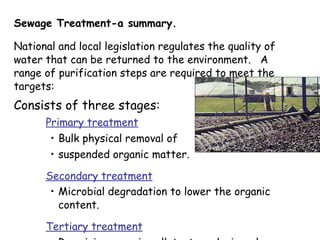
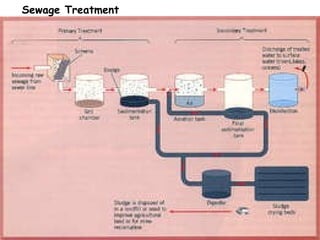
Sewage Treatment-a summary. National and local legislation regulates the quality of water that can be returned to the environment.  A range of purification steps are required to meet the targets: Consists of three stages: Primary treatment   Bulk physical removal of  suspended organic matter. Secondary treatment   Microbial degradation to lower the organic content.   Tertiary treatment Remaining organic pollutants and minerals removed.
Sewage Treatment
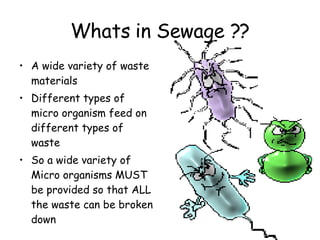
Whats in Sewage ?? A wide variety of waste materials Different types of micro organism feed on different types of waste So a wide variety of Micro organisms MUST be provided so that ALL the waste can be broken down
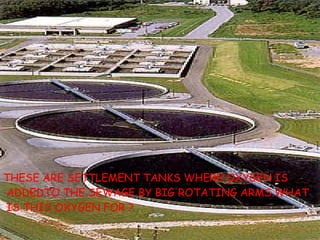
THESE ARE SETTLEMENT TANKS WHERE OXYGEN IS ADDEDTO THE SEWAGE BY BIG ROTATING ARMS.WHAT IS THIS OXYGEN FOR ?
USEFUL PRODUCTS FROM WASTE MATERIALS BIOGAS (usually methane) can be produced from sewage sludge and domestic refuse. High quality PROTEIN foods from waste such as Whey(from cheese making) and fruit pulps (after juice extraction) In this way,useless or poisonous substances are converted Into useful substances such as fuel and food…
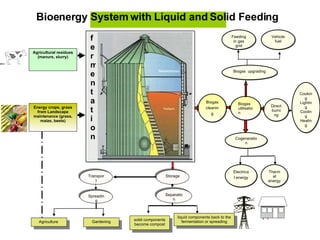
Biogas utilisation Electrical energy Thermal energy Feeding in gas grid Biogas cleaning Biogas  upgrading Cogeneration Cooking Lighting Cooling Heating Direct burning Vehicle fuel Spreading Gardening Agriculture  Transport Energy crops, grass from Landscape maintenance (grass, maize, beets) Agricultural residues (manure, slurry) f e r m e n t a t i o n Bioenergy System with Liquid and Solid Feeding Storage Separation solid components become compost liquid components back to the fermentation or spreading
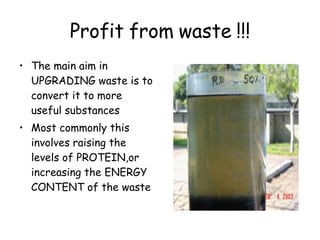
Profit from waste !!! The main aim in UPGRADING waste is to convert it to more useful substances Most commonly this involves raising the levels of PROTEIN,or increasing the ENERGY CONTENT of the waste
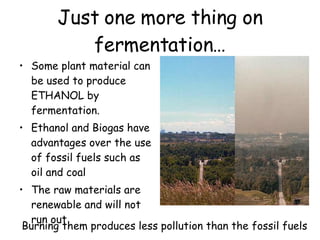
Just one more thing on fermentation… Some plant material can be used to produce ETHANOL by fermentation. Ethanol and Biogas have advantages over the use of fossil fuels such as oil and coal The raw materials are renewable and will not run out Burning them produces less pollution than the fossil fuels
REPROGRAMMING MICROBES.
First of all….some Bacterial Genetics Bacteria have a chromosome which controls all of its activities Genetic engineering allows us to transfer pieces of chromosome from different organisms into bacteria This allows bacteria to make new substances This process involves several steps…..
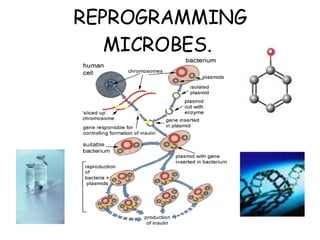
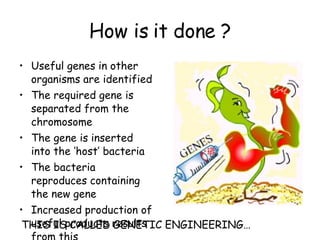
How is it done ? Useful genes in other organisms are identified The required gene is separated from the chromosome The gene is inserted into the ‘host’ bacteria The bacteria reproduces containing the new gene Increased production of useful products results from this THIS IS CALLED GENETIC ENGINEERING…
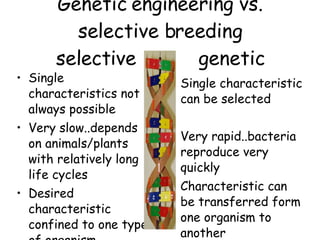
Genetic engineering vs. selective breeding selective  genetic Single characteristics not always possible Very slow..depends on animals/plants with relatively long life cycles Desired characteristic confined to one type of organism Single characteristic can be selected Very rapid..bacteria reproduce very quickly Characteristic can be transferred form one organism to another
More advantages of genetic engineering.. Expensive and difficult to produce substances can be made cheaply and easily eg…….. Insulin for Diabetes Antibiotics such as Penicillin Vaccines for the control of diseases This is how its done………
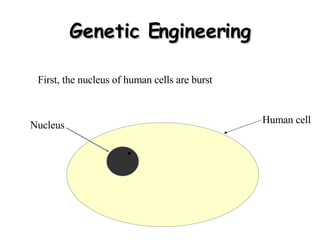
Genetic Engineering First, the nucleus of human cells are burst Human cell Nucleus
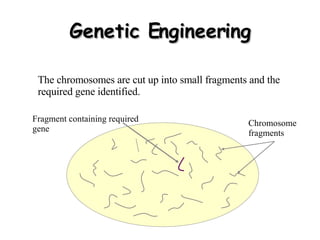
Genetic Engineering The chromosomes are cut up into small fragments and the required gene identified. Chromosome  fragments Fragment containing required gene
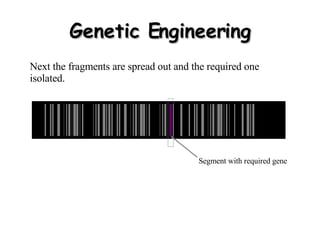
Genetic Engineering Next the fragments are spread out and the required one isolated. Segment with required gene
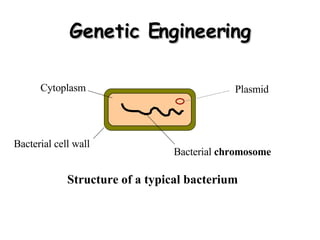
Genetic Engineering Cytoplasm Bacterial  chromosome Bacterial cell wall Plasmid Structure of a typical bacterium
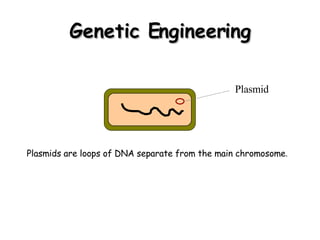
Genetic Engineering Plasmid Plasmids are loops of DNA separate from the main chromosome .
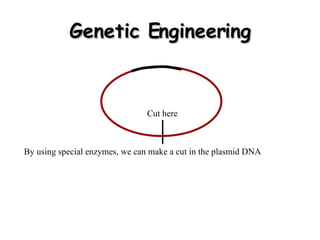
Genetic Engineering By using special enzymes, we can make a cut in the plasmid DNA Cut here
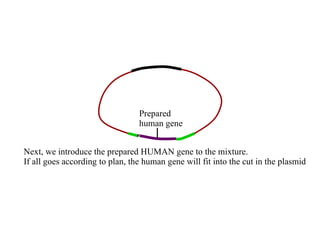
Next, we introduce the prepared HUMAN gene to the mixture.  If all goes according to plan, the human gene will fit into the cut in the plasmid Prepared human gene
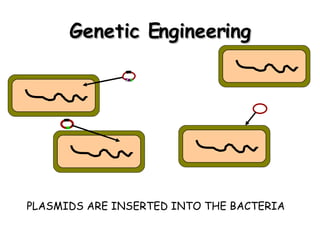
Genetic Engineering PLASMIDS ARE INSERTED INTO THE BACTERIA
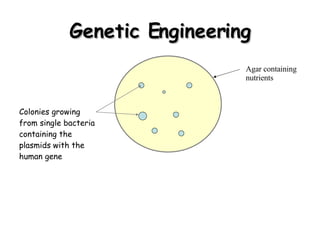
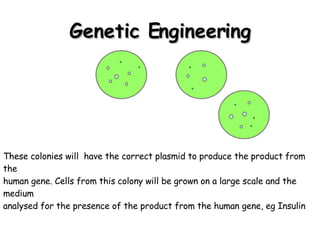
Genetic Engineering Agar containing nutrients Colonies growing from single bacteria containing the plasmids with the human gene
Genetic Engineering These colonies will  have the correct plasmid to produce the product from the human gene. Cells from this colony will be grown on a large scale and the medium analysed for the presence of the product from the human gene, eg Insulin
The need for Insulin is increasing… People are living longer Populations are increasing Diabetes often occurs at middle/old age Unhealthy lifestyles contribute to diabetes Better medical treatments mean that people are living longer
So what's the problem then ? Purifying Insulin from the pancreas of slaughtered cattle and pigs is slow and expensive. Animal Insulin is not as effective as Human insulin. Some people are allergic to animal Insulin Many diabetics object to the use of a product from slaughtered animals…
And the solution ? The insulin produced from bacteria which have been genetically altered is pure Human insulin Its production is quick and inexpensive It has non of the physiological and ethical problems associated with the use of cattle or pig insulin  BUT…. There are dangers involved with genetic engineering.It involves Creating new strains of bacteria which MIGHT prove harmful To animals and plants……an ethical dilemma..
 
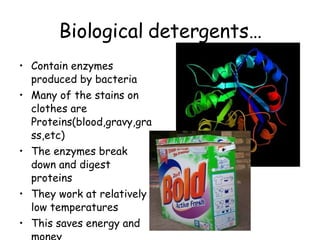
Biological detergents… Contain enzymes produced by bacteria Many of the stains on clothes are Proteins(blood,gravy,grass,etc) The enzymes break down and digest proteins They work at relatively low temperatures This saves energy and money
Disadvantages of Batch Processing Slow and Expensive….Fermenter has to be cleaned and sterilised between each product batch. Enzymes or micro-organisms cannot be recovered for use again at the end of each batch every time. Continuous flow processing solves these problems by relying on.. ENZYME IMMOBILISATION TECHNIQUES
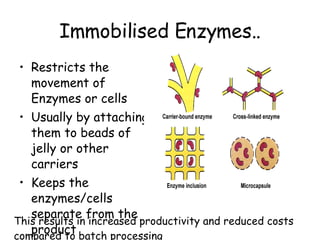
Immobilised Enzymes.. Restricts the movement of Enzymes or cells Usually by attaching them to beads of jelly or other carriers Keeps the enzymes/cells separate from the product This results in increased productivity and reduced costs compared to batch processing
Antibiotics Chemicals which prevent the growth of micro-organisms. There are many different diseases caused by bacteria. Different bacteria are affected by different antibiotics One antibiotic may only work against certain types of bacteria A range of different antibiotics is needed for the treatment Of bacterial diseases
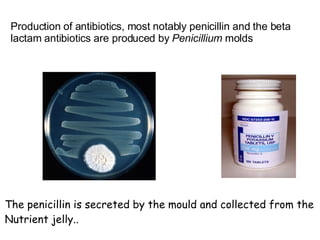
Production of antibiotics, most notably penicillin and the beta lactam antibiotics are produced by  Penicillium  molds The penicillin is secreted by the mould and collected from the  Nutrient jelly..

Biotechnology Std Grade

  • 1.
  • 2.
    What is Biotechnology? The use of organisms to make products for man Raw materials Suitable organisms Usually micro-organisms Biotechnology processes Foods, enzymes, Antibiotics, fuels Sewage treatment Water purification
  • 3.
    Where is itused Brewing Baking Dairy Industry Pollution control Food Industry Medicine Biological detergents Immobilised enzymes
  • 4.
    Ancient Egyptians AncientEgyptians Noticed that when grapes were left a silvery dust appeared on them On leaving them they also noticed they began to break down and leave a liquid behind Alcohol Biotechnology been used for thousands of years but was not given the fancy name
  • 5.
    What is thatdust ? Yeast !! It is a single celled fungus It has no chlorophyll so it has to make its own food Yeast feeds on the sugar in fruit and makes alcohol
  • 6.
    Yeast It isof great use in two major industries Brewing Baking
  • 7.
    Baking After theyeast has been added to the flour mixture the dough is kneaded The mixture is left and we see the dough rise The yeast produces CO 2 which makes the dough rise
  • 8.
    Baking The doughcan now be baked in a hot oven
  • 9.
    Brewing Add yeastto any fruit juice and we will see the yeast convert the sugar into alcohol water
  • 10.
    Fermentation Glucose alcohol+ Carbon Dioxide + Energy In baking the alcohol evaporates The above shows Anaerobic Respiration Little Energy produced in absence of oxygen
  • 11.
    Beer making Avery complex and series of controlled measure goes into making beer There is no involvement of grapes – so how do the yeast get food for energy The Barley grain
  • 12.
    Malting Before theyeast can use the grain for food it must be malted The starch is converted into simple sugars the yeast can break down The barley is spread out in a large area where it is kept moist and warm and allowed to germinate Germination sees the starch being broken down into sugar
  • 13.
  • 14.
    Mash The germinatedgrains are killed by heat to prevent the sugar being used in germination The grains are then crushed into a MASH Water is added As the sugar dissolves in the water it is sweet tasting WORT
  • 15.
    Wort Next ?Extra sugar is added Hops can be added to give flavour Wort is boiled to kill bacteria
  • 16.
    Fermentation The wortis cooled and yeast is added The mixture is allowed to ferment until the yeast is killed by the alcohol
  • 17.
  • 18.
    Storage Stored incontainers to allow it to mature It is then filtered then ………
  • 19.
  • 20.
  • 21.
    Batch Processing Rawmaterials Nutrients fed Into vessel Reactor vessel Fermenter Microbes growing and bringing about fermentation process Micro-organisms fed in
  • 22.
    Product formed Microbesno longer growing Products and microbes removed separately
  • 23.
  • 24.
    Yeast are facultativeorganisms- will grow with or without oxygen In the absence of O 2 , they live by fermentation. End products are alcohol (ethanol) and CO 2 In the presence of O 2 they live by respiration. CO 2 is final product Torula yeast. Candida utilis
  • 25.
    Conditions favoring growthof yeasts: air, sugar, acid food, liquid, wide temperature range Where yeasts are found: environments high in sugar - skins of fruits, nectar of flowers, surfaces of plants and mucous membranes of animals
  • 26.
    Associations with humans:Some yeasts are normal flora of the oral cavity, skin, GI tract and vagina
  • 27.
    Useful fermentations Saccharomycescerevisiae is yeast that is used to ferment sugars to ethanol and CO 2 CO 2 is the desired end product of bread makers that leavens bread. Ethanol is the sought after end product of brewers and winemakers.
  • 28.
    Commercial yeasts forbakers, brewers and wine makers
  • 29.
    Harmful associations -Agents of disease in humans and other animals Candida albicans associates with humans in the mouth, intestine and vagina. It grows in most moist areas. It can cause disease under some conditions. Candida albicans budding cells and colonies
  • 30.
    Harmful associations -Agents of disease in humans and other animals Candida causes thrush in the oral cavity, athlete’s foot, and is the most frequent cause of vaginitis in women. Candidiasis in the oral cavity (thrush) and between toes (“athlete’s foot”)
  • 31.
    Lactic Acid BacteriaThe main bacteria used in manufacture of dairy products are commonly known as Lactic Acid Bacteria (LAB). The bacteria utilise the lactose in the milk to produce lactic acid.
  • 32.
    Cheese Manufacture Startersare used in the manufacture of cheese. Main Types Lactobacillus Lactococcus Leuconostoc Streptococcus
  • 33.
    Role of LacticAcid The fresh acidic flavour of unripened cheese Important to the formation and texturising of the curd. Produces volatile flavours Synthesis of proteolytic and lipolytic enzymes - important in cheese ripening. May influence micro-flora.
  • 34.
    Cheese Ripening Mostcheeses are ripened before consumption from 2 weeks for semi-hard Caerphilly to 2 years for parmesan. Ripened by enzymes derived from rennet, starter m/orgs, non-starter m/orgs and from the milk itself.
  • 35.
    How do youmake cheese? Normal produced from anaerobic fermentation from milk Involves fermentation of milk (lactose) by lactic acid bacteria (streptococcus)
  • 36.
    Milk (containing lactose)Starter culture Rennet added Soft curd Firm curd Salting Moulding and pressing Ripening and maturation
  • 37.
    The production ofcheese Cheese is produced from Milk ________ using anaerobic bacteria. Anaerobic bacteria respire without using __ Oxygen ______. The way in which cheese is made involves using a starter _ Culture ______ which is added to the milk and left for a few hours to ferment at a temperature of _ 37degrees ____ C. The soft curd is then _ Salted ______, moulded and pressed to make the final cheese.
  • 38.
    Fig A :Streptococcus used to make Edam Cheese
  • 39.
    Yogurt A cultureddairy product Soured by LAB Role of LAB is to produce acid and flavour compounds. Mixed culture usually added to develop different flavour profiles within the product.
  • 40.
    Making yogurt Milk containing lactose Lactic acid bacteria added to the milk Bacteria feed off lactose in milk Lactic acid produced increases the milk acidity Milk protein caesin thickens and coagulates to produce yogurt
  • 41.
    The production ofyogurt Yoghurt is produced from MILK using ______. These lactic acid bacteria feed on the _______ in the milk and lactic acid is produced which increases the ______ of the milk. As this occurs the milk _______, called caesin, coagulates the milk and thickens producing yogurt!!! Flavouring and colouring can then be added. BACTERIA ACIDITY LACTOSE THICKENS
  • 42.
    SUMMARY…. The souringof milk is a fermentation process Fresh milk contains sugars(lactose)and some bacteria The bacteria feed on the sugars The lactose is converted into Lactic acid by BACTERIAL FERMENTATION The increased acidity makes the milk turn sour
  • 43.
    Sub Topic B…Problemswith profit and waste…
  • 44.
  • 45.
    Microbes can beharmful… Useful microbes like yeast and Lactic acid bacteria are not harmful to humans. Some types of microbe are harmful though… They cause diseases Scientists studying these harmful microbes MUST take precautions to STOP them escaping and contaminating equipment….
  • 46.
    ..Sterile conditions areVITAL…. Wear lab.coats,overalls,gloves and masks where necessary. Wash hands CAREFULLY. Sterilise equipment and work surfaces. No food or drinks in the lab. Careful disposal of microbes using HIGH TEMPERATURES. These precautions are needed in all biotechnological Processes to avoid contamination of pure cultures of other Microbes by unwanted types from the surroundings
  • 47.
    PENICILLIN WAS DISCOVEREDBECAUSE OF POOR BIOTECHNOLOGY PRECAUTIONS WHICH LED TO CONTAMINATED CULTURE PLATES IN ALEXANDER FLEMING’S LAB…..BUT OF COURSE,MOST CASES OF CONTAMINATION ARE NOT USEFUL AT ALL… THEY CAN BE VERY HARMFUL…. EG MRSA IN HOSPITALS DUE TO POOR HYGIENE PRACTICE….
  • 48.
    DANGER….SPORES !!! Precautionsduring manufacturing processes are very important as well.. A particular danger can be SPORES from Bacteria and Fungi which are Resistant to normal hygiene measures THEY CAN ONLY BE KILLED BY VERY HIGH TEMPERATURES IN AN AUTOCLAVE,OR BY CHEMICALS..
  • 49.
    USING BACTERIA FORDECOMPOSITION Decay is important as it recycles raw materials and gets rid of waste at the same time. Decay is the decomposition of ORGANIC matter by Micro-organisms They feed on the waste to provide themselves with ENERGY. During the process,both carbon and nitrogen are recycled DO YOU REMEMBER THE CARBON AND NITROGEN CYCLES ?????
  • 50.
    N 2 Nitrogenfixing bacteria in soil and nodules of plants Nitrates are made into proteins in plants NO 3 - Animals get their protein by eating Death and decay Bacteria break down the protein into nitrates NO 3 - Which can be taken back up by plants and made into proteins Denitrifying bacteria use nitrates and release nitrogen into the air Lightning and the addition of fertilisers also adds nitrates to soil Nitrogen is returned to the soil so that plants can use it to produce new proteins..
  • 51.
    Carbon dioxide reservoirin the air Animals Decomposers Plants eating respiration respiration death death respiration photosynthesis Carbon is recycled into carbon dioxide which plants need For PHOTOSYNTHESIS
  • 52.
    Kew Gardens compostheap… … Britains’ largest!
  • 53.
    What do wedo with our waste then ????? Flushed away down the drains and sewers. Cannot be emptied into the water system Must be treated to be made safe Micro-organisms help to make sewage harmless to the environment.
  • 54.
    Just flush itaway ? Untreated sewage causes problems It LOWERS the oxygen concentration of rivers It also lowers their pH (makes acid rivers!) Causes diseases from the poisons,and harmful micro-organisms Such diseases include Typhoid,Polio,Dysentry and Cholera !!
  • 55.
    So what dowe do then ? Use micro-organisms to breakdown the waste to produce products which are harmless to the environment They do this using their ‘decaying’action The micro organisms need LOTS of OXYGEN to do this Why do you think this is ??
  • 56.
    Its all todo with respiration.. Lack of oxygen means ANAEROBIC respiration This means that the microrganisms will only partially breakdown waste Lots of oxygen allows AEROBIC respiration AEROBIC respiration allows the COMPLETE breakdown of the waste material
  • 57.
    Sewage Treatment-a summary.National and local legislation regulates the quality of water that can be returned to the environment. A range of purification steps are required to meet the targets: Consists of three stages: Primary treatment Bulk physical removal of suspended organic matter. Secondary treatment Microbial degradation to lower the organic content. Tertiary treatment Remaining organic pollutants and minerals removed.
  • 58.
  • 59.
    Whats in Sewage?? A wide variety of waste materials Different types of micro organism feed on different types of waste So a wide variety of Micro organisms MUST be provided so that ALL the waste can be broken down
  • 60.
    THESE ARE SETTLEMENTTANKS WHERE OXYGEN IS ADDEDTO THE SEWAGE BY BIG ROTATING ARMS.WHAT IS THIS OXYGEN FOR ?
  • 61.
    USEFUL PRODUCTS FROMWASTE MATERIALS BIOGAS (usually methane) can be produced from sewage sludge and domestic refuse. High quality PROTEIN foods from waste such as Whey(from cheese making) and fruit pulps (after juice extraction) In this way,useless or poisonous substances are converted Into useful substances such as fuel and food…
  • 62.
    Biogas utilisation Electricalenergy Thermal energy Feeding in gas grid Biogas cleaning Biogas upgrading Cogeneration Cooking Lighting Cooling Heating Direct burning Vehicle fuel Spreading Gardening Agriculture Transport Energy crops, grass from Landscape maintenance (grass, maize, beets) Agricultural residues (manure, slurry) f e r m e n t a t i o n Bioenergy System with Liquid and Solid Feeding Storage Separation solid components become compost liquid components back to the fermentation or spreading
  • 63.
    Profit from waste!!! The main aim in UPGRADING waste is to convert it to more useful substances Most commonly this involves raising the levels of PROTEIN,or increasing the ENERGY CONTENT of the waste
  • 64.
    Just one morething on fermentation… Some plant material can be used to produce ETHANOL by fermentation. Ethanol and Biogas have advantages over the use of fossil fuels such as oil and coal The raw materials are renewable and will not run out Burning them produces less pollution than the fossil fuels
  • 65.
  • 66.
    First of all….someBacterial Genetics Bacteria have a chromosome which controls all of its activities Genetic engineering allows us to transfer pieces of chromosome from different organisms into bacteria This allows bacteria to make new substances This process involves several steps…..
  • 67.
    How is itdone ? Useful genes in other organisms are identified The required gene is separated from the chromosome The gene is inserted into the ‘host’ bacteria The bacteria reproduces containing the new gene Increased production of useful products results from this THIS IS CALLED GENETIC ENGINEERING…
  • 68.
    Genetic engineering vs.selective breeding selective genetic Single characteristics not always possible Very slow..depends on animals/plants with relatively long life cycles Desired characteristic confined to one type of organism Single characteristic can be selected Very rapid..bacteria reproduce very quickly Characteristic can be transferred form one organism to another
  • 69.
    More advantages ofgenetic engineering.. Expensive and difficult to produce substances can be made cheaply and easily eg…….. Insulin for Diabetes Antibiotics such as Penicillin Vaccines for the control of diseases This is how its done………
  • 70.
    Genetic Engineering First,the nucleus of human cells are burst Human cell Nucleus
  • 71.
    Genetic Engineering Thechromosomes are cut up into small fragments and the required gene identified. Chromosome fragments Fragment containing required gene
  • 72.
    Genetic Engineering Nextthe fragments are spread out and the required one isolated. Segment with required gene
  • 73.
    Genetic Engineering CytoplasmBacterial chromosome Bacterial cell wall Plasmid Structure of a typical bacterium
  • 74.
    Genetic Engineering PlasmidPlasmids are loops of DNA separate from the main chromosome .
  • 75.
    Genetic Engineering Byusing special enzymes, we can make a cut in the plasmid DNA Cut here
  • 76.
    Next, we introducethe prepared HUMAN gene to the mixture. If all goes according to plan, the human gene will fit into the cut in the plasmid Prepared human gene
  • 77.
    Genetic Engineering PLASMIDSARE INSERTED INTO THE BACTERIA
  • 78.
    Genetic Engineering Agarcontaining nutrients Colonies growing from single bacteria containing the plasmids with the human gene
  • 79.
    Genetic Engineering Thesecolonies will have the correct plasmid to produce the product from the human gene. Cells from this colony will be grown on a large scale and the medium analysed for the presence of the product from the human gene, eg Insulin
  • 80.
    The need forInsulin is increasing… People are living longer Populations are increasing Diabetes often occurs at middle/old age Unhealthy lifestyles contribute to diabetes Better medical treatments mean that people are living longer
  • 81.
    So what's theproblem then ? Purifying Insulin from the pancreas of slaughtered cattle and pigs is slow and expensive. Animal Insulin is not as effective as Human insulin. Some people are allergic to animal Insulin Many diabetics object to the use of a product from slaughtered animals…
  • 82.
    And the solution? The insulin produced from bacteria which have been genetically altered is pure Human insulin Its production is quick and inexpensive It has non of the physiological and ethical problems associated with the use of cattle or pig insulin BUT…. There are dangers involved with genetic engineering.It involves Creating new strains of bacteria which MIGHT prove harmful To animals and plants……an ethical dilemma..
  • 83.
  • 84.
    Biological detergents… Containenzymes produced by bacteria Many of the stains on clothes are Proteins(blood,gravy,grass,etc) The enzymes break down and digest proteins They work at relatively low temperatures This saves energy and money
  • 85.
    Disadvantages of BatchProcessing Slow and Expensive….Fermenter has to be cleaned and sterilised between each product batch. Enzymes or micro-organisms cannot be recovered for use again at the end of each batch every time. Continuous flow processing solves these problems by relying on.. ENZYME IMMOBILISATION TECHNIQUES
  • 86.
    Immobilised Enzymes.. Restrictsthe movement of Enzymes or cells Usually by attaching them to beads of jelly or other carriers Keeps the enzymes/cells separate from the product This results in increased productivity and reduced costs compared to batch processing
  • 87.
    Antibiotics Chemicals whichprevent the growth of micro-organisms. There are many different diseases caused by bacteria. Different bacteria are affected by different antibiotics One antibiotic may only work against certain types of bacteria A range of different antibiotics is needed for the treatment Of bacterial diseases
  • 88.
    Production of antibiotics,most notably penicillin and the beta lactam antibiotics are produced by Penicillium molds The penicillin is secreted by the mould and collected from the Nutrient jelly..