Green electronics:
a technology for a sustainable future
E. Fortunato, P. Barquinha, D. Gaspar, R. Branquinho,
E. Carlos, L. Pereira, A. Vicente, H. Águas, and R. Martins
CENIMAT/I3N, Materials Science Department, Faculty of Sciences and Technology,
Universidade Nova de Lisboa and CEMOP/UNINOVA, Campus de Caparica, 2829-516 Caparica,
Portugal
Outline
 Oxitronics (oxide electronics/transparent
electronics)
 Papertronics (paper electronics)
 Applications @CENIMAT
 Conclusions
 Challenges/Opportunities
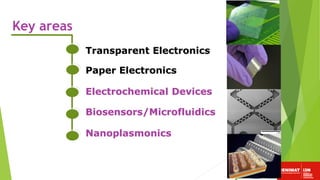
Key areas
Nanoplasmonics
Transparent Electronics
Electrochemical Devices
Paper Electronics
Biosensors/Microfluidics
Analog
Digital
Feature displays
Smart displays
Big Data
Flexible
Devices
IoT
Convergence
Wearable
Devices
Cloud
Touch
Screen
1990’s Near Future2000’s
Transparent bus
Metal oxide semiconductors
Low cost
Biocompatible
Recyclable
Green technology
Superior electrical performances
Materials
Devices
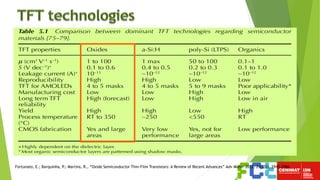
Fortunato, E.; Barquinha, P.; Martins, R., “Oxide Semiconductor Thin-Film Transistors: A Review of Recent Advances” Adv Mater 2012, 24 (22), 2945-2986.
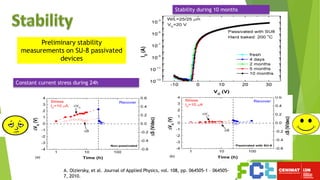
Preliminary stability
measurements on SU-8 passivated
devices
Stability during 10 months
Constant current stress during 24h
A. Olziersky, et al. Journal of Applied Physics, vol. 108, pp. 064505-1 – 064505-
7, 2010.
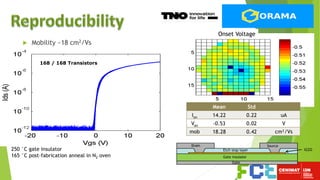
 Mobility ~18 cm2/Vs
 Excellent uniformity
168 / 168 Transistors
Onset Voltage
250 °C gate insulator
165 °C post-fabrication anneal in N2 oven
Mean Std
Ion 14.22 0.22 uA
Von -0.53 0.02 V
mob 18.28 0.42 cm²/Vs
Gate
Drain Source
Etch stop layer
Gate insulator
IGZO
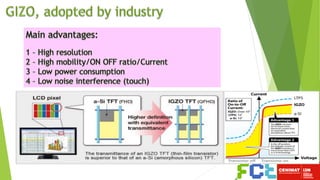
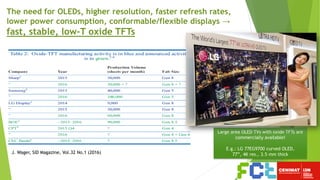
The need for OLEDs, higher resolution, faster refresh rates,
lower power consumption, conformable/flexible displays →
fast, stable, low-T oxide TFTs
Large area OLED TVs with oxide TFTs are
commercially available!
E.g.: LG 77EG9700 curved OLED,
77”, 4K res., 3.5 mm thickJ. Wager, SID Magazine, Vol.32 No.1 (2016)
Data from: Display Bank
But...
Oxide TFTs: are much
more than
transparency!
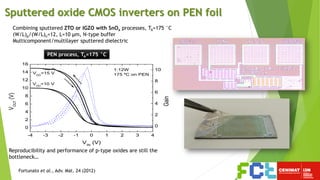
Combining sputtered ZTO or IGZO with SnOx processes, TA=175 °C
(W/L)p/(W/L)n=12, L=10 μm, N-type buffer
Multicomponent/multilayer sputtered dielectric
-4 -3 -2 -1 0 1 2 3 4
0
2
4
6
8
10
12
14
16
VDD
=15 V
VOUT
(V)
VIN
(V)
VDD
=10 V
1:12W
175 ºC on PEN
0
2
4
6
8
10
Gain
PEN process, TA=175 °C
Sputtered oxide CMOS inverters on PEN foil
Fortunato et al., Adv. Mat. 24 (2012)
Reproducibility and performance of p-type oxides are still the
bottleneck…
Freq. response
Circuit No. of
TFTs
C (pF) Power
(mW)
Bandwidth
(kHz)
Gain
(dB)
Load
Amp3 5 40 0.576 20 22 10 MΩ//16 pF
Amp3 5 330 0.576 5 34 10 MΩ//16 pF
[ref] 16 - 0.9 54 18.7 1 MΩ//2 pF
Analog blocks with high-gain topology with IGZO TFTs
P. Bahubalindruni et al., IEEE JDT 11 (2015)
Functional verification, kHz
Adder-subtractor Amplifier
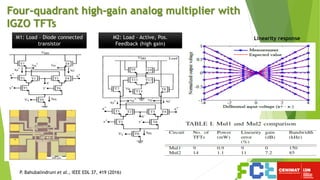
Four-quadrant high-gain analog multiplier with
IGZO TFTs
M1: Load – Diode connected
transistor
M2: Load – Active, Pos.
Feedback (high gain)
Linearity response
P. Bahubalindruni et al., IEEE EDL 37, 419 (2016)
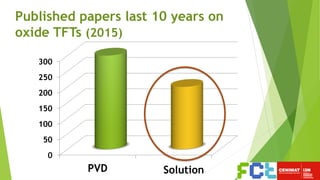
Solution process
0
50
100
150
200
250
300
PVD CVD
Published papers last 10 years on
oxide TFTs (2015)
Solution
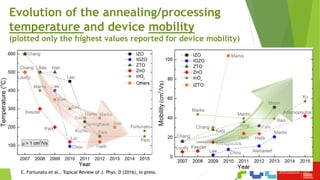
Evolution of the annealing/processing
temperature and device mobility
(plotted only the highest values reported for device mobility)
E. Fortunato et al., Topical Review of J. Phys. D (2016), in press.
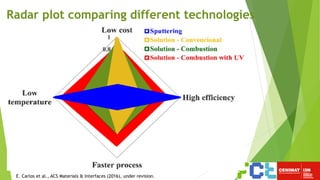
Radar plot comparing different technologies
E. Carlos et al., ACS Materials & Interfaces (2016), under revision.
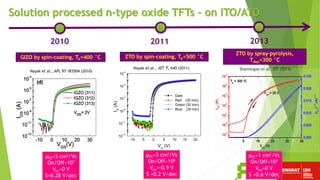
GIZO by spin-coating, TA=400 °C
µFE≈5 cm2/Vs
On/Off≈107
Von≈0 V
S=0.28 V/dec
ZTO by spin-coating, TA=500 °C
µFE≈5 cm2/Vs
On/Off≈108
Von=-0.9 V
S ≈0.2 V/dec
ZTO by spray-pyrolysis,
Tdep=300 °C
µFE≈1 cm2/Vs
On/Off≈105
Von≈0 V
S ≈0.6 V/dec
Shanmugan et al. JDT (2013)Nayak et al., APL 97 183504 (2010)
Solution processed n-type oxide TFTs – on ITO/ATO
Nayak et al., JDT 7, 640 (2011)
2010 2011 2013
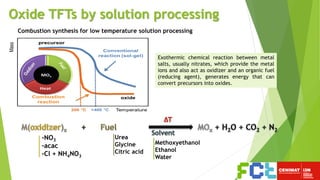
Oxide TFTs by solution processing
Combustion synthesis for low temperature solution processing
Methoxyethanol
Ethanol
Water
Urea
Glycine
Citric acid
-NO3
-acac
-Cl + NH4NO3
Exothermic chemical reaction between metal
salts, usually nitrates, which provide the metal
ions and also act as oxidizer and an organic fuel
(reducing agent), generates energy that can
convert precursors into oxides.
Si
SiO2
GZTO
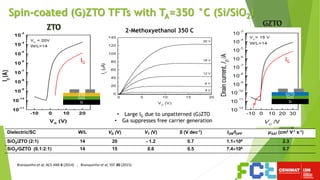
Dielectric/SC W/L VD (V) VT (V) S (V dec-1) ION/IOFF µSAT (cm2 V-1 s-1)
SiO2/ZTO (2:1) 14 20 - 1.2 0.7 1.1106 2.3
SiO2/GZTO (0.1:2:1) 14 15 0.6 0.5 7.4106 0.7
IG
Si
SiO2
ZTO
IG
2-Methoxyethanol 350 C
• Large IG due to unpatterned (G)ZTO
• Ga suppresses free carrier generation
Spin-coated (G)ZTO TFTs with TA=350 °C (Si/SiO2)
Branquinho et al, ACS AMI 6 (2014) , Branquinho et al, SST 30 (2015)
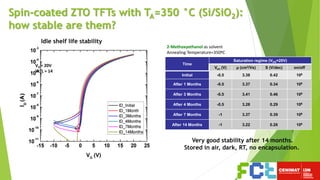
Idle shelf life stability
Very good stability after 14 months.
Stored in air, dark, RT, no encapsulation.
2-Methoxyethanol as solvent
Annealing Temperature=350ºC
Spin-coated ZTO TFTs with TA=350 °C (Si/SiO2):
how stable are them?
VD = 20V
W/L = 14
Time
Saturation regime (VDS=20V)
Von (V) µ (cm2/Vs) S (V/dec) on/off
Initial -0.5 3.38 0.42 106
After 1 Months -0.5 3.37 0.34 106
After 3 Months -0.5 3.41 0.46 106
After 4 Months -0.5 3.28 0.29 106
After 7 Months -1 3.37 0.39 106
After 14 Months -1 3.22 0.26 108
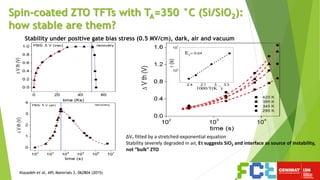
Kiazadeh et al, APL Materials 3, 062804 (2015)
ΔVT fitted by a stretched-exponential equation
Stability severely degraded in air, Eτ suggests SiO2 and interface as source of instability,
not “bulk” ZTO
Stability under positive gate bias stress (0.5 MV/cm), dark, air and vacuum
Spin-coated ZTO TFTs with TA=350 °C (Si/SiO2):
how stable are them?
44
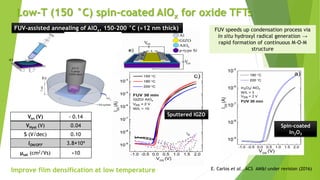
Von (V) - 0.14
VHyst (V) 0.04
S (V/dec) 0.10
ION/OFF 3.8×10⁴
µsat (cm2/Vs) ≈10
Low-T (150 °C) spin-coated AlOx for oxide TFTs
E. Carlos et al., ACS AM&I under revision (2016)
FUV speeds up condensation process via
in situ hydroxyl radical generation →
rapid formation of continuous M-O-M
structure
FUV-assisted annealing of AlOx, 150-200 °C (≈12 nm thick)
Sputtered IGZO
Spin-coated
In2O3
Improve film densification at low temperature
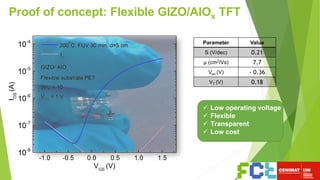
Proof of concept: Flexible GIZO/AlOx TFT
 Low operating voltage
 Flexible
 Transparent
 Low cost
Parameter Value
S (V/dec) 0.21
µ (cm2/Vs) 7.7
Von (V) - 0.36
VT (V) 0.18
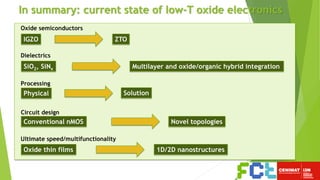
In summary: current state of low-T oxide electronics
IGZO ZTO
Oxide thin films 1D/2D nanostructures
Physical Solution
Novel topologies
Multilayer and oxide/organic hybrid integrationSiO2, SiNx
Conventional nMOS
Oxide semiconductors
Dielectrics
Processing
Circuit design
Ultimate speed/multifunctionality
In 2008 …
Thin Film Transistors – interstrate
structure
Patent: E. FORTUNATO, R. MARTINS, P. BARQUINHA, G. GONLAVES, N. CORREIA, PROCEDURE FOR THE USE OF NATURAL CELLULOSE MATERIAL,
SYNTHETIC MATERIAL OR MIXED NATURAL ANS SYNTHETIC MATERIAL SIMULTANEOUSLY AS PHYSICAL AND DIELECTRIC SUPPORT IN SELF-
SUSTAINABLE FIELD EFFECT ELECTRONIC AND OPTOELECTRONIC DEVICES; PTI 40053-09-PT.
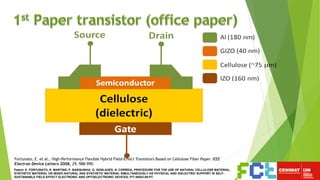
Fortunato, E. et al., High-Performance Flexible Hybrid Field-Effect Transistors Based on Cellulose Fiber Paper. IEEE
Electron Device Letters 2008, 29, 988-990.
Why paper?
Most abundant biopolymer and environmentally friendly
Flexible and unbreakable
Low cost material
The lightest known material
Well established production technology (100 km/h)
Good dielectric properties
Paper is ubiquitous
Recyclable
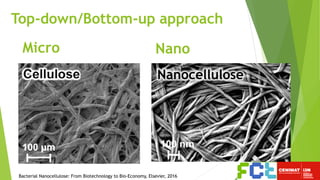
Top-down/Bottom-up approach
NanoMicro
Nanocellulose
Bacterial Nanocellulose: From Biotechnology to Bio-Economy, Elsevier, 2016
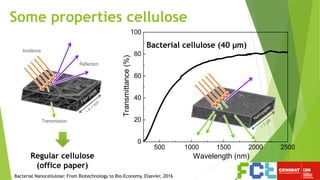
Some properties cellulose
Nano
10 15 20 25 30 35 40
(004)
Bacterial cellulose
Ic
= 92%
Intensity(a.u.)
2 (degrees)
(200)
(110)
(110)
Micro
80%
>90%
Segal et al.
Bacterial Nanocellulose: From Biotechnology to Bio-Economy, Elsevier, 2016
500 1000 1500 2000 2500
0
20
40
60
80
100
Transmittance(%)
Wavelength (nm)
Incidence
Reflection
Transmission
Filter paper
Nanopaper
~
1
µm
~
0.1
m
m
Incidence
Reflection
Transmission
Filter paper
Nanopaper
~
1
µm
~
0.1
m
m
Regular cellulose
(office paper)
Bacterial cellulose (40 μm)
Some properties cellulose
Bacterial Nanocellulose: From Biotechnology to Bio-Economy, Elsevier, 2016
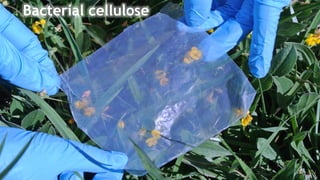
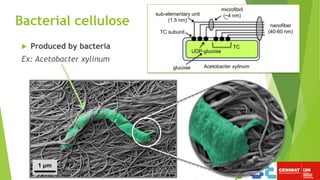
Bacterial cellulose
Bacterial cellulose
 Produced by bacteria
Ex: Acetobacter xylinum
TC
glucose
UDP-glucose
TC subunit
Acetobacter xylinum
nanofiber
(40-60 nm)
sub-elementary unit
(1.5 nm)
microfibril
(~4 nm)
1 µm
2-3 days
4-5 years
Work done @CENIMAT
Electronic devices/circuits
Solar cells
Electrochromic devices
Work done @CENIMAT
Biosensors
Affordable
Sensitive
Specific
User-friendly
Rapid and Robust
Equipment-free
Delivered to those in need
World Health Organization
The WHO established guidelines for developing
diagnostic tests adequate for developing countries
and resource-poor settings, which are summarized under
the acronym ASSURED
NSF, Workshop on Papertronics, Arlington, 2016.
90% glucose testing
8% - 10% increase in industry per year
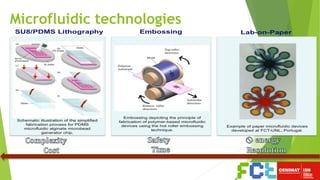
Microfluidic technologies
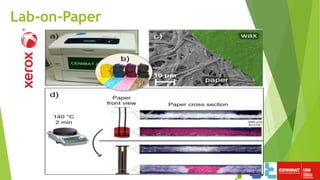
Lab-on-Paper
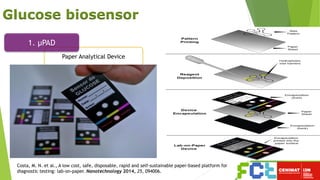
Paper Analytical Device
Glucose biosensor
1. μPAD
Costa, M. N. et al., A low cost, safe, disposable, rapid and self-sustainable paper-based platform for
diagnostic testing: lab-on-paper. Nanotechnology 2014, 25, 094006.
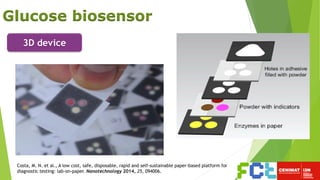
Glucose biosensor
3D device
Costa, M. N. et al., A low cost, safe, disposable, rapid and self-sustainable paper-based platform for
diagnostic testing: lab-on-paper. Nanotechnology 2014, 25, 094006.
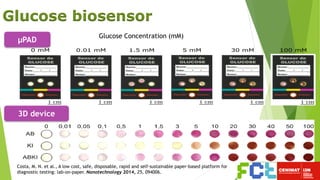
Glucose biosensor
0 mM 0.01 mM 1.5 mM 5 mM 30 mM 100 mM
Glucose Concentration (mM)
μPAD
3D device
Costa, M. N. et al., A low cost, safe, disposable, rapid and self-sustainable paper-based platform for
diagnostic testing: lab-on-paper. Nanotechnology 2014, 25, 094006.
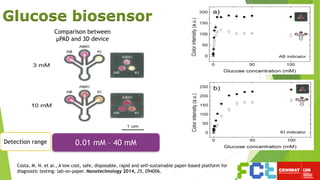
Glucose biosensor
Comparison between
μPAD and 3D device
Detection range 0.01 mM – 40 mM
Costa, M. N. et al., A low cost, safe, disposable, rapid and self-sustainable paper-based platform for
diagnostic testing: lab-on-paper. Nanotechnology 2014, 25, 094006.
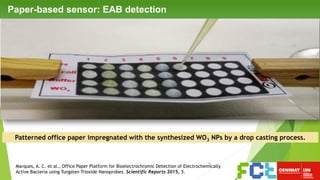
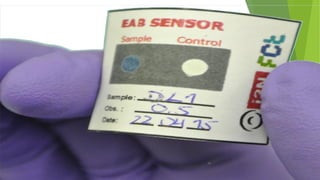
Paper-based sensor: EAB detection
72
Patterned office paper impregnated with the synthesized WO3 NPs by a drop casting process.
Marques, A. C. et al., Office Paper Platform for Bioelectrochromic Detection of Electrochemically
Active Bacteria using Tungsten Trioxide Nanoprobes. Scientific Reports 2015, 5.
73
Geobacter
Colorimetric assays - optimization
10 µL 15 g/L h - WO3 NPs
20 µL Gs and E. coli
Well diameter: 3.38 mm
15 g/L: linear response
EAB detection at latent phase
Response time ~ 2 hours
[Gs]
[WO3NPs]
Marques, A. C. et al., Office Paper Platform for Bioelectrochromic Detection of Electrochemically
Active Bacteria using Tungsten Trioxide Nanoprobes. Scientific Reports 2015, 5.
75
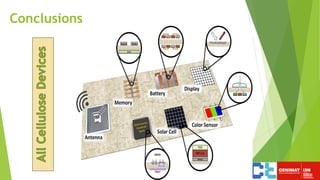
Conclusions
“If you want to go fast, go alone.
If you want to go far, go together”
Acknowledgments – Current Projects
Green electronics: a technology for a sustainable future.

Green electronics: a technology for a sustainable future.

  • 1.
    Green electronics: a technologyfor a sustainable future E. Fortunato, P. Barquinha, D. Gaspar, R. Branquinho, E. Carlos, L. Pereira, A. Vicente, H. Águas, and R. Martins CENIMAT/I3N, Materials Science Department, Faculty of Sciences and Technology, Universidade Nova de Lisboa and CEMOP/UNINOVA, Campus de Caparica, 2829-516 Caparica, Portugal
  • 2.
    Outline  Oxitronics (oxideelectronics/transparent electronics)  Papertronics (paper electronics)  Applications @CENIMAT  Conclusions  Challenges/Opportunities
  • 5.
    Key areas Nanoplasmonics Transparent Electronics ElectrochemicalDevices Paper Electronics Biosensors/Microfluidics
  • 11.
    Analog Digital Feature displays Smart displays BigData Flexible Devices IoT Convergence Wearable Devices Cloud Touch Screen 1990’s Near Future2000’s
  • 16.
  • 18.
  • 21.
    Low cost Biocompatible Recyclable Green technology Superiorelectrical performances Materials Devices
  • 22.
    Fortunato, E.; Barquinha,P.; Martins, R., “Oxide Semiconductor Thin-Film Transistors: A Review of Recent Advances” Adv Mater 2012, 24 (22), 2945-2986.
  • 24.
    Preliminary stability measurements onSU-8 passivated devices Stability during 10 months Constant current stress during 24h A. Olziersky, et al. Journal of Applied Physics, vol. 108, pp. 064505-1 – 064505- 7, 2010.
  • 25.
     Mobility ~18cm2/Vs  Excellent uniformity 168 / 168 Transistors Onset Voltage 250 °C gate insulator 165 °C post-fabrication anneal in N2 oven Mean Std Ion 14.22 0.22 uA Von -0.53 0.02 V mob 18.28 0.42 cm²/Vs Gate Drain Source Etch stop layer Gate insulator IGZO
  • 26.
    The need forOLEDs, higher resolution, faster refresh rates, lower power consumption, conformable/flexible displays → fast, stable, low-T oxide TFTs Large area OLED TVs with oxide TFTs are commercially available! E.g.: LG 77EG9700 curved OLED, 77”, 4K res., 3.5 mm thickJ. Wager, SID Magazine, Vol.32 No.1 (2016)
  • 27.
  • 28.
  • 29.
    Oxide TFTs: aremuch more than transparency!
  • 30.
    Combining sputtered ZTOor IGZO with SnOx processes, TA=175 °C (W/L)p/(W/L)n=12, L=10 μm, N-type buffer Multicomponent/multilayer sputtered dielectric -4 -3 -2 -1 0 1 2 3 4 0 2 4 6 8 10 12 14 16 VDD =15 V VOUT (V) VIN (V) VDD =10 V 1:12W 175 ºC on PEN 0 2 4 6 8 10 Gain PEN process, TA=175 °C Sputtered oxide CMOS inverters on PEN foil Fortunato et al., Adv. Mat. 24 (2012) Reproducibility and performance of p-type oxides are still the bottleneck…
  • 31.
    Freq. response Circuit No.of TFTs C (pF) Power (mW) Bandwidth (kHz) Gain (dB) Load Amp3 5 40 0.576 20 22 10 MΩ//16 pF Amp3 5 330 0.576 5 34 10 MΩ//16 pF [ref] 16 - 0.9 54 18.7 1 MΩ//2 pF Analog blocks with high-gain topology with IGZO TFTs P. Bahubalindruni et al., IEEE JDT 11 (2015) Functional verification, kHz Adder-subtractor Amplifier
  • 32.
    Four-quadrant high-gain analogmultiplier with IGZO TFTs M1: Load – Diode connected transistor M2: Load – Active, Pos. Feedback (high gain) Linearity response P. Bahubalindruni et al., IEEE EDL 37, 419 (2016)
  • 35.
  • 36.
    0 50 100 150 200 250 300 PVD CVD Published paperslast 10 years on oxide TFTs (2015) Solution
  • 37.
    Evolution of theannealing/processing temperature and device mobility (plotted only the highest values reported for device mobility) E. Fortunato et al., Topical Review of J. Phys. D (2016), in press.
  • 38.
    Radar plot comparingdifferent technologies E. Carlos et al., ACS Materials & Interfaces (2016), under revision.
  • 39.
    GIZO by spin-coating,TA=400 °C µFE≈5 cm2/Vs On/Off≈107 Von≈0 V S=0.28 V/dec ZTO by spin-coating, TA=500 °C µFE≈5 cm2/Vs On/Off≈108 Von=-0.9 V S ≈0.2 V/dec ZTO by spray-pyrolysis, Tdep=300 °C µFE≈1 cm2/Vs On/Off≈105 Von≈0 V S ≈0.6 V/dec Shanmugan et al. JDT (2013)Nayak et al., APL 97 183504 (2010) Solution processed n-type oxide TFTs – on ITO/ATO Nayak et al., JDT 7, 640 (2011) 2010 2011 2013
  • 40.
    Oxide TFTs bysolution processing Combustion synthesis for low temperature solution processing Methoxyethanol Ethanol Water Urea Glycine Citric acid -NO3 -acac -Cl + NH4NO3 Exothermic chemical reaction between metal salts, usually nitrates, which provide the metal ions and also act as oxidizer and an organic fuel (reducing agent), generates energy that can convert precursors into oxides.
  • 41.
    Si SiO2 GZTO Dielectric/SC W/L VD(V) VT (V) S (V dec-1) ION/IOFF µSAT (cm2 V-1 s-1) SiO2/ZTO (2:1) 14 20 - 1.2 0.7 1.1106 2.3 SiO2/GZTO (0.1:2:1) 14 15 0.6 0.5 7.4106 0.7 IG Si SiO2 ZTO IG 2-Methoxyethanol 350 C • Large IG due to unpatterned (G)ZTO • Ga suppresses free carrier generation Spin-coated (G)ZTO TFTs with TA=350 °C (Si/SiO2) Branquinho et al, ACS AMI 6 (2014) , Branquinho et al, SST 30 (2015)
  • 42.
    Idle shelf lifestability Very good stability after 14 months. Stored in air, dark, RT, no encapsulation. 2-Methoxyethanol as solvent Annealing Temperature=350ºC Spin-coated ZTO TFTs with TA=350 °C (Si/SiO2): how stable are them? VD = 20V W/L = 14 Time Saturation regime (VDS=20V) Von (V) µ (cm2/Vs) S (V/dec) on/off Initial -0.5 3.38 0.42 106 After 1 Months -0.5 3.37 0.34 106 After 3 Months -0.5 3.41 0.46 106 After 4 Months -0.5 3.28 0.29 106 After 7 Months -1 3.37 0.39 106 After 14 Months -1 3.22 0.26 108
  • 43.
    Kiazadeh et al,APL Materials 3, 062804 (2015) ΔVT fitted by a stretched-exponential equation Stability severely degraded in air, Eτ suggests SiO2 and interface as source of instability, not “bulk” ZTO Stability under positive gate bias stress (0.5 MV/cm), dark, air and vacuum Spin-coated ZTO TFTs with TA=350 °C (Si/SiO2): how stable are them?
  • 44.
    44 Von (V) -0.14 VHyst (V) 0.04 S (V/dec) 0.10 ION/OFF 3.8×10⁴ µsat (cm2/Vs) ≈10 Low-T (150 °C) spin-coated AlOx for oxide TFTs E. Carlos et al., ACS AM&I under revision (2016) FUV speeds up condensation process via in situ hydroxyl radical generation → rapid formation of continuous M-O-M structure FUV-assisted annealing of AlOx, 150-200 °C (≈12 nm thick) Sputtered IGZO Spin-coated In2O3 Improve film densification at low temperature
  • 45.
    Proof of concept:Flexible GIZO/AlOx TFT  Low operating voltage  Flexible  Transparent  Low cost Parameter Value S (V/dec) 0.21 µ (cm2/Vs) 7.7 Von (V) - 0.36 VT (V) 0.18
  • 46.
    In summary: currentstate of low-T oxide electronics IGZO ZTO Oxide thin films 1D/2D nanostructures Physical Solution Novel topologies Multilayer and oxide/organic hybrid integrationSiO2, SiNx Conventional nMOS Oxide semiconductors Dielectrics Processing Circuit design Ultimate speed/multifunctionality
  • 48.
    In 2008 … ThinFilm Transistors – interstrate structure
  • 50.
    Patent: E. FORTUNATO,R. MARTINS, P. BARQUINHA, G. GONLAVES, N. CORREIA, PROCEDURE FOR THE USE OF NATURAL CELLULOSE MATERIAL, SYNTHETIC MATERIAL OR MIXED NATURAL ANS SYNTHETIC MATERIAL SIMULTANEOUSLY AS PHYSICAL AND DIELECTRIC SUPPORT IN SELF- SUSTAINABLE FIELD EFFECT ELECTRONIC AND OPTOELECTRONIC DEVICES; PTI 40053-09-PT. Fortunato, E. et al., High-Performance Flexible Hybrid Field-Effect Transistors Based on Cellulose Fiber Paper. IEEE Electron Device Letters 2008, 29, 988-990.
  • 51.
    Why paper? Most abundantbiopolymer and environmentally friendly Flexible and unbreakable Low cost material The lightest known material Well established production technology (100 km/h) Good dielectric properties Paper is ubiquitous Recyclable
  • 52.
  • 53.
    Some properties cellulose Nano 1015 20 25 30 35 40 (004) Bacterial cellulose Ic = 92% Intensity(a.u.) 2 (degrees) (200) (110) (110) Micro 80% >90% Segal et al. Bacterial Nanocellulose: From Biotechnology to Bio-Economy, Elsevier, 2016
  • 54.
    500 1000 15002000 2500 0 20 40 60 80 100 Transmittance(%) Wavelength (nm) Incidence Reflection Transmission Filter paper Nanopaper ~ 1 µm ~ 0.1 m m Incidence Reflection Transmission Filter paper Nanopaper ~ 1 µm ~ 0.1 m m Regular cellulose (office paper) Bacterial cellulose (40 μm) Some properties cellulose Bacterial Nanocellulose: From Biotechnology to Bio-Economy, Elsevier, 2016
  • 55.
  • 56.
    Bacterial cellulose  Producedby bacteria Ex: Acetobacter xylinum TC glucose UDP-glucose TC subunit Acetobacter xylinum nanofiber (40-60 nm) sub-elementary unit (1.5 nm) microfibril (~4 nm) 1 µm
  • 57.
  • 60.
    Work done @CENIMAT Electronicdevices/circuits Solar cells Electrochromic devices
  • 61.
  • 62.
    Affordable Sensitive Specific User-friendly Rapid and Robust Equipment-free Deliveredto those in need World Health Organization The WHO established guidelines for developing diagnostic tests adequate for developing countries and resource-poor settings, which are summarized under the acronym ASSURED
  • 64.
    NSF, Workshop onPapertronics, Arlington, 2016.
  • 65.
    90% glucose testing 8%- 10% increase in industry per year
  • 66.
  • 67.
  • 68.
    Paper Analytical Device Glucosebiosensor 1. μPAD Costa, M. N. et al., A low cost, safe, disposable, rapid and self-sustainable paper-based platform for diagnostic testing: lab-on-paper. Nanotechnology 2014, 25, 094006.
  • 69.
    Glucose biosensor 3D device Costa,M. N. et al., A low cost, safe, disposable, rapid and self-sustainable paper-based platform for diagnostic testing: lab-on-paper. Nanotechnology 2014, 25, 094006.
  • 70.
    Glucose biosensor 0 mM0.01 mM 1.5 mM 5 mM 30 mM 100 mM Glucose Concentration (mM) μPAD 3D device Costa, M. N. et al., A low cost, safe, disposable, rapid and self-sustainable paper-based platform for diagnostic testing: lab-on-paper. Nanotechnology 2014, 25, 094006.
  • 71.
    Glucose biosensor Comparison between μPADand 3D device Detection range 0.01 mM – 40 mM Costa, M. N. et al., A low cost, safe, disposable, rapid and self-sustainable paper-based platform for diagnostic testing: lab-on-paper. Nanotechnology 2014, 25, 094006.
  • 72.
    Paper-based sensor: EABdetection 72 Patterned office paper impregnated with the synthesized WO3 NPs by a drop casting process. Marques, A. C. et al., Office Paper Platform for Bioelectrochromic Detection of Electrochemically Active Bacteria using Tungsten Trioxide Nanoprobes. Scientific Reports 2015, 5.
  • 73.
  • 74.
    Colorimetric assays -optimization 10 µL 15 g/L h - WO3 NPs 20 µL Gs and E. coli Well diameter: 3.38 mm 15 g/L: linear response EAB detection at latent phase Response time ~ 2 hours [Gs] [WO3NPs] Marques, A. C. et al., Office Paper Platform for Bioelectrochromic Detection of Electrochemically Active Bacteria using Tungsten Trioxide Nanoprobes. Scientific Reports 2015, 5.
  • 75.
  • 76.
  • 78.
    “If you wantto go fast, go alone. If you want to go far, go together”
  • 79.