GREEN electronics 
Prepared By 
SAKET RAI 
B. Tech., ECE,3rd Yr 
1003031097 
IPEC,GZB
Contents 
• Objective 
• Towards E-waste ….. 
* E-waste generation 
* Hazardous substances in E-waste 
* E-toxic components in computers 
* E-waste Export 
• Disposal of E-waste 
* Incineration 
* Landfilling 
* Recycling 
• Statistics 
• Advantages 
• Disadvantages 
• Essence
Objective 
Green Electronics = Green + Electronics 
The word ‘green’ demonstrates the ‘ecofriendly’ character. 
“ Green Electronics emphasizes on 
elemination of harmful substances 
& the disposal of electronic wastes ; 
by applying ecofriendly techniques.” 
Green Electronics is simply E-waste Management.
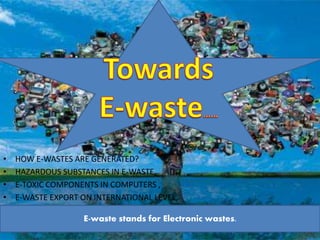
• HOW E-WASTES ARE GENERATED? 
• HAZARDOUS SUBSTANCES IN E-WASTE, 
• E-TOXIC COMPONENTS IN COMPUTERS , 
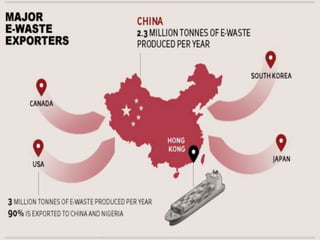
• E-WASTE EXPORT ON INTERNATIONAL LEVEL, 
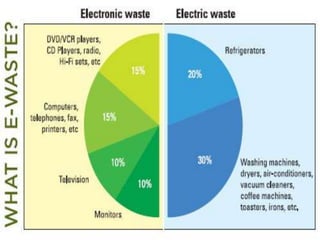
E-waste stands for Electronic wastes.
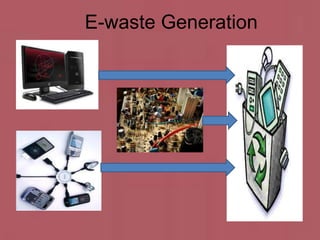
E-waste Generation
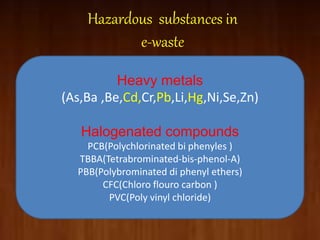
Hazardous substances in 
e-waste 
Heavy metals 
(As,Ba ,Be,Cd,Cr,Pb,Li,Hg,Ni,Se,Zn) 
Halogenated compounds 
PCB(Polychlorinated bi phenyles ) 
TBBA(Tetrabrominated-bis-phenol-A) 
PBB(Polybrominated di phenyl ethers) 
CFC(Chloro flouro carbon ) 
PVC(Poly vinyl chloride)
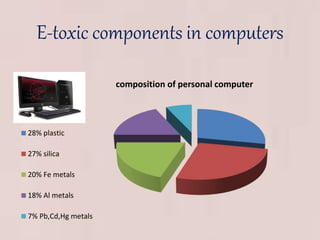
E-toxic components in computers 
composition of personal computer 
28% plastic 
27% silica 
20% Fe metals 
18% Al metals 
7% Pb,Cd,Hg metals
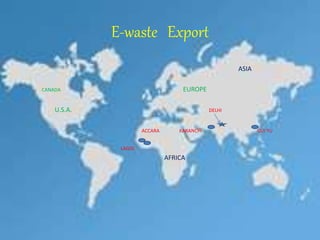
E-waste Export 
ASIA 
CANADA EUROPE 
U.S.A. DELHI 
ACCARA KARANCHI GUI YU 
LAGOL 
AFRICA
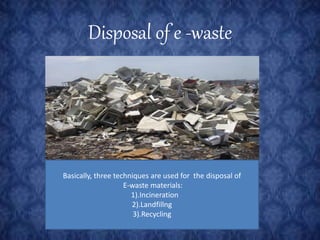
Disposal of e -waste 
Basically, three techniques are used for the disposal of 
E-waste materials: 
1).Incineration 
2).Landfillng 
3).Recycling
incineration 
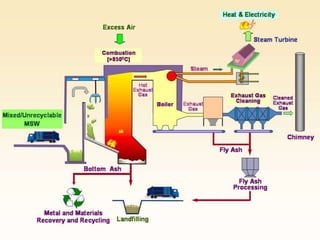
Incineration involves combustion of 
E-waste materials. 
Volume of E-waste materials can be 
Reduced upto 20-30% . 
Incineration is also called as “Thermal 
treatement”. 
e. g. incinerators .
Land filling 
Simplest & highly applicable technique . 
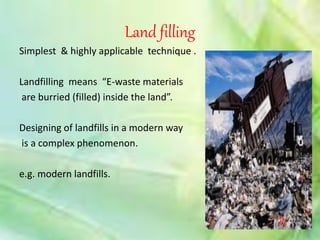
Landfilling means “E-waste materials 
are burried (filled) inside the land”. 
Designing of landfills in a modern way 
is a complex phenomenon. 
e.g. modern landfills.
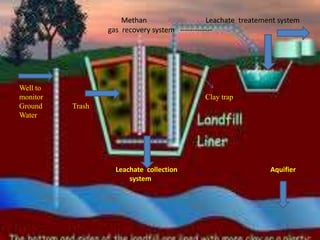
Methan Leachate treatement system 
gas recovery system ------------- 
Well to 
monitor Clay trap 
Ground Trash 
Water 
Leachate collection Aquifier 
system
recycling 
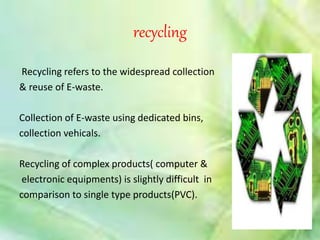
Recycling refers to the widespread collection 
& reuse of E-waste. 
Collection of E-waste using dedicated bins, 
collection vehicals. 
Recycling of complex products( computer & 
electronic equipments) is slightly difficult in 
comparison to single type products(PVC).
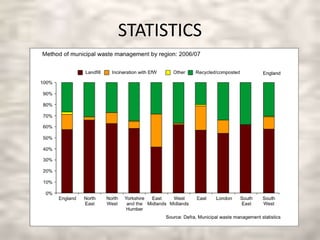
STATISTICS
Advantages 
Ecofriendly techniques 
Healthy environment 
Reduce, Reuse & Recycle 
Electricity & heat generation
Disadvantages 
Air pollution 
Water pollution 
Soil pollution 
Health problems
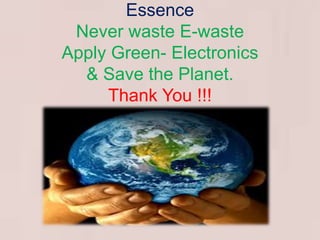
Essence 
Never waste E-waste 
Apply Green- Electronics 
& Save the Planet. 
Thank You !!!
Refereces 
Websites 
www.wikipedia.com 
www.scribedworld.com 
www.ewasteguideinfo.com 
Resources 
Green Electronics paper presented by “Tarandeep Singh” 
E-waste Management ppt by “ Purva Sharma” 
Industrial Engineering & Management by”O.P.Khanna”
Any query ??

Green electronics

  • 1.
    GREEN electronics PreparedBy SAKET RAI B. Tech., ECE,3rd Yr 1003031097 IPEC,GZB
  • 2.
    Contents • Objective • Towards E-waste ….. * E-waste generation * Hazardous substances in E-waste * E-toxic components in computers * E-waste Export • Disposal of E-waste * Incineration * Landfilling * Recycling • Statistics • Advantages • Disadvantages • Essence
  • 3.
    Objective Green Electronics= Green + Electronics The word ‘green’ demonstrates the ‘ecofriendly’ character. “ Green Electronics emphasizes on elemination of harmful substances & the disposal of electronic wastes ; by applying ecofriendly techniques.” Green Electronics is simply E-waste Management.
  • 4.
    • HOW E-WASTESARE GENERATED? • HAZARDOUS SUBSTANCES IN E-WASTE, • E-TOXIC COMPONENTS IN COMPUTERS , • E-WASTE EXPORT ON INTERNATIONAL LEVEL, E-waste stands for Electronic wastes.
  • 5.
  • 7.
    Hazardous substances in e-waste Heavy metals (As,Ba ,Be,Cd,Cr,Pb,Li,Hg,Ni,Se,Zn) Halogenated compounds PCB(Polychlorinated bi phenyles ) TBBA(Tetrabrominated-bis-phenol-A) PBB(Polybrominated di phenyl ethers) CFC(Chloro flouro carbon ) PVC(Poly vinyl chloride)
  • 8.
    E-toxic components incomputers composition of personal computer 28% plastic 27% silica 20% Fe metals 18% Al metals 7% Pb,Cd,Hg metals
  • 9.
    E-waste Export ASIA CANADA EUROPE U.S.A. DELHI ACCARA KARANCHI GUI YU LAGOL AFRICA
  • 11.
    Disposal of e-waste Basically, three techniques are used for the disposal of E-waste materials: 1).Incineration 2).Landfillng 3).Recycling
  • 12.
    incineration Incineration involvescombustion of E-waste materials. Volume of E-waste materials can be Reduced upto 20-30% . Incineration is also called as “Thermal treatement”. e. g. incinerators .
  • 14.
    Land filling Simplest& highly applicable technique . Landfilling means “E-waste materials are burried (filled) inside the land”. Designing of landfills in a modern way is a complex phenomenon. e.g. modern landfills.
  • 15.
    Methan Leachate treatementsystem gas recovery system ------------- Well to monitor Clay trap Ground Trash Water Leachate collection Aquifier system
  • 16.
    recycling Recycling refersto the widespread collection & reuse of E-waste. Collection of E-waste using dedicated bins, collection vehicals. Recycling of complex products( computer & electronic equipments) is slightly difficult in comparison to single type products(PVC).
  • 17.
  • 18.
    Advantages Ecofriendly techniques Healthy environment Reduce, Reuse & Recycle Electricity & heat generation
  • 19.
    Disadvantages Air pollution Water pollution Soil pollution Health problems
  • 20.
    Essence Never wasteE-waste Apply Green- Electronics & Save the Planet. Thank You !!!
  • 21.
    Refereces Websites www.wikipedia.com www.scribedworld.com www.ewasteguideinfo.com Resources Green Electronics paper presented by “Tarandeep Singh” E-waste Management ppt by “ Purva Sharma” Industrial Engineering & Management by”O.P.Khanna”
  • 22.