Bioinspired strategies for bone
regeneration
Maria-Pau Ginebra
Biomaterials, Biomechanics and Tissue Engineering Group
Dept. Materials Science and Metallurgy
Universitat Politècnica de Catalunya, Barcelona, Spain
Maria.pau.ginebra@upc.edu
B-MRS, Balneario Camboriù, 22-26 September 2019
http://biomaterials.upc.edu/en
Department of Materials Science and Metallurgy
Biomaterials, Biomechanics and Tissue Engineering Group
Outline
Biomimetic materials for bone regeneration
Porosity: how relevant is material
architecture at different lengthscales?
Osteoinducction and osteogenesis
Nanostructure and osteoimmunomodulation
1
2
3
4
2,000,000 bone grafting procedures are performed annually
worldwide to restore bone function
GreenwaldAS et al. J Bone Joint SurgAm.
2001;83-A, suppl 2, part 2:98-103.
Bone grafting
4
Bone grafting
Non-union fracture Comminuted fracture Alveolar ridge defect
Bone tumor/cyst Spinal disc degeneration
5
Bone regeneration: the problem
Sedentary lifestyle
Ageing population
7
Bone grafting
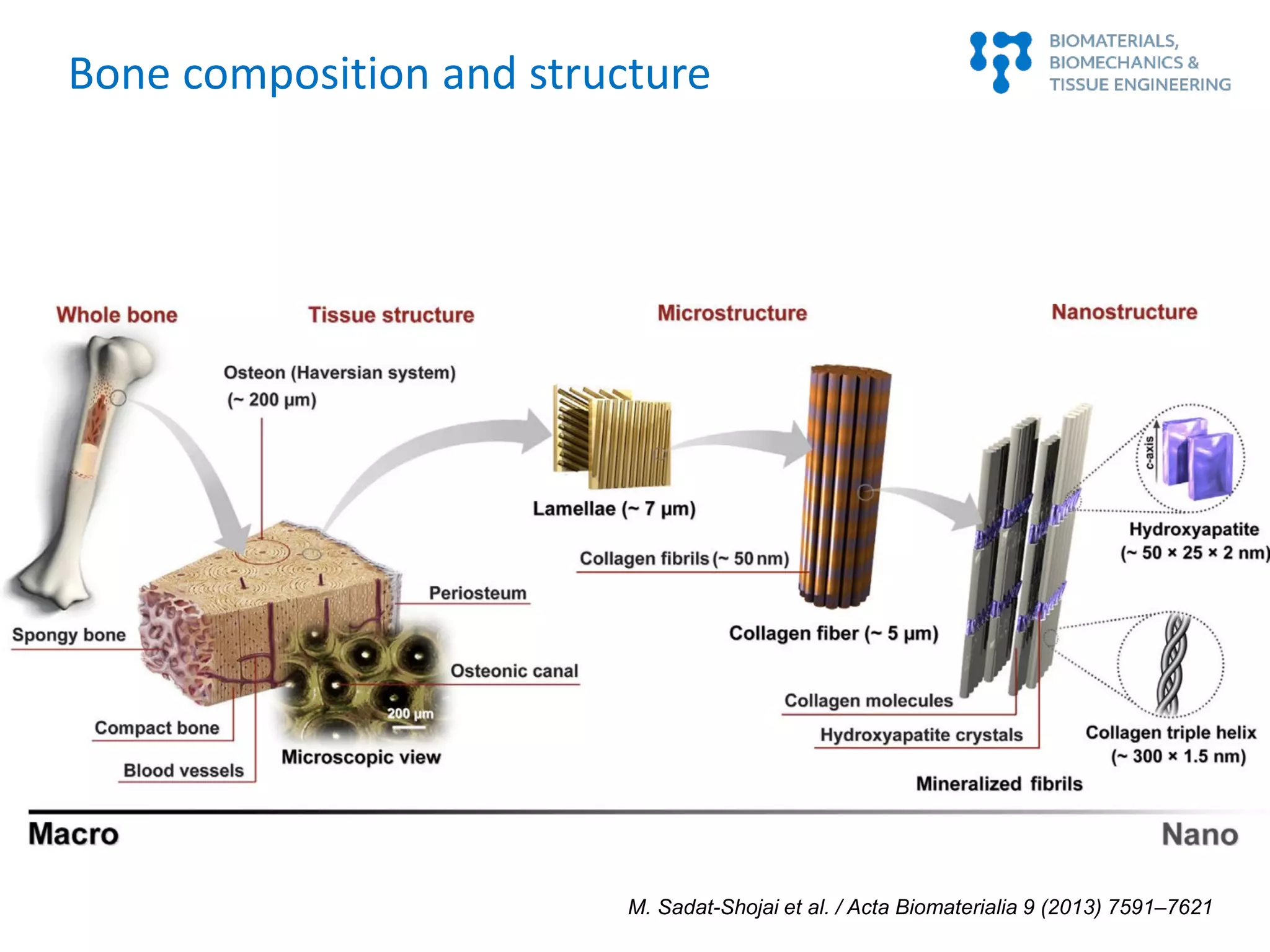
Bone composition and structure
M. Sadat-Shojai et al. / Acta Biomaterialia 9 (2013) 7591–7621
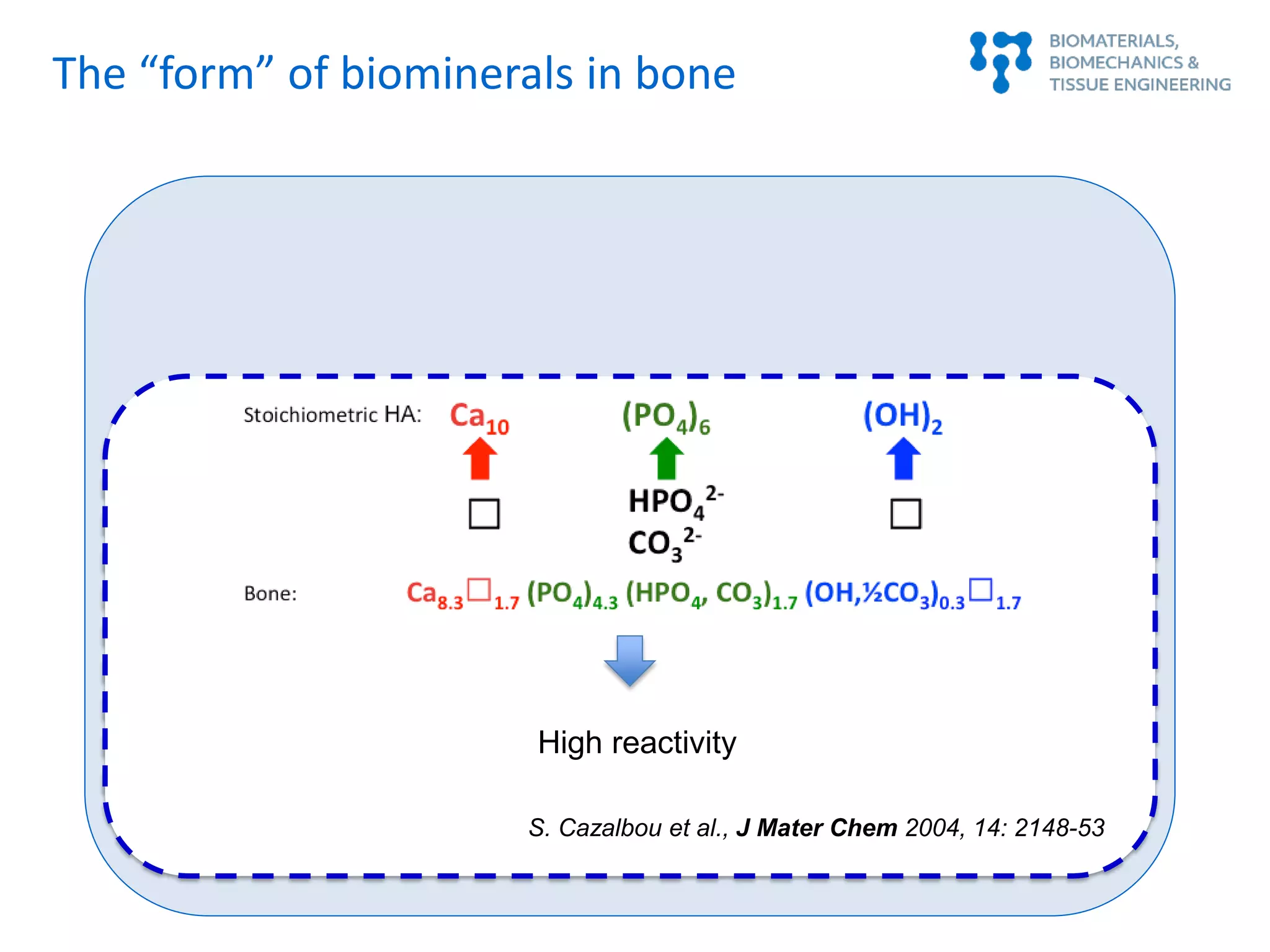
The “form” of biominerals in bone
Fratzl and Weinkamer. Progress in Materials
Science 52 (2007) 1263–1334
Mineral crystal shape/size:
Nanocrystals:
Platelets
(20-60 x 10-20 x 2-5 nm3)
Large specific surface area
H.P. Schwarcz, E.A. McNally, G.A. Botton. Journal of Structural Biology 188 (2014) 240–248
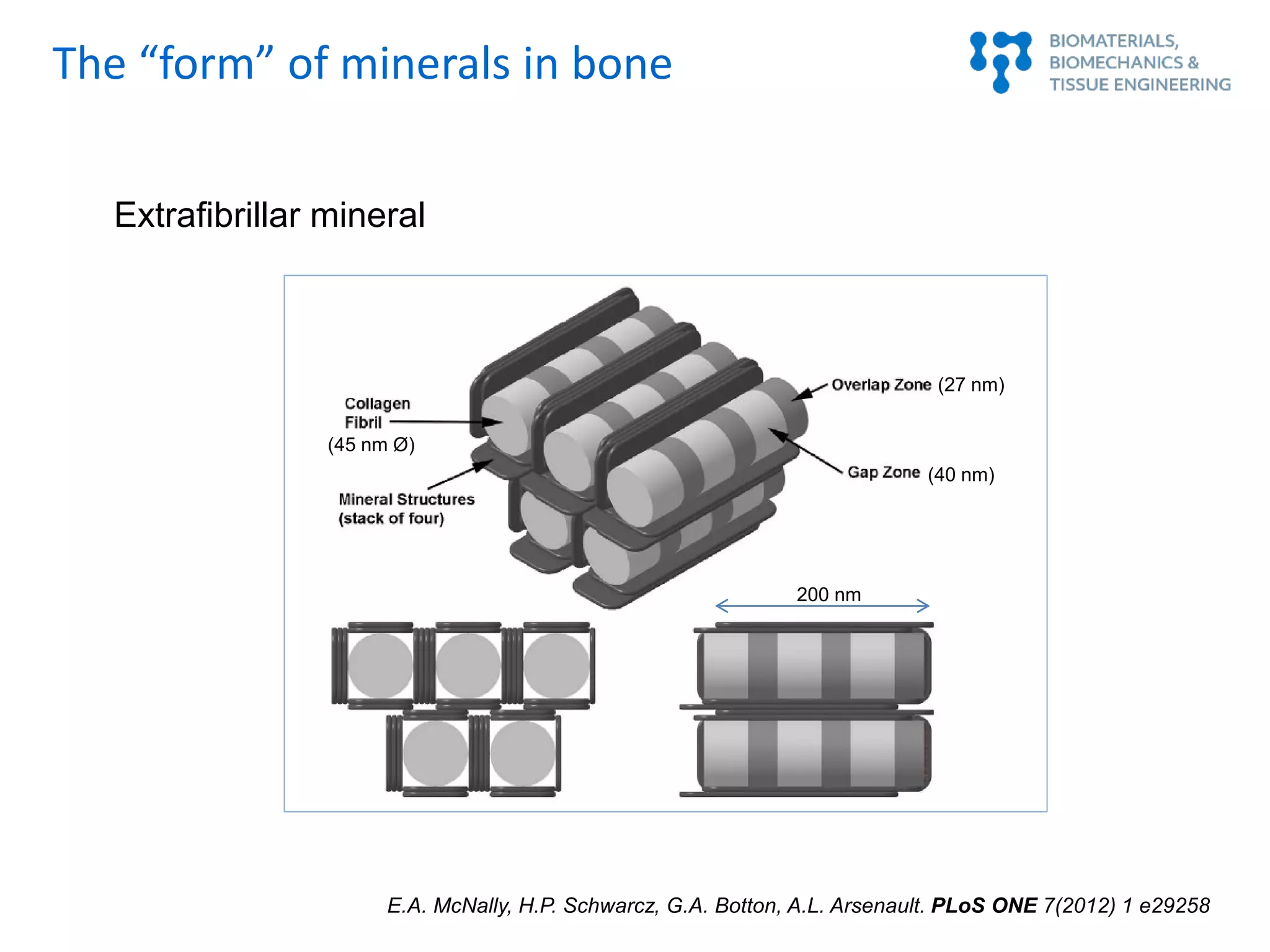
Extrafibrillar mineral
The “form” of minerals in bone
E.A. McNally, H.P. Schwarcz, G.A. Botton, A.L. Arsenault. PLoS ONE 7(2012) 1 e29258
Extrafibrillar mineral
(40 nm)
(27 nm)
(45 nm Ø)
200 nm
The “form” of minerals in bone
The “form” of biominerals in bone
HighHigh reactivity
S. Cazalbou et al., J Mater Chem 2004, 14: 2148-53
Bone remodeling
- 2-5% cortical bone remodeled every year
- Trabecular bone 10 times faster
C: Bone mineral
phase
A,B: High-T
Synthetic HA
LeGeros, (1991)
HIGH T SINTERED HA
Stoichiometric
Highly crystalline
Low porosity
Low SSA
Non resorbable in vivo
14
High Temperature Calcium Phosphates:
Sintered ceramics
Low-T CaPs: Calcium Phosphate CementsBiomimetic Calcum Phosphates
3Ca3(PO4)2 + H2O → Ca9(HPO4)(PO4)5(OH)
α-Tricalcium phosphate Ca-deficient Hydroxyapatite (CDHA)
M.P. Ginebra et al., Adv Drug Del Rev (2012) 1μm
1μm
Fine powder
Coarse powder
High T CaP ceramics vs low T biomimetic CaP
SSA < 5 m2/g SSA ≈ 20 m2/g SSA ≈ 40 m2/g
250 µm
M. Espanol et al., Acta Biomaterialia (2009), 5: 2752–2762
3 α-Ca3(PO4)2 + H2O → Ca9(HPO4) (PO4)5(OH)
L/P= 0.65 L/P= 0.35
Textural properties of nanostructured CDHA
Liquid/powder ratio
250 µm
M. Espanol et al., Acta Biomaterialia (2009), 5: 2752–2762
3 α-Ca3(PO4)2 + H2O → Ca9(HPO4) (PO4)5(OH)
L/P= 0.65 L/P= 0.35
Textural properties of nanostructured CDHA
250 µm
M. Espanol et al., Acta Biomaterialia (2009), 5: 2752–2762
3 α-Ca3(PO4)2 + H2O → Ca9(HPO4) (PO4)5(OH)
L/P= 0.65 L/P= 0.35
Textural properties of nanostructured CDHA
Outline
Biomimetic materials for bone regeneration
Porosity: how relevant is material
architecture at different lengthscales?
Osteoinducction and osteogenesis
Nanostructure and osteoimmunomodulation
1
2
3
4
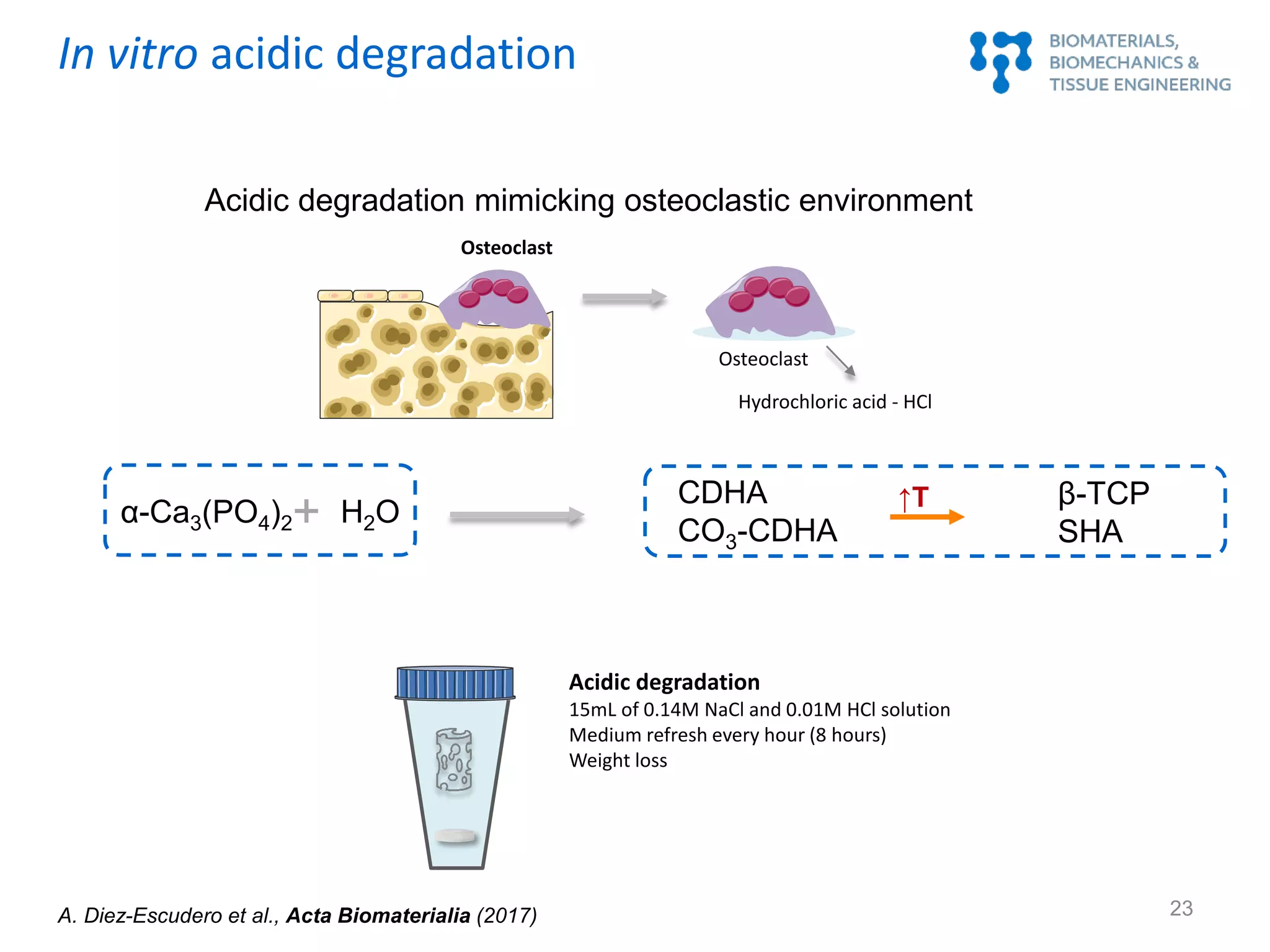
Acidic degradation mimicking osteoclastic environment
CDHA
CO3-CDHA
α-Ca3(PO4)2+ H2O ↑T β-TCP
SHA
Osteoclast
Osteoclast
Hydrochloric acid - HCl
In vitro acidic degradation
A. Diez-Escudero et al., Acta Biomaterialia (2017) 22
Solubility
SHA < CDHA < β-TCP
- logKps 116.8 85.1 28.9
Anna Diez Escudero
Acidic degradation
15mL of 0.14M NaCl and 0.01M HCl solution
Medium refresh every hour (8 hours)
Weight loss
Acidic degradation mimicking osteoclastic environment
CDHA
CO3-CDHA
α-Ca3(PO4)2+ H2O ↑T β-TCP
SHA
Osteoclast
Osteoclast
Hydrochloric acid - HCl
In vitro acidic degradation
A. Diez-Escudero et al., Acta Biomaterialia (2017) 23
500 nm
β-TCP
500 nm 500 nm
A. Diez-Escudero et al., Acta Biomaterialia 60 (2017):81-92
In vitro degradation
0.01M hydrochloric acid in 0.14M sodium chloride at 37 oC for 8h.
*
24
In vitro acidic degradation
Rizzoli Orthopaedic
Institute, Dr. Baldini
Diez-Escudero, A. Tissue Engineering Part C: Methods, 2017, 23(2), 118–124.
Ciapetti G., et al., Acta Biomaterialia, 50(2017):102–113
Anna Diez Escudero
Osteoclastogenesis and osteoclastic resorption
25
F-HA
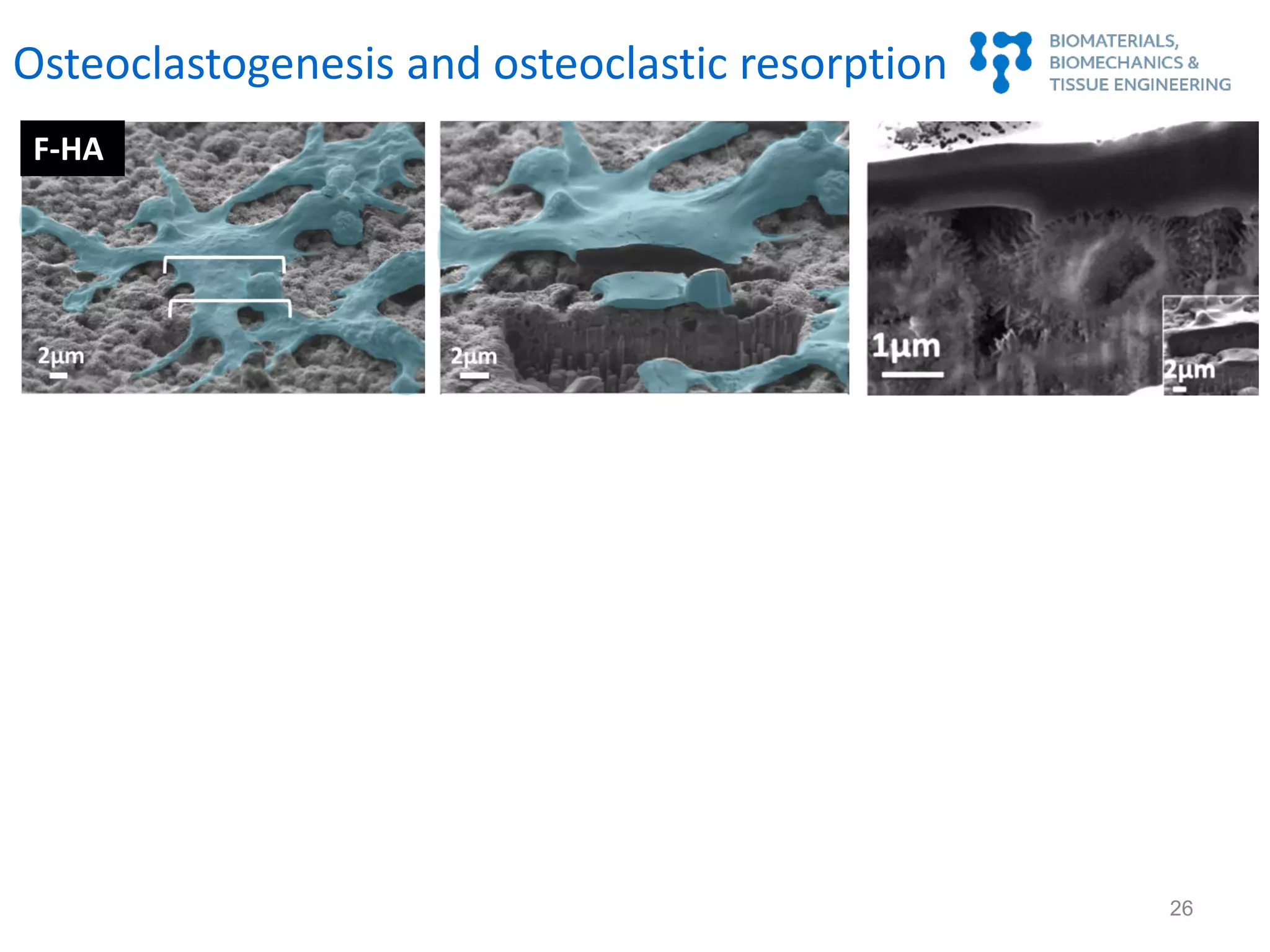
Osteoclastogenesis and osteoclastic resorption
26
F-HA
F-HA
Osteoclastogenesis and osteoclastic resorption
27
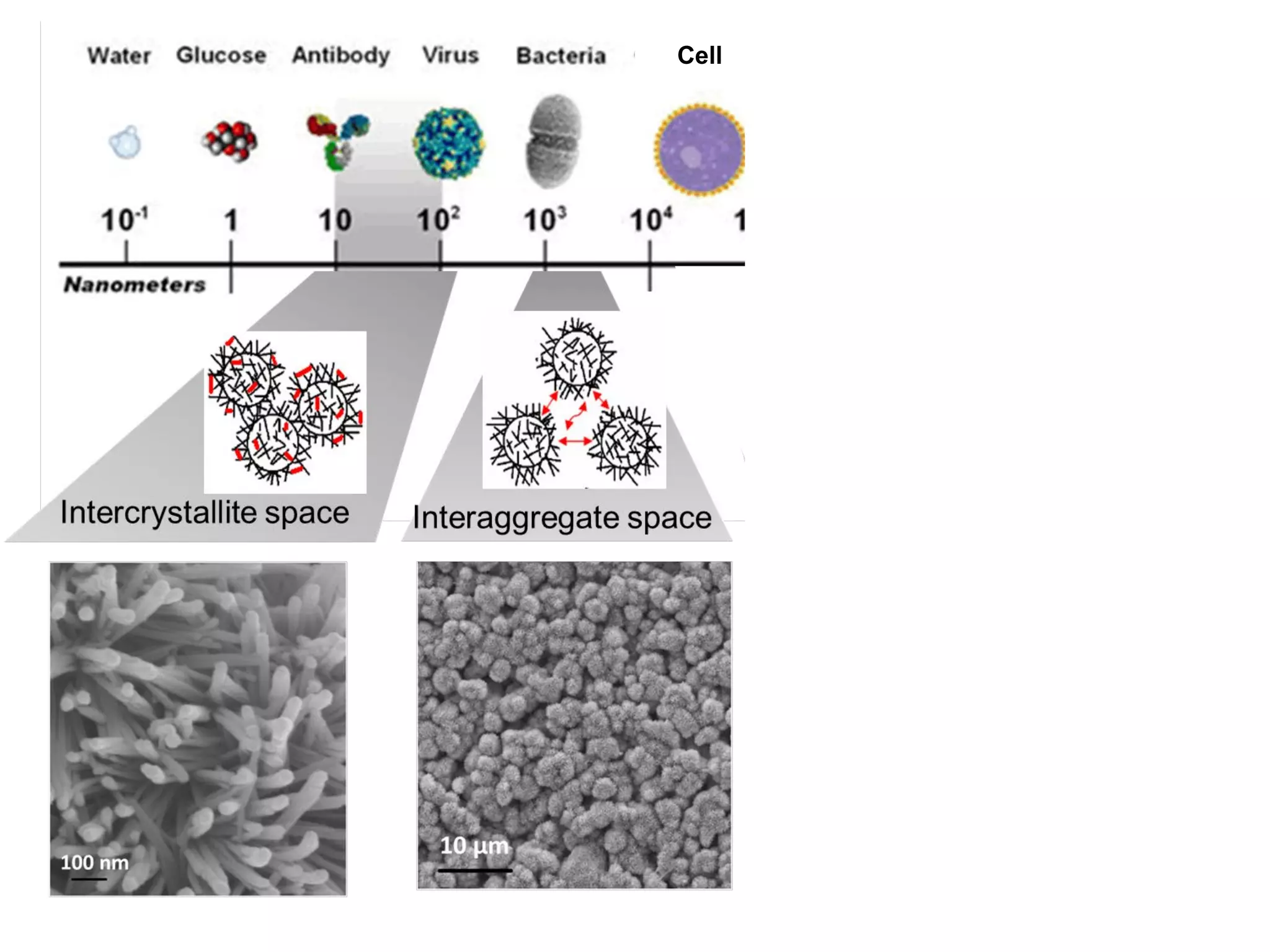
Cell
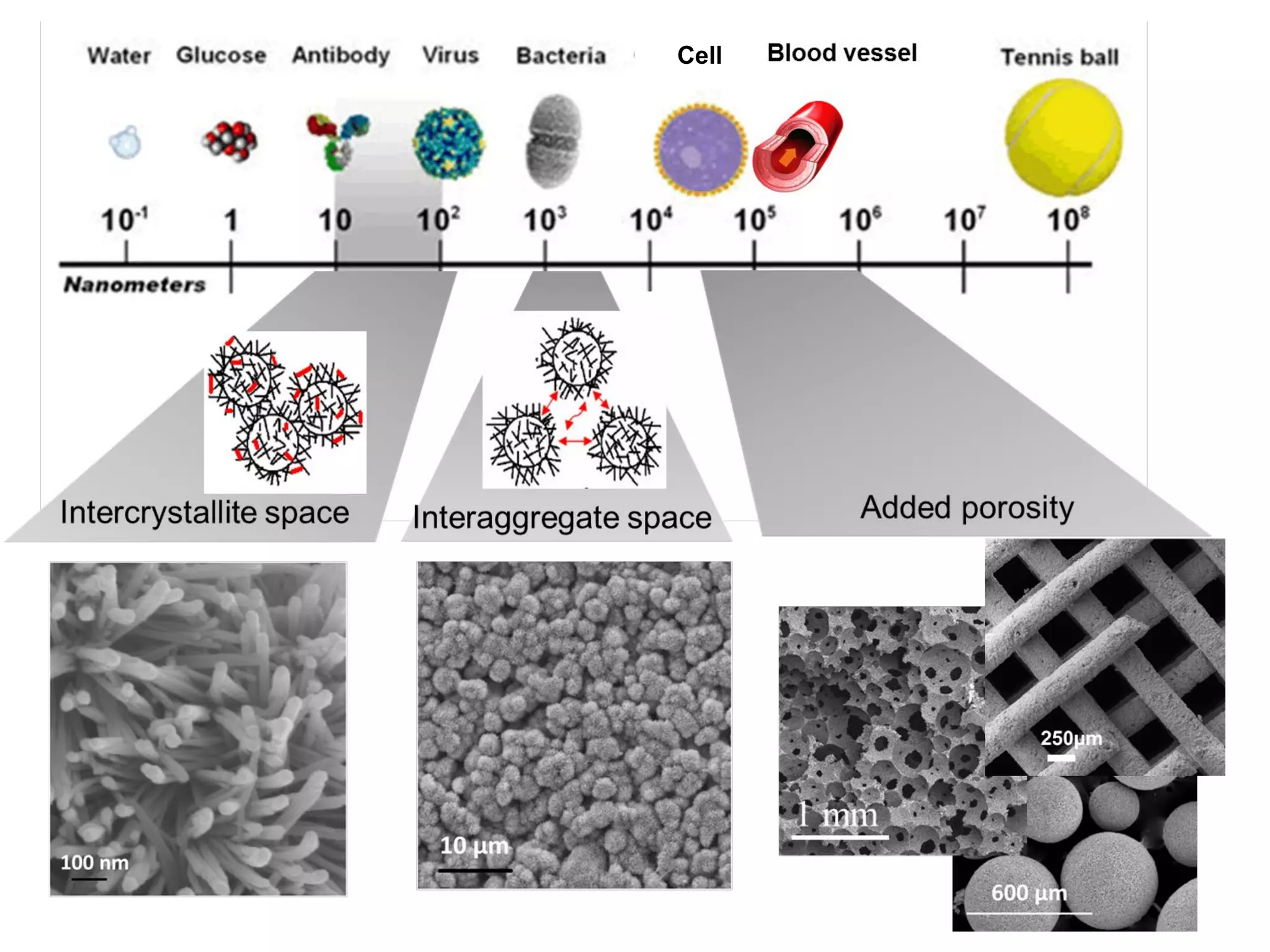
The biomaterial as a scaffold
The cells
29
Cell
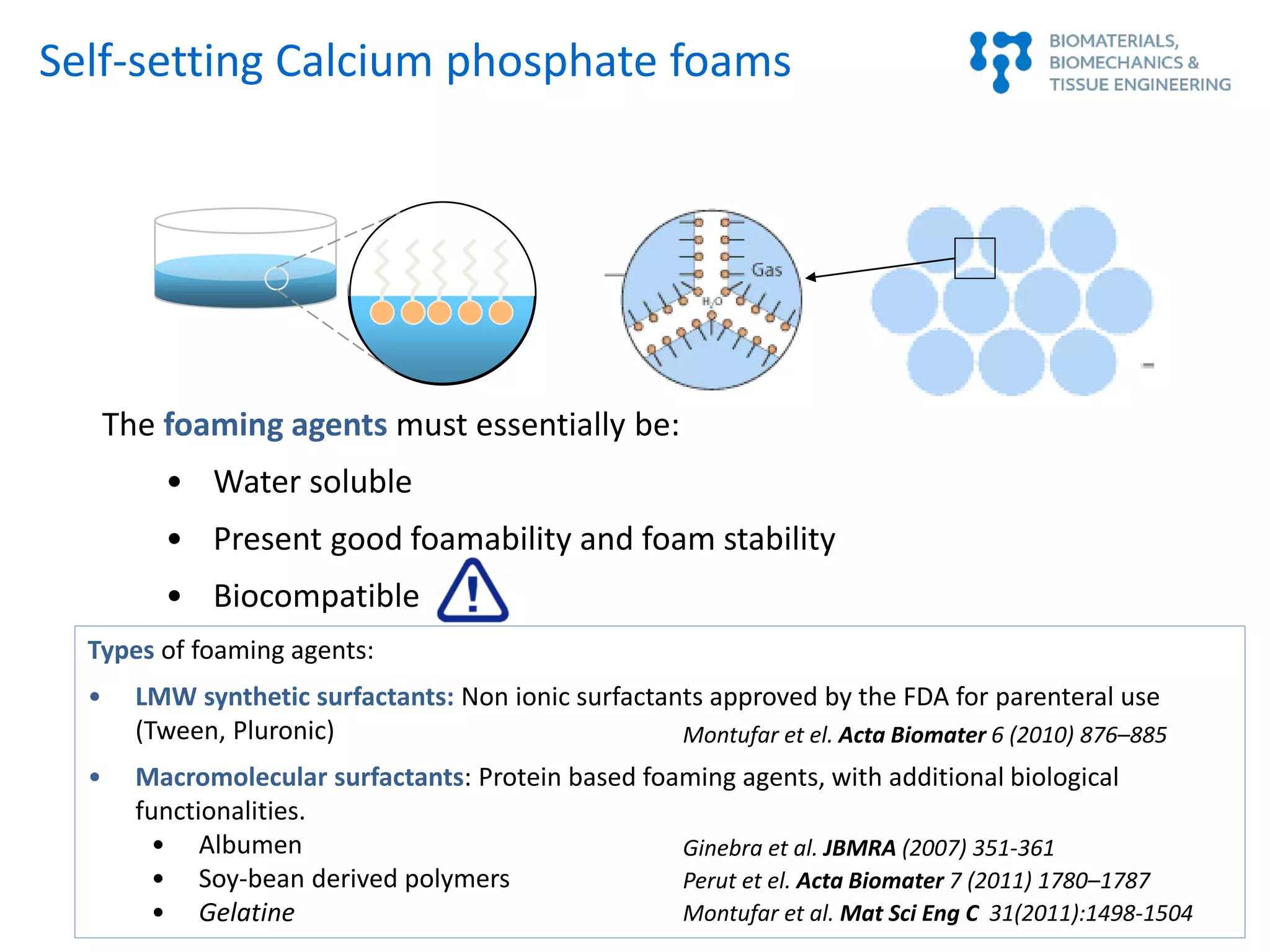
The foaming agents must essentially be:
• Water soluble
• Present good foamability and foam stability
• Biocompatible
Types of foaming agents:
• LMW synthetic surfactants: Non ionic surfactants approved by the FDA for parenteral use
(Tween, Pluronic)
• Macromolecular surfactants: Protein based foaming agents, with additional biological
functionalities.
• Albumen
• Soy-bean derived polymers
• Gelatine
Montufar et el. Acta Biomater 6 (2010) 876–885
Ginebra et al. JBMRA (2007) 351-361
Perut et el. Acta Biomater 7 (2011) 1780–1787
Montufar et al. Mat Sci Eng C 31(2011):1498-1504
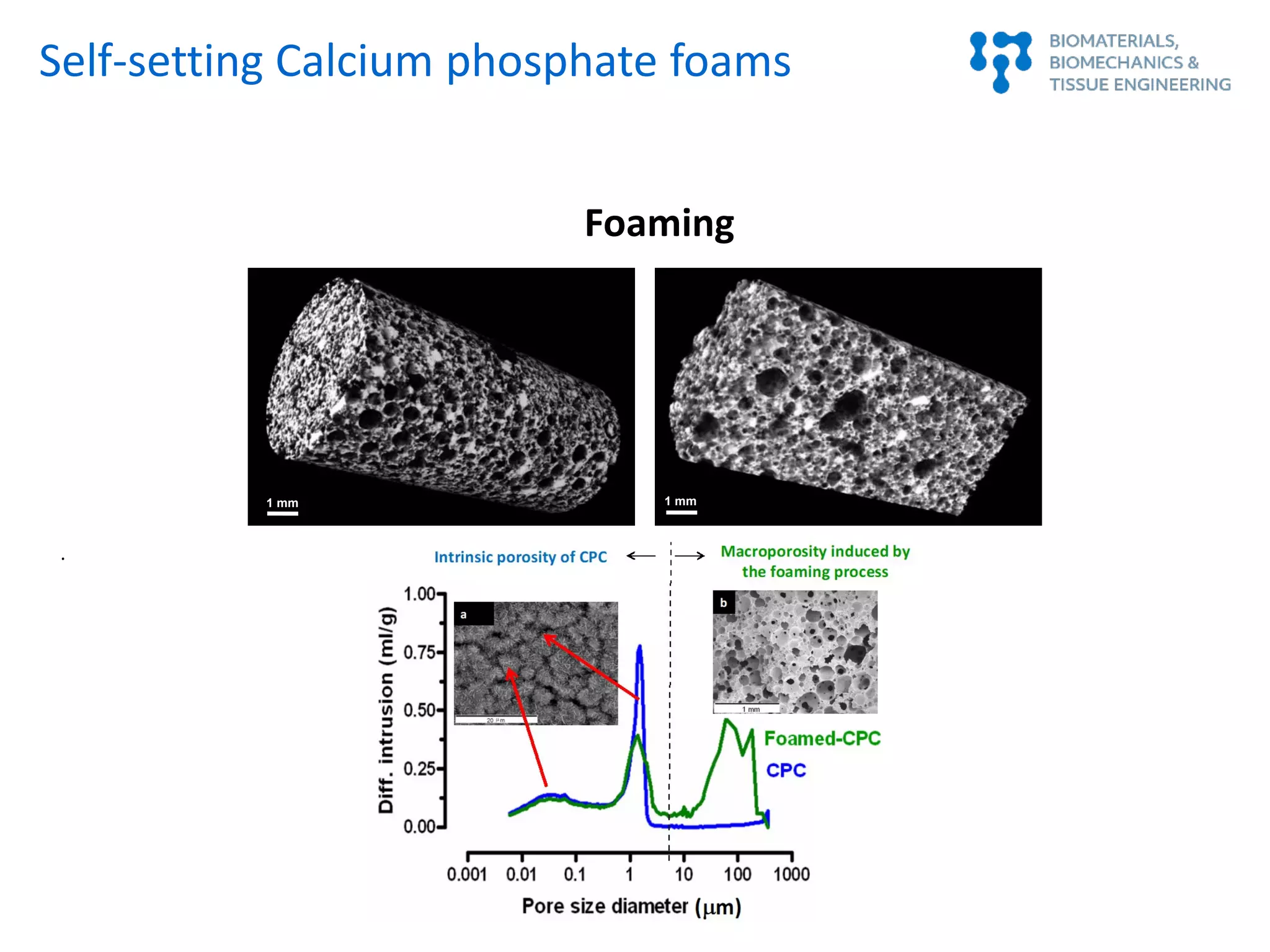
Self-setting Calcium phosphate foams
Foaming
.
1 mm 1 mm
(Tween 80)
Montufar EB, et al. Acta Biomater 2010;6:876-85
Pastorino et al. Acta Biomater 12 (2015) 250–59
Kovtun et al. Acta Biomater 12 (2015) 242-49
Self-setting Calcium phosphate foams
Foaming
.
1 mm 1 mm
Self-setting Calcium phosphate foams
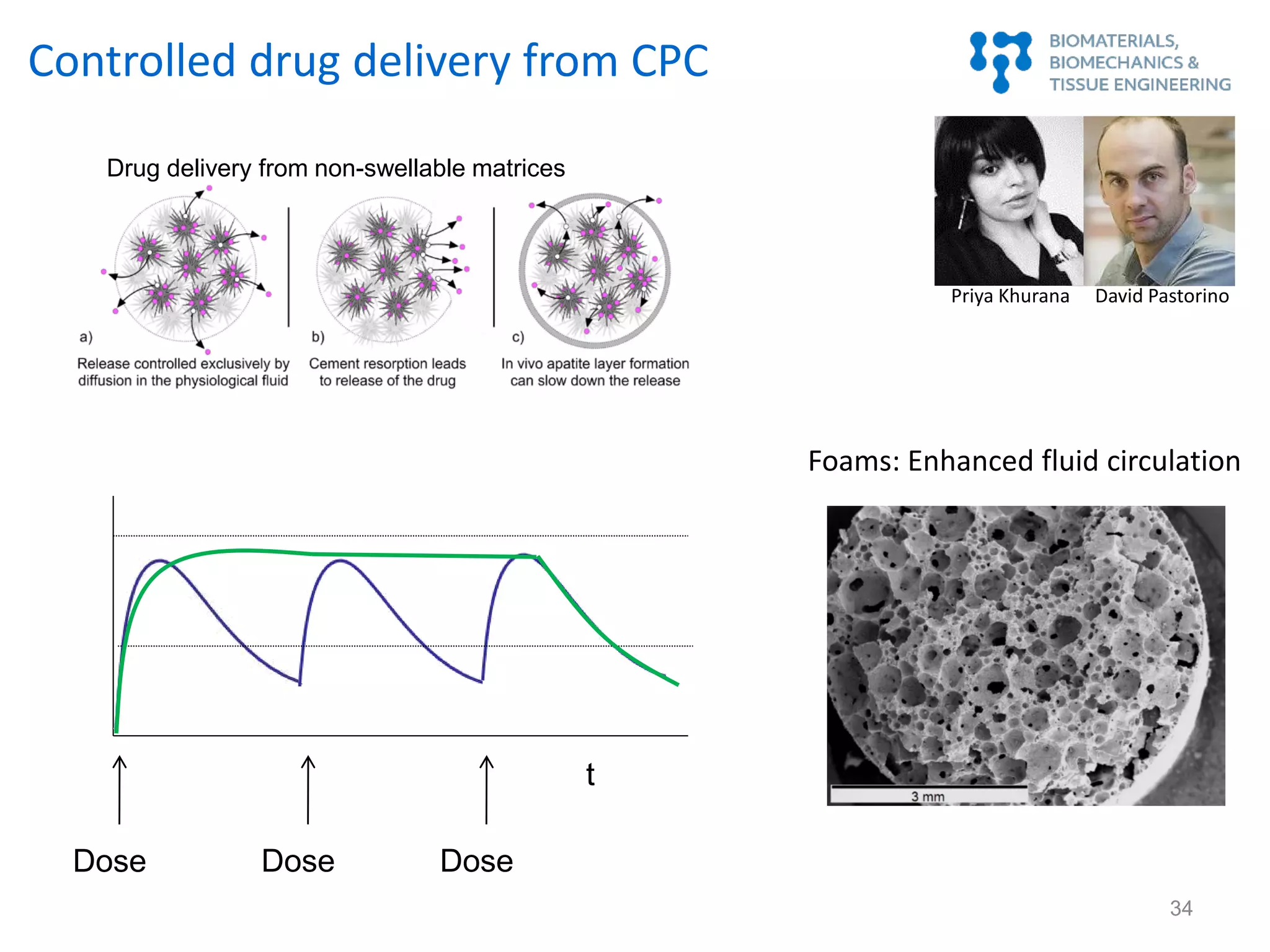
Controlled drug delivery from CPC
David Pastorino
t
Dose Dose Dose
t
Drug delivery from non-swellable matrices
Priya Khurana
Foams: Enhanced fluid circulation
34
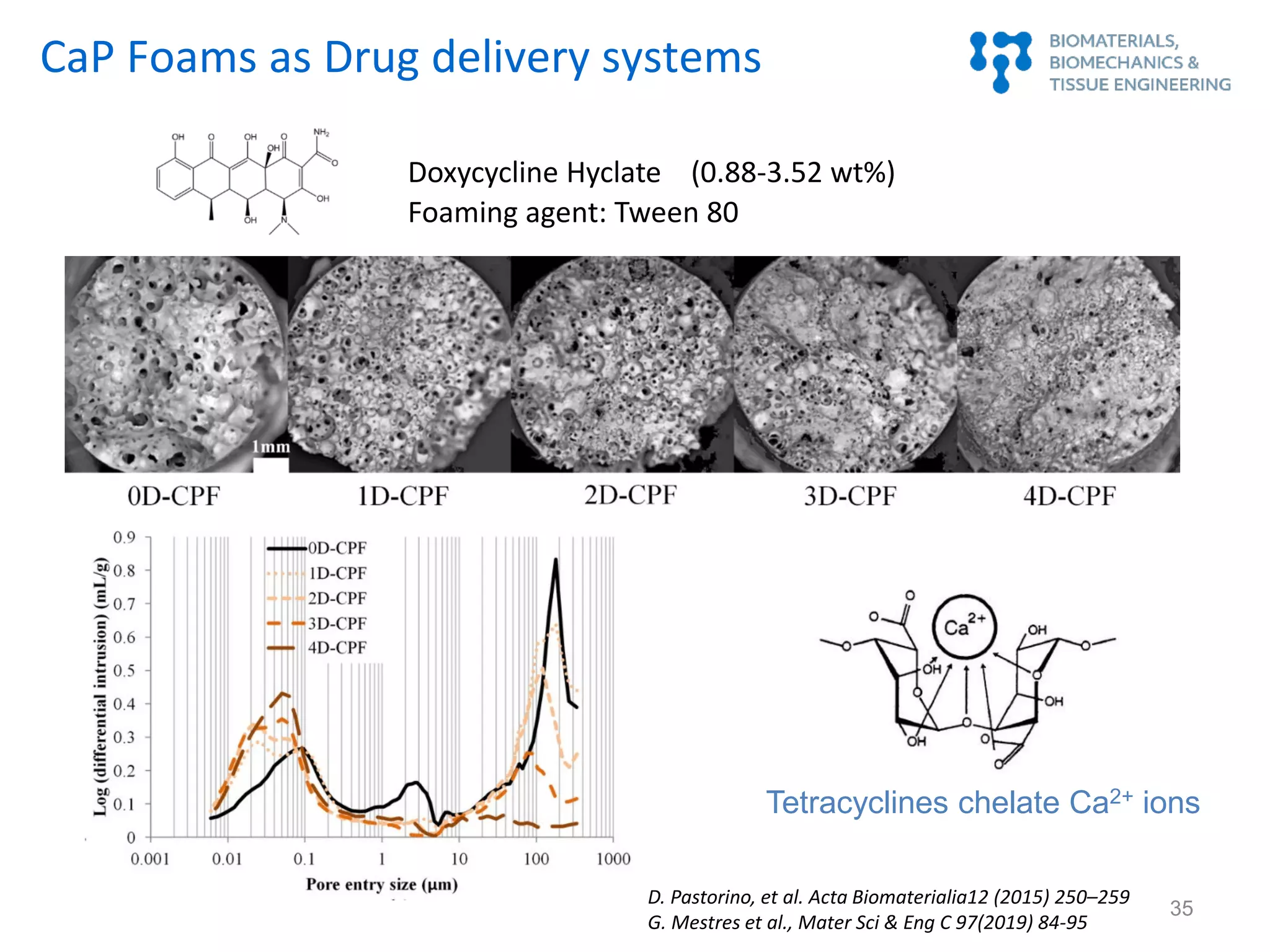
CaP Foams as Drug delivery systems
Doxycycline Hyclate (0.88-3.52 wt%)
D. Pastorino, et al. Acta Biomaterialia12 (2015) 250–259
G. Mestres et al., Mater Sci & Eng C 97(2019) 84-95
Foaming agent: Tween 80
Tetracyclines chelate Ca2+ ions
35
CaP Foams as Drug delivery systems
D. Pastorino, et al. Acta Biomaterialia12 (2015) 250–259 36
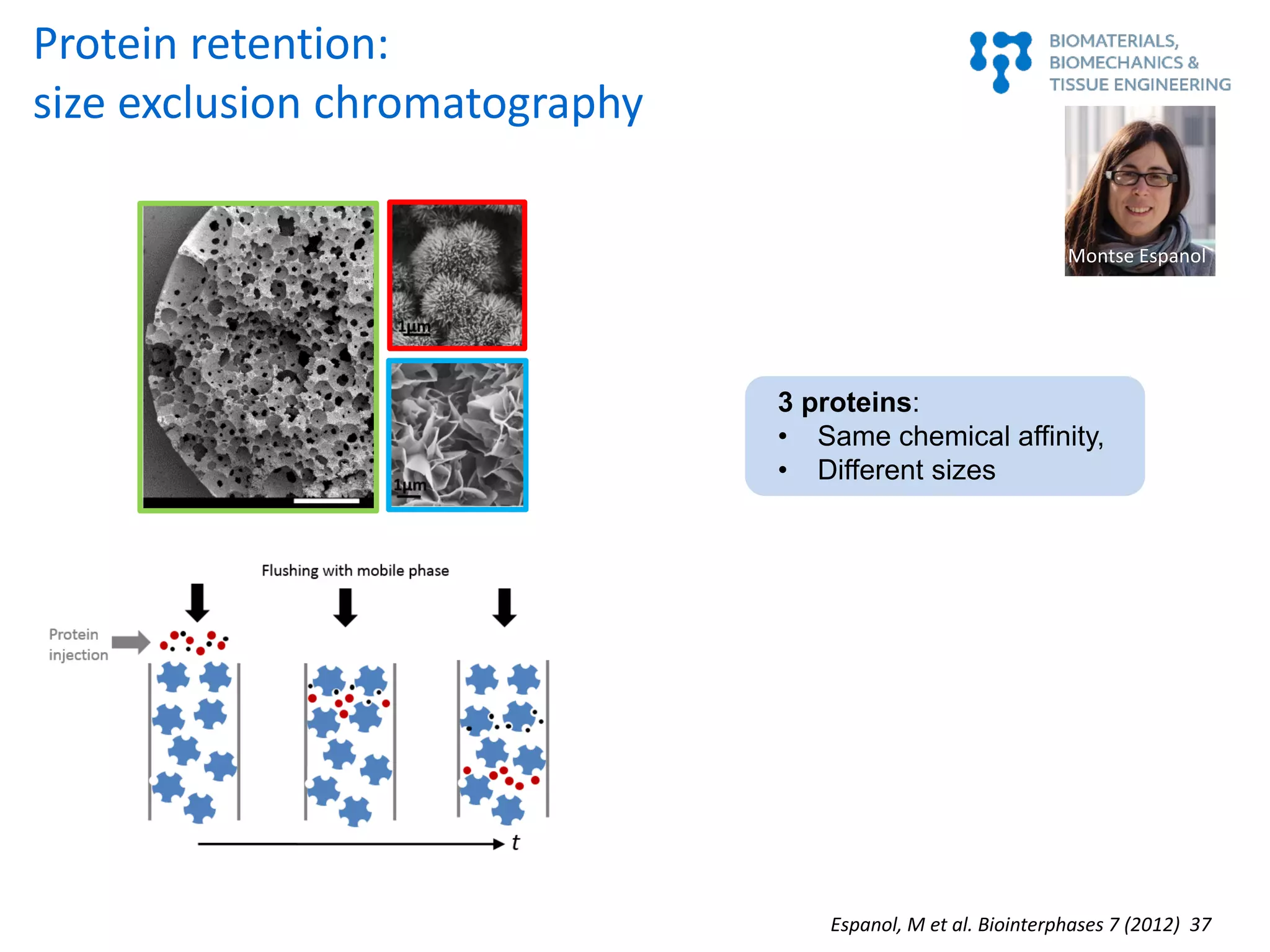
Espanol, M et al. Biointerphases 7 (2012) 37
Protein retention:
size exclusion chromatography
3 proteins:
• Same chemical affinity,
• Different sizes
Montse Espanol
Espanol, M et al. Biointerphases 7 (2012) 37
Protein retention:
size exclusion chromatography
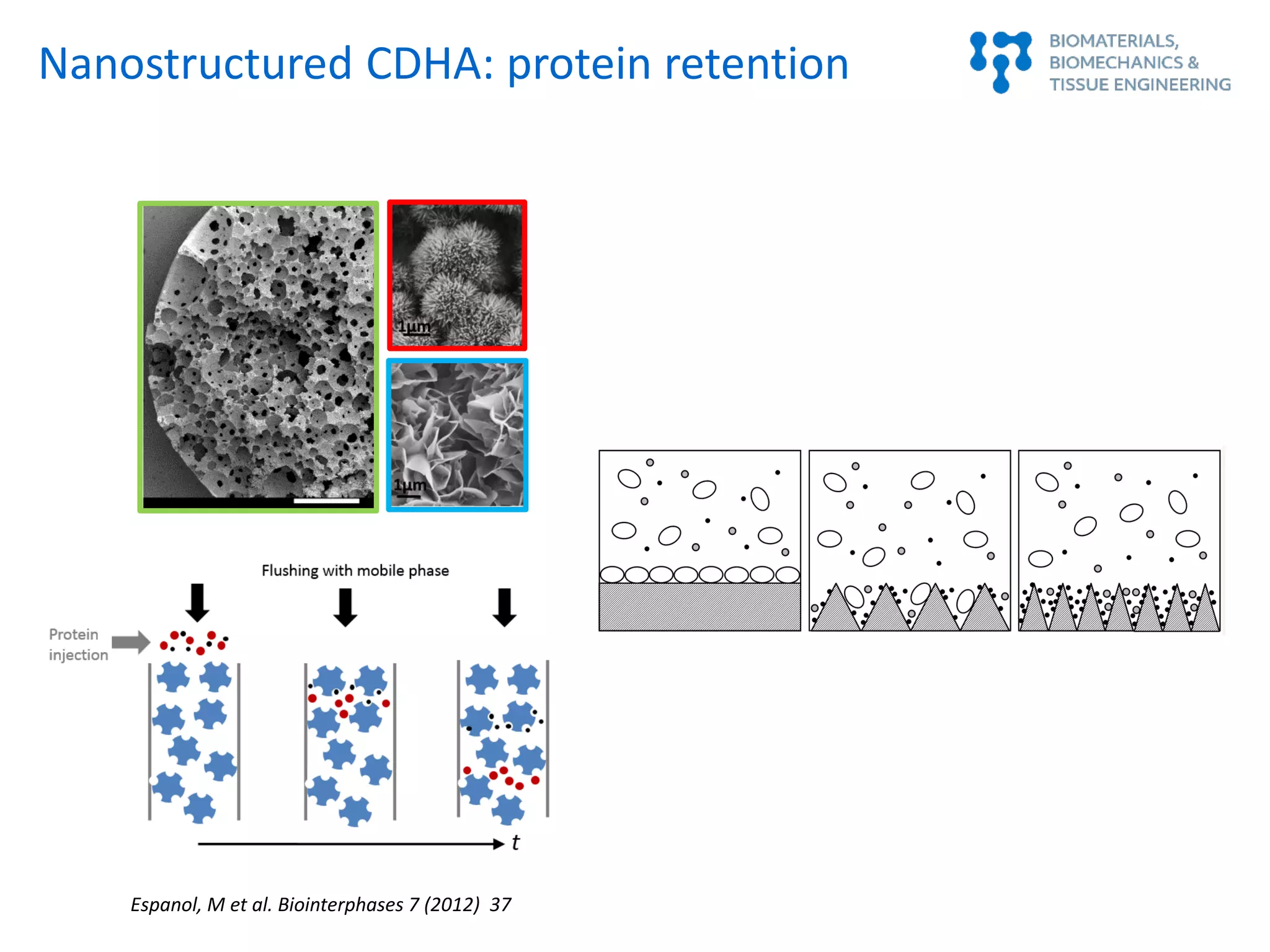
Espanol, M et al. Biointerphases 7 (2012) 37
Nanostructured CDHA: protein retention
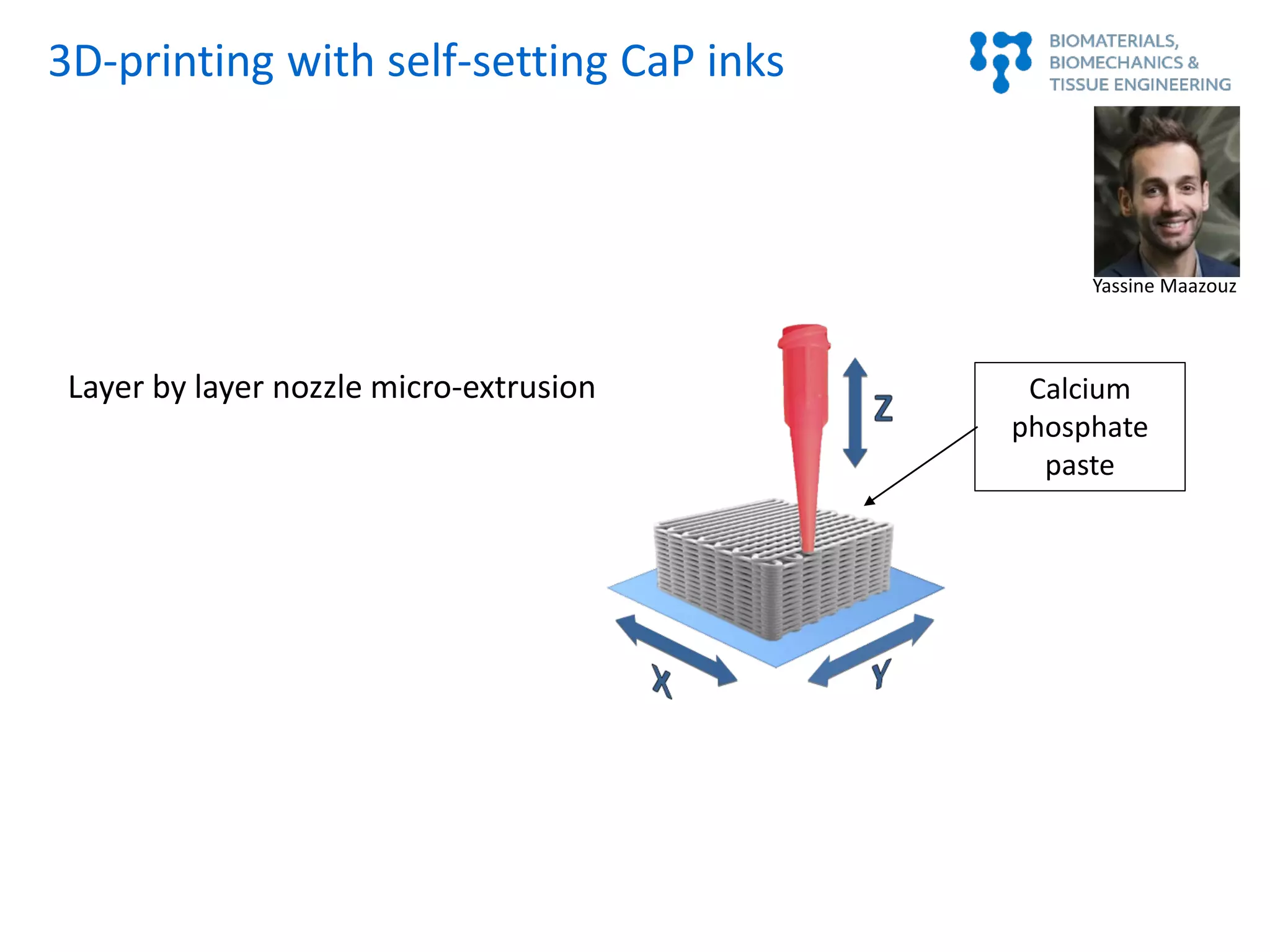
3D-printing with self-setting CaP inks
Yassine Maazouz
Layer by layer nozzle micro-extrusion Calcium
phosphate
paste
3D-printing with self-setting CaP inks
Classic route
Biomimetic route
Hardening post-treatments
Cesarano, J., Baer, T. A., & Calvert, P. (1997), Proc Solid Freeform Fabr Symp; Smay, J., & III, J. C. (2002), Langmuir;
Michna, S., Wu, W., & Lewis, J. A. (2005), Biomaterials; Miranda, P., Saiz, E., Gryn, K., & Tomsia, A. P. (2006), Acta
Biomater
• Injectability
• Pseudoplastic
behaviour
• Self-supporting 3D
structures
3D-printing with self-setting CaP inks
1 mm 1 mm
Yassine Maazouz
Maazouz et al., J. Mater. Chem. B 2 (2014), 5378 – 5386
Maazouz et al., Acta Biomaterialia 49 (2017) 563-574
Raymond et al., Acta Biomaterialia 75 (2018): 451-462
Outline
Biomimetic materials for bone regeneration
Porosity: how relevant is material
architecture at different lengthscales?
Osteoinducction and osteogenesis
Nanostructure and osteoimmunomodulation
1
2
3
4
Intrinsic osteoinductive biomaterials
o Tunning intrinsic physico-chemical
parameters:
- Chemical Composition
- Macropore architecture
- Microstructre
Barradas AM, et al.2011
Arboleya L, et al. 2013
Janicki P, et al.2011
Engineered osteoinductive biomaterials
o Addition of exogenous growth factors
(BMPs)
o Drawbacks:
- Undesirable side effects
- Variable efficacy
- High costs
Osteoinduction
SSA: 0.5-6 m2/g SSA: 20-60 m2/g
Biomimetic Calcium Phosphates
Foaming  Interconnected concave macropores
Montufar EB, et al. Acta Biomater 2010;6:876-85.
3D Inkjet printing  Interconnected prismatic macropores
Maazouz Y, et al. Acta Biomaterialia 2018, in press
1 mm 1 mm
1 mm 1 mm
FOAMS
ROBOCASTED
The scaffolds
Foams
Macrostructure
Micro/nanostru
cture
3D-Printed
Macrostructure
47
1 µm
BCP
(HA:β-TCP80:20)
Micro/nanostru
cture 2 µm2 µm
2 μm
Macroporosity (%) 52.3 50.7 47.4
SSA (m2/g) 38.5 19.3 0.5
Macroporosity (%) 54.6 54.5
SSA (m2/g) 35.1 17.8
 Ectopic implantation (epaxial muscles) in Beagle dog, 6 and 12 weeks
 Orthotopic Implantation (femur) in Beagle dog, 6 and 12 weeks
In vivo study
Albert Barba
• μ-CT threshold adjustment
µ-CT BS-SEM µ-CT 3D quantification
S. Lewin et al., Biomedical Materials (2017)
In vivo study
Ectopic bone formation
A. Barba et al., ACS Applied Materials and Interfaces 2017, 9, 41722−36)
6 weeks12 weeks
50
Osteoinduction is accelerated in biomimetic nanostructured HA
with concave macroporosity
BCP-F : 0/6
Osteoinduction: 6 weeks
BCP-F: 0/6
A. Barba et al., ACS Applied Materials and Interfaces (2017)
1 mm
1 mm 50 μm200 μm
200 μm 50 μm1 mm
F-Foam
A. Barba et al., ACS Applied Materials and Interfaces (2017)
Osteoinduction: 6 weeks
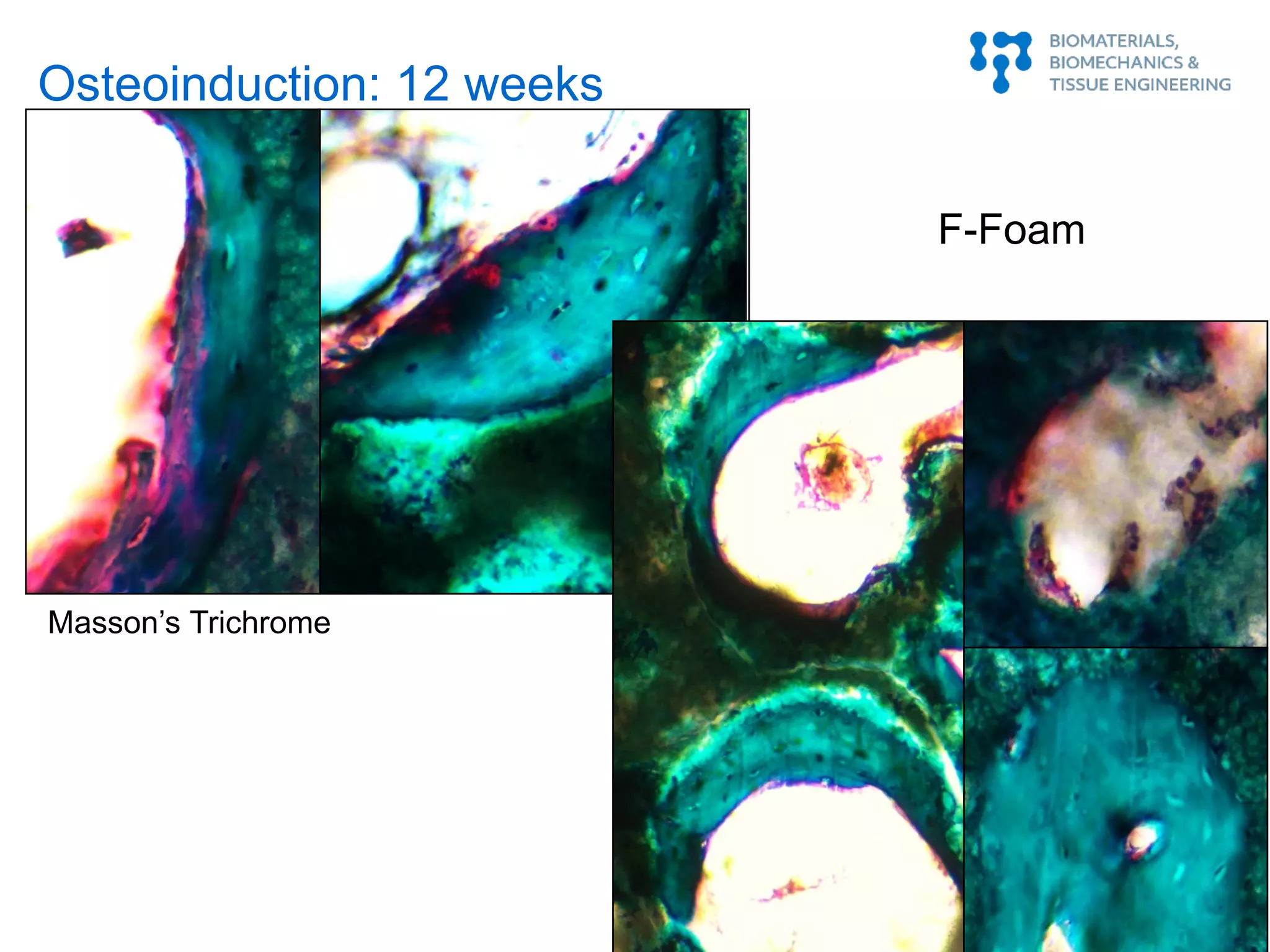
Osteoinduction: 12 weeks
CDHA-F: 6/6
1 mm 1 mm
BCP-F: 4/6 CDHA-Rob: 1/6
1 mm
A. Barba et al., ACS Applied Materials and Interfaces (2017)
F-Foam
Masson’s Trichrome
Osteoinduction: 12 weeks
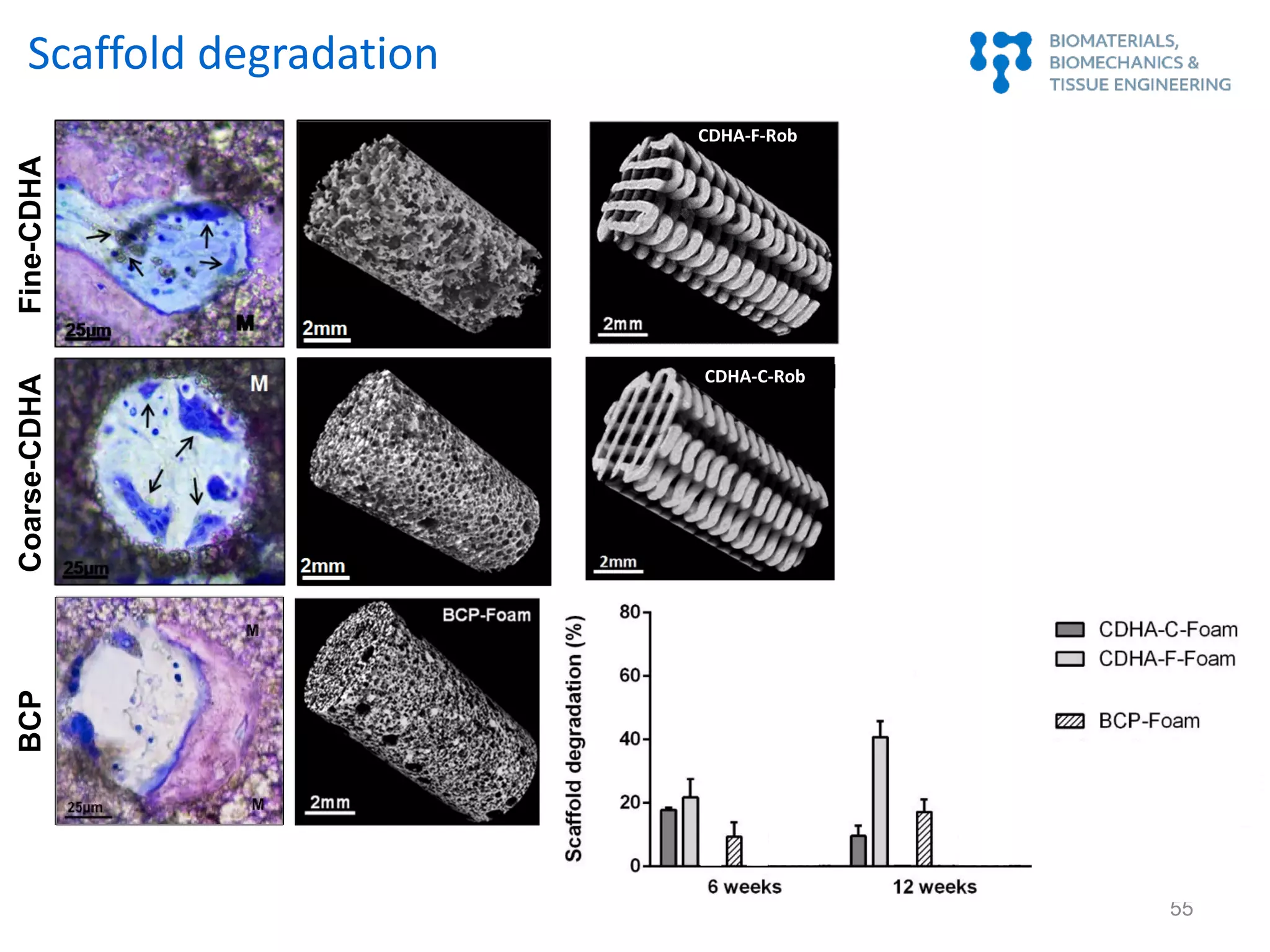
Fine-CDHACoarse-CDHA
Scaffold degradation
CDHA-F-Rob
55
BCP
CDHA-C-Rob
F-Foam
Orthotopic implantation
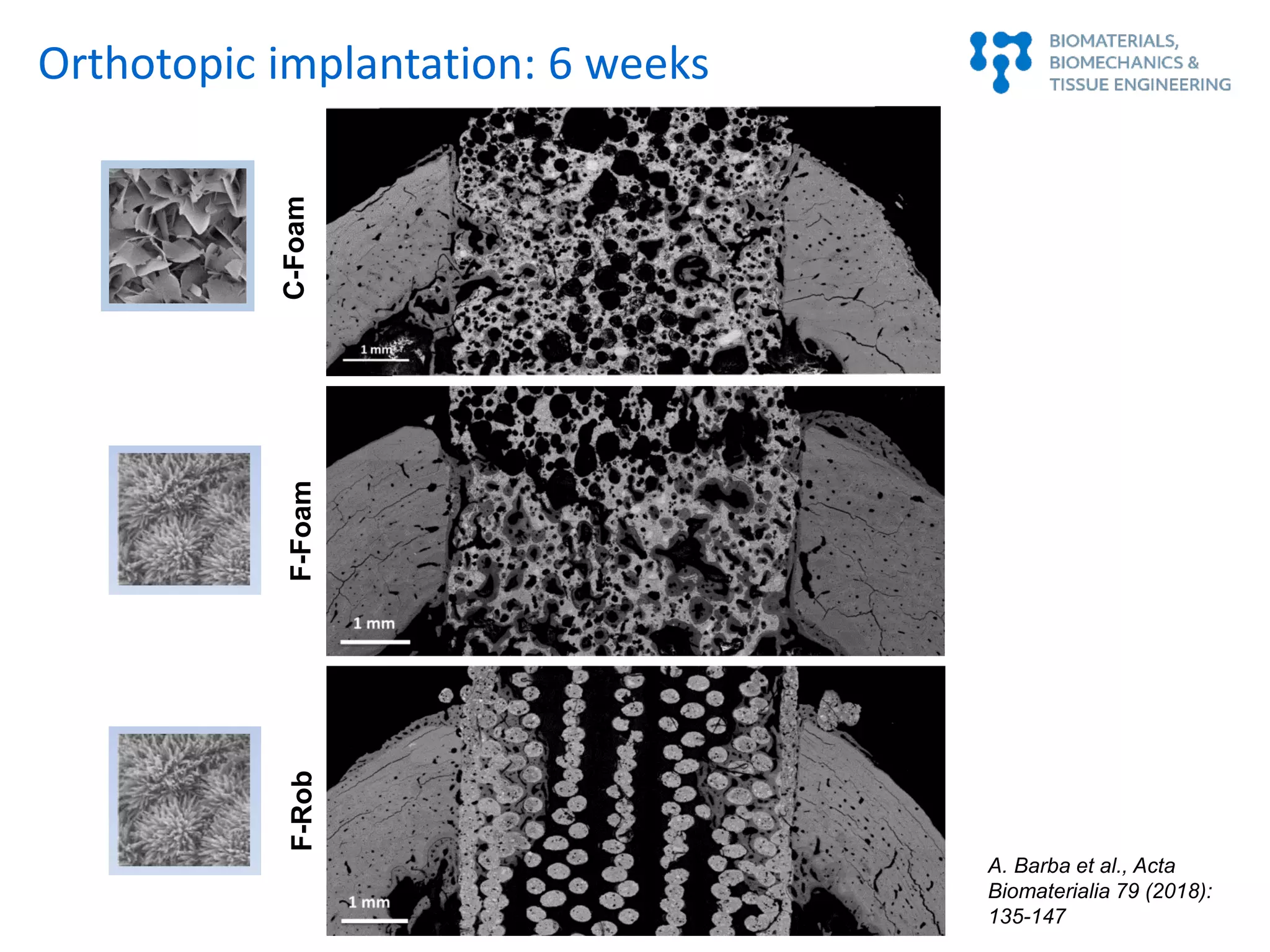
Monocortical defect in the femur of Beagle dogs
12 weeks
Orthotopic implantation: 6 weeks
C-FoamF-RobF-Foam
A. Barba et al., Acta
Biomaterialia 79 (2018):
135-147
Orthotopic implantation: 12 weeks
C-
Foam
F-RobF-
Foam
A. Barba et al., Acta
Biomaterialia 79 (2018):
135-147
Orthotopic implantation (μ-CT 3D quantification)
<
<
A. Barba et al., Acta Biomaterialia 79 (2018): 135-147
Outline
Biomimetic materials for bone regeneration
Porosity: how relevant is material
architecture at different lengthscales?
Osteoinducction and osteogenesis
Nanostructure and osteoimmunomodulation
1
2
3
4
(i) Direct trigger of osteogenic differentiation of MSCs through
physicochemical properties or local accumulation/production of
endogenous osteoinductive proteins such as BMP-2
(ii) Osteoimmunomodulation: indirect trigger of osteogenic
differentiation through the inflammatory response or osteoclastogenesis
Mechanisms of osteoinduction
61
Fine-CDHA
rMSCs
Coarse-CDHA
A. Barba et al., ACS Applied Materials and Interfaces (2019)
In vitro study:
Effect of nanostructure on MSCs
CO3-CDHA
BCP
62
In vitro study:
Effect of nanostructure on MSCs
63
POROSITY
TOPOGRAPHY
OSTEOIMMUNOMODULATIONIMMUNOMODULATION
RAW 264.7
RAW 264.7- CDHA
environment
SaOS-2
Nanostructure and osteoimmunomodulation
RAW 264.7
64
Prof. Xiao
Joanna SadowskaF65
C65
4μm
4μm
J. Sadowska et al., Biomaterials 181 (2018): 318-332
65
Gene expression of osteogenic markers
Nanostructure and osteoimmunomodulation
J. Sadowska et al., Biomaterials 181 (2018): 318-332
66
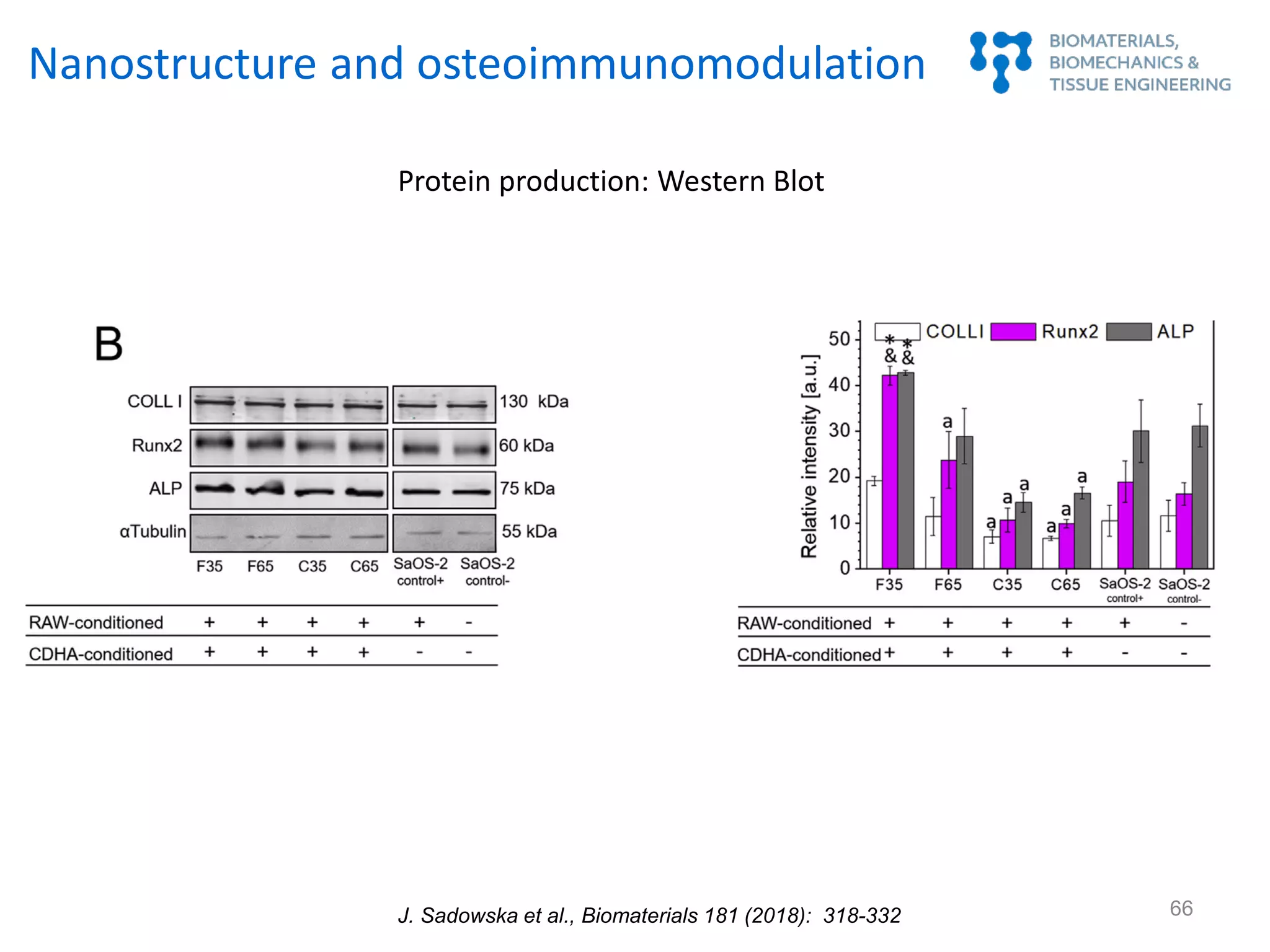
Protein production: Western Blot
Nanostructure and osteoimmunomodulation
J. Sadowska et al., Biomaterials 181 (2018): 318-332
67
Nanostructure and osteoimmunomodulation
J. Sadowska et al., Biomaterials 181 (2018): 318-332
F35 F65 C35 C65 control
-10
0
10
20
30
40
50
ALParea/cellarea[%]
F35 F65 C65C35 SaOS-2 SaOS-2
control+ control-
a
a
b
a
b
*&
200 µm
ALP, F-actin, nuclei
67
Immunohistochemistry: ALP expression
J. Sadowska et al., Biomaterials (2018)
 There is room for improvement of synthetic bone grafts
 Nanostructure and macropore geometry are key parameters controlling
osteoinduction and osteogenesis by CaP
 Biomimetic processing allows pushing the material associated
osteoinduction beyond the limits of microstructured CaP ceramics
 Advanced technologies, like 3D printing, open up new possibilities in the
design of patient-specific bone grafts
Summary
Acknowledgements
Funding bodies
J. Franch, University of Barcelona
M.C. Manzanares, Univ. Autònoma de Barcelona
C. Persson, Uppsala University, Sweden
P. Layrolle, INSERM, France
C. Aparicio, Univ. Minneapolis, USA
Y. Xiao, Queensland Univ of Technology,Brisbane,
Australia
M. Santin, Univ. Brighton, UK
N. Baldini, G. Ciapetti, Rizzoli Institute, Bolonia, Italy
A. Ignatius, Univ Ulm, Germany
O. Hoffmann, Univ Vienna, Austria
P. Boudeville, Univ. Montpellier, France
Collaborations
71
maria.pau.ginebra@upc.edu
https://biomaterials.upc.edu/ca
THANK YOU FOR YOUR
ATTENTION

Bioinspired strategies for bone regeneration.

  • 1.
    Bioinspired strategies forbone regeneration Maria-Pau Ginebra Biomaterials, Biomechanics and Tissue Engineering Group Dept. Materials Science and Metallurgy Universitat Politècnica de Catalunya, Barcelona, Spain Maria.pau.ginebra@upc.edu B-MRS, Balneario Camboriù, 22-26 September 2019
  • 2.
    http://biomaterials.upc.edu/en Department of MaterialsScience and Metallurgy Biomaterials, Biomechanics and Tissue Engineering Group
  • 3.
    Outline Biomimetic materials forbone regeneration Porosity: how relevant is material architecture at different lengthscales? Osteoinducction and osteogenesis Nanostructure and osteoimmunomodulation 1 2 3 4
  • 4.
    2,000,000 bone graftingprocedures are performed annually worldwide to restore bone function GreenwaldAS et al. J Bone Joint SurgAm. 2001;83-A, suppl 2, part 2:98-103. Bone grafting 4
  • 5.
    Bone grafting Non-union fractureComminuted fracture Alveolar ridge defect Bone tumor/cyst Spinal disc degeneration 5
  • 6.
    Bone regeneration: theproblem Sedentary lifestyle Ageing population
  • 7.
  • 8.
    Bone composition andstructure M. Sadat-Shojai et al. / Acta Biomaterialia 9 (2013) 7591–7621
  • 9.
    The “form” ofbiominerals in bone Fratzl and Weinkamer. Progress in Materials Science 52 (2007) 1263–1334 Mineral crystal shape/size: Nanocrystals: Platelets (20-60 x 10-20 x 2-5 nm3) Large specific surface area
  • 10.
    H.P. Schwarcz, E.A.McNally, G.A. Botton. Journal of Structural Biology 188 (2014) 240–248 Extrafibrillar mineral The “form” of minerals in bone
  • 11.
    E.A. McNally, H.P.Schwarcz, G.A. Botton, A.L. Arsenault. PLoS ONE 7(2012) 1 e29258 Extrafibrillar mineral (40 nm) (27 nm) (45 nm Ø) 200 nm The “form” of minerals in bone
  • 12.
    The “form” ofbiominerals in bone HighHigh reactivity S. Cazalbou et al., J Mater Chem 2004, 14: 2148-53
  • 13.
    Bone remodeling - 2-5%cortical bone remodeled every year - Trabecular bone 10 times faster
  • 14.
    C: Bone mineral phase A,B:High-T Synthetic HA LeGeros, (1991) HIGH T SINTERED HA Stoichiometric Highly crystalline Low porosity Low SSA Non resorbable in vivo 14 High Temperature Calcium Phosphates: Sintered ceramics
  • 15.
    Low-T CaPs: CalciumPhosphate CementsBiomimetic Calcum Phosphates 3Ca3(PO4)2 + H2O → Ca9(HPO4)(PO4)5(OH) α-Tricalcium phosphate Ca-deficient Hydroxyapatite (CDHA)
  • 16.
    M.P. Ginebra etal., Adv Drug Del Rev (2012) 1μm 1μm Fine powder Coarse powder
  • 17.
    High T CaPceramics vs low T biomimetic CaP SSA < 5 m2/g SSA ≈ 20 m2/g SSA ≈ 40 m2/g
  • 18.
    250 µm M. Espanolet al., Acta Biomaterialia (2009), 5: 2752–2762 3 α-Ca3(PO4)2 + H2O → Ca9(HPO4) (PO4)5(OH) L/P= 0.65 L/P= 0.35 Textural properties of nanostructured CDHA Liquid/powder ratio
  • 19.
    250 µm M. Espanolet al., Acta Biomaterialia (2009), 5: 2752–2762 3 α-Ca3(PO4)2 + H2O → Ca9(HPO4) (PO4)5(OH) L/P= 0.65 L/P= 0.35 Textural properties of nanostructured CDHA
  • 20.
    250 µm M. Espanolet al., Acta Biomaterialia (2009), 5: 2752–2762 3 α-Ca3(PO4)2 + H2O → Ca9(HPO4) (PO4)5(OH) L/P= 0.65 L/P= 0.35 Textural properties of nanostructured CDHA
  • 21.
    Outline Biomimetic materials forbone regeneration Porosity: how relevant is material architecture at different lengthscales? Osteoinducction and osteogenesis Nanostructure and osteoimmunomodulation 1 2 3 4
  • 22.
    Acidic degradation mimickingosteoclastic environment CDHA CO3-CDHA α-Ca3(PO4)2+ H2O ↑T β-TCP SHA Osteoclast Osteoclast Hydrochloric acid - HCl In vitro acidic degradation A. Diez-Escudero et al., Acta Biomaterialia (2017) 22 Solubility SHA < CDHA < β-TCP - logKps 116.8 85.1 28.9 Anna Diez Escudero
  • 23.
    Acidic degradation 15mL of0.14M NaCl and 0.01M HCl solution Medium refresh every hour (8 hours) Weight loss Acidic degradation mimicking osteoclastic environment CDHA CO3-CDHA α-Ca3(PO4)2+ H2O ↑T β-TCP SHA Osteoclast Osteoclast Hydrochloric acid - HCl In vitro acidic degradation A. Diez-Escudero et al., Acta Biomaterialia (2017) 23
  • 24.
    500 nm β-TCP 500 nm500 nm A. Diez-Escudero et al., Acta Biomaterialia 60 (2017):81-92 In vitro degradation 0.01M hydrochloric acid in 0.14M sodium chloride at 37 oC for 8h. * 24 In vitro acidic degradation
  • 25.
    Rizzoli Orthopaedic Institute, Dr.Baldini Diez-Escudero, A. Tissue Engineering Part C: Methods, 2017, 23(2), 118–124. Ciapetti G., et al., Acta Biomaterialia, 50(2017):102–113 Anna Diez Escudero Osteoclastogenesis and osteoclastic resorption 25
  • 26.
  • 27.
  • 28.
  • 29.
    The biomaterial asa scaffold The cells 29
  • 30.
  • 31.
    The foaming agentsmust essentially be: • Water soluble • Present good foamability and foam stability • Biocompatible Types of foaming agents: • LMW synthetic surfactants: Non ionic surfactants approved by the FDA for parenteral use (Tween, Pluronic) • Macromolecular surfactants: Protein based foaming agents, with additional biological functionalities. • Albumen • Soy-bean derived polymers • Gelatine Montufar et el. Acta Biomater 6 (2010) 876–885 Ginebra et al. JBMRA (2007) 351-361 Perut et el. Acta Biomater 7 (2011) 1780–1787 Montufar et al. Mat Sci Eng C 31(2011):1498-1504 Self-setting Calcium phosphate foams
  • 32.
    Foaming . 1 mm 1mm (Tween 80) Montufar EB, et al. Acta Biomater 2010;6:876-85 Pastorino et al. Acta Biomater 12 (2015) 250–59 Kovtun et al. Acta Biomater 12 (2015) 242-49 Self-setting Calcium phosphate foams
  • 33.
    Foaming . 1 mm 1mm Self-setting Calcium phosphate foams
  • 34.
    Controlled drug deliveryfrom CPC David Pastorino t Dose Dose Dose t Drug delivery from non-swellable matrices Priya Khurana Foams: Enhanced fluid circulation 34
  • 35.
    CaP Foams asDrug delivery systems Doxycycline Hyclate (0.88-3.52 wt%) D. Pastorino, et al. Acta Biomaterialia12 (2015) 250–259 G. Mestres et al., Mater Sci & Eng C 97(2019) 84-95 Foaming agent: Tween 80 Tetracyclines chelate Ca2+ ions 35
  • 36.
    CaP Foams asDrug delivery systems D. Pastorino, et al. Acta Biomaterialia12 (2015) 250–259 36
  • 37.
    Espanol, M etal. Biointerphases 7 (2012) 37 Protein retention: size exclusion chromatography 3 proteins: • Same chemical affinity, • Different sizes Montse Espanol
  • 38.
    Espanol, M etal. Biointerphases 7 (2012) 37 Protein retention: size exclusion chromatography
  • 39.
    Espanol, M etal. Biointerphases 7 (2012) 37 Nanostructured CDHA: protein retention
  • 40.
    3D-printing with self-settingCaP inks Yassine Maazouz Layer by layer nozzle micro-extrusion Calcium phosphate paste
  • 41.
    3D-printing with self-settingCaP inks Classic route Biomimetic route Hardening post-treatments Cesarano, J., Baer, T. A., & Calvert, P. (1997), Proc Solid Freeform Fabr Symp; Smay, J., & III, J. C. (2002), Langmuir; Michna, S., Wu, W., & Lewis, J. A. (2005), Biomaterials; Miranda, P., Saiz, E., Gryn, K., & Tomsia, A. P. (2006), Acta Biomater
  • 42.
    • Injectability • Pseudoplastic behaviour •Self-supporting 3D structures 3D-printing with self-setting CaP inks 1 mm 1 mm Yassine Maazouz Maazouz et al., J. Mater. Chem. B 2 (2014), 5378 – 5386 Maazouz et al., Acta Biomaterialia 49 (2017) 563-574 Raymond et al., Acta Biomaterialia 75 (2018): 451-462
  • 43.
    Outline Biomimetic materials forbone regeneration Porosity: how relevant is material architecture at different lengthscales? Osteoinducction and osteogenesis Nanostructure and osteoimmunomodulation 1 2 3 4
  • 44.
    Intrinsic osteoinductive biomaterials oTunning intrinsic physico-chemical parameters: - Chemical Composition - Macropore architecture - Microstructre Barradas AM, et al.2011 Arboleya L, et al. 2013 Janicki P, et al.2011 Engineered osteoinductive biomaterials o Addition of exogenous growth factors (BMPs) o Drawbacks: - Undesirable side effects - Variable efficacy - High costs Osteoinduction
  • 45.
    SSA: 0.5-6 m2/gSSA: 20-60 m2/g Biomimetic Calcium Phosphates
  • 46.
    Foaming  Interconnectedconcave macropores Montufar EB, et al. Acta Biomater 2010;6:876-85. 3D Inkjet printing  Interconnected prismatic macropores Maazouz Y, et al. Acta Biomaterialia 2018, in press 1 mm 1 mm 1 mm 1 mm FOAMS ROBOCASTED The scaffolds
  • 47.
    Foams Macrostructure Micro/nanostru cture 3D-Printed Macrostructure 47 1 µm BCP (HA:β-TCP80:20) Micro/nanostru cture 2µm2 µm 2 μm Macroporosity (%) 52.3 50.7 47.4 SSA (m2/g) 38.5 19.3 0.5 Macroporosity (%) 54.6 54.5 SSA (m2/g) 35.1 17.8
  • 48.
     Ectopic implantation(epaxial muscles) in Beagle dog, 6 and 12 weeks  Orthotopic Implantation (femur) in Beagle dog, 6 and 12 weeks In vivo study Albert Barba
  • 49.
    • μ-CT thresholdadjustment µ-CT BS-SEM µ-CT 3D quantification S. Lewin et al., Biomedical Materials (2017) In vivo study
  • 50.
    Ectopic bone formation A.Barba et al., ACS Applied Materials and Interfaces 2017, 9, 41722−36) 6 weeks12 weeks 50 Osteoinduction is accelerated in biomimetic nanostructured HA with concave macroporosity
  • 51.
    BCP-F : 0/6 Osteoinduction:6 weeks BCP-F: 0/6 A. Barba et al., ACS Applied Materials and Interfaces (2017)
  • 52.
    1 mm 1 mm50 μm200 μm 200 μm 50 μm1 mm F-Foam A. Barba et al., ACS Applied Materials and Interfaces (2017) Osteoinduction: 6 weeks
  • 53.
    Osteoinduction: 12 weeks CDHA-F:6/6 1 mm 1 mm BCP-F: 4/6 CDHA-Rob: 1/6 1 mm A. Barba et al., ACS Applied Materials and Interfaces (2017)
  • 54.
  • 55.
  • 56.
    F-Foam Orthotopic implantation Monocortical defectin the femur of Beagle dogs 12 weeks
  • 57.
    Orthotopic implantation: 6weeks C-FoamF-RobF-Foam A. Barba et al., Acta Biomaterialia 79 (2018): 135-147
  • 58.
    Orthotopic implantation: 12weeks C- Foam F-RobF- Foam A. Barba et al., Acta Biomaterialia 79 (2018): 135-147
  • 59.
    Orthotopic implantation (μ-CT3D quantification) < < A. Barba et al., Acta Biomaterialia 79 (2018): 135-147
  • 60.
    Outline Biomimetic materials forbone regeneration Porosity: how relevant is material architecture at different lengthscales? Osteoinducction and osteogenesis Nanostructure and osteoimmunomodulation 1 2 3 4
  • 61.
    (i) Direct triggerof osteogenic differentiation of MSCs through physicochemical properties or local accumulation/production of endogenous osteoinductive proteins such as BMP-2 (ii) Osteoimmunomodulation: indirect trigger of osteogenic differentiation through the inflammatory response or osteoclastogenesis Mechanisms of osteoinduction 61
  • 62.
    Fine-CDHA rMSCs Coarse-CDHA A. Barba etal., ACS Applied Materials and Interfaces (2019) In vitro study: Effect of nanostructure on MSCs CO3-CDHA BCP 62
  • 63.
    In vitro study: Effectof nanostructure on MSCs 63
  • 64.
    POROSITY TOPOGRAPHY OSTEOIMMUNOMODULATIONIMMUNOMODULATION RAW 264.7 RAW 264.7-CDHA environment SaOS-2 Nanostructure and osteoimmunomodulation RAW 264.7 64 Prof. Xiao Joanna SadowskaF65 C65 4μm 4μm J. Sadowska et al., Biomaterials 181 (2018): 318-332
  • 65.
    65 Gene expression ofosteogenic markers Nanostructure and osteoimmunomodulation J. Sadowska et al., Biomaterials 181 (2018): 318-332
  • 66.
    66 Protein production: WesternBlot Nanostructure and osteoimmunomodulation J. Sadowska et al., Biomaterials 181 (2018): 318-332
  • 67.
    67 Nanostructure and osteoimmunomodulation J.Sadowska et al., Biomaterials 181 (2018): 318-332 F35 F65 C35 C65 control -10 0 10 20 30 40 50 ALParea/cellarea[%] F35 F65 C65C35 SaOS-2 SaOS-2 control+ control- a a b a b *& 200 µm ALP, F-actin, nuclei 67 Immunohistochemistry: ALP expression J. Sadowska et al., Biomaterials (2018)
  • 70.
     There isroom for improvement of synthetic bone grafts  Nanostructure and macropore geometry are key parameters controlling osteoinduction and osteogenesis by CaP  Biomimetic processing allows pushing the material associated osteoinduction beyond the limits of microstructured CaP ceramics  Advanced technologies, like 3D printing, open up new possibilities in the design of patient-specific bone grafts Summary
  • 71.
    Acknowledgements Funding bodies J. Franch,University of Barcelona M.C. Manzanares, Univ. Autònoma de Barcelona C. Persson, Uppsala University, Sweden P. Layrolle, INSERM, France C. Aparicio, Univ. Minneapolis, USA Y. Xiao, Queensland Univ of Technology,Brisbane, Australia M. Santin, Univ. Brighton, UK N. Baldini, G. Ciapetti, Rizzoli Institute, Bolonia, Italy A. Ignatius, Univ Ulm, Germany O. Hoffmann, Univ Vienna, Austria P. Boudeville, Univ. Montpellier, France Collaborations 71
  • 72.