How can academic publishing increase
diversity and inclusion
Christiane Barranguet
Publishing Director, Materials Today / Elsevier
2
Materials Science: FWCI
3
Materials Science, country output and impact
81,552
21,175
965,025
343,946
212,625
86,693
1,389,772
732,359
0% 10% 20% 30% 40% 50% 60% 70% 80% 90% 100%
2011-2015
1996-2000
2011-2015
1996-2000
MaterialsScienceAllScience
Women Men
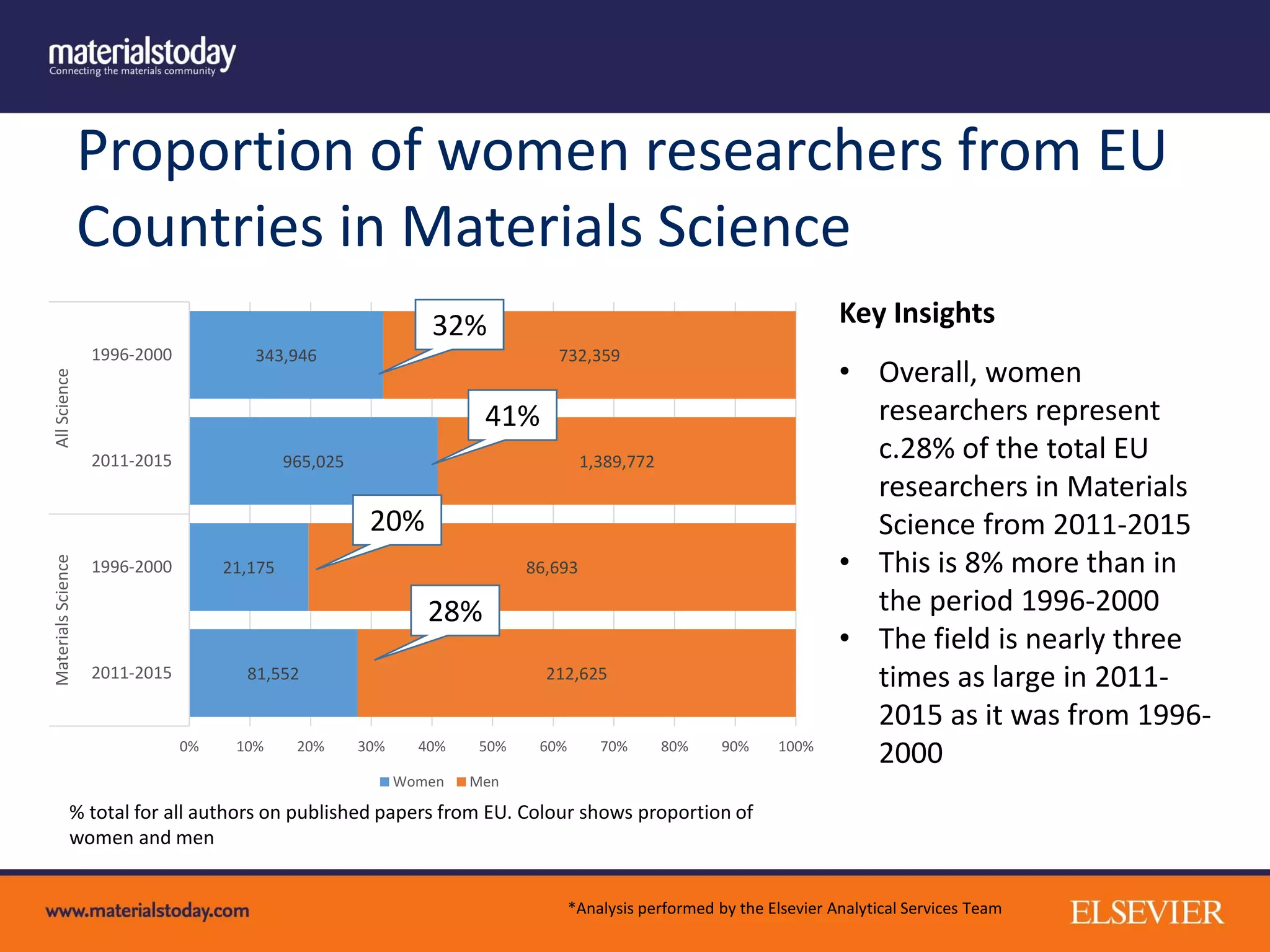
Proportion of women researchers from EU
Countries in Materials Science
Key Insights
• Overall, women
researchers represent
c.28% of the total EU
researchers in Materials
Science from 2011-2015
• This is 8% more than in
the period 1996-2000
• The field is nearly three
times as large in 2011-
2015 as it was from 1996-
2000
*Analysis performed by the Elsevier Analytical Services Team
32%
41%
20%
28%
% total for all authors on published papers from EU. Colour shows proportion of
women and men
What happens in Brazil?
• Female researchers in Brazil = 49%
• Female researchers tend to specialize in the health and life sciences; men tend to
specialize in the physical sciences. Less female researchers in the physical sciences than
in the life and health sciences, in which women tend to comprise more than 50% of
researchers in Brazil.
• In Brazil, women tend to publish slightly fewer papers than men on average; however,
for most comparators there is little difference in citation and download impact between
the genders.
• The proportion of women among inventors in Brazil is 19%, and 21% of Brazil patent
applications list a woman among their authors – a similar proportion to Mexico’s and
Chile’s.
• Overall, female scientists seem to collaborate internationally less than men on papers: in
Brazil, 20% of their output result from international collaboration compared to 25% for
men. Among researchers in Brazil, women also tend to be less international mobile than
men.
• Overall, women seem to collaborate across the academic and corporate sectors on
papers at a slightly lower rate than men (1% vs 2% of their scholarly output in Brazil).
• In Brazil, 10% of women’s and 9% of men’s scholarly output belongs to the top 10%
interdisciplinary papers.
Engineering is a field of science in which
women researchers are generally
significantly outnumbered by men
researchers.
When men appear as authors in
Engineering papers, they are more likely to
take the first or corresponding author
position than when women publish in the
same field.
In Brazil, women are first or corresponding
author on 48% of their Engineering
papers, 15 percentage points less than
men, who are first or corresponding
author on 63% of their Engineering
papers. The difference is similar to
France’s and Canada’s.
Brazil has relatively low shares of
papers reflecting international
collaboration for both men (25%)
and women (20%).
In line with global patterns, scholarly
output reflecting international
collaboration increased between
1996-2000 and 2011-2015 as a
proportion of total scholarly output
For all comparators, women’s
scholarly output is less likely to result
from international collaboration than
men’s. For Brazil, the difference is 5
percentage points, similar to the
US’s.
Brazil has relatively low shares of
papers reflecting academic-
corporate collaboration for both
men and women, similar to
Mexico.
In Brazil, the proportion of
scholarly output resulting from
academic-corporate collaboration
is slightly lower for women (1%)
than for men (2%).
For most comparators, the
proportion of cross-sector
collaboration increases between
periods for both men and
women. For Brazil, it increases
only for men.
For Brazil, the proportion of
scholarly output that belongs to
the top 10% interdisciplinary
output is 10% for women and 9%
for men, stable for women and
increasing for men.
The differences across gender are
overall limited; however, for most
comparators, women tend to have
a slightly higher share than men of
the top 10% of interdisciplinary
scholarly output relative to their
total scholarly output. In most
comparators, the proportion
decreases for women and
increases for men between 1996-
2000 and 2011-2015.
If women are less
internationally mobile, it may
restrict their network and
international collaboration
opportunities. If international
collaboration occurs less
frequently for women than
men, their networks may
remain small and this may
negatively affect opportunities
for career progression and
mobility.
In Brazil, the proportion of women researchers classified as migratory (in any one of the
three classes: outflow, transitory, or inflow) is lower than the share of active women
researchers overall. The share of non-migratory women researchers is higher than the
share of women researchers overall: this indicates that women researchers may be less
internationally mobile than men researchers. The highest impact research comes from the
transitory group. Although research from the outflow group has a lower impact than that
of all active researchers, the FWCI is lowest for the non-migratory researchers.
| 11
• We publish c.29% of all materials science research*
• That’s c.69,000 papers in 2017 (out of c.125,000
submissions)
• We work with c.2,200 editors and editorial board
members
Why can Elsevier make a difference in
the Materials Science community…
*data taken from Scival.com
We publish 60-130 journals relating to materials science
| 13
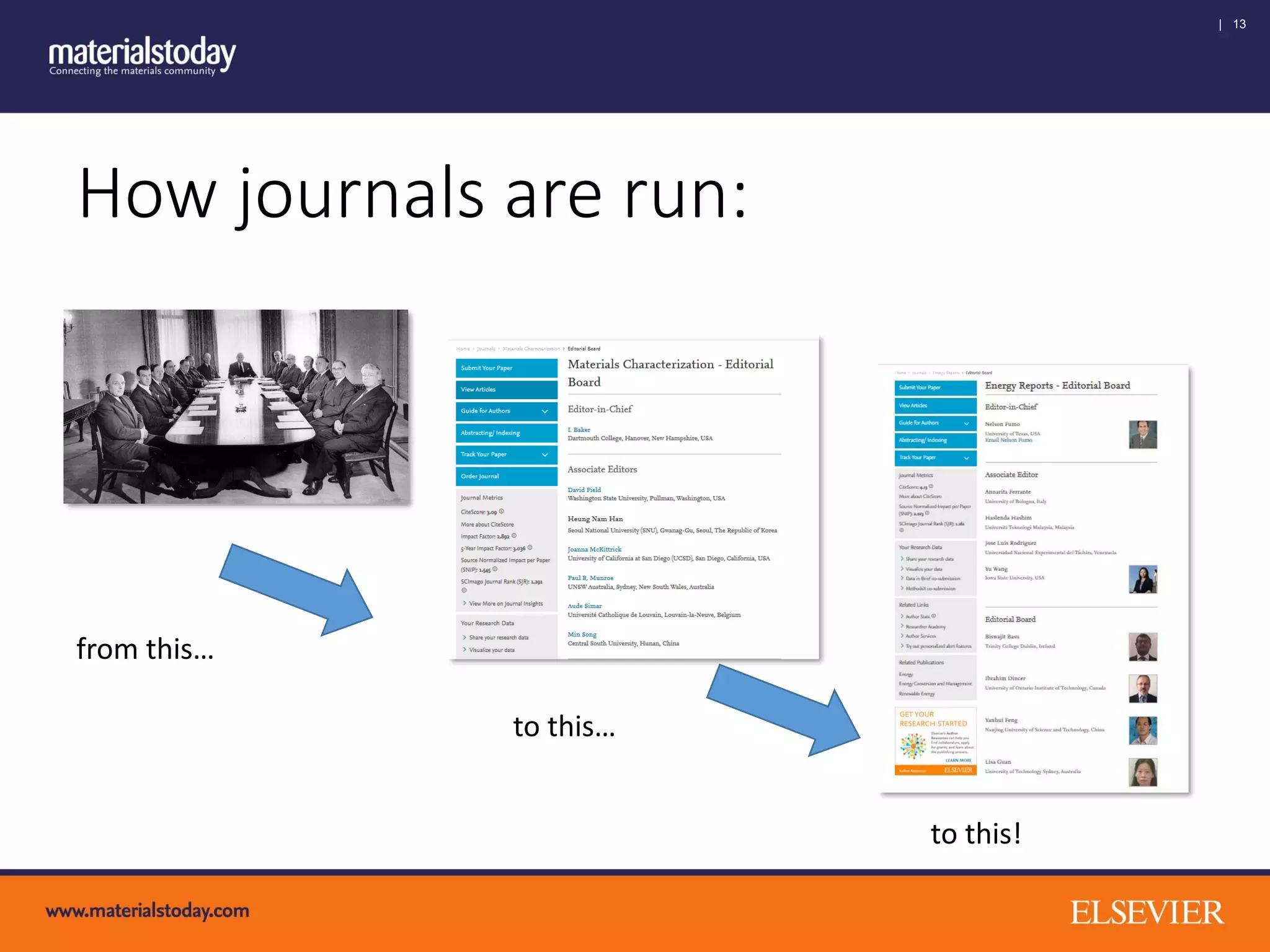
from this…
to this…
to this!
How journals are run:
| 14
• As of 2017 we focus on making our editorial appointments
more diverse from a gender and geographic perspective
• BUT, we don’t want to create targets for appointment (yet)
• We still appoint on basis of suitability for role
• We ask editors to consider equal shortlisting of women for
editorial appointments, and we do the same when we’re
appointing an editor
How we are diversifying our editorial
boards…
| 15
Some results we found from our
conferences
A focus on diversity in our journals
and conferences
Encouraging greater involvement from under
represented groups in materials science
• Our materials science journals receive over 125,000 submissions per
year and our conferences have over 2,000 annual attendees – we
touch on all sections of the materials science community
• We use an evidence based approach to drive our initiatives in
diversity
• We are setting challenges for our journals to ensure that we mirror
the makeup of the scientific community on our editorial boards
• We are ensuring that our conferences have a diverse mix of chairs
and speakers to encourage a more diverse mix of attendees
18
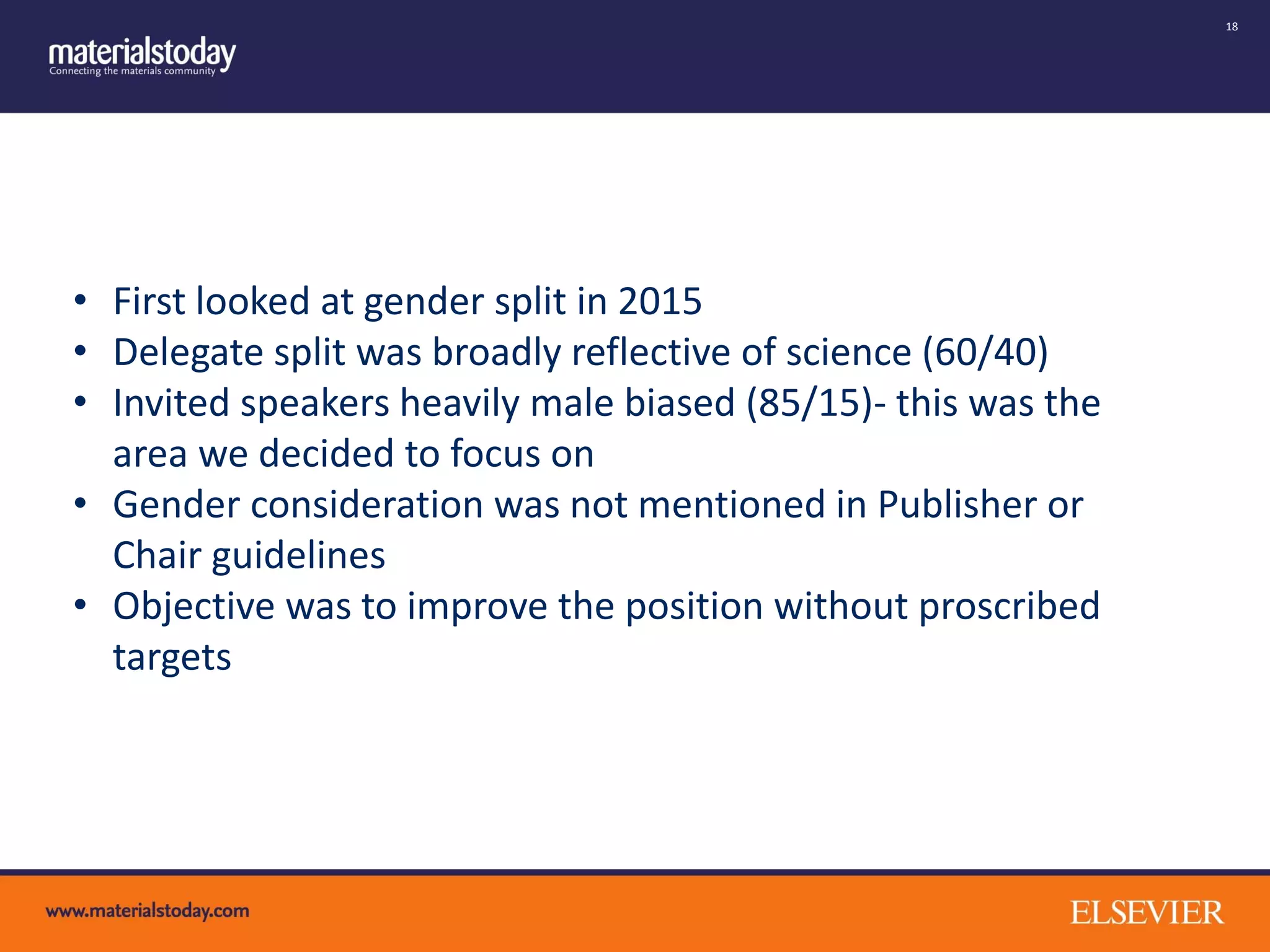
• First looked at gender split in 2015
• Delegate split was broadly reflective of science (60/40)
• Invited speakers heavily male biased (85/15)- this was the
area we decided to focus on
• Gender consideration was not mentioned in Publisher or
Chair guidelines
• Objective was to improve the position without proscribed
targets
19
Split of invited speakers
2015 2016
84.56%
15.44%
76.23
23.76
Men
Women
2017
• Chair guidelines were updated to stress importance of gender
balance and, specifically, to avoid all male panels
• Project Leads reiterate this during planning calls
• We find that the feedback from conferences with better gender
diversity of speakers is more positive
80.70%
19.29%
Our expectations…
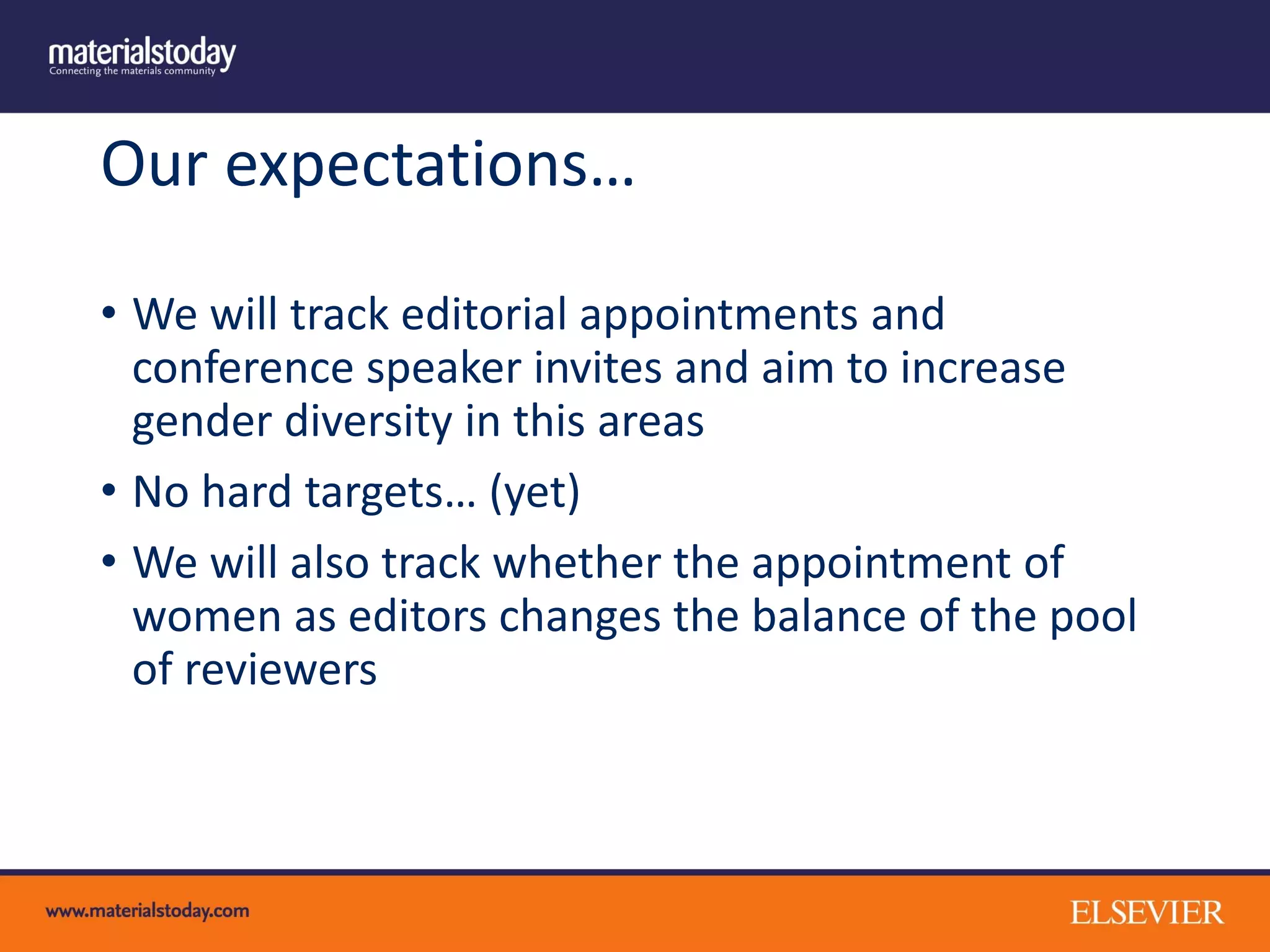
• We will track editorial appointments and
conference speaker invites and aim to increase
gender diversity in this areas
• No hard targets… (yet)
• We will also track whether the appointment of
women as editors changes the balance of the pool
of reviewers
The Materials Today Award Program
The Embracing Challenge Award
Recognising researchers who have
overcome significant personal
difficulties to make an impact in the
materials science community
• Highlighting researchers for the challenges that they have
overcome that others may also face pursuing a career in
materials science research
• Comes with a $5,000 prize and travel costs to attend a
Materials Today event
The Materials Today Award Program
Serving as a source of inspiration by recognising
those who have made a significant contribution
to the advancement of their field, thereby having
a positive influence on our society
• Over 25 awards associated with our journals and conferences, as well as
general awards
• The awards recognise established researchers, young scientists, referees,
science communicators and more
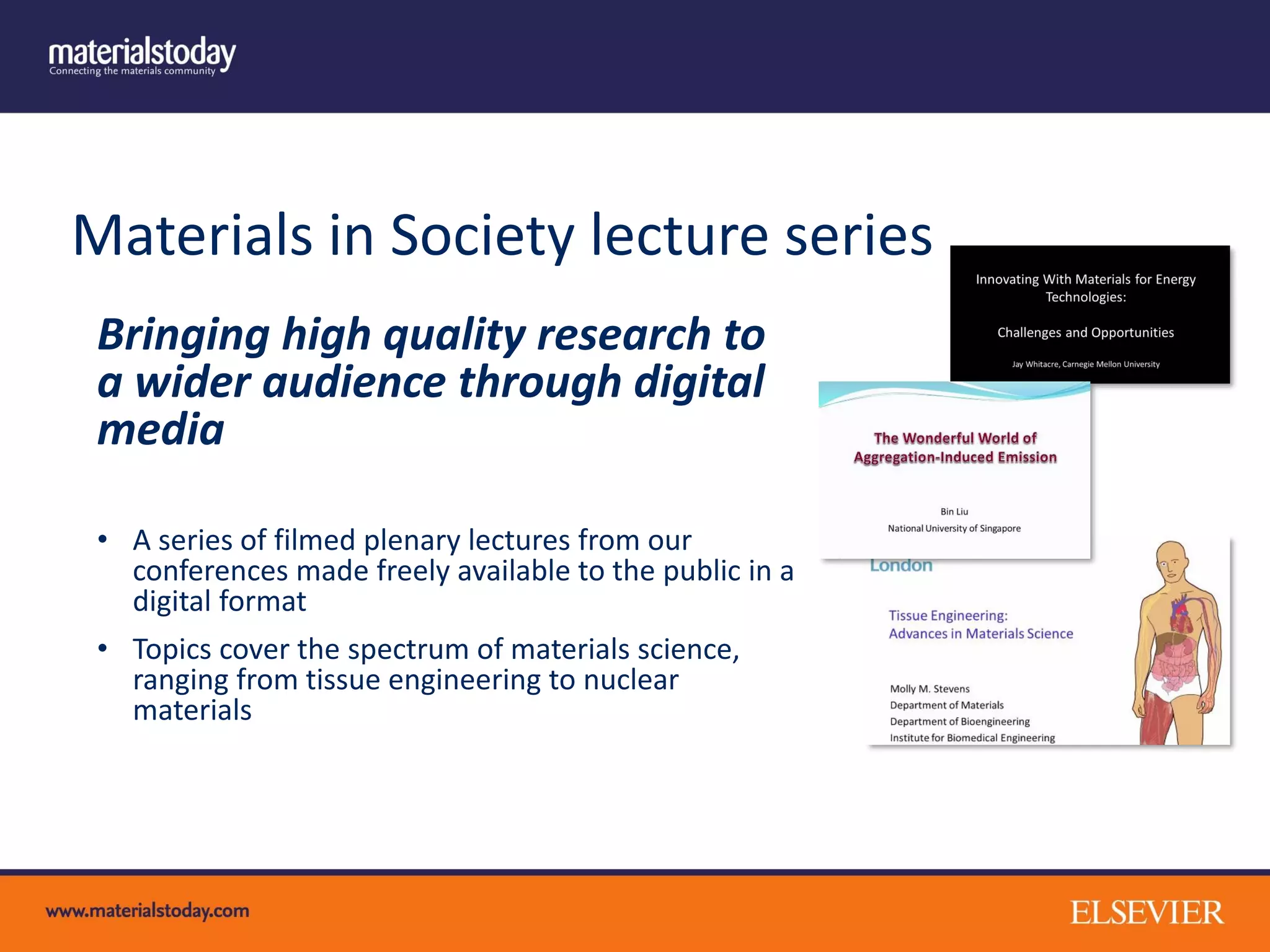
Materials in Society lecture series
Bringing high quality research to
a wider audience through digital
media
• A series of filmed plenary lectures from our
conferences made freely available to the public in a
digital format
• Topics cover the spectrum of materials science,
ranging from tissue engineering to nuclear
materials
24
New Scholars - 10 years, 50 grants, ca $2.5 million
Advancing women scientists: grants for family friendly
policies, career skills, dual career issues, recognition
awards, benchmarking studies, and boosting
professional visibility through childcare grants.
Creating more opportunities to recognize and support women in
Science
Engaging with Gender Summits
The partnership between Elsevier and Gender Summit
has increased over time, encompassing a wider range
of initiatives, such as sponsorships, reports, and the
bilateral learning and ‘growing’ process.
The Elsevier Family Support Award
In 2015, Cell Press launched $500 awards for early
career researchers to mitigate childcare expense and
promote professional visibility.
Social media
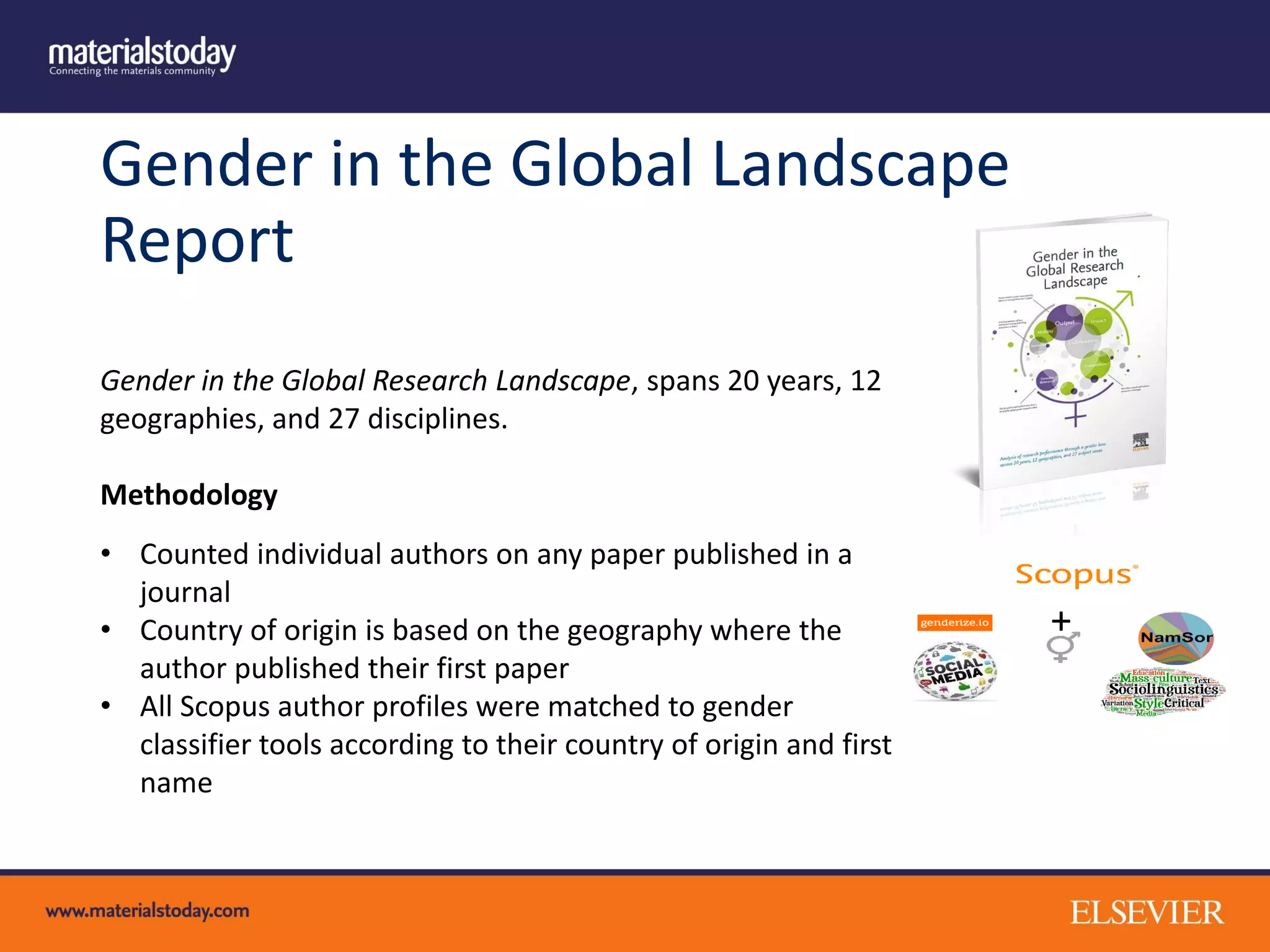
Gender in the Global Landscape
Report
Gender in the Global Research Landscape, spans 20 years, 12
geographies, and 27 disciplines.
Methodology
• Counted individual authors on any paper published in a
journal
• Country of origin is based on the geography where the
author published their first paper
• All Scopus author profiles were matched to gender
classifier tools according to their country of origin and first
name
+
Thank you
Christiane Barranguet
c.barranguet@elsevier.com

How can academic publishing increase diversity and inclusion,

  • 1.
    How can academicpublishing increase diversity and inclusion Christiane Barranguet Publishing Director, Materials Today / Elsevier
  • 2.
  • 3.
  • 4.
    81,552 21,175 965,025 343,946 212,625 86,693 1,389,772 732,359 0% 10% 20%30% 40% 50% 60% 70% 80% 90% 100% 2011-2015 1996-2000 2011-2015 1996-2000 MaterialsScienceAllScience Women Men Proportion of women researchers from EU Countries in Materials Science Key Insights • Overall, women researchers represent c.28% of the total EU researchers in Materials Science from 2011-2015 • This is 8% more than in the period 1996-2000 • The field is nearly three times as large in 2011- 2015 as it was from 1996- 2000 *Analysis performed by the Elsevier Analytical Services Team 32% 41% 20% 28% % total for all authors on published papers from EU. Colour shows proportion of women and men
  • 5.
    What happens inBrazil? • Female researchers in Brazil = 49% • Female researchers tend to specialize in the health and life sciences; men tend to specialize in the physical sciences. Less female researchers in the physical sciences than in the life and health sciences, in which women tend to comprise more than 50% of researchers in Brazil. • In Brazil, women tend to publish slightly fewer papers than men on average; however, for most comparators there is little difference in citation and download impact between the genders. • The proportion of women among inventors in Brazil is 19%, and 21% of Brazil patent applications list a woman among their authors – a similar proportion to Mexico’s and Chile’s. • Overall, female scientists seem to collaborate internationally less than men on papers: in Brazil, 20% of their output result from international collaboration compared to 25% for men. Among researchers in Brazil, women also tend to be less international mobile than men. • Overall, women seem to collaborate across the academic and corporate sectors on papers at a slightly lower rate than men (1% vs 2% of their scholarly output in Brazil). • In Brazil, 10% of women’s and 9% of men’s scholarly output belongs to the top 10% interdisciplinary papers.
  • 6.
    Engineering is afield of science in which women researchers are generally significantly outnumbered by men researchers. When men appear as authors in Engineering papers, they are more likely to take the first or corresponding author position than when women publish in the same field. In Brazil, women are first or corresponding author on 48% of their Engineering papers, 15 percentage points less than men, who are first or corresponding author on 63% of their Engineering papers. The difference is similar to France’s and Canada’s.
  • 7.
    Brazil has relativelylow shares of papers reflecting international collaboration for both men (25%) and women (20%). In line with global patterns, scholarly output reflecting international collaboration increased between 1996-2000 and 2011-2015 as a proportion of total scholarly output For all comparators, women’s scholarly output is less likely to result from international collaboration than men’s. For Brazil, the difference is 5 percentage points, similar to the US’s.
  • 8.
    Brazil has relativelylow shares of papers reflecting academic- corporate collaboration for both men and women, similar to Mexico. In Brazil, the proportion of scholarly output resulting from academic-corporate collaboration is slightly lower for women (1%) than for men (2%). For most comparators, the proportion of cross-sector collaboration increases between periods for both men and women. For Brazil, it increases only for men.
  • 9.
    For Brazil, theproportion of scholarly output that belongs to the top 10% interdisciplinary output is 10% for women and 9% for men, stable for women and increasing for men. The differences across gender are overall limited; however, for most comparators, women tend to have a slightly higher share than men of the top 10% of interdisciplinary scholarly output relative to their total scholarly output. In most comparators, the proportion decreases for women and increases for men between 1996- 2000 and 2011-2015.
  • 10.
    If women areless internationally mobile, it may restrict their network and international collaboration opportunities. If international collaboration occurs less frequently for women than men, their networks may remain small and this may negatively affect opportunities for career progression and mobility. In Brazil, the proportion of women researchers classified as migratory (in any one of the three classes: outflow, transitory, or inflow) is lower than the share of active women researchers overall. The share of non-migratory women researchers is higher than the share of women researchers overall: this indicates that women researchers may be less internationally mobile than men researchers. The highest impact research comes from the transitory group. Although research from the outflow group has a lower impact than that of all active researchers, the FWCI is lowest for the non-migratory researchers.
  • 11.
    | 11 • Wepublish c.29% of all materials science research* • That’s c.69,000 papers in 2017 (out of c.125,000 submissions) • We work with c.2,200 editors and editorial board members Why can Elsevier make a difference in the Materials Science community… *data taken from Scival.com
  • 12.
    We publish 60-130journals relating to materials science
  • 13.
    | 13 from this… tothis… to this! How journals are run:
  • 14.
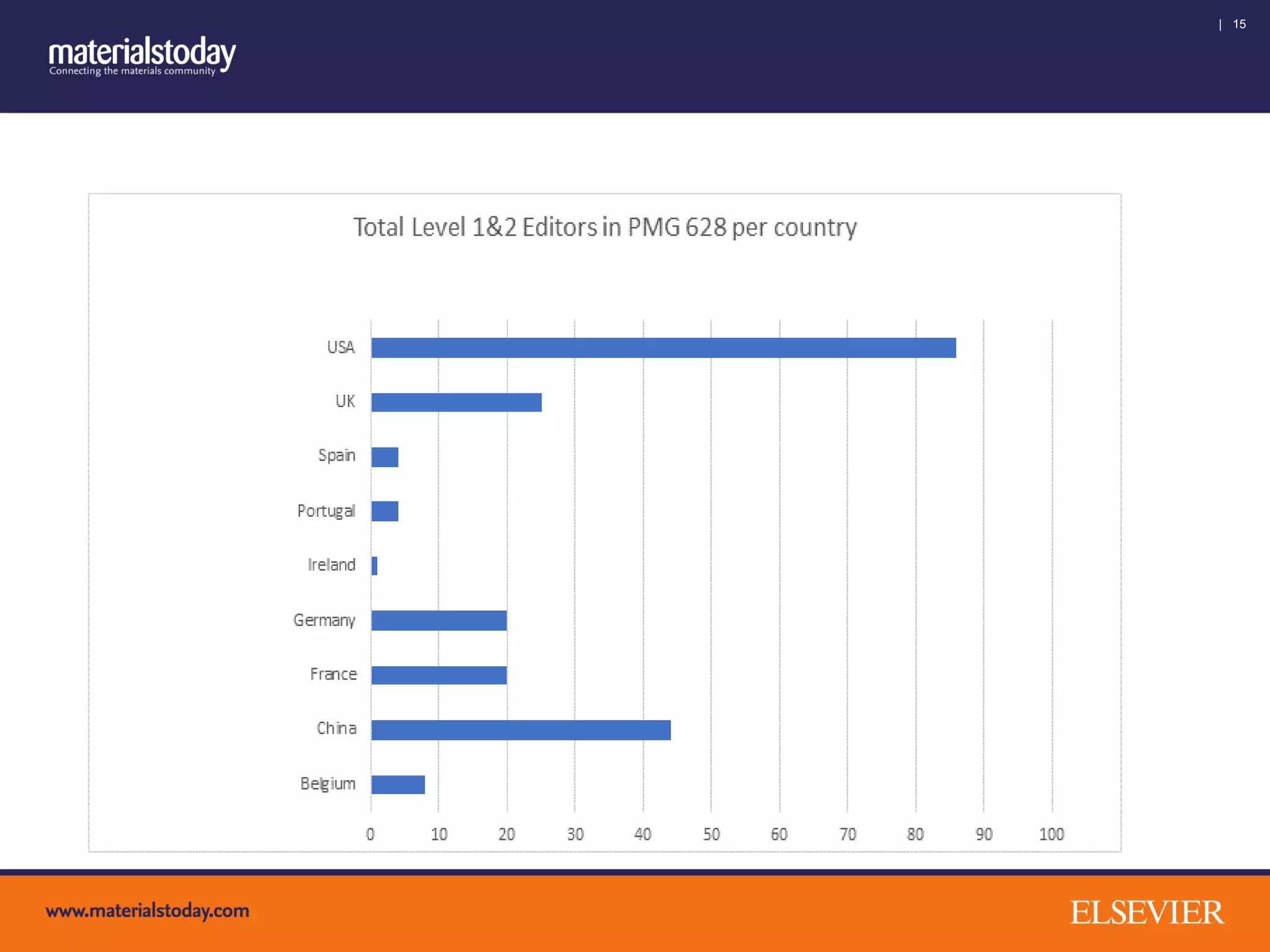
    | 14 • Asof 2017 we focus on making our editorial appointments more diverse from a gender and geographic perspective • BUT, we don’t want to create targets for appointment (yet) • We still appoint on basis of suitability for role • We ask editors to consider equal shortlisting of women for editorial appointments, and we do the same when we’re appointing an editor How we are diversifying our editorial boards…
  • 15.
  • 16.
    Some results wefound from our conferences
  • 17.
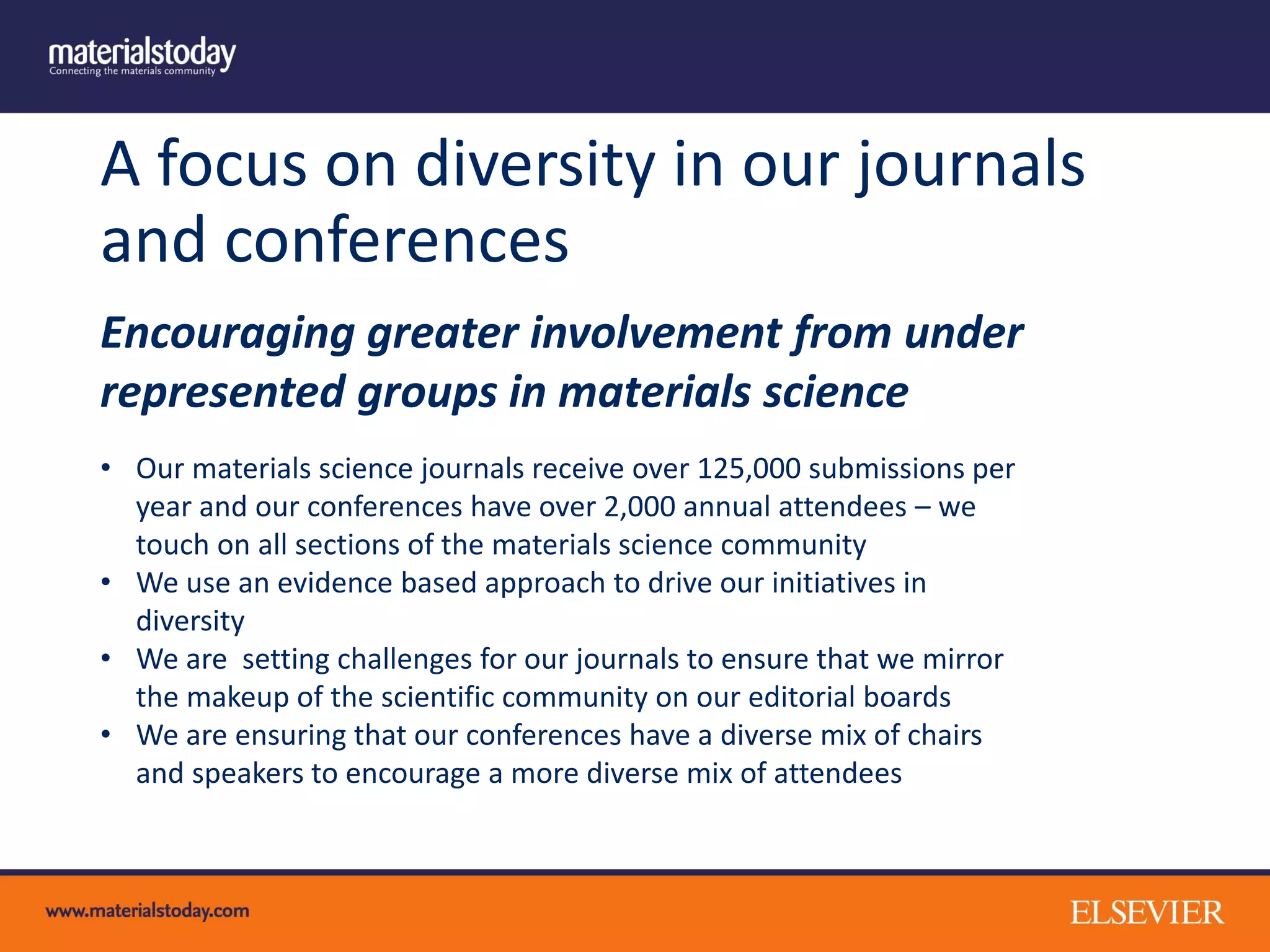
    A focus ondiversity in our journals and conferences Encouraging greater involvement from under represented groups in materials science • Our materials science journals receive over 125,000 submissions per year and our conferences have over 2,000 annual attendees – we touch on all sections of the materials science community • We use an evidence based approach to drive our initiatives in diversity • We are setting challenges for our journals to ensure that we mirror the makeup of the scientific community on our editorial boards • We are ensuring that our conferences have a diverse mix of chairs and speakers to encourage a more diverse mix of attendees
  • 18.
    18 • First lookedat gender split in 2015 • Delegate split was broadly reflective of science (60/40) • Invited speakers heavily male biased (85/15)- this was the area we decided to focus on • Gender consideration was not mentioned in Publisher or Chair guidelines • Objective was to improve the position without proscribed targets
  • 19.
    19 Split of invitedspeakers 2015 2016 84.56% 15.44% 76.23 23.76 Men Women 2017 • Chair guidelines were updated to stress importance of gender balance and, specifically, to avoid all male panels • Project Leads reiterate this during planning calls • We find that the feedback from conferences with better gender diversity of speakers is more positive 80.70% 19.29%
  • 20.
    Our expectations… • Wewill track editorial appointments and conference speaker invites and aim to increase gender diversity in this areas • No hard targets… (yet) • We will also track whether the appointment of women as editors changes the balance of the pool of reviewers
  • 21.
    The Materials TodayAward Program The Embracing Challenge Award Recognising researchers who have overcome significant personal difficulties to make an impact in the materials science community • Highlighting researchers for the challenges that they have overcome that others may also face pursuing a career in materials science research • Comes with a $5,000 prize and travel costs to attend a Materials Today event
  • 22.
    The Materials TodayAward Program Serving as a source of inspiration by recognising those who have made a significant contribution to the advancement of their field, thereby having a positive influence on our society • Over 25 awards associated with our journals and conferences, as well as general awards • The awards recognise established researchers, young scientists, referees, science communicators and more
  • 23.
    Materials in Societylecture series Bringing high quality research to a wider audience through digital media • A series of filmed plenary lectures from our conferences made freely available to the public in a digital format • Topics cover the spectrum of materials science, ranging from tissue engineering to nuclear materials
  • 24.
    24 New Scholars -10 years, 50 grants, ca $2.5 million Advancing women scientists: grants for family friendly policies, career skills, dual career issues, recognition awards, benchmarking studies, and boosting professional visibility through childcare grants. Creating more opportunities to recognize and support women in Science Engaging with Gender Summits The partnership between Elsevier and Gender Summit has increased over time, encompassing a wider range of initiatives, such as sponsorships, reports, and the bilateral learning and ‘growing’ process. The Elsevier Family Support Award In 2015, Cell Press launched $500 awards for early career researchers to mitigate childcare expense and promote professional visibility.
  • 25.
  • 27.
    Gender in theGlobal Landscape Report Gender in the Global Research Landscape, spans 20 years, 12 geographies, and 27 disciplines. Methodology • Counted individual authors on any paper published in a journal • Country of origin is based on the geography where the author published their first paper • All Scopus author profiles were matched to gender classifier tools according to their country of origin and first name +
  • 28.