




Flexible ElectronicsFlexible ElectronicsFlexible ElectronicsFlexible Electronics
Outline:Outline:
Flexible electronicsFlexible electronics
Flexible electronics, also known as flex circuits, is a technology for
assembling electronic circuits by mounting electronic devices on
flexible plastic substrates.
Flexible Circuit boardsFlexible Circuit boards
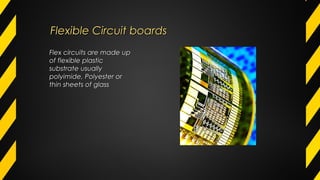
Flex circuits are made upFlex circuits are made up
of flexible plasticof flexible plastic
substrate usuallysubstrate usually
polyimide, Polyester orpolyimide, Polyester or
thin sheets of glassthin sheets of glass
Flexible electronic componentsFlexible electronic components
Electronic components such as transistors are being made from silicon
nanomembrane usually called TFT’s(thin film transistors).
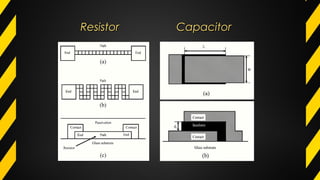
Flexible resistors & capacitors structures are shown diagrammatically usually called
thin flim resistors and thin flim capacitors
ResistorResistor CapacitorCapacitor
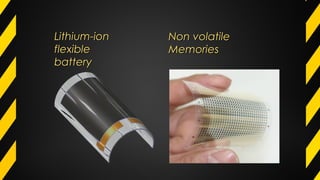
Lithium-ionLithium-ion
flexibleflexible
batterybattery
Non volatileNon volatile
MemoriesMemories
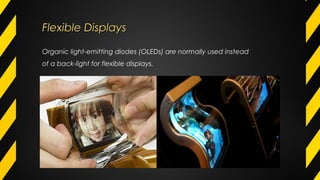
Flexible DisplaysFlexible Displays
Organic light-emitting diodes (OLEDs) are normally used instead
of a back-light for flexible displays.
Manufacturing of flexible circuits &Manufacturing of flexible circuits &
devicesdevices
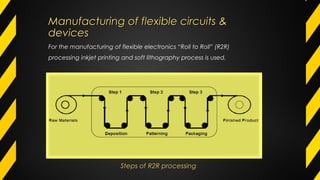
For the manufacturing of flexible electronics “Roll to Roll” (R2R)
processing inkjet printing and soft lithography process is used.
Steps of R2R processingSteps of R2R processing
Layers materials and their thicknessLayers materials and their thickness
Base material or
substrate
1.Flexible polymer flim
2. Polyethylene
terephthalate
3. Thin glass sheet
12-125 µm
Conductive path 1. Copper foil
2. Polyester
3. Graphene
200 nm
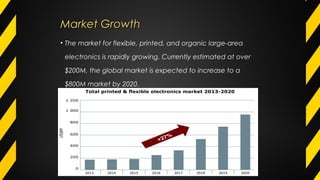
Market GrowthMarket Growth
• The market for flexible, printed, and organic large-area
electronics is rapidly growing. Currently estimated at over
$200M, the global market is expected to increase to a
$800M market by 2020.
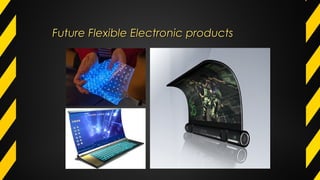
Future Flexible Electronic productsFuture Flexible Electronic products
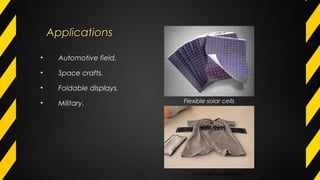
ApplicationsApplications
• Automotive field.
• Space crafts.
• Foldable displays.
• Military. Flexible solar cells
Flexible outwears
Samsung key note CESSamsung key note CES
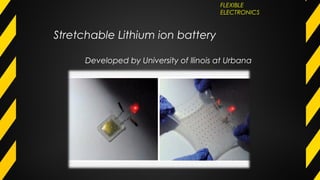
Stretchable Lithium ion battery
FLEXIBLE
ELECTRONICS
Developed by University of llinois at Urbana
ADVANTAGESADVANTAGES
• light weight
• Smaller dimensions required
• Space saving
• Foldable and bendable
DISADVANTAGESDISADVANTAGES
• Initial investment may be
expensive
• Integration of components
would be challenge for
engineers
• Precision machines required
FLEXIBLE
ELECTRONICS
ConclusionConclusion
Flexible electronics in future will play a part in field of
security, entertainment and may lead to innovative
applications
The demand for flexible electronic products at present
may not be noticed but upto 2020 there would be huge
demand and preference will be given to the flexible
products in market
Skillcruise.com

flexible electronics